Category: UNCATEGORIZED

24 Jul 2019

Tesla reports larger-than-expected losses of $408 million in second quarter

Tesla reported Wednesday a loss of $408 million, or $2.31 a share per share, and generated $6.3 billion in revenue in the second quarter despite record deliveries.

Tesla shares fell 11% after the report was posted.

Earlier this month, Tesla reported it delivered 95,200 of its electric vehicles in the second quarter, a dramatic reversal from a disappointing first period. Those numbers have been since adjusted to 95,356 vehicles. The record-breaking figures stood in stark contrast to the company’s first quarter delivery numbers when it reported deliveries of 63,000 vehicles, nearly a one-third drop from the previous period.

Analysts surveyed by FactSet were expecting an adjusted loss of 35 cents a share on revenue of $6.47 billion. The net loss in the second quarter included a $117 million of restructuring and other charges, the company said in its earnings report.

While earnings missed Wall Street expectations, Tesla has recovered since the first quarter of the year when it posted a loss of $702 million, or $4.10 a share, after disappointing delivery numbers, costs and pricing adjustments to its vehicles cut into profits. When adjusted for one-time losses, Tesla lost $494 million, or $2.90 a share in the first quarter.

Revenue has also jumped 40% from $4.5 billion in the first quarter to $6.3 billion in the second period thanks again to the increase in sales, particularly for the Model 3.

Those losses were smaller than previous quarter,  were buffered by record-setting deliveries in the second quarter.

Tesla generated free cash flow (operating cash flow less capital expenditures) $614 million compared to a loss of $920 million in the first quarter.

Developing

24 Jul 2019

Facebook says it’s under antitrust investigation by the FTC

Facebook’s investors were not phased by the announcement of a $5 billion FTC fine after baking it into share price expectations, but Facebook’s admission that it was not under investigation by the FTC over antitrust issues was a surprise.

Facebook detailed in its Q2 earnings release that it has paid a the record fine and agreed to certain privacy stipulations, but a short sentence in the release also detailed that the company’s FTC troubles may continue.

“The online technology industry and our company have received increased regulatory scrutiny in the past quarter,” the release read. “In June 2019, we were informed by the FTC that it had opened an antitrust investigation of our company. In addition, in July 2019, the Department of Justice announced that it will begin an antitrust review of market-leading online platforms.”

We’ll have more details from the company’s earnings call starting shortly.

24 Jul 2019

Lyft poaches Bird’s head of vehicle product

Shared electric bike and scooter services are constantly at war with each other — whether it’s battling for an operating permit in a highly-coveted market, raising a massive round of funding or making a key hire. Today, the war continues with Lyft’s recent hiring of Eugene Kwak, Bird’s now-former head of vehicle product. Kwak’s first day as Lyft’s head of hardware product for bikes and scooters was this past Monday.

Bird has been on a tear as of late, between actively raising a massive D round at a $2.5 billion valuation and having been one of the first scooter startups to deploy its own custom-built scooter. The in-house scooters, previously overseen by Kwak, have proven to have a positive impact on Bird’s unit economics.

Lyft, on the other hand, is still relying on Segway for its scooters. This hire, however, signals Lyft’s shift to deploying scooters built in house.

In addition to Kwak’s hire, Lyft has spent the last couple of months beefing up its bikes and scooters hardware team in order to keep iterating on its products. Earlier this month, Lyft also brought on Marc Fenigstein, co-founder of the now-defunct electric motorcycle company Alta Motors. Fenigstein is Lyft’s product lead for new vehicles.

Last month, Lyft brought on Mark Holveck from Tesla, where he served as a senior manager for the technology research and development team. At Lyft, Holveck is the head of hardware technology.

“We couldn’t be more excited to add these three leaders to take our hardware team to the next level,” Lyft Head of Bikes and Scooters Dor Levi said in a statement to TechCrunch. “They bring experience from some of the top hardware technology companies in the industry, and we look forward to continue offering best-in-class mobility solutions to our riders to help them easily get around their cities.”

Lyft is undoubtedly hitting its stride as a multi-modal transportation provider. To date, Lyft operates its bikes and scooters in 20 markets. Just last week, Lyft had a major legal win when a judge granted the company a preliminary injunction to prevent San Francisco from offering permits to other bike-share services.

Although Lyft is newer to the micromobility space than Bird, it’s noteworthy that the company poached a key member of one of its major competitor’s teams. Given the relative newness of this space, any little bit of a leg up on the competition will surely help.

I’ve reached out to Bird and will update this story if I hear back.

24 Jul 2019

Following record FTC fine, Facebook stock pops on Q2 earnings beat

Hours after receiving a record $5 billion FTC fine on privacy violations, Facebook delivered a Q2 earnings beat with revenue of $16.9 billion with $1.99 adjusted EPS compared to the Zacks Consensus Estimate of $1.90 EPS on revenue of $16.45 billion.

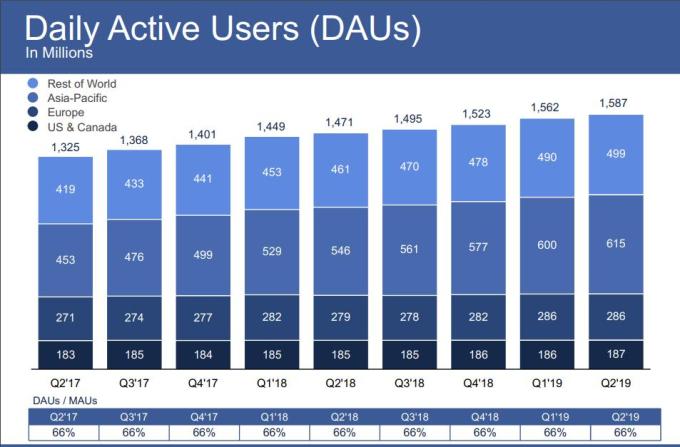
Facebook reported it has 1.59 billion DAUs and 2.1 billion daily active users of its family of apps. The US & Canada and Asia-Pacific contingents continued to see nearly flat growth while the company saw quicker growth in its European and “Rest of World” sectors.

EARTU4AAffxT

The company’s stock was up 3% in after-hours trading.

Facebook detailed that it will be paying a $5 billion FTC fine as was confirmed this morning, but for those hoping this agreement signaled the end of Facebook’s FTC troubles, the earnings report detailed that may not be the case. The release disclosed that last month theFTC opened an antitrust investigation of Facebook, this news follows reports of a DOJ investigation into the company — among others — as well.

The online technology industry and our company have received increased regulatory scrutiny in the past quarter. In June 2019, we were informed by the FTC that it had opened an antitrust investigation of our company. In addition, in July 2019, the Department of Justice announced that it will begin an antitrust review of market-leading online platforms.

Updating

24 Jul 2019

Postmates’ self-driving delivery rover will see with Ouster’s lidar

Postmates’ cooler-inspired autonomous delivery robot, which will roll out commercially in Los Angeles later this year, will rely on lidar sensors from Ouster, a burgeoning two-year-old startup that recently raised $60 million in equity and debt funding.

Postmates unveiled the first generation of its self-described “autonomous rover” — known as Serve — late last year. The vehicle uses cameras and light detection and radar sensors called lidar to navigate sidewalks as well as a backup human who remotely monitors the rover and can take control if needed.

A new second-generation version made its debut on stage earlier this month at Fortune’s Brainstorm Tech event. This newer version looks identical to the original version except a few minor details, including a change in lidar sensors. The previous version was outfitted with sensors from Velodyne, a company that has long dominated the lidar industry.

The supplier contract is notable for Ouster, a startup trying to carve out market share from the giant Velodyne and stand out from a global pack lidar companies that now numbers close to 70. And it could prove substantial for the company if Postmates takes Serve to other cities as planned.

Lidar measures distance using laser light to generate highly accurate 3D maps of the world around the car. It’s considered by most in the self-driving car industry a key piece of technology required to safely deploy robotaxis and other autonomous vehicles.

Ouster’s strategy has been cast wider net for customers by selling its lidar sensors to other industries, including robotics, drones, mapping, defense, building security, mining and agriculture companies. It’s an approach that Waymo is also pursuing for its custom lidar sensors, which will be sold to companies outside of self-driving cars. Waymo will initially target robotics, security and agricultural technology.

Ouster’s business model, along with its tech, has helped it land 437 customers to date and raise a total of $90 million.

The contract with Postmates is its first major customer announcement. COAST Autonomous announced earlier this week that it was using Ouster sensors for its a low-speed autonomous shuttles. Self-driving truck companies Kodiak and Ike Robotics have also been using the sensors this year.

Ouster, which has 125 employees, uses complementary metal-oxide-semiconductor (CMOS) technology in its OS1 sensors, the same tech found in consumer digital cameras and smartphones. The company has announced four lidar sensors to date, with resolutions from 16 to 128 channels, and two product lines, the OS-1 and OS-2.

24 Jul 2019

Snap overtakes its IPO debut price

Snap may no longer be the laughing stock of the New York Stock Exchange.

On the heels of renewed user growth and an earnings beat, Snap closed Wednesday with a share price at $17.60, up 18.68% for the day, giving the company its first close above its $17 IPO debut price since March of last year.

After a highly anticipated debut sent Snap’s share price climbing 44% on its first day of trading in March of 2017, the company’s stock soon plummeted as its first earnings report detailed slowed user growth that would continue for the next several periods. It was only a few months later that the company’s stock dipped below its $17 debut share price, a number it briefly rose above in early 2018 before sinking to an all-time low of $4.82 in late December.

The company’s earnings report yesterday may signify a turning point for the social media company which has reportedly struggled to retain executive and engineering talent in recent months in the face of a rapidly declining investor enthusiasm. In the company’s Q2 earnings report, Snap executives highlighted their strengths as they highlighted a 13 million quarter-over-quarter increase in daily active users and a command over the 18-24 age bracket.

The key to maintaining that growth will be whether Snap can continue to deliver viral hits that bring users to the platform like its augmented reality lenses that the company said contributed 7-9 million of the new users that came aboard last quarter.

Wednesday’s rally will give Snap more breathing room to pursue its original content strategy and its more ambitious efforts like its game development and augmented reality platforms.

24 Jul 2019

Peer-to-peer parking marketplace Rover tests monthly subscriptions

In today’s instalment of ‘the future is 100% subscription-based,’ Toronto-based startup Rover is testing out subscriptions for its parking marketplace. Rover lets users list their unused parking spots for on-demand rental by others on the service, giving them a passive way to earn some income while hopefully increasing the utilization rate of parking spaces at the same time.

Rover has offered the spots on their platform on a per use, on-demand basis before now, but it’s going to pilot a monthly subscription starting this summer, with a planned test phase extending into early fall. The company says it’s going to try out a few different versions of a monthly sub, including potential perks like a percentage discount vs. individual on-demand parking charges, advanced booking and premium customer service.

Pricing should be in the ballpark of between $5 and $15 Canadian depending on the features you’re willing to pay for, and this should inform eventual subscription price points for the startup’s services should they move beyond this pilot phase. Rover currently offers spots in Toronto, Montreal and Ottawa, with plans to expand to Canada’s west coast and then eventually California in future.

Uber recently debuted a subscription pilot that rolls in its ride-hailing, Eats, bikes and scooter rental services, and Rover cites this move as an example of the move to subscriptions generally in the on-demand space in its own announcement. Subscriptions are a great way for consumers to easily take car of known recurring costs, but the rise of this business model across a range of industries will definitely test the limits of consumer willingness to trade cost for convenience.

24 Jul 2019

Dataplor raises $2M to digitize small businesses in Latin America

There’s a gap forming in Latin America between the growing digital food delivery market and the number of businesses in the region that are actually online. 

Food delivery startups continue to replicate and expand throughout the region, and VCs are channeling mega rounds into them with the hope of capitalizing on consumer online buying trends within growing digital populations.

VCs from all over the world have collectively invested billions into food delivery in the Latin American region. One of the largest rounds to date in Latin American startup history is Movile’s $400 million raise for Brazilian delivery business iFood. SoftBank recently confirmed a $1 billion investment into Colombia’s Rappi in March. 

As big checks, new business models and consolidation mold a new on-demand landscape in Latin America, smaller players are coming in to supplement existing marketplaces like Rappi and iFood.

Dataplor founder and CEO Geoffrey Michener saw an opportunity to bring more vendors online. That’s why he invented Dataplor, a platform that indexes micro businesses in emerging markets. Now, Dataplor has raised a third round of seed capital, bringing the company’s total raised to $2 million. Quest Venture Partners led the company’s most recent funding, along with participation from ffVC, Magma Partners, Sidekick Fund, and the Blue Startups accelerator. 

What does Dataplor actually do? The 13-person company created platform that recruits, trains, and manages what has grown to more than 100,000 independent contractors – or what Dataplor calls Explorers.

Explorers are tasked with feet-on-the-street visits to businesses to capture information like latitude and longitude points, photos, hours of operation, owners names and contact info, and whether or not a business accepts credit cards. Dataplor then licenses that data to companies like American Express, iZettle and PayPal. Dataplor also works within a joint partnership to digitize Mexico with Google and Virket. 

GettyImages 1091916996

Michener says that 20% of Mexican businesses don’t have any digital footprint, and less than 5% of businesses have a website. This impacts the reach of what Google can index, as well as where companies like iFood subsidiaries or Rappi can deliver from.

Dataplor, founded in 2016, says it’s responsible for getting 150,000 businesses onto Google in its three years of operation. Michener says Dataplor pays Explorers above-market wages, and is careful about “not using the Uber model to drive down the cost of paying contractors.”

Michener likes to think of his business model as a trifecta of helping small businesses get onto Google for free, creating part time opportunities for a growing workforce in LatAm, and using its tech to help Google and Uber become better populated with accurate info in geos that might be more difficult for a foreign company to access.

Take Mexico for example. Michener says that 20% of Mexican businesses don’t have any digital footprint, and less than 5% of businesses have a website. This impacts the reach of what Google can index, as well as where companies like iFood or Rappi can deliver from. Basically, offline businesses are missing out on new digital distribution opportunities and therefore, big cash.

In the United States and Europe, companies like Google and Uber scrape data from online directories in order to power their platforms. But this process works differently in Latin America. A small business’ chance of showing up in Google’s index is a lot slimmer, because most businesses are still offline in growing economies. Dataplor first launched in Mexico and bootstrapped its way into Brazil – an aggressive move for a young company due to Brazil’s competitive startup scene and Spanish-Portuguese language barriers. Dataplor says it will expand to Chile, Peru, and Colombia in 2019.

Michener tested the minimum viable product by literally going on Craigslist Mexico City and sending willing people money over PayPal to go out and gather data about small businesses. Turns out there was some traction.

What happens when all the businesses in Latin America are online? Dataplor plans to make money by licensing its data, but there’s another component to the equation. Dataplor is building a relationship with these businesses. Google will pay to know when a menu changes, hours of operation shift or a restaurant goes out of business. 

Dataplor’s tech stack could pique interest for any company that wants a hand in the digitization of growing markets. Now that they’ve built a playbook for Explorer logistics, that operational piece of their business may be interesting to companies like Google, Apple and Uber too.




24 Jul 2019

Daily Crunch: Facebook will pay $5B fine

The Daily Crunch is TechCrunch’s roundup of our biggest and most important stories. If you’d like to get this delivered to your inbox every day at around 9am Pacific, you can subscribe here.

1. Facebook settles with FTC: $5 billion and new privacy guarantees

Although in line with what was reported before the official announcement, the FTC notes this is the largest fine for any company violating consumer privacy.

In addition to the payment, Facebook has agreed to new oversight, with a board committee on privacy covering WhatsApp and Instagram, as well as Facebook itself.

2. Netflix launches Rs 199 ($2.80) mobile-only monthly plan in India

Netflix has a new plan to win users in India: make the entry point to its service incredibly cheap. The new tier restricts the usage to one mobile device, with standard definition viewing.

3. DOJ announces investigation into big tech

More regulatory fun! In a statement, the DOJ said that it will consider “widespread concerns that consumers, businesses, and entrepreneurs have expressed about search, social media and some retail services online.”

Camping site with a caravan and a four wheel drive parked under a tree by the Darling River in Australia.

4. Andreessen Horowitz values camping business Hipcamp at $127M

The San Francisco-based startup provides a “people-powered platform” that unlocks access to private land for camping, glamping or just a beautiful spot to park your RV.

5. Google intros Gallery Go offline photo editor

The new product joins a suite of Google apps created specifically for users in development markets, where solid online connections aren’t always a given.

6. Tile finds another $45M to expand its item-tracking devices and platform

Tile makes popular square-shaped tags to help people keep track of physical belongings like keys and bags. Recently, it’s been linking up with chipmakers to expand into wireless headsets and other electronics.

7. Digging into the Roblox growth strategy

After 15 years, the company has accumulated 90 million users and a new $150 million venture funding war chest. (Extra Crunch membership required.)

24 Jul 2019

DoorDash will change controversial tipping model

DoorDash CEO Tony Xu announced via Twitter that the company will be changing its model for compensating Dashers (a.k.a. DoorDash drivers and other delivery people).

The company faced criticism this year its payment policies. Under the current system, a Dasher’s payment consists of a $1 base from DoorDash, the customer’s tip and — when the first two items fall below the guaranteed minimum — an additional payment boost from DoorDash.

In other words, although DoorDash insists that Dashers get to keep 100% of their tips, it starts to look like those tips are being used to subsidize payments that would otherwise come from DoorDash. (Instacart has been criticized and sued for similar practices, leading to a CEO apology and policy changes.)

Xu has defended this approach in the past. For example, when the company announced raising a $400 million round shortly after the controversy broke, he said the system was tested “not in a quarter, not in a month, but tested for months” before being implemented in 2017.

However, the issue didn’t go away. Last month, DoorDash tried to address it — not by changing the system, but by offering more transparency.

In his recent tweets, Xu insisted that the company designed the system to “to prioritize transparency, consistency of earnings, and to ensure all customers get their food as fast as possible.” However, he acknowledged that DoorDash “didn’t strike the right balance.”

“We thought we were doing the right thing by making Dashers whole when a customer left no tip,” he said. “What we missed was that some customers who did tip would feel like their tip did not matter.”

So Xu said DoorDash will be changing that model. The company isn’t releasing all the details yet, but the key change is that “Dashers’ earnings will increase by the exact amount a customer tips on every order.”