Category: UNCATEGORIZED

24 Jul 2019

Revolut tweaks business accounts with new pricing structure

Fintech startup Revolut announced changes to its business accounts this week. The good news is that if you were thinking about trying Revolut for your business needs, it’s now cheaper to get started. But there are some limits.

While Revolut is better known for its regular consumer accounts that let you receive, send and spend money all around the world, the company has been offering launched business accounts for a couple of years.

The main advantage of Revolut for Business is that you can hold multiple currencies. If you work with clients or suppliers in other countries, you can exchange money and send it to your partners directly from Revolut’s interface.

The company also lets you issue prepaid corporate cards and track expenses. Revolut for Business also has an API so that you can automate payments and connect with third-party services, such as Xero, Slack and Zapier.

None of this is changing today. Revolut is mostly tweaking the pricing structure.

Previously, you had to pay £25 per month to access the service with a £100,000 topup limit per month. Bigger companies had to pay more to raise that ceiling.

Now, Revolut is moving a bit more toward a software-as-a-service approach. Instead of making you pay more to receive and hold more money, you pay more as your team gets bigger and you use Revolut for Business more intensively.

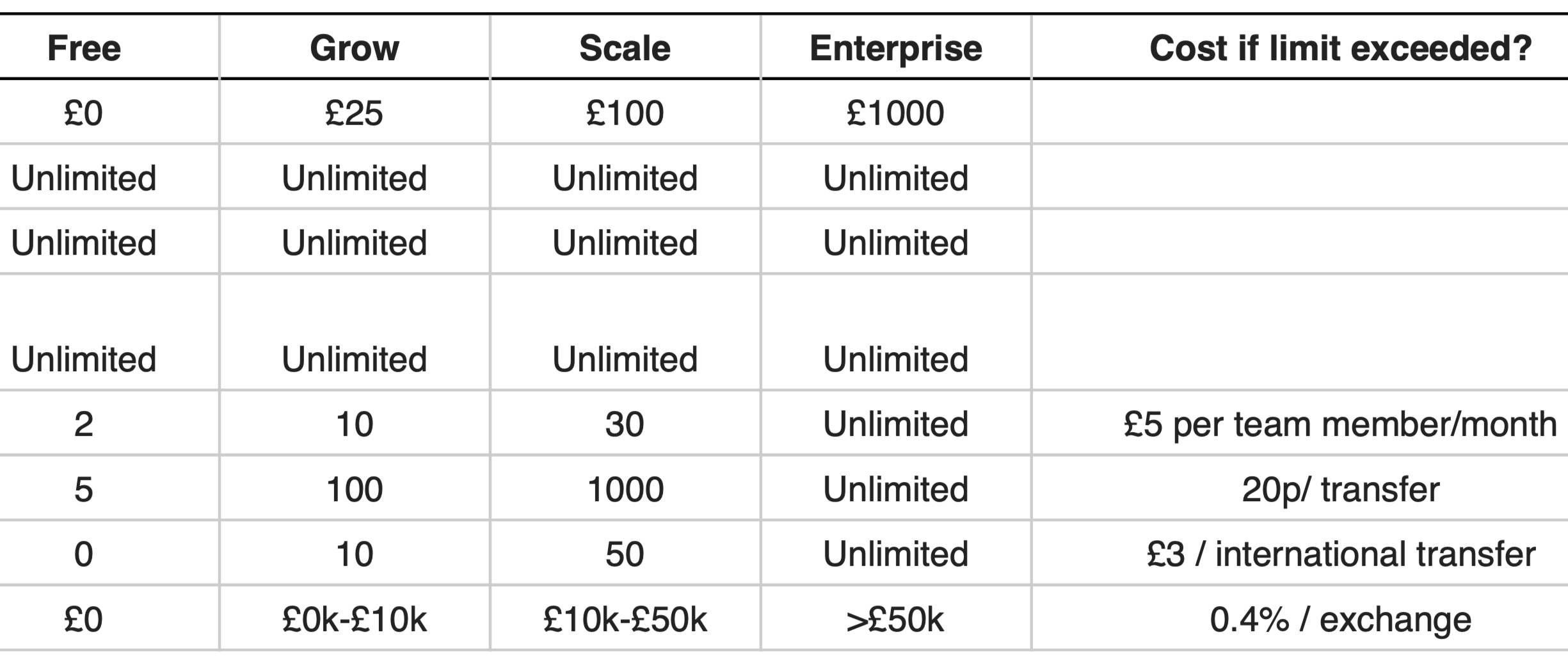
The basic plan is free with 2 team members, 5 free local transfers per month and 0.4% in foreign exchange fees. If you want to add more team members or initiate more transfers, you pay some small fees.

If you were paying £25 before, you can now top up as much money as you want in your Revolut account, but there are some limits when it comes to team members (10), local transfers (100 per month) and international transfers (10 per month, interbank exchange rate up to £10,000).

Once again, going over the limits doesn’t necessarily mean that you need to change to a new plan. You’ll pay £0.20 per extra local transfer, £3 per extra international transfer, etc.

Here’s a full breakdown of the new plans:

Screen Shot 2019 07 24 at 7.35.45 PM

If you’re a freelancer, there’s now a free plan. You’ll pay 0.4% on foreign exchange and £3 per international transfer, but there’s no topup limit anymore.

Similarly, the old £7 plan for freelancers has been replaced by a new £7 plan that removes the limit on inbound transfers but adds some limits on transfers.

It’s good news if you’re a small customer. But if you vastly exceed the transfer limit in one of the categories, you might pay more than before. With this change, the company wanted to make Revolut for Business more accessible instead of making small customers subsidize bigger customers with high entry pricing.

Existing customers can switch to a new plan starting today. And Revolut plans to switch everyone to the new plans on October 1st, 2019.

Revolut for Business 2

24 Jul 2019

Occipital’s Structure Sensor Mark II is a smaller and much improved 3D scanner for your iPad


Back in 2013, Occipital (a company then best known for making the RedLaser barcode scanning app) released the Structure Sensor, a device that turned any iPad you strapped it to into a portable 3D scanner.

Five years later, they’re back with the next one: Structure Sensor Mark II. It’s about half the size, but considerably more capable.

After releasing the original Structure Sensor, Occipital found that it was particularly popular in two different use cases: making 3d scans of people (like, say, scanning someone’s foot to make orthotics), and making 3d scans of rooms. Mark II’s specs and design have been tuned with these use cases in mind.

To improve accuracy when scanning a person, they’ve bumped up the resolution (from 640×480 on the original sensor to 1280×960 on Mark II), and increased the distance between the Structure’s cameras — thereby allowing it to capture finer details up close.

higher res

To help with room scanning, they’ve introduced a fish eye lens; this widens the Structure’s view, which should help it perform better in smaller rooms.

Scanning range has been increased from 4m to 10m, they’ve added built-in gyroscopes/accelerometers, moved from a rolling shutter to a global shutter, and a pair of new IR depth cameras let it scan outdoors (whereas v1 was stuck inside)

If you’ve been watching this space closely, you might remember that Occipital released a device called the Structure Core late last year. Whereas the original Structure is primarily meant to be strapped to an iPad (and is built with iOS compatibility in mind), the Structure Core was built to work with everything else — it’ll play friendly with Linux, MacOS, Windows, and Android, acting as the eyes for whatever project you might have in mind. Beyond the wider compatibility, the Structure Core also saw a pretty significant spec bump over the original Structure.

Occipital co-founder Jeff Powers tells me that Structure Mark II shares a lot of its guts with that recently released Structure Core. The main differences, I’m told, are that it uses a different connector (USB 2.0/Lightning versus USB 3.0 on Core), has a built-in battery (because they need more power than they can pull from the iPad, currently), and runs “significantly modified” firmware to make it play friendly with iOS.

Occipital tells me that Structure Sensor Mark II will sell for $399. They’re also planning to open up a trade-in program, allowing anyone who has the original Structure to turn it back in and get $100 off a Mark II.

24 Jul 2019

What lower Netflix pricing tells us about competing in India

At a conference in New Delhi early last year, Netflix CEO Reed Hastings was confronted with a question that his company has been asked many times over the years. Would he consider lowering the subscription cost in India?

It’s a tactic that most Silicon Valley companies have adapted to in the country over the years. Uber rides aren’t as costly in India as they are elsewhere. Spotify and Apple Music cost less than $2 per month to users in the country. YouTube Premium, LinkedIn Premium and many of Microsoft’s services, as well as subscriptions to U.S. news outlets such as WSJ and New York Times are also priced significantly lower compared to the prices they charge in their home turf.

Hastings had also come prepared: He acknowledged that the entertainment viewing industry in India is very different from other parts of the world. To be sure, much of the pay-TV in India is supported by ads and the access fee remains too low ($5). But that was not going to change how Netflix likes to roll, he said.

“We want to be sensitive to great stories and to fund those great stories by investing in local content,” he said. “So yes, our strategy is to build up the local content — and of course we have got the global content — and try to uplevel the industry,” he said, identifying movie-goers who spend about Rs 500 ($7.25) or more on tickets each month as Netflix’s potential customers.

GettyImages 992527026 1

Indian commuters walking below a poster of “Sacred Games”, an original show produced by Netflix (Image: INDRANIL MUKHERJEE/AFP/Getty Images)

Less than a year and a half later, Netflix has had a change of heart. The company today rolled out a lower-priced subscription plan in India, a first for the company. The monthly plan, which restricts usage of the service to mobile devices only, is priced at Rs 199 ($2.8) — a third of the least expensive plan in the U.S.

At a press conference in New Delhi today, Netflix executives said that the lower-priced subscription tier is aimed at expanding the reach of its service in the country. “We want to really broaden the audience for Netflix, want to make it more accessible, and we knew just how mobile-centric India has been,” said Ajay Arora, Director of Product Innovation at Netflix.

The move comes at a time when Netflix has raised its subscription prices in the U.S. by up to 18% and in the UK by up to 20%.

Netflix’s strategy shift in India illustrates a bigger challenge that Silicon Valley companies have been facing in the country for years. If you want to succeed in the country, either make most of your revenue from ads, or heavily subsidize your costs.

But whether finding users in India is a success is also debatable.

24 Jul 2019

Benchling’s software for managing biotech research nabs $34.5 million

In a field where the laboratory notebook is still considered the state of the art, it’s no wonder a company like Benchling, which provides software for managing life sciences research was able to nab $34.5 million.

Considering how much detailed technical work goes into the research that produces all of our great leaps forward in biotechnology, it’s a wonder that the practice wasn’t digitized sooner.

Financiers certainly see the benefit in Benchling’s technology — a new twist on what’s now a standard verticalized software as a service for a niche industry. Y Combinator Continuity, Thrive Capital, Benchmark Lead Edge Capital joined lead investor, Menlo Ventures in financing the company.

The company said it would use the money to grow internationally and develop new products and services.

“Life science R&D has become incredibly complex across molecules, processes, and data structures. And until Benchling, there had been no end to end purpose-built SaaS application to enhance, streamline, and drive collaboration across R&D processes,” said Matt Murphy, Partner at Menlo Ventures, in a statement. “Biologics are the future of life sciences and the faster that innovation gets to market, the more society benefits. Benchling‘s software replaces pen and paper workflows and becomes the system of record for a wide range of biotech and pharma R&D projects from medicine and cancer treatment to plant-based meat and sustainable materials.”

benchling screenshot Mol Bio

Screenshot of Benchling’s molecular modeling tool.

Benchling’s software is used by over 170,000 scientists around the world in academic labs at Harvard, Stanford, MIT, and Berkeley, according to the company. Its paying customers include Beam Therapeutics, Regneron Pharmaceuticals, Zoetis, and Zymergen .

Benchling started out with free software for researchers to replace notebooks with an electronic records management system and a digital model of molecules that could be collaboratively updated by a team of researchers.

Since those initial products the company added project management, cross-project visibility, and real-time views of development progress for business customers, according Menlo’s Murphy.

Benchling was created for today’s researchers who are working on cutting-edge science, allowing them to focus on achieving the next breakthrough outcomes,” said Sajith Wickramasekara, co-founder and CEO at Benchling, in a statement. “The next generation of scientists is already on Benchling and at the forefront of establishing the future of the life science and biotech industries. We’ll use this investment to support deeper engagements with large commercial customers and bring the power of the cloud to tackle the complexity of biotech.”

benchling screenshot Samples

Screenshot of Benchling’s batch management software


24 Jul 2019

Duo’s Wendy Nather to talk security at TC Sessions: Enterprise

When it comes to enterprise security, how do you move fast without breaking things?

Enter Duo’s Wendy Nather, who will join us at TC Sessions: Enterprise in San Francisco on September 5, where we will get the inside track on how to keep enterprise networks secure without slowing growth.

Nather is head of advisory CISOs at Duo Security, a Cisco company, and one of the most respected and trusted voices in the cybersecurity community as a regular speaker on a range of topics, from threat intelligence to risk analysis, incident response, data security and privacy issues.

Prior to her role at Duo, she was the research director at the Retail ISAC, and served as the research director of the Information Security Practice at independent analyst firm 451 Research.

She also led IT security for the EMEA region of the investment banking division of Swiss Bank Corporation — now UBS.

Nather also co-authored “The Cloud Security Rules,” and was listed as one of SC Magazine’s Women in IT Security “Power Players” in 2014.

We’re excited to have Nather discuss some of the challenges startups and enterprises face in security — threats from both inside and outside the firewall. Companies large and small face similar challenges, from keeping data in to keeping hackers out. How do companies navigate the litany of issues and threats without hampering growth?

Who else will we have onstage, you ask? Good question! We’ll be joined by some of the biggest names and the smartest and most prescient people in the industry, including Bill McDermott at SAP, Scott Farquhar at Atlassian, Julie Larson-Green at Qualtrics, Aaron Levie at Box and Andrew Ng at Landing AI and many, many more. See the whole agenda right here.

Early-bird tickets are on sale right now! For just $249 you can see Nather and these other awesome speakers live at TC Sessions: Enterprise. But hurry, early-bird sales end on August 9; after that, prices jump up by $100. Book here.

If you’re a student on a budget, don’t worry, we’ve got a super-reduced ticket for just $75 when you apply for a student ticket right here.

Enterprise-focused startups can bring the whole crew when you book a Startup Demo table for just $2,000. Each table gives you a primo location to be seen by attendees, investors and other sponsors, in addition to four tickets to enjoy the show. We only have a limited amount of demo tables and we will sell out. Book yours here.

24 Jul 2019

Hear Hans Vestberg talk about the 5G opportunity at Disrupt SF 2019

The promise of 5G is staggering. With its ultra-high bandwidth and low latency, it has the potential to alter how consumers interact with technology. However, questions remain around its deployment, use cases, and marketing.

We’re excited to have Verizon CEO Hans Vestberg sit down for a fireside chat at Disrupt SF to talk about the telecom’s 5G efforts. Vestberg took over Verizon on the eve of 5G.

Here’s the thing: Hans Vestberg is my boss. (Technically, he’s my boss’s boss’s boss’s boss.) TechCrunch is owned by Verizon, operating under the Verizon Media Group, yet we remain editorially independent. Verizon doesn’t tell us what to write or not to write. Likewise, nothing is off-limits for this interview.

Verizon and other telecoms began rolling out the next-generation network to their subscribers this year. And the company has announced plans to launch 5G in at least 30 U.S. cities by the end of this year even though there are limited hardware options and few marketable use cases.

How will consumers use 5G? When should startups begin building for 5G? How will Verizon educate consumers about real 5G versus fake 5G? We have questions, and we hope Vestberg has answers.

Vestberg became CEO of Verizon in August 2018, succeeding Lowell McAdam. Vestberg joined Verizon in 2017 as its CTO and VP of Network and Technology. Previously, he worked at Ericsson for 25 years, six of which he spent as CEO until he was ousted in 2016 following poor financial results.

Under McAdam, Verizon looked to media companies for additional channels for growth, notably acquiring Aol and Yahoo and merging the two into an ad-serving giant called Oath. Earlier this year Oath was renamed Verizon Media. Its future remains in question as rumors persist about Verizon wanting to spin out the division en masse or by dumping various brands like Huffpo or even TechCrunch.

Vestberg is joining Disrupt SF’s long list of speakers that includes other chief executives, such as Sebastian Thrun, Evan Spiegel, Rachel Haurwitz and many more. The three-day conference is shaping up to feature a fantastic speaker lineup covering all aspects of the startup world.

Tickets to the show, which runs October 2 to October 4 in SF, are available now.

24 Jul 2019

Tinder’s new personal security feature can protect LGBTQ+ users in hostile nations

A new security feature rolling out on Tinder will help to protect LBGTQ+ users who travel to dozens of nations, which still criminalize same-sex acts or relationships.

As part of the update, users who identify as lesbian, gay, bisexual, transgender or queer on the app will no longer automatically appear on Tinder when they arrive in an oppressive state. This feature, which Tinder dubs the Traveler Alert, relies on your phone’s network connection to determine its location. From there it will give users the choice to keep their location private. If users opt-in to make their profile public again, Tinder will hide their sexual orientation or gender identity from their profile to safeguard the information from law enforcement and others who may target them, the company said.

Once a user leaves the country or changes their location, their profile will become visible again.

“The purpose of this is to protect users who could be persecuted for their identity in these countries,” a spokesperson said.

The dating app maker, which has tens of millions of users in 190 countries, said the update will warn users when they travel to a country where same-sex relationships are punished under law help to keep “all its users safe.”

“It is unthinkable that, in 2019, there are still countries with legislation in place that deprives people of this basic right,” said Elie Seidman, Tinder’s chief executive.

Seidman said it was part of the company’s belief that “everyone should be able to love who they want to love.”

tinder alert

Tinder’s new Traveler Alert feature. (Image: supplied)

When traveling internationally, foreign nationals have to abide by the laws of their host country — no matter how different or abhorrent the rules may be. Although LGBTQ+ rights have come a long way in recent years in many Western countries, dozens of less-progressive countries consider same-sex acts or relationships illegal.

In March, the International Lesbian, Gay, Bisexual, Trans and Intersex Association (ILGA) found 69 countries considered same-sex acts illegal — the number of countries included in the Traveler Alert — sans Botswana, which recently decriminalized same-sex relationships.

Nine of the countries, including Iran, Sudan, and Saudi Arabia — a major U.S. ally in the Middle Easy — allow for prosecutors to pursue the death penalty against same-sex acts and relationships.

Despite a slow but promising push for equal rights, several countries have reversed course and doubled down on their laws, despite international condemnation. One such nation — Brunei, a small south Asian absolute monarchy — was forced to back down from its plans to sentence those who had gay sex to be stoned to death amid outcry from several major companies and celebrities who threatened to boycott the country.

ILGA’s executive director André du Plessis praised Tinder’s effort to warn its users.

“We work hard to change practices, laws and attitudes that put LGBTQ people at risk — including the use of dating apps to target our community — but in the meantime, the safety of our communities also depends on supporting their digital safety,” he said.

Read more:

24 Jul 2019

Why do media companies struggle to produce anything of value?

It’s the absolute best economy the United States has seen in decades, and yet, you wouldn’t know it from looking at the employee rolls at major news and media outlets. Thousands of journalists have lost their jobs this year through restructurings and layoffs while cities like Youngstown, Ohio have lost their one and only daily local newspaper.

That’s led to much hand-wringing: can media be saved? And even more specifically, can media companies ever build the kinds of scalable product businesses that we’ve seen in the software world? In short, why does media struggle to create value?

One trigger for this conversation was Maxwell Strachan’s in-depth HuffPost retrospective analysis of the rise and demise of Mic, which had garnered tens of millions of venture capital in its heyday before fire-selling to Bustle Digital Group. That piece led venture capitalist and former media company founder Om Malik to opine with a great post yesterday assigning blame for the (many) plights facing the media industry squarely on the shoulders of, let’s just call them dumb media executives:

When you have sales guys (they are mostly guys) in charge, decisions will reflect their usual approach, which is to maximize their personal gains as quickly as possible, cash in their bonus checks, and then move on to another outfit desperate enough to let them do it all again. This won’t work in an industry in need of the focus, foresight, and boldness that brings about transformational change. Sadly, the media establishment’s attitude appears to track more with our politicians’ thinking on climate change. They tell themselves, “I’ll be dead before the bad stuff happens.”

Malik’s answer is direct but only partially correct. Yes, media executives share plenty of the blame for what’s happened to the industry the past two decades. But part of the reason they failed to produce value is that they believed in this widespread notion that software “product” and media “product” are somehow similar and can borrow each others’ mental models and frameworks.

It’s just not true though, and the alchemical fusion of digital and media into our modern “digital media” hellscape is still predicated on a fundamental mistake: that somehow media can be made to look like software, and all we need is “foresight” and “innovation” to bridge the divide.

Let’s start with just the pure economics of these businesses. Venture capitalists and founders love software businesses because there is both leveraged scale and high rates of return on effort. Once you write code, you can deploy it today at global scale to as many customers as you want. It’s the old Java slogan of “Write once, run everywhere” and it is perhaps the single greatest profit driver in the past century if market caps are anything to judge by.

Once written, software produces revenues without additional labor. Yes, you need bug fixes and devops and analytics and monitoring to keep everything running smoothly, for sure. But like the building manager of a real estate investment, the entire engineering team can take a vacation for spates at a time — and yet the underlying asset continues to throw off cash.

Compare that to the media world. If the entire editorial team of TechCrunch or the New York Times takes a vacation … well, then, there is no site (or paper, as it were). Unlike code, which reproduces value, content has an incredibly short half-life in nearly all media segments. It doesn’t matter if a site’s business model is traffic or premium subscription — one way or another, you need to stoke that content boiler on a very regular basis lest your readers shift their time (and wallets) to some other diversion.

Wealth in media comes from only a handful of places: a database that is reusable by a wide number of customers (think Crunchbase), evergreen articles that are good for repeated referencing (think WebMD), and brands that bring traffic, attention, and customer dollars without additional labor (think Disney’s extended animated movie catalog).

In software, you are valued by the total effort expended on building your product. In media, you are valued by the marginal effort expended on producing your product, with the margin determined by your content’s half-life. Adding a new feature to an app is a capital expense. Adding a new vertical to a site is a recurring operational expense.

Other than glib summaries of “product” as “do what users need,” those differential economics prevent media PMs from just following software PM playbooks. Resources are different, staffing is different, metrics are different, brand is different, users and their willingness to pay are different.

Media companies struggle to create value since they borrow too much, but they also have too much of an obsession with finding something new over the horizon. Malik also wrote in his piece that:

To put it bluntly, media execs are good at aping, not at innovating. Most wait for others to try new things, and then adopt those things once they have proven successful. As a smart media insider quipped to me, “The smartest people in media get out.” It is a forest fire of an industry.

Counterintuitively, media has actually been too responsive to new avenues for growth and fresh products. That whole pivot to video a few years ago was pretty blazing stupid in retrospect — but a whole flotilla of smart PMs at major media companies sure got those products out the door. We might be headed the same way in podcasts given the extreme increase in audio hours being produced these days. Everyone in media is searching for the next frontier, that next disruptive innovation that is going to be magic formula for growth and profit.

Instead, we need to throw out pretty much everything we have learned the past decade to create value and double down on what makes media, media — which is consistent quality, engaging editorial voice, and a true purpose that fulfills the needs of users.

It’s that last part that so many media companies continue to get wrong. Asking your users to pay is the first step to building a deeper relationship with them and ensuring they enjoy what they are consuming (hence why we launched Extra Crunch).

And I will tell you — and here the media industry does have a similarity with software and with all businesses — many of our readers are not interested in paying. Who can blame them when so much of media is so badly produced and targeted? Media brands ask their users, “Do we create value?” and a huge chunk of readers go, “Nah.”

That’s Malik’s forest fire in a nutshell. But like real forest fires and even metaphorical ones like the 2008 financial crisis, these conflagrations have a real purpose: to burn away the deadwood and replenish the soil with nutrients for future growth. These are tough times, but everyone in media — from executives to editors and writers and producers — needs to start focusing on how they are creating value to users who will pay.

All the jobs lost today can come back — if only people produced what users demand and will pay for.


24 Jul 2019

Fintech mega rounds, Gogoro scooters, Waymo, Shift, Microsoft, and employee engagement

Final Reminder: Extra Crunch Event Discount for Tomorrow’s Summer Party

TechCrunch’s annual Summer Party is tomorrow — come meet all the staff at the Park Chalet beer garden on the Pacific Coast in San Francisco. If you want to join us, be sure to use your event discount (part of the annual EC subscription offering) by emailing your member customer service representative at extracrunch@techcrunch.com.

Embedded finance, or why fintech mega VC rounds have become so common

Every day there seems to be another multi-hundred million dollar venture round for a fintech startup. Why? I’ve been chatting with a bunch of leading fintech VCs and CEOs, and my analysis is a first sketch of why fintech is the hot darling of the growth equity markets these days. In short: fintech is finally embedding itself where customers already are.

24 Jul 2019

Raena raises $1.82 million to help influencers in Southeast Asia launch their own consumer brands

Raena, an Indonesian startup that helps social media influencers launch their own e-commerce brands, announced today that it has raised $1.82 million in seed funding. The round was led by Beenext, with participation from Beenos, Strive and the personal offices of Shailesh Rao, a partner with TPG Growth, and Sanjay Nath, managing partner of Blume Ventures. Like Revolve Group in the United States and Ruhnn Holding in China, which both recently went public, Raena partners with influencers, providing them with the resources to create products under their own branding.

The company launched two months ago and is currently focused on Southeast Asia, where it has partnered with seven influencers so far, who have a total following of 12 million. Founded by CEO Sreejita Deb, who previously held roles at Amazon, InMobi and Google, Raena started by selling Japanese and Korean beauty brands to Indonesian customers. Deb says the company decided to start working with influencers after the products sold well, despite their premium prices and having little brand recognition in Indonesia.

She adds that Southeast Asian countries like Indonesia, Vietnam, Malaysia and Thailand, have some of the highest rates of social media penetration in the world, especially on Instagram, but influencers still have few ways to make money no matter how large their follower base is.

“The internet ad market is not as robust as in the U.S. or China, so influencers have a ready-made audience, but their opportunity to monetize their audience is very low,” says Deb. “That’s the premise on which I started the company. If influencers want to monetize their audiences, one way is to become their own e-commerce unit.”

Raena’s team includes people who previously worked at Google, Amazon, Alibaba, Zalora, beauty brand Foreo, Indonesian education startup Ruangguru and Benscrub, an online skincare store. The company draws on their connections to product development teams, suppliers and distribution networks in India, China, Japan and Korea. In order to figure out who to work with and what products to launch, Raena takes a data-driven approach, Deb says.

The company looks for influencers that have at least 500,000 subscribers on YouTube or Instagram and has had discussions with people who have as many as 6.6 million followers. Its most important metric, however, is audience engagement, and to gauge that Raena has developed internal tools that crawl the last 50 posts made by an influencer on Instagram to see how many of their followers liked or commented on it (in the case of videos, it checks the percentage of people who watched the whole thing). Deb says a good engagement rate is anywhere about two percent, with 10 percent being “amazing.”

Since Raena is currently focused on women’s beauty products, its internal tools then hone in on how many of their posts are about beauty-related products and checks if engagement on those posts is higher or lower than the average aggregated engagement for their other posts.

“If someone has a million followers and has 10 percent engagement on average, but when you check branded content or a promo she’s done and see the engagement dips to .5 percent, that indicates her audience doesn’t want to hear her talking about brands or beauty,” Deb says. “Those nuances become very important for us. We look for influencers who have a certain threshold of engagement and influence in different categories.”

RaenaFor influencers who meet their metrics, Raena provides product development and logistical resources. The first brand it launched was Moonella and Family, created with babymoonella, a family with a total audience of more than two million. Deb says its debut offering, the Calm and Rescue Balm, took five weeks to create from conception to launch and was chosen because the company saw demand among milliennial parents for childcare products that are paraben- and sulphate-free. They also saw that many young women, even those without children, like to buy all-purpose balms to use on their lips or dry skin.

Raena’s team first discusses consumer research with its influencer partners, who are usually presented with about five product concepts. Then they go back to suppliers with feedback and the influencer’s criteria. After that, products are refined over several iterations. During that process, the influencer polls followers about what they want in the final product, before it goes into production. Deb says Raena plans to keep a very standardized product development process in order to ensure quality as the company scales up. Raena isn’t disclosing how much revenue it shares with influencers, but Deb says they get a cut of sales, without flat fees or minimum guarantees so the company and its partners share risk more evenly.

One key difference between Southeast Asia and many other markets is the importance of marketplaces versus individual online stores. For example, the Calm and Rescue Balm is sold on Shopee and Lalabee.co. Deb says that presents unique distribution challenges, but on the other hand, it also leaves a lot of room for new products and direct-to-consumer brands.

“One of the biggest things in our favor is that in the U.S., the U.K. or Europe, when companies like Unilever or Procter and Gamble plan out a pipeline, those come to the top in more mature, developed markets like that. Essentially there is still very little product innovation for audiences in markets like Indonesia or India and a lot of direct-to-consumer brands have rushed to fill that void,” she says.

“We are launching in new markets and there are key differences,” she adds. “The approach to distribution needs to be more thoughtful and tailored to the market. You can’t copy and paste distribution models from the U.S., but on the plus side, video and social media have much higher penetration and because consumer companies are not moving at a fast enough pace for these markets, it leaves them ripe for direct-to-consumer innovation.”