Category: UNCATEGORIZED

05 Jul 2019

Lance Armstrong’s Next Ventures targets $75M

Next Ventures, an investment firm led by Lance Armstrong, has filed to raise $75 million for its debut venture capital fund.

According to paperwork submitted to the U.S. Securities and Exchange Commission this morning, Armstrong and Next Ventures general partner Lionel Conacher have so far attracted $24.5 million from limited partners to back startups in the sports, fitness, nutrition and wellness markets.

Both Armstrong and Conacher are long-time athletes, with Armstrong, of course, known for his professional cycling career and high-profile doping scandal that resulted in the International Cycling Union stripping him of his seven Tour de France titles in 2012. Conacher’s bio states he is “a life-long multi-sport athlete and outdoorsman and proud member of Canada’s first family of sport.” Conacher also has experience in investment banking and private equity as the former vice chairman of Roth Capital Partners.

Next Ventures disclosed its first investment six months ago. The fund supplied capital to Carlsbad, Calif.-based PowerDot, a 2.5-year-old maker of an app-based, smart muscle stimulation device that sends electrical pulses to contract tender soft tissue, helping runners and other athletes recover from their workouts. The firm has since invested in sleep and activity tracker Oura, community-building fitness app Spar, and two others.

Armstrong, banned from cycling for life, got his start in investing after serving as an LP to Lowercase Capital. Through his investment in Lowercase, he received early stock in Uber that he claims “saved” his family from financial ruin.

If Armstrong and Conacher reach their targeted amount, Next Ventures would become one of the larger sports and fitness-focused funds as VCs double down on an industry led by Peloton’s sky-high success.

05 Jul 2019

‘Apollo: Missions to the Moon’ brings the history of space exploration to life

To celebrate the 50th anniversary of the Moon landing, National Geographic has plans for an entire Space Week of programming, kicking off Sunday night with the premiere of a new documentary called “Apollo: Missions to the Moon.”

It’s a story that’s been told many times, including in last year’s Neil Armstrong biopic “First Man.” And of course, there’s a whole slate of new documentaries and specials airing in the next few weeks — something that “Apollo: Missions to the Moon” director Tom Jennings acknowledged with a rueful laugh when we spoke on the phone.

But Jennings brought his distinctive approach to the project, one that he’s employed in previous documentaries like “Challenger Disaster: Lost Tapes” and “Diana: In Her Own Words.” The idea is to rely entirely on archival audio, video and photos, so that viewers can experience the story in the present tense, rather than hearing about it from talking heads 50 years later.

In this case, National Geographic says the film draws on 800 hours of audio, 500 hours of film and more than 10,000 photos. That includes previously unheard audio from Mission Control.

“In documentaries in the past, whether it’s the Moon landing or any of the Apollo missions, when you would hear audio in Mission Control, it’s a single line open line — that was the guy called CAPCOM,” Jennings said. “[But] there were hundreds of people there, and many of them are wearing headsets.”

Apollo Missions to the Moon

Flurry of handshakes erupts after successful launch of Apollo 11. (NASA)

So by incorporating this new audio, the film can give a fuller picture of what was happening in Mission Control, and how the Earth-bound team was responding to events in space.

Also worth emphasizing: The film tells the story of the whole Apollo program, not just Apollo 11. It spends more time on some missions than others, but the idea is to give viewers the full context of how we got to the Moon, and what happened after.

That includes tracing the program’s Cold War roots, although Jennings said that over time, it became “less and less about the space race and the Russians” and more about “doing the impossible.” Or, as he summed it up, “It became more about the expedition and less about the politics.”

One of the big elements in the story is the breathless way the media followed the initial missions. (“The media was a character.”) After all, Apollo 7 featured the first live television broadcast from a crewed space mission, and one of the most striking scenes shows how people around the world were watching Apollo 1.

“How much the world stopped was unprecedented,” Jennings said. “I don’t think that it’ll ever happen again.”

Apollo Missions to the Moon

Aerial view of spectators around their campsites awaiting the Apollo 11 launch. (Otis Imboden/National Geographic Creative)

Indeed, you can see that in the film itself, as public interest in the program begins to wane after Moon landing. Jennings speculated, ” “It was about the quest. Once that quest was completed, it was like: Now what?”

In fact, he said some of the footage cut from the film made that point as well, with “NASA spokespeople wandering around the press room after 11, before 13 got into trouble, basically saying, ‘For Apollo 11 this place was standing-room only, and now it’s just vacant.'”

And while the film doesn’t skimp on the triumph of Apollo 11, by tracing the full arc of the program, it ends on a melancholy note, as Apollo ends and NASA officials predict correctly that we won’t return to the Moon in their lifetimes. “Apollo: Missions to the Moon” doesn’t directly address what’s happened in more recent decades but you can’t help but see an implicit critique of NASA’s scaled-back ambitions.

“I felt like we needed the film to properly acknowledge what we’ve lost,” Jennings said. He recalled talking to Frances “Poppy” Northcutt, who worked as an engineer for the Apollo program, and she told him, “You know, everything was there. We were ready to go farther into deep space. If we had kept going we would have had people on Mars 30 years ago.”

Still, recent developments, like the work Jeff Bezos’s Blue Origin and Elon Musk’s SpaceX, have made him hopeful for the future: “I think we will go back to the Moon. Something will be set up on the Moon.”

“Apollo: Missions to the Moon” will air on National Geographic on Sunday, July 7 at 9pm (8pm Central time).


05 Jul 2019

Heat waves bring record-breaking temperatures on a geological scale

From Alaska to Europe the world has spent the past few weeks roasting under temperatures never before seen in recorded history.

In Alaska, all-time high record temperatures were set across the state on July 4th, according to the National Weather Service. In Anchorage, the mercury soared to highs of 90 degrees, the highest temperature since recording began in 1952.

Temperatures in Alaska have reached 90 degrees in other cities around the state before, but this is the first time that the thermometer hit that mark in Anchorage.

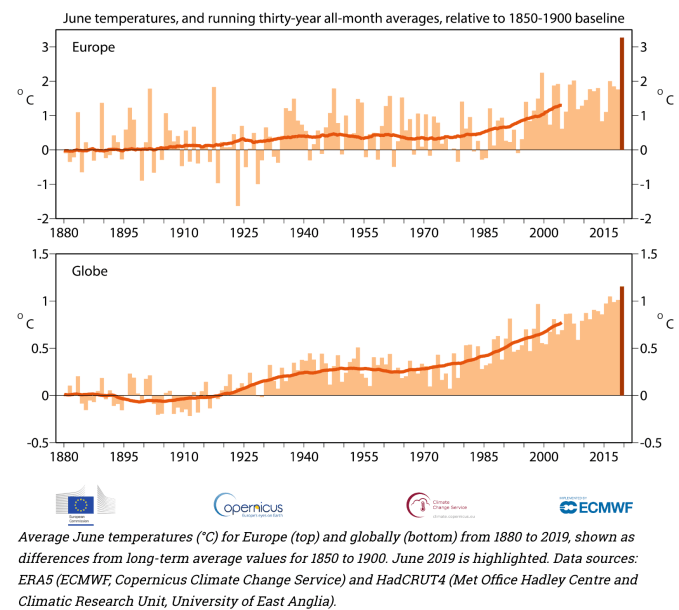
Meanwhile, hot winds blowing North from the Sahara set temperatures in Europe soaring to record highs, according to data released by the Copernicus Climate Change Service.

It was Europe’s record three degree temperature spike that brought global temperatures to their recorded-history highs.

Screen Shot 2019 07 05 at 12.16.41 PM

“Although local temperatures may have been lower or higher than those forecast, our data show that the temperatures over the southwestern region of Europe during the last week of June were unusually high,” said Jean-Noël Thépaut, head of the Copernicus Climate Change Service. “Although this was exceptional, we are likely to see more of these events in the future due to climate change.”

According to data from Copernicus, the temperature spikes across Europe was the highest on record for the month.

Compared for the same five-day period during the last thirty year climatological reference period, six to ten degree Celsius temperature spikes happened in most of France and Germany, throughout northern Spain, northern Italy, Switzerland, Austria and the Czech Republic.

As these events become common, the need for technologies that can reduce carbon emissions because more pressing.

Increasingly, businesses and investors are returning to the once-shunned market of clean technology and renewable energy to back new electric vehicle manufacturers, new energy efficient construction technologies, the rehabilitation of outdated infrastructure and consumer goods that have a smaller carbon footprint or reduce waste.

Data from Bloomberg New Energy Finance published earlier this year indicated that venture investments into what was once called clean technology hit $9.2 billion in 2018. That’s the highest cumulative investment in the sector since 2009. Much of those deals were in Chinese electric vehicle manufacturers who attracted some $3.3 billion in venture capital and private equity dollars.

That’s critical because global carbon emissions have increased over the past two years, according to estimates from the Global Carbon Project.

“We thought, perhaps hoped, emissions had peaked a few years ago,” said Rob Jackson, a professor of Earth system science in Stanford’s School of Earth, Energy & Environmental Sciences (Stanford Earth). “After two years of renewed growth, that was wishful thinking.”

In the U.S. specifically, climate related pressures (a warmer summer and a colder winter) led to increasing demand along with an uptick in gasoline consumption as demand for bigger vehicles fueled higher gas consumption.

“We’re driving more miles in bigger cars, changes that are outpacing improvements in vehicle fuel efficiency,” Jackson explained.

05 Jul 2019

In addition to urban air mobility, why not rural air mobility?

Personal air vehicles — those nifty electric vertical takeoff and landing (eVTOL) aircraft — have become one of the hottest aviation concepts since the Wright Flyer inspired a flood of competitors.

Touted as quieter, cleaner and cheaper than commercial helicopters, these electric air taxis promise to address city-dwellers’ mobility woes and have captured the attention of major aircraft and aerospace designers worldwide, including Bell Helicopter, Boeing and Airbus.

With hundreds of millions in startup capital flowing to a nascent urban air mobility (UAM) industry, we might pause to ask: Can these new eVTOL aircraft serve rural areas, too? Could they help lift economic prospects for the millions of people living outside of big cities? Should we be thinking beyond UAM to rural air mobility — RAM?

The initial focus of the 100 or more companies working to create eVTOL aircraft and related systems may help solve the pressing urban problems of congestion and gridlock. It’s no surprise that Silicon Valley entrepreneurs are in the thick of this pursuit, as their lives are directly affected by the terrible traffic their mushrooming enterprises help to create.

But there are good reasons to consider applying these technologies to rural America as well, or even first.  Rural residents face a host of logistical issues that have contributed to significant declines in rural population and economic stability in recent decades. If you’re living in a rural area, you’re almost certainly far away from specialized healthcare, let alone a GP. You’re a long way from community colleges and universities; and far from advanced manufacturing jobs, or knowledge-based desk jobs, or even the nearest Costco. Many rural towns are so hard to access, why would anyone want to expand or relocate a business there?

Already, we see the merits of bringing greater connectivity to rural areas, which is why rural broadband is subsidized to the tune of more than $700 million annually by the U.S. Department of Agriculture. Rural air mobility could be part of a new infrastructure plan, should DC mandarins ever create one. The FAA’s Essential Air Service program for small communities, or something like it, could be expanded to include vertiports in towns and on farms or at small manufacturing facilities. RAM operators could receive essential air service subsidies, at least as part of test projects.

RAM clearly isn’t a panacea for every economic challenge facing rural America, but it may be part of the solution. Indeed, flying these RAM flying taxis around in wide-open areas and small towns may help refine the technologies required for denser airspace.

One big challenge for urban air vehicles is operating safely over heavily populated areas. They need to pretty reliably not crash. They need complex deconfliction traffic management. They need an infrastructure of lots of landing pads on prime real estate. These challenges, and many others, will need to be addressed before eVTOLs grace urban skylines.

Do these vehicles have the range and payload capacity to fly across vast rural counties and not just across San Francisco Bay? The Lilium Jet air taxi, according to its designers, will be capable of covering 300 km in 60 minutes.

Will we ever get an infrastructure initiative from Washington? Who knows. But if we do, I would advocate for RAM test programs in selected rural areas. And if the government won’t do it, private industry certainly has that capability — and an opportunity to refine valuable technologies in the process.

Remember, the Wright Flyer wasn’t perfected over New York City.

05 Jul 2019

In addition to urban air mobility, why not rural air mobility?

Personal air vehicles — those nifty electric vertical takeoff and landing (eVTOL) aircraft — have become one of the hottest aviation concepts since the Wright Flyer inspired a flood of competitors.

Touted as quieter, cleaner and cheaper than commercial helicopters, these electric air taxis promise to address city-dwellers’ mobility woes and have captured the attention of major aircraft and aerospace designers worldwide, including Bell Helicopter, Boeing and Airbus.

With hundreds of millions in startup capital flowing to a nascent urban air mobility (UAM) industry, we might pause to ask: Can these new eVTOL aircraft serve rural areas, too? Could they help lift economic prospects for the millions of people living outside of big cities? Should we be thinking beyond UAM to rural air mobility — RAM?

The initial focus of the 100 or more companies working to create eVTOL aircraft and related systems may help solve the pressing urban problems of congestion and gridlock. It’s no surprise that Silicon Valley entrepreneurs are in the thick of this pursuit, as their lives are directly affected by the terrible traffic their mushrooming enterprises help to create.

But there are good reasons to consider applying these technologies to rural America as well, or even first.  Rural residents face a host of logistical issues that have contributed to significant declines in rural population and economic stability in recent decades. If you’re living in a rural area, you’re almost certainly far away from specialized healthcare, let alone a GP. You’re a long way from community colleges and universities; and far from advanced manufacturing jobs, or knowledge-based desk jobs, or even the nearest Costco. Many rural towns are so hard to access, why would anyone want to expand or relocate a business there?

Already, we see the merits of bringing greater connectivity to rural areas, which is why rural broadband is subsidized to the tune of more than $700 million annually by the U.S. Department of Agriculture. Rural air mobility could be part of a new infrastructure plan, should DC mandarins ever create one. The FAA’s Essential Air Service program for small communities, or something like it, could be expanded to include vertiports in towns and on farms or at small manufacturing facilities. RAM operators could receive essential air service subsidies, at least as part of test projects.

RAM clearly isn’t a panacea for every economic challenge facing rural America, but it may be part of the solution. Indeed, flying these RAM flying taxis around in wide-open areas and small towns may help refine the technologies required for denser airspace.

One big challenge for urban air vehicles is operating safely over heavily populated areas. They need to pretty reliably not crash. They need complex deconfliction traffic management. They need an infrastructure of lots of landing pads on prime real estate. These challenges, and many others, will need to be addressed before eVTOLs grace urban skylines.

Do these vehicles have the range and payload capacity to fly across vast rural counties and not just across San Francisco Bay? The Lilium Jet air taxi, according to its designers, will be capable of covering 300 km in 60 minutes.

Will we ever get an infrastructure initiative from Washington? Who knows. But if we do, I would advocate for RAM test programs in selected rural areas. And if the government won’t do it, private industry certainly has that capability — and an opportunity to refine valuable technologies in the process.

Remember, the Wright Flyer wasn’t perfected over New York City.

05 Jul 2019

Watch a plane land itself truly autonomously for the first time

A team of German researchers have created an automatic landing system for small aircraft that lets them touch down not only without a pilot, but without any of the tech on the ground that lets other planes do it. It could open up a new era of autonomous flight — and make ordinary landings safer to boot.

Now it would be natural to think that with the sophisticated autopilot systems that we have today, a plane could land itself quite easily. And that’s kind of true — but the autoland systems on full-size aircraft aren’t really autonomous. They rely on a set of radio signals emitted by stations only found at major airports: the Instrument Landing System, or ILS.

These signals tell the plane exactly where the runway is even in poor visibility, but even so an “automatic” landing is rarely done. Instead, the pilots — as they do elsewhere — use the autopilot system as an assist, in this case to help them locate the runway and descend properly. A plane can land automatically using ILS and other systems, but it’s rare and even when they do it, it isn’t truly autonomous — it’s more like the airport is flying the plane by wire.

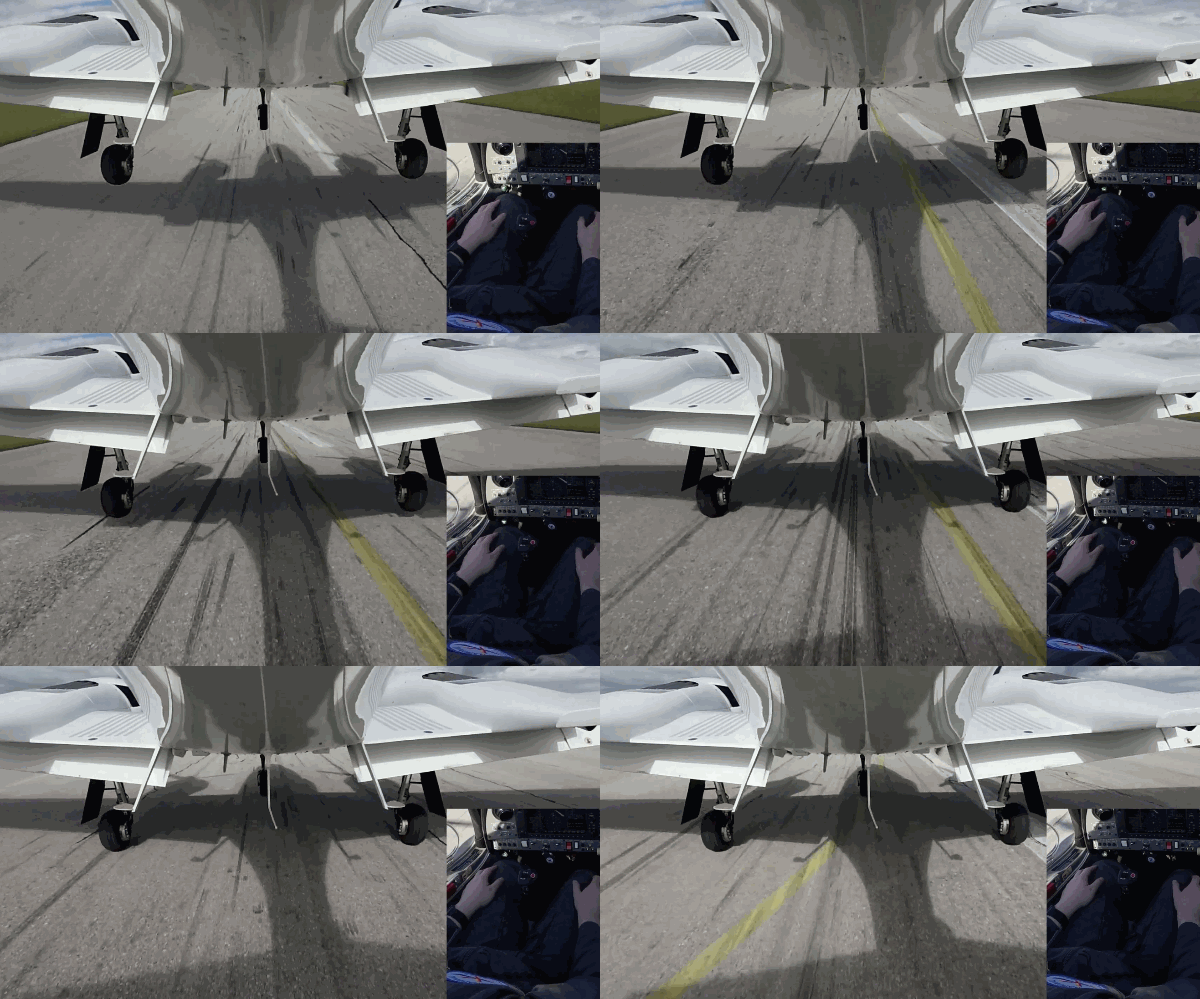
But researchers at Technische Universität München (TUM, or think of it as Munich Tech) have created a system that can land a plane without relying on ground systems at all, and demonstrated it with a pilot on board — or rather, passenger, since he kept his hands in his lap the whole time.

tum plane

The automated plane comes in for a landing.

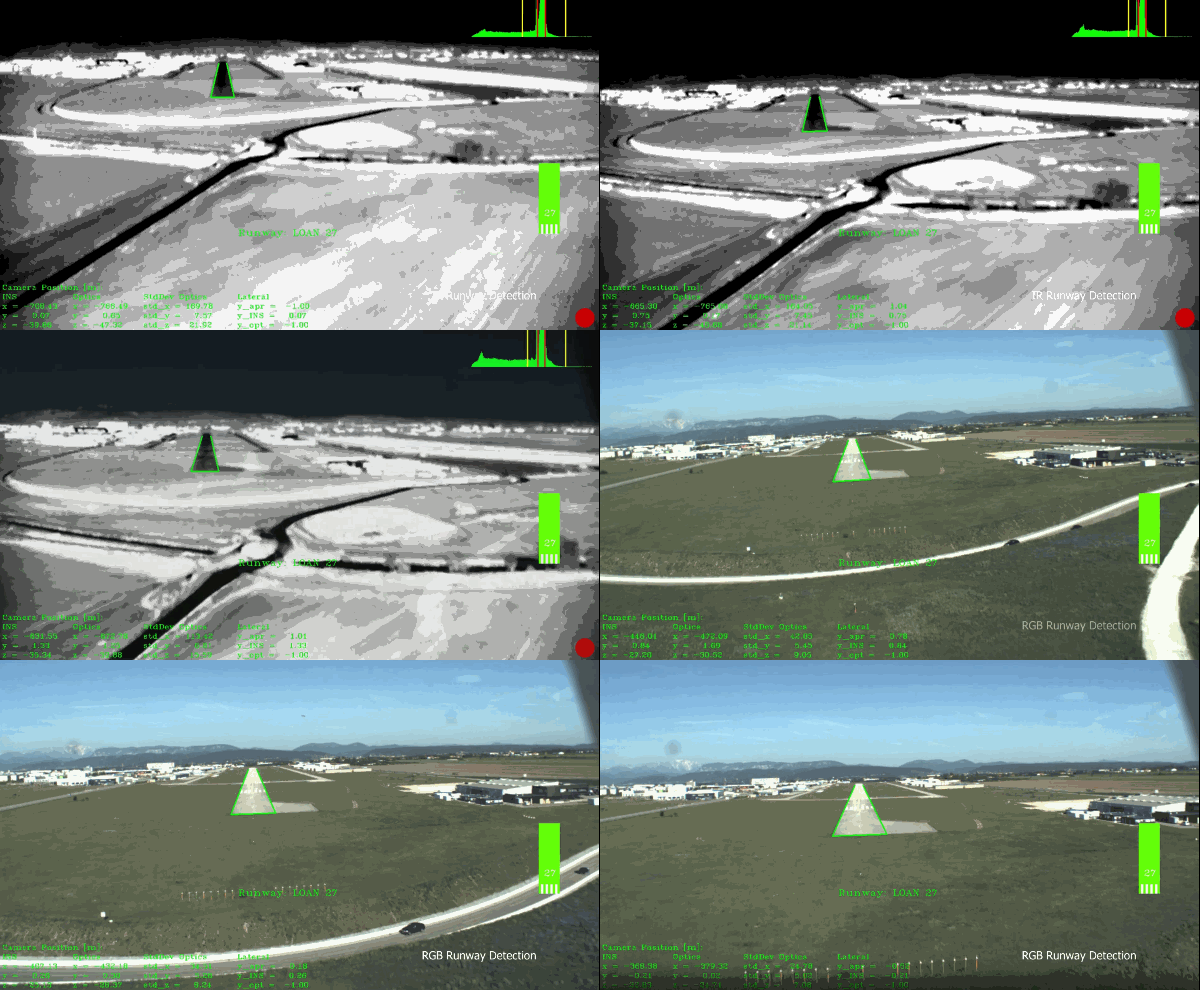
A plane making an autonomous landing needs to know exactly where the runway is, naturally, but it can’t rely on GPS — too imprecise — and if it can’t use ILS and other ground systems, what’s left? Well, the computer can find the runway the way pilots do: with its eyes. In this case, both visible-light and infrared cameras on the nose of the plane.

TUM’s tests used a a single-passenger plane, a Diamond DA42 that the team outfitted with a custom-designed automatic control system and a computer vision processor both built for the purpose, together called C2Land. The computer, trained to recognize and characterize a runway using the cameras, put its know-how to work in May taking the plane in for a flawless landing.

tumlanding

autotum

As test pilot Thomas Wimmer put it in a TUM news release: “The cameras already recognize the runway at a great distance from the airport. The system then guides the aircraft through the landing approach on a completely automatic basis and lands it precisely on the runway’s centerline.”

You can see the full flight in the video below.

This is a major milestone in automated flight, since until now planes have had to rely on extensive ground-based systems to perform a landing like this one — which means automated landings aren’t currently possible at smaller airports or should something go wrong with the ILS. A small plane like this one is more likely to be at a small airport with no such system, and should a heavy fog roll in, an autoland system like this might be preferable to a pilot who can’t see in infrared.

Right now the tech is very much still experimental, not even at the level where it could be distributed and tested widely, let alone certified by aviation authorities. But the safety benefits are obvious and even as a backup or augmentation to the existing, rarely used autoland systems it would likely be a welcome addition.

05 Jul 2019

Daily Crunch: Layoffs at HQ Trivia

The Daily Crunch is TechCrunch’s roundup of our biggest and most important stories. If you’d like to get this delivered to your inbox every day at around 9am Pacific, you can subscribe here.

1. HQ Trivia lays off ~20% as it preps subscriptions

The cuts hit HQ’s HR, marketing and product engineering teams, according to LinkedIn profiles of employees let go. The cuts could further hamper morale at the startup following a tough first half of the year.

It also could leave the company short-handed as it attempts to diversify revenue with the upcoming launch of monthly subscriptions.

2. Tesla shows off next-gen automated emergency braking stopping for pedestrians and cyclists

The upcoming features include automatically engaging the brakes on a vehicle when the system detects a pedestrian crossing the car’s path, and doing the same for a cyclist.

3. Internet group brands Mozilla ‘internet villain’ for supporting DNS privacy feature

The trade group for U.K. internet service providers nominated Mozilla for the title because of a proposed security feature that ISPs say will allow users to “bypass U.K. filtering obligations and parental controls, undermining internet safety standards in the U.K.”

4. Apple reportedly shifting to new keyboard design in 2019/2020 MacBooks

Apple is set to replace the technology underlying the keyboards found in its MacBook Air and MacBook Pro computers, according to a new report from Apple analyst Ming-Chi Kuo.

5. Sony’s new wireless earbuds pack great noise-canceling and battery life

Brian Heater has only had a limited time with Sony’s WF-1000XM3, but he says they seem custom-built for long flights.

6. Waresix hauls in $14.5M to advance its push to digitize logistics in Indonesia

Like others in its industry — which include Chinese unicorn Manbang and BlackBuck in India — Waresix is focused on optimizing logistics by making the process more transparent for clients and more efficient for haulage companies and truckers.

7. What everyone at a startup needs to know about immigration

Over the past three years, immigration policies and procedures have been in a state of flux and the process has become more unforgiving for even the smallest mistakes. (Extra Crunch membership required.)

05 Jul 2019

Mozilla readies launch of news subscription service

Way back in February, Mozilla announced an upcoming collaboration with Scroll aimed finding a way to help fund news outlets. The organization appears ready to finally launch to the service, sending users a survey, along with invites to an upcoming beta launch of what it calls “Firefox Ad-free Internet.”

The service is one of countless third-party platforms aimed at helping ailing publications find a way to better monetize in an an era of defunding, when journalistic voices are more important than ever. Apple News offering is probably the most notable in the category, but Mozilla’s offering provides an interesting alternative to a standalone app.

The Firefox version essentially provides a way to bring users ad-free access to their favorite publications by paying an upfront fee of $5 a month. Per Mozilla,

The service enables web users to pay for an ad-free experience on their favorite sites, across their devices. By enabling more direct funding of publishers, Scroll’s model may offer a compelling alternative in the ecosystem. We will be collaborating with Scroll to better understand consumer attitudes and interest towards an ad-free experience on the web as part of an alternative funding model.

Buzzfeed, Gizmodo Media, Slate, The Atlantic, USA Today all seem to be onboard with the offering, ahead of launch.

05 Jul 2019

It was a really bad month for the internet

If these past few weeks felt like the sky was falling, you weren’t alone.

In the past month there were several major internet outages affecting millions of users across the world. Sites buckled, services broke, images wouldn’t load, direct messages ground to a halt, and calendar and email unavailable for hours at a time.

It’s not believed any single event tied the outages together, more so just terrible luck for all involved.

It started on June 2 — a quiet Sunday — where most weren’t working. A massive Google Cloud outage took out service for most on the U.S. east coast. Many third-party sites like Discord, Snap, and Vimeo, as well as several of Google’s own services, like Gmail and Nest, were affected.

A routine but faulty configuration change was to blame. The issue was meant to be isolated to a few systems but a bug caused the issue to cascade throughout Google’s servers, causing gridlock across its entire cloud for more than three hours.

On June 24, Cloudflare dropped 15% of its global traffic during an hours-long outage because of a network route leak. The networking giant quickly blamed Verizon (TechCrunch’s parent company) for the fustercluck. Because of inherent flaws in the border gateway protocol — which manages how internet traffic is routed the internet — Verizon effectively routed an “entire freeway down a neighborhood street,” said Cloudflare in its post-mortem blog post. “This should never have happened because Verizon should never have forwarded those routes to the rest of the Internet.”

Amazon, Linode, and other major companies reliant on Cloudflare’s infrastructure also ground to a halt.

A week later on July 2, Cloudflare was hit by a second outage — this time caused by an internal code push that went badly. In a blog post, Cloudflare’s chief technology officer John Graham-Cumming blamed the half-hour outage on a rogue bit of “regex” code in its web firewall, designed to prevent its customer sites from getting hit by JavaScript-based attacks. But the regex code was bad and caused its processors to spike across its machines worldwide, effectively crippling the entire service — and any site reliant on it. The code rollback was swift, however, and the internet quickly returned to normal.

Google, not wanting to out-do Cloudflare, was hit by another outage on July 2 thanks to physical damage to a fiber cable in its U.S. east coast region. The disruption lasted for about six hours, though Google says most of the disruption was mitigated by routing traffic through its other datacenters.

Then, Facebook and its entire portfolio of services — including WhatsApp and Instagram — stumbled along for eight hours during July 3 as its shared content delivery network was hit by downtime. Facebook took to Twitter, no less, to confirm the outage. Images and videos across the services wouldn’t load, leaving behind only the creepy machine learning-generated descriptions of each photo.

instagram creepy

Instagram was one of the many Facebook-owned services hit by an outage this week, with several taking to Twitter noting the automatic tagging and categorization of images. (Image: Derek Kinsman/Twitter)

At about the same time Twitter too had to face the music, admitting in a tweet that direct messages were broken. Some complained of ‘ghost’ messages that weren’t there. Some weren’t getting notified of new messages at all.

Then came Apple’s turn. On July 4, iCloud was hit by a three-hour nationwide outage, affecting almost every part of its cloud-based service — from the App Store, Apple ID, Apple Pay and Apple TV. In some cases, users couldn’t access their cloud-based email or photos.

According to internet monitoring firm ThousandEyes, the cause of the outage was yet another border gateway protocol issue — similar to Cloudflare’s scuffle with Verizon.

apple status

Apple’s nondescript outage page. It acknowledges issues, but not why or for how long. (Image: TechCrunch)

It was a rough month for a lot of people. Points to Cloudflare and Google for explaining what happened and why. Less so to Apple, Facebook, and Twitter, all of which barely acknowledged their issues.

What can we learn? For one, internet providers need to do better with routing filters, and secondly perhaps it’s not a good idea to run new code directly on a production system.

These past few weeks have not looked good for the cloud, shaking confidence in the many reliant on hosting giants — like Amazon, Google and more. Although some quickly — and irresponsibly and eventually wrongly — concluded the outages were because of hackers or threat actors launching distributed denial-of-service attacks, it’s always far safer to assume that an internal mistake is to blame.

But for the very vast majority of consumers and businesses alike, the cloud is still far more resilient — and better equipped to handle user security — than most of those who run their own servers in-house.

The easy lesson is to not put all your eggs in one basket — or your data in single cloud. But as this week showed, sometimes you can be just plain unlucky.

05 Jul 2019

These humanoid robots can autonomously navigate cinder block mazes thanks to IHMC

Programming robots to walk on flat, even ground is difficult enough, but Florida’s Institute for Human and Machine Cognition (IHMC) is talking the grander challenge of making sure bipedal robots can successfully navigate rough terrain. The research organization has been demonstrating its work in this area since 2016, but its latest video (via Engadget) shows the progress its made.

In the new video, IHMC’s autonomous footstep planning programming is at work on both Boston Dynamics’ Atlas robot, and the NASA-developed Valkyrie robot (humanoid robots have the coolest names). This video shows off navigation of a heaping pile of cinder blocks, as well as narrower paths which are trickier to navigate because of limited navigation options.

Basically, IHMC manages these complex navigation operations by specifying a beginning and end point for the robot, and then mapping all possible paths on a footstep-by-footstep basis, evaluating the cost of each and ultimately arriving at a best possible path – all of which can occur relatively quickly on modern hardware.

These robots can also quickly adapt to changes in the environment and path blockage thanks to IHMC’s work, and it can even manage single-path tightrope style walking (albeit on a narrow row of cinder books, not on an actual rope).

There’s still work to be done – the team at IHMC says that it’s having about a 50 percent success rate on narrow paths, but its ability to navigate rough terrain with these robots and its software is at a much higher 90 percent, and it’s pretty near a perfect track record on flat ground.