Category: UNCATEGORIZED

03 Jul 2019

Apple reveals App Store takedown demands by governments

For the first time, Apple has published the number of requests it’s received from governments to take down apps from its app store.

In its latest transparency report published Tuesday, the tech giant said it received 80 requests from 11 countries to remove 634 apps from its localized app stores during July 1 and December 31, 2018.

Apple didn’t list the apps that were removed but noted in most cases why the apps were pulled. China made up the bulk of the requests, seeking to remove 517 apps claiming they violated its gambling and pornography laws. Vietnam and Austria also requested the takedown of several apps which violated its gambling laws, while Kuwait asked Apple to pull some apps that fell foul of its privacy laws.

Saudi Arabia, Turkey, and Lebanon were among the countries that requested the removal of some apps, along with The Netherlands, Norway, and Switzerland.

The move comes more than a year after the company promised to publish the figures starting with this latest transparency report.

Apple said it will in a future transparency report — slated for mid-2020 — will report on appeals received in response to government demands to remove apps from the company’s localized app stores.

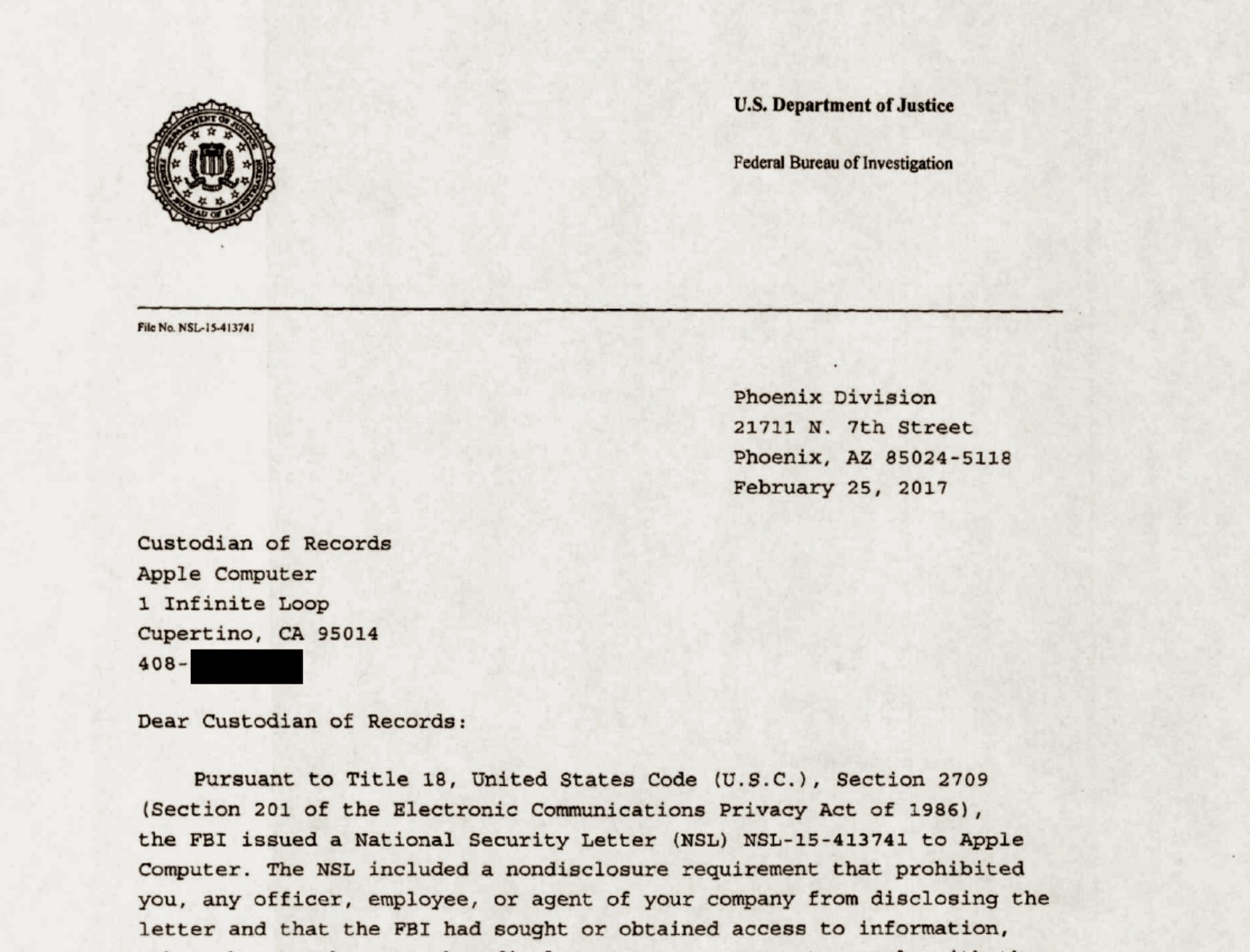
The tech giant also for the first time posted several national security letters it received permission to publish.

National security letters (NSLs) are controversial subpoenas issued by the FBI with no judicial oversight and often with a gag order preventing the company from disclosing their existence. Since the introduction of the Freedom Act in 2015, the FBI was required to periodically review the gag orders and lift them when they were no longer deemed necessary.

Apple first revealed it received an NSL in 2017 but never published the document. In its latest transparency report, the company finally published the letter — along with four others from 2018 which had the gag order lifted in April and May 2019.

Screen Shot 2019 07 02 at 8.52.33 PM

The first national security letter Apple disclosed but never released — until now. (Image: Apple)

As for the rest of the report, most of the government demands went down during the six-month period compared to the previous reporting period.

Apple said it received 29,183 demands from governments — down almost 10 percent on the last reporting period — to access 213,737 devices in the second half of last year.

Germany issued the most legal demands for the six-month period ending December 2018 with 12,343 requests for 19,380 devices. Apple said the large number of requests were primarily due to police investigating stolen devices.

The U.S. was in a distant second place with 4,680 demands for 19,318 devices.

Apple also received 4,875 requests for account data, such as information stored in iCloud — up by 16 percent on the previous reporting period — affecting 22,503 accounts.

The tech giant also saw a rise in the number of government requests to preserve data for up to three months. Apple said it received 1,823 requests, up by 15 percent, affecting 5,553 accounts, during which law enforcement sought to obtain the appropriate orders to access the data.

02 Jul 2019

Newly unsealed court documents reveal additional allegations against Andy Rubin

Newly unsealed documents have revealed a spate of bombshell allegations against Android founder, Andy Rubin. BuzzFeed’s Ryan Mac has made the documents available as a PDF, and there’s a lot to unpack.

The nearly 40 pages detail a pre-martial agreement made with Rubin’s now-ex-wife, Rie Hirabaru Rubin, three days before their wedding. The documents refer to the agreement as “unconscionable, capping spousal support and stripping Plaintiff of her community property rights under California law without informed consent.”

The Essential Phone and Playground Global founder has largely operated in the background since The New York Times published an explosive story in late-2018 detailing sexual misconduct and massive severance package from his former employer, Google.

The documents go on to allege that her attorney, Stephen Peters, had previously represented Rubin in a prior divorce without her knowledge. This lawsuit seeks to make that prenuptial agreement invalid.

“Plaintiff was not aware of this pre-existing attorney-client relationship or the extent of Peters’ detailed knowledge regarding Rubin’s property and assets which were not fully disclosed at the time,” according to the document, “his detailed knowledge of Rubin’s extravagant payments to women or sex or that Peters was in reality working for the benefit of Rubin, and to the Plaintiff’s detriment.

Allegations of Rubin’s improprieties echo many of the claims reported in the 2018 Times piece, including, “ownership relationships […] whereby Rubin would pay for their expenses in exchange for offering them to other men.”

Over the last several months, Rubin and his ex-wife have been battling in court regarding whether or not the complaint would remain sealed. In April, a California state judge tentatively concluded that small portions of the complaint could be sealed. In May, the plaintiff argued that much of the material in the complaint had already been reported and that there was a notable public interest in the case. For example, Rubin’s alleged payments to women for sex — in the sum of hundreds of thousands of dollars — has already been reported and is relevant to the plaintiff’s case, she argued.

“Rubin hid these payments from Plaintiff during‘their marriage by using his individual bank account and routing payments through his wholly owned company Cosmofion LLC,” the plaintiff states in a court filing. “These allegations show, and the evidence at trial will prove, that Rubin was highly motivated to coerce and defraud Plaintiff to enter into an unconscionable Premarital Agreement so that ‘he would be able to conceal and continue to engage in these illicit sexual activities and continue to make payments of hundreds of thousands of dollars to these women without being detected by Plaintiff.”

Regarding the parts of the document that remain under seal, the judge ruled they either involve post-marital allegations and/or information that is covered by a stipulated protective order.

We’ve reached out to Rubin’s lawyers for comment.

02 Jul 2019

KKR has acquired Corel (including its recent acquisition Parallels), reportedly for $1B+

Only six months after snapping up virtualization specialist Parallels, Canadian software company Corel is itself getting acquired. TechCrunch has learned and confirmed with multiple sources that private equity giant KKR has closed a deal to buy the company from Vector Capital, which has owned some or all of Corel since 2003.

KKR’s interest in Corel was first rumored in May, when PE Hub reported the two were in talks for a sale valued at over $1 billion. At the time, representatives of Corel declined to comment, although our sources inside the company indicated that the reports were not inaccurate.

Fast forward to today, and both KKR and and a spokesperson for Parallels/Corel declined to comment. But, we now have a copy of the memo provided by an internal source that has been sent out to staff announcing that the deal has indeed closed, and that Corel is now officially part of the KKR family of companies.

According to the memo, KKR is very optimistic about Corel’s prospects. It plans to give Corel an “infusion of capital” to accelerate its growth, which will go into two areas. First will be expanding operations for the existing business: Corel is the company behind a number of longstanding software brands including WordPerfect, Corel Draw, WinZip, PaintShop Pro. Second will be making acquisitions (and the sheer proliferation of promising startups in the last decade dedicated to all variety of apps and other software that may have found it a challenge to scale means Corel could have rich pickings).

There are no layoffs planned as part of the deal, and the official announcement had been planned to go out next week, but now looks like it may be moved up to tomorrow (Wednesday).

Vector and Corel itself have never publicly disclosed much on user numbers or financials, but Vector has described the company as “highly profitable”, with dividends of over $300 million to date. The memo we’ve seen notes that Corel (including Parallels) has millions of customers across its various software platforms and apps.

The acquisition of Corel by KKR marks another chapter in the company’s long corporate history.

Founded in the 1980s — when personal computers were just starting to enter the mainstream but well before we had anything like the internet (not to mention the world of cloud-based apps) that we know today — Corel once positioned itself as a potential competitor to Microsoft in the software wars.

When Corel purchased WordPerfect from Novel in 1996, Corel founder Michael Cowpland viewed the software package as an integral part of that rivalry, describing it as the Pepsi to Microsoft’s Coke — that is, Word.

Microsoft proved the mightier of the two, and it even eventually signed a partnership with Corel that saw it investing in the company: a sell out, as one disappointed Canadian journalist described it at the time. The two have also sparred over patents.

Corel, which went public early in its life, got battered in the first dot-com bust (which was not helped by an insider trading scandal that led to Cowpland’s departure). Vector stepped in and took it private in 2003.

After restructuring the company, Vector listed Corel again in 2006. But, amid another recession that again hit Corel hard, it once more took it private in 2010. In the intervening years, Corel has been focused on modernising its offerings, bringing in e-commerce, direct downloads, subscriptions, and acquisitions to bring the company’s products and wider business closer to how consumers and workers use computers today.

Parallels was a part of that strategy: its products help people work seamlessly across multiple platforms, letting employees (and IT managers) run a unified workflow regardless of the device or operating system, with Parallels providing support for Windows, Mac, iOS, Android, Chromebook, Linux, Raspberry Pi and cloud — a timely offering in the current, fragmented IT market.

If the $1 billion+ figure is accurate, that strategy seems to have worked: across the two times that Vector took Corel private, it never paid more than $124 million for the company (the second time, as its stock was tanking, it paid just $30 million).

02 Jul 2019

Another major theater chain is reportedly working on a MoviePass competitor

Movie ticket subscription services have had a tough time of it. The two largest names in the business — MoviePass and Sinemia — have been waging what looks to have been a mostly losing battle in the war to reinvigorate box office sales. The category has been plagued by mind-boggling cash burn rates and disastrous customer service.

AMC’s A-List service, on the other hand, appears to be moving along swimming. In May, it hit 785,000 subscribers, effectively tripling MoviePass’ most recent numbers, according to a report. Of course, AMC has one key thing the competition doesn’t: it’s own theaters. That means, among other things, that the company operates with far few middlemen.

According to a new report from Deadline, Regal is also set to get into the subscription business. As of last year, the Tennessee-based chain is number two in the U.S., with 558 theaters to AMC’s 659, which means it has similar infrastructural for support in place. The plan would be tiered, giving premium subscribers access to all theaters in the change, with another plan cutting that down to about half of its locations (which would cut out access to locations in big cities like LA and NYC).

Like AMC’s offering, the deal would also offer discounts on some concessions — deals on $20 buckets of popcorn are another advantage theater chains have over third parties like MoviePass and Sinemia. The plans are reportedly set to launch at the end of the month, as soon as Regal’s parent company has worked out the finer details with studios.

02 Jul 2019

Uber Eats invades restaurants with Dine-In option

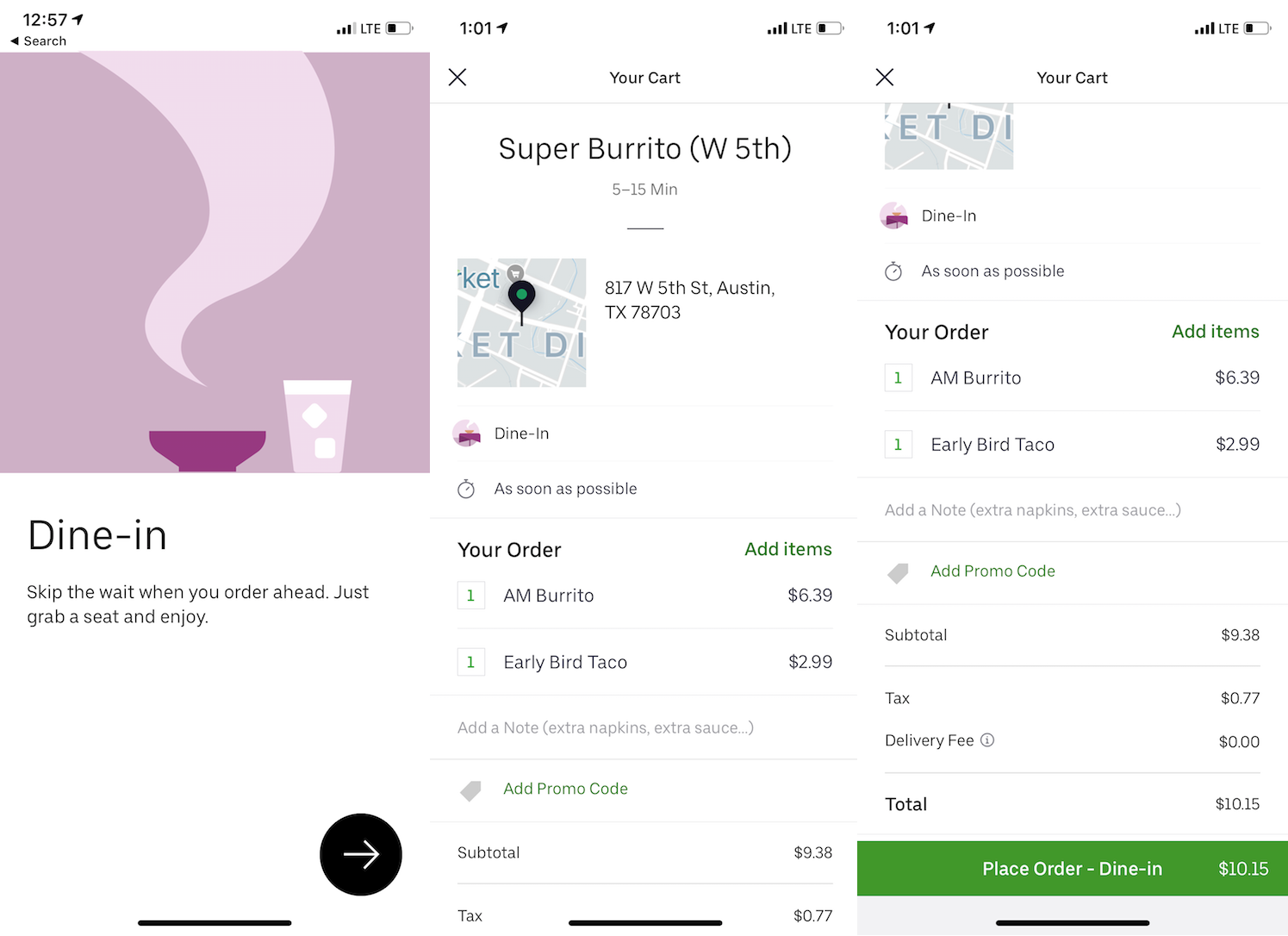
Tired of cleaning up after take-out or getting hangry waiting at your table in restaurants? Well Uber Eats is barging into the dine-in business. A new option in some cities lets you order your food ahead of time, go to the restaurant, and then sit down inside to eat, a tipster from competing dine-in app Allset tells us. We tested it, and Uber Eats Dine-In even waives the standard Uber delivery and service fees.

Adding Dine-In lets Uber Eats insert itself into more food transactions, expand to restaurants that care about presentation and don’t do delivery, and avoid paying drivers while earning low-overhead revenue. Uber’s Dine-In option is now available in some cities including Austin, Dallas, Phoenix and San Diego where it could save diners time and fees while helping restaurants fill empty tables and waiters earn tips.

UberEats Dine In Option

Uber confirmed the existence of the Dine-In option, telling me “We’re always thinking about new ways to enhance the Eats experience.” They also verified there are no delivery or service fees, and restaurants get 100% of tips left in-app buy users. However, we found some items were silently marked up from restaurants’ listed prices in both Uber Eats Delivery and Dine-In options, which could help it make some money directly from these purchases. We also discovered this buried Uber Help Center FAQ with more details.

Uber has been rapidly experimenting with Uber Eats, trying discounted specials, Uber Eats Pool where you pay less for slower delivery, and $9.99 unlimited delivery subscriptions. It’s steadily becoming an omnivore.

How Uber Dine-In Works

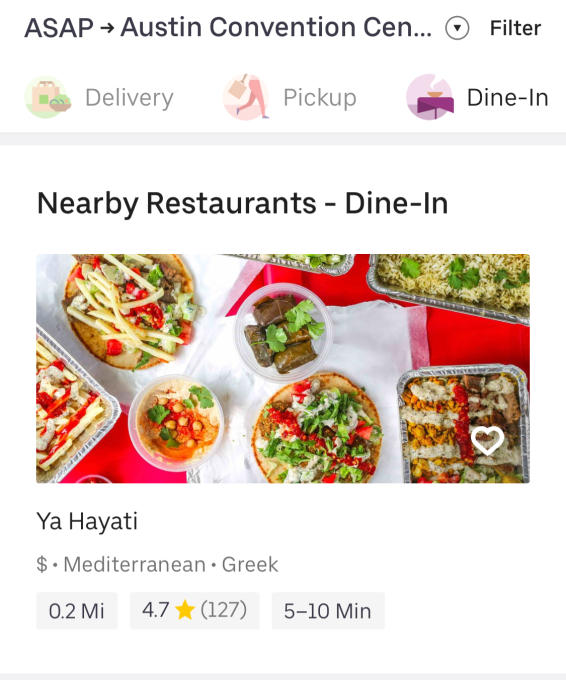
Dine-in appears next to the Delivery and Pick-Up options across the top of the Uber Eats app in select cities. You can choose to go eat “ASAP” or in some cases schedule when you want to arrive and sit down. You’ll be shown how long the food will take to prep, distance to the restaurant, your price, and the restaurant’s rating. You’ll then be notified as the order is prepared and approaches readiness. Then you just deliver yourself to the restaurant and add a tip in-app or on the table.

Uber Eats should obviously make it easy for you to hail an Uber with the restaurant as the pre-set destination. An Uber spokesperson called that a good idea but not something it’s doing yet. Back in 2016, Uber tried a merchant-sponsored rides option where you’d get a rebate on your travel if you spent money at a given store. You could imagine restaurants that want to show off their ambiance giving customers some money back if they come across town to eat there.

Uber Dine In

The new feature could spell trouble for other dine-in apps like Allset that’s been in the business for four years. Users might also opt for Uber Eats Dine-In over restaurant reservation apps like OpenTable and Resy. Why waste time waiting to order and for your food to be cooked when you could just show up as it comes out of the oven?

“I think that more delivery players will be tapping into dine-in space. It’s all about convenience and time saving. But it’s going to be very difficult for them, given their focus on delivery” AllsetCEO Stas Matviyenko said of Uber becoming a competitor. He believes dedicated apps for different modes of dining will succeed. But Uber Eats’ ubiquity and its one-stop-shop model for all your dining needs could make it stickier than a dine-in only app you use less frequently.

UberEatsheader

With Dine-In, Uber could aid restaurants that are empty at the start or end of their open hours. Last year we reported that Uber Eats was giving restaurants prominence in a Featured section of the app to drive up demand if they offered discounts to customers. Similarly, Uber could let restaurants entice more Dine-In customers especially when foot-traffic was slow by providing discounts on food or subsidized Uber transportation. Better to knock a dollar or two off an entree if it means filling the restaurant at 5:30 or 9:30pm.

And now that Uber Eats does delivery, take-out, and dine-in, it’d make perfect sense to offer traditional restaurant reservations through the app as well. That would pit it directly against OpenTable, Resy, and Yelp. Instead of trying to own a single use case that might only appeal to certain demographics in certain situations, Uber Eats’ strategy is crystallizing: be the app you open whenever you’re hungry.

02 Jul 2019

From seed to Series A: Scaling a startup in Latin America today

It’s not easy to raise growth-stage capital in Latin America, but it’s getting easier. As startups begin to flourish in the region’s largest markets, available funding is evolving to suit the needs of these maturing companies. However, Silicon Valley-style Series A rounds in Latin America are still rare, especially outside of Brazil and Mexico.

Even in Silicon Valley, only a small percentage of startups can bring together enough pieces to raise a Series A round. Jacob Mullins, a partner at Shasta Ventures, recently published an article on Medium on what it takes to raise a Series A round in San Francisco today, which inspired my take for the Latin American ecosystem.

In the piece, he lays out the table stakes for any startup looking to raise Series A capital, including product-market fit, a strong revenue model, 2x or 3x YOY growth, a data-driven go-to-market strategy, a compelling market opportunity, a great team and a great story. These prerequisites apply to startups anywhere in the world. However, if these requirements are the minimum needed for a Series A in San Francisco, startups outside of the Valley, including in Latin America, will have to work even harder.

Latin America’s exceptional growth in VC funding over the past 12 months speaks to the growing number of later-stage rounds startups are raising across the region. 2018 was Latin America’s inflection point for startups, with four big trends:

Record-breaking rounds: Mexico’s Grin Scooters raised Latin America’s largest seed round, and Brazilian bike and scooter-sharing startup Yellow raised Latin America’s largest Series A round to date (then they merged!). Food delivery startup Rappi became Colombia’s first unicorn, raising $200 million (and then $1 billion from SoftBank shortly thereafter), and Brazil’s iFood also raised $400 million, one of Latin America’s biggest rounds ever.

A closer examination reveals patterns in what it takes to raise scale capital in the Latin American market today.

Soaring Asian investment: Brazil’s most popular ride-hailing app, 99, was acquired by Didi Chuxing, China’s version of Uber . Tencent invested in Brazilian fintech Nubank; Ant Financial invested in Brazilian POS company StoneCo; SoftBank invested in Brazil’s logistics provider Loggi, Brazil’s Gympass and Colombia’s largest hotel chain, Ayenda Rooms. SoftBank also committed a $5 billion fund for Latin America, outstripping all previous funds by an order of magnitude.

Exits to Latin American and U.S. corporates: Chilean-Mexican grocery delivery startup Cornershop went to Walmart for $225 million and e-commerce company Linio was acquired by Falabella for $138 million. These deals reveal a growing concern from large companies in Latin America about competition from startups.

More YC grads: Latin America sent at least 10 startups to the Y Combinator, and many more to other international accelerators, in the past year. These companies include Grin, Higia, Truora, Keynua, The Podcast App, SkyDrop, UBits, Cuenca, BrainHi, Pachama, Calii, Cuanto, Pronto and Fintual.

2018 really was a breakout year for Latin American startups.

So who is raising Series A rounds in the region?

Within the list of 30 or so companies that have managed to raise a Series A in Latin America in the past year, most of the startups fit into a few categories. There is also significant overlap between the investors who are pursuing tickets of this size, most of whom are located in major markets like Mexico and Brazil, or have offices in Silicon Valley. A closer examination of these startups reveals patterns in what it takes to raise scale capital in the Latin American market today.

Copycats

Copycats — or startups that copy a successful business model from another market — are a good business in Latin America. Among those to raise Series A rounds within the past year were:

  • Grin and Yellow (now Grow Mobility): Bird/Lime clones raised $150 million as Grow Mobility from GGV Capital and Monashees.

  • LentesPlus: 1-800-Contacts clone raised $5 million from Palm Drive Capital, with participation from IGNIA and InQLab.

  • Mercadoni: Instacart clone raised $9 million from Movile.

  • Uala and Albo: Monzo/Revolut clones raised $10 million from Soros, Greyhound Capital, Recharge Capital and Point 72 Ventures, and $7.4 million from Omidyar, Greyhound and Mountain Nazca, respectively.

International investors often see copycat models as less risky, because the model has been tested before.

Logistics and last-mile delivery

Brazil’s CargoX, the “Uber for trucks,” is leading the market for logistics solutions in Latin America, receiving international investment from Valor Capital and NXTP Labs starting in their first round. They have also received funding from Soros, Goldman Sachs and Blackstone in later rounds. Recently, logistics startups like Colombia’s Liftit and Mexico’s Skydrop have raised multimillion-dollar rounds from Silicon Valley investors, including IFC, Monashees, MercadoLibre Fund, Variv Capital, Sierra Ventures and Sinai Ventures . Startups like Rappi, Loggi and Mandaê have also raised Series A rounds, and beyond.

Brazilian startups

In many ways, the Brazilian market operates separately from the rest of Latin America, and not only because of the language difference. Brazil has Brazil-centric funds and its startups follow their own rules, because the market is big enough to accommodate companies that only operate locally. Brazil also receives a majority of international VC funding and has produced a significant portion of Latin America’s unicorns.

Brazilian (and some Mexican) startups in edtech, healthtech and fintech, including Neon, Sanar, Mosyle, UnoDosTres and Nexoos, raised Series A rounds in 2018. Key investors included Quona Capital, e.Bricks Ventures, Elephant and Peak Ventures. Brazilian startups tend to scale more quickly at all sizes; Creditas and Loggi were able to raise their Series A in 2016 and 2014 respectively. In 2018, they were already raising $55 million at Series C and $100 million+ Series D from investors such as Vostok Emerging Capital, Kaszek Ventures, IFC, Naspers and SoftBank. However, startups in these industries in other Latin American countries might not find it as easy to raise larger rounds.

How much to raise in a Latin American Series A

Latin American valuations are noticeably lower than their Silicon Valley equivalents. A Series A round in a small or medium Latin American market like Chile or Colombia might end up looking a lot like a San Francisco seed round. Valuations and amount are bifurcated: those that have access to Silicon Valley-style capital can get higher valuations and bigger checks (still lower and smaller than the U.S.), while those that don’t have access have lower valuations.

The startup’s team, story and revenue model should all align to create an unbeatable business.

Outside of Brazil or Mexico, startups should not expect to raise more than $5 million in a Series A, even if they are receiving co-investments from the U.S. The average Series A round in the U.S. hit $11.29 million in 2018; however, the top 10% of deals averaged more than $60 million.

In Latin America, a Series A could range from as little as $1 million to around $10 million in most countries. Brazil and Mexico might break the mold, but startups looking for growth capital in Latin America should not expect to raise more than $5 million if they are not in a massive market. For example, Chile’s Destacame raised $3 million in their Series A from Chilean funds in early 2019. By comparison, Brazil’s Neon raised $22 million in their Series A in the same year. While these are different industries and comparing apples to oranges, the orders of magnitude seem right.

If we compare in the same industry but different years, the results are similar. Nubank’s Series A in 2014, led by Sequoia Capital, was $14.3 million. Neobanks in smaller markets, like albo and Uala, raised $7.4 million and $10 million, respectively, in their Series A rounds.

To date, the largest Series A raised in the region went to Yellow, Brazil’s bike-share and e-scooter company, created by the founders of 99, Ariel Lambrecht, Eduardo Musa, and Renato Freitas. Yellow raised a $63 million Series A within a year after launch, then merged with Mexico’s Grin Scooters.

Where to look for investment: Latin America or USA?

There are still very few entirely Latin American funds investing at Series A. Most of the time, Latin American startups must look to Mexico and Brazil, or beyond the region to Asia and the U.S., to fund rounds beyond the seed stage.

Within Latin America, some of the actors in this investment sector include Brazil’s Monashees and Valor Capital, Argentina’s Kaszek Ventures, Peru and Mexico’s Angel Ventures and Mexico’s ALLVP, MITA Ventures and Ignia. Startups might also find Series A-level investment from major regional tech leaders who are scouting acquisition opportunities, like Movile’s investment in Mercadoni. Movile is Brazil’s leader in mobile technology, with a mission to impact one billion people, following in the footsteps of China’s giant conglomerate, Tencent. Movile has invested in and acquired many Latin American startups to increase their mobile offerings for its customers.

While some funds in Latin America participate in investments of this scale, most Latin American startups target at least a part of their Series A rounds from outside the region. Latin American startups have been able to reach U.S. VCs in one of three ways: through top-tier accelerators, by selling to consumers in the U.S. market or by taking on a copycat model. U.S.-based VCs Accel Partners, Sequoia Capital, Andreessen Horowitz, Base10, Liquid2 Ventures, Quona Capital, QED, IFC and Sierra Ventures have all made multiple contributions to Series A rounds in Latin America within the past year.

Raising a Series A round in Latin America today

Raising a Series A round anywhere means checking a lot of boxes. Beyond bringing a great product to market, the startup’s team, story and revenue model should all align to create an unbeatable business. In Latin America, raising a Series A also means knowing where to look for capital, and which models are receiving funding.

Although there is no instruction manual for raising a Series A anywhere, following in the footsteps of companies that have done so successfully can be a wise way to start. Latin America’s Series A success stories outline a list of investors that are interested in this stage, as well as how much they are investing in Latin American companies. Founders can use this information to structure their fundraising efforts and optimize their time to raise a Series A and continue to scale.


02 Jul 2019

Tesla sets new delivery record of 95,200 electric vehicles

Tesla delivered 95,200 of its electric vehicles in the second quarter, a dramatic reversal from a disappointing first period that set a new record and beat analysts’ expectations.

Analysts expected Tesla to deliver 91,000 vehicles during the second quarter, according to estimates compiled by FactSet.

The record-breaking figures stand in stark contrast to the company’s first quarter delivery numbers when it reported deliveries of delivered 63,000 vehicles, nearly a one-third drop from the previous period. The low numbers signaled what was to come: wider-than-expected loss of $702 million driven by disappointing delivery numbers, costs and pricing adjustments to its vehicles.

The second quarter, at least in terms of deliveries, is giving a rosier view of the company and possibly its earnings, which have yet to be reported..

Tesla also reported production of 87,048 vehicles in the second quarter compared to 77,100 in the previous period. The second-quarter production figure also beats the company’s fourth quarter stats of 86,555 vehicles.

Tesla reported that it made “significant progress” streamlining its global logistics and delivery operations at higher volumes — a major pinch point for the company. Tesla said this has improved cost efficiencies and improvements to our working capital position.

The company also signaled that this record would not be a blip. Orders in the second quarter exceeded deliveries, which means Tesla is entering the third quarter with a backlog.

Customer vehicles in transit at the end of the quarter were over 7,400, according to Tesla. The company says it doesn’t plan to disclose the customer vehicles in transit metric going forward.

02 Jul 2019

Demo your startup at TC Sessions: Enterprise 2019

Every year hundreds of startups launch with dreams of becoming the next enterprise software unicorn. And it’s no wonder, given the $500 billion market and the rate at which the enterprise giants snap up emerging players. If you’re the founder of an early-stage enterprise startup, join us for TC Sessions: Enterprise in San Francisco on September 5 at the Yerba Buena Center for the Arts.

Even better, grab the opportunity by the horns and buy a Startup Demo Package. There is limited space available. This is your chance to plant your company in front of some of the most influential enterprise movers and shakers — we’re talking more than 1,000 attendees. Demo tables are reserved for startups with less than $3 million in funding and are available for $2,000, which includes four tickets to the event.

This day-long intensive event features speakers, panel discussions, demos, workshops and world-class networking. Get ready for a head-on, hype-free exploration of the considerable challenges enterprise companies face — regardless of their size.

TechCrunch editors will interview founders and leaders from both established and up-and-coming companies on topics ranging from intelligent marketing automation and the cloud to machine learning and AI. And they’ll question enterprise-focused VCs about where they’re directing their early, middle and late-stage investments.

The full roster of speakers is still to be announced, but here’s a quick hit of who you can expect at TC Sessions: Enterprise.

You’ll hear from Scott Farquhar, co-founder and co-CEO of Atlassian, a company that’s changed the way developers work. Want to hear more about enterprise and the cloud? Snowflake’s co-founder and president of product, Benoit Dageville, will be on hand to talk about the company’s mission to bring the enterprise database to the cloud.

Have someone you want to hear from our stage? Submit your speaker suggestion here.

Pro Tip: For each TC Sessions: Enterprise ticket you buy, we’ll register you for a complimentary Expo Only pass to TechCrunch Disrupt SF on October 2-4.

TC Sessions: Enterprise takes place September 5 at San Francisco’s Yerba Buena Center for the Arts. Don’t miss this opportunity to showcase your early-stage enterprise startup in front of leading enterprise software founders, investors and technologists. Buy your Startup Demo Package today.

Looking for sponsorship opportunities? Contact our TechCrunch team to learn about the benefits associated with sponsoring TC Sessions: Enterprise 2019.

02 Jul 2019

Sam Lessin and Andrew Kortina on their voice assistant’s workplace pivot

Sam Lessin, a former product management executive at Facebook and old friend to Mark Zuckerberg, incorporated his latest startup under the name “Fin Exploration Company.”

Why? Well, because he wanted to explore. The company — co-founded alongside Andrew Kortina, best known for launching the successful payments app Venmo — was conceived as a consumer voice assistant in 2015 after the two entrepreneurs realized the impact 24/7 access to a virtual assistant would have on their digital to-do lists.

The thing is, developing an AI assistant capable of booking flights, arranging trips, teaching users how to play poker, identifying places to purchase specific items for a birthday party and answering wide-ranging zany questions like “can you look up a place where I can milk a goat?” requires a whole lot more human power than one might think. Capital-intensive and hard-to-scale, an app for “instantly offloading” chores wasn’t the best business. Neither Lessin nor Kortina will admit to failure, but Fin‘s excursion into B2B enterprise software eight months ago suggests the assistant technology wasn’t a billion-dollar idea.

Staying true to its name, the Fin Exploration Company is exploring again.

02 Jul 2019

Netflix’s ‘Stranger Things’ comes to Roblox ahead of its July 4 premiere

Netflix is bringing its hit TV show Stranger Things to Roblox. On Monday, Roblox announced the launch of limited-time, Stanger Things-themed items that will be made available to its over 90 million players, who can earn them by solving daily riddles and puzzles. Other free, limited-time items like a “Scoops Ahoy” hat and Demogorgon mask will also be offered as virtual items for players’ Roblox avatars.

The first of the two themed items are live now and will be free to download through July 12. Four more items can be unlocked by solving daily riddles and puzzles, with a new clue arriving each day ahead of the July 4 premiere of Stranger Things Season 3.

Roblox will also share clues across its social media accounts on FacebookTwitter, and Instagram, it says.

What’s interesting about the Roblox integration is that it may reach children younger than those ages 14 and up — the ages that the series itself is rated for (TV-14). (Likely, some braver tweens are already familiar with the show and are watching alongside mom or dad…or at least with their approval).

However, the Roblox partnership is only one of several gaming-focused initiatives Netflix has planned to market some of its most anticipated programming, including both Stranger Things and other titles.

At this year’s E3, Netflix detailed a series of gaming initiatives, including integrations with partners like Ubisoft, Behavior Interactive, and even Fornite, in addition to Roblox. Already, some Fornite players had found the “Scoops Ahoy” easter egg back when Season 9 launched, Netflix said.

Plus, the company is preparing not one but two new Stranger Things-themed games. The first, called Stranger Things 3: The Game, will launch across platforms including Nintendo Switch, Xbox One, PlayStation 4, PC, Mac, Android and iOS on the same day the third season premieres. Like its predecessor, also by developer BonusXP, the game is meant to be a companion to the current season and features 16-bit action for a nostalgic feel.

Next year, Netflix is planning another new Stranger Things title, with a mobile game for iOS and Android. This one is a location-based RPG/puzzler where players explore The Upside Down hidden all around them, while working with other players to “overcome its emerging evils.”

Netflix is also preparing to launch a turn-based tactics game adapted from the Netflix Original series The Dark Crystal: Age of Resistance, on Nintendo Switch, Xbox One, PlayStation 4, PC and Mac.

A wave of digital marketing isn’t entirely new for the streaming service.

In the past, it toyed with mobile experiences to advertise its shows — like the standalone Orange is the New Black app it launched back in 2014, or the “FakeBlock” app introduced to advertise the new season of Arrested Development.

The company also toyed around with a cross between games and TV with the 2018 launch of Minecraft: Story Mode, which some could consider a form of gaming. Netflix, however, did not. It even claimed at the time that the company did not have any plans “to get into gaming.”

Well, that’s no longer true.

While many of the integrations and games themselves are built by partnered developers, Netflix is clearly involved. And unlike the throwaways apps from years prior, these are more series efforts on Netflix’s part — not just promotional vehicles for its shows.

The marketing doesn’t stop at digital games either.

Netflix’s Stranger Things is more than just a show, its a whole business unto itself. It’s Baskin Robbins ice cream flavors, and Target exclusives like a Stranger Things bike, toys and apparel. It’s posters, games, and all kinds of other merch, too. And that’s just one show. An analyst previously said Netflix’s merch biz could be a billion-dollar addition to the company’s revenue.

Beyond gaming and other stuff to buy, the Stranger Things empire extends to brand deals with Coke, Levi’s, H&M, Nike, Eggo, Schwinn, Trivial Pursuit, Burger Kind, and more. 

The Roblox and Fornite integrations are live now. The Season 3-themed game arrives July 4.