Category: UNCATEGORIZED

26 Jun 2019

What is the Libra Association going to do, really?

When Facebook unveiled Libra a few days ago, the company also announced the Libra Association, a not-for-profit that will oversee all things Libra. Facebook wants to make sure that everyone is aware that Libra was created by Facebook but isn’t controlled by Facebook.

And yet, given Facebook’s reputation, it seems useful to evaluate the project and the company’s promises — should we trust Facebook?

Regulation

Before going into technical details, let’s start with Facebook’s promises when it comes to privacy. Facebook launched a subsidiary called Calibra that is responsible for its cryptocurrency projects. It’s a separate company with a separate team.

In addition to contributing to the development of the project at the protocol level, Calibra will release a wallet and build an integration with WhatsApp and Messenger. In other words, you’ll be able to tap on a button to launch a Calibra menu. You’ll then be able to send and receive money through the Calibra wallet.

While a clear separation is always an encouraging sign, it could be seen as a way to deal more effectively with regulation more than anything else.

Calibra was built for regulation purposes

If you compare Calibra with other peer-to-peer payment services, PayPal is regulated as a money transfer service in the U.S. Venmo, a PayPal subsidiary, relies on PayPal’s license to operate. Square Cash also complies with a long list of money transmission regulation.

In the U.S. in particular, each state has its own set of regulation when it comes to financial services. And Calibra also has to deal with cryptocurrency regulation, which is another source of troubles. That’s why it took a while to access Coinbase from all 50 states.

Creating a subsidiary makes this process easier for Facebook. The subsidiary has to comply with cryptocurrency and financial regulation, but not Facebook at large.

This isn’t the first time Facebook is creating a subsidiary to handle peer-to-peer payments. Facebook created a subsidiary called Facebook Payments Inc. It has money transmitter licenses in all 50 states.

That’s why it’s misleading to say Calibra was created to “ensure separation between social and financial data and to build and operate services on its behalf on top of the Libra network.” Calibra was built for regulation purposes.

26 Jun 2019

What is the Libra Association going to do, really?

When Facebook unveiled Libra a few days ago, the company also announced the Libra Association, a not-for-profit that will oversee all things Libra. Facebook wants to make sure that everyone is aware that Libra was created by Facebook but isn’t controlled by Facebook.

And yet, given Facebook’s reputation, it seems useful to evaluate the project and the company’s promises — should we trust Facebook?

Regulation

Before going into technical details, let’s start with Facebook’s promises when it comes to privacy. Facebook launched a subsidiary called Calibra that is responsible for its cryptocurrency projects. It’s a separate company with a separate team.

In addition to contributing to the development of the project at the protocol level, Calibra will release a wallet and build an integration with WhatsApp and Messenger. In other words, you’ll be able to tap on a button to launch a Calibra menu. You’ll then be able to send and receive money through the Calibra wallet.

While a clear separation is always an encouraging sign, it could be seen as a way to deal more effectively with regulation more than anything else.

Calibra was built for regulation purposes

If you compare Calibra with other peer-to-peer payment services, PayPal is regulated as a money transfer service in the U.S. Venmo, a PayPal subsidiary, relies on PayPal’s license to operate. Square Cash also complies with a long list of money transmission regulation.

In the U.S. in particular, each state has its own set of regulation when it comes to financial services. And Calibra also has to deal with cryptocurrency regulation, which is another source of troubles. That’s why it took a while to access Coinbase from all 50 states.

Creating a subsidiary makes this process easier for Facebook. The subsidiary has to comply with cryptocurrency and financial regulation, but not Facebook at large.

This isn’t the first time Facebook is creating a subsidiary to handle peer-to-peer payments. Facebook created a subsidiary called Facebook Payments Inc. It has money transmitter licenses in all 50 states.

That’s why it’s misleading to say Calibra was created to “ensure separation between social and financial data and to build and operate services on its behalf on top of the Libra network.” Calibra was built for regulation purposes.

26 Jun 2019

TransferWise’s new debit card for the US fires the starting gun on a new war for travelers

International money transfer service TransferWise, has made a significant incursion into the US market today, launching a MasterCard debit card alongside a multicurrency account. Mirroring the card it has already launched in the UK and Europe last year, the card will work in over 40 currencies without balance limits, and conversion fees will be competitive with current exchange rates. A similar card aimed at businesses will follow the consumer launch.

Co-founder Taavet Hinrikus told me that the card effectively makes the average person able to act like a millionaire when they are traveling. “Alternative ‘travel’ cards are four times more expensive for every dollar spent and are only available to the top 10% of people who pass credit checks and also pay hundreds of dollars per year,” he said.

He believes this card will democratize the whole market. That means it’s likely that US tourists in Europe or elsewhere will be hugely attracted to this card because they will be charged as if they were a local person, in the local currencies, without all the normal fees.

Transferwise is also pushing an immigration angle to the launch featuring Tan France (pictured), star of “Queer Eye For The Straight Guy”.

Key features of the account and debit card include international bank details for the UK, the US, Europe, Australia, and New Zealand, meaning account and routing numbers that are unique to the account holder. Additionally, if a holder swipes a card in a currency they don’t have in their account, the card knows to choose the cheapest option from their available balances. The card is also free to get, with now no subscription, no sign-up fees, and no monthly maintenance fee. Holders can also freeze/unfreeze the card from the Transferwise app and receive push notifications every time they spend. It will also sync with Apple Pay, Google Pay, and Samsung Pay.

Hinrikus added: “Our goal is to offer bank details for every country in the world through one account — the world’s first global account — and we’re starting with five of the world’s top currencies. The 40-currency debit card completes the package, so we’re excited to be releasing the card in the US.

Earlier this year TransferWise said it was now valued at $3.5 billion after closing a $292 million secondary funding round. In November it reported an annual post-tax net profit of $8 million for the year ending March 2018. At the time it said it had five million users transacting $5 billion across its platform a month.

While Transferwise competes with the smaller Revolut and WorldRemit, as well as incumbents like Western Union and MoneyGram, with the launch of this new card it will also be breathing down the neck of Paypal.

Its investors include Old Mutual, Institutional Venture Partners, Andreessen Horowitz, Lead Edge Capital, Lone Pine Capital, Vitruvian Partners, BlackRock, Valar Ventures, Baillie Gifford, PayPal founder Max Levchin, and Virgin Group founder Richard Branson, among others.

26 Jun 2019

Shopify Ping adds support for Apple Business Chat and Apple Pay

Last year Shopify announced Shopify Ping, a free unified messaging platform for merchants to communicate directly with customers in a chat context. Today, it announced it’s adding support for Apple Business Chat to Shopify Ping.

The real benefit to this is that users can not only use Apple’s business chat product to communicate with customers, the customers can pay directly with Apple Pay right inside the chat client, reducing friction, and making it more likely the person will complete his or her purchase.

As the company wrote in a blog post announcing the new integration, this approach is likely to increase sales. “We know that customers who engage in a conversation with a brand are nearly three times as likely to complete a purchase. Live chat also creates a personal connection between a brand and the customer which builds trust and makes them more likely to come back,” the company wrote.

With Shopify Ping, merchants can manage all of the Apple Business Chat interactions together with its other chat traffic in a single place. This means that small merchants have access to the same rich set of customer interaction tools as some of the biggest merchants on the planet, enabling them to provide a more sophisticated level of service, something that has often been out of reach for smaller businesses without deep pockets.

Apple Business Chat was released last year to provide businesses with a way to use iMessage in a business context. The company has been expanding the product over the last year, and today’s announcement puts it in reach of Shopify’s vast user base.

26 Jun 2019

Tesla reportedly working on its own battery cell manufacturing capability

Automaker Tesla is looking into how it might own another key part of its supply chain, through research being done at a secret lab near its Fremont, CA HQ, CNBC reports. The company currently relies on Panasonic to build the battery pack and cells it uses for its vehicles, which is one of, if not the most significant component in terms of its overall bill of materials.

Tesla is no stranger to owning components of its own supply chain rather than farming them out to vendors as is more common among automakers – it builds its own seats at a facility down the road from its Fremont car factory, for instance, and it recently started building its own chip for its autonomous features, taking over those duties from Nvidia.

Eliminating links in the chain where possible is a move emulated from Tesla CEO Elon Musk inspiration Apple, which under Steve Jobs adopted an aggressive strategy of taking control of key parts of its own supply mix and continues to do so where it can eke out improvements to component cost. Musk has repeatedly pointed out that batteries are a primary constraint when it comes to Tesla’s ability to produce not only is cars, but also its home power products like the Powerwall consumer domestic battery for solar energy systems.

Per the CNBC report, Tesla is doing its battery research at an experimental lab near its factory in Fremont, at a property it maintains on Kato road. Tesla would need lots more time and effort to turn its battery ambitions into production at the scale it requires, however, so don’t expect it to replace Panasonic anytime soon. And in fact, it could add LG as a supplier in addition to Panasonic once its Shanghai factory starts producing Model 3s, per the report.

26 Jun 2019

Why Carbon just raised another $260 million

Two months ago, we reported that Carbon was set to raise up to $300 million, bringing the 3D printing company’s valuation up to a lofty $2.5 billion. The real numbers released this week by the company aren’t quite so lofty, but are impressive nonetheless. The Series E fetched $260 million, putting its valuation at closer to $2.4 billion.

The latest round follows a $200 million Series D that arrived in late-2017, bringing the company’s total raise to $680 million. What exactly is the bay area-based startup planning to do with that massive sum, in the wake of high profile manufacturing partnerships with companies like Adidas and Riddell?

CEO/co-founder Joseph M. DeSimone and recent addition CMO Dara Treseder (most recently of GE Ventures) stopped by our offices to discuss what the latest round means for the Bay Area-based company.

Asked for a timeline around when Carbon might exit, DeSimon offered a non-committal answer. “As we grow our business, we haven’t made announcements for our IPO or anything like that yet,” he told TechCrunch. But the revenue business is growing nicely. So we’re in pretty good shape.”

It’s hard to say precisely what goals the company is hoping to attain before going public, but at the very least, Carbon presents a good indicator that the 3D printing industry is back on the uptick — in some circles, at least.

26 Jun 2019

D-Wave launches its quantum hybrid platform

D-Wave, one of the earliest quantum computing startups, today announced the general availability of D-Wave Hybrid, it’s open-source hybrid workflow platform that makes it easier for developers to build — you guessed it — hybrid quantum applications that combine classical and quantum computing. D-Wave Hybrid is part of the company’s Ocean software development kit, which itself is part of its Leap quantum computing cloud service.

Pretty much by default, all quantum computer systems are hybrids, as you still need a standard classical computer to control the quantum chips. The platform gives developers the tools to develop their applications for D-Wave’s recently launched 2000Q family of machines, as well as future systems.

The general idea behind D-Wave Hybrid and similar tools from its competitors like Rigetti is to help developers build applications that essentially use the quantum computer as a co-processor when it’s useful. D-Wave Hybrid also helps developers to break larger problems into smaller parts in order to allow today’s generation of what are still relatively limited quantum processors to process them.

“Quantum hybrid development very quickly brings the power of classical computing and quantum computing together. In fact, we expect most applications of our quantum technology to be run as hybrids of quantum and classical computation, much as CPUs and GPUs work together for many tasks today,” said Alan Baratz, executive vice-president and chief product officer at D-Wave. “Our approach is practical: D-Wave Hybrid facilitates applying current problem-solving knowledge to a hybrid platform so customers can increasingly use quantum power. This approach ensures we’re building toward outcomes where customers will see real business benefit.”

One of the earliest customers of this system is Volkswagen, which is currently using the system for a number of small proof-of-concepts around traffic flow optimization and other optimization problems.

26 Jun 2019

Low-cost TV streaming service Philo comes to Android

Despite a slight price increase in April, Philo’s live TV streaming service is still one of the more affordable options on the market because of its strategic decision to not stream sports. That helps keep its costs down while providing an option for cord cutters who mainly want access to the traditional cable TV networks focused on entertainment, news, movies, kids, and other lifestyle content. But until today, Philo hasn’t been well-serving a large portion of its user base: Android users. That’s now changing with the official launch of a native Android app.

Before, Android users could only access Philo from a mobile web browser, while iOS users had their own dedicated app.

Android Home Page

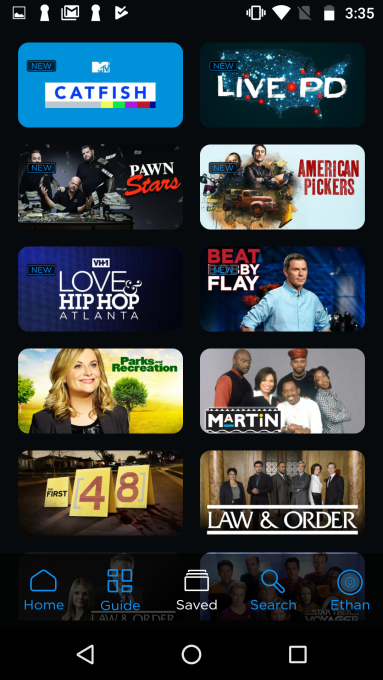
The new Android app will be generally comparable to the iOS experience, though it has a somewhat different layout.  While iOS features navigation buttons for Home, Live, Saved, Search, and Settings, the Android version switches things up a bit. Instead, its navigation features Home, Guide, Saved, Search, and a user profile button.

Android Recommended

It also includes a Recommended section, in addition to the Trending Live and New and Upcoming sections. And instead of row of thumbnails in iOS’s Live, it presents a grid-like TV guide for finding something to watch in Guide. Many of the live TV services have switched over to the grid guide format, having realized that when it comes to finding live content, people still prefer to see things organized by what’s on now in a more standard layout.

Schedule Screenshot

Philo users can choose to either watch TV live or save shows to watch later, on up to three devices. The company recently did away with its multiple tiered pricing to combine packages into a single $20 per month option with 58 channels.

In addition to the Android native app, Philo is also today launching an app for Amazon’s Fire tablets (Fire OS 5 and up).

Android Saved Channels

These new apps join Philo’s existing lineup of apps for web (Chrome, Safari, Edge, and Firefox); TV (Amazon Fire TV, Apple TV, and Roku); and iOS.

The company doesn’t disclose its subscriber numbers, but its app is much further behind its rivals. Today, the iOS version ranks No. 153 on the App Store’s Entertainment category. That’s behind live streaming TV services YouTube TV (No. 22), Sling TV (No. 68) and No. 2 Hulu — although the latter is top-ranked for its more popular on-demand product, not its live TV service.

That said, Philo had been missing out on a reaching huge swath of potential customers until today. Now available cross-platform, it may better appeal to consumers who use multiple devices — as well as those who are budget conscious and own less expensive Android smartphones.

The app is available here on Google Play.


26 Jun 2019

Bright Machines wants to put AI-driven automation in every factory

There’s a mythology around today’s factories that says everything is automated by robotics, and while there is some truth to that, it’s hard to bring that level of sophistication to every facility, especially those producing relatively small runs. Today, Bright Machines, a San Francisco startup announced its first product designed to put intelligence and automation in reach of every manufacturer, regardless of its size.

The startup, which emerged last fall with $179 million in Series A funding, has a mission to make every aspect of manufacturing run in a software-defined automated fashion. Company CEO Amar Hanspal understands it’s a challenging goal, and today’s announcement is about delivering version 1.0 of that vision.

“We have this ambitious idea to fundamentally change the way factories operate, and what we are all about is to get to autonomous programmable factories,” he said. To start on that journey, since getting its initial funding in October, the company has been building a team that includes manufacturing, software and artificial intelligence expertise. It brought in people from Autodesk, Amazon and Google and opened offices in Seattle and Tel Aviv.

The product it is releasing today is called the Software Defined Microfactory and it consists of hardware and software components that work in tandem. “What the Software Defined Microfactory does is package together robotics, computer vision, machine handling and converged systems in a modular way with hardware that you can plug and play, then the software comes in to instruct the factory on what to build and how to build it,” Hanspal explained.

Obviously, this is not an easy thing to do, and it’s taken a great deal of expertise to pull it together over the last months since the funding. It’s also required having testing partners. “We have about 20 product brands around the world and about 25 production lines in seven countries that have been iterating with us toward version one, what we are releasing today,” Hanspal said.

The company is concentrating on the assembly line for starters, especially when building smaller runs like say a specialized computer board or a network appliance where the manufacturer might produce just 50,000 in total, and could benefit from automation, but couldn’t justify the cost before.

“The idea here is going after the least automated part inside of factory, which is the assembly line, which is typically where people have to throw bodies at the problem and assembly lines have been hard to automate. The operations around assembly typically require human dexterity and judgment, trying to align things or plug things in,” Hanspal said.

The hope is to create a series of templates for different kinds of tooling, where they can get the majority of the way there with the software and robotics, and eventually just have to work on the more customized bits. It is an ambitious goal, and it’s not going to be easy to pull off, but today’s release is a first step.

26 Jun 2019

Europe should ban AI for mass surveillance and social credit scoring, says advisory group

An independent expert group tasked with advising the European Commission to inform its regulatory response to artificial intelligence — to underpin EU lawmakers’ stated aim of ensuring AI developments are “human centric” — has published its policy and investment recommendations.

This follows earlier ethics guidelines for “trustworthy AI”, put out by the High Level Expert Group (HLEG) for AI back in April, when the Commission also called for participants to test the draft rules.

The AI HLEG’s full policy recommendations comprise a highly detailed 50-page document — which can be downloaded from this web page. The group, which was set up in June 2018, is made up of a mix of industry AI experts, civic society representatives, political advisers and policy wonks, academics and legal experts.

The document includes warnings on the use of AI for mass surveillance and scoring of EU citizens, such as China’s social credit system, with the group calling for an outright ban on “AI-enabled mass scale scoring of individuals”. It also urges governments to commit to not engage in blanket surveillance of populations for national security purposes. (So perhaps it’s just as well the UK has voted to leave the EU, given the swingeing state surveillance powers it passed into law at the end of 2016.) 

“While there may be a strong temptation for governments to ‘secure society’ by building a pervasive surveillance system based on AI systems, this would be extremely dangerous if pushed to extreme levels,” the HLEG writes. “Governments should commit not to engage in mass surveillance of individuals and to deploy and procure only Trustworthy AI systems, designed to be respectful of the law and fundamental rights, aligned with ethical principles and socio-technically robust.”

The group also calls for commercial surveillance of individuals and societies to be “countered” — suggesting the EU’s response to the potency and potential for misuse of AI technologies should include ensuring that online people-tracking is “strictly in line with fundamental rights such as privacy”, including (the group specifies) when it concerns ‘free’ services (albeit with a slight caveat on the need to consider how business models are impacted).

Last week the UK’s data protection watchdog fired an even more specific shot across the bows of the online behavioral ad industry — warning that adtech’s mass-scale processing of web users’ personal data for targeting ads does not comply with EU privacy standards. The industry was told its rights-infringing practices must change, even if the Information Commissioner’s Office isn’t about to bring down the hammer just yet. But the reform warning was clear.

As EU policymakers work on fashioning a rights-respecting regulatory framework for AI, seeking to steer  the next ten years+ of cutting-edge tech developments in the region, the wider attention and scrutiny that will draw to digital practices and business models looks set to drive a clean up of problematic digital practices that have been able to proliferate under no or very light touch regulation, prior to now.

The HLEG also calls for support for developing mechanisms for the protection of personal data, and for individuals to “control and be empowered by their data” — which they argue would address “some aspects of the requirements of trustworthy AI”.

“Tools should be developed to provide a technological implementation of the GDPR and develop privacy preserving/privacy by design technical methods to explain criteria, causality in personal data processing of AI systems (such as federated machine learning),” they write.

“Support technological development of anonymisation and encryption techniques and develop standards for secure data exchange based on personal data control. Promote the education of the general public in personal data management, including individuals’ awareness of and empowerment in AI personal data-based decision-making processes. Create technology solutions to provide individuals with information and control over how their data is being used, for example for research, on consent management and transparency across European borders, as well as any improvements and outcomes that have come from this, and develop standards for secure data exchange based on personal data control.”

Other policy suggestions among the many included in the HLEG’s report are that AI systems which interact with humans should include a mandatory self-identification. Which would mean no sneaky Google Duplex human-speech mimicking bots. In such a case the bot would have to introduce itself up front — thereby giving the human caller a chance to disengage.

The HLEG also recommends establishing a “European Strategy for Better and Safer AI for Children”. Concern and queasiness about rampant datafication of children, including via commercial tracking of their use of online services, has been raised  in multiple EU member states.

“The integrity and agency of future generations should be ensured by providing Europe’s children with a childhood where they can grow and learn untouched by unsolicited monitoring, profiling and interest invested habitualisation and manipulation,” the group writes. “Children should be ensured a free and unmonitored space of development and upon moving into adulthood should be provided with a “clean slate” of any public or private storage of data related to them. Equally, children’s formal education should be free from commercial and other interests.”

Member states and the Commission should also devise ways to continuously “analyse, measure and score the societal impact of AI”, suggests the HLEG — to keep tabs on positive and negative impacts so that policies can be adapted to take account of shifting effects.

“A variety of indices can be considered to measure and score AI’s societal impact such as the UN Sustainable Development Goals and the Social Scoreboard Indicators of the European Social Pillar. The EU statistical programme of Eurostat, as well as other relevant EU Agencies, should be included in this mechanism to ensure that the information generated is trusted, of high and verifiable quality, sustainable and continuously available,” it suggests. “AI-based solutions can help the monitoring and measuring its societal impact.”

The report is also heavy on pushing for the Commission to bolster investment in AI — calling particularly for more help for startups and SMEs to access funding and advice, including via the InvestEU program.

Another suggestion is the creation of an EU-wide network of AI business incubators to connect academia and industry. “This could be coupled with the creation of EU-wide Open Innovation Labs, which could be built further on the structure of the Digital Innovation Hub network,” it continues. 

There are also calls to encourage public sector uptake of AI, such as by fostering digitalisation by transforming public data into a digital format; providing data literacy education to government agencies; creating European large annotated public non-personal databases for “high quality AI”; and funding and facilitating the development of AI tools that can assist in detecting biases and undue prejudice in governmental decision-making.

Another chunk of the report covers recommendations to try to bolster AI research in Europe — such as strengthening and creating additional Centres of Excellence which address strategic research topics and become “a European level multiplier for a specific AI topic”.

Investment in AI infrastructures, such as distributed clusters and edge computing, large RAM and fast networks, and a network of testing facilities and sandboxes is also urged; along with support for an EU-wide data repository “through common annotation and standardisation” — to work against data siloing, as well as trusted data spaces for specific sectors such as healthcare, automative and agri-food.

The push by the HLEG to accelerate uptake of AI has drawn some criticism, with digital rights group Access Now’s European policy manager, Fanny Hidvegi, writing that: “What we need now is not more AI uptake across all sectors in Europe, but rather clarity on safeguards, red lines, and enforcement mechanisms to ensure that the automated decision making systems — and AI more broadly — developed and deployed in Europe respect human rights.”

Other ideas in the HLEG’s report include developing and implementing a European curriculum for AI; and monitoring and restricting the development of automated lethal weapons — including technologies such as cyber attack tools which are not “actual weapons” but which the group points out “can have lethal consequences if deployed. 

The HLEG further suggests EU policymakers refrain from giving AI systems or robots legal personhood, writing: “We believe this to be fundamentally inconsistent with the principle of human agency, accountability and responsibility, and to pose a significant moral hazard.”

The report can downloaded in full here.