Category: UNCATEGORIZED

26 Jun 2019

Facebook squeezes money from Instagram with new ads in Explore

Half of Instagram’s billion-plus users open its Explore tab each month to find fresh content and creators. Now the Facebook-owned app will due more to carry its weight by injecting ads into Instagram Explore for the first time. But rather than bombard users with marketing right on the Explore grid, Instagram will instead only show ads after users tap into a post and then start scrolling through similar imagery.

The move feels like a respectful way to monetize Explore without annoying users too much or breaking the high visual quality of the space. Instagram’s director of business product marketing Susan Bucker Rose tells me she believes the ads will feel natural becaus users already come to Explore “in the mindset of discovery. They want to be exposed to new accounts, people, and brands.”

Instagram will test the ad slots itself at first to promote its ailing IGTV product before they “launch to a handful of brands over the coming weeks” Rose says. That includes both big name corporations and smaller advertisers looking to drive conversions, video views, or reach. Instagram hopes to roll the ad format out broadly in the next few months.

Advertisers will buy the slots through the same Facebook ads manager and API they use to buy Instagram feed and Stories space. At first advertisers will have to opt in to placing their ads in Instagram Explore too, but eventually that will be the default with an opportunity to opt out.

Here’s how ads work in Instagram Explore. When you open the tab it will look the same as always with a scrollable grid of posts with high engagement that’s personalized based on your interests. When you tap into a photo or video, you’ll first see that full-screen. But if you keep scrolling down, Instagram will show you a contextual feed of content similar to the original post where it will insert photo and video ads. And if you tap into one of the themed video channels and then keep scrolling after watching the clip, you may see Instagram video ads.

Instagram describes the introduction as “slowly and thoughtfully” — which makes it sound like the volume of ads will ramp up over time.

Explore was first launched in 2012, some two years after Instagram itself, as a merger of the app’s search and “popular” tabs, with an aim of using algorithms that were informed by your existing interests to give you a new way to discover new people and themes to follow in the app beyond those you might pick up by way of you own social circles. It’s had a few revamps, such as the addition of topical channels and hashtags, and the addition of Stories, the format that has proven to be such a hit on Instagram itself. There won’t be any ads in Stories that recently started appearing in Explore.

But interestingly, through all of that, Instagram appeared to stay hands-off when it came to advertising and Explore. The idea is that the content that each person sees in Explore is individualised, with algorithms detecting the kinds of things you like to show you photos, videos and subjects you might most want to see.

On the other side of the coin, this has meant that up to now, individuals and brands have not been able to proactively request or pay to be in anyone’s specific Explore tab — although that doesn’t mean that people don’t game this situation (just Google “how to get on Instagram Explore” and you will find many how-to’s to show you the way).

Today’s addition of advertising to appear after you click on an Explore link seems to be a nudge away from that algorithm, offering brands a way of using advertising to connect with you even if you might not be part of its natural Explore audience.

The move to bring ads into the Explore experience has some logic to it. Even before monetization made its way to Instagram in the form of feed advertising, shoppable links and sponsored content posted by influencers, brands and businesses had started using the platform to promote products and to connect with customers. Instagram says that today, 80 percent of its users follow at least one business on Instagram.

At the same time, brands have — as we mentioned above — been gaming the system somewhat to make sure they get seen on Explore: Instagram says Explore is used by over 50% of accounts each month to enhance their Insta experience, so it is a key way for a brand to get discovered — and notably more organic than paid advertising.

Instagram is rolling extra features into the mix to extend their sales cycle with advertisers. It says they can add in automatic placements by opting in to reach further audiences.

For those who are not yet seeing this in their own Explore feeds, here’s a short video running through how it will look:

Instagram Explore Ads

26 Jun 2019

HER, the dating app for queer women, revamps profiles

HER, the app that provides safe space for queer women to meet, has today revamped the app’s profiles.

The updated profiles allow users to express themselves more fully in the categories of gender, sexuality, pronouns, diet preferences, star signs, drinking, smoking and cannabis habits, among others. HER has also added space for a text bio, which is very common on other dating apps but wasn’t a part of Her .

“It was interesting to reflect on how people have changed,” said founder and CEO Robyn Exton, in reference to text profiles. “People used to worry about writing a bio but now they really want more ways to express themselves, and they want to see other people’s writing skills when they’re browsing profiles.”

There is a downside to text profiles, which the Grindr community is all too familiar with, in that it allows users to also express their discrimination against certain people or groups. That said, HER’s first commitment is to provide safe space to queer women and has thusly built out reporting tools to weed out bad actors.

Perhaps more importantly, HER is providing a ‘What does this mean’ field across the categories of Sexuality, Gender and Pronouns, to help users understand each other more authentically.

Here’s what Exton had to say in a prepared release:

Profiles are a critical space to tell people who we are yet mostly end up becoming a bland wash where everyone sounds the same. Few social apps have invested any time in trying to truly understand and support the expression of queer identity – a limited number of sexualities and genders just doesn’t cut it. By enforcing these limitations, companies are denying LGBTQ+ people the opportunity to truly be ourselves. To express all of our identity, all the tiny, intersecting facets of what makes us, us.

[gallery ids="1849081,1849079,1849080"]

HER launched four years ago, rebranded from Daatch, with the intent to give queer women a space to safely and freely express themselves and meet each other. The profiles on the app have always been slightly more expressive than those of other dating apps, allowing users to post multiple pictures, interests etc., all of which were ‘likeable’ by other users.

The new profiles have refined the options available to users and have implemented multiple select so that no user ever gets put in a box.

Like most dating apps, HER operates with a freemium model, offering premium features to subscribers who pay $15USD/month. The company also makes money off of its events business, which operates in fifteen cities across the U.S.

HER has 4.5 million registered users, and has raised $2.5 million in funding. Exton says that HER has been profitable for several years.

Happy Pride!

26 Jun 2019

MIT AI tool can predict breast cancer up to 5 years early, works equally well for white and black patients

MIT’s Computer Science and Artificial Intelligence Lab has developed a new deep learning-based AI prediction model that can anticipate the development of breast cancer up to five years in advance. Researchers working on the product also recognized that other similar projects have often had inherent bias because they were based overwhelmingly on white patient populations, and specifically designed their own model so that it is informed by “more equitable” data that ensures it’s “equally accurate for white and black women.”

That’s key, MIT notes in a blog post, because black women are more than 42 percent more likely than white women to die from breast cancer, and one contributing factor could be that they aren’t as well-served by current early detection techniques. MIT says that its work in developing this technique was aimed specifically at making the assessment of health risks of this nature more accurate for minorities, who are often not well represented in development of deep learning models. The issue of algorithmic bias is a focus of a lot of industry research and even newer products forthcoming from technology companies working on deploying AI in the field.

This MIT tool, which is trained on mammograms and patient outcomes (eventual development of cancer being the key one) from over 60,000 patients (with over 90,000 mammograms total) from the Massachusetts General Hospital, starts from the data and uses deep learning to identify patters that would not be apparent or even observable by human clinicians. Because it’s not based on existing assumptions or received knowledge about risk factors, which are at best a suggestive framework, the results have so far shown to be far more accurate, especially at predictive, pre-diagnosis discovery.

Overall, the project is intended to help healthcare professionals put together the right screening program for individuals in their care and eliminate the heartbreaking and all-too common outcome of late diagnosis. MIT hopes the technique can also be used to improve detection of other diseases that have similar problems with existing risk models with far too many gaps and lower degrees of accuracy.

26 Jun 2019

Songtrust adds another 55,000 artists to its rights management service

Over the past year, Songtrust has added another 55,000 artists to its rights management service.

The company, a subsidiary of Downtown Music Publishing, a publishing and rights management firm that manages rights for artists such as John Lennon, One Direction and Santigold, now has 205,000 artists on its roster and has 2 million songs it tracks.

The company has also opened three offices in Atlanta, Los Angeles, and Nashville to complement existing locations in New York, London and Amsterdam.

The company’s growth follows that of a music industry that continues to enjoy a renaissance (at least in terms of dollars spent).

The global recorded music market grew 9.7% in 2018 to $19.1 billion, according to data from the International Federation of the Phonographic Industry (which has been tracking the industry since the days when the dominant technology was the record player).

Much of that growth is now coming from streaming, the IFPI reports, with streaming revenues growing 34% year over year and accounting for 47% of total revenue thanks to paid subscription services. There were 255 million users of paid services by the end of 2018 — and Songtrust can attribute much of its growth to the opacity in how that money makes its way back to artists.

Increasingly, those artists are having to track their performance in international markets as well. Latin America continues to be the fastest gorwing region for music consumption, followed by Asia and Australasia. Most of that growth is due to K-Pop, since South Korea accounts for 17.9% growth in money spent alone.

All of this movement shows no sign of abating, according to the bankers that track these kinds of things. Goldman Sachs recently projected that the industry could grow to over $130 billion in revenue over the next decade.


26 Jun 2019

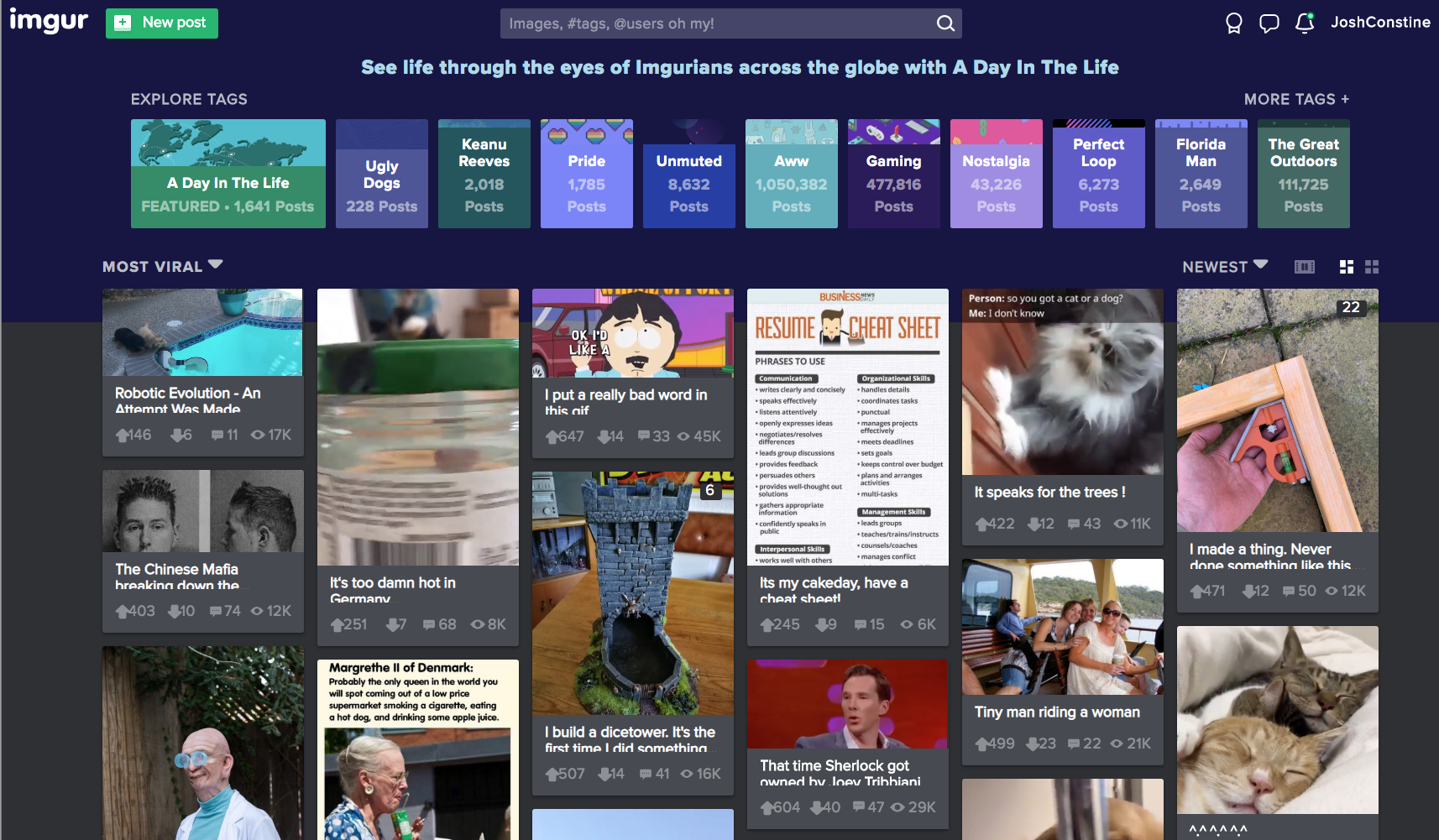
300M-user meme site Imgur raises $20M from Coil to pay creators

Meme creators have never gotten their fair share. Remixed and reshared across the web, their jokes props up social networks like Instagram and Twitter that pay back none of their ad revenue to artists and comedians. But 300 million monthly user meme and storytelling app Imgur wants to pioneer a way to pay creators per second that people view their content.

Today Imgur announces that it’s raised a $20 million venture equity round from Coil, a micropayment tool for creators that Imgur has agreed to build into its service. Imgur will eventually launch a premium membership with exclusive features and content reserved for Coil subscribers. Users pay Coil a fixed monthly fee, install its browser extension, the Ripple XRP cryptocurrency is used to route assets around, and then Coil pays creators per second that the subscriber spends consuming their content at a rate of 36 cents per hour. Imgur and Coil will earn a cut too, diversifying the meme network’s revenue beyond ads.

Imgur

“Imgur began in 2009 as a gift to the internet. Over the last 10 years we’ve built one of the largest, most positive online communities, based on our core value to ‘give more than we take’” says Alan Schaaf, founder and CEO of Imgur. The startup bootstrapped for its first five years before raising a $40 million Series A from Andreessen Horowitz and Reddit. It’s grown into the premier place to browse ‘meme dumps’ of 50+ funny images and GIFs, as well as art, science, and inspirational tales.

While the new round brings in fewer dollars, Schaaf explains that Imgur raised at a valuation that’s “higher than last time. Our investors are happy with the valuation. This is a really exciting strategic partnership.” Coil founder and CEO Stefan Thomas who was formerly the CTO of cryptocurrency company Ripple Labs will join Imgur’s board. Coil received the money it’s investing in Imgur from Ripple Labs’ Xpring Initiative, which aims to fund proliferation of the Ripple XRP ecosystem, though Imgur received US dollars in the funding deal.

Thomas tells me that “There’s no built in business model” as part of the web. Publishers and platforms “either make money with ads or with subscriptions. The problem is that only works when you have huge scale” that can bring along societal problems as we’ve seen with Facebook. Coil will “hopefully offer a third potential business model for the internet and offer a way for creators to get paid.”

Coil Micropayments

Founded last year, Coil’s $5 per month subscription is now in open beta, and it provides extensions for Chrome and Firefox as it tries to get baked into browsers natively. Unlike Patreon where you pick a few creators and choose how much to pay each every month, Coil lets you browse content from as many creators as you want and it pays them appropriately. Sites like Imgur can code in tags to their pages that tell Coil’s Web Monetization API who to send money to.

The challenge for Imgur will be avoiding the cannibalization of its existing content to the detriment of its non-paying users who’ve always known it to be free. “We’re in the business of making the internet better. We do not plan on taking anything away for the community” Schaaf insists. That means it will have to recruit new creators and add bonus features that are reserved for Coil subscribers without making the rest of its 300 million users feel deprived.

It’s surprising thT meme culture hasn’t spawned more dedicated apps. Decade-old Imgur precedes the explosion in popularity of bite-sized internet content. But rather than just host memes like Instagram, Imgur has built its own meme creation tools. If Imgur and Coil can prove users are willing to pay for quick hits of entertainment and creators can be fairly compensated, they could inspire more apps to help content makers turn their passion into a profession…or at least a nice side hustle.

26 Jun 2019

Apple News launches a guide to the 2020 Democratic candidates and debates

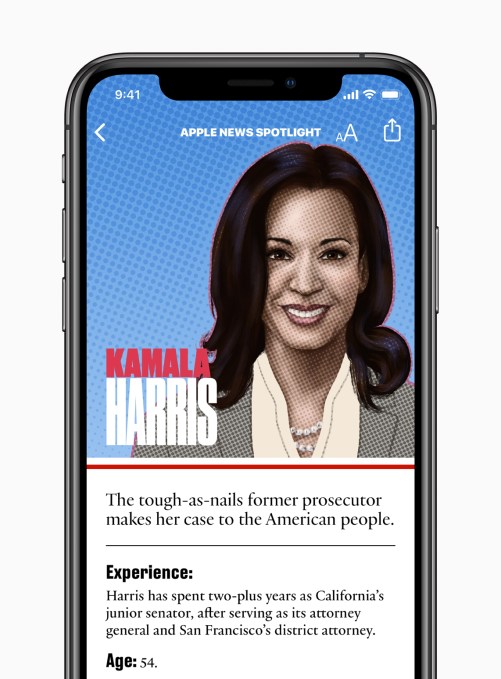
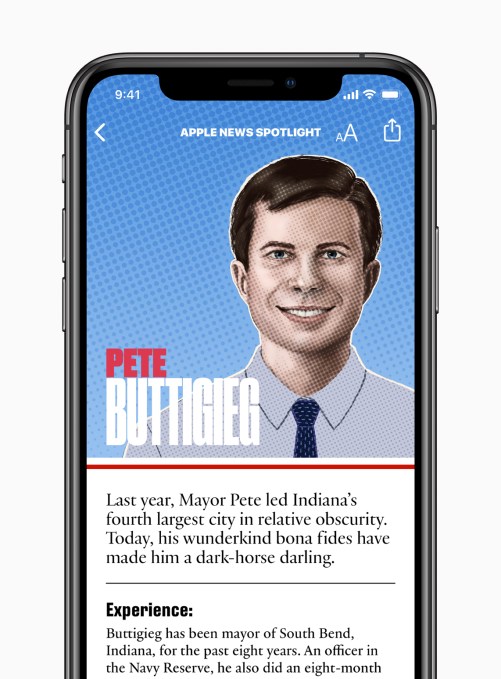
Apple today is introducing a new section in its Apple News application for iOS, iPad and Mac that’s designed to familiarize voters with the 20 U.S. Democratic presidential candidates ahead of the first Democratic debates hosted on June 26 and June 27 by NBC News, MSNBC, and Telemundo in Miami, Florida. The new guide is meant to provide a single place where readers can learn about a candidate’s biography, experience, and current position on key issues, among other things.

It will also feature photos and videos, along with recent coverage from trusted news sources.

Apple says that it will leverage a diverse set of news sources to provide this information, including ABC News, Axios, CNN, Fox News, NBC News, Politico, The Hill, The New York Times, The Wall Street Journal, The Washington Post, TIME, USA Today, Vox and others.

The candidate information is curated and organized by Apple’s team of News editors, and will be found in the Top Stories section of its Apple News app.

Apple News candidate guide Elizabeth Warren 062619

As the debates begin, the section will expand from being only a guide to candidates to being a hub for updates from the debates, too. It will then include articles and video highlights from NBC News, as well as fact-checking, reactions, and key onstage moments and takeaways, says Apple in an announcement about the new feature.

The hub will continue to be updated after the debates, as well, with more news throughout the campaign.

In addition, users can personalize their experience by tracking their favorite candidates in Apple News. To do so, they’ll just click the “follow” button for the candidate in the app, then will receive any breaking news around that candidate as well as see ongoing news coverage about the candidate appear in their Apple News Today feed and elsewhere within the News app.

This isn’t the first time Apple has involved itself in helping curate and organize election-related information. Most recently, it launched a real-time news hub for the 2018 Midterms.

Apple News candidate guide Kamala Harris 062619

The company has taken the opposite approach from Facebook when it comes to providing easy access to news and information to its users. Facebook fired its news editors then turned its “trends” section over to an algorithm, before giving up and killing it altogether. But Apple has instead hired an editorial team of former journalists to organize and curate the news that tens of millions of people read. The News team doesn’t write its own stories, but plays a large role in selecting the stories that people first see when they open the app.

The result is an easy-to-use app designed with Apple’s aesthetic, where journalism gets top billing — not clickbait, viral news, and intentional sources of disinformation.

“The 2020 Democratic field is complex, and we want to offer Apple News readers a trusted place to learn more about candidates they’re familiar with and those they may be hearing about for the first time,” said Lauren Kern, editor-in-chief of Apple News. “The candidate guide in Apple News is a robust and reliable resource, connecting readers to valuable at-a-glance information and to great journalism from our partners.”

Apple News candidate guide Pete Buttigieg 062619

26 Jun 2019

NSA improperly collected Americans’ phone records for a second time, documents reveal

Newly released documents reveal the National Security Agency improperly collected Americans’ call records for a second time, just months after the agency was forced to purge hundreds of millions of collected calls and text records it unlawfully obtained.

The document, obtained by the American Civil Liberties Union, shows the NSA had collected a “larger than expected” number of call detail records from one of the U.S. phone providers, though the redacted document did not reveal which provider nor how many records were improperly collected.

The document said the erroneously collected call detail records were “not authorized” by the orders issued by the Foreign Intelligence Surveillance Court, which authorizes and oversees the U.S. government’s surveillance activities.

Greg Julian, a spokesperson for the NSA, confirmed the report in an email to TechCrunch, saying the agency “identified additional data integrity and compliance concerns caused by the unique complexities of using company-generated business records for intelligence purposes.”

NSA said the issues were “addressed and reported” to the agency’s overseers, but did not comment further on the violations as they involve operational matters.

The ACLU called on lawmakers to investigate the improper collection and to shut down the program altogether.

“These documents further confirm that this surveillance program is beyond redemption and a privacy and civil liberties disaster,” said Patrick Toomey, a staff attorney with the ACLU’s National Security Project. “The NSA’s collection of Americans’ call records is too sweeping, the compliance problems too many, and evidence of the program’s value all but nonexistent.”

“There is no justification for leaving this surveillance power in the NSA’s hands,” he said.

Under the government’s so-called Section 215 powers, the NSA collects millions of phone records every year by compelling U.S. phone giants to turn over daily records, a classified program first revealed in a secret court order compelling Verizon — which owns TechCrunch — from documents leaked by whistleblower Edward Snowden. Those call records include the phone numbers of those communicating and when — though not the contents — which the agency uses to make connections between targets of interest.

But the government was forced to curtail the phone records collection program in 2015 following the introduction of the Freedom Act, the only law passed by Congress since the Snowden revelations which successfully reined in what critics said was the NSA’s vast surveillance powers.

In recent years, the number of call records has gone down but not gone away completely. In its last transparency report, the government said it collected 434 million phone records, down 18% on the year earlier.

But the government came under fire in June 2018 after it emerged the NSA had unlawfully collected 600 million call and text logs without the proper authority. The agency said “technical irregularities” meant it received call detail records it “was not authorized to receive.”

The agency deleted the entire batch of improperly collected records from its systems.

Following the incidents, the NSA reportedly shut down the phone records collection program citing overly burdensome legal requirements imposed on the agency. In January, the agency’s spokesperson said the NSA was “carefully evaluating all aspects” of the program and its future, amid rumors that the agency would not ask Congress to reauthorized its expiring Section 215 powers, set to expire later this year.

In an email Wednesday, the NSA spokesperson didn’t comment on the future of the program, saying only that it was “a deliberative interagency process that will be decided by the Administration.”

The government’s Section 215 powers are expected to be debated by Congress in the coming months.

26 Jun 2019

Lifestyle goods resale marketplace StockX raises $110M, pushing valuation past $1B

Detroit-based StockX, which provides a way for people to resell luxury and lifestyle goods including streetwear, bags, watches and shoes, is now valued at over $1 billion based on its most recent raise of $110 million, just revealed by the New York Times. Alongside the raise, StockX is bringing on a new CEO – ecommerce vet and former eBay SVP Scott Cutler.

Cutler replaces co-founder Josh Luber at the helm of the company, but he’ll continue to be the “public face” of the company according to the NYT, which is not unusual for a founder-led company when it brings on more traditionally experienced executives to steer the startup through periods of aggressive growth and business maturation.

StockX’s success rode the sneaker culture boom of the past half-decade or so, as the startup first focused exclusively on acting as a resale source for shoes with high levels of hype. Their unique value prop, for consumers, was offering a verification service so that you knew when you were buying (often at a premium, and often so-called ‘deadstock’ or stuff that’s new in condition but not available through typical consumer sales channels) was the real deal.

The company expanded from there into new categories, first with watches, then handbags, and most recently streetwear – all categories where high potential for fraud mean that consumers are willing to pay more for some assurance of authenticity.

Also unique to StockX is its treatment of the marketplace as analogous to a public stock exchange, with shoe releases, watch, bag and clothing SKUs replacing companies as the trade commodity. The app for StockX displays charts trending value and features bids and calls, making it similar in concept to another company where new CEO Cutler has experience – the NYSE.

With this funding, the company will focus on growing its international business and also do more with selling new products, which it has done on occasion for select releases, but which hasn’t been a primary focus of its business to date.

26 Jun 2019

Vulcan Cyber announces $10M Series A to automate security patching efforts

Many software vulnerabilities are already known, and vendors have even issued patches, but the problem is there are so many patches that it’s often difficult for companies to keep up. Vulcan Cyber wants to help by bringing a level of automation to the patching operation, and in the process reduce exposure to known risks.

Today, it announced a $10 million Series A round from Ten Eleven Ventures and YL Ventures .

In a typical scenario, security researchers find vulnerabilities, the vendors disclose them and patch them. From there it’s up to individual companies to take care of downloading and installing the patch, but Vulcan Cyber co-founder and CEO Yaniv Bar-Dayan says the number of patches has been growing at a furious pace with 6000 patches in 2016, 16,000 in 2017 and 18,000 last year. And that growth trajectory is continuing this year, he says.

Vulcan’s ultimate mission is to help companies remediate security vulnerabilities from their infrastructure. They do this by bringing a level of automation to the process, recognizing that humans can’t keep up with these numbers. “We automate the process of prioritization and deployment to remediate more vulnerabilities faster,” Bar-Dayan explained. What’s more, he said that Vulcan does this without risking business operations, while reducing risk and costs.

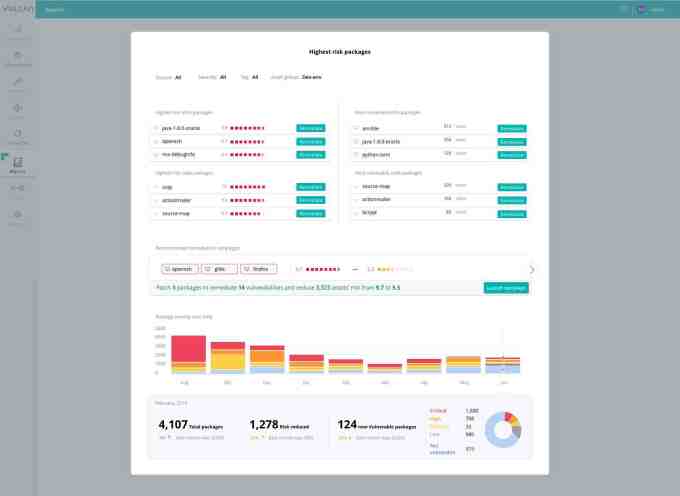
Highest risk packages

Vulcan Cyber risk prioritization view. Screenshot: Vulcan Cyber

The company raised a $4 million seed round last year, bringing the total raised to $14 million so far. As TechCrunch’s Frederic Lardinois pointed out while writing about that seed round, it’s able to achieve this level of automation, while working with the tools developers and security teams typically work with anyway.

“Vulcan Cyber plays nicely with all of the major cloud platforms, as well as tools like Puppet, Chef and Ansible, as well as GitHub and Bitbucket. It also integrates with a number of major security testing tools and vulnerability scanners, including Black Duck, Nessus, Fortify, Tripwire, Checkmarx, Rapid7 and Veracode,” Lardinois wrote.

The company was founded last year and has 25 employees. It plans to continue building its engineering team in Israel with the money from this round, as well as opening an office in San Francisco for sales, marketing and customer success.

26 Jun 2019

Scribd introduces bite-sized nonfiction previews called Snapshots

Subscription e-book and audiobook service Scribd is unveiling a new content type that it calls a Snapshot — a distillation of a nonfiction book’s key points, which can be read or listened to in 15 minutes or less.

In fact, although it’s only announcing Snapshots today, Scribd says it’s already created around 500 of them, for example, this preview of Jaron Lanier’s audiobook “Ten Arguments for Deleting Your Social Media Accounts Right Now” and this Snapshot of Mark Hanson’s “The Subtle Art of Not Giving A Fuck.”

CEO Trip Adler said a Snapshot is meant to capture “the key insights, the key themes, the tone, the structure of the book.”

As Scribd creates more Snapshots, subscribers will see them show up alongside the books themselves, in both text and audio formats.

And while it’s easy to think of this as a CliffsNotes version that allows you to skip the book itself, Adler said it’s actually designed to do the opposite, namely to help readers “make a better decision” about whether to read the whole thing. In other words, you should get a clear sense of what an author is trying to say, but you’ll have to turn to the book itself if you want the full argument.

In fact, Adler said the idea for Snapshots emerged from a Scribd surveyed of its users about what would make them more likely to read a book.

He also emphasized that Snapshots are “completely original content” created by Scribd’s freelance team — original in the sense that even though they’re citing ideas from the books, they’re not quoting them directly. This puts it in line with Scribd’s original content initiative launched earlier this year, and it’s also an important distinction since the company isn’t striking new deals with publishers or authors to create these previews.