Category: UNCATEGORIZED

26 Jun 2019

Web3 platform 3Box raises seed to bring back control of user data

Few debates in technology have been as intense over the past few years as the debate over privacy. As companies like Facebook and Google have swelled with all the minutia of our daily lives — our likes, our searches, our calendar invites — there is increasing awareness of the risks to our privacy as these large data guzzlers suck up our digital selves.

Worse, these companies have used their incumbent network effects to increasingly be the identity layer of the web. From Login with Facebook to being the repository of our data that we shuttle from service to service, it’s increasingly clear that a handful of companies have centralized our data into their own profitable silos.

3Box wants to undo that trend toward identity centralization. Building upon and extending the concepts of the Web3 movement, 3Box offers a decentralized identity cloud storage layer that allows developers to save identity information outside of the big tech stacks.

The company announced today that it has raised a $2.5 million seed round led by Brad Burnham through Placeholder Ventures, where he is a venture partner. Brunham is also a partner at Union Square Ventures, where he invested in developer-focused companies like StackOverflow and Cloudflare. Burnham will join 3Box’s board of directors.

3Box was founded by a trio of alums from ConsenSys, the Ethereum-focused decentralized blob of an accelerator/VC/incubator based in Brooklyn that rode the blockchain wave in 2017 and 2018 only to scale back its ambitions with the decline in asset prices. CEO Michael Sena and COO Danny Zuckerman worked together at ConsenSys company uPort, which was also focused on identity, and they are joined by ConsenSys engineer Joel Thorstensson as CTO.

“We were always interested in the smart identity space … aggregating all of your data and all of your stuff and having agency over that data,” Sena explained. After co-founding uPort though, he increasingly saw an opportunity in distributed databases rather than the mobile application-focused product that uPort was building.

A distributed database is critical for decentralized apps (dApps) to be able to store identity information. “The angle in the Web3 ecosystem that we are seeing, these developers want to write apps with limited backends,” Sena said. “And now they have a distributed place for user data.”

What exactly is identity data though? It “can be anything,” Zuckerman said. “We take the approach of being unopinionated about what kind of data is stored in there.” He added that it “can include data about yourself, browsing data, transaction history, photos.” Ultimately, “identity is the abstraction or emergence of all of that data.”

While there is obviously a privacy and political angle to 3Box’s technology as with many blockchain projects, Sena and Zuckerman see a much more pragmatic reason to use their platform. “It reduces the burden of on-boarding” a new user, Zuckerman said. “Not only can you pull in your profile information, but your other data can also be pulled.” Sena added that “3Box allows you to write a new minimally-viable dApp … our value proposition works best for dApps because they want to avoid the backend.”

While identity layers like 3Box are certainly offered by the big tech giants, other startups have made a play for the space as well. “We’re somewhere between Gravatar and Firebase,” Sena said. “We’re less about owning that [login] button, but enabling the quick on-boarding” of new users.

Developers looking to use 3Box download the company’s JavaScript API library and integrate it into their app. Today, the company offers three API primitives: Profiles (for information like handles and profile photos), Messaging (for communicating between users), and Storage (for app-specific storage).

Right now, 3Box is built around the Ethereum ecosystem. Zuckerman foresees expanding that to other ecosystems as they scale, and the company has also published a roadmap for the rest of 2019 of the new features and themes it intends to focus on.

3Box is co-headquartered in New York City, where Sena and Zuckerman call home, and Berlin, where Thorstensson has his base. With its funding, 3Box intends to build out its team in both locations.

In addition to Placeholder, the round was joined by David Pakman at Venrock, Wendy Xiao Schadeck at Northzone, and Jake Brukhman at CoinFund. The company was funded through ConsenSys’ venture studio, and ConsenSys Global Lead of Media Mike Kriak also sits on the company’s board.


26 Jun 2019

Splyt wants to connect the world’s ride-hailing apps for easy international roaming

The vision of a universal global ride-hailing service is over. Uber’s decision to exit markets like China, Southeast Asia and Russia coupled with the failure of its rivals to develop a proposed roaming system, means that global travelers must install multiple apps if they are to take advantage of on-demand taxis. That’s unless a little-known startup can turn a bold plan into reality.

In the world of ride-hailing and its billion-dollar investment checks, an $8 million capital raise may not be a big deal but it does represent a coming-out for Splyt, a UK-based startup that is aiming to help make global ride-hailing roaming a reality — and not just within ride-hailing apps.

The four-year-old company announced this week that it closed an $8 million Series A round from a range of undisclosed (and existing) family offices and angel investors. In addition, the round included participation from Southeast Asian ride-hailing company Grab, the firm valued at $14 billion which acquired Uber’s regional business last year.

The deal will see Grab become a Splyt partner and it comes hot-on-the-heels of a similar rollout with Alipay, the digital wallet app run by Alibaba affiliate Ant Financial.

In both cases, Splyt is hooking Alipay and Grab up to its ride-hailing networks to allow users to book (and take) a taxi from another provider within the Alipay or Grab app.

Splyt allows users of Alipay to book taxis on the Grab network in Southeast Asia without downloading Grab’s app

The integration is already live within Alipay for Southeast Asia — Grab is scheduled to work overseas from early 2020 — and it means that users can book and manage rides directly from the payment app thanks to Splyt’s system. In other words, Alipay users can take rides through Grab without having to download the Grab app.

Splyt is not visible to the consumer’s eye. Instead, it lurks behind the scenes acting as the interconnecting services. In that respect, it is much like digital banking services that provide the infrastructure that enables banks to offer digital services. In Splyt’s case, it provides connections for ride-hailing services outside of their markets, but beyond them it allows other apps to access ride-hailing booking features, too.

Relationships are the key part of this offering, beyond Grab and Alipay, Splyt has partnerships with Chinese travel app Ctrip, Careem — the Middle East-based service being acquired by Uber — Gett and car rental service Cartrawler, which added ride-hailing via the tie-up.

“There’s a long way to go to get comfortable with where we are and how close we are to our vision,” Splyt CEO Philipp Mintchin said, admitting that the goal is for all major ride-hailing firms to join.

That said, the existing partner base already gives Splyt reach into some 2,000 cities. The deal with Grab, in particular, will help allow Alipay and Ctrip — two popular services — to open up ride-hailing in Southeast Asia, a region that is an increasingly popular travel destination for Chinese tourists.

Indeed, such is the focus on Asia at this point that Splyt has opened an office in Singapore. Mintchin told TechCrunch that he expects headcount in Singapore will reach 15 this year, mostly on the tech side, while overall the company is predicted to grow to 50 people by the end of this year.

“Most of our business and partners are based out of Asia,” he added of the new office.

Splyt Team

The Splyt Team at the company’s office in London

While connecting ride-hailing services and popular apps makes absolute sense for consumers who can enjoy the convenience of roaming, navigating and securing partnerships is not straightforward in today’s ride-hailing world. Aside from a network of complicated relationships — Uber and Didi, in particular, are investors in many competing services and each other — many companies are also developing new features behind simply taxis.

Mintchin declined to discuss potential deals but he did tease that Splyt is working to onboard a number of new partners this year.

“In this industry, everyone is talking to everyone,” he said of the partnership push.

Mintchin admitted that the “politics of the ride-hailing industry” mean that some companies refuse to work with others — no names named, alas — and others prefer to work with specific firms, too. Then there’s also an element of trust involved with giving a third party access to a service which ends up being used by yet another third party.

“We are here to partner and benefit each other rather than to try to steal a fleet and run our own app,” he said of Splyt’s neutral position and its role as the behind-the-scenes integrator. “We are not all of a sudden going to influence the partners we work with… the partners make decisions.”

It’s a patient game, but already Splyt is seeing growth double on a weekly basis since May. In some areas, Mintchin said that the service is seeing a 90 percent repeat use through its partners. Going forward, he added, the Series A funding will go towards closing those supply gaps to make the service more usable in more locations.

It’s an audacious vision but, given the balkanization of the industry in recent years, it remains the best hope that travelers have of delivering on the vision of using their favorite ride-hailing app anywhere in the world.

26 Jun 2019

EU opens formal antitrust probe of Broadcom and seeks interim order

The European Commission has opened a formal investigation into US chipmaker Broadcom which it suspects of restricting competition via a number of exclusivity practices in markets where it holds a leading position such as for systems-on-a-chip, front-end chips and wifi chipsets.

Earlier this year press reports suggested US authorities are broadening their own antitrust probe of the company.

The FTC opened its investigation into Broadcom back in January 2018.

Commenting in a press release announcing the antitrust action against the chipmaker, the EU’s antitrust chief Margrethe Vestager said: “TV set-top boxes and modems are part of our daily lives, for both work and for leisure. We suspect that Broadcom, a major supplier of components for these devices, has put in place contractual restrictions to exclude its competitors from the market. This would prevent Broadcom’s customers and, ultimately, final consumers from reaping the benefits of choice and innovation. We also intend to order Broadcom to halt its behaviour while our investigation proceeds, to avoid any risk of serious and irreparable harm to competition.

The Commission has issued a formal statement of objections in which it sets out its preliminary conclusions and explains its reasons for seeking interim measures, saying (emphasis its) it believes that:

  • Broadcom is likely to hold a dominant position in various markets for the supply of systems-on-a-chip for TV set-top boxes and modems
  • certain agreements between Broadcom and seven of its main customers manufacturing TV set-top boxes and modems contain exclusivity provisions that may result in those customers purchasing systems-on-a-chip, front-end chips and WiFi chipsets exclusively or almost exclusively from Broadcom
  • the provisions contained in these agreements may affect competition and stifle innovation in these markets, to the detriment of consumers

The formal investigation could take several years to conclude and the Commission notes that the outcome is not prejudiced by preliminary findings nor any interim measures.

“The Commission has gathered information indicating that Broadcom may be implementing a range of exclusionary practices in relation to these products,” it writes. “These practices may include (i) setting exclusive purchasing obligations, (ii) granting rebates or other advantages conditioned on exclusivity or minimum purchase requirements, (iii) product bundling, (iv) abusive IP-related strategies and (v) deliberately degrading interoperability between Broadcom products and other products.

“As a result of concerns relating to these alleged practices by Broadcom, the Commission has decided to open a formal investigation.”

The Commission says it wants to impose interim measures to prevent the suspected anti-competitive behaviour from damaging the market “irreparably” — i.e. before a regulatory intervention could issue a corrective sanction, assuming it ends up deciding such action is necessary after the investigation has run its course.

Its assessment of the case found that the alleged competition concerns to be “of a serious nature and that Broadcom’s conduct may result in the elimination or marginalisation of competitors before the end of proceedings” — allowing it to meet the threshold for ordering interim measures under EU law.

The Commission says it has informed the chipmaker and the competition authorities of EU Member States that it has opened proceedings and of its intention to impose interim measures.

It’s not clear at this stage when such interim measures could be applied — with anything from several weeks to many months being possible.

Broadcom could also seek to appeal against them.

We’ve reached out to the company for comment. 

In recent years the semiconductor supplier has walked away from a proposed hostile takeover of mobile chipmaker Qualcomm after it was blocked by the Trump administration. It went on to shell out $18.9BN in cash to pick up IT management software and solutions provider, CA Technologies — in what looked like a bid to diversify its offerings.

26 Jun 2019

India’s Unacademy raises $50 million to grow its online learning platform

Big money continues to flow in India’s growing education market. Bangalore-based Unacademy, which operates an online learning platform to help millions prepare for competitive exams in India, has raised $50 million to further scale its reach.

The Series B financing round was led by Steadview Capital, Sequoia India, Nexus Venture Partners and Blume Ventures, with Unacademy’s own co-founders Gaurav Munjal and Roman Saini also participating in it. The new round means the startup has raised close to $90 million to date.

The four-year-old startup is aimed at students who are preparing for competitive exams to get into a college and those who are pursuing graduation level courses. Unacademy allows students to watch live classes from educators and then engage with the team in any questions they may have. It has 10,000 registered educators and 13 million learners — up from 3 million a year ago.

The startup said it will use the new fund to expand the number of educators it has on the platform, and also add more exam courses. It will also improve its product and expand the team.

Unacademy began its journey as a YouTube channel, but has since expanded to its own app where it offers some courses for free and others through a recently launched subscription business. The subscription service — called Unacademy Plus Subscription — has 50,000 users.

Unacademy also maintains an archive of all the classes, giving students the option to reference to older lectures at any time through the app. The startup says YouTube is still its largest distribution channel. Overall, the platform sees more than 100 million monthly views across the platforms.

“We are seeing unprecedented growth and engagement from learners in smaller towns and cities, and are also very humbled to see that top-quality educators are choosing Unacademy as their primary platform to reach out to students. In the last few months, we have taken bigger strides toward achieving this mission. We have more than 400 top educators from across the country taking live classes every day on Unacademy Plus. This is available to every student, irrespective of their location,” Gaurav Munjal, a founder and CEO of Unacademy said in a statement.

Unacademy competes with unicorn Byju’s, which is widely believed to be the biggest edtech startup in the world with its valuation nearing $4 billion. Unlike Unacademy, Byju’s, which has more than 2.4 million paid subscribers, covers primary school and high school courses as well in addition to competitive under graduation level courses.

In recent months, Unacademy has grown more aggressive with marketing. Last year it tied up with web producing house The Viral Fever to fund a show called “Kota Factory”, which revolves around the lives of students who are preparing to go to an engineering college. In the midst of it, Unacademy also offered low-cost, discounted subscription plans to attract users to its subscription platform.

Unacademy has presence in Indonesia as well, where as of last year, it had about 30 educators. The startup did not offer an update on how its international ambitions are holding up. A representative of Unacademy told TechCrunch recently that the platform does not rely on ads for monetization.

26 Jun 2019

UK law review eyes abusive trends like deepfaked porn and cyber flashing

The UK government has announced the next phase of a review of the law around the making and sharing of non-consensual intimate images, with ministers saying they want to ensure it keeps pace with evolving digital tech trends.

The review is being initiated in response to concerns that abusive and offensive communications are on the rise, as a result of it becoming easier to create and distribute sexual images of people online without their permission.

Among the issues the Law Commission will consider are so-called ‘revenge porn’, where intimate images of a person are shared without their consent; deepfaked porn, which refers to superimposing a real photograph of a person’s face onto a pornographic image or video without their consent; and cyber flashing, the unpleasant practice of sending unsolicited sexual images to a person’s phone by exploiting technologies such as Bluetooth that allow for proximity-based file sharing.

On the latter practice, the screengrab below is of one of two unsolicited messages I received as pop-ups on my phone in the space of a few seconds while waiting at a UK airport gate — and before I’d had a chance to locate the iOS master setting that actually nixes Bluetooth.

On iOS, even without accepting the AirDrop the cyberflasher is still able to send an unsolicited placeholder image with their request.

Safe to say, this example is at the tamer end of what tends to be involved. More often it’s actual dick pics fired at people’s phones, not a parrot-friendly silicone substitute…

cyber flashing

A patchwork of UK laws already covers at least some of the offensive and abusive communications in question, such as the offence of voyeurism under the Sexual Offences Act 2003, which criminalises certain non-consensual photography taken for sexual gratification — and carries a two-year maximum prison sentence (with the possibility that a perpetrator may be required to be listed on the sexual offender register); while revenge porn was made a criminal offence under section 33 of the Criminal Justice and Courts Act 2015.

But the government says that while it feels the law in this area is “robust”, it is keen not to be seen as complacent — hence continuing to keep it under review.

It will also hold a public consultation to help assess whether changes in the law are required.

The Law Commission published Phase 1 of their review of Abusive and Offensive Online Communications on November 1 last year — a scoping report setting out the current criminal law which applies.

The second phase, announced today, will consider the non-consensual taking and sharing of intimate images specifically — and look at possible recommendations for reform. Though it will not report for two years so any changes to the law are likely to take several years to make it onto the statute books.

Among specific issues the Law Commission will consider is whether anonymity should automatically be granted to victims of revenge porn.

Commenting in a statement, justice minister Paul Maynard said: “No one should have to suffer the immense distress of having intimate images taken or shared without consent. We are acting to make sure our laws keep pace with emerging technology and trends in these disturbing and humiliating crimes.”

Maynard added that the review builds on recent changes to toughen UK laws around revenge porn and to outlaw ‘upskirting’ in English law; aka the degrading practice of taking intimate photographs of others without consent.

“Too many young people are falling victim to co-ordinated abuse online or the trauma of having their private sexual images shared. That’s not the online world I want our children to grow up in,” added the secretary of state for digital issues, Jeremy Wright, in another supporting statement.

“We’ve already set out world-leading plans to put a new duty of care on online platforms towards their users, overseen by an independent regulator with teeth. This Review will ensure that the current law is fit for purpose as we deliver our commitment to make the UK the safest place to be online.”

The Law Commission review will begin on July 1, 2019 and report back to the government in summer 2021.

Terms of Reference will be published on the Law Commission’s website in due course.

26 Jun 2019

South African SME finance startup Lulalend raises $6.5M Series A

South African digital lender Lulalend has raised a $6.5 million Series A round co-led by IFC and Quona Capital.

The Cape Town based startup uses an online application process and internal credit metrics to provide short-term loans to small and medium sized businesses that are often unable to obtain working capital.

Lulalend will use the round to build its tech and data team and improve its ability to reach more SMEs in South Africa, according CEO Trevor Gosling—who co-founded the startup in 2014 with Neil Welman.

“The biggest thing is strengthening our balance sheet so we can access traditional debt funding to grow our loan book,” Gosling told TechCrunch on a call.

On the market for Lulalend’s business, Gosling highlighted IFC numbers indicating a $23 billion financing gap for South Africa’s SME’s—which are estimated to contribute 34 percent of the GDP for the country of 56 million.

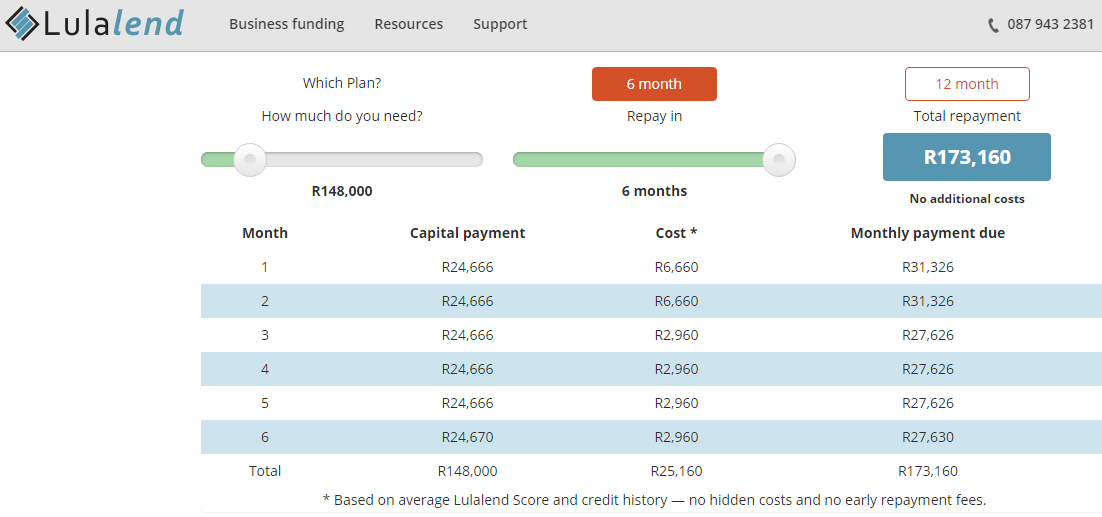
Lulalend’s loan sizes range from around $1500 (≈ 20,000 South African Rand) up to $70,000, for 6 to 12 month tenors, requiring monthly payments of one-sixth or one-twelfth the total loan with monthly costs of 2 to 6 percent.

The most common loan is around $10,000 (≈ 148,000 Rand) over a 6 month term for a cost over principal of roughly $1700, according to Gosling.

Lulalend loan terms

SMEs can apply online and need a bank account to receive a loan disbursement. A high percentage of Lulalend’s approvals are processed automatically—without requiring manual due diligence—using the company’s proprietary credit scoring tech.

Loans by sector for the startup run pretty evenly across online commerce companies, manufacturing and distribution type businesses, and professional and business services firms.

Lula 197 2Lulalend does not release info on revenue or loan portfolio size, but Gosling said the company has a loss-rate below 4 percent and has reached profitability—something confirmed in the round due diligence process.

The startup has an internal data-base, developer team, and operates on Microsoft’s Azure cloud services. Co-Founder Neil Welman is the company’s CTO and brings previous experience in financial credit risk analysis.

“When we set up the company the biggest piece within the automation that we’ve had to solve for is the underwriting component and ability to score companies,” Gosling said.

That internal ability to assess loan risk and process loan applications (largely) straight through is how Lulalend is able to serve an under-served SME market. For many big South African banks, that require traditional due diligence and collateral, booking small loans doesn’t make economic sense, according to Gosling.

“With a very manual credit process and little automation, it doesn’t make…it….profitable to do $5000 loans,” he said.

As part of the $6.5 million Series A, investor Quona Capital (which is sponsored by fintech organization Accion) will join LulaLend’s board.

On why the fund invested in the startup, “We believe Lulalend’s tech-enabled scoring, combined with their ability to provide funding in a quick and transparent way, has the potential to…catalyze SME growth in South Africa,” said Quona Capital Partner Johan Bosini.

LulaLend co-founder Trevor Gosling said the the startup could consider expansion in the future but will remain focused on South Africa for now.

On long-term performance goals for the startup, he named generating revenue and lending volume as the primary target. “What we’re trying to achieve is building a $100 million loan book as quickly as possible and that’s what this raise is assisting us with,” he said.

“We believe if you build a quality business opportunities will present themselves, whether it’s through a strategic partnership or an IPO or whatever makes sense at that time.”

Gosling said Lulalend is also keeping its door opened to partnerships with big banks or telcos to provide access to finance to greater numbers of South Africa’s SMEs.


26 Jun 2019

The Office is leaving Netflix in 2021 because NBC wants it back

Well, it’s official: The Office is leaving Netflix .

Michael Scott and the rest of Dunder Mifflin will be heading for another streaming service come January 2021.

By far the most popular show on Netflix in 2018, The Office was bound to leave the service eventually — or, at the very least, see some HUGE contract renegotiations.

The show’s departure had been rumored a few times before now, but were quickly debunked. Now word of the end date comes straight from Netflix itself:

NBC backs this up with a press release here, saying that they plan to hold it for a “soon-to-be-launched streaming service” of their own. In other words: ‘yeah, it’s the most popular on-demand show on the Internet, of course we’re taking it back.’ (Or, to paraphrase Michael G. Scott: ‘Sometimes I start a [streaming service] and I don’t even know where it’s going. I just hope I find it along the way.’)

It’s been a good run. The Office has been on a more-or-less endless loop in our household for the past few years (though, admittedly, sometimes that loop restarts a few seasons before the actual end because, well, come on.)

On the upside, you’ve got a well over a year to finish watching it, be it for the first time or the 81st. Will its departure make me sign up for yet-another-streaming service? Probably not. Will it make me just buy the whole damned thing outright on iTunes/Google Play/whatever so I can keep streaming it in the background until the end of time? That’s a bit more likely.

I can’t decide whether to end this with a Michael Scott “NOOOOOO” GIF or a Kelly Kapoor “Number one, how dare you?”, so imagine that the sentiment is something of a combination of the two.

26 Jun 2019

WeWork acquires Waltz, an app that lets users access different spaces with a single credential

WeWork announced today that it will acquire Waltz, a building access and security management startup, for an undisclosed amount. Waltz’s smartphone app and reader allows users to enter different properties with a single credential and will make it easier for WeWork’s enterprise clients, such as GE Healthcare and Microsoft, to manage their employees’ on-demand memberships to WeWork spaces.

WeWork’s announcement said “with deep expertise in mobile access and system integrations, Waltz has the most advanced and sophisticated products to provide that single credential to our members and to help us better connect them with our spaces.” Waltz was founded in 2015 by CEO Matt Kopel and has offices in New York and Montreal. After the acquisition, Waltz will be integrated into WeWork, but maintain its current customer base.

WeWork has been on an acquisition spree over the past year as it evolves from co-working spaces to a software-as-a-service provider. Companies it has bought include office management platforms Teem (for $100 million) and Managed by Q, as well as Euclid, a “spatial analytics platform” that allows companies to analyze the use of workspaces by their employees and participation at meetings and other events.

Likewise, Waltz isn’t just an alternative to keys or access cards. Its cloud-based management portal gives companies data about who enters and exits their buildings and also allows teams to set “Door Groups,” which restricts the use of some spaces to certain people. According to Waltz’s help site, it can also be used to make revenue through ads displayed in its app.

26 Jun 2019

San Francisco takes the final steps toward becoming the first U.S. city to ban vaping product sales

San Francisco’s Board of Supervisors unanimously approved an ordinance today that prohibits the sale of e-cigarettes within the city. If signed into law, the new legislation would amend the city’s health code, making it illegal for stores to sell vaping products or for online retailers to ship them to San Francisco addresses, which means it would become the first city to enact such a ban.

San Francisco City Attorney Dennis Herrera, who co-sponsored the ban on sales, told Bloomberg that products will be allowed to be sold in the city again if they receive approval from the Food and Drug Administration. The FDA oversees e-cigarettes, but will not require vape companies to submit for approval until 2022.

The ordinance is now waiting to be signed by Mayor London Breed, who has 10 days to review the legislation. If she signs it, the ban goes into place in seven months. Juul, the San Francisco-based company that captured 75 percent of the e-cigarette market last year, according to Nielsen, is already fighting back. The company, which has been blamed for lowering the barrier to nicotine addiction for underage users, told Bloomberg that it has already collected enough signatures to add a ballot measure that would allow San Francisco stores to keep selling e-cigarettes to customers over 21 if it passed by voters in November.

The ordinance passed today cites the increase in vaping among underage users as a key reason for the ban. “According to the Centers for Disease Control and Prevention (“CDC”), the number of middle and high school students who reported being current users of tobacco products increased 36%—from 3.6 million to 4.9 million students—between 2017 and 2018,” the proposal said. “This dramatic increase, which has erased past progress in reducing youth tobacco use, is directly attributable to a nationwide surge in e-cigarette use by adolescents.”

Though it markets itself as a device to help adult smokers who want to stop using cigarettes, Juul has been blamed for getting more teens hooked on nicotine because its discreet e-cigarettes are carried in many retail stores, including convenience stores and easy to hide. Juul pods all contain nicotine, unlike other vaping companies that make liquids with lower levels of nicotine or none at all. As cigarette sales in the U.S. are decreasing, cigarette makers have turned to vaping, creating their own products or investing in e-cigarette companies. Altria Group, the tobacco products conglomerate that includes Philip Morris, bought a 35 percent stake in Juul last year, giving the company a valuation of $38 billion.

On Tuesday, San Francisco also passed a separate ordinance that would ban the sale, manufacturing and distribution of e-cigarettes on city property. Though the ordinance does not mention Juul by name, the company’s headquarters are at Pier 70 in office space leased from the city. Juul would be able to stay in Pier 70 if the ordinance passes, since the ordinance would not apply retroactively, but it has already purchased its own office tower in downtown San Francisco.

A Juul spokesperson told Bloomberg that it is committed to preventing the sale of its products to customers under 21, but that “this full prohibition will drive former adult smokers who successfully switched to vapor products back to deadly cigarettes, deny the opportunity to switch for current adult smokers and create a thriving black market instead of addressing the actual causes of underage access and use.”

Juul is not the only business that will be affected by the ban, with many stores in San Francisco worrying about the ordinance’s impact on their sales if it is passed. Moe Mohomed, who works at a smoke shop in the Mission District, told Mission Local that last year’s ban on flavored e-cigarettes caused profits to fall by about 30 to 50 percent. According to the news site, 800 businesses in San Francisco sell e-cigarettes.

26 Jun 2019

Boeing is going to work with Kitty Hawk on flying cars and safety

Kitty Hawk, the flying car company backed by Google’s Larry Page and led by Udacity co-founder Sebastian Thrun, has struck a deal with aerospace giant Boeing.

The terms of the strategic partnership are vague. But it appears the two companies will collaborate on urban air mobility, particularly around safety and how autonomous and piloted vehicles will co-exist.

Kitty Hawk’s portfolio of vehicles includes Cora, a two-person air taxi, and Flyer, a vehicle for personalized flight. The partnership is focused on the fully electric, self-piloting flying taxi Cora, according to the announcement.

“Working with a company like Kitty Hawk brings us closer to our goal of safely advancing the future of mobility,” said Steve Nordlund, vice president and general manager of Boeing NeXt, an organization within the company focused on next-generation transport.

Thrun, who founded X, Google’s moonshot factory, also co-founded Kitty Hawk. The company is based in Mountain View, Calif., however much of its testing occurs in New Zealand. Last year, Kitty Hawk took the wraps off of Cora, a vertical take-off and landing aircraft that can take off like a helicopter and fly like a plane.