Category: UNCATEGORIZED

24 Jun 2019

The next service marketplace wave: Vertical market-networks

The last few decades have produced many successful marketplaces. We went from goods marketplace pioneers such as eBay and Amazon to simple service marketplaces such as Uber, Lyft, Doordash, Upwork, Thumbtack, TaskRabbit, and Fiverr. But why haven’t we seen many successful B2B service marketplaces?

Table of Contents


Why Many B2B Service Marketplaces Failed

Some would argue that companies such as Upwork, Thumbtack, Fiverr, or TaskRabbit are horizontal B2B marketplaces in the sense that they provide access to suppliers of different services. But while businesses do indeed transact with freelancers on such “horizontal” marketplaces, for most service verticals these are limited-value, one-off transactions. They fail to enable long-term business collaborations.

So, such marketplaces haven’t delivered more valuable services nor introduced a new paradigm for how businesses buy specific services at scale and on an on-going basis. Why is that?

Horizontal marketplaces are stuck at the discovery process

Horizontal services marketplaces don’t provide much value beyond matching clients with quality service providers. In other words, they don’t facilitate collaboration between buyers and suppliers, never mind provide ways for the two parties to collaborate more efficiently over time as they engage in follow-on projects.

In essence, the model these marketplaces were built around is not much different from the likes of Craigslist, which put a convenient UX on traditional classified advertisements.

Complex B2B services require workflow and collaboration tools

In their article “What’s Next for Marketplace Startups?,” Andrew Chen and Li Jin found that there aren’t many successful service marketplaces because those offerings are complex, diverse, and difficult to evaluate. It’s challenging to define a successful transaction in a service marketplace because it’s harder to quantify success.

One reason is that several service providers must often work together to complete a single job for a buyer, requiring a complex workflow from end to end. As a result, it’s difficult for marketplaces to not only mediate service delivery but also make it significantly more efficient for buyers and suppliers. If both the buyer and suppliers don’t see a significant efficiency gain other than being initially matched, why would they continue using the marketplace?

(Image via Getty Images / Lidiia Moor)

The $50 billion translation industry is a prime example of complex B2B services marketplaces. On the supply side are roughly 50,000 small agencies around the globe responsible for more than 85% of this $50 billion industry. (Note we are referring to agencies here as suppliers, though they play on both sides.)

On the demand side are businesses that need to translate text from one language into another. Plus about 1,500,000 freelance linguists work in this industry, many of whom are more specialized than professionals in other industries.

Anyone can find and hire a translator on Fiverr or Upwork. Both provide a vast selection of language translators. However, the quality and cost of the translation depends on the translation tools available to the translator as well as their subject expertise.

Neither Fiverr nor Upwork provide computer-aided translation (CAT) and collaborative workflow solutions for users of their platforms. Additionally, neither provides an effective way for all parties to collaborate and continuously improve the efficiency and quality.

But the problem with traditional marketplaces goes even further: Multiple translators and reviewers are usually needed to complete a single job for a customer. Multi-language translation projects are even more complicated. Such projects require multiple service providers and cost estimates, in addition to project management tools.

This is why building a B2B service marketplace is difficult. Service marketplaces must not only connect buyers and suppliers, but also provide tools to enable an efficient and collaborative workflow that reduces wasted time and effort.

Horizontal marketplaces suffer high attrition

In addition to the problems already outlined, traditional marketplaces experience another issue that prevents them from growing and retaining market participants: Buyer and supplier attrition.

Many business services are based on regularly recurring engagements. In some cases, a buyer and a service provider interact daily, requiring a different workflow than gig-marketplaces are built around.

Buyers and suppliers have little motivation to continue interacting on a platform with no workflow automation solutions. They lack a way to improve service efficiency and quality, automate collaboration, payment, paperwork, and other basic processes required for a business.

This is why many traditional marketplaces suffer from slow network effects and high attrition. (A network effect is what happens when a platform, product, or service delivers more value the more it is used.

Think Facebook, eBay, WhatsApp.) Why wouldn’t companies work directly with service providers outside of a marketplace after they were introduced? What incentives keep the service transaction on the marketplace? These are critical questions to answer when building a marketplace.

Traditional marketplaces target broad services, making it nearly impossible to provide workflow solutions for buyers and suppliers. Going forward, successful service marketplaces will be developed relying on an industry-specific SaaS workflow. This will focus buyers and suppliers on longer-term projects and interactions that serve the unique needs of collaborations and transactions in a specific vertical.

Image via Getty Images / OstapenkoOlena

What makes a successful service marketplace?

In “The next 10 Years Will Be About Market Networks,” James Currier, Managing Partner at NFX Ventures, defines a new era of service marketplaces, which he calls market networks.

A market network is a platform that combines elements of an n-sided marketplace, a network, and workflow solutions. An n-sided marketplace is one that requires coordination of multiple supply-side parties to provide a complex service for a single buyer.

Market networks enable multiple buyers and suppliers to interact, collaborate, and transact on the same platform. They provide users with industry-specific workflow solutions that enable efficient, ongoing collaboration on long-term projects. This reduces costs and leads to a higher quality of services and increased overall value for all users.

But how do you actually build a successful market-network platform? While the answer to that varies from company to company, here is our approach. We were able to build a market network for the translation industry that combines the components: network, marketplace, and workflow solution.

STEP 1: SaaS workflow platform unlocks high-value collaboration

The first step to building an effective complex market network is to develop a workflow that is easy for users to embrace. It might not seem like much, but this increases productivity by enabling teams to perform tasks that were previously impossible.


24 Jun 2019

Trash uses AI to edit your footage into a fun, short videos

Trash is a new startup promising to make it easier for anyone to create well-edited videos.

Social video is an area that CEO Hannah Donovan knows well, having previously served as general manager at Vine (the video app that Twitter acquired and eventually shut down). She said that in user research, even though people had “really powerful cameras in their pockets,” when it came to editing their footage together, they’d always say, “Oh, I’m not technical enough, I’m not smart enough.”

Donovan, who also worked as head of creative at Last.fm, said she “got curious about whether we could use computer vision to analzye the video and synthesize it into a sequence.”

The result is the Trash app, which comes with a straightforward tag line: “You shoot, we edit.”

Donovan demonstrated the app for me last week, shooting a few brief clips around the TechCrunch New York office, which were then assembled into a video — not exactly an amazing video but much, much better than anything I could have done with the footage. We also got to tweak the video by adjusting the music, the speed or the “vibe,” then post it on Trash and other social networks.

Donovan founded the company with its Chief Scientist Genevieve Patterson, who has a Ph.D. from Brown and also did postdoctoral work with Microsoft Research.

Patterson told me that Trash’s technology covers two broad categories. First there’s analysis, where a neural network analyzes the footage to identify elements like people, faces, interesting actions and different types of shots. Then there’s synthesis, where “we try to figure out what are the most cool and interesting parts of the video, to create a mini-music video for you with a high diversity of content.”

The app should get smarter over time as it gets more training data to work with, Patterson added. For one thing, she noted that most of the initial training footage used “Hollywood-style cinematography,” but as Trash brings more users on-board, it can better adapt to the ways shoot on their phone.

It’s staring that on-boarding process now with what Donovan calls a “creator beta,” where the team is looking for a variety of creators — particularly talented photographers who haven’t embraced video yet — to try things out. You can request an invite by downloading the iOS app. (Donovan said there are plans to build an Android version eventually.)

Trash screenshot

Trash has raised $2.5 million from sources as varied as the National Science Foundation, Japan’s Digital Garage and Dream Machine, the fund created by former TechCrunch Editor Alexia Bonatsos. Donovan said the startup isn’t focused on revenue yet — but eventually, it could make money through sponsorships, pro features and by allowing creators to sell their footage in the app.

And if you’re wondering where the name come from, Donovan offered both a “snarky response” (“I don’t give a damn and I don’t take myself too seriously”) and a more serious one.

“We believe that one person’s trash is another person’s treasure,” she said. “With filmmaking, as you know, there’s a lot of things that get left on the cutting room floor. That’s one of the product concepts, in the longer term, that we want to explore.”

24 Jun 2019

Scientists discover a new way to provide plants the nutrients they need to thrive

Researchers at Carnegie Mellon University have discovered a new method for delivering key nutrients to plant roots – without having to ensure they’re present in the soil where the plants are growing.

The landmark study greatly increases the efficiency of surface delivery of nutrients and pesticides to plants. Currently, when crops are sprayed with stuff that’s supposed to help them grow faster or better, the vast majority of that (up to 95 percent, according to CMU’s engineering blog) will just end up either as concentrated deposits in the surrounding soil, or dissolving into ground water. In both cases, accumulation over time can have negative knock-on effects, in addition to being terribly inefficient at their primary task.

This method, described by researchers in detail in a new academic paper, would manage to improve efficiency to nearly 100% absorption of nutrients and pesticides delivered as nanoparticles (particles smaller than 50 nanometers across – a human hair is about 75,000 nanometers wide, for context) sprayed onto the leaves of plants, which then make their way through the plant’s internal vascular system all the way down into the root system.

Using this method, agricultural professionals could also greatly improve delivery of plant antibiotics, making it easier and more cost-effective to treat plant diseases affecting crop yields. It would be cheaper to delivery all nutrients and pesticides, too, because the big bump in efficiency of uptake by the plants means you can use much less of anything you want to deliver to achieve your desired effect.

This research could have huge impact in terms of addressing growing global food supply needs while making the most existing agricultural land footprint and decreasing the need for potentially damaging expansion of the same.

24 Jun 2019

Watch SpaceX’s spectacular first Falcon Heavy night launch live

SpaceX is going to launch a Falcon Heavy rocket for only the third time ever tonight, should all go according to the current mission plan. The launch, set to take place during a four-hour launch window that opens at 11:30 PM EDT (8:30 PM PDT) [UPDATE: The launch is now targeting 2:30 AM EDT (11:30 PM PDT), which still falls within the four-hour launch window] tonight, will lift off from Launch Complex 39A at Florida’s Kennedy Space Center.

On its first-ever nighttime launch, Falcon Heavy’s STP-2 mission will carry a cargo made up of a number of payloads from commercial customers, as well as from the U.S. Department of Defence, the National Oceanic and Atmospheric Administration (NOAA) and NASA. The mission involves putting 24 different spacecraft into orbit, along three separate orbital paths. One of the is an experimental research satellite for the Air Force Research Laboratory, and NASA’s payload includes four different experimental craft, which the agency detailed this month.

It’ll also carry LightSail 2, a crowdfunded spacecraft spearheaded by Bill Nye’s Planetary Society, which will make its way through space using the literal solar wind beneath its massive sail. SpaceX is also re-using Falcon Heavy boosters for the first time, with side boosters used on the Arabsat-6A mission flown in April, and it’ll attempt to recover all three first-stage rockets via landings at Cape Canaveral and aboard its drone landing pad barge.

The launch will be streamed live above, with the feed getting started around 15 minutes prior to scheduled launch window opening.

24 Jun 2019

Comscore raises $20M with an option to bump it to $50M, in a bid to rebuild its digital measurement business

Comscore’s name is usually in the news because of its widely-cited research and stats around media traffic and other analysis charting digital consumer behavior. More recently, it’s been coming up for another reason: ongoing corporate upheaval and its tumbling stock price. Today comes the latest development in that story: the company announced that it has raised $20 million, with the option of increasing the sum to $50 million, from a firm called CVI Investments.

“This transaction strengthens our balance sheet and positions us to pursue our refocused growth strategy while providing the flexibility to better apply resources to meet our business objectives, and ultimately drive long-term value for our stockholders,” Dale Fuller, Interim Chief Executive Officer of Comscore, said in a statement.

As explained in the 8-K, the money is coming in the form of a share purchase that is expected to close around June 26.

Comscore did not give more specifics about how it plans to use the funding, but it comes at a tricky time, with the stock today at one point dipping to a 52-week low at $7.39/share. Earlier this year, it lost both its CEO and its president, and then this month its COO departed after less than a month with the company. Counting its current interim CEO, it has been through five CEOs in the last five years. In May, the loss-making company also announced that it would be reducing headcount by 10%, or 180 people, as part of a restructuring and effort to move into profitability.

Comscore competes with the likes of Nielsen in measuring media consumption and patterns of digital consumers, but that is not its only challenge.

The company, and others like it, have traditionally been a key component in the world of advertising, as they provide an inportant, third-party assessment of audience data, necessary for helping to plan media spend and campaigns. But the rise of adtech and marketing tech, and a new array of places where ad inventory is placed beyond websites, has created a new level of more granular measurements and customer demands, so part of the challenge for Comscore has been to build new products to meet those new scenarios.

Its most recent series of executive departures and workforce reductions have not been the first faced by the company: it has also been the subject of an SEC investigation into its accounting practices, having admitted in 2018 that it overstated revenues by some $127 million resulting from a long-term WPP partnership. Prior to that, longtime CEO Gian Fulgoni left the company over the same problem.

Last year, it was reported that Comscore had engaged Goldman Sachs to reach out to parties potentially interested in acquiring it, including strategic acquirers operating in a similar space and buyout firms. The talks were never confirmed and nothing ever materialised at the time.

The company’s market cap is now at around $460 million, having seen its share price decline drastically since 2015.


24 Jun 2019

DJI looks to assemble drones in California as government concerns mount

With increased pressure on Chinese manufacturers like Huawei and ZTE, Shenzhen-based drone giant DJI has no doubt had cause for concern of late. In late-2017, the U.S. government’s Immigration and Customs Enforcement office raised concern that the company’s camera-equipped flying machines could be sending data back to China.

A few weeks back, the Department of Homeland Security similarly raised warning over commercial drones from China. In a hearing entitled “Drone Security: Enhancing Innovation and Mitigating Supply Chain Risks” last week, meanwhile, the National Defense University’s Harry Wingo told the Senate Transportation Subcommittee, “American geospatial information is flown to Chinese data centers at an unprecedented level. This literally gives a Chinese company a view from above of our nation.”

DJI fired back in a letter provided to TechCrunch, noting,

Because the drone industry is becoming an increasingly critical engine for small American businesses as well as the entire U.S. economy, it is essential that decisions affecting key components of the industry are based on fact. We are deeply concerned that, left unchecked, the unsubstantiated speculation and inaccurate information presented during your Subcommittee hearing will put the entire U.S. drone industry at risk, causing a ripple effect that will stunt economic growth and handcuff public servants who use DJI drones to protect the public and save lives.

The letter also breaks down some of the finer points of the discussion as follows,

  • DJI drones do not share flight logs, photos or videos unless the drone pilot deliberately chooses to do so. They do not automatically send flight data to China or anywhere else. They do not automatically transmit photos or videos over the internet. This data stays solely on the drone and on the pilot’s mobile device. DJI cannot share customer data it never receives.

  • DJI’s professional pilot app has a built-in setting to disconnect all internet connection, as an extra precaution for pilots performing sensitive flights. Unlike some technology companies, DJI does not sell or monetize customer data.

  • DJI embeds password and data encryption features in the design of our products. This provides customers with secure access to the drone and its onboard data. In cases when U.S. drone users do choose to share their data, it is only uploaded to U.S. cloud servers.

  • DJI operates a global Bug Bounty Program so the world’s security researchers can identify unforeseen security issues, and we hire independent security experts to test our products. These are just some of the steps we take to assure high-security users they can use our products with confidence.

With increased speculation, the company is looking to assemble some of its products stateside. A warehouse in Cerritos, California is set to be repurposed to build those drone models sold in the U.S., in order to better comply with government regulation. 

The company tells TechCrunch,

DJI is committed to investing in America and providing U.S. government workers, first responders, and public servants with customized solutions that meet their unique security, safety, and procurement needs. As part of our long-term commitment to America that began in 2015 with our research and development facility located in Palo Alto, we are opening a new production facility in California and filing for compliance under the U.S. Trade Agreements Act. This new investment will expand DJI’s footprint in the U.S. so we can better serve our customers, create U.S. jobs, and strengthen the U.S. drone economy. We look forward to working with U.S. Customs and Border Protection in its review of our application.

DJI hopes that assembling products in California will help the company better comply with the Trade Agreements Act, a move that comes as preps the release of the DJI Government Edition, a repurposed Mavic Pro drone designed for use by government agencies.

24 Jun 2019

SpaceRyde wants to make access to space more available and more affordable

Life can be tough for a small satellite operator – it may be relatively cheap and easy to build small sats (or CubeSats, as they’re sometimes called), but arranging transportation for those satellites to get to orbit is still a big challenge. That’s why SpaceRyde is pursuing a novel way of launching light payloads, that could help small sat companies skip the line, and save some cash in the process.

SpaceRyde’s co-founders, wife and husband team Saharnaz Safari and Sohrab Haghighat, saw the opportunity to address this growing customer base by making launches easier by reducing the impact of one of the biggest complicating factors of getting stuff into space: Earth’s atmosphere.

In an interview, Safari explained that SpaceRyde’s technology works by making it possible to use a relatively tiny rocket rather than a huge one by attaching it to a stratospheric balloon and launching from much closer to orbit. Because of the size of the rocket and the lift limitations of the balloons, SpaceRyde ends up carrying much smaller payloads than say, SpaceX or Rocket Lab, but on the upside, clients don’t have to share rides like they do with the big rocket providers.

“Just getting a ride to orbit for these small satellite, even if they have the money, or they want to pay as much as they’re getting charged right now, on big rockets, is a big problem,” Safari said. “Because they have to wait until a mission with their parameters, to the orbit they want, the inclination they want, all that becomes available and then if there’s space, they can, you know, hitch a ride. So it’s more or less like a bus system.”

No one loves waiting for the bus, least of all the emerging crop of space startups hoping to build sustainable businesses. Many of these young companies, like fellow Canadian startup Wyvern, are looking to launch and operate small sats as the backbone of their go-to-market plan. Trouble is, they’re at the whim of whatever primary client current launch providers are serving, with launch condition requirements for the largest, most expensive satellites on board dictating when, where and if launches will happen for the tag-along smaller customers.

SpaceRyde’s stratospheric balloon-based rocket launch platform concept.

“What we’re building is, instead of this bus system, where it’s a set schedule, and it can get delayed,” Safari explained. “We want to give them the taxi or Uber service to space, where they buy an entire rocket and we provide the payload capacity that smaller satellite companies typically use in one launch, and so they can basically buy the entire rocket, and they can put a bunch of their satellites, depending on how big their satellites are, and then they just tell us where they want us to drop it for them.”

SpaceRyde is early in its own journey, having been founded less than a year ago. But Haghighat, the company’s CEO in addition to being Safari’s husband and co-founder, has a PhD in Aerospace, Aeronatical and Astronautical Engineering from the University of Toronto and was an early employee of success story Cruise Automation. Safari brings business and sales expertise, as well as a Master’s degree in Bioanalytical Chemistry from the University of Waterloo . But more important than either of their credentials, they’ve already demonstrated a sub-scale prototype of their system in action.

Earlier this year, SpaceRyde launched a stratospheric balloon carrying a scaled down version of their launch platform and rocket in Northern Ontario, Canada. The test wasn’t a complete success – a modification to the off-the-shelf rocket engine they used didn’t work exactly as expected – but it did demonstrate that their in-flight launch platform orientation tech worked as intended, and Safari says the malfunction that did occur is relatively easy to fix.

Next up for SpaceRyde is to work towards a full-scale demonstration of their platform, which Safari says should happen sometime next year. The company is hiring to grow its small team and accelerate its pace of development, and Safari says they’re excited specifically about the potential SpaceRyde has to bring back domestic launch capabilities to Canada – the country hasn’t had a rocket launch in 21 years.

For the private space economy, the startup can’t commercialize its product fast enough: Safari says they’ll be able to offer their launches at “around half” of what their customers would be charged currently (thanks to using mostly off-the-self rocket parts and balloons), but again she stressed that it’s actually not cost, but availability that is the biggest challenge for most.

24 Jun 2019

Sam’s Club launches alcohol delivery through Instacart

Walmart -owned Sam’s Club is expanding into same-day alcohol delivery, the retailer announced this morning. The delivery service is being powered by Sam’s Club partner Instacart and is currently live in 215 stores across 12 U.S. states, with plans to reach other cities and markets in the months ahead.

At launch, the list of states supporting alcohol delivery includes Florida, California, Missouri, Hawaii, Idaho, Illinois, Ohio, Wyoming, Connecticut, Texas, Kentucky, and Minnesota. Not all clubs in those states will offer the service — only select markets.

Where available, Sam’s Club members will be able to order both from the in-house “Member’s Mark” brand — like Member’s Mark Sangria, Member’s Mark Prosecco and Member’s Mark Moscato D’Asti, for example — as well as from other popular brands, like Kendall Jackson Chardonnay, Modelo Especial, and Tito’s Handmade Vodka, among others. The deliveries can arrive as fast as one hour.

The move pits Sam’s Club as a rival to other same-day alcohol delivery services, including Target’s Shipt, which delivers alcohol in a number of cities from various retailers (including Target), Amazon’s Prime Now, Drizly, Postmates, plus other Instacart partner retailers which vary by market and regional chains.

Sam’s Club parent Walmart also delivers alcohol in select markets through Walmart Grocery.

To order alcohol, Sam’s Club members will need to order through the Instacart app or website. They’ll also obviously need to be 21 years of age and will need to present their government ID at the time of delivery.

“Sam’s Club is focused on offering quality products, unexpected finds and better customer experiences,” said Racquel Harris, Vice President, Adult Beverage, in a statement. “Now you can select the perfect bottle of wine to complement your dinner or stock up on your favorite beer or spirits for the big game with the convenience of delivery.”

Instacart is proud to collaborate with Sam’s Club to provide wine, beer, and spirits delivery for their valued members. By extending our marketplace categories, we’re making it even easier for customers to shop from Sam’s Club for all their needs – from groceries and household essentials to alcohol,” said Andrew Nodes, Vice President of Retail at Instacart. “We’re proud to have grown our relationship with Sam’s Club to include its clubs across the U.S., helping members across the country get the groceries they need in as fast as an hour.”


24 Jun 2019

Climate change, AI and ethical leadership in ‘big tech’, with Amazon principal UX design lead Maren Costa

“I just want to be proud of the company that I work for,” Maren Costa told me recently.

Costa is a Principal UX Design Lead at Amazon, for which she has worked since 2002. I was referred to her because of her leadership in the Amazon Employees for Climate Justice group I covered earlier this week for my series on the ethics of technology.

Like many of her peers at Amazon, Costa has been experiencing a tension between work she loves and a company culture and community she in many ways admires deeply, and what she sees as the company’s dangerous failings, or “blind spots,” regarding critical ethical issues such as climate change and AI.

Indeed, her concerns are increasingly typical of employees not only at Amazon, but throughout big tech and beyond, which seems worth noting particularly because hers is not the typical image many call to mind when thinking of giant tech companies.

A Gen-X poet and former Women’s Studies major, Costa drops casual references to neoliberal capitalism running amok into discussions of multiple topics. She has a self-deprecating sense of humor and worries about the impact of her work on women, people of color, and the Earth.

If such sentiments strike you as too idealistic to take seriously, it seems Glass Lewis and ISS, two of the world’s largest and most influential firms advising investors in such companies, would disagree. Both firms recently advised Amazon shareholders to vote in support of a resolution put forward by Amazon Employees for Climate Justice and its supporters, calling on Amazon to dramatically change its approach to climate issues.

Glass Lewis’s statement urged Amazon to “provide reassurance” about its climate policies to employees like Ms. Costa, as “the Company’s apparent inaction on issues of climate change can present human capital risks, which have the potential to lead to the Company having problems attracting and retaining talented employees.” And in its similar report, ISS highlighted research reporting that 64 percent of millennials would be reluctant to work for a company “whose corporate social responsibility record does not align with their values.”

Amazon’s top leadership and shareholders ultimately voted down the measure, but the work of the Climate Justice Employees group continues unabated. And if you read the interview below, you might well join me in believing we’ll see many similar groups crop up at peer companies in the coming years, on a variety of issues. All of those groups will require many leaders — perhaps including you. After all, as Costa said, leadership comes from everywhere.”

Maren Costa: (Apologizes for coughing as interview was about to start)

Greg Epstein: … Well, you could say the Earth is choking too.

Costa: Segue.

Epstein: Exactly. Thank you so much for taking the time, Maren. You are something of an insider at your company.

Costa: Yeah, I took two years off, so I’ve actually worked here for 15 years but started 17 years ago. I actually came back to Amazon, which is surprising to me.

Epstein: You’ve really seen the company evolve.

Costa: Yes.

Epstein: And, in fact, you’ve helped it to evolve — I wouldn’t call myself a big Amazon customer, but based on your online portfolio, you’ve even worked on projects I personally have used. Though find it hard to believe anyone can find jeans that actually fit them on Amazon, I must say.

Costa: [My work is actually] on every page. You can’t use Amazon without using the global navigation, and that was my main project for years, in addition to a lot of the apparel and sort of the softer side of Amazon. Because when I started, it was very super male-dominated.

I mean, still is, but much more so. Jeff literally thought by putting a search box that you could type in Boolean queries was a great homepage, you know? He didn’t have any need for sort of pictures and colors.

(Photo: Lisa Werner/Moment Mobile/Getty Images)

Epstein: My previous interview [for this TechCrunch series on tech ethics] was with Jessica Powell, who used to be PR director of Google and has written a satirical novel about Google . One of the huge themes in her work is the culture at these companies that are heavily male-dominated and engineer-dominated, where maybe there are blind spots or things that the-

Costa: Totally.

Epstein: … kinds of people who’ve been good at founding these companies don’t tend to see. It sounds like that’s something you’ve been aware of and you’ve worked on over the years.

Costa: Absolutely, yes. It was actually a great opportunity, because it made my job pretty easy.

24 Jun 2019

Google’s new media literacy program teaches kids how to spot disinformation and fake news

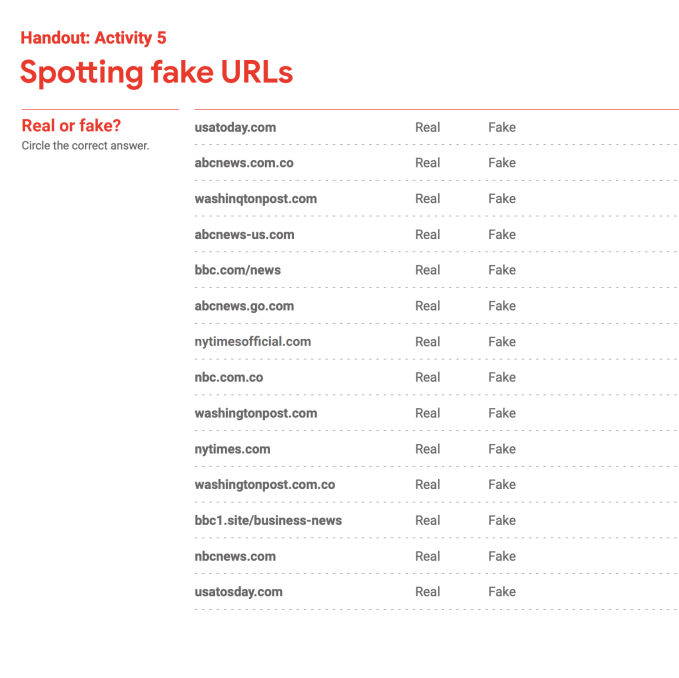
Google announced this morning it’s expanding its two-year-old digital safety and citizenship curriculum for children, “Be Internet Awesome,” to now include media literacy — specifically, the ability to identify so-called “fake news” and other false content. The company is launching six new media literacy activities for the curriculum that will help teach kids things like how to avoid a phishing attack, what bots are, how to verify that information is credible, how to evaluate sources, how to identify disinformation online, spot fake URLs, and more.

The new media literacy classes — which frankly, some adults should read through as well — were developed in collaboration with Anne Collier, executive director of The Net Safety Collaborative, and Faith Rogow, Ph.D., co-author of The Teacher’s Guide to Media Literacy and a co-founder of the National Association for Media Literacy Education.

“We need the right tools and resources to help kids make the most of technology, and while good digital safety and citizenship resources exist for families, more can be done for media literacy,” writes educator and teachmama.com founder Amy Mascott, in an announcement on Google’s blog today. “I’ve worked alongside dozens of educators who believe that media literacy is essential to safety and citizenship in the digital age, but agree that it’s a topic that can be tough to cover.”

The courses offer kids not only instruction, but also a combination of activities and discussion starters aimed at helping them develop critical thinking skills when it comes to pursuing online resources.

Its overall theme, the course material explains, is to help kids understand that the content they find online isn’t necessarily true or reliable  — and it could even involve malicious efforts to steal their information or identity.

The kids learn how phishing works, why it’s a threat, and how to avoid it. They then practice their anti-phishing skills by acting out and discussing reactions to suspicious online texts, posts, friend requests, pictures, and emails.

In the bots section, they learn about how A.I. works and compare and contrast talking to a bot versus talking to a human being.

In the following media literacy sections, kids learn what a credible source is, how to figure out what a source’s motives are, and learn that “just because a person is an expert on one thing doesn’t make them an expert on everything.”

In a related classroom activity, the kids pick a question related to something they’ve seen online or are learning in class and try to get the answers online, while figuring out if the sources are credible.

They also learn to fact check credible sources with other credible sources as a way to look for a variety of sources.

“If you can’t find a variety of credible sources that agree with the source you are checking, you shouldn’t believe that source,” the curriculum explains.

Kids are additionally taught how to spot fake information using clues like deceptive URLs as well as checking the sources for credibility. They’re told that some people don’t know how to do this, and share fake information online — which is how it spreads.

“There are a lot of people and groups who are so passionate about what they believe that they twist the truth to get us to agree with them. When the twisted information is disguised as a news story, that’s disinformation,” the curriculum says.

Kids are also informed that some of the fake news organizations are hard to spot because they use names that sound like they’re real.

And the course delves into various tricks some websites use — like using photos that don’t relate to the story, using clickbait words like “shocking” or “outrageous” which they know make people curious,” using bold, underline, exclamation points or ALL CAPS, to convince you to agree with them.

This section concludes with an online game, Reality River, that asks kids to use their best judgment in order to cross the river rapids. This takes place in Interland, the game developed as a companion to Google’s digital safety and citizenship curriculum.

The overall goal of the media literacy course is to encourage the kids to make checking all news and information a habit — not just those they think seem suspicious.

Google says the new curriculum is available online for both teachers and families alike to use, and are offered in English, Spanish and eight other languages.

Google is partnering with the YMCA and National PTA across multiple cities to host online safety workshops, as well.