Category: UNCATEGORIZED

24 Jun 2019

EU-US Privacy Shield legal showdown now set for July 9

A legal challenge to a data transfer mechanism that’s used by thousands of companies to authorize taking European citizens’ personal data to the US for processing has been delayed.

As we reported last month, the General Court of the EU had set a date of July 1 and 2 to hear the complaint brought by French digital rights group, La Quadrature du Net, against the European Commission’s renegotiated data transfer agreement, the EU-US Privacy Shield.

That hearing has now been canceled — as the court intends to await the decision on another separate but related hearing, on July 9.

La Quadrature du Net has argued for years that Privacy Shield is incompatible with EU law as a result of US government mass surveillance practices — filing its first complaint back in October 2016.

Nor is it alone in its concerns, with the European parliament, European data protection agencies, and privacy and data protection experts all raising questions about the legality of the arrangement which went into operation in August 2016.

But in a series of tweets posted to Twitter today the digital rights group says it has been informed by the court that the hearing has been cancelled — in favor of waiting for the upshot of July 9 hearing.

The latter pertains both to the EU-US Privacy Shield and another data transfer mechanism, called standard contractual clauses (SCCs).

Following an updated complaint against Facebook’s use of SCCs, filed with the Irish Data Protection Commission by lawyer and privacy campaigner Max Schrems back in 2016, the watchdog referred its concerns to the courts.

Irish judges went on to ask Europe’s top court to weigh in on a number of legal questions — including whether Privacy Shield ensures an adequate level of protection for EU citizens’ personal data, as EU law requires that it must. So European judges will be considering how US government mass surveillance programs of the digital sphere — as revealed back in 2013 by NSA whistleblower, Esward Snowden — impact European’s fundamental privacy rights.

At this point you’d be forgiven for feeling a sense of deja-vu because it was via an earlier legal challenge, also brought by Schrems, that led Europe’s top court to strike down the prior data arrangement, Safe Harbor, back in 2015.

Critics of Privacy Shield are hoping the successor arrangement’s days are similarly numbered.

“All that remains is to wait for the Court’s decision, which is not expected to arrive for several months,” writes La Quadrature du Net in a final tweet [translated from French using Microsoft technology]. “We wish a lot of courage and a lot for his business! Hearing on July 9th!”

Facebook tried and failed to block the Irish court’s referral of legal questions about Privacy Shield to the CJEU.

Following the July 9 hearing, a decision from the CJEU is possible later this year — perhaps as soon as October. Although a deliberation timeframe of up to six months is not unusual European judges have shown themselves willing to move remarkably quickly in issuing decisions if they believe EU citizens’ fundamental rights are being undermined.

Since getting up and running less than three years’ ago, Privacy Shield has also suffered from the Trump effect — with key elements of the arrangement, which had been agreed in writing between the European Commission and the Obama administration, being neglected by the incoming US president.

Late last year Europe’s executive body expressed its impatience by issuing the US with a deadline to fulfil outstanding Privacy Shield requirements — including nominating a permanent ombudsperson to handle EU citizens’ complaints.

In January the US duly nominated DocuSign chairman and former CEO, Keith Krach, to be the undersecretary of state for economic growth, energy, and the environment — and also the Privacy Shield ombudsperson.

All of that will, however, be meaningless fiddling if Europe’s top court decides the mechanism is fundamentally incompatible with EU law on account of US national security priorities that allow the government to help itself to everyone’s data. So, er, watch this space.
24 Jun 2019

Gartner finds RPA is fastest growing market in enterprise software

If you asked the average person on the street what Robotic Process Automation is, most probably wouldn’t have a clue. Yet new data from Gartner finds the RPA market grew over 63% last year, making it the fastest growing enterprise software category. It is worth noting, however, that the overall market value of $846.2 million remains rather modest compared to other multi-billion dollar enterprise software categories.

RPA helps companies automate a set of highly manual processes.The beauty of RPA, and why companies like it so much, is that it enables customers to bring a level of automation to legacy processes without having to rip and replace the legacy systems.

As Gartner points out, this plays well in companies with large amounts of legacy infrastructure like banks, insurance companies, telcos and utilities.”The ability to integrate legacy systems is the key driver for RPA projects. By using this technology, organizations can quickly accelerate their digital transformation initiatives, while unlocking the value associated with past technology investments,” Fabrizio Biscotti, research vice president at Gartner said in a statement.

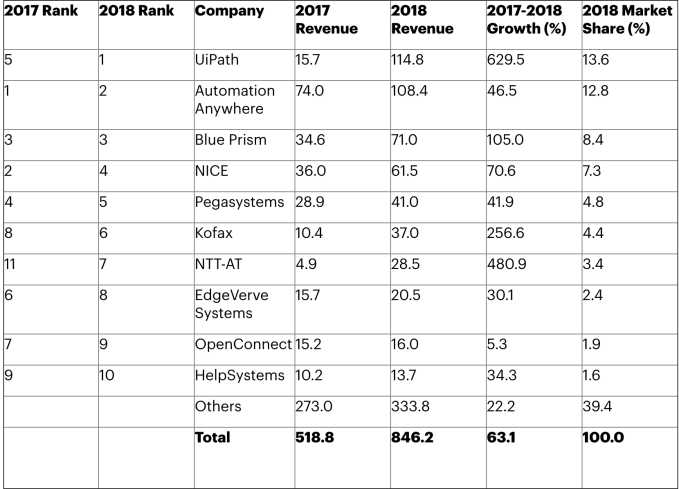
The biggest winner in this rapidly growing market is UIPath, the startup that raised $225 million on a fat $3 billion valuation last year. One reason it’s attracted so much attention is its incredible growth trajectory. Consider that UIPath brought in $15.7 million in revenue in 2017 and increased that by a whopping 629.5% to $114.8 million last year. That kind of growth tends to get you noticed. It was good for 13.6% marketshare and first place, all the way up from fifth place in 2017, according to Gartner.

Another startup nearly as hot as UIPath is Automation Anywhere, which grabbed $300M from SoftBank at a $2.6B valuation last year. The two companies have raised a gaudy $1.5 billion between them with UIPath bringing in an even $1 billion and Automation Anywhere getting $550 million, according to Crunchbase.

Chart: Gartner

Automation Anywhere revenue grew from $74 million to $108.4 million, a growth clip of 46.5%, good for second place and 12.8 percent marketshare. Automation Anywhere was supplanted in first place by UIPath last year.

Blue Prism, which went public in 2016, issued $130 million in stock last year to raise some more funds, probably to help keep up with UIPath and Automation Anywhere. Whatever the reason, it more than doubled its revenue from $34.6 million to $71 million, a healthy growth rate of 105 percent, good for third place with 8.4 percent marketshare.

For now, everyone it seems is winning as the market grows in leaps and bounds. In fact, the growth numbers down the line are impressive with NTT-ATT growing 456% and Kofax growing 256% year over year as two prime examples, but even with those growth numbers, the marketshare begins to fragment into much smaller bites.

While the market is still very much in a development phase, which could account for this level of growth and jockeying for market position, at some point that fragmentation at the bottom of the market might lead to consolidation as companies try to buy additional marketshare.

24 Jun 2019

Samsung releases a trio of smart home products

Samsung’s approach to the smart home has been — “uneven” seems like a nice way of putting it. None of this has really been helped along by the fact that Bixby and the company’s long-promised smart speaker, the Galaxy Home, are still lost in the woods.

SmartThings, the home automation startup the company acquired in 2014, has been relatively steady under its watch, on the other hand. The brand just released a trio of products maintaining its focus on low cost entry points for the starter smart home.

Two, the SmartThings Cam and WiFi Smart Plug have the helpful bonus of not requiring a separate hub. The Smart Bulb, on the other hand, does require one, but that’s not particularly surprising given the $10 price point. Samsung’s SmartThings Hub currently runs around $70, by the way.

None of the new entrants looks particularly exciting. The $90 Cam shoots in 1080p at a 145 degree angle and switches into night vision when the lights are off. It can capture HDR footage and has two-way audio.

The Smart Plug does seem like a pretty solid bargain at $18 vs. Amazon’s $25. Plugging in lights, appliances and the like gives the user app and voice control with Alexa, Google Assistant and, of course, Bixby. All three of the above will work with all of the new products.

The Cam, Smart Plug and Smart Bulb are available starting today.

24 Jun 2019

Byju’s-owned Osmo education startup enters pre-schoolers market

Osmo, a Palo Alto-based education startup acquired by Indian unicorn Byju’s for $120 million this year, is expanding its product lineup to serve a new and largely untapped market: pre-schoolers.

Osmo today announced Osmo Little Genius Starter Kit, a set of tools that aims to help children that have yet to enter schools to understand letters, expand their vocabulary, and build motor and social skills. The kit is priced at $79 and is available through Amazon, Target, and Apple stores in the U.S.

The kit provides children with sticks and rings of varying shapes, tasking them to assemble them to mimic objects and words that they see through video instructions on an accompanying tablet. Osmo claims its kit for pre-schoolers is based on Friedrich Froebel’s and Maria Montessori’s manipulative with advanced computer vision for a personalized experience.

Pramod Sharma, CEO of Osmo, told TechCrunch in an interview that he believes that the market for pre-schoolers remains untapped with little innovation hitting the space over the last 100 years. This new product launch represents a large and new opportunity for Osmo, which has so far catered to kids aged between five and 12.

In the U.S. alone, there are about 10 million kids who are in the pre-school stage. Additionally, “half of all the toys sale are aimed at kids who have not entered schools,” Sharma said.

The announcement today comes weeks after Byju’s, which acquired Osmo for $120 million earlier this year, expanded its own product catalog. Earlier this month, it partnered with Disney to roll out a new app that aims to educate children aged between six and eight.

Until recently, Byju’s focused entirely on high school students and those preparing for university entrance exams. It has since broadened its courses to cover all school grades. Byju’s, which competes with Unacademy in India, is heavily-funded by investors and valued at nearly $4 billion — it is widely acknowledged to be the leader in India’s e-learning market.

To tackle the pre-schoolers’ market, Osmo is leveraging on the interactive content produced by Byju’s, Sharma said. The nature of the product and market it serves will allow Osmo and Byju’s to expand the kit to many global markets, he explained.

The distribution of the new kit could prove challenging, however, Sharma acknowledged. Osmo has tie-ups with more than 30,000 U.S. elementary classrooms that help it deploy its product to a large number of students. It lacks that for earlier-stage education, but Osmo does plan to replicate that model in some capacity by partnering with pre-schools.

Sharma said also that a number of parents have asked Osmo whether it will have any products for their younger children which gives him confidence that there is raw demand. That said, he acknowledged that Osmo will initially need to be more aggressive than usual with its marketing and other outreach programs to parents.

In terms of subject matter, Osmo has largely focused on science and math to date. Moving forward, though, it plans to broaden its existing product lineup with more content and explore subjects including English language, history and social studies to “cover every aspect of learning,” Sharma said.

Byju’s claims 35 million registered users and some 2.4 million paid customers. It generated around $205 million in revenue in the fiscal year that ended in March this year. The company said it aims to increase that figure to over $430 million this year.

24 Jun 2019

Echo Show 5 review

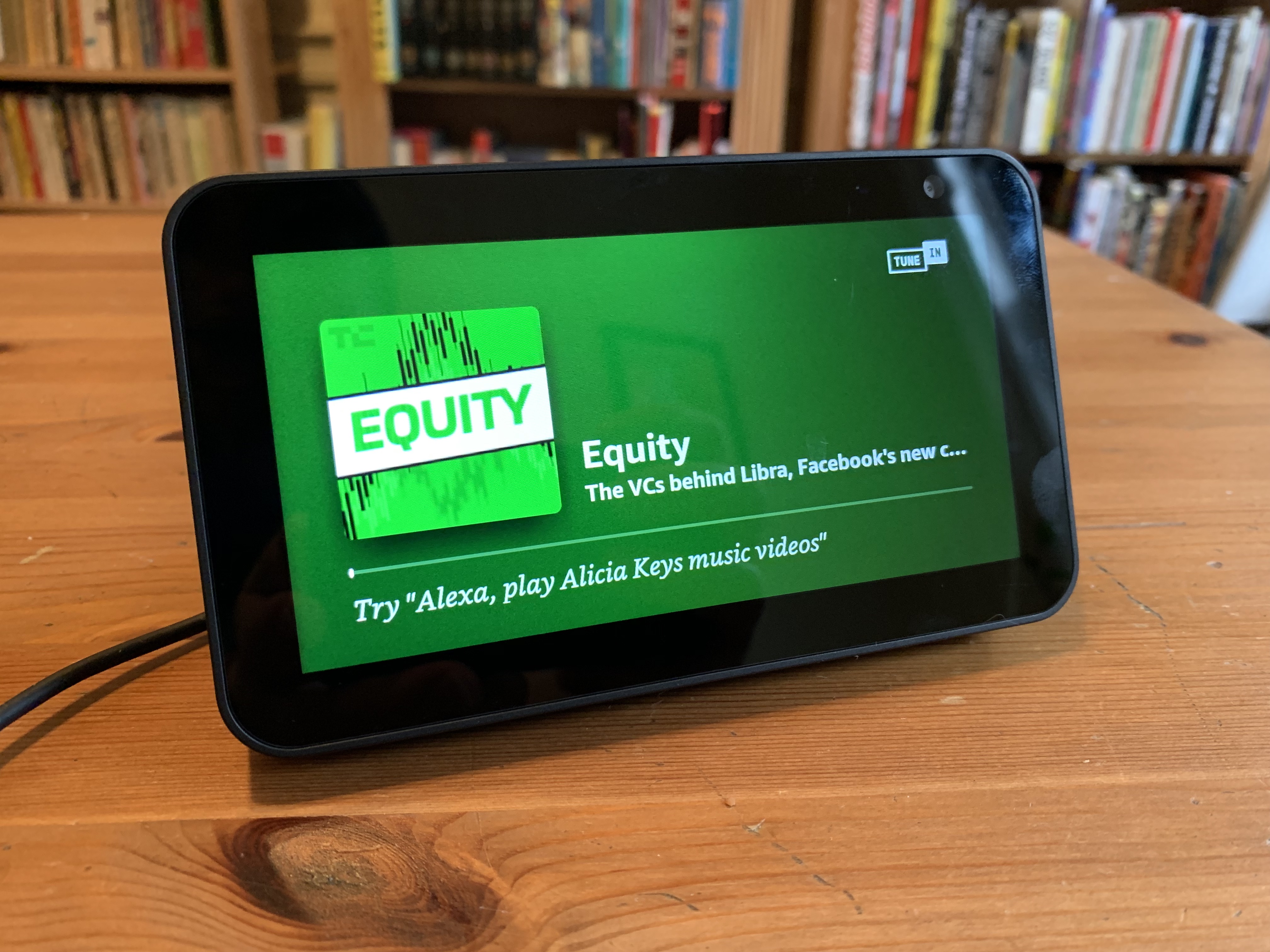
The Echo team must have started sweating when the Lenovo Smart Clock was announced during CES. Deep inside Seattle’s Day One building, Amazon was reading the release of the Echo Show 5, a pint-sized version of the company’s smart screen that bore more than a passing resemblance to Lenovo’s Google Assistant device.

Amazon, of course, beat Google to the category by years with the first Echo Show and innovated the bedside model with the Echo Spot. But Google and its cohort have a way of catching up to and eventually passing the competition.

The Echo Show 5 isn’t designed solely for the nightstand. In fact, the product packs in a few features that Lenovo’s device lacks, including video playback and an on-board camera — both elements that could ultimately make it something of a mixed bag for the bedroom. It’s hard to know precisely where the Show 5 lives, especially with Amazon keeping the Spot around for the time being.

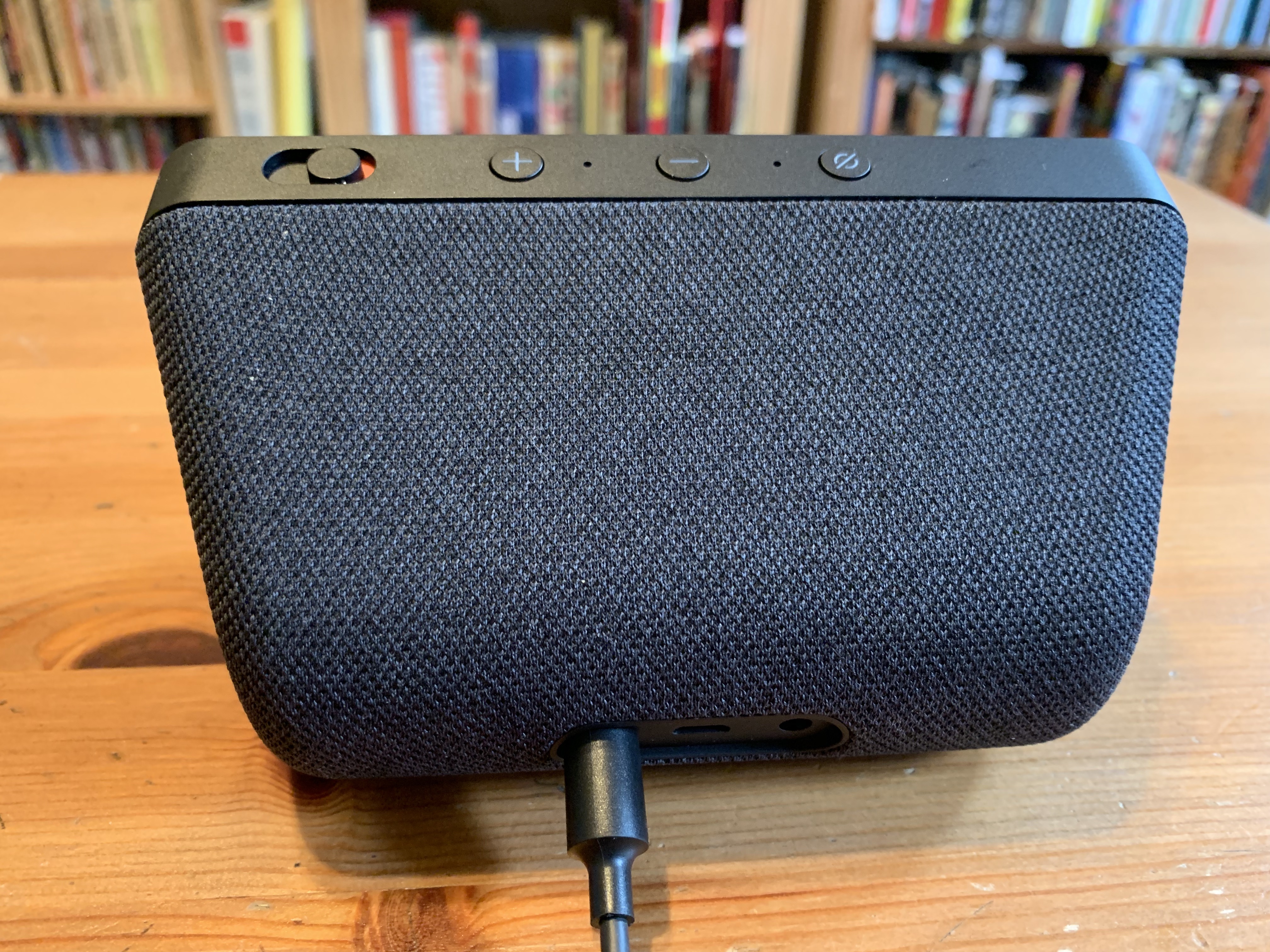
The Spot’s round form factor makes it the most delightful member of the Echo family, but like the Smart Clock, the new Show does a better job blending in, courtesy of a square design and cloth-covered backing. At 5.5 inches, its display is considerably larger than the Spot’s 2.5-inch screen, and a bit above Lenovo’s four inches. It will take up a bit more space on a nightstand — but just a bit. The Spot’s round design gives it a fairly sizable footprint in spite of a small screen.

In most ways, in fact, the Show 5 makes the current generation Spot redundant. In fact, I was a bit surprised to hear that the company would not only be keeping the original Spot around, it would be maintaining the same $130 price point — a $40 premium over the mini Show. Amazon could well be refreshing the Spot toward the end of the year, but it’s not going to burn through back stock at that price.

I do think Lenovo’s device loses something without the ability to play back video. A four-inch smart display isn’t the ideal way to watch video and it’s probably an unnecessary feature for the bedside, but YouTube integration is one of the biggest strengths of Google’s smart screens. That’s kind of squandered here.

On the Show, you’re stuck with Amazon’s video offerings. There are other instances, however, where video’s a great idea. The ability to watch live streams from smart security cameras and baby monitors comes to mind. I can certainly see the appeal in being able to see what’s going on out in front of the house without having to leave my warm bed.

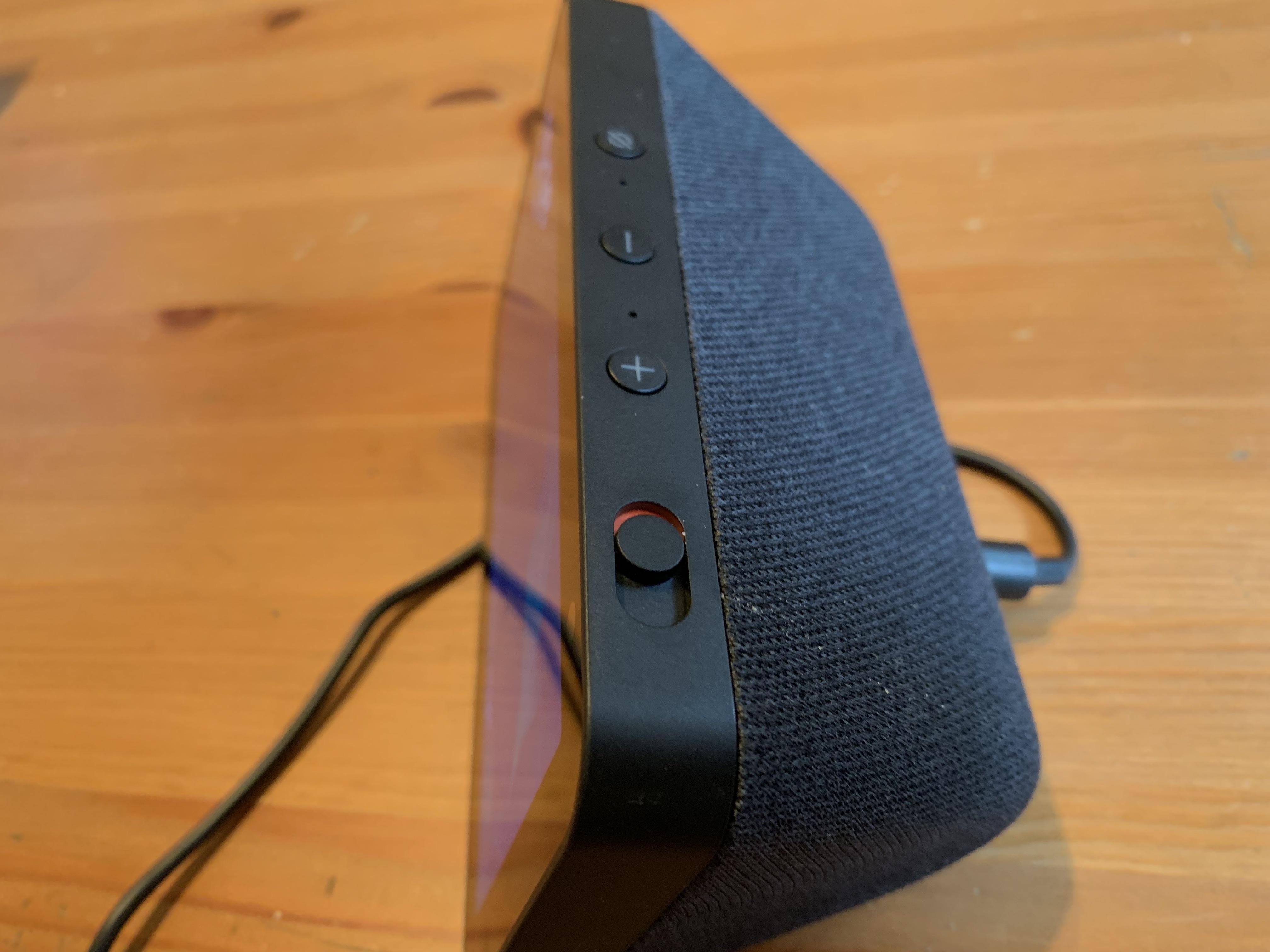
The inclusion of a camera, on the other hand, continues to feel like a misstep. I understand that Amazon’s continuing to push video chat with all of the products, but introducing a camera on a product that will likely primarily be used in the bedroom is probably more trouble than it’s worth. Amazon clearly got the memo on this and other privacy issues, including a physical lens cap. By flipping a switch up top, you slide a barrier in front of the camera.

The lens cap is bright white to contrast with the large surrounding black bezel. There’s also a red marking up top that appears when the camera is obstructed. I kept the cap on for a majority of my testing — you know, just in case.

Where the Smart Clock really shone was its features designed specifically for a night table. The new Show has some, including routines like “Alexa, start my day.” That will trigger a succession of different features, including weather, traffic and customized news selections — it’s a nice blend for tempting you to get out of bed (though the news might have the knock-on effect of making you pull the sheets over your head). Lacking here are the gradual wake alarm, tap to snooze and the inclusion of a USB port for charging your phone while you sleep.


As for the inevitable showdown between the Show 5 and Smart Clock, that’s almost entirely down to which smart assistant you prefer. For my money, Google’s got the edge with Assistant, but both perform most tasks at roughly the same level. That includes the standard array of multimedia offerings played through middling speakers, along with smart home features — though it will be interesting to see how Google continues to refine the latter on its own Nest Hubs.

At $90, the Show 5 is considerably cheaper than its 10-inch namesake and $10 more than Lenovo’s offering. The latter at least will likely be negligible for most. Simply put, if you’re looking for a smart home hub to double as an alarm clock, Lenovo’s your best bet. If video playback and chat are important, Amazon’s got you covered.

24 Jun 2019

FedEx lures online sellers with two-day air shipping at ground rates after Amazon contract ends

International shipping giant FedEx is showing it’s serious about attracting the ecommerce crowd after a high-profile termination of one of its contracts with Amazon to provide delivery using its express air service in the US. FedEx is now offering the same two-day express air shipping direct to some customers for the same price it usually charges for ground service, which is typically much less expensive, the New York Times reports.

FedEx is offering the price cut in order to better compete with rival UPS, the report claims, and to help refactor its product with ecommerce sellers in mind. These include large competitors to Amazon, including Walmart and Walgreens, as well as smaller customers. Note that FedEx will still act as a carrier for Amazon even once its Express contract comes to an end this month, providing last-mile ground shipping.

Meanwhile, Amazon is expanding its own cargo air fleet, with 15 more planes joining its network and a goal of operating a total of 70 planes by 2021. Amazon launched Prime Air in 2016 to help increase its delivery speed to customers, and has been building out the network ever since. The company’s investment in its own delivery and logistics network has helped it provide free two-day, next day and even same day shipping on many items available on the platform to its Prime subscribers.

24 Jun 2019

Cloudflare outage affecting numerous sites on Monday AM

Cloudflare, a company providing performance and security to websites, is having network problems of its own this morning — and taking down a lot of its customers’ sites and apps in the process. Affected companies include podcast app Overcast, chat service Discord, managed hosting provider WP Engine, eCommerce hosting provider Sonassi, public web front-end CDN service CDNJS, and many others — including the sites that rely on the web hosting or who partner with Cloudflare for their CDN service.

According to Cloudflare, it identified a possible route leak that’s impacting some of the Cloudflare IP ranges, and its working now to resolve the issue.

The problems were first identified around 7:02 AM EST, says Cloudflare, and the problem was identified shortly thereafter.

Its status page has been providing continual updates.

The company said at 8:34 AM EST, “this leak is impacting many internet services including Cloudflare. We are continuing to work with the network provider that created this route leak to remove it.”

Update: The company at 12:42 AM UTC / 8:42 AM EST says the issue is resolved:

The network responsible for the route leak has now fixed the issue. We are seeing improvement and are continuing to monitor this before we consider this issue resolved.


24 Jun 2019

Cricket World Cup highlights just how big video streaming is in India

As hundreds of millions of people turn their attention to the ongoing ICC Cricket World Cup tournament, many of them are using an Indian streaming service to follow the ins and outs of the game.

More than 100 million users tuned in to Hotstar, an on-demand streaming service owned by Disney, on June 16, the day India and Pakistan played a league match against each other. That’s the highest engagement the four-year-old service has clocked on its platform to date, it said in a statement today.

Hotstar said about 66% of its viewers came from outside of big metro cities, an equally remarkable feat that illustrates the growing adoption of the streaming service in smaller cities and towns that remain sporadic consumers — if at all — of internet services.

To be sure, these 100 million users are not paying subscribers. Hotstar offers five-minute streaming of live events to users at no cost. The platform, which competes with Netflix, Prime Video, AltBalaji, Zee5, and YouTube in India, declined to share its paying subscribers base. In April, the company said it had 300 million monthly active users.

Regardless, 100 million daily active users is an impressive feat for any service in India. Especially for streaming services that, thanks to dramatically dwindling mobile data prices in the country in recent years, are increasingly changing users’ behavior toward intensive data usage online. (For some context, Facebook and WhatsApp have under 300 monthly active users in India; Google’s YouTube, which is its fastest growing service in the nation, also has fewer than 300 million monthly active users in the country.)

It also helps that the game between India and Pakistan, two neighboring nations with a long history, remains one of the most anticipated events for cricket following countries.

Cricket itself has emerged as the biggest driver of video streaming in India in the last three years. The game is followed by hundreds of millions of users across the globe — if not more. In 2010, Hilary Clinton urged nations to look at cricket as a model for improving relationships with other countries.

“I might suggest that if we are searching for a model of how to meet tough international challenges with skill, dedication and teamwork, we need only look to the Afghan national cricket team,” she said as U.S. Secretary of State in 2010.

Star India, which operates Hotstar, owns rights to most cricket tournaments, a bet that has immensely helped it scale its business. This then wouldn’t come as a surprise that both Amazon Prime Video and Netflix, that do not offer live streaming of sporting events in India, have produced shows themed around cricket to cash in on the game’s popularity.

Both Amazon and Netflix have fewer than 5 million subscribers in India, according to industry estimates. While Amazon Prime Video, which bundles a range of other services including faster delivery of goods, and Hotstar are priced at Rs 999 ($14.4) for a year-long service, Netflix’s monthly offering starts at Rs 500 ($7.2) — though it has been experimenting with more options.

Even Facebook made an unsuccessful bid to acquire streaming rights to a cricket tournament in India two years ago, months before it began to talk about its Watch ambitions. That cricket tournament was Indian Premier League (IPL), which concluded its 12th edition last month. Hotstar, which also owns the right to stream IPL matches, set a global record for most simultaneous views to a live event in the final game of the tournament last month.

Beating its own previous record, Hotstar claimed that more than 18.6 million viewers watched the game simultaneously. Interestingly enough, even as a record 100 million plus users simultaneously watched the game between India and Pakistan this month, Hotstar said the concurrent views count peaked at 15.6 million.

It remains unclear why Hotstar was not able to break its concurrent record that day. TechCrunch reported earlier this month that Hotstar had identified a security flaw in its service that allowed some Safari browser users to access and distribute Hotstar’s content without a paid subscription. To fix it, Hotstar temporarily discontinued support for Safari browser.

Last year, Hotstar and Walmart-owned Flipkart began a collaboration on building an advertising business in India. According to media planners TechCrunch has spoken to, Hotstar-Flipkart’s digital ad business is already the third largest in India, only behind Google and Facebook.

For Hotstar, the biggest challenge is in retaining customers after the mega cricket season ends next month. Each year, the service struggles to appease customers and sees a massive drop in users count after the cricket season is over, a source familiar with the matter said. In the last one year, it has started to invest in producing its original shows. Many inside the company have high hopes that people will show up to watch the Indian versions of Jim and Pam in the remake of NBC’s “The Office.” It premieres on Hotstar later this week.

24 Jun 2019

Creandum closes $300M fund for early-stage investments out of Europe

As one European VC raises a fund to double down on bigger growth rounds in Europe, another has closed a fund to continue focusing on early-stage investments. Stocklhom-founded Creandum, an early backer of companies like Spotify and iZettle, has closed a fifth fund €265 million ($300 million). The plan is to use the money to continue investing in European startups and startups with European founders (Creandum also has offices in San Francisco and Berlin) with a focus on seed and Series A rounds.

European venture capital has closely mirrored the trajectory that the startup ecosystem has taken in the region.

A strong culture of research in technical fields in public universities has meant no shortage of interesting ideas and talent to pursue them. But it was not that long ago that opportunities to raise capital to see those threads spun into cloth — much less fully-fledged items of clothing — were not so easy to come by. Funding rounds were smaller, and generally harder to raise, and if startups wanted to scale, the most promising of them often decamped to the US to do it.

Fast forward to today, and times are very different. The bigger startups in the region are staying put and finding the financial support — and customers — they need to take their businesses to the next level here in Europe, helped by the push into technologies like cloud services. And on the early-stage side, we’ve seen both the emergence of a new wave of VC firms, and an expansion of those that have been around for a while, to help fuel the explosion of startups that have formed and developed in the region.

Creandum, now 15 years old, fits into the latter category. Johan Brenner, a general partner at the firm, said that this round was oversubscribed with a view to seeing it add later-stage funding into the mix. Creandum, however, opted to reject that push to upsize to stay focused on seed and Series A.

“Creandum believes strongly that focusing on early stage is where the best returns are made,” he said in an email interview. “Being first institutional investors in Spotify, iZettle and Small Giant games and Creandum’s returns from those investments last year are proof points of that. Having too large funds will likely make the funds do larger and later investments or make too many small investments which is hard to support.”

He added that Creandum has already made a few investments out of this fund but is keeping mum on the details for now. “The investments in the new fund is still in stealth but they are in the areas of mobility, fintech, logistics and food tech,” he said. “We are excited to see the entrepreneurs that the fund is able to invest in.”

As is often the case with VCs, it often only takes a couple of huge hits to see a strong return — one reason why we see many built on the premise of multiple bets, to see what takes off (a model that SoftBank has taken, and with the vast coffers of the Vision Fund, now applies to making prolific later-stage investments). Creandum has followed a similar pattern and has had a strong run so far, helped in no small part by a few big hits. In its case they included the IPO of Spotify, the exit of iZettle to PayPal, Small Giant Games getting acquired by Zynga for $700 million, and the IPO of Elastic, which now has a market cap of $4.9 billion. The firm said that in total its portfolio exits have totalled $35 billion, with more than $800 million returned to investors in 2018.

In terms of areas and industries that are catching the firm’s attention, it’s a mark of the relative health of the market, I think, that Brenner declined to single out anything specific.

“Creandum is actually quite agnostic to the industry we focus on,” he said. “The most important thing is to find the best teams to invest in across Europe.” The firm estimates that 90% of GNP is “still largely undisrupted by technology.” That said, he added, “we continue to see opportunities in health tech, fintech, logistics, manufacturing technologies and mobility.”

Given the big swing of attention (if not, necessarily, usage) we’ve seen to cryptocurrency and blockchain architecture, it’s notable, too, that one of Europe’s bigger early-stage investors is looking at that as well.

“Creandum is a big believer in blockchain and the services and products it can enable,” Brenner said. “We also believe cryptocurrencies will be very important in the long term.”

Among other investments in crypto, the firm currently backs Argent, a decentralized wallet among that “fits into our thesis that the long-term potential of crypto is not about a few random people suddenly making a lot of money on a hot new ICO,” he said. “It is to profoundly change the world by making it more decentralised.” He said the firm is on the hunt for more startups in adjacent areas also looking for investment.

24 Jun 2019

Carrefour sale shifts the balance of power in China’s new retail battle

Hot on the heels of Amazon’s decision to shutter its local marketplace, Carrefour — another global commerce giant — is switching up its approach to China, and shifting the balance of power between the country’s tech giants.

Carrefour, which is Europe’s largest retailer, sold a majority 80% stake in its China-based business to Chinese retailer Suning, according to an announcement made this weekend. The deal is worth €620 million — that’s RMB 4.8 billion or $705 million — and it is set to close by the end of this year.

Beyond a retail story, the news also has a strong tech angle given the convoluted relationships of the parties that are involved, and it’s a reminder of the power that Chinese tech giants have grown to command.

Ties to Alibaba

Suning has had close links to Alibaba. The e-commerce giant owns a 20% stake in Suning courtesy of a $4.6 billion investment in 2015 and Suning, in turn, invested 14 billion yuan ($2 billion) in Alibaba a deal that kickstarted Alibaba’s ‘new retail’ strategy.

Suning started in 1990 as a home appliance retail store and is now one of China’s largest retailers with an extensive brick-and-mortar reach and an e-commerce share trailing behind Alibaba and JD.com . While it worked closely with Alibaba on merging offline commerce with online a few years back, the pair have gradually distanced themselves from each other in recent times.

Suning last year cashed out and cut its stake in Alibaba from an initial 1.1% to 0.51%. Since the Suning deal, Alibaba has continued to back old-school retail chains that would ramp up its offline operations through mega-deals like the $2.88 billion offer for Sun Art in 2017.

In other words, Alibaba has gone from being an ally to Suning to a potential competitor in the omnichannel commerce space.

The Carrefour deal is tipped to up the arms race as Carrefour China’s retail presence could boost Suning’s offline reach. Carrefour numbers 210 hypermarkets and 24 convenience stores and generated €3.6 billion — RMB 28.5 billion or $4.09 billion — in sales last year. Suning, meanwhile, has over 8,880 stores across 700-plus cities in China.

Alibaba’s Hippofresh store combines online and offline commerce [Image via Alibaba]

Tencent’s attempt

If the sale’s relevance to tech sounds far-fetched, consider that Carrefour China previously had a “strategic partnership” with Tencent, which is, of course, Alibaba’s arch-rival.

Chasing Alibaba’s shadow, Tencent’s retail footprint is most closely associated with its alliance with JD.com — we visited their flagship store last year — but Tencent also ran hybrid stores in partnership with Carrefour in Beijing.

Indeed, the FT reported that Carrefour had tried to sell a minority stake in its China business to Tencent but those talks are now over.

Instead, the Suning deal will give Carrefour “several liquidity windows to sell its remaining 20% stake in Carrefour China,” according to a statement provided to the FT.

That’s the interesting power swing, Carrefour’s allegiance appears to have moved from away Tencent.

It certainly goes against the grain and what you might expect. Tencent and JD.com — its own proxy — have tended to do deals with international retailers.

Walmart sold its China-based business to JD.com as part of its exit from the country in 2016, and Walmart has remained a partner with deals that include leading a $500 million investment in Dada-JD Daojia, an online-to-offline grocery business which is part-owned by JD.com. Other investment-led relationships include an investment in JD.com from Google, which itself has developed partnerships with Tencent.

It is likely too early to know what impact the Carrefour deal will have, but it sure seems significant that the operations will cross a hard line and switch between China’s internet tribes.