Category: UNCATEGORIZED

06 Jun 2019

A ‘backdoor’ in Optergy smart building tech gets maximum severity score

Homeland Security has given the maximum severity score for a vulnerability in a popular smart building automation system.

Optergy’s Proton allows building owners and managers to remotely monitor energy consumption and manage who can access the premises. The box is web-connected, and connects to other devices — like air conditioning and heating — in the building for real-time monitoring through a web interface.

CISA, the government’s dedicated cybersecurity unit, said the device had serious vulnerabilities.

An advisory said an attacker could gain “full system access” through an “undocumented backdoor script.” This, the advisory said, could allow the attacker to run commands on a vulnerable device with the highest privileges. Backdoors typically grant hidden or undocumented access to a system, and can be used for tech support to remotely login and troubleshoot issues. But if found by an attacker, backdoors can also be used maliciously.

The vulnerability required a “low level” of skill to remotely exploit, and was rated 10.0, the highest score on the industry standard common vulnerability scoring system.

The advisory noted several other bugs, one of which was rated with a score of 9.9.

Although 10.0 scores are not unheard of, they are not common in everyday technology. 10.0 scores rely on vulnerabilities that can have a significant impact on the system’s integrity and availability, or put data on the affected system at high risk of damage or theft.

Gjoko Krstic, a security researcher at Applied Risk who reported the vulnerabilities to Optergy, told TechCrunch that the bug was “very, very bad” and “easy to exploit.” According to Krstic, there are 50 buildings vulnerable at the time of writing. His findings were presented last month in Amsterdam at Hack In The Box, a security conference, as part of wider issues with four other vendors — including Opertgy.

By exploiting the vulnerability, it’s possible to “shut down a building with one click,” he said at his talk.

Optergy president Steve Guzelimian said the company fixed the issues but wouldn’t confirm how many devices were affected. The company says it serves more than 1,800 facilities.

“We fix everything brought to our attention as well as do our own regular testing,” he said.

06 Jun 2019

The Ticket Fairy is tech’s best hope against Ticketmaster

Ticketmaster’s dominance has led to ridiculous service fees, scalpers galore, and exclusive contracts that exploit venues and artists. The moronic approval of venue operator and artist management giant Live Nation’s merger with Ticketmaster in 2010 produced an anti-competitive juggernaut. It pressures venues to sign ticketing contracts under veiled threat that artists would otherwise be routed to different concert halls. Now it’s become difficult for venues, artists, and fans to avoid Ticketmaster, which charges fees as high as 50% that many see as a ripoff.

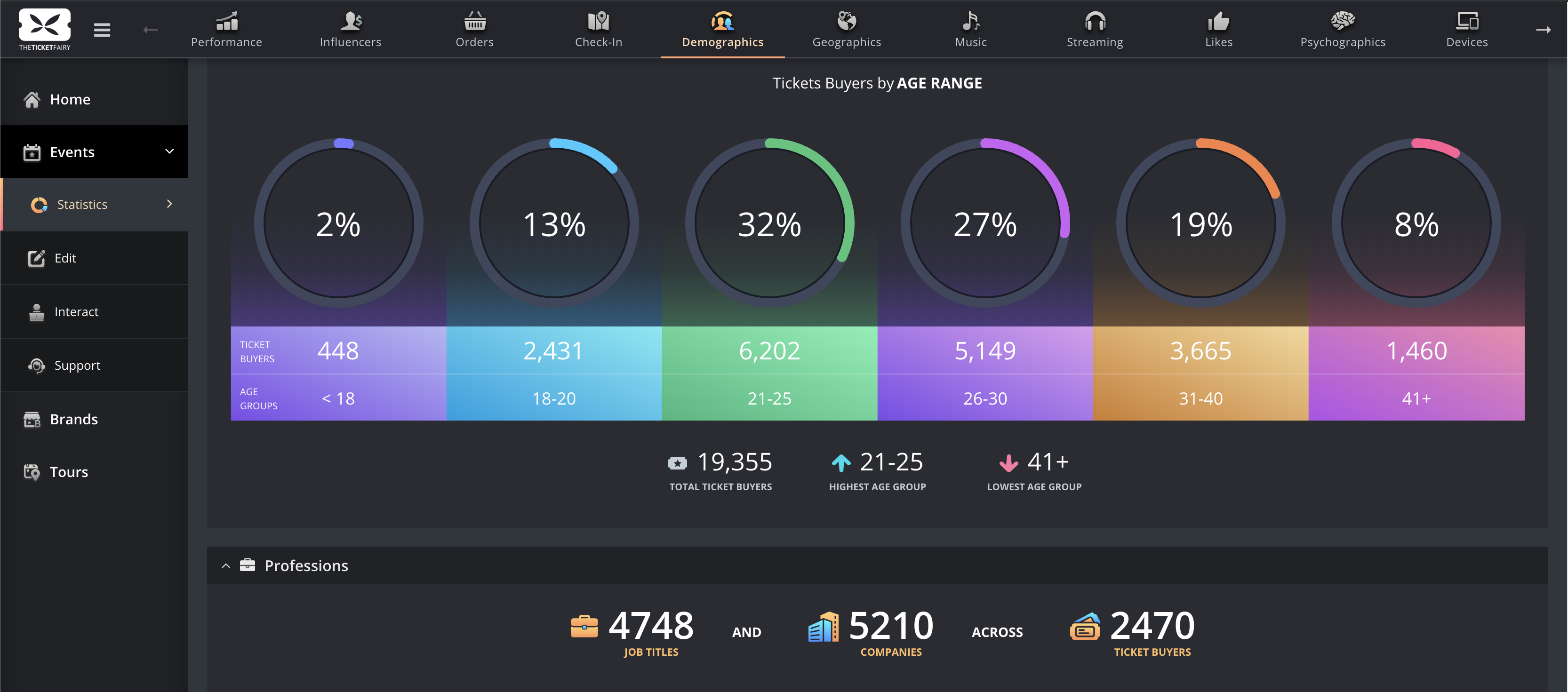
But The Ticket Fairy wants to wrestle control of venues away from Ticketmaster while giving fans ways to earn tickets for referring their friends. The startup is doing that by offering the most technologically advanced ticketing platform that not only handle sales and checkins, but acts as a full-stack Salesforce for concerts that can analyze buyers and run ad campaigns while thwarting scalpers. Co-founder Ritesh Patel says The Ticket Fairy has increased revenue for event organizers by 15% to 25% during its private beta focused on dance music festivals.

Now after 850,000 tickets sold, it’s officially launching its ticketing suite and actively poaching venues from EventBrite as it moves deeper into esports and conventions. With a little more scale, it will be ready to challenge Ticketmaster for lucrative clients.

Ritesh’s combination of product and engineering skills, rapid progress, and charismatic passion for live events after throwing 400 of his own has attracted an impressive cadre of angel investors. They’ve delivered a $2.5 million seed round for Ticket Fairy adding to its $485,000 pre-seed from angels like Twitch/Atrium founder Justin Kan, Twitch COO Kevin Lin, and Reddit CEO Steve Huffman. The new round includes YouTube founder Steve Chen, former Kleiner Perkins partner and Mark’s sister Arielle Zuckerberg, and funds like 500 Startups, ex-Uber angels Fantastic Ventures, G2 Ventures, Tempo Ventures, and WeFunder. It’s also scored music industry angels like Serato DJ hardware CEO AJ Bertenshaw, Spotify’s head of label licensing Niklas Lundberg, and celebrity lawer Ken Hertz who reps Will Smith and Gwen Stefani.

“The purpose of starting The Ticket Fairy was not to be another EventBrite, but to reduce the risk of the person running the event so they can be profitable. We’re not just another shopping cart” Patel says. The Ticket Fairy charges a comparable rate to EventBrite’s $1.59 + 3.5% per ticket plus payment processing that brings it closer to 6%, but Patel insists it offers far stronger functionality.

Constantly clad in his golden disco hoodie over a Ticket Fairy t-shirt, Patel lives his product, spending late nights dancing and taking feedback at the events his clients host. He’s been a savior of SXSW the past two years, injecting the aging festival that shuts down at 2am with multi-night after-hours raves. Featuring top DJs like Pretty Lights in creative locations cab drivers don’t believe are real, The Ticket Fairy’s parties have won the hearts of music industry folks.

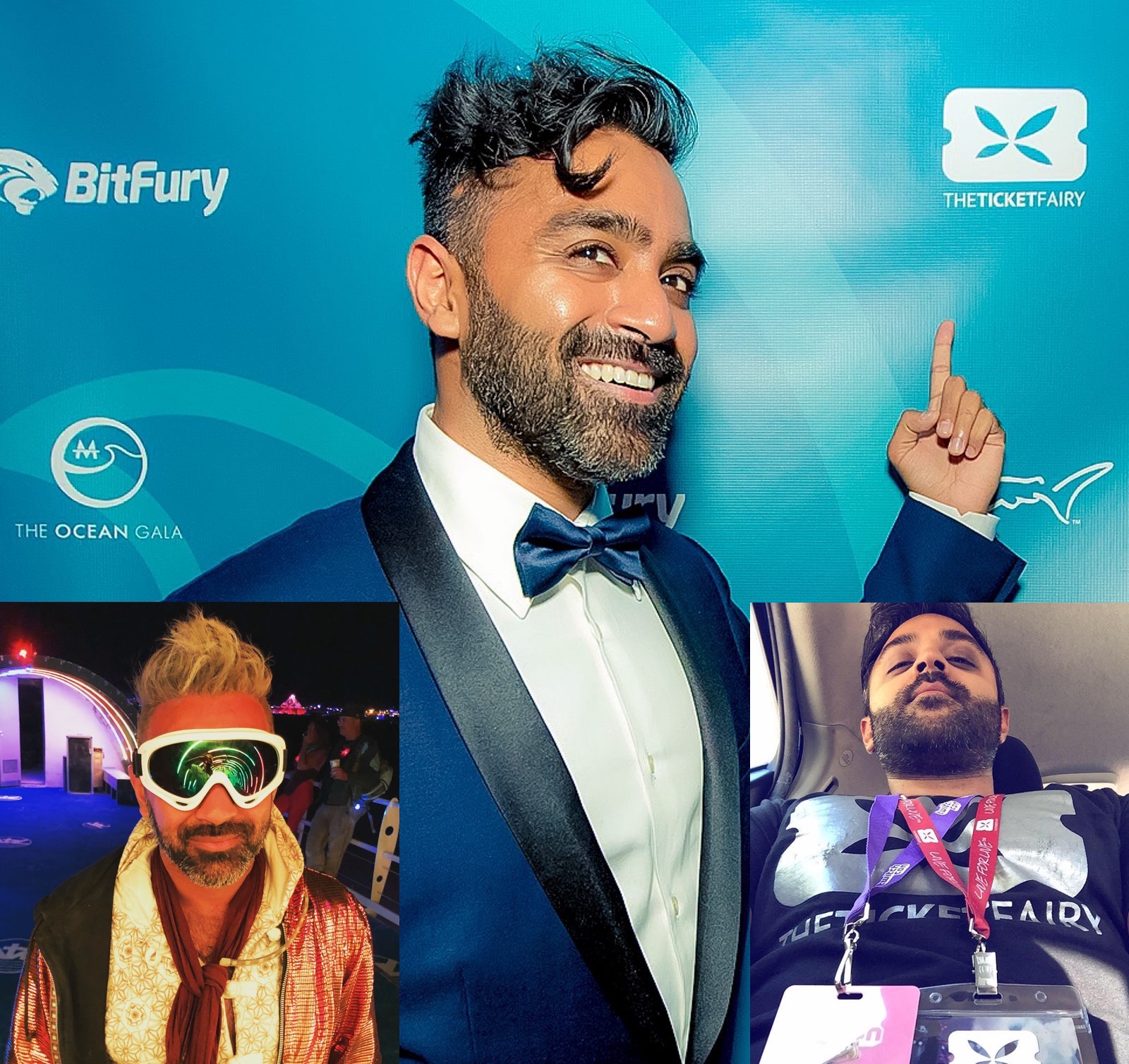
The Ticket Fairy co-founders. Center and inset left: Ritesh Patel. Inset right: Jigar Patel

Now the Y Combinator startup hopes its ticketing platform will do the same thanks to a slew of savvy features:

Earn A Ticket – The Ticket Fairy supercharges word of mouth marketing with a referral system that lets fans get a rebate or full-free ticket if they get enough friends to buy a ticket. 30% of ticket buyers are now sharing a Ticket Fairy referral link, and Patel says the return on investment is $30 in revenue for each $1 paid out in rewards, with 10% to 25% of all ticket sales coming from referrals. A public leaderboard further encourages referrals, with those at the top eligible for backstage passes, free merch, and bar tabs. And to prevent mass spamming, only buyers, partners, and street teamers get a referral code.

Creative Payment Options – The startup offers “FreeFund” tickets for free events that otherwise see huge no-show rates. Users pay a small deposit that’s refunded when they scan their ticket for entry, discouraging RSVPs from those who won’t come. Buyers can also pay on layaway with Affirm or LayBuy and then earn a ticket before their debt is due.

Anti-Scalping – The Ticket Fairy offers identity-locked tickets that must be presented with the buyer’s ID on arrival, which means customers can’t scalp them. Instead, the startup offers a waitlist for sold out events, and buyers can sell their tickets back to the company which then redistributes them at face value with a new QR code to a specific friend or whoever’s at the top of the waitlist. Patel says client SunAndBass Festival hasn’t had a scalped ticket in five years of working with the ticketer.

Clever Analytics – Never wasting an opportunity, The Ticket Fairy lets events collect contact info and demand before ticket sales start with its pre-registration system. It can ceate multiple variants of ticketing sites designed for different demographics like rock vs dance fans for a festival, track sales and demographics in real-time, and relay instant stats about checkins at the door. Integration of email managers like MailChimp and sales pixels like Facebook plus the ability to instantly retarget people who abandoned their shopping via Facebook Custom Audience ads makes marketing easier. And all the metrics, budgets, and expenses are automatically organized into financial reports to eliminate spreadsheet busywork.

Still, the biggest barrier to adoption remains the long exclusive contracts Ticketmaster and other giants like AEG coerce venues into in the US. Abroad, venues typically work with multiple ticket promoters who sell from the same pool, which is why 80% of The Ticket Fairy’s business is international right now. In the US, ticketing is often handled by a single company except for the 8% of tickets artists can sell however they want. That’s why The Ticket Fairy has focused on signing up non-traditional venues for festivals, trade convention halls, newly built esports arenas, as well as concert halls.

“Coming from the event promotion background, we understand the risk event organizers take in creating these experiences” The Ticket Fairy’s co-founder and Ritesh’s brother Jigar Patel explains. “The odds of breaking even are poor and many are unable to overcome those challenges, but it is sheer passion that keeps them going in the face of financial uncertainty and multi-year losses.” As competitors’ contracts expire, The Ticket Fairy hopes to swoop in by dangling its sales-boosting tech. “We get locked out of certain things because people are locked in a contract, not because they don’t want to use our system.”

The live music industry can brutal, though. Events can have slim margins, organizers are loathe to change their process, it’s a sales heavy process convincing them to try new software. But while record business has been redefined by streaming, ticketing looks a lot like it did a decade ago. That makes it ripe for disruption.

“The events industry is more important than ever, with artists making the bulk of their income from touring instead of record sales, and demand from fans for live experiences is increasing at a global level” Jigar concludes. “When events go out of business, everybody loses, including artists and fans. Everything we do at The Ticket Fairy has that firmly in mind – we are here to keep the ecosystem alive.”

06 Jun 2019

Zoom outperforms in first-ever earnings report

2019 is a great year for Zoom (Nasdaq:: ZM). The company outperformed analyst expectations on Thursday upon the release of its first earnings report.

The video communications business, which went public in one of the year’s most successful initial public offerings this April, posted revenues of $122 million for the three months ended April 30, 2019, an increase of 109% year-over-year.

The Zoom stock is rising in after-hours trading following the news. Zoom closed up 2 percent Thursday at just over $79 per share. The stock has been trading at more than double initial offering price in two months following its IPO.

“In our first quarter as a public company, strong execution and expanding adoption of Zoom’s video-first unified communications platform drove total revenue growth of 103% year-over-year,” Zoom founder and chief executive officer Eric Yuan said in a statement. “Delivering happiness to our customers is our number one priority. If we keep them happy, we believe we will succeed today and in the future.”

Zoom, once a relatively under-the-radar tech unicorn, continues to defy expectations. The company priced its IPO back in April at a meager $36 per share only to pop 81% at its Nasdaq debut.

This story is updating.

06 Jun 2019

AT&T’s WarnerMedia might be punting on its original streaming service plans

WarnerMedia’s plans for a three-tiered streaming service appear to be influx. The AT&T-owned company is reportedly scrapping that idea and opting instead to offer HBO, Cinemax and the library of Warner Bros. content in a single subscription service that would cost between $16 and $17 a month, Wall Street Journal reported citing unnamed sources.

The service would first be offered as a beta product later this year and could be offered broadly as early as next March.

TechCrunch will update the article if WarnerMedia responds to a request for comment.

This latest development follows a number of changes over at WarnerMedia, including the departure of HBO CEO Richard Pleper and Turner president David Levy.

Former NBC Entertainment chairman Bob Greenblatt has joined as chairman of WarnerMedia Entertainment and Direct-to-Consumer, putting him in charge of HBO, TBS, truTV and the WarnerMedia streaming service.

AT&T first opened up in November about its plans for its WarnerMedia streaming service. The company said at the time, that the service would have three tiers — an entry-level, movie-focused service; a premium tier with original programming and blockbusters as well as a bundle that includes them both.

During an earnings call a few months later,  AT&T CEO Randall Stephenson expounded on the service and said it would have a “two-sided business model.” The idea was to include subscription-based, commercial-free programming on the high-end as well as an entry-level portion of the service will be ad-supported, according to the Stephenson’s comments at the time..

Whatever the structure ultimately ends up being, the aim is to leverage the entertainment properties AT&T gained by way of its Time Warner acquisition last year.

06 Jun 2019

Zoox co-founder Jesse Levinson is coming to TC Sessions: Mobility

Autonomous vehicle startup Zoox has a history of keeping its progressive and plans to itself. But that’s starting to change.

The venture-backed company that is creating ground-up fully autonomous electric vehicles is ready to share a bit more about its tech, strategy and plans. And who better to talk to than co-founder and CTO Jesse Levinson, the person who oversees the company’s software, artificial intelligence, computing and sensing platforms.

We’re excited to announce that Levinson will join us onstage at TC Sessions: Mobility on July 10 in San Jose. TechCrunch will discuss with Levinson the tech that is driving the company’s autonomous vehicles, recent changes at Zoox, including its new CEO Aicha Evans, challenges facing the company and its deployment plans.

Levinson is among a group of insiders who participated in early government-backed competitions aimed at pushing the development of autonomous vehicles. While completing a computer science Ph.D. and postdoc under Sebastian Thrun at Stanford University, Levinson developed algorithms for the school’s winning entry in the 2007 DARPA Urban Challenge. He went on to lead the self-driving car team’s research efforts before joining Zoox.

Levinson also co-created a popular mobile photography app, Pro HDR, that has been purchased by more than a million people.

Levinson is just one of the many leaders in autonomous vehicles, scooters and electric mobility who will participate in TC Sessions: Mobility.

The agenda is packed with some of the biggest names and most exciting startups in the transportation industry, including Mobileye co-founder and CEO Amnon Shashua, Alisyn Malek with May Mobility, Dmitri Dolgov at Waymo, Karl Iagnemma of Aptiv, Seleta Reynolds of the Los Angeles Department of Transportation and Ford Motor CTO Ken Washington. With early-bird ticket sales ending soon, you’ll want to be sure to grab your tickets. Others include Katie DeWitt of Scoot, Argo AI’s chief safety officer Summer Fowler, Uber’s engineering director for Elevate Mark Moore and Stonly Baptiste, co-founder of early-stage venture capital fund Urban Us.

We have a few surprises too, including demos showcasing some cool tech and startups coming out of stealth.

The event will feature startup founders and industry experts and partake in discussions about the future of transportation, the promise and problems of autonomous vehicles, the potential for bikes and scooters, investing in early-stage startups and more.

Early-bird tickets are now on sale — save $100 on tickets before prices go up after June 14.

Students, you can grab your tickets for just $45.

06 Jun 2019

Is there potential for blockchain in copyright and licensing applications?

By all accounts, we appear to be in the early stages of a classic “hype cycle” about the potential for uses of blockchain technology. Careful analysts need to filter out that noise, but, as with all technology bubbles, there are blockchain skeptics, and blockchain enthusiasts.

I am somewhere in the middle — currency speculation, in my opinion, is nothing but a big distraction; it is improving information services that I am interested in. And I’m most interested in technologies that show promise in bringing more accuracy and efficiency to the worlds of copyright and licensing.

So, does blockchain technology show meaningful promise for real-world copyright and licensing applications? Let’s take a closer look.

What are blockchains, and why should I care?

What is a blockchain? Why are so many startups and techno-pundits going on and on about it? What sort of problems can it solve, and who has these problems? And, more importantly, what is it good for (in the sense of being useful)?

Simply and practically put, in this context a block is a unique number, derived mathematically through computing. This number is applied for a single use, which typically would be as the root identifier for a digital work of any sort. Examples of a work protected by such a blockchain would include a document (PDF) or the source code for a program, or a digital image, or anything in a fixed form represented in ones and zeroes.

Once established as the root identifier, any changes to the digital work are written — more numbers — into the blockchain, which is then distributed, through a network, to all the parties participating in this block, at each of whose “locations” third parties (including but not limited to “others involved with the work”) can see the applicable updated information. This distribution of updates explains why blockchains are categorized as “distributed digital ledgers,” such that the entire transaction history of any item provided with a blockchain is, in theory, always updated and available to inspection.

For the purposes of this article, any time I say “blockchain” I intend to refer to a distributed digital ledger technology, whether one that already exists, or is invented in the near future. I don’t mean any particular implementation. And, although the recent spate of articles talking about blockchain is probably a direct result of its association with cryptocurrencies, such as the well-known and controversial Bitcoin (although Ethereum and later implementations seem to represent an improvement on the original concept), I think it important to note that tradeable currency of any sort is not a necessary part of blockchain implementations.

Rather, as at the amusement park or in collecting comics, while it is always possible to use unique tokens to trade, it is not a required and inevitable result of using the technology. Rather, cryptocurrencies introduce an additional element to the theory and practice of blockchain — the token — which is an element of no concern to our focus here.

As with any promising and potentially disruptive technology, it will stand or fall on the usefulness it demonstrates in addressing real-world problems.

Of course, there are many applications for which blockchains simply aren’t suitable. A critical reader can easily find as many papers criticizing the hype around blockchain as a new “snake oil” as those suggesting that the technology holds promise.

For now, let’s assume that these limitations can and will be overcome in the next 3-5 years. Where might we be then — in terms of the potential for practical implementation of this technology — in addressing important problems surrounding licensing in copyright and perhaps other IP?

For one, copyright registrars or similar entities could create a blockchain to serve as a global registry, and then invite significant rightsholders and consumers in as nodes — this would meet the “no-personal-trust-required” mindset of blockchain enthusiasts. I’d see this as supplementary to existing systems and relatively fast to implement.

A blockchain-derived content identifier, when used in the service of creators and their works, could become one of many unique identifiers already in place, such as ISBN, ORCID, DOI, ISNI, ISRC and so forth. The International Standard Content Code (ISCC) is an experiment in exactly this vein.

The simplest and easiest fix to a copyright problem a simple blockchain might bring is the old (and nearly useless) “poor man’s copyright,” which boils down to creating a simple timestamp for your work by snail-mailing yourself a copy via the USPS. The folks over at Rightschain are seeking to take that old hack up a notch, although problems of cost-at-scale may limit broader feasibility.

Note, too, that blockchains are unlikely to be of much use in mitigating run-of-the-mill infringements; it is still just too easy to crop or screen-scrape or dumb-down the high-quality version of record and create a “good enough to pirate” version. And this is likely to remain true for some time.

Although I can foresee significant difficulties with the grayer areas of custom licensing, and may even be unhelpful when it comes to legitimate fair uses, blockchains might serve as a natural fit for storing the sale and terms of more routine licenses. For example, producing and distributing e-books. Self-executing contracts — ones that are limited to entries in the ledger — might be quite useful in such a context. Essentially, the license contract could include (or exclude) resale of the rights and the ledger could enforce it.

In the rarefied domain of copyright recordation, terminations and transfers, I can envision a blockchain that is quite useful in providing access to the public about updates in the reversion of rights back to a creator, or transfer to a new agent, or other recorded rights transactions of that sort.

As with any promising and potentially disruptive technology, it will stand or fall on the usefulness it demonstrates in addressing real-world problems to which answers are sought by real people. If there are costs — and there inevitably are costs — those who will bear them need to be convinced by clear creation of new value.

Not persuaded? I, too, remain skeptical. But on balance, I do wonder if, given the real-world content and rights issues that the industries that depend on copyright and licensing already have to deal with on a daily basis, a critical look a few steps ahead into a promising technology is warranted.

What do you think?

Disclosures: I own no cryptocurrencies, have never owned any and don’t expect to own any. I have no financial stake in any of the companies I have mentioned. 

06 Jun 2019

Voatz has raised $7 million in Series A funding for its mobile voting technology

Voatz, the four-year-old, Boston, Ma.-based voting and citizen engagement platform that has been at the center of debate over the merits and dangers of mobile voting, has raised $7 million in Series A funding. The round was co-led by Medici Ventures and Techstars, with participation from Urban Innovation Fund and Oakhouse Partners.

Voatz, which current employs 17 people, is modeled after other software-as-a-service companies but geared toward election jurisdictions, working with state and local governments to conduct elections and provide related election management and cybersecurity services.

As we’d reported back in March, the city of Denver agreed to implement a mobile voting pilot in its May municipal election using Voatz’s technology, an opportunity that was offered exclusively to active-duty military, their eligible dependents and overseas voters using their smartphones.

The company hasn’t yet shared how many people wound up using the platform. As Voatz cofounder and CEO Nimit Sawhney told us late yesterday, “Our most recent election in Denver CO finished last night on June 4th and the post election audit will be beginning shortly.”

Denver was not the company’s first pilot program. Rather, Voatz had conducted more than 30 pilots previously, including two in West Virginia last year that had attracted the financial backing of Tusk Philanthropies, the philanthropic operation of investor and strategist Bradley Tusk.

As for where Voatz will be used next, Sawhney says to “stay tuned. The next phase of our pilot programs will be announced by the relevant jurisdictions a bit later in the summer.”

Voatz has become the best-known mobile voting app up and running, which has also made it the target of some unflattering attention, including last summer, when numerous security experts criticized it roundly in a Vanity Fair piece, with one say it was “going to backfire,” another warning that the the “United States needs some form of vetting process for online voting in elections,” and a software expert separately calling Voatz an “horrifically bad idea.”

Apparently, investors, along with growing number of city and state governments, are still willing to bet that it’s better than what’s currently available.

Voatz had previously raised $2.2 million in funding led by the venture arm of Overstock.com.

06 Jun 2019

The 10 benefits and policies any modern workplace should have

Want to attract (and retain) top talent, making your company’s workforce more competitive and cutting down on turnover costs to boot? The simplest way to do so starts with the benefits and policies you offer to employees.

We already know that benefits play a major hand in how candidates evaluate a job offer. One recent survey conducted by Fairygodboss, the largest career community for women, in partnership with Extend Fertility, found that 87% of professional women say a benefits package is important or very important to them when interviewing at a company. Respondents stated that the presence (or absence) of certain benefits would impact their likelihood to stay at an employer, too.

So, which specific benefits and policies are the ones that will set your company apart as a modern, desirable workplace? We spoke to experts — from CEOs to heads of HR — to find out exactly what the benefits package of today’s most relevant employers looks like.

1. Summer Fridays

Giving employees a few extra hours to jumpstart their weekend through “Summer Fridays” can lead to a whole spate of positive benefits, including improved morale, focus and engagement at work, according to Brian Kropp, Group Vice-President of HR at Gartner . “Most companies have told us that with this benefit in place, they’ve found employees work harder earlier in the week because they know they have to complete their work before Friday,” Kropp said.

2. Pay transparency

Via Getty Image / abstractdesignlabs

The days of salary and bonus conversations happening only behind closed doors are long gone. Thanks to whisper networks and a growing belief in salary sharing, for many companies, this information is available with or without their consent. Companies who want to appear modern (as well as do the right thing) should embrace this trend through official pay transparency policies.

“Companies that don’t want to appear outdated have written pay, incentive and bonus plans for all employees at all levels so that how pay is calculated is not a mystery,” Sarah Morgan, Senior HR Director of SafeStreets USA, said.

“The compensation is equitable across gender and races so everyone is paid fairly based on the position, experience, skills and responsibilities. Such companies are also open about their pay policies and share general information about how much people are earning at every level. This may be shared as ranges or as specific amounts.”

3. Inclusion initiatives

06 Jun 2019

8 benefits and policies that are making your company seem outdated

The competition for top talent today is more fierce than ever. And when it comes to attracting and retaining that talent, we know that benefits play a major hand in how well an employer fares.

To that end, Fairygodboss, the largest career community for women, in partnership with Extend Fertility recently conducted research on the benefits today’s female talent cares most about. After surveying 1,000 professional women, we found a full 87% of them said a company’s benefits package was either important or very important to them when evaluating a job offer.

The presence — or lack thereof — of certain benefits also had a noticeable impact on respondents’ likelihood to stay at an employer. Given that, when a worker leaves a company, it can cost 33% of their annual salary to replace them, ensuring benefits packages are up to snuff is crucial for companies that want to avoid turnover.

Not all benefits are created equal, though. If the package at your company seems outdated, it’s possible you could actually be driving top talent away. So, we spoke to thought leaders — from CEOs to heads of HR — to find out which benefits and policies send a red flag to job seekers that an organization is behind the times. If your company’s handbook includes any of the following eight policies, it’s possible you’re seen as outdated, according to experts.

Check out our accompanying article highlighting the 10 benefits and policies any modern workplace should have on Extra Crunch.

1. Paid maternity leave is offered — but other leave benefits aren’t.

Image via Getty Images / Aleutie

Considering at least 40% of middle- and large-sized U.S. companies still offer zero paid maternity leave to employees, we’re not saying this benefit isn’t worth having. But as Sarah Morgan, a Senior HR Director of SafeStreets USA, said, to stop at a paid maternity leave benefit is to fail to acknowledge our expanding understanding of families and the ways those families need to be supported.

“The definition of family is changing, and people are living longer,” Morgan said. “Employees need more than just time away from work when they have a baby or someone dies. They also need time for school-aged children, aging parents, deployed spouses and even pets…when they need this time, they should not have to choose between their loved ones and financial hardship.”

2. There’s a gym reimbursement benefit.

Again, at face value, this isn’t exactly the worst benefit for a company to offer. The problem, as Tasia Duske, CEO of Museum Hack, put it, is that too many companies see a gym membership credit as checking off their “employee wellness” box in full.

“What if an employee wants to join a yoga studio, or what if they want a massage instead? Especially with millennial employees, defining what’s ‘healthy’ varies from person to person,” Duske said. “A smart benefit to provide is a Healthy Lifestyle Credit where there’s a lot more flexibility and no judgment. Employees can use their credit to pay for a visit to the dentist, tai chi lessons, to see a therapist or anything in between.”

3. Employees are beholden to a set time and place to work.

A lack of flexibility is one of today’s biggest tell-tale signs of an outdated employer, something Matthew Ross, Co-owner and COO of The Slumber Yard, spoke to. “We don’t have a set time employees need to be in the office by and we frequently allow them to work from home, coffee shops and sometimes even bars for a change of scenery,” Ross said.

“I know how mentally draining it can be to sit down at the same desk all day, so it’s nice when employees are able to leave and work from different locations. I believe this helps keep the work fresh and boosts overall morale.”

4. There’s a strict dress code.

Image via Getty Images / TatianaKrylova

Unless a uniform is legitimately required for a role, companies that mandate strict employee dress codes should seriously rethink these policies, said Greg Kuchcik, VP of HR at Zeeto.io. “Almost all companies have moved to a business casual at most with a lot of companies moving to no dress code altogether,” Kuchcik said.

“If you have strong HR/management and trusted employees, there is no reason that you can’t allow your workers to be comfortable all day, every day.” Nicole Green, HR and Employee Engagement Manager at Perfect Search Media, echoed this. “Casual dress can lead to an environment that is more open-minded and allows for focus on ideas over a dress code,” she said.

5. There are policies that restrict employees’ social media use.

Not long ago, it wasn’t uncommon for companies to have set policies in place that regulated employees’ use of and access to social media platforms. But now, such a policy makes a company look outdated, as Lucas Group’s Chief People Officer, Carolina King, said.

“I certainly feel that limiting employee’s access to social media is a thing of the past and detrimental to a company’s ability to attract top talent,” King said. “I also think when companies do not offer bring your own device (cell phone) programs or policies, they feel behind the times.”

6. Performance reviews are the only policy for sourcing employee feedback.

Research shows that 75% of the causes for employee turnover are preventable. But companies that remain married to an outdated model of performance review-based feedback miss out on opportunities to address those causes. “Performance reviews are often the only official opportunity for an employee to share concerns, ask questions, and have a conversation with a manager,” Vivek Kumar, a recruiter, said.

“However, performance reviews are also used by companies to determine bonuses and raises, which restricts employees from speaking freely and without fear of consequences. Implementing a system of continuous employee feedback is an excellent replacement for an uncomfortable, high-pressure quarterly or yearly performance review.”

7. There’s an official bereavement leave benefit or policy.

Image via Getty Images / Nataliia Kostiukova

On the surface, bereavement leave may seem like a humanitarian benefit for employers to offer. But by enforcing a set number of days for this kind of leave, companies are engaging in a form of employee hand-holding that has no place in the modern working world, said Cindy Harvey, CEO of Amelia Dee.

“Instead of dictating how long it should take someone to recover from an illness or to grieve, these policies should be more flexible, empower managers and employees to have conversations, and do what is right for the person and situation,” Harvey said. “Doing this also supports positive employee mental health and wellness practices in the workplace, two critical issues in workplaces today.”

8. There’s unlimited PTO.

A policy of flexibility, as referenced earlier, is crucial for any employer that wants to remain relevant today. An increasingly trendy benefit in this space is unlimited paid time off; but research around the detriments of this policy may soon make it an outdated offering, argued Samuel Johns, HR Specialist and Office Manager at Resume Genius.

“On the face of it, unlimited PTO is a blessing, since an employee can theoretically take off the time they need to recenter and recharge themselves. However, recent 180-degree about-faces by several companies have revealed that unlimited PTO policies are unworkable, since employees end up toiling away with less PTO than they would using a standard PTO system,” Johns said.

“At Resume Genius, we do offer unlimited PTO, but we also have a minimum PTO requirement of 10 days a year. On top of that, managers are notified if their team members haven’t taken a day off in the last six months, and are asked to schedule them some much-deserved time off.”

Check out our accompanying article highlighting the 10 benefits and policies any modern workplace should have on Extra Crunch.


06 Jun 2019

Jeff Bezos wants to build the infrastructure for space startups

At its re:Mars conference, Amazon’s CEO Jeff Bezos took the stage today to be “interviewed” by Jenny Freshwater, Amazon’s director of forecasting. As any AWS machine learning tool could have forecasted, having an employee interview her boss didn’t lead to any challenging questions or especially illuminating answers, but Bezos did get a chance to talk about a variety of topics, ranging from business advice to his plans for Blue Origin.

We can safely ignore the business advice, given that Amazon’s principle of “disagree and commit” is about as well known as it could be, but his comments about Blue Origin, his plans for moon exploration and its relationship to startups were quite interesting.

He noted that we now know so much more about the moon than ever before, including that it does provide a number of resources that make it a good base for further space exploration. “The reason we need to go to space is to save the Earth,” he said. “We are going to grow this civilization — and I’m talking about something that our grandchildren will work on — and their grandchildren. This isn’t something that this generation is able to accomplish. But we need to move heavy industry off Earth.”

Building up the infrastructure for this is obviously expensive, though. “Infrastructure is always expensive,” he said. “Amazon was easy to start in 1994 with a small amount of capital because the transportation system already existed.” Similarly, the payment system, in the form of credit cards, was already in place, as was the telecom network.

“You cannot start an interesting space company today from your dorm room. The price of admission is too high and the reason for that is that the infrastructure doesn’t exist,” Bezos noted. “So my mission with Blue Origin is to help build that infrastructure, that heavy lifting infrastructure that future generations will be able to stand on top of the same way I stood on top of the U.S. Postal Service and so on.”

The obvious follow-ups here would have been about how Amazon is now building its own logistics network and replacing the U.S. Postal Service with its own delivery services.

Once the Amazon space station opens, Bezos expects that the first deliveries will be of liquid hydrogen and liquid oxygen. “It’s going to be a small selection but a very important one,” he joked.

Either way, though, it’s clear that Bezos does see Blue Origin as having a vital mission for the future of mankind. In that, he shares his passion with Elon Musk and other space entrepreneurs.

It’s worth noting that Amazon already offers satellite ground stations as a service and is looking to offer space-based internet access with Project Kuiper.

Bezos’s fireside chat was briefly interrupted by a protestor, who urged the billionaire to “save the animals.” As far as conference protests go, this one was pretty mild, though the fact that the protestor made it onto the stage probably means that Amazon will step up security at its next events and that somebody on the security team is going to have to disagree and commit.