Category: UNCATEGORIZED

06 Jun 2019

Thumbtack is raising up to $120M on a flat valuation

Thumbtack, one of the first players in what is now known as the gig economy, has hit the fundraising circuit once again.

The online services marketplace that matches customers with nearby professionals is raising up to $120 million in Series H shares, according to a Delaware stock authorization filing uncovered by the Prime Unicorn Index. Thumbtack did not immediately respond to a request for comment.

At more than 10 years old, the business has previously raised nearly $300 million in a combination of debt and equity funding. The upcoming round comes at a flat valuation to its 2015 Series G funding of $125 million, which valued Thumbtack at $1.3 billion. Scottish asset manager Baillie Gifford led that round, which increased its valuation roughly 60 percent from $804 million, according to PitchBook.


Thumbtack’s funding history

June 2009: $650,000 Series A | $3.3M valuation

Jan. 2012: $4.4B Series C | $16.5M valuation

June 2013: $12.5M Series D | $46.5M valuation

May 2014: $30M Series E | $230M valuation

Aug. 2014: $100M Series F | $804M valuation

Sept. 2015: $125M Series G | $1.3B valuation

June 2019: ~$120M Series H | ~$1.3B valuation

Source: PitchBook


As Thumbtack has worked its way through the fundraising alphabet, the business has sought acquisition offers, TechCrunch has learned. Ahead of filing to raise another 9-digit round, we’ve heard Thumbtack was exploring M&A opportunities with a competing or complimentary companies.

Raising venture capital at a flat valuation is typically a sign a company’s investors are dubious of the business’s future prospects. It’s possible an acquisition deal fell through and Thumbtack, not yet prepared for an initial public offering, turned back to its investors for a necessary capital infusion.

Founded by Marco Zappacosta, whose parents were the founders of Logitech, Thumbtack helps professionals find work close by from home maintenance, to gardening, to DJing a party. The business is supported by investment firms such as CapitalG, Sequoia Capital and Draper Associates, as well as individual investors Scott Banister, Cyan Banister and Jason Calacanis, among others.

Here’s a full look at Thumbtack’s Delaware stock authorization:

06 Jun 2019

Here’s why you should exhibit in Startup Alley at Disrupt SF 2019

Don’t miss your chance to navigate your early-stage startup through an ocean of opportunity at Disrupt San Francisco 2019, our flagship event that takes place October 2-4. We’re talking about exhibiting in Startup Alley, the entrepreneurial heart and soul of every Disrupt.

Exhibiting in the Alley places your business in the path of more than 10,000 attendees and 400 media outlets. Cash, media coverage and customers are essential elements for early startup success and, whether you’re looking for investors, a profile by an accredited tech journalist or to build relationships with prospective customers, you’ll increase your odds significantly when you show your stuff in Startup Alley.

Last year, exhibitors using CrunchMatch — our attendee networking platform — scheduled more than 1,300 meetings and collectively raised $31 million in the months following Disrupt SF 2018. Not too shabby, right?

You have two ways to score an exhibitor table in Startup Alley. First up, founders of early-stage startups in any tech category can buy a Startup Alley Exhibitor Package. The package includes three Founder passes and one day to exhibit your startup. You also get full access to all three days at DSF ’19 — including the Startup Battlefield competition, speakers, workshops, Q&A Sessions, the complete attendee list via Disrupt Mobile App, CrunchMatch and a bunch more perks.

If you like free (and who doesn’t?), you’re going to love the other way to exhibit in Startup Alley. Apply to participate in our TC Picks program. Important note: To qualify, your startup must fall into one of these tech categories: AI + Machine Learning, Biotech + Healthtech, Blockchain, Fintech, Mobility, Privacy + Security, Retail + E-commerce, Robotics + IoT + Hardware, SaaS and Social Impact + Education.

TechCrunch editors vet each application and hand-pick up to five startups to represent each category. It’s a selective, competitive process, but if you’re chosen you’ll get a free Startup Alley Exhibition Package good for one full day of exhibiting in Startup Alley. You also receive three Founder passes, CrunchMatch, the complete Disrupt SF 2019 press list and invitations to special events at Disrupt SF — plus a boatload of media and investor attention.

Chart your course for success in Startup Alley at Disrupt San Francisco 2019. No matter how you get there, it’s a stellar opportunity to find new customers, get media attention and meet future investors. Join us!

Is your company interested in sponsoring at Disrupt SF 2019? Contact our sponsorship sales team by filling out this form.

06 Jun 2019

Destiny 2 goes free to play and gains cross-saving on all platforms

Bungie aims to fortify the popular but flagging Destiny 2 with an expanded free-to-play plan and universal cross-platform saving, the company announced today. It’s an interesting and player-friendly evolution of the “games as a service” model, and other companies should take note.

The base game, which is to say the original campaign and the first year of updates, will be available on PC, Xbox One, PlayStation 4, and Google Stadia. You can play as much as you want, and your progress will be synced to your account, so you can do some easy patrols on console and then switch to your PC’s mouse and keyboard for the more difficult raids.

The PS4 cross-save ability is a surprise, since Sony has resisted this sort of thing in the past and rumors had it before the announcement that they would be left out of the bargain. It’s heartening to see this level of cooperation, if that’s what it is, in the new gaming economy.

As part of Bungie’s separation from Activision, which published Destiny 2 to begin with, the game is now switching over to Steam on the PC. That’s probably a good thing for most, and you won’t lose any progress. It’s also being renamed “Destiny: New Light,” because why not?

Importantly, no platform will have any content advantage over another — no Xbox-specific guns or PC-specific levels. At a time when consoles are fighting one another on the basis of exclusives, this is a breath of fresh air.

The news was announced in a stream this morning, though players got a sneak peak when a publication I shall not name posted it slightly early. But we also learned more ahead of Bungie’s announcement when Google’s Stadia event showed the game coming to the streaming service in free form.

Destiny 2 came out two years ago and has had a number of expansions — and has also been free for limited times or platforms a handful of times. The base game was really a bit threadbare and honestly may not convince new players that it’s worth it to pay. But the price is right and if you like the basic gameplay the expansions, which improved considerably on the game and added a lot of contents, can be bought year by year.

The move is obviously meant to help Destiny 2 compete with other games-as-services, such as the constantly improving Warframe and youth-devouring Fortnite. And it’s a good test bed for the new cross-platform economy that gamers are beginning to demand. You’ll be able to test it out for yourself on September 17, when the switchover is set to take effect — more details should be available well ahead of the relaunch.

06 Jun 2019

Vive Pro Eye launches in US, costs four times as much as Rift S

HTC had the hottest VR headset out of the gate in 2016, but the thinning margins on consumer hardware thanks to Oculus have pushed them into the enterprise business.

Today, the company released the Vive Pro Eye headset, its latest enterprise play that integrates eye-tracking camera to give users an additional input mode and a way for users to signal attention. It’s available in a bundle with SteamVR 2.0 base stations and Vive controllers for $1,599.

The only difference over the previous-generation Vive Pro (with a $1,399 bundle price) is the eye-tracking capabilities. The $200 premium for that feature seems a bit healthy, but I suppose you don’t need much of an excuse to charge enterprise users more.

As a consumer, there’s really no reason to buy this. Few titles are going to boost eye-tracking support until more consumer-grade headsets integrate the tech. It’s worth contrasting the price point here with other headsets like the Valve Index which is several hundred dollars less and then the Rift S which is $1,200 less.

06 Jun 2019

Protecting the integrity U.S. elections will require a massive regulatory overhaul, academics say

Ahead of the 2020 elections former Facebook chief security officer Alex Stamos and his colleagues at Stanford University have unveiled a sweeping new plan to secure U.S. electoral infrastructure and combat foreign campaigns seeking to interfere in U.S. politics.

As the Mueller investigation into electoral interference made clear, foreign agents from Russia (and elsewhere) engaged in a strategic campaign to influence the 2016 U.S. elections. As the chief security officer of Facebook at the time, Stamos was both a witness to the influence campaign on social media and a key architect of the efforts to combat its spread.

Along with Michael McFaul, a former ambassador to Russia, and a host of other academics from Stanford, Stamos lays out a multi-pronged plan that incorporates securing U.S. voting systems, providing clearer guidelines for advertising and the operations of foreign media in the U.S. and integrating government action more closely with media and social media organizations to combat the spread of misinformation or propaganda by foreign governments.

The paper lays out a number of suggestions for securing elections including:

  • Increasing the Security of the U.S. Election Infrastructure
  • Explicitly prohibit foreign governments and individuals from purchasing online advertisements targeting the American electorate
  • Require greater disclosure measures for FARA-registered foreign media organizations.
  • Create standardized guidelines for labeling content affiliated with disinformation campaign producers.
  • Mandate transparency in the use of foreign consultants and foreign companies in U.S. political campaigns.
  • Foreground free and fair elections as part of U.S. policy and identifying election rights as human rights
  • Signal a clear and credible commitment to respond to election interference.

A lot of heavy lifting by Congress and media and social media companies would be required to enact all of these policy recommendations and many of them speak to core issues that policymakers and corporate executives are already attempting to manage.

For lawmakers that means drafting legislation that would require paper trails for all ballots and improve threat assessments of computerized election systems along with a complete overhaul of campaign laws related to advertising, financing, and press freedoms (for foreign press).

The Stanford proposals call for the strict regulation of foreign involvement in campaigns including a ban on foreign governments and individuals from buying online ads that would target the U.S. electorate with an eye toward influencing elections. The proposals also call for greater disclosure requirements indicating articles, opinion pieces or media produced by foreign media organizations. Furthermore, any campaign working with a foreign company or consultant or with significant foreign business interests should be required to disclose those connections.

Clearly, the echoes of Facebook’s Cambridge Analytica and political advertising scandals can be heard in some of the suggestions made by the paper’s authors.

Indeed, the paper leans heavily on the use and abuse of social media and tech as a critical vector for an attack on future U.S. elections. And the Stanford proposals don’t shirk from calling on legislators to demand that these companies do more to protect their platforms from being used and abused by foreign governments or individuals.

In some cases companies are already working to enact suggestions from the report. Facebook, Alphabet, and Twitter have said that they will work together to coordinate and encourage the spread of best practices. Media companies need to create (and are working to create) norms for handling stolen information. Labeling manipulated videos or propaganda (or articles and videos that come from sources known to disseminate propaganda) is another task that platforms are undertaking, but an area where there is still significant work to be done (especially when it comes to deepfakes).

As the report’s author’s note:

Existing user interface features and platforms’ content delivery algorithms need to be utilized as much as possible to provide contextualization for questionable information and help users escape echo chambers. In addition, social media platforms should provide more transparency around users who are paid to promote certain content. One area ripe for innovation is the automatic labeling of synthetic content, such as videos created by a variety of techniques that are often lumped under the term “deepfakes”. While there are legitimate uses of synthetic media technologies, there is no legitimate need to mislead social media users about the authenticity of that media. Automatically labeling content, which shows technical signs of being modified in this manner, is the minimum level of due diligence required of the major video hosting sites.

There’s more work that needs to be done to limit the targeting capabilities for political advertising and improving transparency around paid and unpaid political content as well, according to the report.

And somewhat troubling is the report’s call for the removal of barriers around sharing information relating to disinformation campaigns that would include changes to privacy laws.

Here’s the argument from the report:

At the moment, access to the content used by disinformation actors is generally restricted to analysts who archived the content before it was removed or governments with lawful request capabilities. Few organizations have been able to analyze the full paid and unpaid content created by Russian groups in 2016, and the analysis we have is limited to data from the handful of companies who investigated the use of their platforms and were able to legally provide such data to Congressional committees. Congress was able to provide that content and metadata to external researchers, an action that is otherwise proscribed by U.S. and European law. Congress needs to establish a legal framework within which the metadata of disinformation actors can be shared in real-time between social media platforms, and removed disinformation content can be shared with academic researchers under reasonable privacy protections.

Ultimately, these suggestions are meaningless without real action from the Congress and the President to ensure the security of elections. As the events of 2016  — documented in the Mueller report — revealed there are a substantial number of holes in the safeguards erected to secure our elections. As the country looks for a place to build walls for security, perhaps one around election integrity would be a good place to start.

06 Jun 2019

Instagram one-ups TikTok with karaoke lyrics

Lip-syncing jumpstarted TikTok’s rise to the center of teen culture, arguably displacing Instagram . Now the Facebook-owned app is striking back with a new feature that lets you displays lyrics on your video Story synced to a soundtrack you’ve added with the Music sticker. Lyrics could help creators and their fans sing along, and the visual flare could make the amateur MTV content more watchable.

Instagram scored a big endorsement from teen scare-pop phenomenon Billie Eilish who’s featured in the demo video for Story lyrics, which are now available in all the countries where Instagram Music has launched including the US, Germany, and France.

To play with the feature, first select the Music lens type (amidst Boomerang and other options) before you shoot or the Music sticker after. Once you pick a song, you’ll see lyrics pop up which can help you cue the segment of the music you want to play. Then you can cycle through a bunch of animation styles like traditional karaoke teleprompter, a typewriter version that preserves mystery by only revealing lyrics as they’re sung, and big flashy billboard font.

“Music can be a big part of expression on Instagram – between adding music to Stories, connecting with artists, sending song recs back-and-forth, there are lots of ways to connect with music on IG” an Instagram spokesperson tells me. “Now, we’re building on our music features and introducing the ability to add lyrics when you add a song to your story.” As with pretty much everything Instagram launches, it was first dug out of Android code and revealed to the world by frequent TechCrunch tipster and reverse engineering master Jane Manchun Wong. She first spotted Lyrics in March and we wrote about the prototype in April.

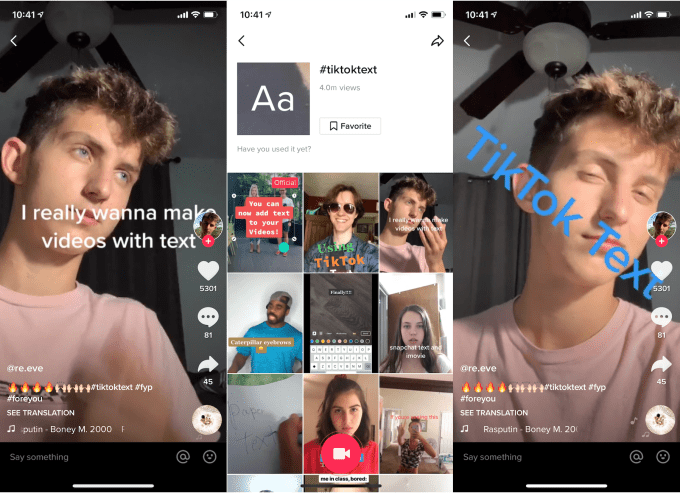
But TikTok isn’t waiting up. Today it launched its own text feature for adding overlaid captions to videos. Typically, creators had to use Snapcat, Instagram Stories, or desktop editing software to add text. Creators are sure to find plenty of hilarious use cases for text on TikTok, and it could help replace the common trope of writing captions on paper and holding them up during clips.

All of these features are about keeping social video from going stale. The manicured, painstakingly posed Instagram aesthetic is over, as The Atlantic’s Taylor Lorenz deftly identified. Fans are sick of perfection, which breeds envy and feels plastic or inauthentic. Comedy, absurdity, and the rough edges of reality are becoming the new ‘look’ of social media. Tools to overlay lyrics and text give creators more freedom to express complex jokes or just act silly. The popularity of Billie Eilish’s own dirtbag chic fashion and willingness to reveal her own insecurities exemplifies this shift, so it’s smart Instagra

06 Jun 2019

Self-driving delivery van startup Gatik AI comes out of stealth with Walmart partnership

Gatik AI, an autonomous vehicle startup that came out of stealth Thursday with $4.5 million in funding and Walmart as a customer, is aiming for the sweet middle spot in the world of logistics.

The company, which operates out of Palo Alto and Toronto, isn’t deploying autonomous delivery bots built for sidewalks, nor is it aiming for self-driving trucks, or even robotaxis to shuttle around people. Instead, the founders of Gatik AI are developing a business that will do short hauls of goods between businesses using autonomous light-commercial trucks and vans.

The Ford transit vehicles outfitted with Gatik’s self-driving system will drive up to 200 miles a day and stay within a city environment, co-founder and CEO Gautam Narang told TechCrunch. He believes the company can close the gap in the market through a variety of use cases, including partnering with third-party logistics giants like Amazon, FedEx or even the U.S. Postal Service, auto part distributors, consumer goods, food and beverage distributors as well as medical and pharmaceutical companies.

The strategy has attracted a number of investors and at least one major partner: Walmart. Gatik AI has raised $4.5 million in a seed round led by former CEO and executive chairman of Google Eric Schmidt’s Innovation Endeavors. Other investors include AngelPad, Dynamo Fund, Fontinalis Partners, Trucks Venture Capital and angel Lior Ron, who heads Uber Freight.

Dror Berman, a founding partner at Innovation Endeavors, is now a Gatik board member.

“There is a huge gap between autonomous Class 8 big rig trucks, which can only operate on highways, and smaller automated vehicles such as sidewalk robots and Nuro vehicles, which are restricted by operation speed, capacity, distance, and the curb. Gatik fills the critical ‘middle mile’ part of logistics, which is only becoming more valuable as a layer in the $800 billion logistics ecosystem,” said Reilly Brennan, founding general partner at Trucks Venture Capital.

The capital will allow Gatik — the name means progressive or speed in Sanskrit —  to expand its team and launch additional commercial services this year.

Narang co-founded the company with his brother Arjun Narang, who is CTO, and chief engineer Apeksha Kumavat. The company has been testing its autonomous vehicle technology on public roads in California for about 18 months.

The trio, which previously founded rehabilitation robotics tech startup Maverick Robotics, contends that their autonomous vehicle technology and approach, if scaled, can reduce the cost of last-mile delivery for businesses by 50% and improve safety.

Walmart could be one such customer. Gatik didn’t provide many details about the deal with Walmart, only to say that it’s launching a service with Walmart in the coming weeks.

The U.S. retail giant has already shown it has a keen interest in autonomous vehicle technology. Last year, Walmart and self-driving vehicle company Waymo announced a partnership in Arizona. Under the test program, members of Waymo’s early rider program were offered grocery savings when they shop from Walmart.com. The riders will be able to take a Waymo car to their nearby Walmart store for grocery pickup when the order is ready.

Walmart also signed a deal in January with startup Udelv to test the use of autonomous vans to deliver online grocery orders to customers. Under the agreement, Udelv will provide its second-generation autonomous delivery van, called the Newton, to Walmart to deliver groceries in Surprise, Ariz.

Gautam Narang says third-party logistics companies are also a particularly good opportunity.

“There’s a huge push, where these companies are trying to build micro-fulfillment centers close to the customer,” Narang said. “So moving goods from a warehouse to these micro centers is one of the use cases that we’re targeting. This is perfect for scaling and commercialization of autonomous technology.”

06 Jun 2019

VC and Warriors’ minority owner Mark Stevens banned from NBA Finals after shoving Kyle Lowry

Venture capitalist Mark Stevens has been banned from the rest of the NBA Finals after last night shoving Toronto Raptor’s player Kyle Lowry and hurling expletives at him after Lowry crashed into a row of seats. Notably, Stevens was not in the same row but rather can be seen on video rising from his chair behind the row to push the NBA star as he tried to regain his footing.

The episode is an embarrassment to the Warriors, as Stevens, a former Sequoia Capital partner who spent nearly 23 years with the firm and today manages his own money through a family office called S-Cubed Capital, is a minority owner of the team as well as an executive board member.

The Warriors issued a statement about the episode this morning, writing:

Mr. Stevens’ behavior last night did not reflect the high standards that we hope to exemplify as an organization. We’re extremely disappointed in his actions and, along with Mr. Stevens, offer our sincerest apology to Kyle Lowry and the Toronto Raptors organization for this unfortunate misconduct. There is no place for such interaction between fans — or anyone — and players at an NBA game.

Mr. Stevens will not be in attendance at any of the remaining games of the 2019 NBA Finals. Review of this matter is ongoing.

Meanwhile, a shaken Lowry said last night of Stevens, who had not yet been identified at the time: “The fans have a place; we love our fans. But fans like that shouldn’t be allowed to be in there, because it’s not right. I can’t do nothing to protect myself. But the league does a good job, and hopefully they ban him from all NBA games forever.”

Lowry hasn’t commented since the news broke that Stevens is the individual who shoved him.

Stevens was featured in March of this year on Forbes’s list of the world’s (then) 2,153 billionaires. Ranked at spot 962, Stevens is believed by the outlet to have amassed a fortune of $2.3 billion. He bought a stake in the Warriors’ franchise in 2013.

06 Jun 2019

Twitter’s updated T&Cs look clearer — yet it still can’t say no to nazis

Twitter has taken a pair of shears to its user rules, shaving almost 2,000 words off of its T&Cs — with the stated aim of making it clearer for users what is not acceptable behaviour on its platform.

It says the rules have shrunk from 2,500 words to just 600 — with each of the reworded rules now encapsulated within a pithy tweet length (280 characters or less).

Though each tweet-length rule is still followed by plenty of supplementary detail — where Twitter explains the rationale behind it and provides examples of what not to do, and details of potential consequences. So the full rule-book is still way over 2,500 words.

“Everyone who uses Twitter should be able to easily understand what is and is not allowed on the service,” writes Twitter’s Del Harvey, VP of trust and safety, in a blog post announcing the changes. “As part of our continued push towards more transparency across every aspect of Twitter, we’re working to make sure every rule has its own help page with more detailed information and relevant resources, with abuse and harassment, hateful conduct, suicide or self-harm, and copyright being next on our list to update. Our focus remains on keeping everyone safe and supporting a healthier public conversation on Twitter.”

The newly reworded rules can be found at: twitter.com/rules

We’ve listed the tweet-sized rules below, without any of their qualifying clutter:

  • You may not threaten violence against an individual or a group of people. We also prohibit the glorification of violence.
  • You may not threaten or promote terrorism or violent extremism.
  • We have zero tolerance for child sexual exploitation on Twitter.
  • You may not engage in the targeted harassment of someone, or incite other people to do so. This includes wishing or hoping that someone experiences physical harm.
  • You may not promote violence against, threaten, or harass other people on the basis of race, ethnicity, national origin, sexual orientation, gender, gender identity, religious affiliation, age, disability, or serious disease.
  • You may not promote or encourage suicide or self-harm.
  • You may not post media that is excessively gory or share violent or adult content within live video or in profile or header images. Media depicting sexual violence and/or assault is also not permitted.
  • You may not use our service for any unlawful purpose or in furtherance of illegal activities. This includes selling, buying, or facilitating transactions in illegal goods or services, as well as certain types of regulated goods or services.
  • You may not publish or post other people’s private information (such as home phone number and address) without their express authorization and permission. We also prohibit threatening to expose private information or incentivizing others to do so.
  • You may not post or share intimate photos or videos of someone that were produced or distributed without their consent.
  • You may not use Twitter’s services in a manner intended to artificially amplify or suppress information or engage in behavior that manipulates or disrupts people’s experience on Twitter.
  • You may not use Twitter’s services for the purpose of manipulating or interfering in elections. This includes posting or sharing content that may suppress voter turnout or mislead people about when, where, or how to vote.
  • You may not impersonate individuals, groups, or organizations in a manner that is intended to or does mislead, confuse, or deceive others.
  • You may not violate others’ intellectual property rights, including copyright and trademark.

Notably the rules make no mention of fascist ideologies being unwelcome on Twitter’s platform. Although a logical person might be forgiven for thinking such hateful stuff would naturally be prohibited — based on the core usage principles Twitter is stating here (such as a ban on threatening and/or promoting violence against groups of people including on the basis of their race, ethnicity and so on).

But for Twitter nazi-ism remains, uh, ‘complicated’.

The company recently told Vice it’s working with researchers to consider whether or not it should ban nazis. Which suggests its new ‘pithier’ rules are missing a few qualifying asterisks.

Here, we fixed one:

  • You may not threaten violence against an individual or a group of people*. We also prohibit the glorification of violence**. *unless you’re a nazi **white supremacists totally get a pass while we mull the commercial implications of actually banning racist hate

Another abuse vector that continues to look like a blindspot in Twitter’s rule-book is sex.

While the company does include both ‘gender’ and ‘gender identity’ among the many categories it stipulates that users must not direct harassment, at or promote violence against, it does not offer the same shield based on a user’s sex. Which appears to have resulted in instances where Twitter has deemed tweets containing violent misogyny to not be in violation of its rules.

Last month a Twitter UK public policy rep told the parliamentary human rights committee, which had raised the issue of the violent sexist tweets, that it believed the inclusion of gender should be enough to protect against instances of violent misogyny, despite having demonstrably failed to do so in the selection of tweets the committee put to it.

We’ve asked Twitter about its continued decision not to prohibit harassment and threats of violence against users based on their sex, as well as its ongoing failure to ban nazis and will update this report with any response.

In addition to editing down the wording of its rules, Twitter says it has thematically organized them under three new categories — safety, privacy, and authenticity — to make it easier for users to find what they’re looking for.

Though it’s not quite as at-a-glance clear as that on the rules page — which also includes a general preamble; a note on wider content boundaries; a section dealing with spam and security; and an addendum on content visibility restrictions that Twitter may apply in cases where it suspects an account of abuses and is investigating.

But, as ever, algorithmically driven platforms are anything but simple.

Hideously wordy T&Cs have of course been a tech staple for years so it’s good to see Twitter paying greater attention to the acceptable conduct signals it gives users — and at least trying to boil down a clearer essence of what isn’t acceptable behavior, albeit tardily.

But, equally, refreshed wording of what’s unacceptable makes it plainer that Twitter retains stubborn blind-spots that allow its platform to be a conduct for targeted racial hatred.

Perhaps these blindspots are commercially motivated, in the case of far right ideologies. Or perhaps Twitter’s leadership is still so drunk on its own philosophical koolaid it really has fuzzed the lines between fascism and, er, humanity.

If that’s the case, no pithily written rules will save Twitter from itself.

Don’t forget, this is a company that has been promising to get a handle on its abuse problem for years. Including — just last year — making a grand stance about wanting to champion ‘conversational health‘.

Yet it still can’t screw its courage to the sticking place and say no nazis.

Twitter’s multi-year struggles to respond to baked in hate might be farcical at this point — if the human impacts of amplifying racial and ethnic hatred weren’t a tragedy for all concerned.

And had it found a moral compass when it was first being warned about the rising tide of amplified abuse, it’s entirely possible one of its most high profile users might not be a geopolitical mega-bully known to retweet fascist propaganda.

Chew on that, Jack.

06 Jun 2019

Unraveling the “Secrets of Sand Hill Road” and the VC thought process, with Andreessen Horowitz’s Scott Kupor

Extra Crunch offers members the opportunity to tune into conference calls led and moderated by the TechCrunch writers you read every day. This week, TechCrunch’s Connie Loizos sat down with Scott Kupor, managing director at venture capital firm Andreessen Horowitz to dig into his new book Secrets of Sand Hill Road, discuss his advice for new founders dealing with VCs and to pick his brain on the opportunities that excite him most today.

Scott gained inspiration for Secrets of Sand Hill Road after realizing he was hearing the same questions from different entrepreneurs over his decade in venture. The book acts as an updated guide on what VCs actually do, how they think and how founders should engage with them.

Scott offers Connie his take on why, despite the influx of available information on the venture world, founders still view VC as a black box. Connie and Scott go on to shed some light on the venture thought process, discussing how VCs evaluate new founders, new market opportunities, future round potential and how they think about investments that aren’t playing out as expected. 

“[Deciding on the right amount of money to raise] is one of the areas where I think people will rely on convention too much, rather than figuring out what makes sense for them. And what I mean by convention is, they say, “Hey, my friends down the street just raised a $7 million A round, so $7 million must be the right size for an A round.”

The way we try to help entrepreneurs think about it is think about the pitch that you’re going to give at the next round of financing. Let’s say you’re raising a Series A, imagine sitting here 18 or 24 months from now doing the Series B financing, what’s the story you’re going to want to be able to tell the investor then, as to what you accomplished over that last 18 to 24 months?

And then, almost work your way backwards to say, “If that’s the story that I want to tell, and we all agree that’s a compelling story where somebody will come in hopefully, and fund it at a valuation that’s higher to reflect the progress of the business, then let’s work our way back, and say “how do we de risk that?””

Image via Getty Images / Heidi Gutman/CNBC/NBCU Photo Bank

Connie and Scott also dive deeper into Andreessen Horowitz’ investing and post-investing structure, and what the future of the firm and its key investments may look like down the road.

For access to the full transcription and the call audio, and for the opportunity to participate in future conference calls, become a member of Extra Crunch. Learn more and try it for free. 

Connie Loizos: Hi, everyone. It’s time to kick off today’s call with Scott Kupor, a managing partner at the venture firm, Andreessen Horowitz, and more recently, the author of the book, Secrets of Sand Hill Road: Venture Capital and How to Get It. Thank you so much for making time for us today.

Scott, I’m still in the process of reading the book, but I have to say, much like your colleague, Ben Horowitz’s book, and this is really true, I’m really enjoying it.

Scott Kupor: Well, thank you.

Connie: It doesn’t really feel remotely like work, which I find to be true with the vast majority of business books.

Scott: Well, I appreciate that. I had great help from Ben [Horowitz] in terms of inspiration from his book. So I’m glad to hear that. Thank you very much.