Category: UNCATEGORIZED

06 Jun 2019

Facebook plans June 18th cryptocurrency debut. Here’s what we know

Facebook is finally ready to reveal details about its cryptocurrency codenamed Libra. It’s currently scheduled for a June 18th release of a white paper explaining its cryptocurrency’s basics, according to a source who says multiple investors briefed on the project by Facebook were told that date.

Meanwhile, the company’s Head of Financial Services & Payment Partnerships for Northern Europe Laura McCracken told German magazine WirtschaftsWoche‘s Sebastian Kirsch that the white paper would debut June 18th, and that the cryptocurrency would indeed be pegged to a basket of currencies rather than a single one like the US dollar to prevent price fluctuations. Kirsch tells me “I met Laura at Money2020 Europe in Amsterdam on Tuesday” after she watched fellow Facebook payments exec Paulette Rowe’s talk. “She told me that she wasn’t involved in what David Marcus’ [Facebook Blockchain] team was doing. But that I’d have to wait until June 18th when a whitepaper was supposed to be published to get more details.” She told him she thought the date was already a publicly known fact, which it wasn’t.

Then, yesterday TechCrunch received a request for a June 18th news embargo from one of the communications managers for Facebook’s blockchain team. The Information’s Alex Heath and Jon Victor also reported yesterday that Facebook’s cryptocurrency project would launch later this month.

Facebook declined to comment on any news regarding its cryptocurrency project. There is always a chance that the announcement date could fluctuate if snafus with partners or governments arise. One source says Facebook is targeting a 2020 formal launch of the cryptocurrency

The debut of Libra or whatever Facebook decides to call it could unlock a new era of commerce and payments for the social network. It could be used to offer low or no-fee payments between friends or remittance of earnings to familys from migrant workers abroad who are often gouged by money transfer services.

Sidestepping credit card transaction fees could also allow Facebook’s cryptocurrency to offer a cheaper way to pay merchants for traditional ecommerce, or facilitate microtransactions for a la carte news articles or tipping of content creators. And a better understanding of who buys what or which brands or popular could aid Facebook in ad measurement, ranking, and targeting to amplify its core business.

How Facebook’s cryptocurrency works

Here’s what we know about Facebook’s blockchain project:

Name: Facebook will likely use the Libra codename as the public facing name for its cryptocurrency, which The Information reports won’t be called GlobalCoin as the BBC had claimed. Facebook has registed a company called Libra Networks in Switzerland for financial services, Reuters reported. Libra could be a play on the word LIBOR, an abbreviation for the London Inter-bank Offered Rate that’s used as a benchmark interest rate for borrowing between banks. LIBOR is for banks, while Libra is meant to be for the people.

Token: The cryptocurrency will be a stablecoin — a token designed to have a stable price to prevent discrepancies and complications due to price fluctuations during a payment or negotiation process. Facebook has spoken with financial institutions regarding contributing capital to form a $1 billion basket of multiple international fiat currencies and low-risk securities that will serve as collateral to stabilize the price of the coin, The Information reports. Facebook is working with various countries to pre-approve the rollout of the stablecoin.
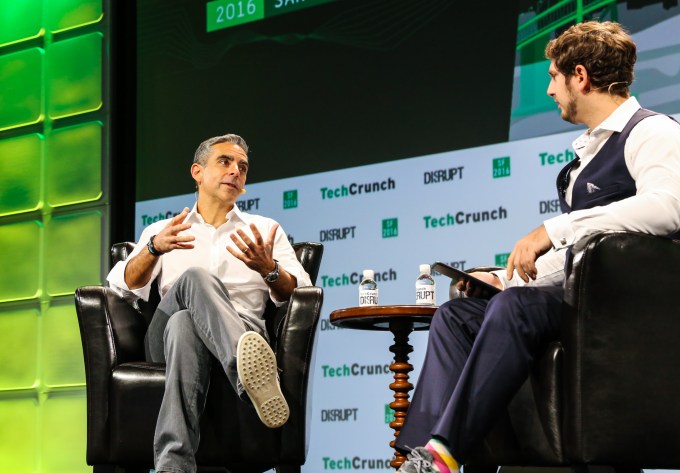
The head of Facebook’s Blockchain team David Marcus (left) speaks at TechCrunch Disrupt 2016

Usage: Facebook’s cryptocurrency will be transferrable with zero fees via Facebook products including Messenger and WhatsApp. Facebook is working with merchants to accept the token as payment, and may offer sign-up bonuses. The Information also reports Facebook also wants to roll out physical devices for ATMs so users can exchange traditional assets for the cryptocurrency.

Team: Facebook’s blockchain project is overseen by former PayPal President and VP of Facebook Messenger David Marcus. His team includes former Instagram VP of product Kevin Weil, Facebook’s former corporate head of treasury operations Sunita Parasuraman who The Information reports will oversee the token’s treasury, and many elite engineers cherrypicked from Facebook’s ranks. They’ve been working in a dedicated part of Facebook’s headquarters off-limits to other employees to boost secrecy, though the nature of the partnerships needed for launch have led to many leaks.

Governance: Facebook is in talks to create an independent foundation to oversee its cryptocurrency, The Information reports. It’s asking companies to pay $10 million to operate a node that can validate transactions made with its cryptocurrency in exchange for a say in governance of the token. It’s possible that node operators could benefit financially too. By introducing a level of decentralization to the governance of the project, Facebook may be able to avoid regulation related to it holding too much power over a global currency.

06 Jun 2019

Postmates taps longtime Apple engineer to lead autonomous delivery efforts

Postmates has hired Apple veteran and author Ken Kocienda as a principal software engineer leading Postmates X, the team building the food delivery company’s semi-autonomous sidewalk rover, Serve.

Kocienda, author of “Creative Selection: Inside Apple’s Design Process During the Golden Age of Steve Jobs,” spent 15 years at Apple focused on human interface design, collaborating with engineers to develop the first iPhone, iPad and Apple Watch. Kocienda left Apple in 2017 to focus on his book.

Now, he’s picked Postmates as his next project, citing the team’s spirit and energy as motivation for joining.

“My goal throughout my career has not been technology for the sake of opportunity, I am interested in making product experiences that people out in the world will find useful and meaningful,” Kocienda tells TechCrunch. “It’s not about the technology or just the design, it’s about the technology and design coming together.”


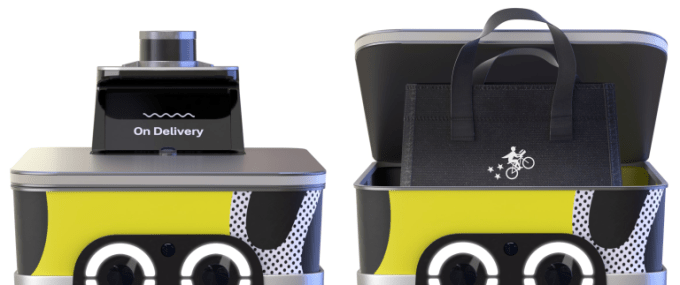
Postmates unveiled Serve, their human-like delivery robot, in December. The semi-autonomous rover uses cameras and lidar to navigate sidewalks and can carry 50 pounds for up to 25 miles after one charge. To ensure safety, the team has a human pilot remotely monitoring the Serve fleets, and each rover has a “Help” button, touchscreen and video chat display for customers or passers-by to use if necessary. The company said they had planned to roll out the bots in 2019, though no pilots have been officially announced yet.

Kocienda said he is working on a variety of tasks within the Postmates X team. Just yesterday, he was focused on creating more expressions for the robot.

“We are spending a lot of time going in and refining and inventing new ways that Serve can communicate,” he said. “It’s not like we are a robotics startup. We have a business rolling, so part of what is interesting to me is that we can mine the data we have and use the intelligence we have to improve the [Serve] experience end-to-end.”

The purpose of Postmates’ incoming fleet of semi-autonomous rovers is not to eliminate the role of human drivers but to make their routes more efficient. If, say, a Postmates customer orders food from a nearby restaurant, Serve could pick up the food, potentially even get back into a car with a human driver, then get back out of the car to complete the last-mile delivery. This saves the driver from sitting in traffic and gets the customer their food much faster, ideally.

One questions how humans might respond to these rovers, however, if they are roaming the streets independently. To protect them from damage or defacement, Postmates is making them as human-like as possible, complete with a set of “eyes.”

“We want to make it socially intelligent,” Kocienda explained. “We want people, when they see Serve going down the street, to smile at it and to be happy to see it there … It’s going to have this halo effect for Postmates. It’s going to be a brand ambassador for Postmates.”

Postmates, headquartered in San Francisco, is expected to go public later this year. Most recently, the company lined up a $100 million pre-IPO financing that valued the business at $1.85 billion. Postmates is backed by Tiger Global, BlackRock, Spark Capital, Uncork Capital, Founders Fund, Slow Ventures and others.

06 Jun 2019

Here are all of the trailers from today’s Google Stadia announcement

You know the deal: a console is nothing without games. Same goes for streaming plans. Google jumped the gun on E3 this week with its Stadia Connect, a livestream that takes more than a page or two from Nintendo’s Direct offering. The event offered a little more insight into pricing, availability and specs — and, mostly importantly showed off some of the titles coming to the streaming platform.

The list includes some familiar franchises and a couple of exclusives, which will be available for a $10 a month subscription fee or for individual purchase.

The first, Moonshine Studios/Coat Sink’s Get Packed will be a Stadia Exclusive at launch. The title brings Overcooked style game play to furniture packing — arguably the most frustrating thing in the world. The co-op title allows up to four players to participate, because you know how easy it is recruiting friends to help you move.

Bungie’s received Destiny sequel will be arriving on Stadia. The first-person shooter includes the new chapter, Shadowkeep, which features a return to the lunar surface.

Another Stadia exclusive, the single player puzzle adventure title Gylt features some dark, supernatural gameplay. The Tequila Works title centers on a young girl’s search for her missing cousin.

Google closed things out with a sizzle reel focused on the breadth of titles coming to the platform, including games from top tier publishers like Ubisoft, Take 2, SquareEnix, Warner Bros, Bandai Namco and Bethesda.

The service launches this November.

06 Jun 2019

Daily Crunch: Google is acquiring Looker

The Daily Crunch is TechCrunch’s roundup of our biggest and most important stories. If you’d like to get this delivered to your inbox every day at around 9am Pacific, you can subscribe here.

1. Google to acquire analytics startup Looker for $2.6 billion

Google Cloud has been mired in third place in the cloud infrastructure market, and grabbing Looker gives it an analytics company with a solid track record. The startup has raised more than $280 million in funding.

Like other big acquisitions, this deal is subject to regulatory approval, but it is expected to close later this year if all goes well.

2. Uber Copter offers on-demand JFK helicopter service for top-tier users

Uber is adding regular helicopter air service with Uber Copter — a new service line launched today that will provide on-demand transportation from Lower Manhattan to JFK airport for, on average, between $200 and $225 per person. That price includes car service to and from the helipad at each end.

3. In trying to clear ‘confusion’ over anti-harassment policy, YouTube creates more confusion

After a series of tweets that made it seem as if YouTube was ignoring its own anti-harassment policies, the video platform published a blog post in an attempt to clarify its stance. Instead, the post raises more questions about YouTube’s commitment to fighting harassment and hate speech on its platform.

4. Sources: Bird is in talks to acquire scooter startup Scoot

The stage of the negotiations is not clear, but it sounds like the deal is not closed. Both Scoot and Bird declined to comment.

5. Apple’s global accessibility head on the company’s new features for iOS 13 and macOS Catalina

“One of the things that’s been really cool this year is the [accessibility] team has been firing on [all] cylinders across the board,“ Apple’s Sarah Herrlinger told us. “There’s something in each operating system and things for a lot of different types of use cases.”

6. A first look at Amazon’s new delivery drone

The drone has an ingenious hexagonal hybrid design with very few moving parts, and Amazon says it’s chock-full of sensors and a suite of compute modules to keep the drone safe.

7. This year’s Computex was a wild ride with dueling chip releases, new laptops and 467 startups

Computex picked up the pace this year, with dueling chip launches by rivals AMD and Intel and a slew of laptop releases. (Extra Crunch membership required.)

06 Jun 2019

Barack and Michelle Obama are developing podcasts for Spotify

Spotify just announced a partnership with Barack and Michelle Obama’s production company Higher Ground.

Through this deal, Spotify says the Obamas will “develop, produce, and lend their voices to select podcasts, connecting them to listeners around the world on wide-ranging topics.”

Higher Ground was founded in 2018 as the Obamas signed a content partnership with Netflix. The company’s initial slate for Netflix was announced just over a month ago, covering everything from a Sundance documentary about industrial development in Ohio, to a scripted anthology adapted from a New York Times series profiling noteworthy names who didn’t previously receive Times obituaries.

Spotify, meanwhile, has been getting more serious about podcasting with the acquisition of startups Gimlet and Anchor, as well as by hiring longtime media executive Dawn Ostroff as its chief content officer.

Like the initial Netflix announcement, the release from Spotify doesn’t include launch dates or information about specific titles. As part of this collaboration, the production company will be launching Higher Ground Audio, a new division focused on podcasts.

“We’re excited about Higher Ground Audio because podcasts offer an extraordinary opportunity to foster productive dialogue, make people smile and make people think, and, hopefully, bring us all a little closer together,” said the former U.S. president in a statement.

06 Jun 2019

Google Stadia launches 4K game-streaming in November for $9.99/mo

We got the full rundown on Google’s Stadia game-streaming platform this morning in the company’s livestream launch ahead of E3 next week. The Stadia platform will let you play console-quality games across a variety of systems on the Chrome browser.

Top-level details are the company’s Stadia Pro service will launch in November for $9.99 per month. The price gets you 4K 60fps streaming but you’ll need at least a 35 mbps internet connection to get that speed. Alongside the streaming capabilities, you’ll get access to some Stadia games with the Pro subscription.

The company will be offering a Founders edition bundle that packages a Stadia copy of Destiny 2, the Stadia controller, a Chromecast Ultra and three months of the Pro service for $130. The Stadia controller alone will be $69.

Google will be offering a base subscription later that lets gamers who purchase titles from the Stadia store stream them for free at a lower resolution. This is a major announcement and something that Google really slid into the stream at the very end.

Updating


06 Jun 2019

Here’s how Google Stadia performs depending on your internet connection

Google is introducing more about the launch of its Stadia streaming gaming service today, and VP Phil Harrison gave us performance specifics today so you can see exactly how the company thinks the service will perform based on what kind of internet connection you have. It tops out at an impress 4K resolution, with HDR color, 60fps frame rate and 5.1 surround sound, but you’ll have to have at least a 35 Mbps connection to get that level of quality.

Meanwhile, at 20 Mbps you’ll get full HD 1080p output, while retaining HDR video, 60fps and 5.1 surround. And Google has optimized for smoothness of stream by retaining 60 fps all the way down to its recommended minimum bandwidth connection quality of 10 Mbps (and even potentially below that based on this chart). You’ll only get 720p streams at that level, however, and stereo instead of surround sound.

“With Stadia, our goal is to make gaming more accessible for everyone,” is how Harrison framed it, and that applies to its range of connection support as well as its device availability. At launch you’ll be able to play stadia games on your TV (via Chromecast Ultra), desktop, laptop, and tablet (via browsers) and on smartphones, though only Pixel phones to begin with starting with Pixel 3 and Pixel 3a (via dedicated Stadia app).

06 Jun 2019

Manifold’s Marketplace as a Service puts app marketplaces in reach of any developer

Manifold, a startup known for providing all of the tools developers need in a single marketplace, has decided to make its core product available as a service, so that other companies can build a catalogue of related services without a fuss.

Everyone wants to be a platform these days, but creating the infrastructure to offer a set of related services, often might not be worth the effort. Beyond developing the actual catalogue of services, it requires skills like collecting money and distributing revenue. Most companies don’t have the skill set or resources to set all of that up, and Manifold decided to use its expertise to help out.

Jevon MacDonald, co-founder and CEO says they set out to build a complete management solution when they released their initial product last year. “The way we do that is by bringing things like billing, a single transaction for a developer, account management, teams and all the sort of things you have to do every time you use a cloud-based service or API.”

They felt the next logical step was to help their customers do something similar within their own ecosystems. “Now we’re here to talk about a Marketplace as a Service, which brings that power to these developer ecosystems directly by integrating with their existing products and platforms to make all the services the developers love to use available no matter where they run the code,” MacDonald explained.

He says that today, companies are really struggling to create marketplaces themselves and this gives them the ability to do that in a fairly straightforward fashion. “There’s a lot more companies attempting to launch marketplaces, and what we’re hearing from customers is that they’re going back to the drawing board on a lot of these fundamental pieces every time, and this is our bread and butter,”

Manifold’s plan is to make that capability available as an out-of-the-box service to allow anyone who wants to launch a marketplace to do it. The company launched in 2016 in Halifax, Nova Scotia, and has raised over $13 million (18.5 million Canadian).

06 Jun 2019

David Krane, the CEO of GV, is coming to Disrupt

David Krane has a very big job. He’s the CEO and managing partner of GV, and he oversees the fund’s global activities, investing in tech companies including Uber, Nest, and Blue Bottle Coffee among hundreds of others.

Yet the journalism major and former director of global communications and public affairs for Google maintains a surprisingly low profile. Indeed, you’d be hard pressed to find news about Krane beyond the revelation several years ago that he was succeeding his far more public-facing predecessor, Bill Maris.

Then again, Krane seems to have a penchant for counterprogramming. He joined Google more than 19 years ago, when even its founders couldn’t imagine it would become one of most dominant companies in the world. He also moved over to GV as a general partner in 2010, making what now looks like a smart bet that the company’s venture arm would not get lost in its other machinery.

Another bold bet Krane made was on Uber, convincing his colleagues to pump nearly $260 million into the company six years ago — its largest deal ever at the time — when Uber was breaking away from the ride-hailing pack from very far from becoming the Goliath that it is today.

In fact, when we sat down with Maris at a StrictlyVC event in 2016, he credited Krane almost entirely with the deal, telling us, “David Krane brought in Uber and we pushed all in [financially] when people thought [Uber’s then valuation of $4 billion] was crazy . . . There was no computer that told us that was as good decision.”

Of course, Krane and the 28 investors who work alongside him at GV have funded a wide variety of consumer, enterprise, life sciences and frontier tech startups since — which is partly why we’re thrilled to announce that Krane is joining us at our upcoming Disrupt show, happening October 2nd through October 4th in sunny San Francisco.

We’ll talk for the first time with Krane about the inner workings of GV circa 2019. How does its decision-making process work, under his leadership? How does the team think about new areas of investment? What are Krane’s views on SoftBank and other giant pools of capital to come into the venture world? And how do GV and Alphabet’s growth-equity investment fund, Capital G, work together?

And that’s merely just the beginning. If you’re interested in understanding GV, its thinking, its processes, and where it’s shopping on Krane’s watch, you won’t want to miss this rare stage appearance. We just hope he’ll put up with our many (many) questions.

Tickets are available here.

06 Jun 2019

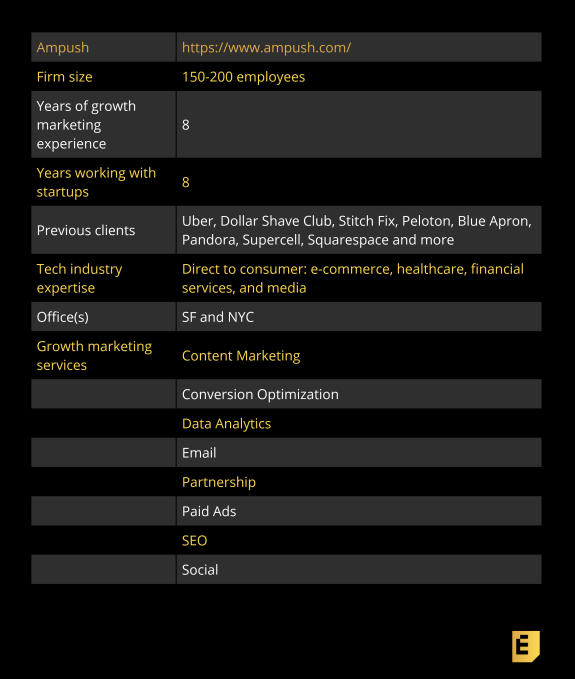
Verified Expert Growth Marketing Agency: Ampush

Customers have described Ampush as the “McKinsey of growth marketing,” and in many ways, it’s apt. Ampush has a relentlessly quantitative, full-funnel approach to growth marketing, and they’ve built proprietary software to back it up. Co-founder and CEO Jesse Pujji explains why Ampush exclusively works with direct to consumer companies, and why they went from serving 100 companies in 2015 to forming deeper partnerships with less than 20 companies today.

On Ampush’s evolution

“From 2011 to 2015, we were one of a handful of companies that could do Facebook really well, although that’s all we did.  As a result, we ended up working with a ton of growth brands and Fortune 1000 brands, like Dollar Shave Club, Uber, Stitch Fix, and all of these direct to consumer brands and businesses.

By 2015, we realized, “what got us here won’t get us there,” and so we started to question how we would evolve our offering and our company. Just doing Facebook would be okay, it would be good, but it wouldn’t be great, and we always said, “We want to be really great.”

Advice to early-stage founders

“Amazing at testing, measuring and iterating. Very quality and long term focused.” Katia Beauchamp, NYC, Co-founder & CEO, Birchbox

“It’s important for a founder to understand the right metrics and what levers can be pulled because they’re going to need to understand it to keep growing their business. I typically recommend that one of the founders spend 50% of their time for 90 to 180 days with one or two contractors who really know the technicalities of Facebook and Google you don’t have to learn those if you’re a founder, but you do want to understand which copy is resonating, which creative, which audience, etc.  It takes a founders’ level of depth to crack the nut, and then Ampush can come in.”

Below, you’ll find the rest of the founder reviews, the full interview, and more details like pricing and fee structures. This profile is part of our ongoing series covering startup growth marketing agencies with whom founders love to work, based on this survey and our own research. The survey is open indefinitely, so please fill it out if you haven’t already.


Interview with Ampush CEO & Co-Founder Jesse Pujji

Yvonne Leow: Tell us about your journey. How did you find yourself working in growth?

Jesse Pujji: I was born and raised in St. Louis, Missouri. My dad was an immigrant so I learned early on how to also be a small business entrepreneur. I was always running a snow-shoveling business, a lemonade stand business, a DJ-ing company. We cornered the Indian DJ-ing market in St. Louis. It turns out there weren’t a lot of Indian DJs in Missouri!