Category: UNCATEGORIZED

29 May 2019

Online lender SoFi has quietly raised $500 million in funding, led by Qatar

Usually when it comes to big sums of funding, companies like to boast about them. Online lending startup Social Finance, better known as SoFi, took another tack this morning, quietly announcing in a press release that it has closed half a billion dollars in a single funding round led by Qatar Investment Authority, a Doha, Qatar-based private equity and sovereign wealth fund.

Even in a world now awash with rounds in the multiple hundreds of dollars, the financing is notable. First, it’s the third giant round in recent years for the nearly eight-year-old, San Francisco-based company. Its biggest round to date came in September 2015, when SoftBank led a $1 billion round in the company. SoftBank’s then COO, Nikesh Arora, abruptly left the Japanese conglomerate the following year, but SoftBank CFO Alok Sama maintains a board seat.

In February 2017, SoFi raised $500 million more in funding led by the private equity firm Silver Lake, but there would come another twist five months later, when SoFi’s founder and its CEO at the time, Mike Cagney, was forced to resign following a sexual harassment lawsuit. (Cagney has since raised a bundle for a new lending company called Figure. )

Indeed, the new, Qatar-led round is the first big vote of confidence for SoFi’s newest CEO, Anthony Noto, joined the company in January of last year after spending three-and-half-years at Twitter, first as its CFO and later as its COO — roles he took on after spending several years with Goldman Sachs as a managing director before that.

Still, the round — which pushes SoFi’s total funding to $2.4 billion altogether — appears to be a flat one.  According to SoFi’s release about the round, its pre-money valuation is $4.3 billion, the same valuation it was assigned at the time of that Silver Lake led round two years ago.

Seemingly, that owes to competitor pressure in the space, including a flood of non-bank lending companies that includes Lending Club and Prosper for consumer loans, OnDeck for small-and mid-size business loans. StreetShares for veteran-owned businesses, and CommonBond and SoFi for student loans.

That’s saying nothing of newer online lenders like Affirm, the Silicon Valley startup that’s led by serial entrepreneur Max Levchin and aggressively chasing millennial shoppers who need loans (or can be easily persuaded to take one).

Little wonder that SoFi, which also markets its services largely to younger customers, has been rolling out new products, including two no-fee exchange-traded funds that it introduced last month.

The move gives SoFi’s a way to access that $3.9 trillion U.S. ETF market, but rollout also reminded many that when dealing with non-traditional institutions busy growing their businesses, there are often unexpected kinks.

In SoFi’s case, customers of weren’t told beforehand was that SoFi intended to liquidate their existing ETF investments and funnel the proceeds into its own new funds, as reported by the WSJ. Indeed, one customer with whom the outlet spoke said that the tax bill he will owe because of the move will outweigh 35 years of fee savings.

Above: SoFi CEO Anthony Noto.

29 May 2019

Allbirds, Everlane investor Maveron turned away more than $70M for its latest fund

Maveron, a venture capital fund co-founded by Starbucks mastermind Howard Schultz, has closed on another $180 million to invest in early-stage consumer startups.

The capital represents the firm’s seventh fundraise and largest to date. To keep the fund from reaching mammoth proportions, the firm’s general partners said they turned away more than $70 million amid high demand for the effort.

“It takes discipline to do something different from the rest of the herd, but we know that we’re not in the business of AUM, we’re in the business of generating cash-on-cash returns,” they wrote. “We know in this market it is hard to adhere to the idea that size is the enemy of performance but we believe in that truth here.”

In a phenomenon dubbed “The SoftBank Effect,” early- and late-stage venture firms have upped the ante when it comes to the size of their funds. Andreessen Horowitz, for example, recently brought in a fresh $2.75 billion to invest in startups, its largest pool to date.

Maveron was launched in 1998 by Schultz and Dan Levitan, a former managing director of investment firm Wertheim Schroder & Co. Schultz, currently considering a presidential run, is no longer actively involved in the firm. Maveron is known for recent bets in startups such as Allbirds, Everlane, General Assembly, Modern Fertility and Eargo.

Fund VII will be led by a team of six, including Levitan, Jason Stoffer, Anarghya Vardhana, David Wu, Cat Lee and Natalie Dillon. Split equally by gender, Maveron says its diversity gives them an edge.

“We’re able to see things others can’t because of our balanced team,” they said. “Last year, 70% of the founders we backed were women and all of those founders were also CEO or co-CEO. Beyond gender diversity, we also have someone on the investment team in every decade of their lives from their 20s to their 60s. That perspective marries the experience and scars of living through multiple market cycles with youthful optimism and connectivity to today’s tastemakers and trends.”

Maveron invests exclusively in consumer startups, with an eye for founders who are “unapologetically non-normal,” who value relationships over transactions, profit and purpose, and who “win the right way.”

29 May 2019

FCC’s broadband deployment report called ‘fundamentally at odds with reality’

The FCC has officially issued this year’s Broadband Deployment Report, summarizing the extent to which the agency and industry have closed the digital divide in this country. But not everyone agrees with it: “The rosy picture the report paints about the status of broadband deployment is fundamentally at odds with reality,” said Geoffrey Starks in a lengthy dissenting statement.

The yearly report, mandated by Congress, documents things like new broadband customers in rural areas, broadband expanding to new regions, and all that sort of thing. The one issued today proclaims cheerfully:

[The FCC] has made closing the digital divide between Americans with, and without, access to modern broadband networks its top priority. As a result of those efforts, the digital divide has narrowed substantially, and more Americans than ever before have access to high-speed broadband.

We find, for a second consecutive year, that advanced telecommunications capability is being deployed on a reasonable and timely basis.

Naturally the FCC wants to highlight the progress made rather than linger on failures, but this year the latter are highly germane, as Starks points out, largely because one error in particular threw off the results by millions.

The statistics in the report are based on forms filled out by broadband providers, which seem to go unchecked even in the case of massive outliers. Barrier Free broadband reported having gone from zero subscribers in March of 2017 to,  seven months later, serving the entirety of New York state’s 62 million residents with state of the art gigabit fiber connections. There are so many things wrong with this filing that the freshest intern at the Commission should have flagged it as suspect.

Instead, the data was accepted as gospel, and only a full year later did reporters at Free Press notice the discrepancy and call it to the FCC’s attention.

That this error, so enormous in scope, so obvious, and so consequential (it skewed the national numbers by large amounts), was not detected, and once detected was only cursorily addressed, leaves Starks flabbergasted:

The fact that a 2019 Broadband Deployment Report with an error of over 62 million connections was circulated to the full Commission raises serious questions. Was the Chairman’s office aware of the errors when it circulated the draft report? If not, why didn’t an “outlier” detection function raise alarms with regard to Barrier Free? Also, once the report was corrected, the fact that such a large number of connections came out of the report’s underlying data without changing the report’s conclusion, and without resulting in a substantial charge to the report, calls into question the extent to which the report and its conclusions depend on and flow from data.

In other words, if the numbers can change that much and the conclusions stay the same, what exactly are the conclusions based on?

Starks is the latest Commissioner to be appointed and one of the two Democrats there, the other being Jessica Rosenworcel (the Commission maintains a 3:2 party balance in favor of the current administration). Both have been outspoken in their criticism of the way the Broadband Deployment Report is researched and issued.

It’s the same data used to create the FCC’s broadband map, which ostensibly shows what carriers and speeds are available in your area. But the issues with this are many and various.
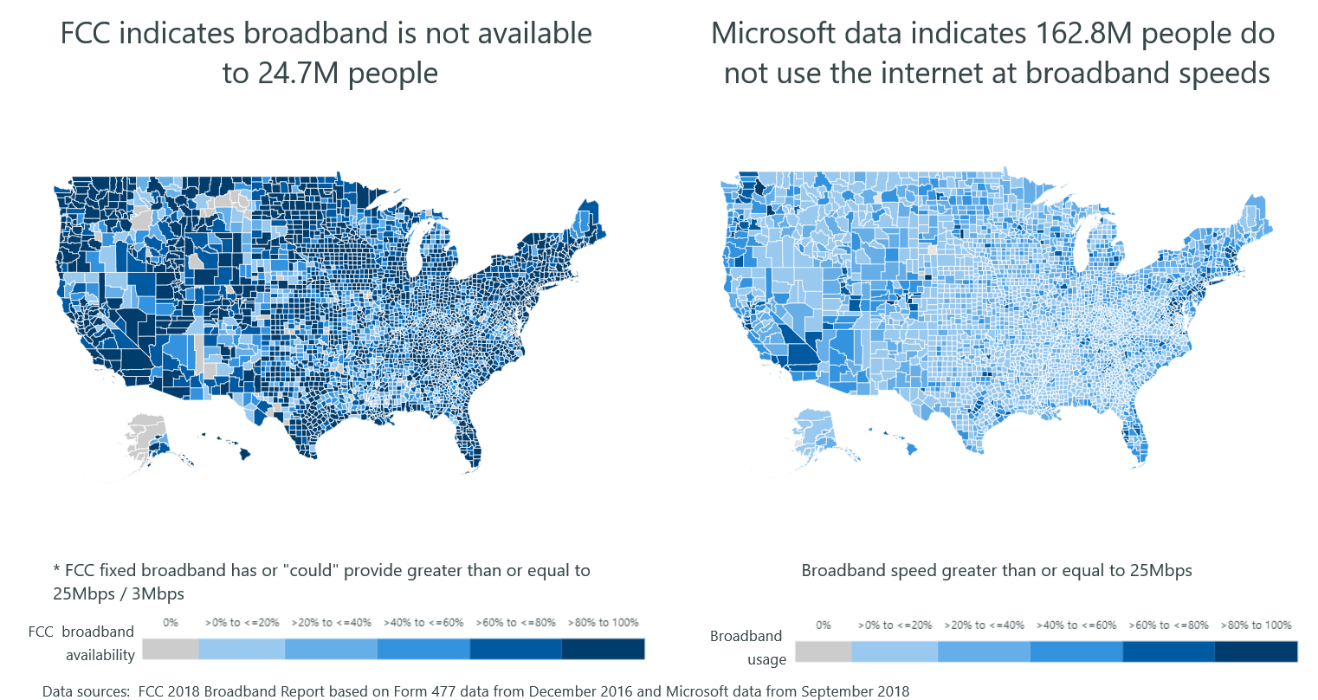
The data is only broken down by census tract, a unit that varies a great deal in size — some are tiny, some enormous. Yet if one company provides service to one person in that tract, it is considered “served” with that broadband capability throughout. The resulting map is so full of inaccuracies as to be useless, many argue — including Microsoft, which recently said it had observed “significant discrepancies across nearly all counties in all 50 states.”

The good news is that the FCC is aware of this and currently working on ways to improve data gathering. In future years better rules or more location-specific reporting could make the maps and deployment report considerably better. But at present, Starks concludes, “I don’t believe that we know what the state of broadband deployment is in the U.S. with sufficient accuracy.”

Commissioner Rosenworcel was similarly unsparing in her dissent.

“This report deserves a failing grade,” she wrote. “Putting aside the embarrassing fumble of the FCC blindly accepting incorrect data for the original version of this report, there are serious problems with its basic methodology. Time and again this agency has acknowledged the grave limitations of the data we collect to assess broadband deployment.”

The data also do not address problems that are unlikely to be addressed in forms filled out by the industry, such as redlining, shady business practices, and high prices for the broadband that is available.

“We will never manage problems we do not measure,” she continued. “Our ability to address the challenge of uneven internet access across the country is only made more challenging by our inability to be frank about the state of deployment today. Moreover, we need to be thoughtful about how impediments to adoption, like affordability, are an important part of the digital equity equation and our national broadband challenge.”

The Republican Commissioners, Brendan Carr and Michael O’Rielly, supported the report and did not mention the systematic data sourcing problems or indeed the enormous error that caused the draft of this report to be totally off base. O’Rielly did have an objection, however. He is “dismayed by the report’s reliance on purported ‘insufficient evidence’ as a basis for maintaining—for yet another year in a row—an outdated siloed approach to evaluating fixed and mobile broadband, rather than examining both markets as one.”

This has been suggested before and is a dangerously bad idea.

It should be said that the report isn’t one big single error. There’s more to it than just repackaging the aspirational numbers of the telecoms industry — though that’s a big part. It still holds interesting data that can be used in apples-to-apples comparisons to previous years. But more than ever it sounds like that data and any conclusions made from it — or for that matter rules or legislation — should be taken with a grain of salt.


29 May 2019

The Crunchbase Unicorn Leaderboard is back, now with a record herd of 452 unicorns

We are very pleased to announce that the new and improved Crunchbase Unicorn Leaderboard re-launched today after nearly a year’s absence from TechCrunch.

Venture investors did a lot of handwringing in the past year over rising valuations, but that did not slow the unicorn juggernaut, as 2018 outstripped all previous years in terms of the number of unicorns created and venture dollars invested. Indeed, 151 new unicorns joined the list in 2018 (compared to 96 in 2017), and investors poured more than $135 billion into those companies, a 52% increase year over year and the biggest sum invested in unicorns in any one year since unicorns became a thing.

Back in 2013, Cowboy Ventures’ Aileen Lee coined the term “unicorn” in a piece on TechCrunch with her report stating “39 companies belong to what we call the ‘Unicorn Club’ with four unicorns born per year in the past decade, … with Facebook being the breakout ‘super-unicorn’ (worth >$100 billion).” A lot has changed in six years.

From 19 new unicorns in 2013, roughly two each month, we now see a new unicorn coming into being every two working days. In 2019 so far, 42 new unicorns have joined the unicorn leaderboard, and by next week that number will have jumped again.

The Unicorn Leaderboard now lists 452 companies, which have collectively raised $345 billion and represent a cumulative valuation of $1.6 trillion. Go back to February 2018 and there were just 279 companies, with $206 billion raised and valued at $1 trillion. In just 15 months 170+ companies reached unicorn status, raised $140 billion more and added $600 billion in company valuations.

View by investor, sector and country

On the new leaderboard, it’s possible to filter by investor, lead investor, market sector and country. The unicorn leaders are the U.S. with 196 companies, China with 165, India with 19 and the U.K. with 12.

Leading investors

Three well-known venture firms, Sequoia Capital, Accel and Andreessen Horowitz, have invested in the most unicorn rounds. The investors that actually led the most rounds are corporate investor Tencent Holdings, venture firm Sequoia Capital and private equity firm Tiger Global Management. The rise of Tencent Holdings and Tiger Global Management reflect the prominence of China-based unicorns, as well as the increase in investment from corporate and alternative investors.

Emerging unicorns

The leaderboard also hosts a list of companies that have disclosed valuations between $500 million and > $1 billion and may well reach unicorn status with their next capital raise, unless, of course, they exit before then.

Unicorn exits

The majority of these 452 companies are in the U.S. or China, and most will plan to exit (go public or get acquired) within the next five to eight years.

2018 was also the best year ever for unicorn exits, as 39 unicorns went public while 14 were acquired. This year so far, six U.S.-based unicorns have gone public, namely, Uber, Lyft, Pinterest, Zoom, PagerDuty and Beyond Meat, representing $131.5 billion in public valuations, with Uber at  $82.5 billion and Lyft at $24 billion. The first Africa-based unicorn to go public is Jumia Group, an e-commerce company that operates in 14 African countries. Four China-based unicorn companies went public so far this year: Maoyan, an online movie ticketing service; mobile stock investing service Tiger Brokers; Lakala, a fintech platform; and, most recently, Luckin Coffee, a retail coffee brand. Hong Kong-based Futu Holdings, an online stock platform, also went public this year.

More than a one-third of all unicorn exits took place in 2018. The exited unicorns section of the Crunchbase Leaderboard lists 144 companies; roughly two-thirds of these companies (98) went public and the balance (46) were acquired.

Is 2018 the peak?

2018 might well be the peak, but 2019 is still strong, with 42 new unicorns announced this year so far, and $33.6 billion invested in this cohort of private companies. With the record of 452 unicorns, $345 billion currently invested, $1.6 trillion in captured value and an average age of 8.2 years since being founded, 2019 will be the year we watch the IPO market closely.

Credit: Steven Rossi who manages the board, Santosh Ankola on the TechCrunch product team and Human Made Design for their work on recreating the board.

29 May 2019

Daily Crunch: Uber will deactivate low-rated riders

The Daily Crunch is TechCrunch’s roundup of our biggest and most important stories. If you’d like to get this delivered to your inbox every day at around 9am Pacific, you can subscribe here.

1. Uber will start deactivating riders with low ratings

Uber drivers have been able to rate their passengers before this, but those passengers were never really at risk of deactivation — until now. In a blog post, Uber’s Kate Parker said that while only “a small number of riders” should be affected, “it’s the right thing to do.”

The company isn’t announcing a specific rating cutoff. Instead, it says it will deactivate users who fall significantly below a city’s average, after “several notifications and opportunities to improve his or her rating.”

2. Huawei files motion to challenge sweeping US ban, calling it ‘not normal’

The Chinese hardware giant has filed a motion for summary judgement that questions the constitutionality of the section of the National Defense Authorization Act that the Trump administration used to halt imports.

3. Flipboard hacks prompt password resets for millions of users

Hackers stole usernames, email addresses, passwords and account tokens for third-party services. According to Flipboard, “not all” users’ account data were involved in the breaches, but the company declined to say how many users were affected.

4. Amazon just launched a $90, 5.5-inch Echo Show

The Echo Show 5 (that’s “five” for inches) doesn’t replace any existing Amazon smart screen, even though the price point will no doubt make many think twice about the $130 Spot.

5. Talkspace picks up $50 million Series D

Talkspace launched back in 2012 with a mission to make therapy accessible to as many people as possible. The platform allows users to pay a subscription fee for unlimited messaging with one of the company’s 5,000 healthcare professionals.

6. NYC subway riders will be able to swipe in with Apple Pay starting Friday

Apple Pay is hitting select subway stations this Friday, May 31. New Yorkers will then be able to swipe their iPhones or Apple Watches to catch a ride.

7. Q&A with J Crowley, Head of Product at Airbnb Lux, on what makes a great PM

Crowley has run product at three big-name companies: Foursquare/Swarm, Blue Apron and now Airbnb. (Extra Crunch membership required.)

29 May 2019

Salesforce’s first blockchain plunge will involve development tools

Last year, Salesforce chairman Marc Benioff mentioned, perhaps for the first time, his interest in the the blockchain. It was not known at the time if he was seriously interested, or if Salesforce would indeed offer a way to use the blockchain on the Salesforce platform. Today, a little over a year later, the company announced its first blockchain product, and it’s one aimed squarely at developers.

Salesforce’s MO with new tech is always to start slowly and branch out after it gets a feel for customer requirements. Today’s announcement follows a similar path. The company is releasing a low code blockchain development tool on the Lightning platform. It’s important to note that this is only available to select design partners, and won’t become generally available until sometime next year.

About the time Benioff was making his first public statements about blockchain, the company began looking at how it could incorporate blockchain into Salesforce and use it to take advantage of gaps in the CRM platform, or if it even made sense to. As Adam Caplan, SVP of emerging technology at Salesforce put it, “Was this technology just looking for a problem to solve or could it really drive big business impact?”

After talking to 100 customers over the last year, Salesforce realized there was something there and felt like they could help companies, especially those working work partners outside the organization. The blockchain could provide a way for these companies to collaborate in a trusted environment.

Caplan said many of the customers he spoke to had begun experimenting with the idea of working in trusted environments with immutable records and other distributed ledger concepts, but most were stuck in Proof of Concept stages and were looking for a way to streamline the application development process.

Bret Taylor, who is president and chief product officer at Salesforce, says the company has been focusing on how the decentralized nature of the blockchain can really open up new business models that might not have been possible on the Salesforce platform in the past.

“We love the idea of extending the CRM with this capability because it really does enable multiple parties to work together in a trusted way and create business models around ecosystems, rather just direct customer relationships,” Taylor explained.

Taylor says the company went for developers as initial entree into blockchain to help customers get going with it in a fairly quick way by abstracting away a lot of the complexity associated with developing blockchain applications.

Brent Leary, who owns the CRM consultancy CRM Essentials sees a lot of potential with the new blockchain tools, even though he cautions it’s still very early. “The concept of leveraging blockchain technology to allow companies to [combine] decentralized data with CRM data can be potentially big. And even though it won’t be available for awhile, Salesforce has the resources and mindshare to bring their large customer base, and enterprise customers with huge scale to blockchain and speed up the adoption process,” Leary told TechCrunch

The new product will consist of three components: Blockchain Builder to help developers build blockchain applications; Blockchain Connect to integrate blockchain actions directly with applications on the Salesforce platform and Blockchain Engage to invite parties to the blockchain application, regardless of whether they are part of the Salesforce ecosystem or not.

“We think that having the Salesforce gravity being around the customer and customer experience, and making blockchain really accessible to a broad range of developers will help enable a lot of our customers to start experimenting with these new business models and new approaches to build ecosystem around their products and experiences,” Taylor said.

29 May 2019

Delane Parnell’s plan to conquer amateur esports

Most of the buzz about esports focuses on high-profile professional teams and audiences watching live streams of those professionals.

What gets ignored is the entire base of amateurs wanting to compete in esports below the professional tier. This is like talking about the NBA and the value of its sponsorships and broadcast rights as if that is the entirety of the basketball market in the US.

Los Angeles-based PlayVS (pronounced “play versus”) wants to become the dominant platform for amateur esports, starting at the high school level. The company raised $46 million last year—its first year operating—with the vision that owning the infrastructure for competitions and expanding it to encompass other social elements of gaming can make it the largest gaming company in the world.

I recently sat down with Founder & CEO Delane Parnell to talk about his company’s formation and growth strategy. Below is the transcript of our conversation (edited for length and clarity):

Founding PlayVS

Eric P: You have a fascinating background as a serial entrepreneur while you were a teenager.

Delane P.: I grew up on the west side of Detroit and started working at the cell phone store of a family friend when I was 13. When I turned 16 or so, I joined two guys in opening our own Metro PCS franchise. And then two additional franchises. And I was on the founding team of a car rental company called Executive Rental Car.

Eric P: And this segued into tech startups after meeting Jon Triest from Ludlow Ventures?

Delane P: He got me a ticket to the Launch conference in SF, and that experience inspired me to start a Fireside Chat series in Detroit that brought in people like Brian Wong from Kiip and Alexis Ohanian from Reddit to speak. Starting at 21, I worked at a venture capital firm called IncWell based in Birmingham, Michigan then joined a startup called Rocket Fiber.

We were focused on internet infrastructure – this is 2015-ish – and I was appointed to lead our strategy in esports. So I met with many of the publishers, ancillary startups, tournament organizers, and OG players and team owners. Through the process, I became passionate about esports and ended up leaving Rocket Fiber to start a Call of Duty team that I quickly sold to TSM.

Eric P: What then drove you to found PlayVS? Did it seem like an obvious opportunity or did it take you a while to figure it out?

Delane P.: What esports means is playing video games competitively bound to governance and a competitive ruleset. As a player, what that experience means is you play on a team, in a position, with a coach, in a season that culminates in some sort of championship.

29 May 2019

Apple’s new App Store website takes aim at antitrust, anti-competitive claims

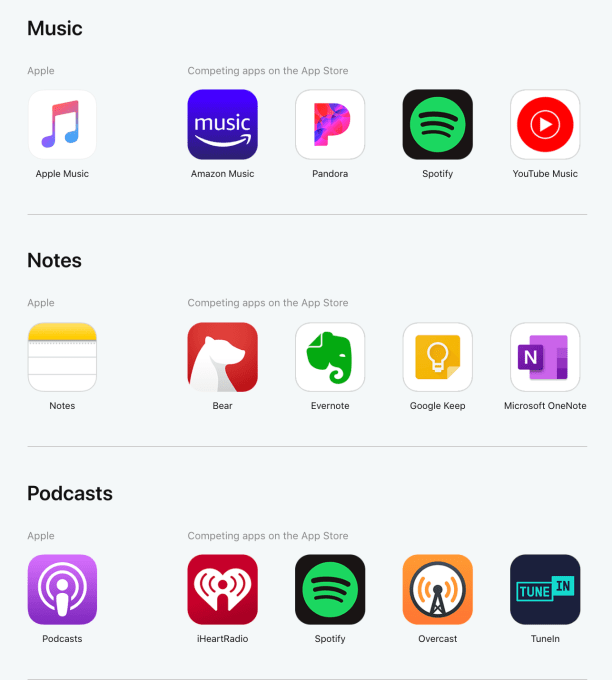
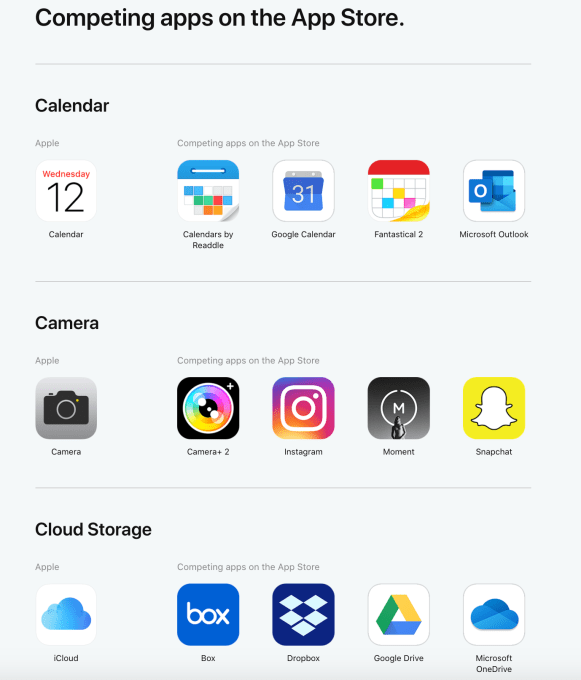
Just ahead of WWDC, Apple has launched a new App Store website in the hopes of better defending itself against recent antitrust and anti-competitive accusations. The website details how Apple runs its App Store, including how apps are curated and reviewed, and what business models are available to developers. It also features a section entitled “A Store that welcomes competition” where Apple makes the case for a marketplace where its own apps live alongside those from third-party developers.

For example, it showcases how Apple’s own Messages app competes with Messenger, Slack, Snapchat, and Viber; Apple’s Mail competes with Gmail, Outlook, Spark and Yahoo Mail. Maps competes with Google Maps, Citymapper, MAPS.ME and Waze; and so on.

Spotify, naturally, is listed among the competitors for both Apple’s Music and Podcasts apps.

That’s not a surprise, given that Spotify has recently been making the case that Apple operates an anti-competitive environment. In a complaint filed with the EU in March, which is now reportedly under investigation, it claimed Apple tilted the playing field in its favor by operating iOS, the App Store, and its own rival applications. Anyone else wishing to distribute an app that competes with Apple’s version, then has to share a 30 percent cut of their app’s revenue with Apple.

Because of this so-called “Apple tax,” some developers chose to mark up the cost of their app or subscription for iOS users. For example, Spotify made its music app $9.99 per month if you subscribed via the web, but charged $12.99 per month if you subscribed via an iOS device — essentially passing along the “Apple tax” to consumers.

This is the basis for a new antitrust lawsuit that the U.S. Supreme Court just this month ruled could proceed to the courts.

At the time of the ruling, Apple commented that “developers set the price they want to charge for their app and Apple has no role in that,” as a way to distance itself from the developers’ decision to set prices for iOS users higher.

“The only instance where Apple shares in revenue is if the developer chooses to sell digital services through the App Store,” it also said — a reminder that developers don’t have to support payments and subscriptions through Apple’s platform.

Several major tech companies already avoid doing just that.

Amazon, for a long time, has only allowed users of its iOS shopping app to buy things like books, music, movies and TV shows via the web browser. Meanwhile, Netflix more recently dropped in-app subscriptions on both Google Play and the App Store.

Unfortunately, developers on iOS are limited in terms of informing their users how to make purchases outside the App Store, and are forbidden from offering a link to their website where consumers could proceed with the non-App Store purchase. But that would be a fairer system, as the “Apple tax” would instead be seen as a convenience fee for the ease of making an Apple Pay transaction on the consumer side, and Apple’s help with payment processing on the developer side.

Apple’s overall position on this matter is reiterated on the new App Store website, where it argues the value of its curated platform and its ability to reach 1 billion customers worldwide. It notes how it continues to invest in developer tools that aid in their financial successes. It references the job creation aspects of the App store — including 1.5 million U.S. jobs and over 1,57 million jobs across Europe.

Apple also reminds us that it has distributed over $120 billion to developers to date — oh, and how iOS customers spend more money than those who use other app stores. (So good luck out there, developers!)

But this may not be the best thing for the company to highlight, as it positions Apple’s App Store as the massive, unavoidable juggernaut it is in the industry. And it paints a picture where it’s easy to imagine how difficult it would be on developers who choose to go elsewhere.


29 May 2019

Use SocialLadder to earn a free pass to TC Sessions: Mobility 2019

TC Sessions: Mobility 2019, TechCrunch’s day-long intensive event focused on the current and future state of mobility, takes place in San Jose, Calif. on July 10. More than 1,000 of the industry’s top technologists, founders, investors, engineers and researchers will join us to discuss, explore and demo transformational technologies that will have a profound effect on people around the world. And you can, too — for free.

Yup, you can earn a free ticket by becoming a TechCrunch ambassador. Simply participate in our referral program, powered by SocialLadder. Here’s how it works:

  1. Download the SocialLadder app on your phone (Apple Store) (Google Play). Already have the SocialLadder app? Tap Find a New Area > Add Invite Code
  2. Share the event code (TECHCRUNCH) with your friends to earn points toward a free ticket
  3. Use the app challenges to earn even more points — share a TechCrunch article on your social feed or “like” the TC Sessions: Mobility Facebook page
  4. When you accumulate enough points, you automatically earn a free ticket

What can you expect at TC Sessions: Mobility? Great question. Check out the agenda for the schedule of speakers, interviews, panel discussions, workshops and demos we have planned. More programming is slated for announcement in the next few weeks, but here’s a small taste of what’s to come:

  • Rethinking Urban Mobility: Motorcycle racing pioneer Erik Buell is back with a new company and vision. We’ll talk to Buell, now chairman of EV startup Fuell, about the tech behind the Flow electric motorcycle and the Fluid electric bicycle.
  • Bringing Ethics to Self-Driving Cars: When you hear the words ethics and autonomous vehicles, the age-old and often overused “trolley problem” thought experiment might spring to mind. We promise this isn’t about that. Instead, Voyage’s Oliver Cameron and Uber’s Clark Haynes will discuss ethical decision-making in autonomous vehicles and detail how robot cars are designed to prioritize some objects over others.
  • Building Mobility-First Cities: What does it look like to move around the city of the future? We’ll be talking with Avery Ash, head of autonomous mobility at INRIX, and Seleta Reynolds, GM of the Los Angeles Department of Transportation, to figure it out.

TC Sessions: Mobility 2019 takes place in San Jose, Calif. on July 10. Download the SocialLadder app, become a TechCrunch ambassador and don’t miss your chance to explore the future of mobility — for free.

Is your company interested in sponsoring or exhibiting at TC Sessions: Mobility? Contact the sponsorship sales team by filling out this form.

29 May 2019

Fitbit Pay will also work with NYC’s subway turnstiles

When it officially launches on Friday, New York City’s contactless fare pilot will have no shortage of options. Following similar announcements from Google and Apple, Fitbit just announced that its own mobile Pay system will work with the MTA program.

Starting Friday, strap hangers sporting a Fitbit Charge 3 Special Edition, Versa Special Edition or Fitbit Ionic will be able to use their device to tap and pay for a ride at select subway stations and buses. The pilot is rolling out for 4, 5, 6 stops between Manhattan’s Grand Central and Atlantic Avenue-Barclays Center in Brooklyn, along will all Staten Island buses on the 31st.

The system uses the smartwatch/trackers’ NFC chip for payment. For starters, things will be limited to single ride passes, which is probably a dealbreaker for many locals who rely on day/week/month passes to save a little on the MTA’s constantly increasing prices. The MTA plans to add additional ride options and branch out to all buses and subway stops by 2021.

For now, however, it’s likely concerned with how the new system will impact foot traffic. Seems likely there will be a bit of a logjam as riders figure out the ins and outs — ultimately, however, it may well save passengers time from not having to fumble for their Metrocard.

Fitbit Pay now also works with transit systems in Chicago, Singapore, Sydney, Taiwan, Vancouver and London.