Category: UNCATEGORIZED

20 May 2019

Agtech startup Agrilyst is now Artemis, raises $8M Series A

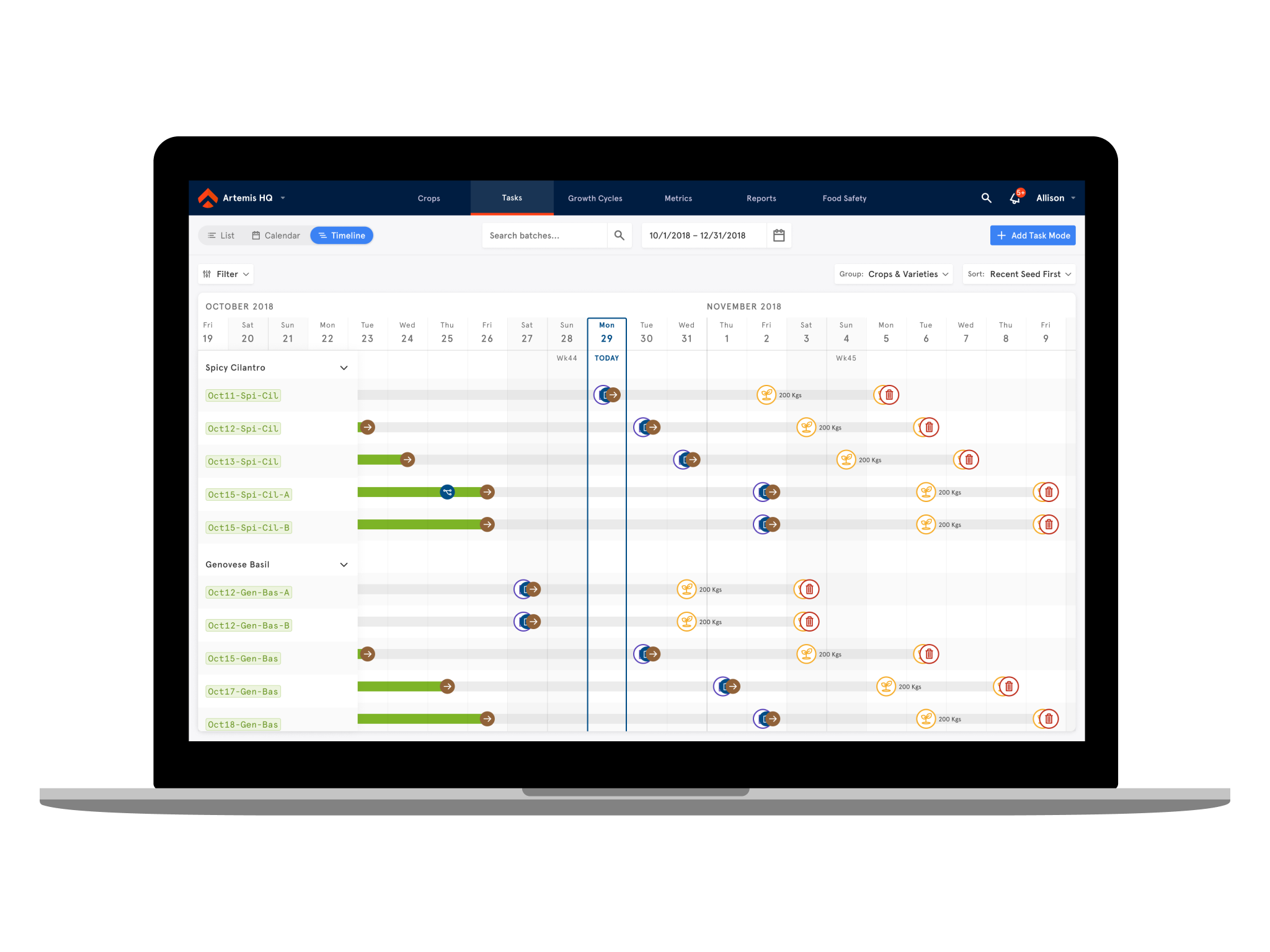
Artemis, the ag-tech startup formerly known as Agrilyst, today announced that it has raised an $8 million Series A funding round. The round was co-led by Astanor Ventures and Talis Capital, with participation from iSelect Fund and New York State’s Empire State Development Fund. With this, the company, which won our 2015 Disrupt SF Battlefield competition, has now raised a total of $11.75 million.

When Agrilyst launched, the company mostly focused on helping indoor farmers and greenhouse operators manage their operations by gathering data about their crop yields and other metrics. Over the course of the last few years, that mission has expanded quite a bit, though, and today’s Artemis sees itself as an enterprise Cultivation Management Platform (CMP) that focuses on all aspects of indoor farming, including managing workers and ensuring compliance with food safety and local cannabis regulations, for example.

The expanded platform is meant to give these businesses a single view of all of their operations and integrates with existing systems that range from climate control to ERP tools and Point of Sale systems.

Compliance is a major part of the expanded platform. “When you look at enterprise operations, that risk is compounded because it’s not just that risk across many, many sites and many acres, so in 2018, we switched to almost entirely focusing on those operations and have gained a lot of momentum in that space,” Kopf said. “And now we’re using the funding to expand from mainly focusing on managing that data to help with profitability to using that data to help you with everything from compliance down to the profitability element. We want to limit that exposure to controllable risk.”

With this new focus on compliance, the company also added Dr. Kathleen Merrigan to its board. Merrigan was the Deputy Secretary of Agriculture in the Obama administration and is the first Executive Director of the Swette Center for Sustainable Food Systems at Arizona State University . She is also a venture partner at Astanor Ventures .

“Technology innovation is rapidly transforming the agriculture sector. Artemis’ approach to using data as a catalyst for growth and risk management provides the company a significant advantage with enterprise-level horticulture operations,” said Merrigan.

Cannabis, it’s worth noting, was not something the company really focused on in its early years, but as the company’s CEO and founder Allison Kopf told me, it now accounts for about half of the company’s revenue. Only a few years ago, many investors were also uncomfortable investing in a company that was in the cannabis business, but that’s far less of an issue today.

“When we raised our seed round in 2015, we were pitching to a lot of funds and a lot of funds told us that they had LPs that can’t invest in cannabis. So if you’re pitching that you’re going to eventually be in cannabis, we’re going to have to step away from the investment, ” Kopf said. “Now, folks are saying: ‘If you’re not in cannabis, we don’t want to invest.'”

Today, Artemis’s clients are worth a collective $5 billion. The company plans to use the

20 May 2019

Vote now in #TheEuropas Awards to find its hottest startups, and join Europe’s key players

In partnership with TechCrunch, The Europas Awards, recognising the hottest tech startups in Europe since 2009, is now open for its public vote.

We’ve sorted and sifted through a record number of entries this year to compile an editorially driven long list of some of Europe’s most exciting startups and investors.

Voting is now live, so please go and vote. The public vote will close on 29 May 2019, 11:59 PM BST.

Vote in the awards by individual category by clicking the links below.

CLICK HERE FOR TICKETS TO THE AWARDS.

As the public vote takes place, our all-star panel of judges will be deliberating on the list as well. Their vote is combined with the public vote to come up with the shortlist. The winners will be announced at the awards ceremony on the evening of 27 June 2019 in London, UK.

This year’s ceremony will be in the setting of a garden party across the front lawn of Hoxton’s Geffrye Museum.

We’ll have editorial content as well – with panels looking at this year’s themes of tech + society, a view of what next for European startups, and a special fireside with Founder’s Forum’s Brent Hoberman.

With free-flowing drinks, great food from Kin, a long British summer’s evening, and VIPs and startups mingling and networking, this is the one event in the tech startup calendar you won’t want to miss. Grab your tickets here.

TechCrunch is once more the exclusive media sponsor of the awards, alongside new “tech, culture & society” event creator The Pathfounder. Those attending The Europas will get deep discounts to TechCrunch Disrupt in Berlin, later this year.

The Europas Awards 2019 is sponsored by: Bizzabo, iHorizon, Fieldhouse Associates, CommsCo, and Isotoma.

Interested in sponsoring The Europas or exhibiting at the awards? Get in touch with Claire Dobson // claire@thepathfounder.com

VOTING:

Polldaddy

TO VOTE IN A SPECIFIC CATEGORY CLICK ON A LINK BELOW. To vote in the entire awards click here.

Please note, you can vote only once.

Thanks for participating in the public voting stage in The 2019 Europas Awards. Please pick your winners from the following entries. For all other information about the awards see the site These votes will be combined with those of our expert judges and the winner will be announced on the evening of 27 June 2019 in London.

CLICK HERE FOR TICKETS

Vote in the entire awards here.

Vote in the awards by individual category:

Hottest AgTech / FoodTech Startup

Hottest CleanTech Startup

Hottest CyberTech Startup

Hottest EdTech Startup

Hottest FashTech Startup

Hottest FinTech Startup

Hottest GovTech, CivTech, PubTech, RegTech

Hottest HealthTech Startup

Hottest MadTech (MarTech or AdTech) Startup

Hottest Mobility Startup

Hottest PropTech Startup

Hottest Retail / ECommerce Tech Startup

Hottest B2B / SaaS Startup

Hottest SpaceTech Startup

Hottest Tech for Good Startup

Hottest Blockchain Project

Hottest Blockchain Investor

Hottest VC Fund

Hottest Seed Fund

Hall Of Fame Award

The Europas Grand Prix Awards: No public voting, picked by judges.

ABOUT THE AWARDS

The Europas Awards celebrates the most forward thinking and innovative tech & blockchain startups and the hottest investors across over some 20+ categories. Startups can apply for an award or be nominated by anyone, including our judges.

For the last ten years The Europas has grown into a fun and fantastic awards ceremony and an awesome daytime conference. The Europas is a chance for you and your team to celebrate a year of hard work in one incredible night in London.

The Europas “Diversity Pass”

We’d like to encourage more diversity in tech! That’s why we’ve reserved a tranche of free tickets to ensure that we include more women and people of colour who are “pre-seed” or “seed-stage” tech startup founders. If you are a women founder or person of colour founder, apply here for a chance to be considered for one of the limited free diversity passes to the event.

Amazing networking

We’re also shaking up the awards dinner itself. Instead of a sit-down gala dinner, we’ve taken feedback for more opportunities to network. Our awards ceremony this year will be in the setting of a garden lawn party, where you’ll be able to meet and mingle more easily, with free-flowing drinks and a wide-selection of street food (including vegetarian/vegan). The ceremony itself will last approximately 75 minutes, with the rest of the time dedicated to networking.

Instead of thousands and thousands of people, think of a great summer event with the most interesting and useful people in the industry, including key investors and leading entrepreneurs.

The Europas Awards have been going for the last 10 years, and we’re the only independent and editorially driven event to recognise the European tech startup scene. The winners have been featured in Reuters, Bloomberg, VentureBeat, Forbes, Tech.eu, The Memo, Smart Company, CNET, many others — and of course, TechCrunch.

• No secret VIP rooms, which means you get to interact with the speakers

• Key founders and investors attending

• Journalists from major tech titles, newspapers and business broadcasters

20 May 2019

GDPR adtech complaints keep stacking up in Europe

It’s a year since Europe’s General Data Protection Regulation (GDPR) came into force and leaky adtech is now facing privacy complaints in four more European Union markets. This ups the tally to seven markets where data protection authorities have been urged to investigate a core function of behavioral advertising.

The latest clutch of GDPR complaints aimed at the real-time bidding (RTB) system have been filed in Belgium, Luxembourg, the Netherlands and Spain.

All the complaints argue that RTB entails “wide-scale and systemic” breaches of Europe’s data protection regime, as personal date harvested to profile Internet users for ad-targeting purposes is broadcast widely to bidders in the adtech chain. The complaints have implications for key adtech players, Google and the Internet Advertising Bureau, which set RTB standards used by other in the online adverting pipeline.

We’ve reached out to Google and IAB Europe for comment on the latest complaints. (The latter’s original response statement to the complaint can be found here, behind its cookie wall.)

The first RTB complaints were filed in the UK and Ireland, last fall, by Dr Johnny Ryan of private browser Brave; Jim Killock, director of the Open Rights Group; and Michael Veale, a data and policy researcher at University College London.

A third complaint went in to Poland’s DPA in January, filed by anti-surveillance NGO, the Panoptykon Foundation.

The latest four complaints have been lodged in Spain by Gemma Galdon Clavell (Eticas Foundation) and Diego Fanjul (Finch); David Korteweg (Bits of Freedom) in the Netherlands; Jef Ausloos (University of Amsterdam) and Pierre Dewitte (University of Leuven) in Belgium; and Jose Belo (Exigo Luxembourg).

Earlier this year a lawyer working with the complainants said they’re expecting “a cascade of complaints” across Europe — and “fully expect an EU-wide regulatory response” give that the adtech in question is applied region-wide.

Commenting in a statement, Galdon Cavell, the CEO of Eticas, said: “We hope that this complaint sends a strong message to Google and those using Ad Tech solutions in their websites and products. Data protection is a legal requirement must be translated into practices and technical specifications.”

A ‘bug’ disclosed last week by Twitter illustrates the potential privacy risks around adtech, with the social networking platform revealing it had inadvertently shared some iOS users’ location data with an ad partner during the RTB process. (Less clear is who else might Twitter’s “trusted advertising partner” have passed people’s information to?)

The core argument underpinning the complaints is that RTB’s data processing is not secure — given the design of the system entails the broadcasting of (what can be sensitive and intimate) personal data of Internet users to all sorts of third parties in order to generate bids for ad space.

Whereas GDPR bakes in a requirement for personal data to be processed “in a manner that ensures appropriate security of the personal data”. So, uh, spot the disconnect.

The latest RTB complaints assert personal data is broadcast via bid requests “hundreds of billions of times” per day — which it describes as “the most massive leakage of personal data recorded so far”.

While the complaints focus on security risks attached by default to leaky adtech, such a long chain of third parties being passed people’s data also raises plenty of questions over the validity of any claimed ‘consents’ for passing Internet users’ data down the adtech chain. (Related: A decision by the French CNIL last fall against a small local adtech player which it decided was unlawfully processing personal data obtained via RTB.)

This week will mark a year since GDPR came into force across the EU. And it’s fair to say that privacy complaints have been piling up, while enforcement actions — such as a $57M fine for Google from the French CNIL related to Android consent — remain far rarer.

One complexity with the RTB complaints is that the technology systems in question are both applied across EU borders and involve multiple entities (Google and the IAB). This means multiple privacy watchdogs need to work together to determine which of them is legally competent to address linked complaints that touch EU citizens in multiple countries.

Who leads can depend on where an entity has its main establishment in the EU and/or who is the data controller. If this is not clearly established it’s possible that various national actions could flow from the complaints, given the cross-border nature of the adtech — as in the CNIL decision against Android, for example. (Though Google made a policy change as of January 22, shifting its legal base for EU law enforcement to Google Ireland which looks intended to funnel all GDPR risk via the Irish DPC.)

The IAB Europe, meanwhile, has an office in Belgium but it’s not clear whether that’s the data controller in this case. Ausloos tells us that the Belgian DPA has already declared itself competent regarding the complaint filed against the IAB by the Panoptykon Foundation, while noting another possibility — that the IAB claims the data controller is IAB Tech Lab, based in New York — “in which case any and all DPAs across the EU would be competent”.

Veale also says different DPAs could argue that different parts of the IAB are in their jurisdiction. “We don’t know how the IAB structure really works, it’s very opaque,” he tells us.

The Irish DPC, which Google has sought to designate the lead watchdog for its European business, has said it will prioritize scrutiny of the adtech sector in 2019, referencing the RTB complaints in its annual report earlier this year — where it warned the industry: “the protection of personal data is a prerequisite to the processing of any personal data within this ecosystem and ultimately the sector must comply with the standards set down by the GDPR”.

There’s no update on how the UK’s ICO is tackling the RTB complaint filed in the UK as yet — but Veale notes they have a call today. (And we’ve reached out to the ICO for comment.)

So far the same RTB complaints have not been filed in France and Germany — jurisdictions with privacy watchdogs that can have a reputation for some of the most muscular action enforcing data protection in Europe.

Although the Belgian DPA’s recently elected new president is making muscular noises about GDPR enforcement, according to Ausloos — who cites a speech he made, post-election, saying the ‘time of sit back and relax’ is over. They made sure to reference these comments in the RTB complaint, he adds.

Veale suggests the biggest blocker to resolving the RTB complaints is that all the various EU watchdogs “need a vision of what the world looks like after they take a given action”.

In the meanwhile, the adtech complaints keep stacking up.

20 May 2019

Ikea invests in Livspace, a one-stop platform for interior design based in India

Fresh from raising $70 million last year via big names including Goldman Sachs and TPG Growth, Livspace, an India-based startup that offers a one-stop-shop for interior design, has lured yet another marquee investor: Ikea.

The startup said today it has taken an undisclosed investment from Ingka Investments, the VC arm of Ikea parent Ingka Group, which operates 90 percent of Ikea’s retail footprint. Livspace CEO and co-founder Anuj Srivastava declined to provide a value for the deal, but he told TechCrunch that the stake involved is a minor one while there is no plan to bolt a larger round on to this investment. Deal Street Asia first reported news of the deal.

“There is strong strategic and commercial potential,” Srivastava, a former Googler who started Livspace in 2015, said of the new investor. “This is an opportunity to create the best possible omnichannel experience for consumers.”

India is a tough place for international retail companies but Ikea has made progress in recent times.

The company opened its first India-based store in Hyderabad last year and, having gained FDI approval to operate retails store, it is planning a substantial expansion with at least 25 new stores in the offing.

Livspace, for those unaware of it, runs a service that is aimed at taking the hassle out of interior design. The company’s platform connects homeowners with designers and the supply chain to go through ideas, chose a plan and implement it. That includes, among other things, 3D virtual renders of a renovation, offline meetings at a Livspace design center and, in some cases, customized furnishings. By bringing all parties together, Livspace claims to offer cost savings to consumers as well as higher rates and more efficient use of time for designers.

That model resonates with Ikea (Ingka), according to Srivastava, who said the company sides began talking following the announcement of Livspace’s Series C round last September.

“We’ve felt the natural synergy always existed,” he said. “This is an extremely strong endorsement of our vision.”

Synergies, indeed, although somewhat frustratingly neither party is saying how they will work together going forward. The obvious suggestion would be that Ikea products become available through Livspace, but Srivastava said the specifics are still to be agreed.

Further down the line, though, he admitted that Ikea’s involvement could fuel an international expansion beyond India. Going overseas is something that the company is openly talked up in the past and, with Ikea’s global footprint of 367 stores across 30 markets, the investment from Ingka could give Livspace a running start in new markets.

That, like the details of the alliance, is something that will come later, however.

“The India business is keeping us really, really busy at this time,” said Srivastava on that possibility.

“We’re engaged in exploratory activities but there’s no immediate plan or timeline,” he added as a tease. A new market launch isn’t likely until something like 12-18 months down the line, the Livspace CEO said.

As for whether this deal might be a precursor to an eventual acquisition, such are the synergies, Srivastava said that possibility isn’t being entertained.

“There is no such intention as of now,” he explained. “We continue to have strong interest from financial investors and continue to operate with the intention to stay independent, there’s now even more belief in our platform approach.”

“There is distinctly an investment outlay involved [with] no long term indication of an M&A opportunity,” he added.

20 May 2019

Huawei responds to Android ban with service and security guarantees, but its future is unclear

Huawei has finally gone on the record about a ban on its use of Android, but the company’s long-term strategy on mobile still remains unclear.

In an effort to appease its worried customer base, the embattled Chinese company said today that it will continue to provide security updates and after-sales support to its existing lineup of smartphones, but it’s what the company didn’t say that will spark concerns.

Huawei was unable to make guarantees about whether existing customers will continue to receive Android software updates, while its statement is bereft of any mention of whether future phones will ship with the current flavor of Android or something else.

The company, which is the world’s second largest smartphone vendor based on shipments, said it will continue to develop a safe software ecosystem for its customers across the globe. Huawei will also extend the support to Honor, a brand of smartphones it owns. Nearly 50 percent of all of Huawei’s sales comes from outside China, research firm Counterpoint told TechCrunch.

Here’s the statement in full:

Huawei has made substantial contributions to the development and growth of Android around the world. As one of Android’s key global partners, we have worked closely with their open-source platform to develop an ecosystem that has benefitted both users and the industry,

Huawei will continue to provide security updates and after sales services to all existing Huawei and Honor smartphone and tablet products covering those have been sold or still in stock globally. We will continue to build a safe and sustainable software ecosystem, in order to provide the best experience for all users globally.

In addition, the company said it plans to launch the Honor 20 as planned. The device is set to be unveiled at an event in London tomorrow. While Honor is a sub-brand, any sanctions levied on Huawei will likely be reflected in its business, too.

Huawei’s lukewarm response isn’t unexpected. Earlier, Google issued a similarly non-committal statement that indicated that owners of Huawei phones will continue to be able to access the Google Play Store and Google Play Protect, but — like the Chinese firm — it made no mention of the future, and that really is the key question.

Indeed, sources within both Google and Huawei have told TechCrunch that the immediate plan of action for what happens next remains unclear.

It could turn out that Huawei is forced to use the open source version of Android, AOSP, which comes stripped of Google Mobile Services, a suite for Google services such as Google Play Store, Gmail, and YouTube. That’s unless it doesn’t plump for its own homespun alternative, which media reports have claimed it has built in the case of an emergency situation.

Huawei’s response comes a day after Reuters reported that Google had suspended some of its businesses with the Chinese technology giant. The Android-maker is complying with a U.S. Commerce Department’s directive that placed Huawei and 70 of its affiliates on an “entity list” that requires any U.S. company to gain government approval before doing business with the Chinese tech company.

In the meantime, the troubles are mounting for Huawei. In addition to Android, the U.S. government’s move has seen Intel, Qualcomm, Xilinx, and Broadcom reportedly pause supplying chips to Huawei until a resolution has been reached.

20 May 2019

Want to save €200 on passes to Disrupt Berlin 2019?

Around here at TechCrunch we like to reward action with savings, and right now, the earlier you act the more money you save. Do we have your attention?

Here’s the deal. Disrupt Berlin 2019 takes place on 11-12 December, and you can’t buy passes until the official registration opens in June. But by taking one simple action now, you’ll save an extra €200 off the super-early-bird price for any pass. Just sign up for our mailing list before registration opens. Boom. Act now, save more. Simple.

Once you sign up, we’ll email you a discount code to use when you purchase your pass. Just think about what you’ll do with the €200 you saved — and all the cool stuff you’ll see and do at Disrupt Berlin.

Network with the more than 1,200 attendees — technologists, founders, investors, media, potential customers and possible employers. CrunchMatch, our free business match-matching platform, simplifies networking. It makes connections based on your specific criteria, goals and interests, so you don’t just meet people — you meet the right people. You never know when goals might align, and opportunity might strike.

Startup Battlefield, TechCrunch’s famous pitch-off competition, is an absolute roller coaster ride as teams of exceptional startups compete head-to-head for $50,000 cash, the Disrupt cup and life-altering media and investor exposure.

You’ll find hundreds of early-stage startups showcasing the very best tech products, platforms and services in Startup Alley, the exhibit hall and the heartbeat of every Disrupt. Don’t miss the TC Top Picks — a group of outstanding startups curated by TechCrunch editors — camped out in the Alley.

We’ll have more information in the coming weeks on how you can apply to both the Startup Battlefield and the TC Top Picks program, so keep checking back.

That’s just for starters. We’re hard at work building the roster of speakers — top tech founders, investors and entrepreneurs who will share their stories, insights and maybe a prediction or two along the way. Plus, we always feature panel discussions, workshops, demos and so much more. Stay tuned for more information!

Disrupt Berlin 2019 takes place on 11-12 December. Sign up for our mailing list before registration opens, and you’ll save an extra €200 on passes. Act early, save more — and we’ll see you in Berlin!

20 May 2019

Facebook’s latest account purge exposes Africa’s misinformation problem

Facebook last week purged a network of hundreds of pages, groups and Instagram accounts it labeled as producing “coordinated inauthentic behavior” toward Africa.

The activity originated in Israel and was largely targeted toward Nigeria, Senegal, Togo, Angola, Niger, and Tunisia.

It was mostly political in nature and primarily paid for by Archemedes Group, a global political consulting firm, Facebook said.

This isn’t the first case of social media platforms used as vehicles for political manipulation in Africa. Cambridge Analytica, the controversial big-data actor employed in Brexit and Donald Trump’s 2016 presidential victory, was active on the continent before and after both events.

On its recent Africa related deletions, Facebook said:

The people behind this network used fake accounts to run Pages, disseminate their content and artificially increase engagement. They also represented themselves as locals, including local news organizations, and published allegedly leaked information about politicians. The Page administrators and account owners frequently posted about political news, including topics like elections in various countries, candidate views and criticism of political opponents.

The activity took place over 65 Facebook accounts, 161 Pages, 23 Groups, 12 events and four Instagram accounts.  There were 2.8 million accounts that followed one or more of these pages and 5,500 accounts joined at least one of these Groups.

Facebook said more than $800,000 was spent on ads associated with these accounts starting in December 2012 and running as recently as April this year.

Facebook declined to offer TechCrunch additional information on the account deletions beyond their release. But the Atlantic Council’s Digital Forensic Research Lab (DFRL) has been digging deeper and released some initial findings in a Medium Post. In addition to connecting the accounts to activity in Ghana — a country not named in FB’s release — DFRL shed some light on fake news targeted at Nigeria’s February 2019 elections.

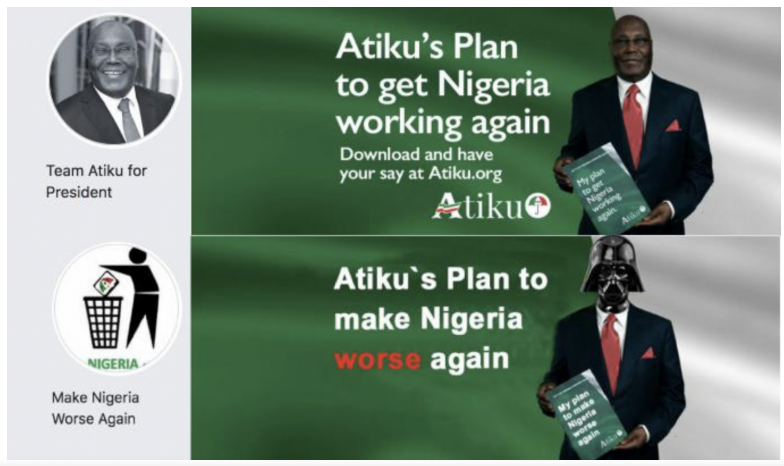
Examples included a “Make Nigeria Worse Again” trolling campaign aimed at the campaign of Atiku Abubakar, who was challenger to Nigeria’s incumbent president Muhammadu Buhari — who won a second-term.

DFRL also shared examples connected to the deleted Facebook accounts aimed at elections in Mali, Tunisia, Niger, Togo, Algeria, and Angola. It noted the ads related to this nexus of activity was paid for in U.S. dollars, Israeli Shekels, and Brazilian reals. “The spending in different currencies suggests how vast the operation was, encompassing multiple regions around the world,” said DFRL’s reporting.

Fake news on social media platforms has reared its head in Africa several times. Cambridge Analytica, backed by U.S. big-data billionaire Robert Mercer, was found to have been involved in elections in Kenya and Nigeria before its controversial role directing pro-Brexit and pro-Trump online activity in 2016. Facebook later banned Cambridge Analytica from its platform.

Social media driven fake news — primarily on Facebook and WhatsApp — became such an issue in Kenya’s 2017 elections the country’s parliament passed a bill in 2018, with specific punitive measures, to combat it. An investigation by the UK’s Channel 4 later revealed that Cambridge Analytica had advised the 2017 presidential campaign of Kenyan incumbent president Uhuru Kenyatta, who won in a disputed run-off vote.

Facebook has prioritized growth in Africa, particularly since Mark Zuckerberg visited the continent’s tech scene in 2016.

The U.S. social media company has grown Africa users to over 200 million and Facebook owned chat-tool, WhatsApp, is the most downloaded messenger app on the continent.

But Facebook’s recent Africa account purge shows when Facebook travels, so too does its list of pros and cons, including the ability of global actors to use it for nefarious uses in local settings.

20 May 2019

Several chip companies, including Qualcomm and Intel, have reportedly stopped supplying Huawei after blacklist

Several key suppliers are reportedly cutting off Huawei after the Trump administration added the Chinese telecom equipment and smartphone giant to a trade blacklist last week. According to Bloomberg, semiconductor companies Intel, Qualcomm, Xilinx and Broadcom will no longer supply Huawei until further notice. This follows another report earlier today that Google has suspended some trade with Huawei, leaving it with access only to the open-source version of Android.

In addition to impacting Huawei’s business, the blacklisting has ramifications for telecom providers who are getting ready to launch 5G networks. In China, the three big telecoms (China Mobile, China Unicom and China Telecom), which are all heavily reliant on Huawei, may be forced to delay 5G rollout. Meanwhile, U.S. carriers, especially smaller ones, may have to spend millions of dollars replacing Huawei equipment they have already installed or looking for new suppliers.

In tweet last week from the account Huawei Facts, the company called the blacklist a “lose-lose” situation. In a more recent tweet, it said “Oops! The U.S. is already coming to its senses over a ban on #Huawei, with a government official admitting that it cannot distance itself from the tech giant as easily as it might like. #HuaweiFacts” in response to a report that the administration might grant Huawei a temporary license to prevent service interruptions.

Meanwhile, Google’s ban, first reported by Reuters, would give Huawei, the second-largest smartphone brand in the world after Samsung, access only to open-source version of Android, leaving it with a significant disadvantage to other handset makers.

According to Bloomberg, Huawei stockpiled three months worth of chips in anticipation of action by the U.S. government, which it has been at odds with since a 2012 Congressional report deemed it a potential threat to national security (accusations the company has repeatedly denied).

A Xilinx spokesperson told TechCrunch “We are aware of the Denial Order issued by the U.S. Department of Commerce with respect to Huawei, and we are cooperating. We have no additional information to share at this time.” TechCrunch has also contacted Huawei, Broadcom, Qualcomm and Intel for comment.

20 May 2019

Google says its app store will continue to work for existing Huawei smartphone owners

Google said today that existing users of Huawei Android devices can continue to use Google Play app store, offering some relief to tens of millions of users worldwide even as it remains unclear if the Chinese tech giant will be able to use the fully-functioning version of Android in its future phones.

Existing Huawei phone users will also be able to enjoy security protections delivered through Google Play Protect, the company said in a statement to TechCrunch. Google Play Protect is a built-in malware detector that uses machine learning to detect and weed out rogue apps. Google did not specify whether Huawei devices will receive future Android updates.

The statement comes after Reuters reported on Sunday that Google is suspending some businesses with Huawei, the world’s second largest smartphone maker that shipped over 200 million handsets last year. The report claimed, a point not addressed by Google, that future Android devices from Huawei will not run Google Mobile Services, a host of services offered by Google including Google Play Store, and email client Gmail. A Huawei spokesperson said the company is looking into the situation but has nothing to share beyond this.

It’s a major setback for Huawei, which unless resolved in the next few weeks, could significantly disrupt its phone business outside of China. The top Android phone vendor, which is already grappling with controversy over security concerns, will have to rethink its software strategy for future phones if there is no resolution. Dearth — or delay in delivery — of future Android updates would also hurt the company’s reputation among its customers around the globe.

“We are complying with the order and reviewing the implications,” a company spokesperson said in a statement.

The two tech companies find themselves in this awkward situation as a result of the latest development in the ongoing U.S-China trade war. Huawei and 70 of its affiliates have been put on an “entity list” by the U.S. Commerce Department over national security concerns, requiring local giants such as Google and Intel to take approval from the government before conducting business with the Chinese firm.

Huawei may have already foreseen this. A company executive revealed recently that Huawei had built its own Android-based operating system in case a future event prevented it from using existing systems. Per Reuters, Huawei can also continue to use AOSP, the open source Android operating system that ships stripped off Google Mobile Services. And on paper, it can also probably have an app store of its own. But convincing enough stakeholders to make their apps available on Huawei’s store and continually push updates could prove incredibly challenging.

20 May 2019

TikTok owner ByteDance’s long-awaited chat app is here

In WeChat -dominated China, there’s no shortage of challengers out there claiming to create an alternative social experience. The latest creation comes from ByteDance, the world’s most valuable startup and the operator behind TikTok, the video app that has consistently topped the iOS App Store over the last few quarters.

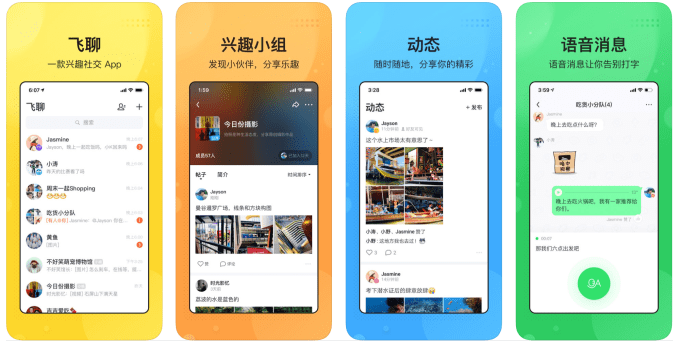
The new offer is called Feiliao (飞聊), or Flipchat in English, a hybrid of an instant messenger plus interest-based forums, and it’s currently available for both iOS and Android. It arrived only four months after Bytedance unveiled its video-focused chatting app Duoshan at a buzzy press event.

Screenshots of Feiliao / Image source: Feiliao

Some are already calling Feiliao a WeChat challenger, but a closer look shows it’s targeting a more niche need. WeChat, in its own right, is the go-to place for daily communication in addition to facilitating payments, car-hailing, food delivery and other forms of convenience.

Feiliao, which literally translates to ‘fly chat’, encourages users to create forums and chat groups centered around their penchants and hobbies. As its app description writes:

Feiliao is an interest-based social app. Here you will find the familiar [features of] chats and video calls. In addition, you will discover new friends and share what’s fun; as well as share your daily life on your feed and interact with close friends.

Feiliao “is an open social product,” said ByteDance in a statement provided to TechCrunch. “We hope Feiliao will connect people of the same interests, making people’s life more diverse and interesting.”

It’s unclear what Feiliao means by claiming to be ‘open’, but one door is already shut. As expected, there’s no direct way to transfer people’s WeChat profiles and friend connections to Feiliao, and there’s no option to log in via the Tencent app. As of Monday morning, links to Feiliao can’t be opened on WeChat, which recently crossed 1.1 billion monthly active users.

On the other side, Alibaba, Tencent’s long-time nemesis, is enabling Feiliao’s payments function through the Alipay digital wallet. Alibaba has also partnered with Bytedance elsewhere, most notably on TikTok’s Chinese version Douyin where certain users can sell goods via Taobao stores.

In all, Flipchat is more reminiscent of another blossoming social app — Tencent-backed Jike — than WeChat. Jike (pronounced ‘gee-keh’) lets people discover content and connect with each other based on various topics, making it one of the closest counterparts to Reddit in China.

Jike’s CEO Wa Nen has taken noticed of Feiliao, commenting with the ? emoji on his Jike feed, saying no more.
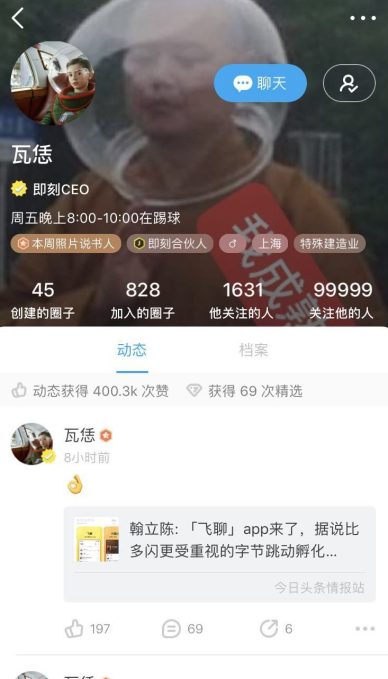
Screenshot of Jike CEO Wa Ren commenting on Feiliao

“I think [Feiliao] is a product anchored in ‘communities’, such as groups for hobbies, key opinion leaders/celebrities, people from the same city, and alumni,” a product manager for a Chinese enterprise software startup told TechCrunch after trying out the app.

Though Feiliao isn’t a direct take on WeChat, there’s little doubt that the fight between Bytedance and Tencent has heated up tremendously as the former’s army of apps captures more user attention.

According to a new report published by research firm Questmobile, ByteDance accounted for 11.3 percent of Chinese users’ total time spent on ‘giant apps’ — those that surpassed 100 million MAUs — in March, compared to 8.2 percent a year earlier. The percentage controlled by Tencent was 43.8 percent in March, down from 47.5 percent, while the remaining share, divided between Alibaba, Baidu and others, grew only slightly from 44.3 percent to 44.9 percent over the past year.