Category: UNCATEGORIZED

19 May 2019

These Johns Hopkins students are slashing breast cancer biopsy costs

Over 2 million women were diagnosed with breast cancer in 2018. And while the diagnosis doesn’t have to be a death sentence for women in countries like the United States, in developing countries three times as many women die from the disease.

Breast cancer survival rates range from 80% or over in North America, Sweden and Japan to around 60% in middle-income countries and below 40% in low-income countries, according to data provided the World Health Organization.

And the WHO blames these low survival rates in less developed countries on the lack of early detection programs, which result in a higher proporation of women presenting with late-stage disease. The problem is exacerbated by a lack of adequate diagnostic technologies and treatment facilities, according to the WHO.

A group of Johns Hopkins University undergraduates believe they have found a solution. The four women, none of whom are over 21-years-old, have developed a new, low-cost, disposable core needle biopsy technology for physicians and nurses that could dramatically reduce cost and waste, thereby increasing the availability of screening technologies in emerging markets.

They’ve taken the technology they developed at Johns Hopkins University and created a new startup called Ithemba, which means “hope” in Swahili, to commercialize their device. While the company is still in its early days, the women recently won the undergraduate Lemelson-MIT Student Prize competition, and has received $60,000 in non-dilutive grant funding and a $10,000 prize associated with the Lemelson award.

Students at Johns Hopkins had been working through the problem of developing low-cost diagnostic tools for breast cancer for the past three years, spurred on by Dr. Susan Harvey, the head of Johns Hopkins Section of Breast Imaging.

While Dr. Harvey presented the problem, and several students tried to tackle it, Ithemba’s co-founders — the biomedical engineering undergrads Laura Hinson, Madeline Lee, Sophia Triantis, and Valerie Zawicki — were the first to bring a solution to market.
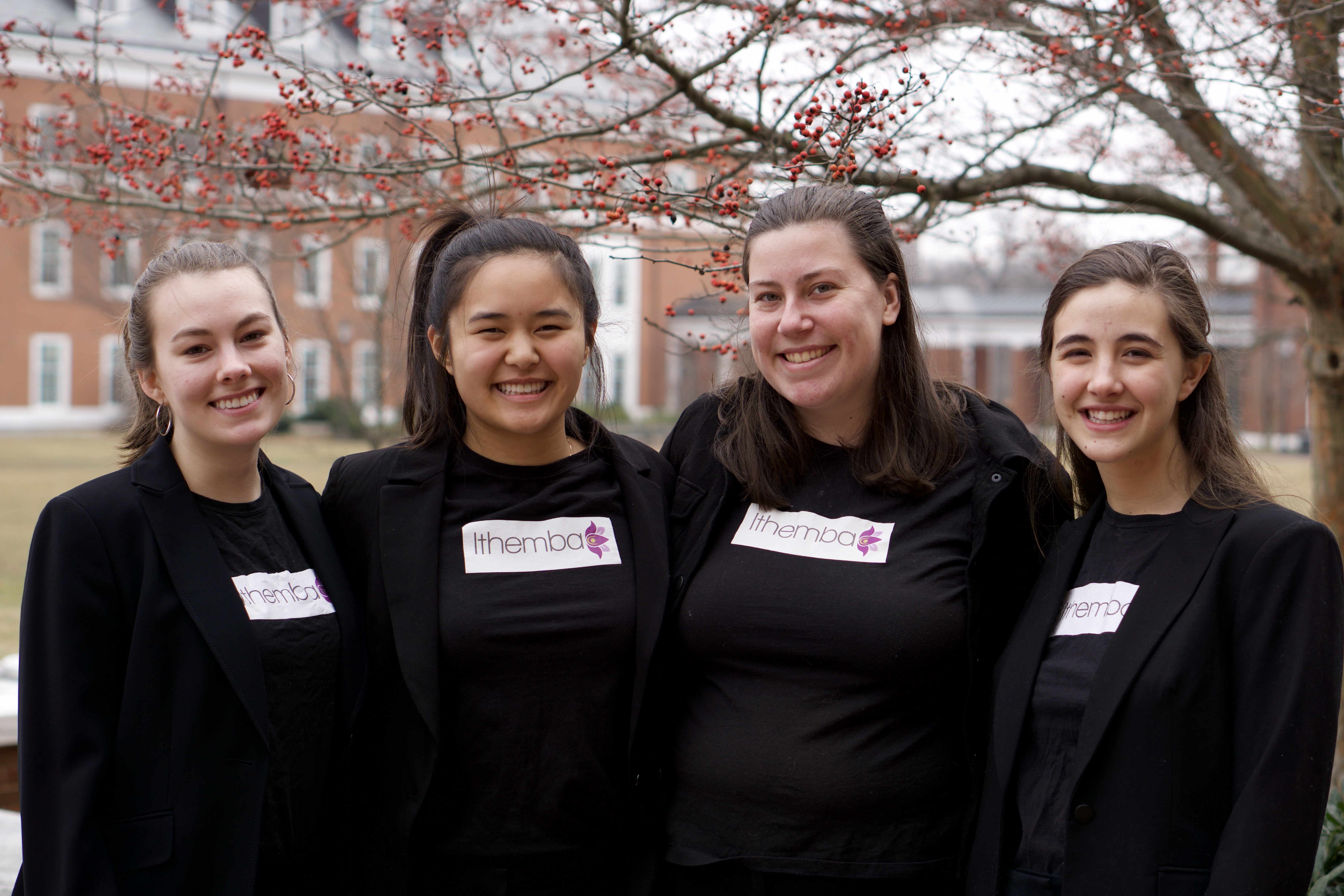
Ithemba co-founders Laura Hinson, Madeline Lee, Valerie Zawicki and Sophia Triantis

The 21-year-old Zawicki, who grew up in Long Beach, Calif., has a personal connection to the work the team is doing. When she was just five years old her mother was diagnosed with breast cancer, and the cost of treatment and toll it took on the family forced the family to separate. “My sister moved in with my grandparents,” Zawicki says, while her mother underwent treatment. “When I came to college I was looking for a way to make an impact in the healthcare space and was really inspired by the care my mom received.”

The same is true for Zawicki’s co-founder, Triantis.

“We have an opportunity to  solve problems that really need solving,” says Triantis, a 20-year-old undergraduate. “Breast cancer has affected so many people close to me… It is the most common cancer among women [and] the fact that women in low resource settings do not have the same standard of diagnostic care really inspired me to work on a solution.”

What the four women have made is a version of a core-needled biopsy that has a lower risk of contamination than the reusable devices that are currently on the market and is cheaper than the expensive disposable needles that are the only other option, the founders say.

We’ve designed a novel, disposable portion that attaches to the reusable device and the disposable portion has an ability to trap contaminants that would come back through the needle into the device,” says Triantis. “What we’ve created is a way to trap that and have that full portion be disposable and making the device as easy to clean as possible… with a bleach wipe.”
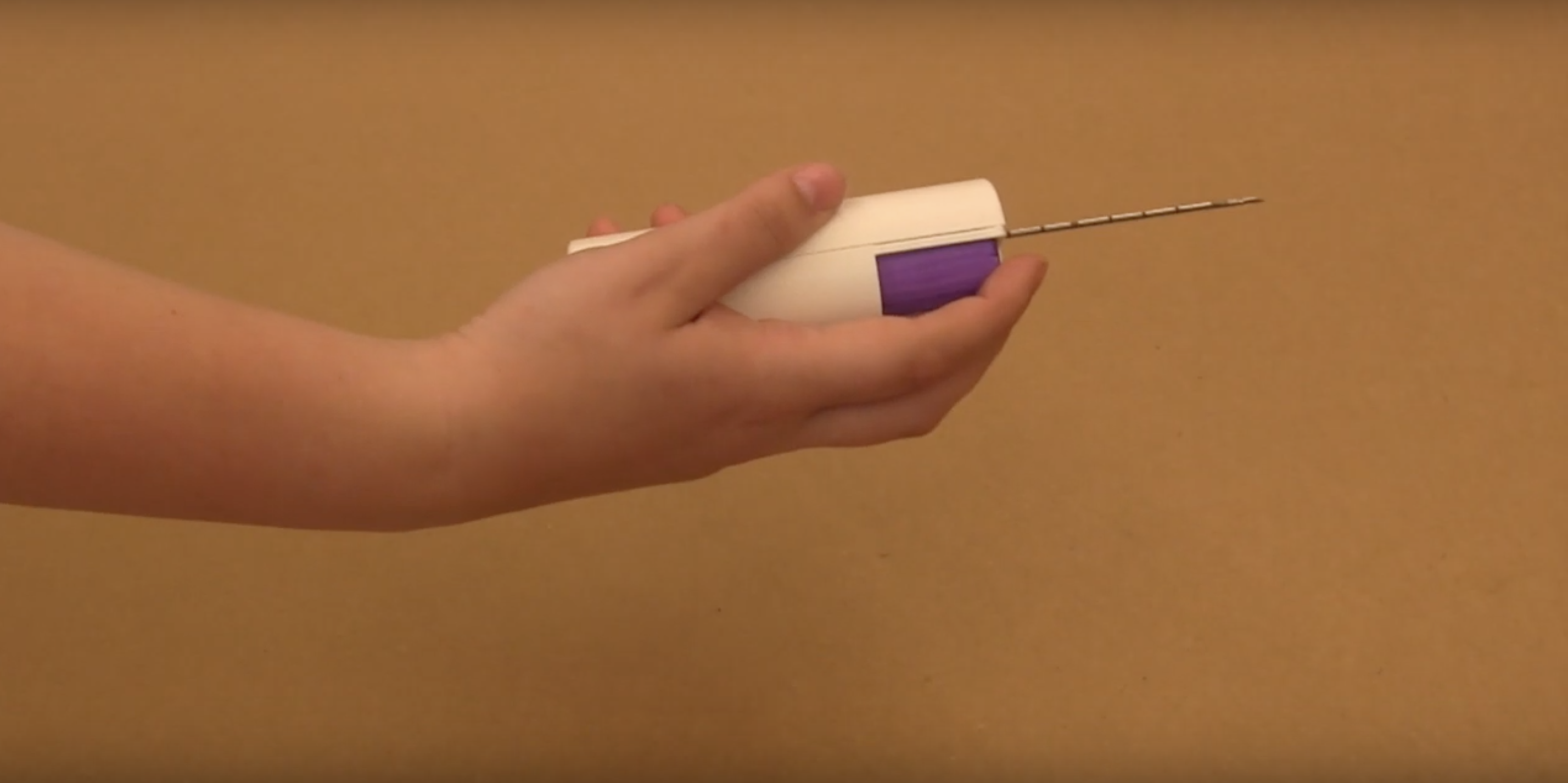
Ithemba’s low-cost reusable core-needle biopsy device

The company is currently in the process of doing benchtop tests on the device, and will look to file a 510K to be certified as a Class 2 medical device. Already a clinic in South Africa and a hospital in Peru are on board as early customers for the new biopsy tool.

At the heart of the new tool is a mechanism which prevents blood from being drawn back into a needle. The team argues it makes reusable needles much less susceptible to contamination and can replace the disposable needles that are too expensive for many emerging market clinics and hospitals.

Zawicki had been working on the problem for a while when Hinson, Lee, and Triantis joined up. “I joined the team when the problem was presented,” says Zawicki. “The project began with this problem that was pitched three years ago, but the four of us are really those that have brought this to life in terms of a device.”

Crucially for the team, Johns Hopkins was fully supportive of the women taking their intellectual property and owning it themselves. “We received written approval from the tech transfer office to file independently,” says Zawicki. “That is really unique.” 

Coupled with the Lemelson award, Ithemba sees a clear path to ownership of the intellectual property and is filing patents on its device.

Zawicki says that it could be anywhere from three to five years before the device makes it on to the market, but there’s the potential for partnerships with big companies in the biopsy space that could accelerate that time to market.

“Once we get that process solidified and finalize our design we will wrap up our benchtop testing so we can move toward clinical trials by next summer, in 2020,” Zawicki says.


19 May 2019

Game of Thrones petition reaches 1M signatures ahead of finale

Life is short, difficult and, most likely, ultimately meaningless. In this age of immediate fan service, it’s important to remember that you can’t always get what you want. That goes double when it comes to the final season of a beloved television series (I’m looking at you, The Wire). TV, like life, rarely has a satisfying ending.

But perhaps the internet — the cause of and solution to all of life’s problems — can fix that. Irritated Games of Thrones fans have taken to that bastion the bastion of fan annoyance (no, not that one) Change.org in a futile hope of getting a remake of the show’s eighth and final series to end thing they way they want.

As the petition has cruised past one million signatures, its creators have penned a prediction and spoiler note to let signers know where things stand. Tempering expectations for the possibility of a reshoot, it notes that the state of the world demands escapism via sci-fi and fantasy like GoT and Star Wars.

“I didn’t make this petition to be an entitled, whiny fan,” the petition’s creator writes. “I made it because I was immensely disappointed and needed to vent. Do I have a solution? I’ve got plenty of ideas, but no, I’m not a Hollywood writer. But you don’t need to be a mechanic to know your car is broken.”

Who knows, maybe tonight’s final episode will make everything right. Perhaps it will be so good that the world’s corporations and governments will join forces to end war, obliterate poverty and create a diet soda that doesn’t taste like a liquified pencil eraser. Or maybe we’ll all go back to work to work on Monday knowing that it, like all of us could have been better. And maybe, just maybe true change starts with us, beginning with canceling that HBO account.

Or maybe not. Barry is still pretty great.

19 May 2019

Game of Thrones petition reaches 1M signatures ahead of finale

Life is short, difficult and, most likely, ultimately meaningless. In this age of immediate fan service, it’s important to remember that you can’t always get what you want. That goes double when it comes to the final season of a beloved television series (I’m looking at you, The Wire). TV, like life, rarely has a satisfying ending.

But perhaps the internet — the cause of and solution to all of life’s problems — can fix that. Irritated Games of Thrones fans have taken to that bastion the bastion of fan annoyance (no, not that one) Change.org in a futile hope of getting a remake of the show’s eighth and final series to end thing they way they want.

As the petition has cruised past one million signatures, its creators have penned a prediction and spoiler note to let signers know where things stand. Tempering expectations for the possibility of a reshoot, it notes that the state of the world demands escapism via sci-fi and fantasy like GoT and Star Wars.

“I didn’t make this petition to be an entitled, whiny fan,” the petition’s creator writes. “I made it because I was immensely disappointed and needed to vent. Do I have a solution? I’ve got plenty of ideas, but no, I’m not a Hollywood writer. But you don’t need to be a mechanic to know your car is broken.”

Who knows, maybe tonight’s final episode will make everything right. Perhaps it will be so good that the world’s corporations and governments will join forces to end war, obliterate poverty and create a diet soda that doesn’t taste like a liquified pencil eraser. Or maybe we’ll all go back to work to work on Monday knowing that it, like all of us could have been better. And maybe, just maybe true change starts with us, beginning with canceling that HBO account.

Or maybe not. Barry is still pretty great.

19 May 2019

Google reportedly suspends select business with Huawei following U.S. ban

The Trump administration Huawei ban is sure to have wide-ranging and long lasting effects for all parties. In the meantime, it seems, a number of those involved in the periphery are treading lightly in hope of not burning bridges on either side. Google has taken accidental center stage, in its role providing Android and a variety of apps for the embattled handset maker.

According to a new report from Reuters, the U.S. software giant has taken some steps toward disentangling itself. Word comes from unnamed sources, who say the company has suspended all businesses with Huawei, aside from those covered by open-source licenses. The list appears to include updates to Android and popular apps like Gmail.

From the sound of it, Google is still attempting to wrap its head around how to proceed with the matter. Huawei, too, is assessing its options. Given the complexity of smartphone hardware and software, handsets routinely utilize components source from a variety of different locations. This fact has complicated things as trade tensions have begun to rise, hitting ZTE particularly hard over accusations that the company had violated U.S.-Iran sanctions.

Huawei has called the ban bad for all parties, but has continued to be defiant, noting its plans to become “self-reliant.” The company has no doubt been preparing for the seeming inevitability of heightened trade tensions, but its determination has some industry observers unconvinced that it can carry on with without any input from Google or U.S. chipmakers like Qualcomm.

19 May 2019

Week-in-Review: Apple has a Supreme headache and Bitcoin bites back

For all of the swirling conversations of tech regulation that have continues the past several years, few of those waxing poetic on the topic likely assumed that Apple would be the first tech giant to capture the government’s ire, but a Supreme Court ruling this week cleared the way for an anti-trust reckoning for Apple’s walled garden App Store.

The U.S. Supreme Court ruled 5-4 against Apple on Monday, determining that a group of iPhone users will be allowed to bring an antitrust lawsuit against the tech giant. The group is alleging that Apple’s 30 percent cut in the App Store passes on an unfair cost to users that have no other options to get the apps onto their phone.

The ruling is decidedly not great for Apple, which has long-enjoyed a monopoly on app sales on its devices, with, to be fair, some very clear benefits for users along the way. If Apple were forced to allow other stores on its platform or significantly shape how it monetized app sales, this could have pretty significant effects on how platforms like iOS operate.

Shoot me tips or feedback
on Twitter @lucasmtny or email
lucas@techcrunch.com

While this ruling won’t impact Apple in the near-term obviously, it could have some massive effects if and when other lawsuits in this vein pop up against Apple, especially given the company’s renewed reliance on software services as its iPhone sales slow.

Trends of the week

Here are a few big news items from big companies, with green links to all the sweet, sweet added context.

  • Bitcoin bites back
    After a nice lengthy free fall, the bear cryptocurrency market began showing some strength as Bitcoin brought a number of popular coins back with substantial gains. Bitcoin passed above $8,000 this week and is still hovering in that range. What’s the reason? There are a lot of theories, we detailed some of them here.
  • ZombieLoad is coming for you
    If you recall the pandemonium of Spectre and Meltdown, you should probably keep an eye on a new Intel exploit that emerged onto the scene this week, ZombieLoad. The bug allows hackers to effectively exploit design flaws as opposed to injecting malicious code onto affected systems. Intel is already on it, but you should read up some more on it from my much more in-the-know colleague Zack Whittaker.
  • Trump takes on Twitter with his full presidential might
    Trump’s war on Silicon Valley’s most popular social media sites took an aggressive turn this week, when the president… shared a survey. The 16-part Typeform survey is aiming to gather some very scientific data about Americans who have had their social media accounts banned for perceived “political bias.”
  • TikTok won’t stop
    I’m very intrigued by the success of TikTok, turns out a lot of other people are intrigued by the social app given that it’s topped the App Store for the last five quarters now. The next few popular apps for the first quarter were YouTube and four Facebook apps, so it definitely looks like Chinese tech giant ByteDance is beating Silicon Valley’s best in the app game lately.

GAFA Gaffes

How did the top tech companies screw up this week? This clearly needs its own section, in order of awfulness:

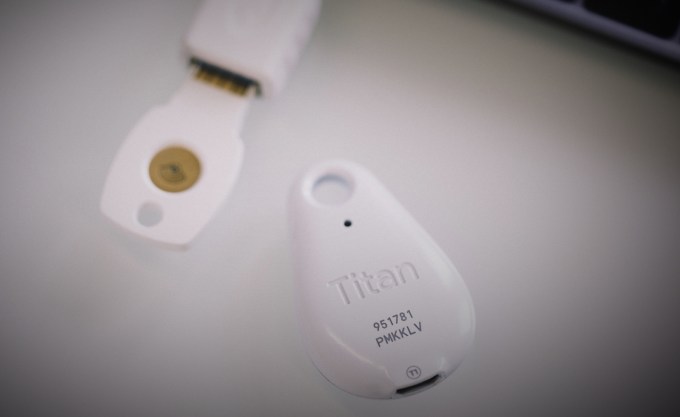
  1. Google’s brand new security key already gets hacked:
    [Google recalls its bluetooth titan security keys because of a security bug]
  2. Alexa outage leaves users hanging:
    [Having trouble with Amazon Alexa? You’re not the only one.]

Extra Crunch

Our premium subscription service had another week of interesting deep dives. This week, we published a deep dive into world of startups aiming to build affordable housing solutions. It’s a terrific deep dive, that’s certainly academic in nature but gets to a lot of the root problems and solutions at play.

Market Map: the 200+ startups tackling affordable housing

“Innovations have reduced costs in the most expensive phases of the housing development and management process. I explore innovations in each of these phases, including construction, land, regulatory, financing, and operational costs…”

Here are some of our other top reads this week for premium subscribers, this week IPOs and public company sagas were front of min for a lot of the TechCrunch writers…

Want more TechCrunch newsletters? Sign up here.

19 May 2019

Is a $600 smart oven ever worth it?

Part of closely following tech is the often mistaken belief that newer, better technologies can help right some of the wrongs older ones caused in the first place. Behold the Wii and the Fitbit — two perfect examples of technologies designed to right some of technologies’ previous wrongs.

It’s tricky because, in some cases, these things do work. We’ve all read the success stories, and for many of us, that’s enough to keep us trying out new things. Some much ultimately relies on our own individual hang ups. If we’re lucky, the right piece of technology at the right time can be legitimately transformative of those things we’d like to change about ourselves.

With something like the June, the hope is two-fold. There’s all of the built-in features and the promise of better baking, coupled with the simple motivating factor of spending $599 on a glorified toaster oven. I’ll admit that test driving it only addresses only the first of those two key things, but my hopes were still pretty high that it could help wean me off of my takeout food dependency.

Thing is, I travel a lot for work. Couple that with a long time living in one of the world’s best and most diverse food cities, and that’s a recipe for picking up food nearly every night. I’m sure I don’t need to tell you what that means for my wallet and waste line, not to mention the packing waste that tends to generate. Bad news all the way around.

Often life gets in the way, as it has with my own testing. This one’s been a little cursed. After a prolonged delay on review units (the second gen oven was announced 10 months ago), I was finally able to get started late last month. Well, after the company sent me a second unit when I discovered the hard way that the first had been damaged in shipping, sending up sparks during my first attempt to cook. I mention that only to say double-check the filaments when you take it out of the box. Perhaps some kind of automotive-like oven health check is in the cards for some future update.

One other thing worth mentioning here, at the risk of offering up TMI, is the fact that I rarely left my bed the week before last, over a particularly bad bout with the stomach flu. The nausea and everything else have been bad enough to put me off of the idea of handling raw meat for the intervening week — something that could hopefully be a boon for my longtime flirtations with vegetarianism.

As someone who’s never been especially enamored with cooking, the June did help fire up those synapsis in my brain a bit. There’s something in being able to cook something decent with minimal effort, and the June does a good job on that front. Locate a recipe with only a handful of ingredients and a stated five to 10 minute prep time, and that’s a solid baby step. Of course, you can only go outside of June’s suggested recipes, but coloring inside the lines is a probably the best place for a beginner to start.

Simplicity, coupled with data collection are where the June really shines. Between the constant heat monitoring, the camera and the inclusion of a meat thermometer, the oven is pulling a lot of data to assure you get the right cook. It’s not idiot-proof (sadly for this culinary dummy), and the first time I tried (the working oven), I’d stuck the thermometer too far in, touching the bottom pan and shortening the cooking time to a too brief five minutes (down from 22).

Make this so idiots like me can use it is probably my main feedback here. Also, though I fully understand why it’s as large as it is, it was still bigger than expected. Which may not mean much to you, if you don’t grapple with the size restrictions of a New York City apartment.

Another minor thing, which probably couldn’t be avoided is that plasticky smell that happens with the first several sessions. Based on the June FAQ, I expected it to go away a lot sooner, but was assured it was just a normal part of the baking process.

For what it’s worth, the simple dishes came out well, which only means a lot if you know how terrible I am at cooking. It’s a weird mental block, I realize. And I did enjoy the process enough to begin experimenting with things outside of the parameters of the June recipes.

Smartphone notifications are a nice feature, though I’m not sure any of the smart features are “necessary” per se. Like, take this time-lapse footage of me slightly overcooking chicken breasts:

[Above: bon appétit?]

Ditto for the image recognition. It does an impressive job mostly identifying the foodstuffs on the tray, but I can’t really foresee a scenario in which you, the chef, is not aware of what you’re cooking before you hit start.

It’s a tricky line to walk. You want to add enough features to justify the purchase of a smart oven, while not loading it up with so many that the price becomes unmanageable. June’s definitely taken a step in the right direction with the second gen oven, but for a majority of users, the balance still isn’t quite there.

19 May 2019

How the (plant-based) sausage is about to be made

It’s been a big year for Impossible . The bay area based food startup kicked the year off with a new take on its titual burger, and just last week announced the closing of a $300 million round hot on the heels of its Burger King distribution.

What comes next for the company likely won’t come as much of a shock to anyone steeped in the world of plant-based meat replacements. Engadget got a bit of behind-the-scenes time at the startup’s Redwood City location, discovering that sausage is next up on the Impossible menu.

From the sound of things, the breakfast food will mostly be made up of the same stuff as the company’s burger patties, right down to the imitation blood. Instead, the amounts of the ingredients will be mixed up in different proportions, with potato protein removed completely. In fact, the company’s got a lot of different recipes in the work that are largely reconfigurations of its “platform” product. Imagine it as a modular menu, if you will. Heck, rotating the same few core ingredients has worked pretty well for chains like Taco Bell over the years, so why not health foodstuffs?

Timing and all that other good stuff is still TBD.

19 May 2019

As Amex scoops up Resy, a look at its history of acquisitions

American Express (also commonly known as AmEx), a popular credit and banking company, recently announced that it purchased a company called Resy. Resy helps people get seats at restaurants, or as AmEx describes it, provides “a digital restaurant reservation booking and management platform.”

The deal might not be as big a surprise as it feels, given that the two have worked together since at least the start of 2018.

As a private company, five-year-old Resy raised a total of $45 million in its lifetime, according to its Crunchbase profile. Its investors include Lerer HippeauAirbnb and Slow Ventures. Resy was co-founded by Ben Leventhal, co-founder of Eater, which produces food news and dining guides. The startup is primarily focused on the United States, but it also has a presence in the United Kingdom, Europe, Canada and Australia.

In a press release, AmEx said the goal of the acquisition was to enhance its ability to help cardmembers have access to “new, notable and hard to get into restaurants across the globe, as well as help restaurants’ businesses grow and thrive.” It also noted that it’s the latest buy in a string of recent purchases “in the dining, travel and lifestyle space.”

However, this being Crunchbase News, let’s see what else we can find out about what AmEx is up to.

Swipe for all the startups

AmEx has been on a buying spree as of late. In March, we reported on its purchase of LoungeBuddy, a former partner that helped travelers with reviews of various airport lounge areas. Also this year, AmEx picked up Pocket Concierge, a firm that we wrote “helps book in-demand restaurants and is similar to OpenTable.”

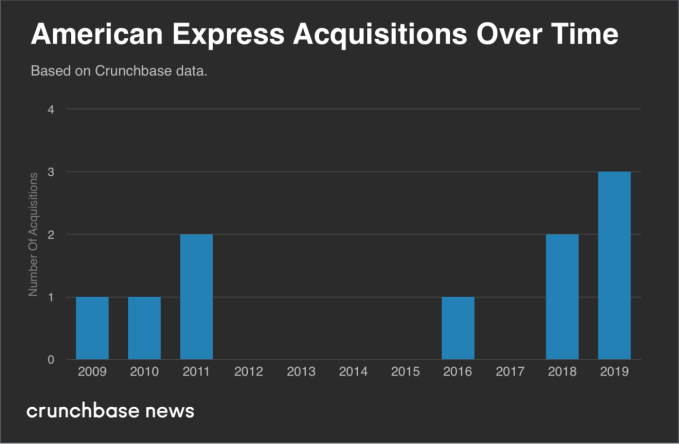
The following chart details American Express’s known acquisitions over the past decade, as reported by Crunchbase:

The chart tell us two things:

  1. AmEx is not a company with a history of buying lots of companies. For a firm of its value ($98.3 billion), buying a few companies a year is more than manageable. And, often, American Express hasn’t even done that. Indeed, in five of the last 11 years, AmEx bought zero known companies.
  2. AmEx has picked up three companies according to Crunchbase data this year. That’s a record, and it’s only May.

So, there could be change in the wind over at the credit card giant. (And if so, I suspect there are a fair few companies that brush up against AmEx that would love to join forces.)

A different checkbook

AmEx also has a venture arm, creatively named American Express Ventures. That means it interfaces with young tech shops both while they are independent and when they are ready to be picked up.

American Express Ventures has made 54 known investments, according to Crunchbase, including 13 led rounds. Unsurprisingly, the firm’s most popular startup categories to invest in are fintech, financial services and e-commerce. AmEx puts money to work where it also plays.

And that’s all for now, but we have our eyes out. If American Express buys something else, we’ll let you know — especially if you are a fintech founder.

18 May 2019

Equity transcribed: Away’s $1.4B valuation and CrowdStrike’s S-1

Welcome back to another transcribed edition of Equity, the wildly popular TechCrunch podcast that digs deep into the week’s news about … equity.

There were no IPOs this week so there was only one episode, but it was jam-packed with news about direct-to-consumer scooters, luggage funding and fake meat. This is where tech has taken us this week.

Oh, and Slack set the date for its direct listing.

Kate: So [Away] raised a 100 million, series D. This round was led by Wellington Management, so not by a traditional venture capital firm. Though Away is backed by big name faces like Forerunner Ventures, which is responsible for investments in pretty much direct to consumer companies. So this valued Away at 1.4 billion, and that’s obviously quite large, but what’s particularly surprising about that valuation is that Away was valued at just 400 million the last time they raised money, which was a series C of 50 million, maybe about 1 or 2 years ago.

Alex: Oh gosh.

Kate: I’m not sure exactly when that was. But we’re seeing a major, major, major uptick in its valuation. And the reason why is because at its series C, Away was profitable already. Like I was telling Alex, they didn’t say anything about profitability this time, so I don’t know where that stands, but I do know they have $150 million in revenue.

Alex: Yearly revenue.

Kate: Yes. They are growing top line at 100%. They have an NPS score in the 80’s, and they have a bunch of new investors in this round that I think kind of shows that they’re going well. And also, they want to use this capital to create a generic travel brand. So they want to be more than just these Instagram-friendly cute luggage, suitcases, carry-ons, whatever they want to be. Kind of provide anything and everything you might need when you’re going on a trip of any kind.

For access to the full transcription, become a member of Extra Crunch. Learn more and try it for free. 


Kate Clark: Hello, and welcome back to Equity. I am TechCrunch’s Kate Clark. This week, I am in the studio with Alex Wilhelm of Crunchbase News. Hello Alex, how are you doing today?

Alex Wilhelm: I am good, but as we were just saying before we hit record, this is in some ways a bittersweet moment for us in this room, because it is the last time that the three of us, you, myself, and our excellent producer Christopher Gates, will be together in the TC podcast studio at 410 Townsend.

Kate: It is indeed a bittersweet moment for all of us.

18 May 2019

Sam Altman’s leap of faith

Earlier this year, founder-investor Sam Altman left his high-profile role as the president of Y Combinator to become the CEO of OpenAI, an AI research center at its outset that founded by some of the most prominent people in the tech industry in late 2015. The idea: to ensure that artificial intelligence is “developed in a way that is safe and is beneficial to humanity,” as one of those founders, Elon Musk, said back then to the New York Times.

The move is intriguing for many reasons, including that artificial general intelligence — or the ability for machines to be as smart as humans — does not yet exist, with even AI’s top researchers far from clear about when it might. Under the leadership Altman, OpenAI has also restructured as a for-profit company with some caveats, saying it will “need to invest billions of dollars in upcoming years into large-scale cloud compute, attracting and retaining talented people, and building AI supercomputers.”

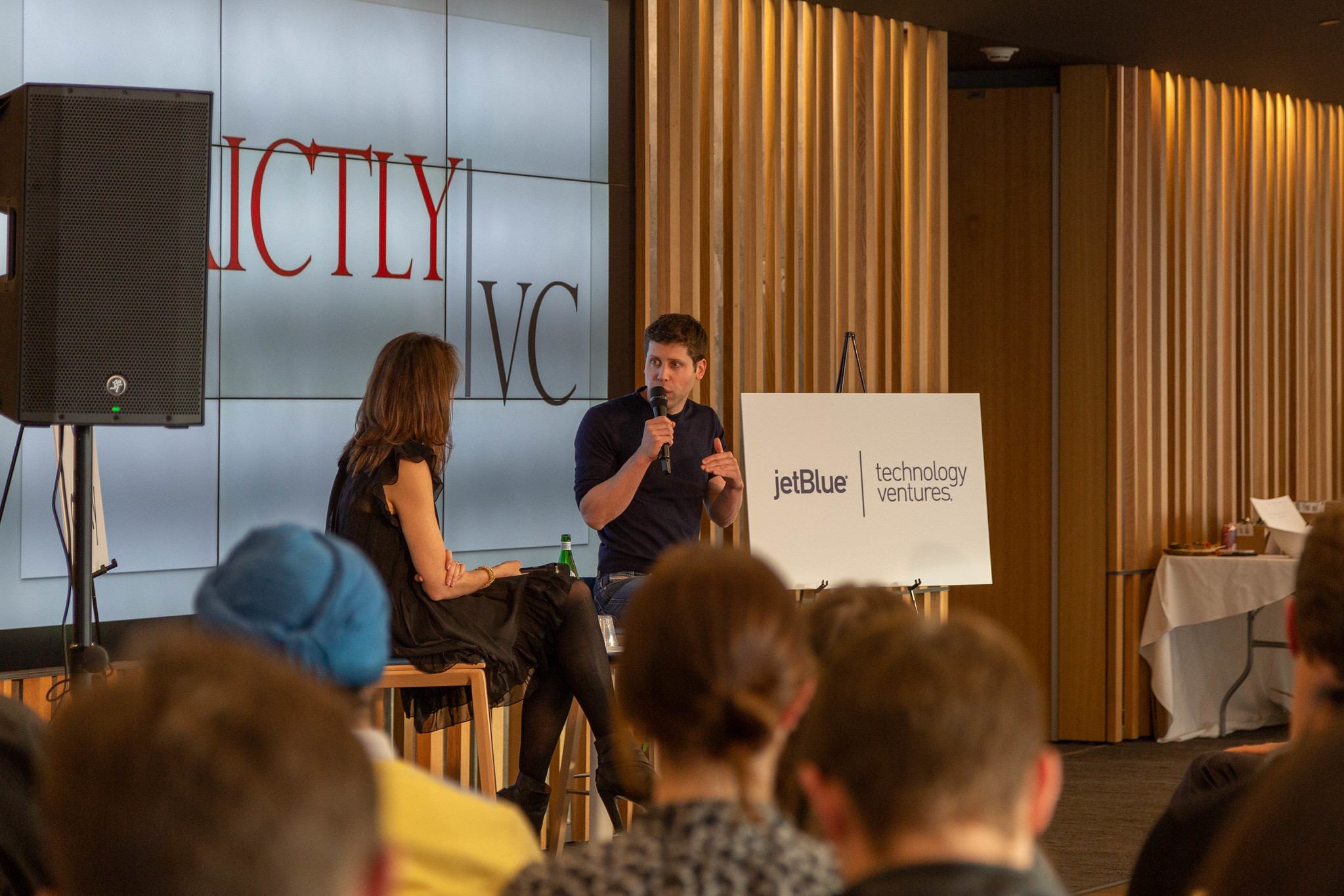
Whether OpenAI is able to attract so much funding is an open question, but our guess is that it will, if for no reason other than Altman himself — a force of nature who easily charmed a crowd during an extended stage interview with this editor Thursday night, in a talk that covered everything from YC’s evolution to Altman’s current work at OpenAI.

On YC, for example, we discussed that “ramen profitable” was once the goal but that a newer goal seems to be to graduate from the popular accelerator program with millions of dollars in venture funding, if not tens of millions of dollars. (“If I could control the market — obviously the free market is going to do its thing — I would not have YC companies raise the amounts of money they raise or at the valuations they do,” Altman told attendees at the small industry event. “I do think it is, on net, bad for the startups.”)

Altman was also candid when asked personal and occasionally corny questions, even offering up a story about the strong relationship he has long enjoyed with mom, who happened to be in town for the event. Not only did he say that she remains one of a small handful of people who he “absolutely” trusts, but he acknowledged that it has become harder over time to get unvarnished feedback from people outside that small circle. “You get to some point in your career where people are afraid to offend you or say something you might not want to hear. I’m definitely aware that I get stuff filtered and planned out ahead of time at this point.”

Certainly, Altman is given more rope than most.  Not only was this evidenced in the way that Altman ran Y Combinator for five years — essentially supersizing it time and again — but it’s plain from the way he discusses OpenAI that his current thinking is no less audacious. Indeed, much of what Altman said Thursday night would be considered pure insanity coming from someone else. Coming from Altman, it merely drew raised brows.

Asked for example, how OpenAI plans to make money (we wondered if it might license some of its work), Altman answered that the “honest answer is we have no idea. We have never made any revenue. We have no current plans to make revenue. We have no idea how we may one day generate revenue.”

Continued Altman, “We’ve made a soft promise to investors that, ‘Once we build a generally intelligent system, that basically we will ask it to figure out a way to make an investment return for you.'” When the crowd erupted with laughter (it wasn’t immediately obvious that he was serious), Altman himself offered that it sounds like an episode of “Silicon Valley,” but he added, “You can laugh. It’s all right. But it really is what I actually believe.”

We also asked what it means that, under Altman’s leadership, OpenAI has become a “capped profit” company, with the promise of giving investors up to 100 times their return before giving away excess profit to the rest of the world. We noted that 100x is a very high bar — so high in fact that most investors investing in plain-old for-profit companies seldom get close to a 100x return. For example, Sequoia Capital, the only institutional investor in WhatsApp, reportedly saw 50 times the $60 million it had invested in the company when it sold to Facebook for $22 billion, a stunning return.

But Altman not only pushed back on the idea the idea that “capped profit” is a bit of marketing brilliance, he doubled down on why it makes sense. Specifically, he said that the opportunity with artificial general intelligence is so incomprehensibly enormous that if OpenAI manages to crack this nut ahead of the big competitors also at work on it, including Google and Microsoft, it could “maybe capture the light cone of all future value in the universe, and that’s for sure not okay for one group of investors to have.”

Before we parted ways, we also shared with Altman various criticisms by AI researchers who we’d interviewed ahead of our sit-down and who’d complained that, among other things, OpenAI seeks out attention for qualitative and not foundational leaps in already proven work, and that its very mission of discovering a path to “safe” artificial general intelligence needlessly raises alarms and makes their research harder.

Altman absorbed and responded to each point. He wasn’t entirely dismissive of them, either, saying of OpenAI’s alarmist bent, for example, that he does have “some sympathy for that argument.”

Still, Altman insisted there’s a better argument to be made for thinking about — and talking with the media about — the potential societal consequences of AI, no matter how aggravating some may find it. “The same people who say OpenAI is fear mongering or whatever are the same ones who are saying, ‘Shouldn’t Facebook have thought about this before they did it?’ This is us trying to think about it before we do it.”

You can check out the full interview below. The first half of our chat is largely centered on his Altman’s career at YC, where he remains chairman. We begin discussing OpenAI in greater detail around the 26-minute mark.