Category: UNCATEGORIZED

16 May 2019

The case for corporates to fill the seed vacuum

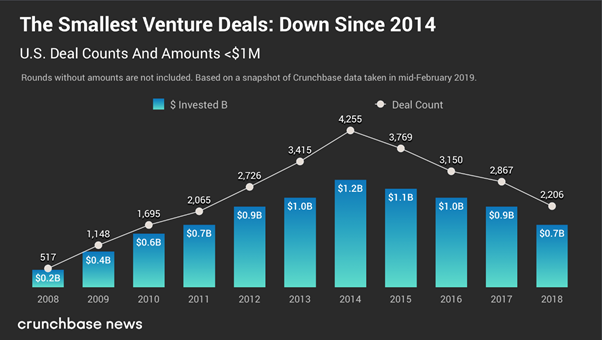
Over the past five years, there has been a clear drop in seed investing. Between 2010 and 2014 there was an influx of “micro” VCs, perfectly equipped to deploy seed capital. Since then, we have seen a gradual decline.

One key reason is that the Micro VCs were successful. Turns out that investing at the seed stage is a really strong strategy for generating returns. Their portfolios performed very well and, as a result, were able to raise a much larger second and third fund.

Unfortunately, once your fund size exceeds $75 million, I’d argue, it is very difficult to focus on the seed stage. It is simply too difficult to identify enough quality opportunities to deploy all that capital. Instead, you need to write bigger checks. In order to do that, you start to focus on later rounds. This leaves a gap at the seed stage, which I’d argue, is the most exciting.

Because of that, I believe there is an incredible opportunity for this gap to be filled by corporate venture funds. We, at dunnhumby, have invested here, successfully, for years. And by successfully, I don’t mean just financially, though we have returned far more than we have invested; I also mean strategically. There are incredible strategic benefits to investing at the seed stage.
Innovation

The seed stage is where the greatest innovation is happening. We invest to inform our own strategic direction and identify new technologies and business models prior to their impact on our own business. We also use it to identify and embed with emerging companies who could, one day, be great partners.

In the recent surge of corporate innovation efforts, venturing is not leveraged nearly enough. There are few ways of exposing innovation better than aligning with a company that is innovating daily as a means of survival. There is no better inspiration than watching a team of two grow into a team of 100-plus, often pulling the slower-moving corporate along for the ride.

Collaboration

There is a flexibility and eagerness with early-stage companies that allows for greater collaboration. They are not so large as to have their own, built-out bureaucracy, and are actively willing to work together. For many, it is why they take money from a strategic, in the hope that there is more than just capital that comes from the relationship.

In many cases, these synergies do not emerge right away. However, there is a closeness that forms between the two companies that begins to bear fruit, from my experience, about one year post-investment.

For the startup, there is increased exposure to the investor’s client base and resources. For the corporation, there is firsthand insight into the success of the startup’s business model, technology and market. From this, partnership and acquisition opportunities emerge.

M&A and partner pipeline

Because of the strategic nature behind these investments, they also act as an incubator for future partnerships and acquisitions.

Participating at the seed stage does not require significant capital contributions.

By aligning at the seed stage, you have the unique opportunity to watch the company grow. What is the market demand and is there an opportunity to enter a new space before others have realized the opportunity? Often, we will take a board or board observer position with the company, which brings even greater insight into their performance, as well as the potential upside of an even closer relationship.

Also, nearly as important, is that you gain an even greater insight into the company culture and their alignment with your own. In most cases, these discussions will emerge from early collaborations, where your broader teams will have the opportunity to interact and form a culture of their own. This cultural alignment will increase the likelihood of a successful outcome, whether that is a partnership or full acquisition.

Value

Participating at the seed stage does not require significant capital contributions. For one later-stage investment, you could make three to four seed investments, which increases your exposure to the above items and drastically reduces the financial impact on your balance sheet. If done right, within four to five years, the fund should contribute much more than it costs.

Does this mean that the corporate should finance the entire seed round? Not typically. In fact, for almost all of our investments to date, we are participating as part of a syndicate of investors. Often this syndicate is made up of other corporate investors (often referred to as “Strategics”). This reduces risk as well as the financial burden for each investor at this stage. The goal is to get a seat at the table. For strategic purposes, there is little difference between owning 5% versus 20% at this stage. Once the company grows larger, this dynamic will change.

Conclusion

At dunnhumby we invest in less than 2% of the companies we meet with. We are diligent about where we invest. However, I’d argue that the 98% we pass on are nearly as important. Because we have an investment arm, we are exposed to incredible innovation across a range of industries that most companies, that lack a seed investing strategy, do not see. At least, not until it is too late. Capital gives us a seat at the table.

These conversations provide signals into emerging trends in our industry, as well as our clients’ industries. When we pass, often the relationship does not end. Many times, they will lead to partnership discussions, referrals and introductions that are equally beneficial to the startup.

The opportunity is there. Corporations just need to seize it.
16 May 2019

Part fund, part accelerator, Contrary Capital invests in student entrepreneurs

First Round Capital has both the Dorm Room Fund and the Graduate Fund. General Catalyst has Rough Draft Ventures. And Prototype Capital and a few other micro-funds focus on investing in student founders, but overall, there’s a shortage of capital set aside for entrepreneurs still making their way through school.

Contrary Capital, a soon-to-be San Francisco-based operation led by Eric Tarczynski, is raising $35 million to invest between $50,000 and $200,000 in students and recent college dropouts. The firm, which operates a summer accelerator program for its portfolio companies, closed on $2.2 million for its debut, proof-of-concept fund in 2018.

“We really care about the founders building a great company who don’t have the proverbial rich uncle,” Tarczynski, a former founder and startup employee, told TechCrunch. “We thought, ‘What if there was a fund that could democratize access to both world-class capital and mentorship, and really increase the probability of success for bright university-based founders wherever they are?’ “

Contrary launched in 2016 with backing from Tesla co-founder Martin Eberhard, Reddit co-founder Steve Huffman, SoFi co-founder Dan Macklin, Twitch co-founder Emmett Shear, founding Facebook engineer Jeff Rothschild and MuleSoft founder Ross Mason. The firm has more than 100 “venture partners,” or entrepreneurial students at dozens of college campuses that help fill Contrary’s pipeline of deals.

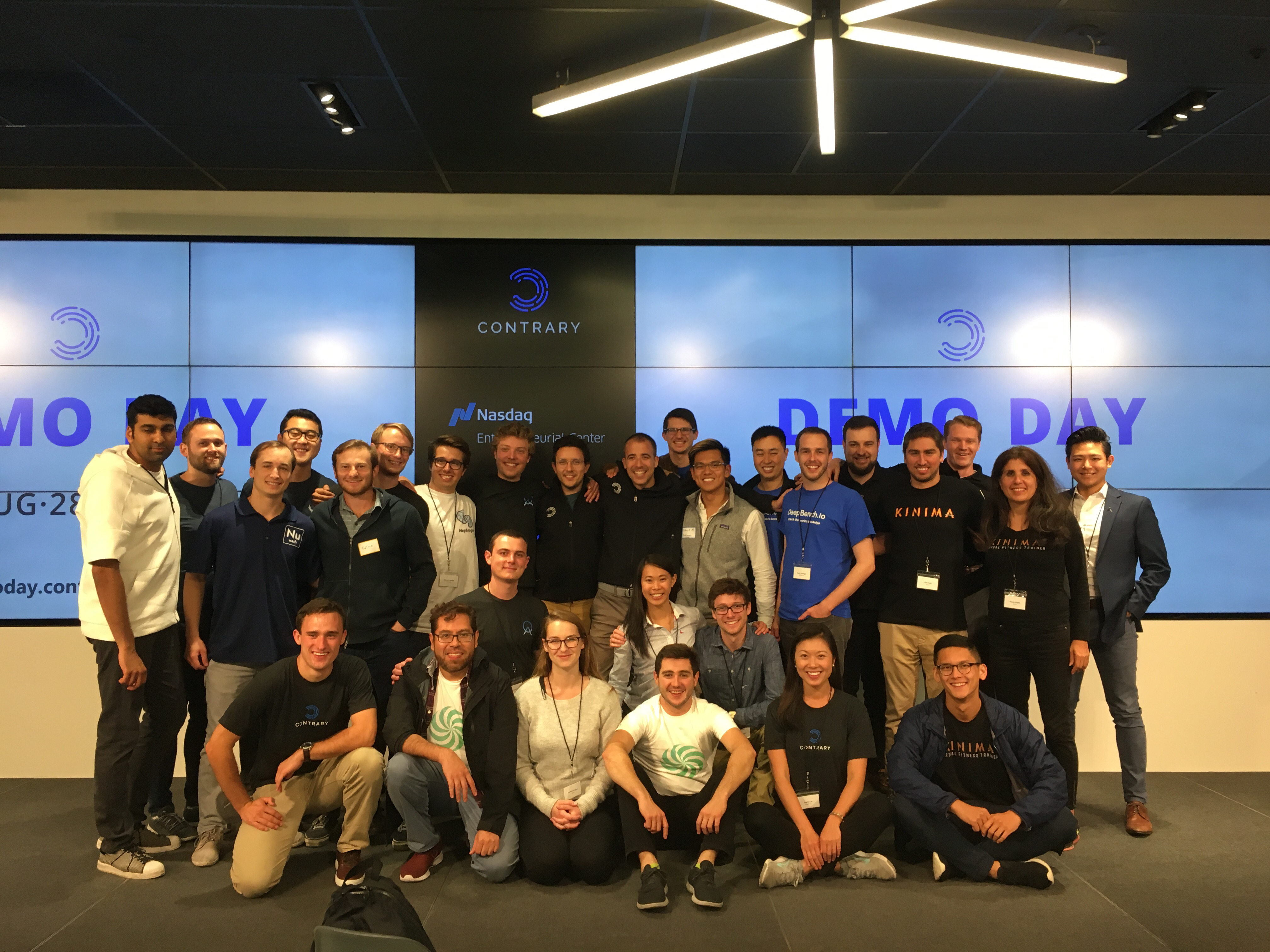
Contrary Capital celebrating its Demo Day event last year

Last year, Contrary kicked off its summer accelerator, tapping 10 university-started companies to complete a Y Combinator -style program that culminates with a small, GP-only demo day. Admittedly, the roughly $100,000 investment Contrary deploys to its companies wouldn’t get your average Silicon Valley startup very far, but for students based in college towns across the U.S., it’s a game-changing deal.

“It gives you a tremendous amount of time to figure things out,” Tarczynski said, noting his own experience building a company while still in school. “We are trying to push them. This is the first time in many cases that these people are working on their companies full-time. This is the first time they are going all in.”

Contrary invests a good amount of its capital in Berkeley, Stanford, Harvard and MIT students, but has made a concerted effort to provide capital to students at underrepresented universities, too. To date, the team has completed three investments in teams out of Stanford, two out of MIT, two out of University of California San Diego and one each at Berekely, BYU, University of Texas-Austin, University of Pennsylvania, Columbia University and University of California Santa Cruz.

“We wanted to have more come from the 40 to 50 schools across the U.S. that have comparable if not better tech curriculums but are underserviced,” Tarczynski explained. “The only difference between Stanford and these others universities is just the volume. The caliber is just as high.”

Contrary’s portfolio includes Memora Health, the provider of productivity software for clinics; Arc, which is building metal 3D-printing technologies to deliver rocket engines; and Deal Engine, a platform for facilitating corporate travel.

“We are one giant talent scout with all these different nodes across the country,” Tarczynski added. “I’ve spent every waking moment of my life the last eight years living and breathing university entrepreneurship … it’s pretty clear to me who is an exceptional university-based founder and who is just caught up in the hype.”

16 May 2019

Part fund, part accelerator, Contrary Capital invests in student entrepreneurs

First Round Capital has both the Dorm Room Fund and the Graduate Fund. General Catalyst has Rough Draft Ventures. And Prototype Capital and a few other micro-funds focus on investing in student founders, but overall, there’s a shortage of capital set aside for entrepreneurs still making their way through school.

Contrary Capital, a soon-to-be San Francisco-based operation led by Eric Tarczynski, is raising $35 million to invest between $50,000 and $200,000 in students and recent college dropouts. The firm, which operates a summer accelerator program for its portfolio companies, closed on $2.2 million for its debut, proof-of-concept fund in 2018.

“We really care about the founders building a great company who don’t have the proverbial rich uncle,” Tarczynski, a former founder and startup employee, told TechCrunch. “We thought, ‘What if there was a fund that could democratize access to both world-class capital and mentorship, and really increase the probability of success for bright university-based founders wherever they are?’ “

Contrary launched in 2016 with backing from Tesla co-founder Martin Eberhard, Reddit co-founder Steve Huffman, SoFi co-founder Dan Macklin, Twitch co-founder Emmett Shear, founding Facebook engineer Jeff Rothschild and MuleSoft founder Ross Mason. The firm has more than 100 “venture partners,” or entrepreneurial students at dozens of college campuses that help fill Contrary’s pipeline of deals.

Contrary Capital celebrating its Demo Day event last year

Last year, Contrary kicked off its summer accelerator, tapping 10 university-started companies to complete a Y Combinator -style program that culminates with a small, GP-only demo day. Admittedly, the roughly $100,000 investment Contrary deploys to its companies wouldn’t get your average Silicon Valley startup very far, but for students based in college towns across the U.S., it’s a game-changing deal.

“It gives you a tremendous amount of time to figure things out,” Tarczynski said, noting his own experience building a company while still in school. “We are trying to push them. This is the first time in many cases that these people are working on their companies full-time. This is the first time they are going all in.”

Contrary invests a good amount of its capital in Berkeley, Stanford, Harvard and MIT students, but has made a concerted effort to provide capital to students at underrepresented universities, too. To date, the team has completed three investments in teams out of Stanford, two out of MIT, two out of University of California San Diego and one each at Berekely, BYU, University of Texas-Austin, University of Pennsylvania, Columbia University and University of California Santa Cruz.

“We wanted to have more come from the 40 to 50 schools across the U.S. that have comparable if not better tech curriculums but are underserviced,” Tarczynski explained. “The only difference between Stanford and these others universities is just the volume. The caliber is just as high.”

Contrary’s portfolio includes Memora Health, the provider of productivity software for clinics; Arc, which is building metal 3D-printing technologies to deliver rocket engines; and Deal Engine, a platform for facilitating corporate travel.

“We are one giant talent scout with all these different nodes across the country,” Tarczynski added. “I’ve spent every waking moment of my life the last eight years living and breathing university entrepreneurship … it’s pretty clear to me who is an exceptional university-based founder and who is just caught up in the hype.”

16 May 2019

A year after outcry, carriers are finally stopping sale of location data, letters to FCC show

Reports emerged a year ago that all the major cellular carriers in the U.S. were selling location data to third party companies, which in turn sold them to pretty much anyone willing to pay. New letters published by the FCC show that despite a year of scrutiny and anger, the carriers have only recently put to end this practice.

We already knew that the carriers, like many large companies, simply could not be trusted. In January it was clear that promises to immediately “shut down,” “terminate,” or “take steps to stop” the location-selling side business were, shall we say, on the empty side. Kind of like their assurances that these services were closely monitored — no one seems to have bothered actually checking whether the third party resellers were obtaining the required consent before sharing location data.

Similarly, the carriers took their time shutting down the arrangements they had in place, and communication on the process has been infrequent and inadequate.

FCC Commissioner Jessica Rosenworcel, who has been particularly frustrated by the foot-dragging and lack of communication on this issue (by companies and the commission).

“The FCC has been totally silent about press reports that for a few hundred dollars shady middlemen can sell your location within a few hundred meters based on your wireless phone data. That’s unacceptable,” she wrote in a statement posted today.

To provide a bit of closure, she decided to publish letters (PDF) from the major carriers explaining their current positions. Fortunately it’s good news. Here’s the gist:

T-Mobile swiftly made promises last May and in June of 2018 CEO John Legere said in a tweet that he “personally evaluated this issue,” and pledged that the company “will not sell customer location data to shady middlemen.”

That seems to have been before “T-Mobile undertook an evaluation last summer of whether to retain or restructure its location aggregator program… Ultimately, we decided to terminate it.” That phased termination took place over the next half a year, finishing only in March of 2019.

AT&T immediately suspended access by the offending company, Securus, to location data, but continued providing it to others. One hopes they at least began auditing properly. Almost a year later, the company said in its letter to Commissioner Rosenworcel that “in light of the press report to which you refer… we decided in January 2019 to accelerate our phase-out of these services. As of March 29, 2019, AT&T stopped sharing any AT&T customer location data with location aggregators and LBS providers.”

Sprint said shortly after the initial reports that it was in the “process of terminating its current contracts with data aggregators to whom we provide location data.” That process sure seems to have been a long one:

As of May 31, 2019, Sprint will no longer contract with any location aggregators to provide LBS. Sprint anticipates that after May 31. 2019, it may provide LBS services directly to customers like those described above [i.e. roadside assistance], but there are no firm plans at this time.

Verizon (the parent company of TechCrunch) managed to kill its contracts with all-purpose aggregators LocationSmart and Zumigo in November of 2018… except for a specific use case through the former to provide roadside assistance services during the winter. That agreement ended in March.

It’s taken some time, but the carriers seem to have finally followed through on shutting down the programs through which they resold customer location data. All took care to mention at some point the practical and helpful use cases of such programs, but failed to detail the apparent lack of oversight with which they were conducted. The responsibility to properly vet customers and collect mobile user consent seems to have been fully ceded to the resellers, who as last year’s reports showed, did nothing of the kind.

Location data is obviously valuable to consumers and many services can and should be able to request it — from those consumers. No one is arguing otherwise. But this important data was clearly being irresponsibly handled by the carriers, and it is probably right that the location aggregation business gets a hard stop and not a band-aid. We’ll likely see new businesses and arrangements appearing soon — but you can be sure that these too will require close monitoring to make sure the carriers don’t allow them to get out of hand… again.

16 May 2019

A year after outcry, carriers are finally stopping sale of location data, letters to FCC show

Reports emerged a year ago that all the major cellular carriers in the U.S. were selling location data to third party companies, which in turn sold them to pretty much anyone willing to pay. New letters published by the FCC show that despite a year of scrutiny and anger, the carriers have only recently put to end this practice.

We already knew that the carriers, like many large companies, simply could not be trusted. In January it was clear that promises to immediately “shut down,” “terminate,” or “take steps to stop” the location-selling side business were, shall we say, on the empty side. Kind of like their assurances that these services were closely monitored — no one seems to have bothered actually checking whether the third party resellers were obtaining the required consent before sharing location data.

Similarly, the carriers took their time shutting down the arrangements they had in place, and communication on the process has been infrequent and inadequate.

FCC Commissioner Jessica Rosenworcel, who has been particularly frustrated by the foot-dragging and lack of communication on this issue (by companies and the commission).

“The FCC has been totally silent about press reports that for a few hundred dollars shady middlemen can sell your location within a few hundred meters based on your wireless phone data. That’s unacceptable,” she wrote in a statement posted today.

To provide a bit of closure, she decided to publish letters (PDF) from the major carriers explaining their current positions. Fortunately it’s good news. Here’s the gist:

T-Mobile swiftly made promises last May and in June of 2018 CEO John Legere said in a tweet that he “personally evaluated this issue,” and pledged that the company “will not sell customer location data to shady middlemen.”

That seems to have been before “T-Mobile undertook an evaluation last summer of whether to retain or restructure its location aggregator program… Ultimately, we decided to terminate it.” That phased termination took place over the next half a year, finishing only in March of 2019.

AT&T immediately suspended access by the offending company, Securus, to location data, but continued providing it to others. One hopes they at least began auditing properly. Almost a year later, the company said in its letter to Commissioner Rosenworcel that “in light of the press report to which you refer… we decided in January 2019 to accelerate our phase-out of these services. As of March 29, 2019, AT&T stopped sharing any AT&T customer location data with location aggregators and LBS providers.”

Sprint said shortly after the initial reports that it was in the “process of terminating its current contracts with data aggregators to whom we provide location data.” That process sure seems to have been a long one:

As of May 31, 2019, Sprint will no longer contract with any location aggregators to provide LBS. Sprint anticipates that after May 31. 2019, it may provide LBS services directly to customers like those described above [i.e. roadside assistance], but there are no firm plans at this time.

Verizon (the parent company of TechCrunch) managed to kill its contracts with all-purpose aggregators LocationSmart and Zumigo in November of 2018… except for a specific use case through the former to provide roadside assistance services during the winter. That agreement ended in March.

It’s taken some time, but the carriers seem to have finally followed through on shutting down the programs through which they resold customer location data. All took care to mention at some point the practical and helpful use cases of such programs, but failed to detail the apparent lack of oversight with which they were conducted. The responsibility to properly vet customers and collect mobile user consent seems to have been fully ceded to the resellers, who as last year’s reports showed, did nothing of the kind.

Location data is obviously valuable to consumers and many services can and should be able to request it — from those consumers. No one is arguing otherwise. But this important data was clearly being irresponsibly handled by the carriers, and it is probably right that the location aggregation business gets a hard stop and not a band-aid. We’ll likely see new businesses and arrangements appearing soon — but you can be sure that these too will require close monitoring to make sure the carriers don’t allow them to get out of hand… again.

16 May 2019

Apple & Google celebrate Global Accessibility Awareness Day with featured apps, new shortcuts

With last fall’s release of iOS 12, Apple introduced Siri Shortcuts — a new app that allows iPhone users to create their own voice commands to take actions on their phone and in apps. Today, Apple is celebrating Global Accessibility Awareness Day (GAAD) by rolling out a practical, accessibility-focused collection of new Siri Shortcuts, alongside accessibility-focused App Store features and collections.

Google is doing something similar for Android users on Google Play.

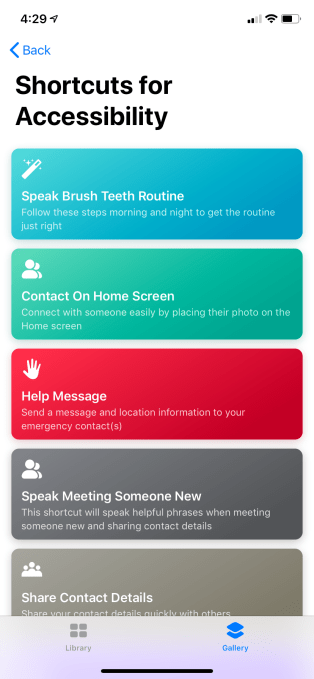
For starters, Apple’s new Siri shortcuts are available today in a featured collection at the top of the Shortcuts app. The collection includes a variety of shortcuts aimed at helping users more quickly perform everyday tasks.

For example, there’s a new “Help Message” shortcut that will send your location to an emergency contact, a “Meeting Someone New” shortcut designed to speed up non-verbal introductions and communication, a mood journal for recording thoughts and feelings, a pain report that helps to communicate to others the location and intensity of your pain, and several others.

Some are designed to make communication more efficient — like one that puts a favorite contact on the user’s home screen, so they can quickly call, text or FaceTime the contact with just a tap.

Others are designed to be used with QR codes. For example, “QR Your Shortcuts” lets you create a QR code for any shortcut you regularly use, then print it out and place it where it’s needed for quick access — like the “Speak Brush Teeth Routine” shortcut that speaks step-by-step instructions for teeth brushing, which would be placed in the bathroom.

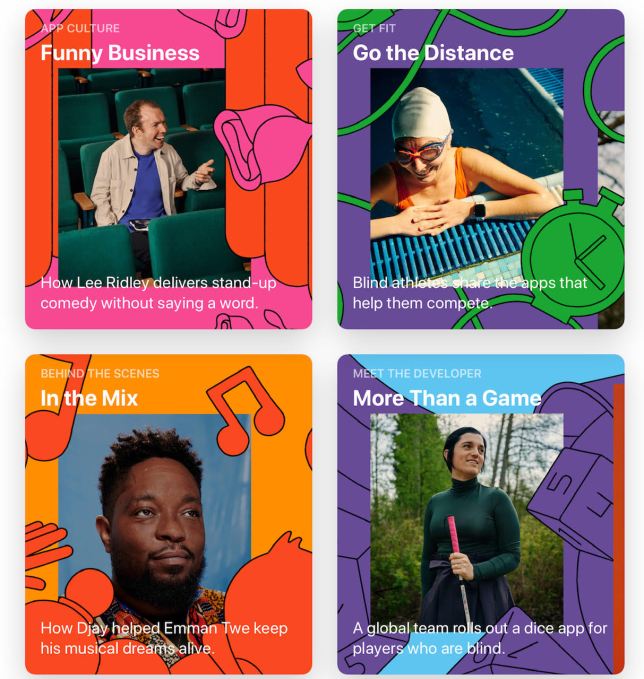
In addition to the launch of the new shortcuts, Apple added a collection of accessibility-focused apps to the App Store which highlights a ton of accessibility-focused apps including Microsoft’s new talking camera for the blind called Seeing AI, plus other utilities like text-to-speech readers, audio games, sign language apps, AAC (Augmentative and Alternative Communication) solutions, eye-controlled browsers, smart home apps, fine motor skill trainers, and much more.

The App Store is also today featuring several interviews with developers, athletes, musicians, and a comedian who talk about how they use accessible technology.

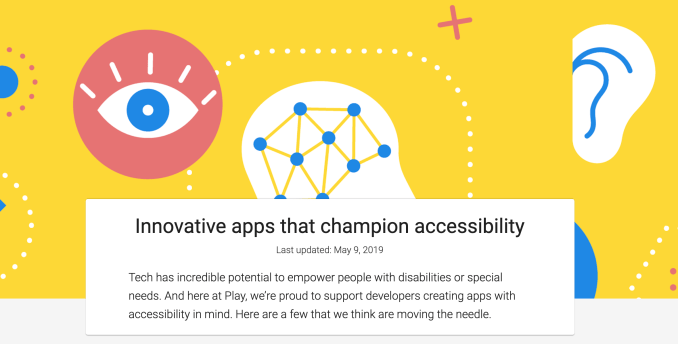
Apple is not the only company rolling out special GAAD-themed collections today. Google also unveiled its own editorial collection of accessible apps and games on Google Play. In addition to several utilities, the collection features Live Transcribe, Google’s brand-new accessibility service for the deaf and hard of hearing that debuted earlier this month at its annual Google I/O developer conference.

Though the app’s status is “Unreleased,” users can install the early version which listens to conversations around you, then instantly transcribes them.

Other selections include home screen replacement Nova Launcher, blind assistant app Be My Eyes, head control for the device Open Sesame, communication aid Card Talk, and more.

16 May 2019

How startups can use Amazon’s SEO best practices to dominate new shopping verticals

Amazon dominates the top ranking positions of Google for tens of thousands of ecommerce queries, but there are plenty of products in newer shopping categories where Amazon has not yet achieved SEO supremacy. Retailers in nascent verticals have an opportunity to follow Amazon’s SEO playbook and become the default ranking ecommerce website.

Achieving this success can be done purely by focusing on on-page SEO without the need to build a brand and a backlink portfolio that rivals Amazon.

For those unfamiliar with mechanisms of SEO, there are essentially two streams of SEO tactics

  1. On-page SEO – This is anything to do with optimizing an actual page or website for maximum SEO visibility. Within this bucket will fall efforts such as the content of a page, metadata, internal links, URL/folder names,  and even things like images.
  2. Off-page SEO – A key component of Google’s algorithm is the quality and sometimes quantity of the links from external sites that point to a page or website. At a high level the better backlinks a page or website has the more authority the page has to rank in search.

On-page SEO teardown

Delving into just their on-page SEO, their tactics can be divided into four distinct areas which we will go through in detail.

  1. Content
  2. SEO site architecture
  3. Cross-linking
  4. Page layout

If you are following along with this process, make sure to log out of your Amazon account or open up an incognito window. Google only views the logged out version of the site, so all of Amazon’s SEO efforts are focused there.

16 May 2019

How startups can use Amazon’s SEO best practices to dominate new shopping verticals

Amazon dominates the top ranking positions of Google for tens of thousands of ecommerce queries, but there are plenty of products in newer shopping categories where Amazon has not yet achieved SEO supremacy. Retailers in nascent verticals have an opportunity to follow Amazon’s SEO playbook and become the default ranking ecommerce website.

Achieving this success can be done purely by focusing on on-page SEO without the need to build a brand and a backlink portfolio that rivals Amazon.

For those unfamiliar with mechanisms of SEO, there are essentially two streams of SEO tactics

  1. On-page SEO – This is anything to do with optimizing an actual page or website for maximum SEO visibility. Within this bucket will fall efforts such as the content of a page, metadata, internal links, URL/folder names,  and even things like images.
  2. Off-page SEO – A key component of Google’s algorithm is the quality and sometimes quantity of the links from external sites that point to a page or website. At a high level the better backlinks a page or website has the more authority the page has to rank in search.

On-page SEO teardown

Delving into just their on-page SEO, their tactics can be divided into four distinct areas which we will go through in detail.

  1. Content
  2. SEO site architecture
  3. Cross-linking
  4. Page layout

If you are following along with this process, make sure to log out of your Amazon account or open up an incognito window. Google only views the logged out version of the site, so all of Amazon’s SEO efforts are focused there.

16 May 2019

Pinterest delivers first earnings report as a public company

Pinterest (NYSE: PINS) shared impressive first-quarter financials on Thursday after the closing bell in what was its first earnings report as a public company.

The digital pinboard went public in April, rising 25 percent during its first day trading on the New York Stock Exchange. Pinterest’s public market performance has continued to stay in the green, closing up about 8 percent Thursday at nearly $31 per share for a market cap of $16.7 billion.

The company, led by co-founder and chief executive officer Ben Silbermann, posted revenues of $202 million on losses of $41.4 million for the three months ending March 31, 2019. This surpassed Wall Street’s revenue estimates of about $200 million in Q1 revenue and represents significant growth from last year’s Q1 revenues of $131 million. Losses, however, came in slightly higher than the expected adjusted loss of 11 cents per share at 32 cents per share.

“The IPO was a significant milestone, but our focus at Pinterest hasn’t changed,” Silbermann said in a statement. “We want to help people discover inspiring ideas for every aspect of their lives, from fashion and home decor to travel and fitness. Our success can be seen in our Q1 results, and we’re excited to continue to grow our reach and impact in the years to come.”

Pinterest in April sold 75 million Class A shares in an IPO that raised $1.4 billion. The IPO gave the company a fully diluted market cap of $12.6 billion, a figure slightly larger than its Series H valuation of $12.3 billion. This was amid concerns the company would see a slighter smaller valuation upon its IPO and gain the unseemly title of “undercorn.”

Pinterest previously disclosed revenues of $755.9 million in the year ending December 31, 2018, up from $472.8 million in 2017. Losses, meanwhile, shrank to $62.9 million last year from $130 million in 2017. For the full year 2019, Pinterest, expected to reach profitability by 2021, predicts full-year revenues of between $1.05 billion and $1.08 billion, up from $755.9 million in 2018.

Pinterest post-IPO performance and earnings report comes in stark contrast to both Lyft and Uber’s treatment on their respective stock exchanges. Lyft, for its part, has fallen since its IPO despite an initial pop of 21 percent. In its first-ever earnings report as a public company, released last week, posted first-quarter revenues of $776 million on losses of $1.14 billion, including $894 million of stock-based compensation and related payroll tax expenses. The company’s revenues surpassed Wall Street estimates of $740 million while losses came in much higher as a result of IPO-related expenses.

Uber suffered through a catastrophic IPO last week only to continue falling in the days since. The ride-hailing giant was previously valued at $72 billion by venture capitalists on the private market. It priced its stock at $45 a share for an $82.4 billion valuation last week. The company closed Thursday trading at about $43 per share for a market cap of $72.5 billion.

Pinterest’s disruptive digital advertising business appears to be more attractive to Wall Street than ride-hailing however. In addition to delivering an attractive earnings report, Pinterest displayed user growth. The company now counts 291 million monthly active users, a 22 percent increase from Q1 2018. Pinterest continues to gain global users, growing an impressive 29 percent in the last year. The U.S., however, remains the company’s core market where average revenue per user grew 41 percent to $2.25.

Pinterest was undeterred by skeptics, who predicted its nice-guy image and history of slower growth would make for a poor performing public company. Today, it’s market cap has surpassed Lyft, which was worth billions more before the two companies transitioned into the public markets.

How long Pinterest can stay in the green remains to be seen.

16 May 2019

Fiverr files to go public, reports revenue of $75.5M and a net loss of $36.1M for 2018

Freelance marketplace Fiverr has filed to go public on the New York Stock Exchange.

The company, which is headquartered in Tel Aviv, is losing money — its net losses grew from $19.3 million in 2017 to $36.1 million in 2018. At the same time, revenue grew by nearly 45 percent, from $52.1 million to $75.5 million.

“Our mission is to change how the world works together,” Fiverr says in the filing. “We started with the simple idea that people should be able to buy and sell digital services in the same fashion as physical goods on an e-commerce platform. On that basis, we set out to design a digital marketplace that is built with a comprehensive SKU-like services catalog and an efficient search, find and order process that mirrors a typical e-commerce transaction.”

Fiverr was founded in 2010 and, thanks in part to controversial marketing, is seen as a key player in the gig economy. It says it has facilitated more than 50 million transactions between 5.5 million buyers and 830,000 freelancers (who sell services like logo design, video creation and editing, website development and blog writing).

The company says its advantages include the breadth of the marketplace and a network effect where the number and success of buyers and freelancers on the site draws more buyers and freelancers. It also says its marketplace can be easily scaled up as it adds more freelancers from around the world.

As for risk factors, the filing points to the need to continue growing the community, the possibility that the overall freelance market may not grow as quickly as the company expects and he aforementioned history of losses.

Fiverr previously raised $111 million in venture funding, according to Crunchbase, from Bessemer Venture Partners, Accel, Square Peg Capital, Qumra Capital and others. It’s also made some acquisitions in recent years, including content marketing marketplace ClearVoice and And Co, which made software for freelancers.