Category: UNCATEGORIZED

17 May 2019

Trump’s Huawei ban ‘wins’ one trade battle, but the US may lose the networking war

While U.S. government officials celebrate what they must consider to be a win in their battle against the low-cost, high-performance networking vendor Huawei and other Chinese hardware manufacturers, the country is at risk of falling seriously behind in the broader, global competition for telecom tech and customers.

It may be a race that the U.S. is willing to concede, but it should be noted that Huawei’s sphere of influence on other shores continues to expand, even as the company’s ability to operate in the U.S. is completely proscribed.

Indeed, Huawei’s executive director and chairman of its investment review board, David Wang, told Bloomberg that, “Our U.S. business is not that big. We have global operations. We still will have stable operations.”

Wang is right… to a point. Huawei derives most of its sales from international markets, according to a 2018 financial report released earlier this year, but it depends heavily on technology from U.S. chip manufacturers for its equipment. Without those supplies, Huawei could find itself in a very difficult spot, indeed.
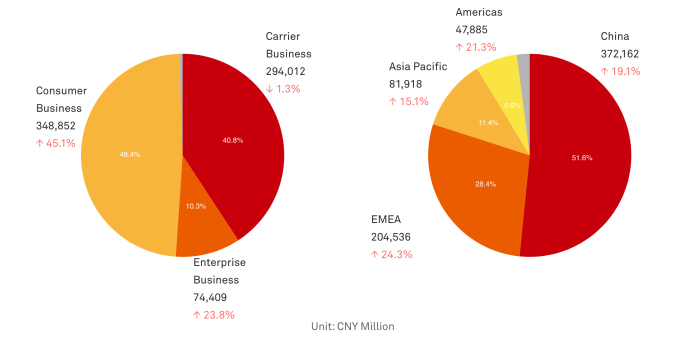
Huawei’s end of year financials showed its consumer devices business is now its main money-maker, while the majority of its revenue is not derived from the U.S. market

And the U.S. has its reasons for working to stymie Huawei’s efforts to expand the reach of its networking technologies as this excellent Twitter thread from Adam Townsend persuasively argues.

Essentially, China has invested its basically limitless capital into subsidizing next-gen wireless technology and buying up next-generation startups and innovators, all while the U.S. has borne early stage risk. Meanwhile, it is also using unlimited money to poach regulators and industry experts who might advocate against it.

Huawei continues to make inroads in nations across the emerging markets of Latin America, Eastern Europe, Southeast Asia and Africa where demand for connectivity is on the rise. Those are regions where the U.S. has plenty of strategic interests, but America’s ability to sway public opinion or entice governments to act against Chinese networking companies could be severely limited by its inability to offer meaningful incentives or alternatives to them.

Even with the passage of the BUILD Act in October 2018, which was meant to revitalize U.S. foreign aid and investment with a $60 billion package, it’s worth noting that China spent nearly $47 billion in foreign investment in Europe alone in 2018. Chinese direct investments totaled another $49.45 billion into Africa and the Middle East and $18 billion into South America, according to data from the American Enterprise Institute, compiled by Foreign Policy.
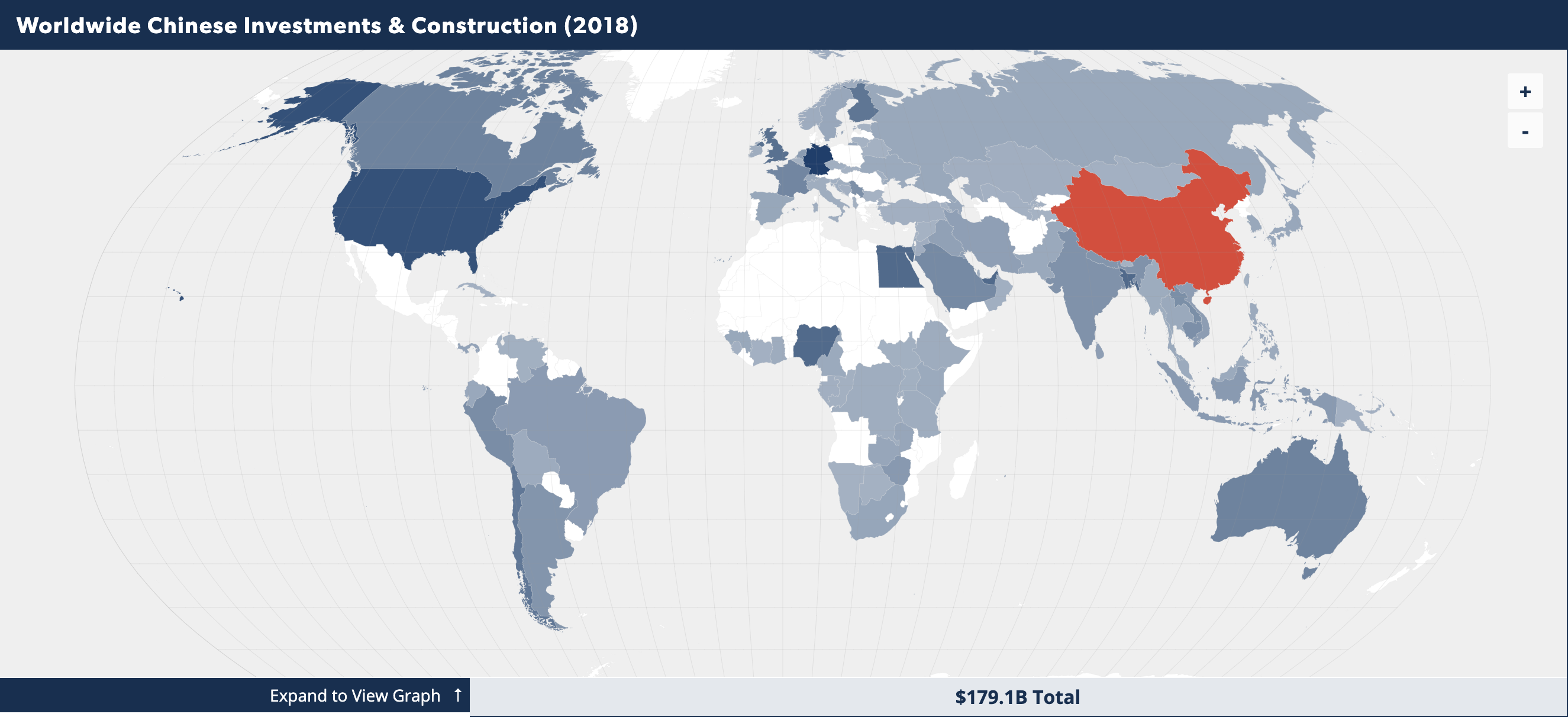
Map courtesy of the American Enterprise Institute.

Those investments have turned nations that should be staunch political allies into reluctant or simply rhetorical backers of the U.S. position. Take the relationship between the U.S. and Brazil, for example — a historically strong partnership going back years and one that seemingly only strengthened given the similarities between the two ultraconservative leaders in power in both nations.

However, as Foreign Affairs reports, Brazil is unlikely to accede to President Trump’s demands that Brazil aids in steps to block China’s economic expansion.

“Brazilian business groups have already begun to defend the country’s deep trade ties to China, rightly pointing out that any hope of containing China and once more turning the United States into Brazil’s most important trading partner is little more than unrealistic nostalgia,” writes Foreign Affairs correspondent, Oliver Stuenkel. “Working alongside powerful military generals, these business associations are mobilizing to avoid any delays that sidelining Huawei in the region could cause in getting 5G up and running.”

The whole article is worth reading, but its refrain is that the attempts by U.S. government officials to paint Huawei and Chinese economic inroads as a national security threat in developing economies are largely falling on deaf ears.

It’s not just networking technologies either. As one venture capitalist who invests in Latin America and the U.S. told TechCrunch anonymously: “It’s interesting how the U.S.-China relationships are going to affect what is happening in Latin America. The Chinese are already being more aggressive on the banking side.”

China’s big technology companies are also taking an interest in South America, both as vendors and as investors on the continent.

In an article in Crunchbase, the South American and Chinese-focused venture capitalist, Nathan Lustig underscored the trend. Lustig wrote:

In both the private and the public sectors, China is swiftly increasing its support for Latin America. Chinese expertise in financial technology, as well as its influence in developing markets around the world, is turning China into a strategic partner for startups and entrepreneurs in Latin America. Most of the Chinese investment in Latin America so far is going to Brazil, although this is likely to spread across the region as Chinese investors become better-acquainted with the local tech ecosystems, most likely to Mexico.

Beyond the Didi Chuxing acquisition of Brazil’s 99 in January, Chinese companies began investing heavily in Brazilian fintech startups, specifically Nubank and StoneCo, this year.

Indeed, China has an entire catalog of low-cost technologies and economic packages from state-owned and privately held investors to support their adoption, backing up its position as the leader for tech across a range of applications in emerging markets.

For the U.S. to compete, it will have to look beyond protectionism at its shores to actual commitments to greater economic development abroad. With lower tax revenues coming in and the prospect of giant deficits building up as far as the eye can see, there’s not much room to promote an alternative to Huawei internationally. That could leave the country increasingly isolated and create far more problems as it gets left behind.

17 May 2019

Macron defends his startup-friendly policies

For the third year as president, France’s president Emmanuel Macron talked to the French tech ecosystem at VivaTech in Paris. This time, he used this opportunity to defend his policies so far and say that tech startups have nearly everything they need to succeed

Frichti’s Julia Bijaoui, TransferWise’s Flora Coleman, OpenClassrooms’ Pierre Dubuc, Vinted’s Thomas Plantenga and UiPath’s Daniel Dines shared the stage with Macron and each asked one question about funding, European regulation, talent, the digital single market, etc.

Just like last year, Macron took a strong stance when it comes to corporate taxes. “In order to compete with American giants, you need to make sure that competition is fair. You pay taxes, so the tech giant that is competing against you should pay taxes too,” Macron said.

France recently approved a tax on tech giants. If you generate more than €750 million in revenue globally and €25 million in France, you have to pay 3 percent of your French revenue in taxes, even if your company is registered in Ireland, Luxembourg or the Netherlands.

“It’s a temporary measure because we want a tax at the European level, and more generally at the OECD level,” Macron said.

When it comes to funding, things look much better now than a few years ago. There are now more than a handful of French unicorns. And Macron defended his taxation policies, such as a the flat tax on capital gain and the end of the wealth tax on your shares in public or private companies.

And yet, it’s still complicated when it comes to exits — if you want to go down the public road, you most likely have to IPO in the U.S. “We have to build a European financial capital market,” Macron said. “It’ll require some modifications and deeper European integration,” he added later.

Given that Europe is about to vote for the European Parliament, a lot of Macron’s solutions involved the European Union. It sometimes felt like Macron was campaigning for his own party by saying that he wants to go further, but you need to vote for his party first.

When it comes to talent, Macron emphasized the quality of French universities and engineering schools. “We are competitive in terms of human capital and it’s no coincidence. A few years ago, everybody was saying ‘there are a lot of French people in Silicon Valley’. French people living in France are the same, but they cost much, much less,” Macron said.

He then mentioned the French Tech Visa to attract foreign talent, a special visa for tech talent and their families. The program has been overhauled a couple of months ago.

When it comes to regulation, Macron says that the European Union should follow the GDPR model. “What we did on privacy, one regulation for all, we have to do it for other areas,” he said. “On competition, on taxation, on data, we need to regulate.”

Macron concluded by defending a third way to regulate and foster tech companies, which is different from China and the U.S. “Europe can become the tech leader of tomorrow because we are building a tech ecosystem that is compatible with democracy,” he said.

According to him, China doesn’t do enough when it comes to individual rights and human rights, which could eventually backfire for tech companies. And American companies have become too powerful and out of control for the U.S. government.

17 May 2019

China’s Luckin Coffee raises up to $651M in upsized US IPO

Another week, another cash-burning tech IPO in the U.S. Following on from Uber’s high-profile listing, ambitious Chinese startup Luckin Coffee has raised up to $650.8 million on the Nasdaq after it priced its shares at $17.

That price is at the top-end of Luckin’s previously announced $15-$17 range but the company has upsized its share offering to 33 million, that’s three million more than previously planned. That gives Luckin an initial net raise of $571.2 million, although that could increase to $650.8 million if underwriters take up the full additional allocation of 4.95 million ‘greenshoe’ shares that are on offer.

The company will list on Friday under the ticker ‘LK.’

Luckin filed to go public last month, just weeks after it closed a $150 million Series B+ funding round led by New York private equity firm Blackrock, which interestingly holds a 6.58 percent stake in Starbucks. The deal valued Luckin at $2.9 billion and it took the three-year-old company to $550 million raised from investors to date.

The company has burned through incredible amounts of cash as it tries to quickly build a brand that competes with Starbucks, and the presence that the U.S. firm has built over the last 20 years in China. Through aggressive promotions and coupons, the company posted a $475 million loss in 2018, its only full year of business to date, with $125 million in revenue. For the first quarter of 2019, it carded an $85 million loss with total sales of $71 million.

We recently went in-depth on the business, which you can read here with a subscription to our Extra Crunch service, but we’ve long covered the startup’s ‘money is no object’ approach to building a digital rival to Starbucks in China.

17 May 2019

Amazon leads $575M investment in Deliveroo

Amazon is taking a slice of Europe’s food delivery market after the U.S. e-commerce giant led a $575 million investment in Deliveroo .

First reported by Sky yesterday, the Series G round was confirmed in an early UK morning announcement from Deliveroo, which confirmed that existing backers including T. Rowe Price, Fidelity Management and Research Company, and Greenoaks also took part. The deal takes Deliveroo to just over $1.5 billion raised to date. The company was valued at over $2 billion following its previous raise in late 2017, no updated valuation was provided today.

London-based Deliveroo operates in 14 countries, including the U.K, France, Germany and Spain, and — outside of Europe — Singapore, Taiwan, Australia and the UAE. Across those markets, it claims it works with 80,000 restaurants with a fleet of 60,000 delivery people and 2,500 permanent employees.

It isn’t immediately clear how Amazon plans to use its new strategic relationship with Deliveroo — it could, for example, integrate it with Prime membership — but this isn’t the firm’s first dalliance with food delivery. The U.S. firm closed its Amazon Restaurants UK takeout business last year after it struggled to compete with Deliveroo and Uber Eats. The service remains operational in the U.S, however.

“Amazon has been an inspiration to me personally and to the company, and we look forward to working with such a customer-obsessed organization,” said Deliveroo CEO and founder Will Shu in a statement.

Shu said the new money will go towards initiatives that include growing Deliveroo’s London-based engineering team, expanding its reach and focusing on new products, including cloud kitchens that can cook up delivery meals faster and more cost-efficiently.

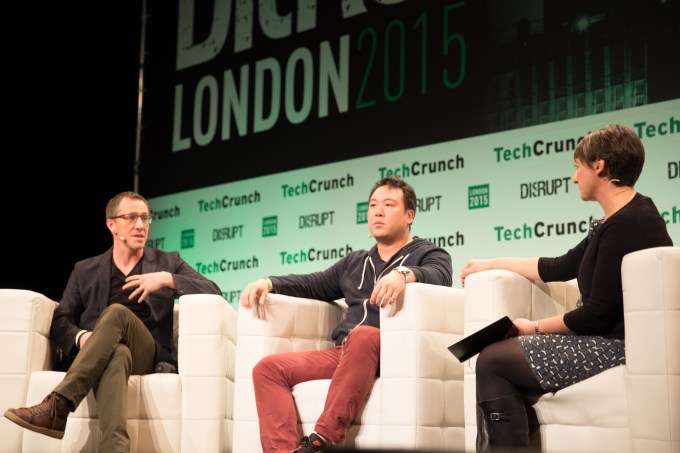
[Center] Will Shu, Deliveroo CEO and co-founder, on stage at TechCrunch Disrupt London

17 May 2019

Chat app Line is adding Snap-style disappearing stories

Facebook cloning Snap to death may be old news, but others are only just following suit. Line, the Japanese messaging app that’s popular in Asia, just became the latest to clone Snap’s ephemeral story concept.

The company announced today that it is adding stories that disappear after 24-hours to its timeline feature, a social network like feed that sits in its app, and user profiles. The update is rolling out to users now and the concept is very much identical to Snap, Instagram and others that have embraced time-limited content.

“As posts vanish after 24 hours, there is no need to worry about overposting or having posts remain in the feed,” Line, which is listed in the U.S. and Japan, wrote in an update. “Stories allows friends to discover real-time information on Timeline that is available only for that moment.”

Snap pioneered self-destructed content in its app, and the concept has now become present across most of the most popular internet services in the world.

In particular, Facebook added stories to across the board: to its core app, Messenger, Instagram and WhatsApp, the world’s most popular chat app with over 1.5 billion monthly users. Indeed, Facebook claims that WhatsApp stories are used by 500 million people, while the company has built Instagram into a service that has long had more users than Snap — currently over one billion.

The approach doesn’t always work, though — Facebook is shuttering its most brazen Snap copy, a camera app built around Instagram direct messages.

Line doesn’t have anything like the reach of Facebook’s constellation of social apps, but it is Japan’s dominant messaging platform and is popular in Thailand, Taiwan and Indonesia.

The Japanese company doesn’t give out global user numbers but it reported 164 million monthly users in its four key markets as of Q1 2019, that’s down one million year-on-year. Japan accounts for 80 million of that figure, ahead of Thailand (44 million), Taiwan (21 million) and Indonesia (19 million.)

While user growth has stagnated, Line has been able to extract increase revenue. In addition to a foray into services — in Japan its range covers ride-hailing, food delivery, music streaming and payments — it has increased advertising in the app’s timeline tab, and that is likely a big reason for the release of stories. The new feature may help timeline get more eyeballs, while the company could follow the lead of Snap and Instagram to monetize stories by allowing businesses in.

In Line’s case, that could work reasonably well — for advertising — since users can opt to follow business accounts already. It would make sense, then, to let companies push stories to users that opted in follow their account. But that’s a long way in the future and it will depend on how the new feature is received by users.

17 May 2019

Chelsea Manning is back in jail after refusing to cooperate with WikiLeaks investigation

Following a week-long release from an Alexandria, Virginia detention center, Chelsea Manning is back in jail. Manning was jailed in March for her refusal to cooperate with a grand jury investigation into WikiLeaks.

Manning has made her position on the grand jury well known and refuses to cooperate with its proceedings on principle. Her release last week came as the grand jury that issued her a subpoena in January expired, though the grand jury that issued Manning her latest subpoena won’t expire for another 18 months.

“We are of course disappointed with the outcome of today’s hearing, but I anticipate it will be exactly as coercive as the previous sanction — which is to say not at all,” Manning’s attorney Moira Meltzer-Cohen said of the day’s events.

A former intelligence analyst for the U.S. Army, Manning leaked more than 250,000 diplomatic cables, a large body of military field reports and harrowing footage of U.S. airstrikes to the secret-sharing organization WikiLeaks in 2010. Manning was convicted of most of the more than 20 charges against, but President Obama commuted her sentence before leaving office.

After her release last week, Manning shared a YouTube video in providing a bit of insight about why she objects to grand juries on moral grounds.

She doesn’t appear likely to back down. Aware of that, Judge Anthony Trenga made the unusual choice to fine Manning $500 for each day she remains uncooperative and in custody, starting after 30 days. After 60 days, that amount will increase to $1000 per day. Prior to her brief period of freedom in the last week, Manning spent two months jailed, a portion of which was served in solitary confinement like conditions, according to her legal team.

“Grand Juries and prosecutions like this one broadcast an expanding threat to the press and function to undermine the integrity of the system according to the government’s own laws,” Meltzer-Cohen said.

During her brief interlude walking free, Manning streamed Apex Legends and Red Dead Redemption 2 on Twitch.

17 May 2019

Baidu, China’s answer to Google, reports first quarterly loss since 2005

Baidu, widely seen as the Google of China, felt the heat from its spending on artificial intelligence and other next-gen technologies that have yet to reach the mass market as it unveiled troubled first-quarter financials on Thursday.

The company logged a net loss attributable to shareholders of $49 million in the quarter ended March 31, marking the first quarterly loss since it went public in 2005. That compares to net income of 6.69 billion yuan a year before.

Baidu is the biggest search service in China and has reaped huge rewards from search ads in the PC era. But as consumers allocate their attention to new forms of mobile services — notably recommendation-based apps to discover content — Baidu is losing its appeal.

Xiang Hailong, senior vice president of Baidu’s search business, resigned after serving the company since 2005, announced the earnings report. The search giant has renamed its search business to a new ‘mobile business’.

Baidu’s revenue for the quarter rose slightly to 24.1 billion yuan ($3.5 billion), up 15 percent year-over-year.

This is a developing story. Check back for analysis.

16 May 2019

Asus’ $499 ZenFone 6 has a flip-up camera and a giant battery

Premium smartphone manufacturers have moved the needle on pricing, but 2019 may well go down as a kind of golden age for budget flagships. Apple, Google and Samsung are all in that business now, and OnePlus has once again shown the world how to offer more for less. And then there’s the new Zenfone.

It’s a bit of an understatement to suggest that Asus has had trouble breaking into the smartphone space. And things aren’t likely to get any easier as the market further consolidates among the top five players. But you’ve got to hand it to the company for swinging for the fences with the $499 ZenFone 6.

First thing’s first. Like the excellent OnePlus 7 Pro, the phone (fone?) forgoes the notch and hole punch, instead opting for a clever pop-up that flips up from the back. That means one camera is doing double duty, toggling between the front and rear with the push of an on-screen button. Like the OnePlus, there’s built-in fall detection that retracts the camera if it slips from your hand.

That whole dealie would be enough to help the phone stand out in a world of similar handsets, but this is a solid budget handset through and through. Inside is a bleeding edge Snapdragon 855, coupled with a beefy 5,000mAh battery. The new ZenFone also sports a headphone jack, because it’s 2019 and rules don’t apply to smartphones anymore.

Is that all enough to right the ship? Probably not, but it’s nice to see Asus stepping up with a compelling product at an even more compelling price point. More information on the phone’s U.S. release should be arriving soon.

16 May 2019

Retail Zipline raises $9.6M from Emergence and Serena Williams

Retail Zipline, a startup aiming to improve communication between retail stores and corporate decision makers , announced today that it has raised $9.6 million in Series A funding.

CEO Melissa Wong previously worked in corporate communications for Old Navy, where she said she saw “such a disconnect between what was decided in headquarters and what was decided in stores.” For example, management might decide on a big marketing push to sell any remaining Mother’s Day-related items after the holiday has passed, but then “the stores wouldn’t do it.”

“The stores would say there were too many messages, they didn’t see the memo, they didn’t know it was a priority,” Wong said.

So she founded Retail Zipline with CTO Jeremy Baker, with the goal of building better communication tools for retailers. Baker said that while they looked at existing chat and task management software for inspiration, those tools were “mostly built for people sitting at a desk all day,” rather than workers who are “on the floor, dealing with customers.”

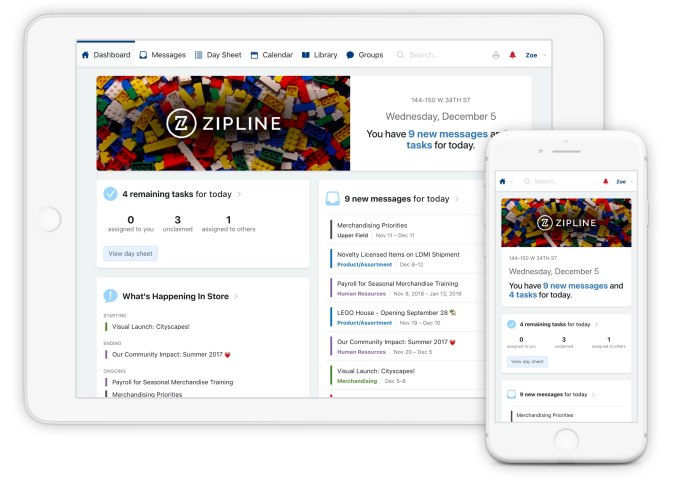
Retail Zipline’s features do include messaging and task management — plus a centralized library of documents and multimedia and a survey tool to track results and feedback from stores.

Retail Zipline screenshot

To illustrate how the software is actually being used, Baker outlined a scenario where an athletic shoe company is launching “a huge initiative,” with a big-name athlete signed on to promote the latest pair of shoes.

“In a traditional environment, someone might FedEx over a package to [the store], someone might send an email down, ‘Hey, look for a package on this day,’ someone else from the marketing team might say, ‘Hey guys, we’re doing a shoe launch,'” he said. “All of this in these disparate systems, where people have to piece together the story. It’s kind of like a murder mystery.”

Baker said that Retail Zipline, on the other hand, provides a single place to find all the needed materials and tasks “tied together with a bow, instead of a store manager spending 10-plus hours in the back room trying to piece this thing together, or even worse not seeing it.”

The company’s customers include Casper, LEGO and Lush Cosmetics. Wong said Retail Zipline works “with anyone that has a retail location” — ranging from Gap, Inc. with thousands of stores, to Toms Shoes with 10.

The funding was led by Emergence, with Santi Subotovsky and Kara Egan from Emergence both joining the startup’s board of directors. Serena Williams’ new firm Serena Ventures also participated.

“As someone with an incredibly active life, I understand the need to be dynamic, and capable of quickly adapting to shifting priorities, but I’m also aware of the stress a fast-paced work environment can impose,” Williams said in a statement. “Retail Zipline is tackling this issue head-on in retail – a notoriously stressful industry – by pioneering products that help store associates get organized, communicate efficiently, and deliver amazing customer experiences.”

16 May 2019

Stack Overflow confirms breach, but customer data said to be unaffected

Developer knowledge sharing site Stack Overflow has confirmed hackers breached its systems, but said customer data is unaffected.

“Over the weekend, there was an attack on Stack Overflow,” wrote Mary Ferguson, vice president of engineering. “We have confirmed that some level of production access was gained on May 11.”

“We discovered and investigated the extent of the access and are addressing all known vulnerabilities,” said Ferguson. “We have not identified any breach of customer or user data,” she said.

An investigation into the breach is ongoing.

The company otherwise remained tightlipped about the breach, its cause, and the effect. We’ve sent several questions to the company but did not immediately hear back.

Stack Overflow has more than 50 million developer members who use the site to share code and knowledge. It remains one of the top 50 most popular sites on the web, according to rankings by internet analytics site Alexa.

Read more: