
Category: UNCATEGORIZED

13 May 2019

SpaceX’s Crew Dragon is having trouble — and that’s okay

We may be poised on the precipice of a new era of spaceflight, but leaping prematurely off it would be a costly mistake — which is why the delays and failures of SpaceX’s Crew Dragon, the new spacecraft that will likely be soonest to take humans to space, are a matter for concern but not worry. In space, you expect the unexpected.

The sudden explosion of a Crew Dragon test capsule is frightening and frankly embarrassing to a company so heavily focused on an image of futurity and reliability. And a failed parachute deployment doesn’t inspire confidence either. But any historian of the space industry will tell you it’s rare that something with rockets on it doesn’t blow up at some point during development.

The Commercial Crew program was established back in 2010 with the goal of sending a crewed mission to the International Space Station, aboard a new spacecraft, well before the end of the decade. The timeline was understood to be flexible, but budgetary, logistic, and technical issues have continually pushed dates further and further out.

While it was once estimated that the first crewed flights might happen in 2018, that year passed without even a  first test flight from either of the contracted spacecraft providers, Boeing and SpaceX. That changed in March with the latter’s successful first test flight of Crew Dragon (loaded with cargo, not people). And Boeing’s Starliner is scheduled for flight later this year. Dogged by delays, the companies’ years of hard work seemed to be paying off at last.

Then this disaster on the test pad occurred: Not just a tipped-over Starship shell or a booster lost to heavy seas, but a full-on explosion of a craft meant for crewed missions, an event which, there’s no way around it, would have been instantly lethal to anyone inside.

Of course, there wasn’t anyone inside. Because this was a test of systems that have not been finalized or brought up to spec. It failed, spectacularly, but that is how rockets tend to fail — with spectacle.

We saw this happen only because someone unwisely had recorded it and distributed the video online. Had they not, we would have heard there was an anomaly during the test and that this capsule was rendered unusable. That kind of phrasing, which goes back many decades in the industry, can mean many things, and its ambiguity is intentional — it’s meant to shield the public from the harsh reality of spaceflight, the risk inherent in the act of riding a bomb faster than sound to a place that’s trying to kill you.

Rockets and capsules and spacecraft have failed since the very beginning, and they will continue to because no one is satisfied with simply refining a design from the ’60s forever. Making advances in space means engineering at the very frontier of what’s possible — indeed, it frequently means expanding that frontier and doing what others thought impossible.

The recent failure in a parachute deployment test is equally alarming — since such a failure could conceivably be equally catastrophic — but again, as SpaceX’s representatives have put it again and again, “This is why we test.”

Previous, nearly identical tests of the parachutes didn’t fail completely (there are four chutes; one was made to fail on purpose, but in the recent test the others did not deploy either), but likely indicated modes of failure that the engineers needed to see. Just like pumping up a pressure vessel to well beyond its rated PSI in order to see how it performs under stress, this is about creating controlled failures in carefully observed environments. You invite failure into your home today so it doesn’t kick the door down on launch day.

It must also be said that these equipment failures are occurring within a larger context of making spaceflight far, far safer than it ever was. No one should entertain the illusion that spaceflight will ever be completely safe — nothing is, least of all traveling at thousands of miles per hour through a lethal vacuum or reentering the atmosphere within arm’s reach of temperatures hot enough to melt steel. But companies like SpaceX and Boeing (though its reputation for safety has been tarnished of late in a more lasting fashion) are making damn sure they’re doing everything they can to reduce that risk.

The shift from Russia’s amazingly reliable but aged Soyuz capsules to new spacecraft with entirely new capabilities is not a simple or easy one. These new craft have been developed from scratch with systems that will ultimately make them safer and more reliable than any in history. But right now both companies are still in the egg-breaking part of the omelette process.

This is not all to say that there will be no effect from these accidents. Confidence is thinned; missions are delayed; costs are incurred; competitors are emboldened. And pragmatically speaking, it seems unlikely that SpaceX will put a crew in space this year, given the severity of these events and the increased scrutiny the capsule and its testing will endure. But it’s all part of the process.

Delays are inherent to the space industry. It can be done fast, but it has to be done right. It’s disappointing when the dream of having a U.S.-built spacecraft delivering astronauts to the ISS is put off again and again, but the rewards for patience will be enormous. It’s done when it’s done. You wouldn’t want it a day before — especially if you were the one riding in it.


13 May 2019

The Pentagon and CIA have a secret missile that shreds targets with giant flying knives

A report by The Wall Street Journal last week revealed a secretive U.S. military weapon designed explicitly to reduce civilian casualties in targeted strikes. Unlike a traditional hellfire missile dispatched from an aerial drone, the missile variant packs no payload, no explosive. The catch? It drops 100 pounds of metal on a target, shredding them to pieces with six giant knives.

As the WSJ reports, the weapon, developed under the Obama administration, is only deployed in special circumstances. Known as the R9X, it is specifically designed for precision operations in which a normal explosive hellfire missile would result in civilian deaths.

The paper was able to confirm two operations that employed the R9X, one this January by the Department of Defense that killed Jamal al-Badawi. The second took place in Syria two years ago, resulting in the death of Al Qaeda leader Ahmad Hasan Abu Khayr al-Masri.

The weapon, nicknamed the “ninja bomb,” woudn’t be the first time the U.S. military has relied on the remarkably deadly combination of metal and gravity. In both Korea and Vietnam, the U.S. military deployed so-called “Lazy Dog” bombs — two-inch metal projectiles that rained down from the sky by the hundreds, picking up speed before making deadly impact.

While the effect was often grisly, the bombs left no unexploded material behind — a perk (if you can call it that) not unlike the grim benefit of minimizing civilian casualties by dropping 100 pounds of sharp metal onto the heads of your enemies.

13 May 2019

Adobe brings new Amazon and Google integrations to Magento

It’s only been a few months since Adobe launched its Commerce Cloud, based on its $1.6 billion acquisition of Magento. Today, at its Imagine 2019 conference, the company announced a number of updates to Magento that focus on expanding the platform’s reach for the small- and mid-size businesses that use the service.

When Adobe acquired Magento, many of these smaller companies that use the service worried that Adobe would mostly focus on its existing base of large enterprise customers — the kind of companies that already use its Experience Cloud. Today’s set of the announcements is, in many ways, meant to alleviate these fears.

The two most important pieces of news for Magento users are its new integrations with Amazon and Google.

On the Amazon side, merchants can now automatically manage and maintain their inventory on Amazon right from the Magento backend. They can set pricing rules for the Amazon Sales Channel, manage multiple Amazon brands with multiple Amazon accounts and, in return, get access to Amazon’s product data, too.

Access to this new feature is now available to all Magento users through a free extension that’s now available in the Magento Marketplace.

“For many brands and merchants, creating an Amazon storefront is not simple,” Jason Woosley, Vice President, Commerce Product & Platform at Adobe, told me. “It requires you to manage a whole host of new operational challenges. You introduce a new platform that your team has to learn how to use, how to manage and maintain. And if your teams are already maxed out, it’s going to require you to hire additional staff or make tradeoffs against your roadmap that don’t deliver against your business.”

As for Google, Magento today launched a native integration with Google Shopping (also through a free extension) that will allow Magento admins to manage their Google ads from their Magento dashboard and manage their Google Merchant Center accounts. This will allow them to manage their Google marketing campaigns right from Magento. Here, too, the idea is to allow merchants to use the tools they are already familiar with to expand their reach into other platforms, which typically involved switching back and forth between services and trying to keep them in sync.

Adobe also today announced that the Progressive Web Application (PWA) Studio, which allows more advanced Magento users to build more app-like online stores, now supports PayPal’s Braintree as a payment option. Woosley expects that PWA’s are the way forward for many Magento customers, especially in emerging markets.

13 May 2019

Updated Apple TV app arrives ahead of Apple TV+’s fall launch

Here’s a big Apple TV update. Not THE big Apple TV update. The whole Apple TV+ thing is still forthcoming, but this major update to the app should go a ways toward setting the stage for its arrival in the fall.

The new version of the app arrives today across a slew of different platforms, including iPhone, iPad, Apple TV and all of Samsung’s 2019 Smart TVs (and select 2018 models) — per the announcement the company made earlier this year at the big TV+ event.

That event also offered previews of a lot of what’s new here. The whole thing breaks down into three key categories: Apple TV channels, a new recommendation system for iTunes movies and TV shows and a new dedicated kids section.

Channels are the biggest change here — it’s essentially Apple’s push to transform Apple TV into its cable provider. Available channels include HBO, Starz, Showtime, Smithsonian Channel, EPIX and Tastemade, with CBS All-Access and MTV Hits coming in the future.

A big piece of the offering is the ability to download and watch shows offline, so users can, say, download episodes of Game of Thrones for a long flight. This is, notably, the first time HBO has offered that ability to a third party. Apple won’t say what the download limit is, but it’s likely large enough that most users won’t hit.

Once subscribed, channels will be available through Family Sharing, with up to six accounts using their Apple ID. Speaking of families, the update also includes a devoted kids section, which includes, curated family friendly TVs and movies.

Apple’s apply editorial curation across the board here, similar to what it’s done with other apps like Books and Music. The app uses a combination algorithms and editorial curation, designed to help users figure out what to watch next before scrolling to the end of the page.

In addition to the above, select Samsung, Vizio, LG and Sony sets will be able to access it using app mirroring.

13 May 2019

Crowned by Burger King, meat replacement company Impossible Foods raises $300 million

After being crowned by Burger King as the first meat replacement patty to roll out nationally with one of the largest fast food chains, Impossible Foods has raised $300 million in capital.

The financing brings the company’s total equity raise to $750 million — and provides a sizable pool of funds to draw from as it continues to compete with its newly-publicly traded rival, Beyond Meat.

Both companies are looking to provide plant-based replacements for animal proteins, but while Beyond Meat has focused on consumers in the grocery store, Impossible Foods has focused on restaurants and business-to-business sales.

That focus paid off earlier this year with the announcement of the Impossible Whopper, and its subsequent nationwide rollout only a month later.

The Impossible Burger is now sold in more than 7,000 restaurants in the U.S. and Europe and has been a top-selling item and a driver of new foot traffic, according to the company. However, since it’s actually driving new foot traffic to restaurants, the product’s impact as a meat replacement is arguable. There’s no data from the company on whether people are actually buying less meat, or whether new customers are entering stores.

Investors don’t seem to mind. And given the success of Beyond Meat’s public offering earlier this year, Impossible Foods has a benchmark it can reference to illustrate the appetite institutional investors have for meat replacement companies.

Indeed, even corporate America has taken notice, with Tyson Foods hatching plans to bring its own meat replacement product to market in the coming years.

Previous investors Temasek, the investment arm of the Singaporean government, and Horizons Ventures, the personal venture fund of Hong Kong multi-billionaire Li Ka Shing, led the new financing, which also included a host of celebrity investors.

Jay Brown, Kirk Cousins, Paul George, Jay Z, Trevor Noah, Alexis Ohanian, Kal Penn, Katy Perry Questlove, Ruby Rose, Phil Rosenthal, Jaden Smith, Serena Williams, will.i.am and Zedd, also joined the financing round, making Impossible Foods officially the coolest cap table I’ve ever seen (no offense to Beyond Meat backer Leonardo DiCaprio).

Institutional investors like Khosla Ventures, Bill Gates, Google Ventures, UBS, Viking Global Investors, Sailing Capital, and Open Philanthropy Project also back the company.

The presence of Impossible Foods’ Asian investors point to the hunger for protein replacements on the continent where the quality of meat is an issue and rising demand is putting increasing pressure on companies looking to feed the continent’s newly wealthy consumers more high quality protein.

There’s a compelling reason to hope that both companies succeed in their mission to reduce demand for animal protein around the world. Animal husbandry and industrial farming contribute heavily to rising greenhouse gas emissions (which is kind of a huge problem).

And it seems that the strategy is working in Asia. Sales across the continent are rising, according to the company, in restaurants across Hong Kong, Singapore and Macau.

Founded in 2011 by former pediatrician and Stanford biochemistry professor, Dr. Patrick O. Brown, Impossible Foods’ plant-based burger may be the second greatest invention by a Doc Brown since the 80s.

Impossible Foods is also hiring extensively in Oakland, Calif., where the company has its largest plant. It has already added to its executive team since the new funding, bringing on Sheetal Shah, a former chief operations officer at Verifone to oversee the company’s manufacturing, supply chain and logistics.


13 May 2019

Yes, Americans can opt-out of airport facial recognition. Here’s how

Whether you like it or not, facial recognition tech to check in for your flight will soon be coming to an airport near you.

Over a dozen U.S. airports are already rolling out the technology, with many more to go before the U.S. government hits its target of enrolling the largest 20 airports in the country before 2021.

Facial recognition is highly controversial and has many divided. On the one hand, it reduces paper tickets and meant to be easier for travelers to check in at the airport before their flight. But facial recognition also has technical problems. According to a Homeland Security watchdog, the facial recognition systems used at airports only worked in 85 percent in some cases. Homeland Security said the system is getting better over time and will be up to scratch by the supposed 2021 deadline — even if the watchdog has its doubts.

Many also remain fearful of the privacy and legal concerns. After all, it’s not Customs and Border Protection collecting your facial recognition data directly — it’s the airlines — and they pass it onto the government.

Delta debuted the tech last year, scanning faces before passengers fly. JetBlue also followed suit, and many more airlines are expected to sign up. That data is used to verify boarding passes before travelers get to their gate. But it’s also passed onto Customs and Border Protection to check passengers against their watchlists — and to crack down on those who overstay their visas.

Clearly that’s rattling travelers. In a recent Twitter exchange with JetBlue, the airline said customers are “able to opt out of this procedure.”

That’s technically true, although you might not know it if you’re at one of the many U.S. airports. The Electronic Frontier Foundation found that it’s not easy to opt-out but it is possible.

A sign allowing U.S. citizens to opt-out of facial scans. (Image: Twitter/Juli Lyskawa)

If you’re a U.S. citizen, you can opt out by telling an officer or airline employee at the time of a facial recognition scan. You’ll need your U.S. passport with you — even if you’re flying domestically. Border officials or airline staff will manually check your passport or boarding pass like they would normally do before you’ve boarded a plane.

Be on the lookout for any signs that say you can opt-out, but also be mindful that there may be none at all. You may have to opt-out multiple times from arriving at the airport until you reach your airplane seat.

“It might sound trite, but right now, the key to opting out of face recognition is to be vigilant,” wrote EFF’s Jason Kelley.

Bad news if you’re not an American: you will not be allowed to opt-out.

“Once the biometric exit program is a nationally-scaled, established program, foreign nationals will be required to biometrically confirm their exit from the United States at the final [boarding] point,” said CBP spokesperson Jennifer Gabris in an earlier email to TechCrunch. “This has been and is a Congressional mandate,” she said.

There are a few exceptions, such as Canadian citizens who don’t require a visa to enter the U.S. are exempt, and diplomatic and government visa holders.

Facial recognition data collected by the airlines on U.S. citizens is stored by Customs and Border Protection for between 12 hours and two weeks, and 75 years for non-citizens. That data is stored in several government databases, which border officials can pull up when you’re arriving or leaving the U.S.

Why should you opt-out? As an American, it’s your right to refuse. Homeland Security once said Americans who didn’t want their faces scanned at the airport should “refrain from traveling.” Now all it takes is a “no, thanks.”

Read more:

13 May 2019

Supreme Court rules against Apple allowing an App Store antitrust case to proceed

The U.S. Supreme Court ruled 5-4 against Apple on Monday on a case involving whether or not a group of iPhone users will be allowed to bring an antitrust lawsuit against the company regarding its App Store practices. The iPhone owners allege that Apple’s 30 percent commission on App Store sales is passed along to users, representing an unlawful and unfair use of Apple’s monopoly power.

Apple had moved to have the case dismissed, arguing that consumers were buying their apps from the developers — not from Apple. And it was the developers who were setting the prices. The court disagreed, saying that Apple contracts with the third-party developers to sell the 2 million apps that are live today on its App Store, keeping its 30 percent commission on every sale along the way.

In addition, the court ruled in favor of the iPhone owners’ lawsuit proceeding for several other reasons. It said that any person injured by an antitrust violation may sue to recover damages, and that ruling in favor of Apple would have prevented consumers from suing monopolistic retailers who took commissions on sales — not just those who marked up the price it paid a supplier or manufacturer for a good or service. This would have created a hole where retailers could restructure their practices to avoid antitrust claims, the court said.

“Apple’s line-drawing does not make a lot of sense, other than as a way to gerrymander Apple out of this and similar lawsuits,” the opinion, authored by Justice Kavanaugh, read.

“If a retailer has engaged in unlawful monopolistic conduct that has caused consumers to pay higher-than-competitive prices, it does not matter how the retailer structured its relationship with an upstream manufacturer
or supplier—whether, for example, the retailer employed a markup or kept a commission,” stated the court.

The iPhone owners also said that Apple’s monopoly on the aftermarket for apps means they’re forced to pay higher prices than if the environment was more competitive. In a different environment, they could have chosen between paying Apple’s higher price and other less costly alternatives.

Instead, iPhone owners say that developers are forced to mark up their prices in order to cover Apple’s “demanded profit.”

We’ve seen this in action already, of course. One recent example is Spotify, whose music app was $9.99 per month if you subscribed on the web, but was $12.99 per month if you subscribed on iOS — a move it made to recoup the commission, but also to make a point about Apple’s monopoly power. And following a complaint in March from Spotify, the EU is preparing to investigate Apple for anti-competitive behavior.

Other large app developers have also ditched selling through Apple. Amazon, for example, redirects many purchases to the browser — like those for books, music, movies, and TV shows, for example. Netflix just dropped in-app subscriptions on iOS in December because of this so-called “Apple tax.” And Fornite maker Epic Games, which also bypassed the Google Play Store at launch, upcharges for in-app purchases on iOS.

Apple’s stock is down by more than 5 percent as of the time of writing.

13 May 2019

Mailchimp expands from email to full marketing platform, says it will make $700M in 2019

Mailchimp, a bootstrapped startup out of Atlanta, Georgia, is known best as a popular tool for organizations to manage their customer-facing email activities — a profitable business that its CEO told TechCrunch has now grown to around 11 million customers and is on track for $700 million in revenue in 2019.

To help hit that number, Mailchimp is taking the wraps off a significant update aimed at catapulting it into the next level of business services. Beginning later this week, Mailchimp will start to offer a full marketing platform aimed at smaller organizations.

Going beyond the email that it has been offering for 20 years, the new platform will feature technology to record and track customer leads, the ability to purchase domains and build sites, ad retargeting on Facebook and Instagram, social media management and business intelligence that leverages a new move in the artificial intelligence to provide recommendations to users on how and when to market to whom.

When the service goes live on Wednesday, Mailchimp also plans a pretty significant shift of its pricing into four tiers of free, $9.99/month, $14.99/month or $299/month (up from the current pricing of free, $10/month, $199/month) — with those fees scaling depending on usage and features.

(Existing paid customers maintain current pricing structure and features for the time being and can move to the new packages at any time, the company said. New customers will sign up to the new pricing starting May 15.)

The expansion is part of a longer-term strategic play to widen Mailchimp’s scope by building more services for the typically-underserved but collectively large small business segment. Even as multinationals like Amazon and other large companies continue to feel like they are eating up the mom-and-pop independent business model, SMBs continue to make up 48 percent of the GDP in the US.
And within that, marketing is one of those areas that small businesses might not have invested in much traditionally but are increasingly turning to as so much transactional activity has moved to digital platforms — be it smartphones, computers, or just the tech that powers the TV you watch or music you listen to.

In March, we reported that Mailchimp quietly acquired a small Shopify competitor called LemonStand to start to build more e-commerce tools for its users. And the new marketing platform is the next step in that strategy.

“We still see a big need for small businesses to have something like this,” Ben Chestnut, Mailchimp’s co-founder and CEO, said in an interview. Enterprises have a range of options when it comes to marketing tools, he added, “but small businesses don’t.” The mantra for many building tech for the SMB sector has traditionally been “dumbed down and cheap,” in his words. “We agreed that cheap was good, but not dumbed down. We want to empower them.”

The new services launch also comes at a time when an increasing number of companies are closing in on the small business opportunity, with e-commerce companies like Square, Shopify and PayPal also widening their portfolio of products. (These days, Square is a Mailchimp partner, Shopify is not.)

Marketing is something that Mailchimp had already been dabbling with over the last two years — indeed, customer-facing email services is essentially a form of marketing, too. Other launches have included a Postcards service, offering companies very simple landing pages online (about 10 percent of Mailchimp’s customers do not have their own web sites, Chestnut said), and a tool for companies to create Google, Facebook and Instagram ads.

Mailchimp itself has a big marketing presence already: it says that daily, more than 1.25 million e-commerce orders are generated through Mailchimp campaigns; over 450 million e-commerce orders were made through Mailchimp campaigns in 2018; and its customers have sold over $250 million in goods through multivariate + A/B campaigns run through Mailchimp.

There are clearly a lot of others vying to be the go-to platform for small businesses to do their business — “Google, Facebook, a lot of the big players see the magic and are moving to the space more and more,” Chestnut said — but Mailchimp’s unique selling point — or so it hopes — is that it’s the platform that has no vested interests in other business areas, and will therefore be as focused as the small businesses themselves are. That includes, for example, no upcharging regardless of the platform where you choose to run a campaign.

“We are Switzerland,” Chestnut said.

13 May 2019

YouTube’s Bumper Machine offers an automated way to create six-second ads

After introducing a six-second “Bumper” ad format back in 2016, YouTube is unveiling a new tool that uses machine learning to automatically pull out a six-second version from a longer ad.

It might seem a little ridiculous to try to compress (say) a 90-second video into a six-second message. In fact, Debbie Weinstein, Google’s vice president of YouTube and video global solutions, acknowledged that there was some skepticism when Bumper ads were first announced, with advertisers wondering, “Can we actually tell our story in six seconds?”

However, Weinstein argued, “We learned over time that creatives love constraints. They’ve historically been constrained to 30 seconds, and then 15 seconds, and constrained by whatever dimensions of a particular media format.”

For some advertisers, she said, a Bumper may simply be a short teaser for a longer ad. For others, the format could provide a way to break down a 30-second ad into a sequence of six-second clips.

And with Bumper Machine — which YouTube is currently alpha testing, which will then lead into beta testing and eventually general availability — advertisers will have a tool to create a Bumper by scanning a longer ad for “key elements,” like a voiceover or a tight focus on human beings or logos or products. The result always ends with “the final call to action in the last two-to-three seconds of the video,” Weinstein said.

For example, as an early test, GrubHub took a 13-second ad and used Bumper machine to create the six-second version below.

Weinstein suggested that Bumper Machine could be used by “many different advertisers of all shapes and sizes” — some of them might be smaller advertisers who want to create Bumpers with as little time and effort as possible, while larger brands and agencies may treat them as more of a “jumping off point,” which can be refined or serve as inspiration.

Either way, Weinstein isn’t expecting advertisers to just start posting machine-created Bumpers willy-nilly. The idea is to always have “some level of human review.”

“You’ll get three to four executions, the best guesses that the machine is going to make,” she said. “A human is going to go through and decide which of the three or four is best, or decide all of them are great, or do some light editing on top of that.”

13 May 2019

Amazon offers employees $10K and 3 months’ pay to start their own delivery businesses

Following news of Amazon’s plans to reduce Prime shipping down to one day, the company this morning announced an expansion of its Delivery Service Partner program, which now includes a new incentive that encourages existing Amazon employees to start their own package delivery company. The partner program, first announced last year, includes access to Amazon’s delivery technology, hands-on training, and a suite of other discounts for assets and services like vehicle leasing and insurance. For employees, it now includes a $10,000 incentive, too.

The retailer says it will fund the startup costs up to $10,000 as well as the equivalent of three months of the former employee’s last gross salary, to give the employees the ability to get their new business off the ground without worrying about a break in pay.

Amazon had said last year that people were able to start their own delivery business with only $10,000. At the time, military veterans were able to get that $10K reimbursed, as Amazon was investing a million into a program that funded their startup costs.

The new incentive to do the same for any employee — and offer them three months’ pay on top of that — is a much broader commitment. And it’s one that makes sense given Amazon’s lofty ambitions to double the speed of its shipments.

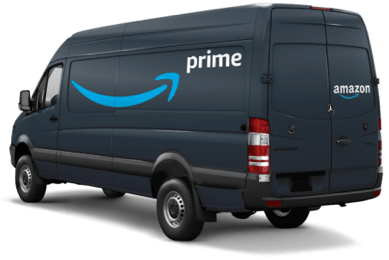
Employees — or any other entrepreneur — who wants to become a delivery partner, are able to lease customized blue delivery vans with the Amazon smile logo on the side, and take advantage of other discounts including fuel, insurance, branded uniforms and more.

Before the launch of the partner program, Amazon had relied on its Amazon Flex crowdsourced workforce to help it deliver packages to help it reduce costs. But these gig workers often faced too much uncertainty with regard to their pay because of things like fluctuating gas prices that cut into profits, lack of insurance, and the general, logistic challenges that come from trying to deliver packages from a smaller, unbranded personal vehicle.

Delivery partners, meanwhile, could earn as much as $300,000 in annual profit by growing their fleet to 40 vehicles, Amazon claims. The company said last year it expected that hundreds of small business owners will come to hire tens of thousands of drivers across the U.S.

That is already happening. Since the launch of the program in June 2018, over 200 small businesses have hired “thousands” of local drivers, Amazon says this morning. It expects to add hundreds more small businesses this year, as well.

The incentive to employees also comes at a time when Amazon is increasing automation in its warehouses that will potentially put some workers out of jobs. A report from Reuters this morning noted that Amazon is rolling out machines that will automate a job that’s currently held by thousands of workers: boxing customer orders. Some of these workers could be candidates for the delivery partner program now, given they may be looking for what’s next — before they’re laid off.

For Amazon, the funds it’s investing today to help employees transition to this new business could be recouped over time as the retailer reduces its reliance on USPS, UPS, and FedEx by shifting more of its business over to its own delivery network where it has control. In the near-term, however, all of Amazon’s delivery partners will benefit from its plans to spend $800 million to make 1-day shipping the new Prime default.

The employee incentives are available in the U.S., and now the U.K., and Spain.