
Category: UNCATEGORIZED

01 May 2019

Twitter grilled on policy approach that reinforces misogyny

Twitter has faced a barrage of awkward questions from the U.K. parliament over its ongoing failure to tackle violent abuse targeted at women. 

Katy Minshall, the social media platform’s head of U.K. government public policy, admitted it needs to do more to safeguard women users — but claimed the company is “acutely aware” of the problems women experience on Twitter, saying it’s in the process of reviewing how it applies its policies to fix its long-running misogyny problem. 

“We are acutely aware of the unique experience women have on Twitter and changes we may have to make in our policies to get that right,” she told the human rights committee session on free speech and democracy this afternoon. “We are very much aware of the real issue that women experience on our platform.”

Parliamentarians raised the issue of how unequally Twitter applies policies on hateful conduct depending on the sex being targeted, with MP Joanna Cherry accusing the company of displaying a pattern of relaxed tolerance to tweets containing violent attacks on women.

She contrasted that with examples of alacritous intolerance to tweets that raised the issue of male violence — citing examples of users who had had their Twitter accounts temporarily suspended for making factual, gender-based observations with a male flavor — such as that, on aggregate, men kill more than women.

Or tweets citing English law — which states that only a man can commit rape.

“There seem to be a number of mistakes here. And they seem to be mistakes that are failing to protect women. Do you accept that?” asked Cherry.

“There is clearly a number of steps that we want to take, we need to take, but we are in a different place to where we were even this time last year,” said Minshall initially, before simplifying her response to “clearly there’s an issue here for us to look at” later in the Q&A session.

She was asked to look at several examples of violent tweets which had been directed at women, including tweets whose recipients had reported them to Twitter — only to be told they did not violate its hateful conduct policy.

Only later, after feminist campaigners, journalists and Cherry herself had tweeted about Twitter’s decision not to take down some of these misogynistic tweets did it reverse course and remove them.

Minshall admitted that one of the abusive tweets had been removed last night, after Cherry had tweeted to draw attention to it.

One tweet cited during the session depicted a cartoon figure with a photo of a real hand holding a gun pointed at the viewer, atop the caption “shut the fuck up terf” — ‘terf’ being a term of abuse which Cherry pointed out tends to be applied to women; another showed a video game clip of a man repeatedly chopping a woman in the neck which had been attached to a tweet saying “what I do to terfs”; a third was what Cherry dubbed “a very unpleasant representation of a male flaying a woman alive” — that she said had been sent to one of the women after they had complained on Twitter about receiving one of the other violent tweets.

Minshall said she believed all the tweets Cherry raised as examples violated Twitter’s policies and should have been removed if they hadn’t already. Though said she doesn’t work in the safety team, caveating her response with: “I’m not the expert.”

She also said that trying to moderate a public discussion about transgender rights can be “difficult” — leading Cherry to point out that none of the counter examples she had raised were in any way abusive towards transgender people.

“What I’m trying to understand is why, initially, the first tweet — the chopping in the neck — was ruled alright by Twitter. And why it took the intervention of a leading journalist, a leading feminist commentator and a member of parliament for it to be ruled not alright,” she went on.

“We need to understand who is actually carrying out these decisions. Who is carrying out the mediation at Twitter. Is it done in the UK, is it done in America, who is done by. Is there any attempt at gender balance within the teams of people looking at these tweets.”

Minshall said she could not answer the gender breakdown question there and then — saying she would write to the committee with an answer.

Cherry also made the point that sex is a protected characteristic in UK law, and pressed Minshall several times on why Twitter’s hateful conduct policy only applies to gender.

“Can you tell us why Twitter has chosen to exclude sex from their hateful conduct policy as a protected characteristic?” she asked. “I’m wondering if that’s what could be going wrong here? That the training is not covering the fact that sexist, misogynistic, demeaning behavior should be treated as seriously as abuse of, for example, trans people.”

Minshall said Twitter’s hateful conduct policy is based upon United Nations definitions, arguing the current policy that protects gender should also protect against misogyny — while admitting there’s still an asymmetrical burden on women users of Twitter to report abuse.

She agreed to follow up with the committee to explain why Twitter’s policy does not include sex as a protected characteristic too.

“There’s a lot that we want to do to reduce the burden on reporters,” she said. “We have rules in place where it would be a breach to target someone based on the fact that they’re a woman — where we need to do far more is to be proactive in reducing the burden on victims to report that to us.”

At another point during the session she said Twitter is also reviewing its policy on harassment — saying it’s concerned about the risk of women being stalked via the platform by ex-partners.

“There is an issue specific to women, typically ex-partners, stalking them on Twitter in ways that have traditionally been difficult to detect in our rules — and we want to do better on that,” she added.
01 May 2019

Google launches CallJoy, a virtual customer service phone agent for small businesses

Google is combining several technologies including virtual phone numbers, audio transcriptions, automated reporting and analytics, in a new effort to help small business owners better manage their inbound phone calls. The company’s latest project from its in-house incubator is CallJoy, launching today.  Aimed at the U.S.’s 30.2 million small business owners, the system offers a low-cost customer service agent that helps block spam calls, provide callers with basic business information, and redirect customers to complete their requests — like appointment booking or placing a to-go order — over SMS.

Any other calls or questions would be directed to the main business phone number.

Typically, customer service phone agents like this are out of reach for small business owners, but CallJoy is priced at a flat monthly fee of $39 to make the technology affordable.

Like other virtual customer service systems, CallJoy can greet the caller and offer basic information like the business hours or address, for example. It also frees up the business owner from having to deal with the ever-increasing number of spam calls which waste their time, and can move customers off of phone lines to complete tasks online, where appropropriate.

To do so, CallJoy’s virtual agent can send a customer who opts in an SMS text message that includes an URL where the task — like appointment booking or online orders, for example — can be completed.

For example, the agent may ask the customer “Can I send you our food ordering link?” If the customer says “yes,” the text is sent immediately. In addition, the feature can be customized for sharing other types of information — like the company’s email or where to find an online contact form.

If the customer is calling from a landline, however, this textback feature will be disabled and they’ll be directed to the business line instead.

Like other customer service software which alerts callers that calls “will be recorded for quality assurance purposes,” CallJoy records the incoming calls (which is also disclosed). This can help cut down on spam calls because once spammers know the call is recorded, they usually hang up.

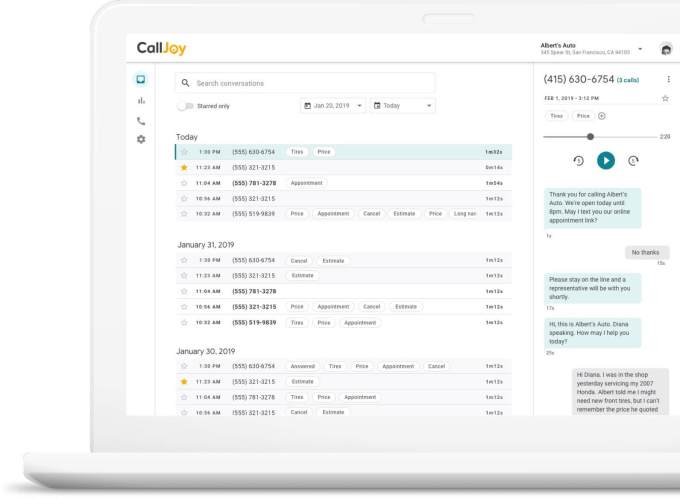
The recorded calls are also encrypted and transcribed, and these transcripts then become searchable in the CallJoy dashboard.

Here, call information — including the phone number, audio, and transcript — is stored. The business owner can also go back and tag the calls in order to run reports that help them gain insight into their business. For example, if a salon got a lot of inbound calls about “wedding hairstyles” they may then decide it would make sense to include this information on their website; or a restaurant may want to track how many calls it gets per night for reservations.

Other insights are available, too, like call volume, peak call times, and new vs. returning callers. These are displayed in the online dashboard and sent out in a daily email.
The service works today with existing landlines, mobile phones, Google Voice lines, or other cloud providers by routing calls to the business phone number.

But phone numbers are not ported to CallJoy. Instead, similar to Google Voice, the business would select their virtual CallJoy number with their local area code.

To start receiving call there, they’d have to update all their business information with this new number — including the website, business cards, online listings, ads, social media, and anywhere else the number appears.

CallJoy is also tied to only one location and one phone number. Additional locations with their own lines can be added within the CallJoy dashboard, but businesses are charged per line.

At launch, CallJoy is available on an invite-only basis. Businesses have to request a spot on the waitlist from the CallJoy homepage. More invites will be shared every day, and eventually, the system will open to all.

01 May 2019

Showcase your startup — buy a demo table at TC Sessions: Mobility 2019

While we haven’t achieved Gene Roddenberry’s vision of the transporter beam (yet), mobility and transportation — and the tech that drives both — are undergoing a huge and rapid evolution. There’s no better place to see, share and learn about these revolutionary advances than at TC Sessions: Mobility 2019, a day-long conference that takes a deep dive into all things mobility.

If you’re an early-stage startup founder in either industry, there’s no better way to position your business in front of the most influential investors, media and technologists. Simply book a demo table and join us on July 10 in San Jose, Calif.

TC Sessions: Mobility 2019 will be packed with a veritable who’s who of mobility movers, shakers and makers. Consider just some of the speakers that are already announced:

  • Oliver Cameron, co-founder and CEO of Voyage, an autonomous driving startup making a big name for itself with a door-to-door self-driving taxi service. Cameron will discuss the company’s mission and its plans for the future.
  • Then there’s Jump founder Ryan Rzepecki — he sold his startup to Uber for about $200 million — and Katie DeWitt, the SVP of product at Scoot. These two visionary leaders will talk about the future of micromobility, including topics like asset management, unit economics, partnering with cities, data sharing and more.
  • You won’t want to miss what Amnon Shashua has to say about autonomous vehicle technology. The co-founder, president and CEO of Mobileye — and a senior vice president at Intel — will share his vision of the future. It includes using Mobileye sensors for mapping to improve operations between businesses and cities, which will help bring us closer to creating smart cities and safer roads.

That’s just a taste of the in-depth programming you’ll find at TC Sessions Mobility. We’re announcing more speakers, panelists and workshops every week. If you’d like to speak, demo your technology or nominate someone else, you can submit an application right here.

TC Sessions: Mobility 2019 goes down on July 10 in San Jose, Calif., with more than 1,000 members of the mobility community — founders, technologists, engineering students and investors — expected to be there.  This inaugural mobility event promises to be a highly focused, world-class networking opportunity. Don’t miss your chance to place your startup front and center. Book a demo table right now. Extra credit if your startup’s working on a transporter beam.

Looking for sponsorship opportunities? Contact our TechCrunch team to learn about the benefits associated with sponsoring TC Sessions: Mobility 2019.

01 May 2019

iPhone hard hit as global smartphone shipments continue nosedive

The smartphone industry is in rough shape. Sundar Pichai used the word “headwinds” to discuss the company’s difficulties moving Pixel 3 units, but Canalys’ latest report is far more blunt, describing the situation as a “freefall.”

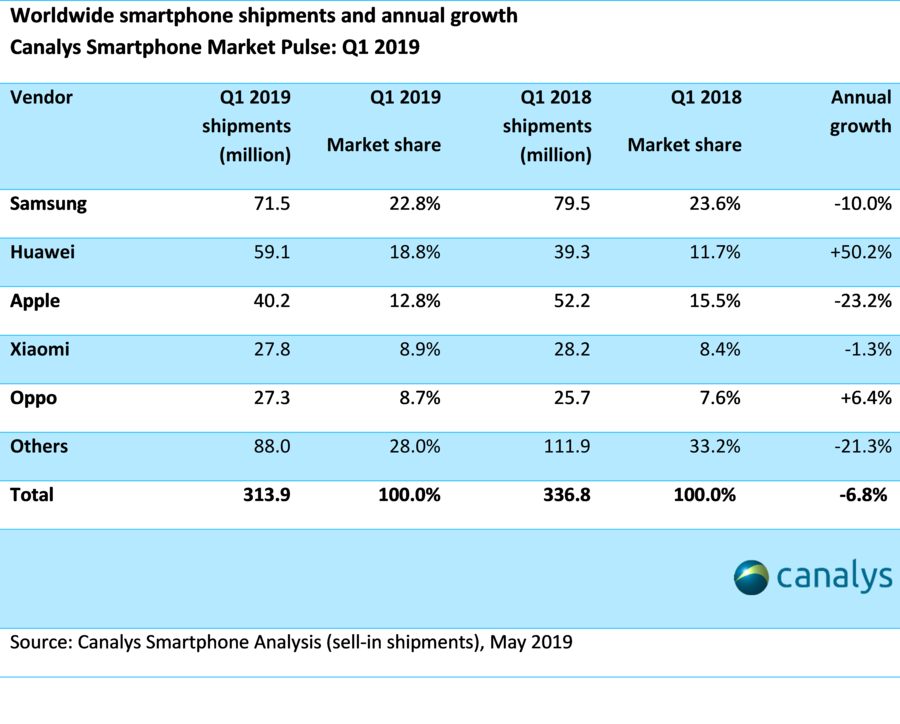
Things are pretty ugly in the Q1 report, as smartphone shipments declined for the sixth quarter in a row. The combined global units hit 313.9 million, marking their lowest point in almost half a decade, according to the firm.

Of the big players, Apple seems to be particularly hard hit, falling 23.2% year on year. Once again, China played a big role here, but as usual, the full story is much more complex.

“This is the largest single-quarter decline in the history of the iPhone,” said analyst Ben Stanton in a release tied to the news. “Apple’s second largest market, China, again proved tough. But this was far from its only problem. Shipments fell in the US as trade-in initiatives failed to offset longer consumer refresh cycles. In markets such as Europe, Apple is increasingly using discounts to prop up demand, but this is causing additional complexity for distributors, and blurring the value proposition of these ‘premium’ devices in the eyes of consumers.”

A lot to unpack there, but what we’re looking at are some larger issues within the industry, including global economic issues and slowed upgrade cycles for users. The XS was also notably much less dramatic of an upgrade than its predecessor. Stanton did add that the iPhone, “show[ed] signs of recovery towards the back-end of the quarter,” which is promising for Q2.

It also remains to be seen what this year will hold in terms of iPhone upgrades, though most signs point to 2020 as the year the company makes the jump to 5G. Tim Cook was noncommittal on the topic during the company’s earnings call last night, instead pointing to positive numbers on the iPad side and, of course, Apple’s continued push into services.

Analysts are somewhat bullish about the potential of innovations like 5G and even foldables in shaking up the stagnant market, but big players like Apple are clearly hedging their bets, should the free-falling headwinds continue.

Huawei, meanwhile, continues to be a bright spot, with a 50.2% year over year growth and an 18.8% global market share, according to the firm. That growth could be hampered, however, by increased competition from Samsung and fellow Chinese handset companies like Xiaomi and Oppo.

01 May 2019

UK plans new law aimed at improving Internet of Things security

The U.K. government is proposing new legislation aimed at improving security of Internet of Things devices.

Digital minister Margot James MP revealed the draft law on Wednesday as part of the government’s efforts to protect millions of internet-connected devices from cyberattacks.

The law will mandate that internet-connected devices, like smart thermostats, appliances and webcams, must be sold with a unique password.

Botnets typically rely on default passwords that are hardcoded into devices when they’re built that aren’t later changed by the user. By selling a device with a unique password, it significantly slows down cybercriminals from scanning the internet and automatically logging into devices with a default password, often to launch distributed denial-of-service attacks.

On a massive scale, botnets operating thousands of hijacked Internet of Things devices entire websites offline. Two years ago, the Mirai botnet briefly downed Dyn, a networking company that provides domain name service to major sites. That outage knocked dozens of major sites offline — like Twitter, Spotify and SoundCloud.

The new U.K. law will also mandate device makers to provide a public point of contact to allow hackers and security researchers submit flaws and vulnerabilities.

And device makers will have to tell consumers for how long each device will receive security updates.

The law, if passed, would create a labeling scheme for consumers to easily see devices that are “Secure by Design,” said James, giving consumers greater confidence that the devices land with a baseline level of security out of the box.

“Many consumer products that are connected to the internet are often found to be insecure, putting consumers privacy and security at risk,” said James. “Our code of practice was the first step towards making sure that products have security features built in from the design stage and not bolted on as an afterthought.”

The U.K. is following in the footsteps of California, which in October passed a law banning default passwords in connected devices. The law will come into effect in 2020. Each device sold in the state must come with a password “unique to each device.”

Ken Munro, founder of security firm Pen Test Partners, said in a blog post that the proposed law was a “great start,” but the new rules were a “fairly light touch.”

His company finds security flaws in internet-connected devices like car alarms and other consumer goods.

“We hope that the government will also commit to a program of continual improvement of smart product security,” he said.

01 May 2019

Netflix launches high-quality audio for TV viewers

Netflix this morning announced a new feature for its streaming service focused on offering viewers better sound. The company is rolling out “high-quality audio,” or an audio experience that features a higher bitrate for TV devices that support either 5.1 or Dolby Atmos. Depending on the device and the customer’s bandwidth capabilities, the actual bitrate you receive will vary, Netflix says.

However, it will range from 192 kbps (good) up to 640 kbps (great) for 5.1, and from 448 kbps to 768 kbps for Dolby Atmos — which is available to members subscribed to the Premium plan.

Netflix says the bitrates will evolve over time as its continues to get more efficient with its encoding techniques.

Netflix’s tech blog gets into more details about the feature, noting that the high-quality sound is not lossless, but is “perceptually transparent” — meaning that even though the audio is compressed, it’s indistinguishable from the original source, Netflix claims.

The company also offered a bit of backstory about how high-quality audio came to be, thanks to sound-quality issues with Stranger Things 2 back in 2017. In one episode, a car chase scene wasn’t sounding crisp, so Netflix tasked its sound expert and engineers to make improvements. They addressed the problem by delivering a higher bitrate for the audio. And since then, the team has been working to roll out the improved audio more broadly.

“Often the subtlety of sound may go unnoticed, but it can have a profound impact on the atmosphere of a scene and fundamentally change how a viewer responds to it,” the company writes in an announcement. “Supporting and delivering on the vision of our creative partners has always been incredibly important to us, and sound is something we’ve been really focused on.”

The feature launches today for TV viewers.


01 May 2019

Alexa in-skill purchasing, which lets developers make money from voice apps, launches internationally

A year after Amazon opened up in-skill purchasing to all Alexa developers in the U.S., the company is launching the service internationally. Initially, the capability will roll out to developers in the U.K., Germany and Japan, and then developers elsewhere in the world. With in-skill purchasing, developers are able to generate revenue from voice apps in a number of ways: through the sale of digital goods as a one-time purchase, subscriptions, or consumables.

Digital goods can include things like expansion packs for a trivia skill, while consumables are one-time-use purchases — like hints for a trivia game. Subscriptions, meanwhile, give developers a more consistent revenue stream, and can be used for things like a premium, upgraded app experience, or a voice app that regularly updates with new content, for example.

The larger idea is that publishers need to make money from voice apps, in order to make their continued development worth their while. As it’s still early days for voice, many developers are still seeing what sort of skills work and which don’t, and how customer loyalty plays out over the long-term.

There are now over 80,000 skills for Alexa, which means there’s a long tail of developers whose apps aren’t getting much traction and only a few hits.

But Amazon today highlighted a couple of skills finding some success. One is the game skill Escape the Airplane from developer Gal Shenar who reports a 34 percent conversion rate. Nick Schwab’s ambient sound skills, meanwhile, have attracted nearly 2 million monthly active users. He offers those customers free trials and monthly subscriptions, and 30 percent convert to trials. A further 90 percent of the free trials then convert to paid subscriptions.

In both cases, the developers present the premium experience as an option — not a hard sell. And they make their skills engaging and habit-forming.

Other top skills include Jeopardy, Escape the Room, Beat the Intro, Big Sky, Would You Rather for Family, Question of the Day, and Yes Sire.

With the international expansion, developers will be able to monetize their skills with localized content that’s relevant to customers in different countries. They can do so using either the Alexa Command-Line Interface or the Alexa Developer Console.

Interested developers are asked to sign up by way of a form, in order to connect with a member of the Alexa team about their idea.

01 May 2019

Google’s Wear OS gets tiles

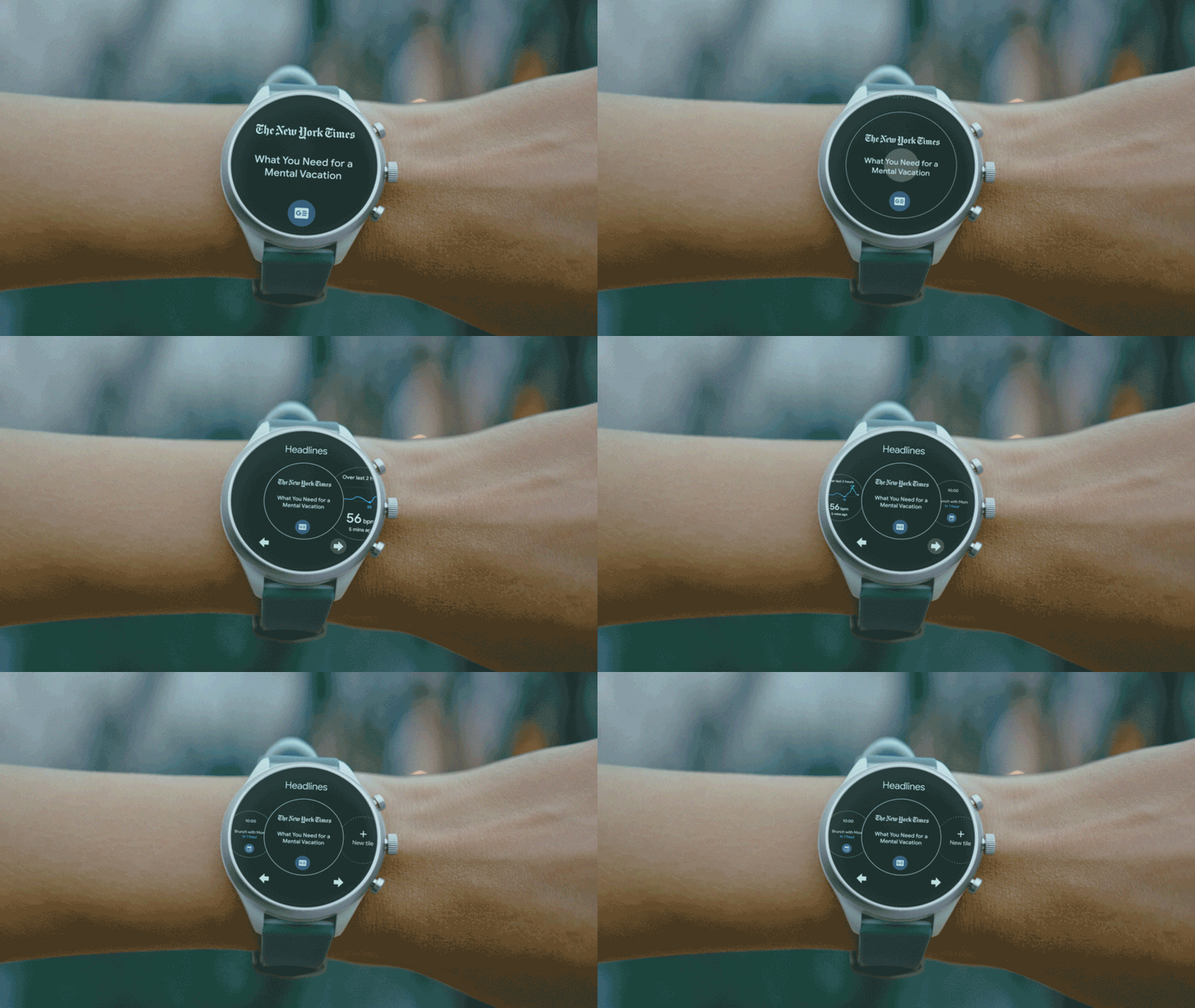
Google announced an interesting new Wear OS feature today that makes a number of highly used features more easily available. Google calls this feature ’tiles’ and it makes both information like the local weather forecast, headlines, your next calendar event, goals and your heart rate, as well as tools like the Wear OS built-in timer available with just a few swipes to the left.

In the most recent version of Wear OS, tiles also existed in some form, but the only available tile was Google Fit, which opened with a single swipe. Now, you’ll be able to swipe further and bring up these new tiles, too.

There is a default order to these tiles, but you’ll be able to customize them, too. All you have to do is touch and hold a given tile and then drag it to the left or right. Over time, Google will also add more tiles to this list.

The new tiles will start rolling out to all Wear OS smartwatches over the course of the next months. Some features may not be available on all devices, though (if your watch doesn’t have a heart rate monitor, you obviously won’t see that tile, for example).

Overall, this looks like a smart update to the Wear OS platform, which now features four clearly delineated quadrants. Swiping down brings up settings, swiping up brings up your notifications, swiping right brings up the Google Assistant and swiping left shows tiles. Using the left swipe only for Google Fit always felt oddly limited, but with this update, that decision makes more sense.

01 May 2019

SeatGeek names former Tumblr and NYT exec Brian Murphy as CTO

Ticketing startup SeatGeek has a new CTO.

Brian Murphy previously held the same position at Tumblr (which, like TechCrunch, is owned by Verizon Media) and has also served as vice president of engineering at The New York Times and senior director of technology at Condé Nast.

“Brian is an incredible leader and team-builder who has overseen engineering teams for some remarkable companies,” said SeatGeek co-founder and CEO Jack Groetzinger in a statement. “He is a perfect fit for this role at SeatGeek and embodies the values we hold – he loves building great products, is humble yet aggressive in how he approaches opportunities, and is focused on creating experiences live event fans will love.”

Murphy told me that his career started out in consulting, but he’s been attracted to technology roles in media companies because he was “drawn to all the smart creative folks who want to use their technology in that medium.”

As for SeatGeek, Murphy described it as a “very consumer-oriented, very mobile-focused” company that’s now moving into the enterprise business by working with teams and venues to sell tickets. He also said he’ll be working on international expansion and on helping Lyft build a broader live event experience.

“You’ve sort of started to see it with partnerships with Lyft and Snapchat and Spotify,” he said.”There’s definitely an opportunity how we bring our Starbucks-esque experience to the stadium.”

Murphy added that he’ll be “very, very busy with recruiting.”

Meanwhile, SeatGeek’s outgoing CTO Eric Waller isn’t leaving the company — instead, he’s becoming chief product officer.

01 May 2019

A16z ushers in new fund strategy with $2.75B

Axios reported this morning that Andreessen Horowitz, the storied venture capital firm with investments in Airbnb, BuzzFeed and Coinbase, has closed on $2.75 billion for two new funds.

The firm has raised $2 billion for a growth fund led by their most recent hire and 15th general partner David George. Additionally, a16z has lassoed $750 million for early stage deals. We’ve reached out to the firm to confirm.

This comes about a month after Forbes explained a16z’s new status as a financial advisor rather than a traditional venture capital fund.

The a16z model, one that couples capital with agency-like services, has for years been replicated by other big venture firms. Now, a16z expects to lead the charge again by turning itself into a registered investment advisor.

The move will allow a16z to experiment in new areas, including the public markets, other VC funds and cryptocurrencies.

George is investing across industries, offering up his knowledge of late-stage economics, valuations and underwriting to a16z’s large and growing team of deal-makers. George is the at least the fourth high-level addition to the team in the last year, including Katie Haun, who joined in June to lead a16z’s cryptocurrency investment effort. Angela Strange and Connie Chan, additionally, were promoted to GP last summer.

This is a market where entrepreneurs have lots of choices and they are making choices on the expertise of the individual partner,” a16z managing director Scott Kupor told TechCrunch. “The purpose of having more GPs is about having the appropriate domain expertise and coverage so we can be in front of the most opportunities out there.”

A16z’s fifth flagship venture fund closed on $1.5 billion in 2016. The firm also deploys capital out of a crypto fund, a bio fund and a cultural fund, which boasts limited partners including Sean “Diddy” Combs, Shonda Rhimes and Jada Pinkett Smith.