Category: UNCATEGORIZED

23 Apr 2019

Chive Media’s out-of-home TV spinoff Atmosphere raises $10M

When Chive Media Group spun out its out-of-home TV business last year, co-founder and CEO Leo Resig said the structure should help the new company, called Atmosphere, raise venture capital.

Looks like those fundraising efforts were successful, with Atmosphere announcing that it has raised $10 million in Series A funding led by S3 Ventures, with participation from Capstar Capital.

“I have yet to meet someone who enjoys watching closed-captioning or talking heads at their favorite establishments,” said S3 Ventures Partner Charlie Plauche in a statement. (Plauche is joining Atmosphere’s board of directors.) “Yet, that is the best option most businesses have to entertain patrons. That all changes with Atmosphere, who offers engaging content to viewers of all ages with no audio needed.”

Chive Media Group is known for its namesake website, theChive, which focuses on funny and viral content. Chive co-founders (and brothers) Leo and John Resig told me that when the company decided to move into video, it didn’t have the money to create a big production arm.

“We stuck to our roots of what we do best: Seek out and curate and package existing content,” John said. As a result, the company was able to license “a pretty large IP library of short form, mostly amateur viral videos,” which it then offered to bars and other out-of-home locations as Chive TV.

Chive TV still exists, but it’s now just one of the channels that Atmosphere offers, with Leo noting that Atmosphere now includes more polished videos from partners like Red Bull and GoPro.

“Everyone’s creating content these days,” John added. “We’re a shiny new distribution vessel for a lot of that content.”

In general, Leo argued that Atmosphere content is better tailored than regular TV to the needs of (say) a restaurant or a doctor’s office.

“It’s ambient TV,” he said. “It’s not episodic, it’s not character-driven, you can pick it up and leave it without missing a touchdown.”

Plus, as Plauche mentioned, it’s designed to be watchable without audio.

The company says Chive TV is already streamed in 4,300 bars, restaurants, gyms and other locations. And it’s adding around 450 venues every month.

At the same time, the Resigs said Atmosphere has been building up a technology backend, with the analytics and ad serving that you get with online video.

Until now, Chive and Atmosphere have been giving the content away for free while monetizing with ads, but Leo said they’ll soon start charging a monthly subscription fee of around $10 or $20, which he suggested is “not a lot of money for what the venues are getting,” particularly compared to their cable bill. There’s an additional product that venues can pay for to insert their own messages and house ads.

The Resigs actually hold the same title at both companies, but Leo (CEO) suggested that he’ll be spending more time on Atmosphere, while John (President) said he’ll be “straddling” the two organizations.

Leo said Atmosphere has around 20 employees — with another 20 who are currently splitting their work between Chive Media and Atmosphere, but will ultimately go work for one of the two organizations.

23 Apr 2019

Blueshift announces $15M Series B to expand AI-fueled cross-channel marketing tool

Blueshift is startup founded by tech industry veterans, who saw first-hand how difficult cross-channel marketing was. They decided to launch a company and build a cross-channel marketing platform from the ground up that uses AI and machine learning to make sense of the growing amount of customer data. Today, the startup announced a $15 million Series B round to keep it going.

The round was led by Softbank Ventures Asia, a fund focused on AI startups like Blueshift . Previous investors Storm Ventures and Nexus Venture Partners also participated. Today’s investment brings the total raised to $30 million, according the company.

Company co-founder and CEO Vijay Chittoor says the marketing landscape is changing, and he believes that requires a new approach to allow marketers to take advantage of the multiple channels where they could be engaging with customers from a single tool.

“If you thought about the world of customer engagement at Walmart or Groupon [or any other retailer] 10 years ago, it was primarily an email problem. Today, we as customers, we’re interacting with these brands on not just email, but also on mobile notifications, Facebook custom audiences and WeChat [and across multiple other channels],” he explained.

He says that this has created a lot more data, which it turns out is a double-edged sword for marketing pros. “I think on one end, it’s exciting for a marketer or a CMO to have more data and more channels. It gives them more ways to connect. But at the same time, it’s also more challenging because now you have to make sense of thousand times more data. And you have to use it intelligently on not just one channel like email, but you’re now trying to make sense of data across 15 different channels,” Chittoor said.

This a crowded field with big players like Adobe, Salesforce and Oracle, among others, offering similar cross-channel, AI-fueled solution. In addition startups are attracting huge chunks of money to attack this problem, including Klayvio pulling in $150 million a couple of weeks ago and Iterable, which landed $50 million last month.

He says his company’s differentiator is the AI piece, and it is this piece that the company’s lead investor in this round has been focusing on in its investments. The company plans to use this round to continue building out its marketing platform and show marketers how to communicate intelligently across channels wherever the consumer happens to be. Customers include LendingTree, Udacity and BBC.

23 Apr 2019

$35M-funded Omni pivots from storage to rentals via retailers

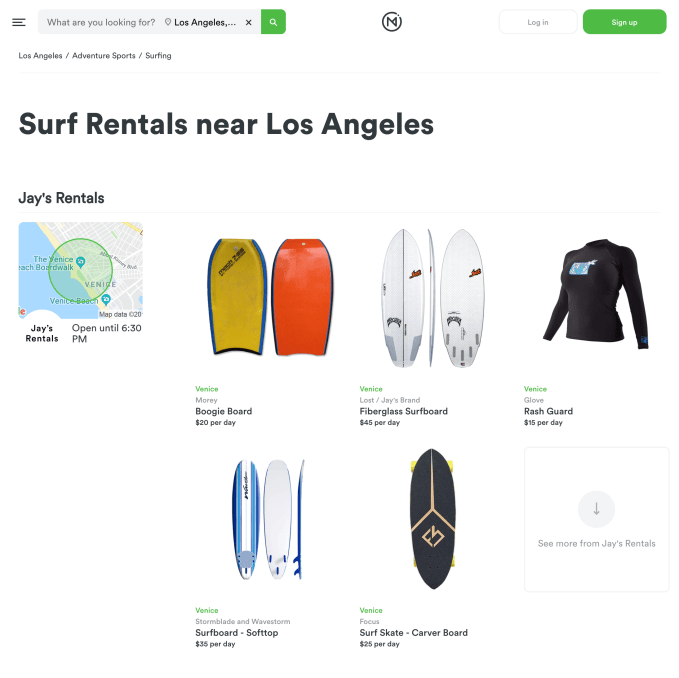
Omni simply couldn’t scale storing stuff in giant warehouses while dropping it and off picking it up from people on demand. Storage was designed to bootstrap Omni into peer-to-peer rentals of the goods in its care. But now it’s found a better way by partnering with retailers which will host and rent out goods for Omni that users will pick up themselves.

With that strategy, Omni is now formally pivoting from storage alongside its expansion from San Francisco and Portland into Los Angeles and New York. In SF and its new markets starting today, users can rent GoPros, strollers, drills, guitars, and more for pick up and drop off at local storefronts which will receive 80 percent of the revenue while Omni keeps 20 percent.

“Storage was always meant to supply a rentals marketplace. We launched storage in an Uber-for everything era and now it’s no secret that physical operations are tough to scale” Omni’s COO Ryan Delk telss me. “This new model gives our users more supply, local entrepreneurs a new revenue stream, and us the ability to launch new markets much more quickly than the old model of building rentals on top of the storage business.”

LA Omni users will be able to rent surf equipment for pickup and dropoff from local surf shop Jay’s

To that end, storage won’t come to any more markets, though storage services with delivery will continue in San Francisco. Users there and in Portland will also be able to pick up and drop off rental items from a few Omni-owned locations including its SF headquarter office. Omni will add retailer pickups in Portland and more in San Francisco soon.

“Ownership has a bit of a burden associated with it” Delk tells me, referencing the shifting attitudes highlighted by Marie Kondo and the tidyness movement. Ownership requires you to pay up front for tons of use down the line that may never happen. “Paying for access when you need it unlocks all these amazing experiences.”

Omni discovered the potential for the model when it ran an experiment. “What if we could pick up items directly from Omni?” Delk explains. Omni learned that many people “can’t afford to pay for transit both ways. It was pricing out a lot of people.” But pick-ups unlocked a new price demographic.

Meanwhile, Omni noticed some semi-pro renters had cropped up on its platform whowere buying tons of a popular item like chairs on Amazon, shipping them to its warehouse, then renting them out and quickly recouping their costs. It saw an opportunity to partner with local retailers who could give it instant supplies of items in new markets while handling all the pick up and drop off logistics. Those  businesses can choose black-out dates, pause for vacations, and sell items like normal and let Omni know to restock them so rentals don’t cannibalize their sales.

23 Apr 2019

Verizon Q1 beats analyst expectations with earnings per share of $1.22

Verizon just released its first quarter earnings report, with earnings per share that came in significantly ahead of analyst expectations, while revenue was right in line with predictions.

The company reported EPS of $1.22 per share (or $1.20 when adjusted to exclude a 2 cent benefit due to a pension re-measurement triggered by its recent voluntary redundancy program) and revenue of $32.1 billion, which was up 1.1 percent year-over-year. Analysts had predicted EPS of $1.17 and revenue of $32.15 billion.

Verizon also saw 61,000 net additions to its postpaid retail wireless business, including 174,000 net additions on the postpaid smartphone side.

The Verizon Media division (which owns TechCrunch) reported revenue of $1.8 billion, down 7.2 percent year-over-year. The company blames this decline on falling desktop ad revenue.

The report comes as Verizon begins its 5G rollout in  Chicago and Minneapolis, with the company saying that the 5G network buildout was part of its $4.3 billion in capital expenditures.

“2019 is shaping up to be an exciting year for Verizon,” said chairman and CEO Hans Vestberg in a statement. “We are leading the world in the development of new technologies with the launch of our 5G Ultra Wideband network. Our ambition remains unchanged to provide the most advanced next-generation networks in the world.”

As of 8am Eastern, Verizon shares are up 0.72 percent in pre-market trading.

23 Apr 2019

The robot-recruiter is coming — VCV’s AI will read your face in a job interview

With remote working becoming more of a norm than ever before, remote interviews have, in turn, become a necessity. But how can you truly assess someone from these? In addition, it’s easy to miss great candidates just because you don’t have time to interview all the candidates.

A number of startups have appeared to try and address the problem. HireVue,
which has raised $93M, has tried to address with an AI-driven ‘Hiring Intelligence’ platform. AllyO, which has raised $19M, is trying to make hiring more efficient by addressing the traditional inefficiencies of lost applicants and conversions due to poor candidate experience. And Arya is a seed stage start-up which uses machine learning to identify successful sourcing patterns and draws potential candidates out of online profiles.

Another player is applying algorithms to the hiring process.

VCV.AI, has now raised $1.7 million to automatically screens job candidates using facial and voice recognition. Yes, it looks like another episode of Black Mirror is on its way…

The investment comes from Japanese VC Will Group, Talent Equity Ventures, 500 Startups and angel investors, including Masahiro Takeshima of Indeed. The funding will help VCV continue to develop its technology and strengthen its position, and will also see it opening an office in Tokyo, Japan.

VCV claims it can help eliminate human bias from the hiring process with preliminarily screening of candidates, automated screening calls, and by conducting these robo-video interviews with voice recognition and video recording.

Through VCV, potential candidates can record a video using a computer or smartphone on iOS or Android. This functions like a real interview, as candidates don’t have the ability to prepare for the questions in advance. Additionally, facial and voice recognition identifies a candidates’ nervousness, mood, and behavior patterns to help recruiters assess whether a person is a good cultural fit for the company.

VCV says this doesn’t replace the job of a recruiter but enhances their toolset so they can find and screen a greater number of candidates more efficiently. The startup says this AI-led approach helps companies save over 20 hours of work with recruiting bots working 24/7 to find, chat, and interview potential candidates.

Clients already include PWC, L’Oreal, Danone, Mars, Schlumberger, and Citibank .

Arik Akverdian, founder and CEO of VCV.AI, said: “AI can improve and streamline the hiring process, while also helping to remove corrosive biases that all humans have. There’s no reason technological innovation shouldn’t transform this area of business—especially considering human talent is an organization’s most important asset.”

We will see how those biases play out once all our hiring is via AI…

23 Apr 2019

Harness hauls in $60M Series B investment on $500M valuation

Series B rounds used to be about establishing a product-market fit, but for some startups the whole process seems to be accelerating. Harness, the startup founded by AppDynamics co-founder and CEO Jyoti Bansal is one of those companies that is putting the pedal the metal with his second startup, taking his learnings and a $60 million round to build the company much more quickly.

Harness already has an eye-popping half billion dollar valuation. It’s not terribly often I hear valuations in a Series B discussion. More typically CEOs want to talk growth rates, but Bansal volunteered the information, excited by the startup’s rapid development.

The round was led by IVP, GV (formerly Google Ventures) and ServiceNow Ventures. Existing investors Big Labs, Menlo Ventures and Unusual Ventures also participated. Today’s investment brings the total raised to $80 million, according to Crunchbase data.

Bansal obviously made a fair bit of money when he sold AppDynamics to Cisco in 2017 for $3.7 billion and he could have rested after his great success. Instead he turned his attention almost immediately to a new challenge, helping companies move to a new continuous delivery model more rapidly by offering Continuous Delivery as a Service.

As companies move to containers and the cloud, they face challenges implementing new software delivery models. As is often the case, large web scale companies like Facebook, Google and Netflix have the resources to deliver these kinds of solutions quickly, but it’s much more difficult for most other companies.

Bansal saw an opportunity here to package continuous delivery approaches as a service. “Our approach in the market is Continuous Delivery as a Service, and instead of you trying to engineer this, you get this platform that can solve this problem and bring you the best tooling that a Google or Facebook or Netflix would have,” Basal explained.

The approach has gained traction quickly. The company has grown from 25 employees at launch in 2017 to 100 today. It boasts 50 enterprise customers including Home Depot, Santander Bank and McAfee.

He says that the continuous delivery piece could just be a starting point, and the money from the round will be plowed back into engineering efforts to expand the platform and solve other problems DevOps teams face with a modern software delivery approach.

Bansal admits that it’s unusual to have this kind of traction this early, and he says that his growth is much faster than it was at AppDynamics at the same stage, but he believes the opportunity here is huge as companies look for more efficient ways to deliver software. “I’m a little bit surprised. I thought this was a big problem when I started, but it’s an even bigger problem than I thought and how much pain was out there and how ready the market was to look at a very different way of solving this problem,” he said.

23 Apr 2019

Twitter Q1 flies past estimates with sales of $787M and EPS of $0.25, but MAUs drop to 330M

Social networking and media platform Twitter today reported its results for the first quarter of the year, and it’s a strong one. The company said that revenues came in at $787 million, up 18 percent on a year ago; with net income of $191 million and earnings per share of $0.25. However, monthly active users continue to paint a challenging picture (no surprise that they are a dying metric for the company). Twitter says MAUs were 330 million in Q1, a drop of 6 million users on a year ago, although up 9 million on last quarter.

Monetizable daily active users — Twitter’s new and preferred metric for user numbers — were 28 million in the quarter, up 8 percent on the 26 million a year ago, and up 6 percent on last quarter’s 27 million.

Still, on the financial side, this is a strong set of results for the company. Going into today, average analyst expectations were for Twitter to post about $775 million in sales ($742-$815 million range) on an EPS of $0.15 per share ($0.10-$0.20 range). Twitter itself last quarter said it expected Q1 revenues to be between just $715 million and $775 million, with operating income between $5 million and $35 million.

With those numbers relatively stabilised, Twitter is putting more focus on trying to improve its actual product in the two areas where it has been considered weak: the ability for people to use Twitter when it gets noisy and active; and the general “health” of content management, around harassment and fake news. For the former, it’s been tinkering with a prototype app, and for the latter, it’s been adding more rules that it is proactively enforcing, which it says has led to “helping [Twitter] remove 2.5 times more of this content since launch.”

This is also the last quarter that Twitter is reporting monthly active users, as makes a switch instead to reporting “mDAUs”, or monetizeable daily active users, which it claims is a more accurate representation of how the business is growing. MAUs have not been a great metric for the company over the years, with one of Twitter’s strongest criticisms being that its user growth is stagnating. Given that the platform has a strong surge of usage around specific events, the average usage on days will work out stronger than that of usage on a monthly period.

Last quarter, while reporting a relatively strong set of Q4 earnings, we noted that Twitter’s stock dropped on that weak guidance, which represented a big drop from Q4 at a time (Q1) when many expect Twitter to report its strongest numbers.

As a point of comparison, a year ago in Q1 2018, Twitter posted revenues of $665 million, on an EPS of $0.16 per share, both blowing past Wall Street estimates with sales up 21 percent year-on-year.

More to come.

23 Apr 2019

Binance’s hotly-anticipated Singapore crypto exchange is now live — and underwhelming

Binance, the company widely seen as the world’s largest crypto exchange, has officially set up shop in Singapore after it launched a service in the country.

The new Singapore service, however, bears more of a resemblance to U.S. rival Coinbase than a classic Binance exchange. Binance’s rapid ascent is thanks to a service that lets users trade a range of crypto tokens with very little verification or individual data required. It’s Singapore venture is quite the opposite: it allows customers to purchase Bitcoin only and at fixed prices, while it doesn’t appear that purchased Bitcoin can be moved out of the exchange at this point.

We checked in with Binance for more details, but the company is yet to respond.

Binance’s Singapore launch follows an investment from Vertex, a VC firm backed by Singapore’s sovereign fund Temasek, in October. Binance has been testing a ‘beta’ version of its service in the country since late 2018 in communication with Singaporean regulator MAS.

The company has prioritized creating fiat ramps — exchanges that allow customers to buy into crypto using currency — over the past six months as it seeks to gain increased legitimacy and play within regulated jurisdictions. CEO Changpeng Zhao has also stressed the importance of going beyond retail customers to reach institutional money and enable it to enter crypto. As a global financial hub, Singapore is its biggest effort on fiat to date.

The Singapore venture is Binance’s third fiat effort following exchanges in Uganda and Jersey — a joint-venture in Lichenstein is yet to launch — although it remains to be seen just how useful the Singapore offering will be in its current form.

Binance users have long been accustomed to a choice of a vast array of crypto assets on sale, while any exchange user will expect to be able to move their newly purchased crypto to a private wallet or alternative storage option. Yet, at this point, the Binance Singapore exchange falls short on both counts, despite considerable expectation for its launch.

Interestingly, information on the website indicates that the new Binance venture appears to be a partnership with Xfers, a crypto startup in Southeast Asia that helped Coinbase set up its service in Singapore. Coinbase ended the partnership and quit the country last year claiming that Xfers was “not suitable in its current form to handle the growth” it had seen. Let’s see how Binance gets on.

The new Binance Singapore exchange is limited to Bitcoin only

Meanwhile, the company made another significant announcement after it officially launched its decentralized exchange, also known as Dex — its other major priority besides fiat.

There are no initial fireworks here — the Dex doesn’t yet include trading pairs or native tokens — but the launch means that blockchain companies are now able to migrate from Ethereum, EOS or other blockchains and begin to issue tokens on Binance Chain. A Binance spokesperson confirmed that the first of those migrations are expected to happen this week. The first is Binance’s own BNB token, which is moving from ERC20 to BEP2.

The Dex has been in testing since February, during which the company said that some 8.5 million transactions have been made. The real test will be when projects begin moving over and (if) traders begin to utilize the platform in large volumes going forward. Binance has always claimed that its Dex will operate as an alternative to its existing centralized exchanges, rather than as a replacement.

Binance draws revenue from over-the-counter (OTC) trading, trading fees on its platform and via BNB. Eventually, the Dex could augment that monetization as Binance will gain a share of network fees when its nodes are used in transactions on the Dex. Likewise, increased usage of the Dex and Binance Chain could raise the value of BNB — which has been on an incredible run this year, outpacing Bitcoin itself.

The value of Binance’s BNB token has quadrupled since the start of 2019, as data from Coinmarketcap.com shows

Valued at $6.02 on January 1, BNB broke $25 last week. Today, the price is $24.20, according to data from Coinmarketcap.com, and it remains to be seen how these two developments will impact it.

Note: The author owns a small amount of cryptocurrency. Enough to gain an understanding, not enough to change a life.

23 Apr 2019

GV-backed KeepTruckin nabs $149M at $1.25B valuation

KeepTruckin, a developer of hardware and software that helps truck drivers manage their vehicles and cargo, has raised $149 million in Series D funding. Greenoaks Capital has led the round, with participation from existing backers GV, IVP, Index Ventures and Scale Venture Partners .

The round values the business at $1.25 billion, according to KeepTruckin co-founder and chief executive officer Shoaib Makani.

Since it was founded in 2013, KeepTruckin has accumulated 55,000 unique customers, deploying its software in hundreds of thousands of vehicles. The San Francisco-headquartered company will use the latest investment to double its employee headcount to 2,000 in the next 12 to 18 months.

“Our technology really improves the life of the driver,” Makani told TechCrunch. “These are real people doing work that keeps our economy moving. Trucking is really the foundation of the American economy. More than 70 percent of all freight is moved over the road in a truck. This is how we eat, consume and produce; without it, our economy wouldn’t thrive.”

The Series D financing brings KeepTruckin’s total raised to $228 million, including a $50 million Series C that closed in March 2018.

KeepTruckin’s software is intended to bring the antiquated trucking industry into the digital age. Its platform provides electronic logs and fleet management tools, including GPS tracking and driver performance monitoring for fleet managers and dispatchers to track and communicate with their drivers.

“We are competing against paper and pencil,” Makani explained.

Makani left Khosla Ventures, where he had been an investor in early-stage consumer and enterprise companies since 2011, in 2013 to build KeepTruckin. At the time, the beginnings of a new sector focused on tech-enabled logistics was beginning to emerge. Since then, several companies have launched and scaled with similar focuses.

There’s Convoy in Seattle, for example, which also operates a network of connected-trucks. Uber Freight, the logistics and supply chain management business inside Uber. And Huochebang, a Chinese mobile app dubbed the “Uber-for-Trucks.”

“Trucking is forecasted to be a $1 trillion industry by 2024 and is the backbone of the global economy, yet has been underserved by technology but change is coming and KeepTruckin is at the leading edge,” Greenoaks managing partner Neil Mehta said in a statement. “KeepTruckin is building the technology that trucking companies need to compete in the modern economy. The network that KeepTruckin has built will enable it to change the way freight is moved on our roads.”

23 Apr 2019

New hack challenge from Eramet for the TC Hackathon at VivaTech

There’s no question that springtime in Paris is the stuff of legend. TechCrunch is returning to the City of Lights to continue building another legendary experience. The TechCrunch Hackathon at VivaTech 2019 takes place at the Expo Porte de Versailles on 17-18 May. If you’re a developer, a UX/UI designer or an all-around tech creator, don’t miss this chance to collaborate, compete and create something great.

Thanks to stellar sponsored hack contests, you can win serious cash and other awesome prizes in the process. There’s no fee to enter, but get your free hackathon ticket now, because they won’t last long.

Thousands of startup founders, business leaders, investors, academics, students and media across Europe and beyond will descend on VivaTech, which makes it the perfect place to host a hackathon of epic proportion.

Here’s how it all works:

Form or join a team and take on a specific hack challenge put forth by the hack sponsors. Fuel up on whatever gets you through the night, because you have just 24 hours to work your tech magic, wield your mighty coding skills and produce a working solution.

It’s pencils down after 24 hours, and then your sleep-deprived team will have just 60 seconds to deliver a rapid-fire presentation to our hackathon judges. Each team receives a score between one and five, and the team with the highest score wins the prize associated with the sponsored hack. In addition, TechCrunch will award a €5,000 grand prize for the best overall hack.

All teams that receive a combined score of three or higher also win tickets to TechCrunch Disrupt Berlin 2019 and VivaTech 2020.

We’re stoked to announce the details of the latest hack contest from our sponsor, Eramet:

In the 21st century, metal alloys are everywhere, e.g. computers, electric cars, satellites. You can find up to 20 different alloys in a single computer. The quality requirements of customers are extremely tight nowadays. Eramet, a global mining and metallurgical group, challenges you to find a solution that can provide our customers with 100 percent transparency on our supply chains, from the extraction of ore from the mine to the final product, with a heavy focus on the quality, environmental, social and ethical aspects. The winner of this challenge will receive a €5,000 prize.

In case you missed it, we already announced a contest from EDHEC. The company’s offering a €5,000 prize to the team that creates the best product to help students make sure they choose the course of studies and career that’s right for them.

Be sure to keep checking back, because we’ll announce plenty more sponsored contests — with awesome prizes — in the coming weeks.

The TechCrunch Hackathon at VivaTech 2019 takes place on May 17-18. Are you ready to put your skills to the ultimate test and become a legend in your own right? Get your free ticket and join us in Paris. We can’t wait to see what you create!