Category: UNCATEGORIZED

22 Apr 2019

Facebook makes its first browser API contribution

Facebook today announced that it has made its first major API contribution to Google’s Chrome browser. Together with Google, Facebook’s team created an API proposal to contribute code to the browser, which is a first for the company. The code, like so much of Facebook’s work on web tools and standards, focuses on making the user experience a bit smoother and faster. In this case, that means shortening the time between a click or keystroke and the browser reacting to that.

The first trial for this new system will launch with Chrome 74.

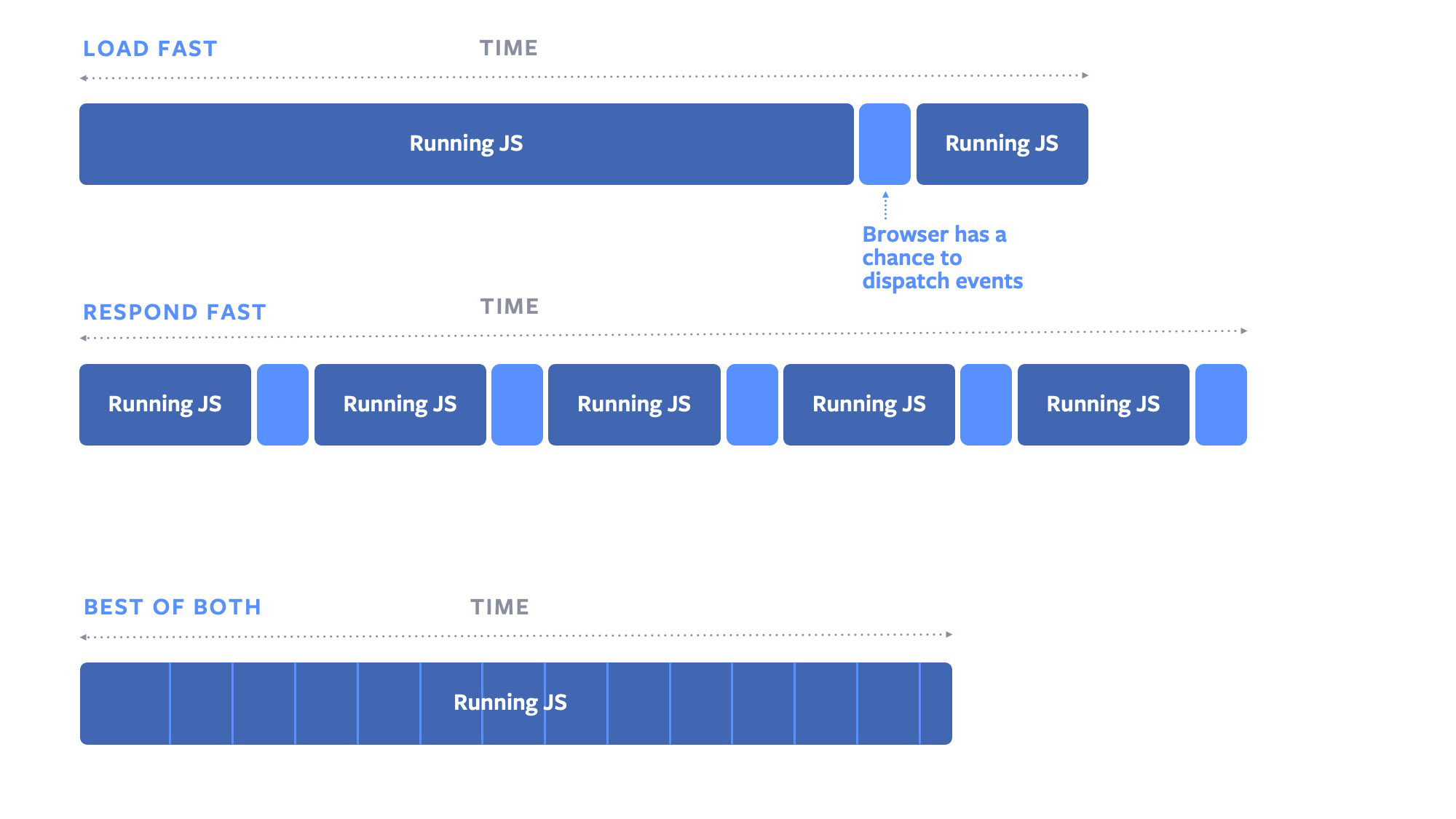
Typically, a browser’s JavaScript engine handles how code is executed and when it will halt for a moment to see if there are any pending input events that it needs to react to. Because even modern JavaScript engines that run on multi-core machines are still essentially single-threaded, the engine can only really do one thing at a time, so the trick is to figure out how to best combine code execution with checking for input events.

“Like many other sites, we deal with this issue by breaking the JavaScript up into smaller blocks. While the page is loading, we run a bit of JavaScript, and then we yield and pass control back to the browser,” the Facebook team explains in today’s announcement. “The browser can then check its input event queue and see whether there is anything it needs to tell the page about. Then the browser can go back to running the JavaScript blocks as they get added.”

Every time the browser goes through that cycle, though, and checks for new events, processes them, a bit of extra time passes. You do this too many times, and loading the page slows down. But if you only check for inputs at slower intervals, the user experience degrades as the browser takes longer to react.

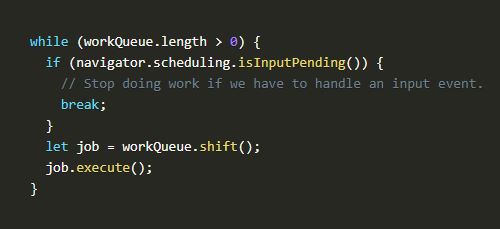
To fix this, Facebook’s engineers created the isInputPending API, which eliminates this tradeoff. The API, which Facebook also brought to the W3C Web Performance Working Group, allows developers to check whether there are any inputs pending while their code is executing.

With this, the code simply checks if there’s something to react to, without having to fully yield control back to the browser and then passing it back to the JavaScript engine.

For now this is just a trial — and since developers have to integrate this into their code, it’s not something that will automatically speed up your browser once Chrome 74 launches. If the trial is successful, though, chances are developers will make use of it (and Facebook surely will do so itself) and that other browser vendors will integrate into through own engines, too.

“The process of bringing isInputPending to Chrome represents a new method of developing web standards at Facebook,” the team says. “We hope to continue driving new APIs and to ramp up our contributions to open source web browsers. Down the road, we could potentially build this API directly into React’s concurrent mode so developers would get the API benefits out of the box. In addition, isInputPending is now part of a larger effort to build scheduling primitives into the web.”

22 Apr 2019

Down To Shop is a tongue-in-cheek mobile shopping network

Cyrus Summerlin and Max Hellerstin, who previously created the Push for Pizza app (which allowed users to order a pizza with the push of a button), are officially launching their new startup today, Down to Shop.

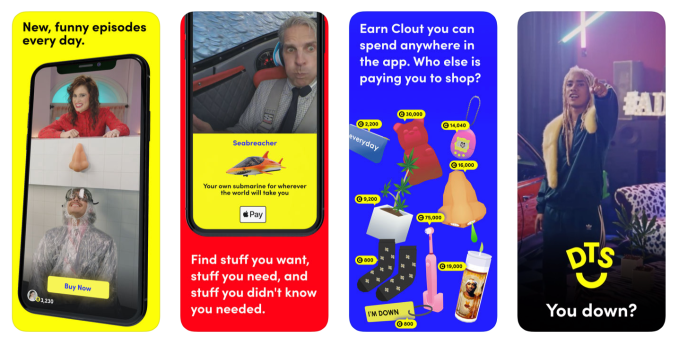
The app bills itself as both a modern reinvention of QVC and “the funnest way to shop.” It allows users to watch funny videos featuring products that can be purchased directly from the app.

In an email, Hellerstein said the pair created Down to Shop out of dissatisfaction with existing advertising and e-commerce. Summerlin described it as “a hypermedia commerce platform.”

“We’ve created a self aware, fun and entertaining, interactive environment that gets customers to engage with brands like never before — because they want to,” Summerlin said. “What a concept!”

To do this, Down to Shop says it has recruited a creative team of Upright Citizens Brigade alums and Instagram influencers like Wahlid Mohammad to star in its shows, which are written, filmed and edited in the startup’s Los Angeles studios. The content is built around four-week seasons, with daily episodes across five shows each season.

Down to Shop

You can actually download the iOS app now, then swipe through different videos and games. Judging from the videos available at launch, the app is holding true to its promise of “content first, advertising second,” with laidback, tongue-in-cheek shows that also happen to feature promoted products.

By playing games and watching videos, you also earn Clout, the in-app currency that be used to make purchases. As for the products available to purchase, the company says it’s already working with more than 60 brands, including Sustain Condoms, Dirty Lemon (water) and Pretty Litter (cat litter).

Down to Shop’s investors include Greycroft, Lerer Hippeau and Firstmark. The startup isn’t disclosing the size of its funding, but according a regulatory filing, it raised $5.9 million last fall.


22 Apr 2019

Tesla Autonomy day is here. Here’s how to watch

It’s a big week for Tesla and it’s kicking off April 22 with “Autonomy Investor Day.”

What is Autonomy Investor Day, you ask? The details are vague, but it’s supposed to be a demonstration that explains and showcases Tesla’s autonomous driving technology.

CEO Elon Musk put it a bit more dramatically when he tweeted earlier this month: “On April 22, Investor Autonomy Day, Tesla will free investors from the tyranny of having to drive their own car.”

Tesla will live stream the event, which is being held at its headquarters in Palo Alto, at 11 a.m. PT. at livestream.tesla.com. You can also watch it here on the Tesla YouTube channel.

Later this week, Tesla will report first quarter earnings April 24. The following day, is the deadline for Tesla and the Securities and Exchange Commission to report back to a judge on an escalating fight over Musk’s recent tweets, which allegedly violated an agreement between the two parties that was reached last year.

Like so many events surrounding Tesla, there is already drama attached to autonomy day. Tesla was granted a temporary restraining order Friday against a short seller and vocal Twitter critic who recently photographed a Model 3 that was being filmed ahead of the autonomy investor day.

PlainSite.org posted the restraining order, in which Tesla claims Randeep Hothi “stalked, harassed and endangered” employees driving in a Model 3 bearing manufacturer plates and mounted with camera equipment. Tesla claims the individual followed the vehicle for 35 minutes and at one point swerved so close to the vehicle that the side collision avoidance safety feature was triggered.

Tesla vehicles are not considered fully autonomous, or Level 4, a designation by SAE that means the car can handle all aspects of driving in certain conditions without human intervention.

Instead, Tesla vehicles are “Level 2,” a more advanced driver assistance system than most other vehicles on the road today. Musk has promised that the advanced driver assistance capabilities on Tesla vehicles will continue to improve until eventually reaching that full automation high-water mark.

Tesla offers two different advanced driver assistance packages to customers: Autopilot and Full Self-Driving. Autopilot is ADAS that offers a combination of adaptive cruise control and lane steering and is now a standard feature on new cars. The price of vehicles has been adjusted higher to reflect the addition of Autopilot as a standard feature.

Full Self-Driving, or FSD, costs an additional $5,000. FSD includes Summon as well as Navigate on Autopilot, an active guidance system that navigates a car from a highway on-ramp to off-ramp, including interchanges and making lane changes. Once drivers enter a destination into the navigation system, they can enable “Navigate on Autopilot” for that trip.

Tesla continues to improve Navigate on Autopilot and the broader FSD system through over-the-air software updates. The company says on its website that FSD will soon be able to recognize and respond to traffic lights and stop signs and automatically driving on city streets. 

22 Apr 2019

Beyond Meat files for a public offering

Beyond Meat, the meat replacement company whose packages of Beyond Burgers line grocery store aisles across America, has filed for an initial public offering.

The company is looking to raise roughly $200 million in the stock sale for its portfolio of burger, chicken and sausage replacements, selling 8.75 million shares of common stock at an upper limit of $21 per share that would value Beyond Meat at more than $1 billion.

The Los Angeles-based company’s public offering should be a nice windfall for the Chicago-based investors DNS Capital, an investment firm managing the private wealth of the Pritzker family, and Cleveland Avenue, founded by former McDonald’s executive Don Thompson; as well as the venture capital firms Kleiner Perkins and Obvious Ventures.

Another winner from the Beyond Meat public offering is the corporate investment arm of Tyson Foods . The meat processor and marketer invested in Beyond Meat back in 2016.

All told, Beyond Meat has raised $122 million from investors, including Obvious Ventures, Kleiner Perkins, Cleveland Avenue, DNS Capital, Tyson Ventures, Bill Gates, S2G Ventures and a whole host of other firms, according to Crunchbase.

While Beyond Meat has increased its revenues steadily — from $16.2 million when it began selling its wares in 2016 to $87.9 million in 2018 — the company is still a loss-generating machine. Its operations were in the red to the tune of $29.9 million in 2018, down from $30.4 million a year earlier.

With the public offering, Beyond Meat becomes the first venture-backed meat replacement company to list its shares, but there are other startups waiting to follow suit. Impossible Burger is another well-financed startup making burger alternatives, as is the current king of animal-free condiments, Just, which is looking at lab-grown meat on its product roadmap.

Supporting all of this investment activity is the potential to carve out a huge chunk of the $270 billion consumers spent on meat in the U.S. in 2017 alone. Globally, consumers bought $1.4 trillion of meat, according to data from Fitch Solutions Macro Research cited by the company.

Meanwhile, consumption of plant-based meat replacements in the U.S. is growing at a steady clip. In the first half of 2018, Americans bought $670 million of meat replacement products, according to a Nielsen study commissioned by the Plant Based Food Association.
22 Apr 2019

Audioburst raises $10M to build A.I.-powered infotainment systems for cars, ad solutions

Audioburst, a startup that uses A.I. technology to extract the best bits from podcasts and talk radio to create new listening experiences, has raised an additional $10 million in strategic funding from Dentsu and Hyundai Motor Company. The new round is focused on helping Audioburst further expand into advertising and in vehicles. It also precedes the company’s planned launch into Japan at the end of 2019.

Dentsu and Hyundai join Audioburst’s other strategic investors, Samsung Ventures, Nippon Broadcasting, and Advanced Media, Inc., and bring the company’s total raise to date to $25 million.

The startup today ingests and indexes millions of audio segments per day then uses A.I. technology — including Automatic Speech Recognition and Natural Language Understanding — to create products like a searchable library of audio, personalized audio feeds and news briefs, notifications, and more.

Through an API, partners can integrate Audioburst’s personalized feeds into their own smart speakers, mobile, in-car infotainment systems, and other products.

The investment from the international ad agency Dentsu, headquartered in Tokyo, will see the company working with Audioburst to create a market for personalized audio in Japan. Brands will leverage the technology to target listeners with more personalized ads, based on an improved understanding of customers’ interests.

“Personalized advertising in the radio space has been limited to-date. In addition, the emergence of voice-activated services and audio content have provided a rapidly growing advertising opportunity for our clients,” noted Hideki Ishibashi, Managing Director of Dentsu Innovation Initiative, in a statement.

Audioburst is not alone in working to create personalized listening experiences as a channel for advertising — Spotify, for example, is doing this with music. And this year, it even opened up its flagship product, the personalized Discover Weekly playlist, to brand sponsorships. Pandora also lets advertisers personalize their messages by leveraging listener data. And as podcasts have become a new priority for streaming services like this, ad personalization will follow as listeners stream more non-music audio.

Meanwhile, Audioburst will work with Hyundai — who contributed half ($5M) of the $10M investment — to develop a new in-car infotainment system that includes a personalized audio search experience and playlists that customers can access via voice commands.

“At Hyundai, our mission is to have our cars connected by 2020 and provide our customers with the best possible in-car experience,” said Dr. Yun-seong Hwang, Vice President of Hyundai Motor Company. “Partnering and investing in Audioburst ensures we will lead the charge in a data-driven first class audio experience.”

Hyundai’s investment follows a December 2018 Audioburst partnership with LGE, which focused on building new infotainment systems for automakers. That deal was the first to use Audioburst’s Deep Analysis API, which adds an additional level of metadata categorization in order provide a more in-depth understanding of the content users searched for. The Hyundai deal will now leverage this API, as well.

Audioburst also has strategic partnerships with Bytedance, Bose, Harman, and more.

22 Apr 2019

Samsung reportedly pushes back Galaxy Fold launch

Can’t say we didn’t see this coming. Four days out from the Galaxy Fold’s official launch date, Samsung is pushing things back a bit, according to a report from The Wall Street Journal that cites “people familiar with the matter.”

There’s no firm timeframe for the launch, though the phone is still expected “in the coming weeks,” at some point in May. We’ve reached out to Samsung for comment and will update accordingly. When a number a reviewers reported malfunctioning displays among an extremely small sample size, that no doubt gave the company pause.

I’ve not experienced any issues with my own device yet, but this sort of thing can’t be ignored. Samsung’s initial response seemed aimed at mitigating pushback, writing, “A limited number of early Galaxy Fold samples were provided to media for review. We have received a few reports regarding the main display on the samples provided. We will thoroughly inspect these units in person to determine the cause of the matter.”

It also went on to note that the problems may have stemmed from users attempting to peel back a “protective layer.” Things took a turn to the more cautious over the weekend, however, when it was reported that the phone’s launch events in parts of Asia would be delayed (we reached out about that, as well, but haven’t heard back). Since then, a larger delay has seemed all but inevitable.

22 Apr 2019

SiriusXM’s new streaming-only ‘Essential’ plan targets smart speaker owners

Last week, Amazon and Google rolled out free music streaming services to cater to the growing base of smart speaker owners. Now, SiriusXM is going after this market, too. The company has launched a new plan called SiriusXM Essential which targets those who listen in-home and on mobile devices, but not in cars. The streaming-only plan is also more affordable — $8 per month, versus the $15.99 per month (and up) plans for SiriusXM’s satellite radio service for cars.

With a subscription to Essential, customers can stream to in-home devices including Amazon Alexa, Amazon Fire TV, Chromecast, Apple TV, Roku, Sonos speakers, Xbox, Sony PlayStation and others, as well as to phones, tablets, and desktops.

The plan offers SiriusXM’s full lineup of over 300 channels, including 200+ channels of commercial-free music stations, and its new Pandora NOW station. There are also 100+ of the newer SiriusXM Xtra channels that offer more music and the ability to skip through songs. Beyond music, listeners can access sport talk channels, as well as entertainment, news and comedy stations.

“The strength of SiriusXM’s programming is evident in the tens of millions of people who subscribe and listen in their cars year after year. We’ve now created the Essential subscription as an appealing option for the many people, particularly younger consumers, who don’t have a car or don’t spend a lot of time in their car,” said Matt Epstein, Vice President of Marketing, SiriusXM Outside the Car, in a statement. “The Essential plan offers an attractive bundle of content at a competitively low price among streaming services,” he added.

The launch comes at a time when several markets are adjusting to better serve a younger demographic that often lives more urban, and doesn’t own a car — or waits until later in life to get one, having also delayed things like marriage, home ownership, and starting a family. That cuts into SiriusXM’s core business of offering in-car subscription radio.

The new plan also arrives just as smart speaker ownership has hit critical mass in the U.S. That’s led to increased competition from streaming music providers, who have now launched entry-level free services to reach listeners in the home. Amazon and Google, for instance, both launched ad-supported free music services last week for their respective smart speakers — the Amazon Echo and Google Home. These free tiers serve as funnels to the companies’ premium, paid subscriptions. Similarly, SiriusXM’s lower-cost subscription plan could later send its users over to pricier plans, if they later on do acquire a vehicle.

But it also caters to those who want a more radio-like experience, with news, sports, and entertainment, not just music; plus always-on streams of curated music, not playlists programmed by A.I.

SiriusXM Essential is $1 per month for three months before converting to the full price of $8 per month.

22 Apr 2019

A hotspot finder app exposed 2 million Wi-Fi network passwords

A popular hotspot finder app for Android exposed the Wi-Fi network passwords for more than two million networks.

The app, downloaded by thousands of users, allowed anyone to search for Wi-Fi networks in their nearby area. The app allows the user to upload Wi-Fi network passwords from their devices to its database for others to use.

But that database of more than two million network passwords, however, was left exposed and unprotected, allowing anyone to access and download the contents in bulk.

Sanyam Jain, a security researcher and a member of the GDI Foundation, found the database and reported the findings to TechCrunch.

We spent more than two weeks trying to contact the developer, believed to be based in China, to no avail. Eventually we contacted the host, DigitalOcean, which took the database down within a day of reaching out.

“We notified the user and have taken the hosting the exposed database offline,” a spokesperson told TechCrunch.

Each record contained the Wi-Fi network name, its precise geolocation, its basic service set identifier (BSSID), and network password stored in plaintext.

Although the app developer claims the app only provides passwords for public hotspots, a review of the data showed countless home Wi-Fi networks. The exposed data didn’t include contact information for any of the Wi-Fi network owners, but the geolocation of each Wi-Fi network correlated on a map often included networks in wholly residential areas or where no discernible businesses exist.

The app doesn’t require users to obtain the permission from the network owner, exposing Wi-Fi networks to unauthorized access. With access to a network, an attacker may be able to modify router settings to point unsuspecting users to malicious websites by changing the DNS server, a vital system used to convert web addresses into the IP addresses used to locate web servers on the internet. When on a network, an attacker can also read the unencrypted traffic that goes across the wireless network, allowing them to steal passwords and secrets.

Tens of thousands of the exposed Wi-Fi passwords are for networks based in the U.S.

22 Apr 2019

Corporations and private investors are backing new “green” deals as climate worries mount

In the nine years since private equity and venture capital investments into sustainable technologies last crossed the $6 billion threshold, the problems caused by global carbon emissions have only intensified.

Now, as the world confronts the reality that there’s not much time left to reverse course on carbon emissions and the impact they will have on life on earth, both corporate and private investors are once again stepping up their commitments to startups in the space.

In 2018 global venture capital investment into startups focused on sustainability jumped 127% to $9.2 billion, the highest since 2010, according to a January report from Bloomberg New Energy Finance. Powering that boost was a $1.1 billion investment in the smart window maker, View, and another $795 million for Chinese electric vehicle firm Youxia Motors. In fact, there were no fewer than eight VC/PE financings of Chinese EV specialist companies in 2018, totaling some $3.3 billion.

That stark assessment is coming from more corners of the scientific community and the reality of the danger is being emphasized by politicians and concerned citizens around the globe.

The simple truth is that things are getting worse. And for the past two years, emissions have been increasing as countries continue to use oil and gas and coal to fuel economic growth, even as the global community realizes that carbon emissions are an increasing threat.

A recent assessment by the U.S. government put the cost of climate change caused by carbon emissions at $500 billion annually by the end of the century. And the financial toll doesn’t begin to assess the cost to the quality of human life and the potential lives that will be lost because of climate-related disasters.

This isn’t the first time that the world has realized the threat climate change poses. It’s not even the second. Back in 1979 — and throughout the next decade —  the U.S. grappled with how to craft an appropriate response to the coming climate-related crisis. Perhaps unsurprisingly, the government failed, and the issue of imminent climate disaster was set aside.

Former Vice President Al Gore, picked up the thread in the mid-2000s in the wake of his defeat in the contested 2000 Presidential election by the Connecticut yankee turned Texas oilman George W. Bush. Through advocacy work and the popular climate-focused documentary “An Inconvenient Truth”, Gore was able to proselytize among a group of technocrats looking for the next big thing in the wake of the Internet explosion that had transformed professional and personal lives.

Venture capital investors flocked to invest in renewable technologies — from biofuels to new solar energy generating technologies to new battery chemistries and beyond.

Over the next seven years billion dollar companies would rise and fall on the back of speculative investment in the promise of a cleaner energy future that would disrupt the oil industry and turn billionaires into multi-billionaires — all while saving the world.

It didn’t work out.

Problems with scaling technologies beyond a controlled laboratory setting; global economic pressures wrought by an explosion of manufacturing capacity in countries like China; and the hubris of investors who thought that their investment acumen in picking winners of the information age could work just as well in centuries-old industries like oil and gas, or electricity, found themselves floundering in complicated, regulated markets with deep-pocketed incumbents and entrenched interests in promoting the status quo.

In the process investors lost hundreds of millions of dollars in the U.S. alone and destabilized some of the oldest firms in the investment industry.

Now, companies and investors are returning to the market in a major way. Some of the largest businesses in teh food and agriculture industry are investing in new companies that are developing protein replacements and novel cultivation technologies; utilities are investing more heavily in smart grid technologies as electrification and microgrids become more real; automakers and battery manufacturers are backing new energy storage technologies; and frontier investors are backing companies tackling everything from biologically based chemical manufacturing to new construction technologies for smart homes and cities, to new kinds of nuclear power that could transform how the world conceives of energy abundance (along with geo-engineering tech to remove carbon from the atmosphere).

“In the last few years, the number of technologies ripe for investment has expanded dramatically,” Ravi Manghani, research director for energy storage at Wood Mackenzie, an energy research and consultancy firm, told CNBC in March. “It’s no longer just three or four technology verticals.”

While none of these technological advancements are a guaranteed solution to the threats carbon emissions pose, or are surefire commercially viable businesses, the fact that investors are once again looking at sustainability as a viable investment thesis — capable of producing multiple billion dollar businesses is a good step forward.

Any plan to address decarbonization has to confront industries as diverse as agriculture, construction, transportation, chemicals and consumer goods from clothes to chemicals.

Failure to confront these challenges would be catastrophic. Even if global warming is restricted to just the 2 degree Celsius target set at the Paris climate agreement, that could mean the extinction of the world’s tropical reefs and several meters of sea-level rise, as The New York Times reported last August. Already the impacts of climate change have meant tens of billions of dollars in damage for the U.S. in 2018 alone.

“The era of incrementalism on climate change is over,” said Massachusetts Senator Ed Markey, one of the architects of the “Green New Deal” legislation, in an interview with Vox. “We are now in the era of the Green New Deal. It’s not going away. It is creating an incentive for governors to do more, for mayors to do more, for companies to do more. The polling says it has political legs that will drive it right into the election of 2020, and when that cycle is done, I think we’re going to see a much greater capacity for us to take the kind of action that we need.”


22 Apr 2019

Tencent’s latest investment is an app that teaches grannies in China to dance

Besides churning out video games for China’s young generations, Tencent has also been attuned to the need of silver-haired users: its latest bet is an app that teaches middle-age and elderly users, most of whom are female, how to dance.

Called Tangdou, or “sugar beans” in Chinese, the app announced on Monday that it’s raised a Series C funding round led by Tencent with participation from existing investors GGV Capital and Xiaomi founder Lei Jun’s Shunwei Capital, as well as IDG Capital.

The financial infusion makes for an interesting move for Tencent, whose WeChat messenger counts users over the age of 55 as its fastest-growing group. In fact, Tangdou has piggybacked off WeChat to acquire users by creating lite-apps that are designed for ease of use and run within the ubiquitous chatting tool, which is many senior users’ first taste of the internet.

While Tangdou did not disclose the size of the round, the new proceeds brought its total funds raised to date to nearly $100 million. It last inked $15 million (in Chinese) from a Series B funding round in 2016 and another $5 million from a B-plus round in 2017.

“As [China’s] mobile internet enters the ‘second half’ of its development phase, the markets for maternal and child care, middle-age and elderly users have become the new red-hot verticals,” said GGV’s managing partner Jenny Lee in a statement.

Of China’s 829 million online users, 12.5 percent were above 50 years old in 2018, up from 10.4 percent in the year-earlier period, according to data collected by the government-run China Internet Network Information Center.

tangdou

Screenshots of the Tangdou app / Source: Tangdou

Clad in color-coordinated costumes, the so-called demographic of “square-dancing aunties,” a term that sometimes carries derogatory color for the dancers are lashed for blasting deafening music, shimmy in parks, squares and when public space is in short supply, on sidewalks. Dancing in the public is now a daily routine for hundreds of millions of female retirees in China, a phenomenon that’s fueling an emerging market, and Tangdou is one of the players who got in early.

Founded four years ago, Tangdou began by offering video tutorials that teach grannies and aunties how to dance but has over time morphed into a one-stop app fulfilling news reading, networking and other needs for its senior users. The app’s content now touches on a wide variety of topics, from fashion, food, health to skin care, and it’s dabbled offline to host meetups for those craving a sense of camaraderie.

All told, the company claims it serves 200 million users across its range of products. More than 4,000 offline events take place each month attracting over 500 thousand attendees. 400 thousand users consume videos and articles on the Tangdou app each month and spend an average of 33 minutes on it every day. That level of user loyalty makes Tangdou an ideal destination for advertising, which is indeed one of the company’s major revenue sources. Tangdou is also mulling an ecommerce business and other forms of offline services, including dance classes and tours for its dance enthusiasts.