Category: UNCATEGORIZED

22 Apr 2019

Go-Jek brings in Misfit co-founder and ex-Facebook head to lead Vietnam business

Ambitious ride-hailing startup Go-Jek’s Southeast Asia expansion plan suffered a blow when it lost the leadership team behind its business in Vietnam, but now it has replaced them with the former head of Facebook in the country.

Christy Trang Le, who led Facebook’s business in Vietnam for nine months before quitting for family reasons in early 2019, has become general manager of Go-Viet, which is the name of Go-Jek business in the country. Le is best known as a co-founder of Misfit, the U.S-Vietnam wearable startup that was acquired by Fossil for $260 million in 2015 — indeed, Misfit CEO Sonny Vu is her husband.

Le, who was previously CFO/COO of Misfit before becoming head of Fossil Vietnam, replaces Nguyen Vu Duc and Nguyen Bao Linh who left their positions as general director and deputy general director, respectively, at the end of March. Go-Jek said that the duo are staying on as “advisors” but their exit sparked suggestions that Go-Jek’s expansion to Vietnam, the first market it moved into beyond its Indonesia homeland, isn’t going as well as had been assumed.

Go-Jek is valued at $9.5 billion and it has also expanded to Thailand and Singapore with the Philippines in its plans. The startup has been pretty boastful of the apparent market share it has picked up in Vietnam, where $14 billion-valued Grab is its main competitor. Go-Jek said in February that it estimated it had gained 40 percent of the two-wheeled taxi market within three months of its launch in August and that its food service became “the leading player among comparable food delivery services.”

Go-Jek said in a statement today that Go-Viet has “completed millions of trips” and is growing 50 percent per month.

Take all those numbers with a pinch of salt since it isn’t clear where the figures originate from and Go-Jek is in ‘fundraising mode’ right now. Even giving it the benefit of the doubt, any market share it gained on arrival would likely be down to the generous subsidies that are typically dolled out when a new company comes to town.

Still, bringing in a new leader — and one with the background of Le — looks like a coup, although her role building out Go-Viet’s on-demand business will be quite different from that of anchoring Facebook or running Misfit/Fossil.

“I’ve seen how the success of Go-Jek’s multi-service platform has transformed the lives of so many people in Indonesia and want to see the same happen in Vietnam,” Le said in a statement.

22 Apr 2019

Confirmed: Pax Labs raises $420 million at a valuation of $1.7 billion

Pax Labs, the popular vape maker, has today confirmed the close of a $420 million equity round, including from existing investors Tiger Global Management and Tao Capital Partners, and new investors including Prescott General Partners.

A Pax Labs spokesperson confirmed to TechCrunch that the post-money valuation for Pax Labs is $1.7 billion.

The Information first reported the round but we’ve confirmed the specific details, including funding amount and valuation.

Pax Labs launched in 2007 with the hopes of creating a cannabis vaporizer. Since, the company has created vaporizers for just about every corner of the space, including the PAX Era for concentrates and the PAX 3 for flower.

Here’s what CEO Bharat Vasan said in a prepared statement:

PAX is investing heavily in growing its brand as well as developing innovative new products to scale and capture an enormous opportunity. This financing round allows us to invest in new products and new markets, including international growth in markets like Canada and exploring opportunities in hemp-based CBD extracts. We aspire to be the gold standard for safety and good stewards of a product that enhances many people’s lives. We are hiring and investing heavily in our people, who power PAX’s mission of establishing cannabis as a force for good.

It’s worth noting that Juul, the popular e-cigarette brand, and Pax Labs used to live under the same corporate umbrella before Pax Labs spun out of Juul in 2017.

Looking forward, Pax has plans to give users more insight into taking the guesswork out of cannabis. As cannabis becomes legal in more areas, the demographic seeking products in the space continues to grow. Pax wants to help, and believes it can do so through a combination of hardware and software, though Vasan wasn’t willing to go into details on the company’s forthcoming products and features.

“People know about different kinds of alcohol,” said Vasan. “They may know that they’re a beer person or a wine person. But none of that exists within cannabis. They see names like ‘Lemon Haze’ and ‘Cherry Fizz’ and they don’t know what that is. These are all really awesome names for a band but not great to let you know what you’re consuming. We want to provide more clarity around what that means.”

As I said, Vasan was not keen on offering more, but this sounds like more of a data play than a combo software/hardware play, which leads me to believe that we may see an acquisition in Pax Labs’ future. (To be clear, this fictional acquisition is based strictly on my conjecture and not based on any evidence at all.)

“Our biggest challenge is safe consumer access,” said Vasan. “Regulation is a good thing in this space. It makes standards higher and products more transparent.”

22 Apr 2019

Huawei says it shipped 59M smartphones in Q1 as revenue jumped 39% to $27B

Fresh from an $8.8 billion profit last year, much-maligned Chinese tech giant Huawei is touting yet more growth. The firm said today that revenue in the first quarter of 2019 grew 39 percent year-on-year to reach $26.78 billion, or 179.7 billion CNY.

The company claims it is owned by its employees — although a recent academic paper challenged that. While it isn’t listed publicly, it declares quarterly and yearly business figures, the latter of which is audited by KPMG.

For Q1, Huawei didn’t reveal a net profit but it said that its net profit margin was eight percent which is “slightly higher” than the same time in the previous year. During the quarter, Huawei said it shipped 59 million smartphones while it added that, as of the end of March, it had signed 40 commercial 5G contracts and shipped over 70,000 base stations to support 5G networks worldwide.

That’s about all it is saying about its top end figures. You can refer back to those 2018 numbers to get an idea of where the company is headed, in short: further into the consumer device space.

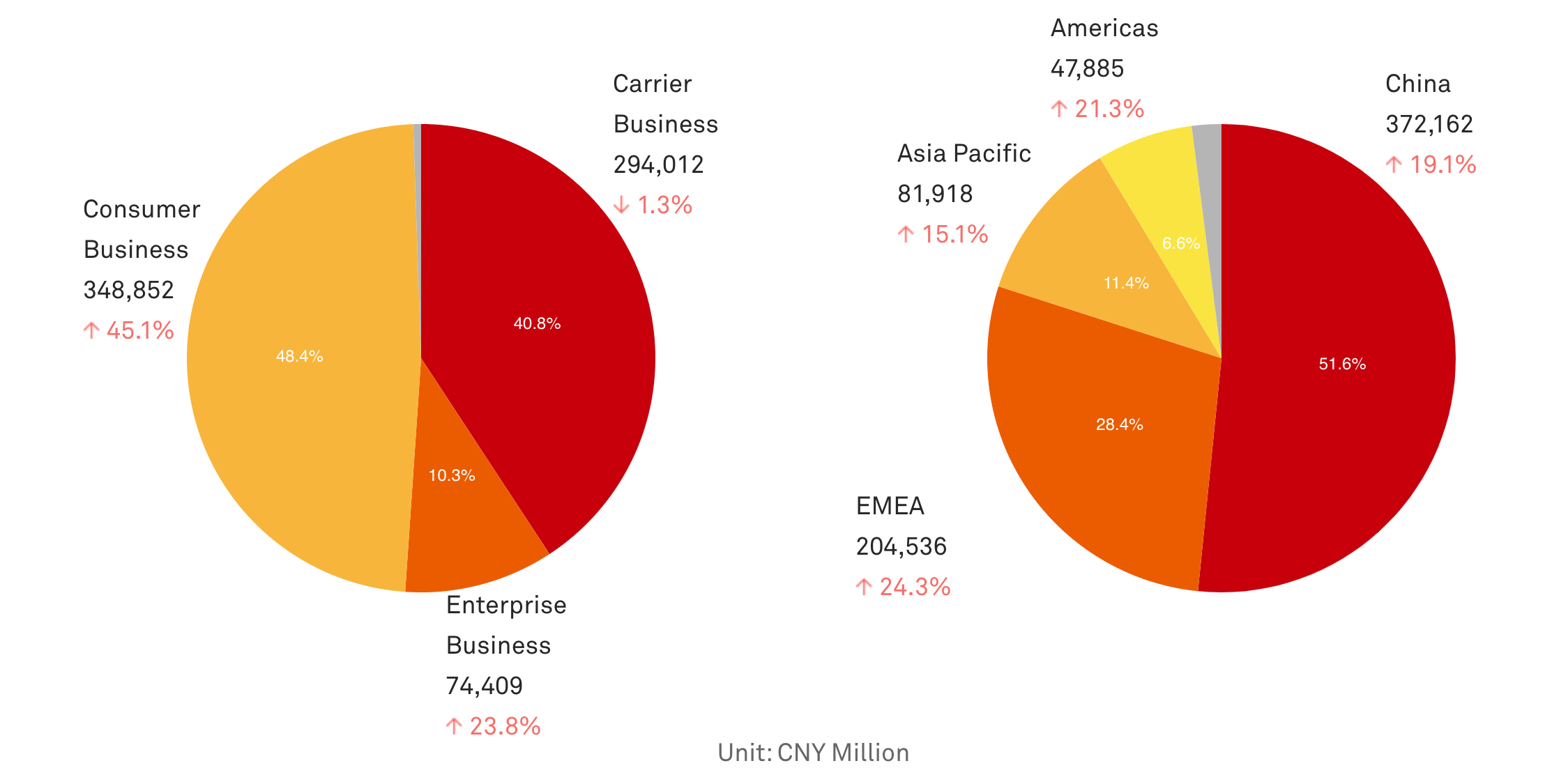
Huawei’s annual revenue increased by 19.5 percent year-on-year to 721 billion CNY, or $107.4 billion, in 2018 as smartphones and other devices became its largest source of income.

Huawei said revenue from the consumer business rose by 45 percent to reach 349 billion CNY ($52 billion), while sales from its carrier business dropped 1.3 percent to 294 billion CNY, or $43.8 billion. Enterprise services accounted for the remaining 74.4 billion CNY.

Huawei’s end of year financials show its consumer devices business is now its main money-maker

That consumer push isn’t a huge surprise given the hostility to Huawei’s traditional networking and carrier business from the U.S. and other Western governments.

Still, the Chinese company has fought back against a ban on its equipment in the U.S. through a lawsuit arguing that federal agencies and contractors have violated due process and acted in a way that is unconstitutional. Still, the U.S. concern around national security has been fortified by a recent U.K. government report claimed there are “significant technical issues” around adopting its telecom network kit.

The report, prepared for the National Security Advisor of the U.K. by the Huawei Cyber Security Evaluation Centre (HCSEC) Oversight Board, said it has “not yet seen anything to give it confidence in Huawei’s capacity to successfully complete the elements of its transformation programme that it has proposed as a means of addressing these underlying defects.”

22 Apr 2019

Sony launches a taxi-hailing app to rival Uber in Tokyo

Sony last year announced it would enter Japan’s taxi-hailing space and, good to its word, the electronics giant has kicked off its S.Ride service in Tokyo.

The service — which was first noted by CNET — is a joint venture between Sony, its payment services subsidiary and five licensed taxi companies. Since ride-hailing with civilian cars is illegal in Japan, the service will focus on connecting licensed taxis with passengers. The electronics giant previously played up its use of AI to match supply and demand and, on the payment side, it supports QR scans as well as Uber-style cash-less credit card.

All together, S.Ride claims to cover 10,000 licensed taxis in Tokyo. Its largest competition is JapanTaxi, a venture from the taxi industry that’s backed by Toyota among others, which claims 50,000 vehicles across Japan as a whole. Other rivals include chat app Line, which has offered taxi-hailing for years, Uber, which has been working on striking deals with taxi operators, and China’s Didi Chuxing, which operates a joint-venture with Uber investor SoftBank. Lyft has expressed an interest in Japan, where its investor Rakuten is a major name, but it has not expanded there yet.

A Sony spokesperson told CNET that there are no plans to launch S.Ride overseas so we can file this in the ‘only in Japan’ file.

22 Apr 2019

Resurgent HappyFresh raises $20M for its online grocery service in Southeast Asia

It’s been a tricky past few years for HappyFresh, the startup seeking to bring Instacart-like grocery deliveries to Southeast Asia. It’s been through a series of rebuilding measures, but there’s light at the end of the tunnel after it announced a $20 million Series C.

Launched in 2015, HappyFresh quickly raised $12 million to expand its vision of digital deliveries across Southeast Asia. In late 2016, however, the tough economics of its business saw it pull out of two markets, as it raised an undisclosed Series B. It then started 2017 with a new CEO and an effort to become financially sustainable.

Today, the service is active in Indonesia, Thailand and the Philippines where it works with supermarkets and other retailers to let customers order groceries online. Same-day delivery is provided by HappyFresh staff — the target is a one-hour window and the process is handled via its website and mobile apps.

HappyFresh has been pretty quiet of late but today it piped up to disclose its Series C, which is led by the Mirae Asset-Naver Asia Growth Fund — a joint fund between South Korean financial firm Mirae and Line parent Naver — with participation from Line Ventures, Singha Ventures from Thailand and Grab Ventures, the investment arm of ride-hailing giant Grab. Other investors include Samena Capital from the Middle East, Vertex Ventures, Sinar Mas Digital Ventures (SMDV), 500 Startups and BeeNext.

Grab’s investment came last year — after HappyFresh joined as its inaugural platform partner — and HappyFresh CEO Guillem Segarra said the company decided to “opportunistically put a round together” since it had interest from others.

“Our vision has always been to be in every single household in Southeast Asia and to democratize grocery delivery,” Segarra told TechCrunch in an interview. “I believe that over the next five years, the grocery industry will change more than last 50 and that’s driven by data and e-commerce.”

Specifically, he said that the company plans to use the new capital to double down on technology, which includes increased personalization for customers when they are shopping as well as more efficient logistics. Segarra also revealed that there are plans to kick back into expansion mode, albeit in a different way to how HappyFresh launched new markets in the past.

“When we look at expansion, we’re going to be very careful and go to those cities where we feel there’s a long-term profitability path [while we are also] making sure that before we go there we understand the appetite for our service,” he explained.

“Now it’s a very market-driven approach [to expansion] rather than to just put a flag on the map… you’ll see small rollouts into markets that make sense, we’re not in a rush,” he added.

Indeed, Segarra claimed that the company is already profitable in the markets that it operates in. Aside from initial cost-cutting, Segarra explained that the new focus on sustainability has come from focusing not only on technology and the retailers that HappyFresh works with, but also front end partners, like Grab, that help create demand for its service among consumers.

“We learned a lot [from the past retrenchment and] for the last two years we focused on our core markets. You have to have the right set of partners, that’s from supermarkets to the top funnel that brings you traffic. We believe we have the right set of partners at the top of the funnel [and we will] go to new markets when we have enough firepower for the long run,” he explained.

HappyFresh’s funding comes at a time of crisis for its nearest rival HonestBee. Tech In Asia reports that the startup has “temporarily suspended” its Philipinnes business and made layoffs in the country, Indonesia and Thailand. In total, the startup is said to have laid off 50-70 of its estimated 1,000 employees while top executives have quit the company in recent months.

Unlike HappyFresh, HonestBee is active across eight countries and it has expanded to takeout food. The company also has a physical store located in Singapore that’s inspired by the efforts of Alibaba and JD.com in China.

22 Apr 2019

China’s new gaming rules to ban poker, blood and imperial schemes

Lots of news has surfaced from China’s gaming industry in recent weeks as the government hastens to approve a massive backlog of titles in the world’s largest market for video games.

Last Friday, the country’s State Administration of Press and Publication, the freshly minted gaming authority born from a months-long reshuffle last year that led to an approval blackout, enshrined a new set of guidelines for publication that are set to move some to joy and others to sorrow.

On April 22, China finally resumed the approval process to license new games for monetization. Licensing got back on track in December but Reuters reported in February that the government stopped accepting new submissions due to a mounting pile of applications.

The bad news: The number of games allowed onto the market annually will be capped, and some genres of games will no longer be eligible. Mahjong and poker games are taken off the approval list following a wave of earlier government crackdown over concerns that such titles may channel illegal gambling. These digital forms of traditional leisure activities are immensely popular for studios for they are relatively cheap to make and bear lucrative fruit. According to video game researcher Niko Partners, 37 percent of the 8,561 games approved in 2017 were poker and mahjong titles.

While the new rule is set to wipe out hundreds of small developers focused on the genre, it may only have a limited impact on the entrenched players as the restriction applies only to new applicants.

“It won’t affect us much because we are early to the market and have accumulated a big collection of licenses,” marketing manager for one of China’s biggest online poker and mahjong games publisher told TechCrunch.

China will also stop approving certain games inspired by its imperial past, including “gongdou”, which directly translates to harem scheming, as well as “guandou”, the word for palace official competition. The life inside palaces has inspired blockbuster TV series such as the Story of Yanxi Palace, an in-house production from China’s Netflix equivalent iQiyi . But these plots also touch a nerve with Chinese officials who worry about “obscene contents and the risk of political metaphors,” Daniel Ahmad, senior analyst at Nikos Partners, suggested to TechCrunch.

china games

Screenshots of Xi Fei Zhuan, a mobile game that lets users play the role of harems to win love from the emperor. Image source: Superjoy Interactive Games

Games that contain images of corpses and blood will also be rejected. Developers previously modified blood color to green to circumvent restrictions, but the renewed guidelines have effectively ruled out any color variations of blood.

“Chinese games developers are used to arbitrary regulations. They are quick at devising methods to circumvent requirements,” a Guangzhou-based indie games developer told TechCrunch.

That may only work out for companies armed with sufficient developing capabilities and resources to counter new policies. For instance, Tencent was quick to implement an anti-addiction system for underage users before the practice became an industry-wide norm as of late.

“Many smaller publishers will have a harder time under this new set of regulations, which will require them to spend extra time and money to ensure games are up to code,” suggested Ahmad. “We’ve already seen that many smaller publishers were unable to survive the temporary game license approval freeze last year and we expect to see further consolidation of the market this year.”

China has over the past year taken aim at the gaming industry over concerns related to gaming addiction among minors and illegal content, such as those that promote violence or deviate from the government’s ideologies. To enforce the growing list of requirements, an Online Game Ethics Committee launched in December under the guidance of the Publicity Department of the Chinese Communist Party to help the new gaming regulator to vet title submissions.

More than 1,000 games have been approved since China ended the gaming freeze in December, though Tencent, the dominant player in the market, has yet to receive the coveted license required for monetizing its hugely popular mobile title PlayerUnknown’s Battlegrounds.

Uncertain waters in the gaming industry have wiped billions of dollars off the giant’s market cap and prompted it to initiate a bigger push in such non-game segments as cloud computing and financial technologies. NetEase, the runner-up in China’s gaming market, reacted by trimming its staff to cut costs.

21 Apr 2019

What you missed in cybersecurity this week

It’s been a busy week — it’s tough to keep up with all the cybersecurity news. We’ve collected some of the biggest cybersecurity stories from the week — from TechCrunch and afar — to keep you up to date with the latest hacks, privacy breaches and security stories you need to know.

Facebook now says its password leak affected ‘millions’ of Instagram users

TechCrunch: As all eyes were on attorney general William Barr giving his highly anticipated summary of the Mueller report out this week, Facebook was quietly updating a blog post it had published a month earlier, revising up the number of Instagram accounts affected by a years-long bug that stored passwords in plaintext. Facebook admitted that “millions” of accounts were affected and not “hundreds of thousands” as it had first estimated. It wasn’t a coincidence; it was a perfect opportunity for Facebook to bury bad news. CNN’s Donie O’Sullivan called it the “most cynical” thing Facebook has done since dropping its report detailing its role in a genocide in Myanmar the day before the U.S. midterm elections.

Utah bans police from searching digital data without a warrant

Forbes: Some good news for privacy advocates this week: a big Fourth Amendment loophole has been closed in the state of Utah. Previously, state law enforcement only required a subpoena to access someone’s digital content — including emails, pictures, video and audio — from internet and cloud providers. Now, following the introduction of HB 57, the Electronic Information or Data Privacy Act, police need a warrant based on probable cause. No more warrantless fishing expeditions allowed.

A mystery agent is doxing Iran’s hackers and dumping their code

Wired: Buried in the news this week was the startling revelation that someone — whose identity isn’t known — has begun spilling the secrets of an Iranian hacker group, known as OilRig or APT34, on a Telegram channel, according to Chronicle, Alphabet’s cybersecurity company. It would be a devastating breach of their operational security if true, only a couple of years after the Shadow Brokers stole and published highly classified hacking tools developed by the National Security Agency.

The Weather Channel knocked off the air for over an hour

Wall Street Journal: For over an hour on Thursday, The Weather Channel was brought offline by a ransomware attack. In a tweet, the channel said it restored its live programming after running through its backup systems. The FBI said it was investigating. It’s the latest ransomware incident hit a major company — from aluminum maker Norsk Hydro to drinks giant Arizona Beverages.

Mueller report: Hacked elections, encrypted messaging, troll farms and more

TechCrunch: After two years, the Special Counsel’s probe into Russian interference with the 2016 U.S. presidential election is over. TechCrunch covered the tech angles you need to know: from how Russian-backed hackers broke into the Hillary Clinton campaign, how the use encrypted messaging apps hindered the investigation, how successful Russia was in breaking into election systems, and what role its troll factory and disinformation had on the election.

FTC said to want to face-off with Mark Zuckerberg over privacy violations

Washington Post: Now more than ever, Facebook is under the watchful eye of the Federal Trade Commission. A report this week said the social media giant’s founder Mark Zuckerberg could also be in the agency’s crosshairs. It’s part of an ongoing effort to hold the company accountable since the Cambridge Analytica scandal, following which has been security incident after incident, amid claims of mismanaged consumer data and gross ethical violations.

Cybersecurity firm Verint hit by ransomware

ZDNet: Verint, a cybersecurity company, was also hit by ransomware this week. Described as an “extreme case of irony,” the company was forced to bring in a third-party security firm to handle the infection. It comes in the same week that Wipro, one of India’s largest outsourcing companies, was hit by hackers. The company initially denied the breach, but was challenged by the security reporter Brian Krebs — who broke the news — live on the company’s earnings conference days following the breach. Of course the call was recorded, forcing Wipro’s chief operating officer Bhanu Ballapuram to come clean.

Security flaw in French government messaging app exposed confidential conversations

TechCrunch: And finally, a security flaw was found in the French government’s own encrypted messaging app Tchap immediately after it launched. Security researcher Baptiste Robert created a user account — even though the service is restricted to government officials. The app, which uses the open-source Signal Protocol, inadvertently allowed access to non-government email addresses, exposing the app’s public channels.

21 Apr 2019

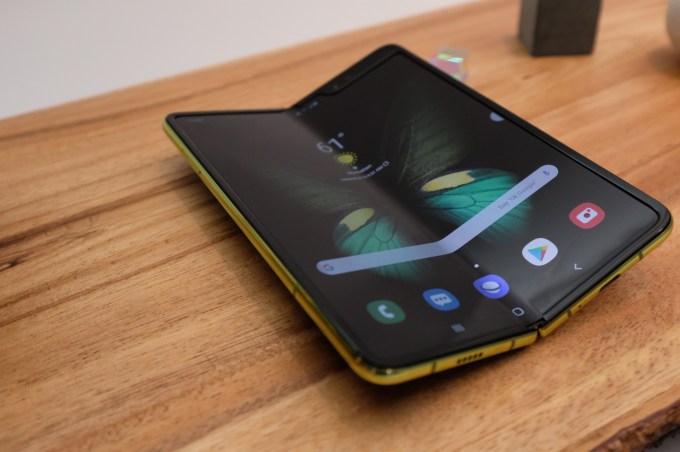
Notes from the Samsung Galaxy Fold: day six

I’m starting to get that thing where my iPhone XS screen feels super tiny when I switch back from the Fold to send a text message from my number. Someone recently asked me if I’m going to have trouble giving the device back to Samsung in a few days, and while the answer is a decided “not really,” the march toward even larger screens does feel inevitable — and I do believe folding phones will be an important part of that push.

Of course, I also believe that we’re as close as a generation or two out from this first shot on that foldable feeling pretty big and bulky (some folks who’ve seen the phone have already said as much about it). I’m back at the airport today, and both airline representatives and TSA agents (who see a LOT of phones as people are checking in) seem pretty impressed with it.

I had the phone standing up at a 45 degree angle on the bathroom sink this morning to watch the news as I brushed my teeth. That’s pretty neat. And If I’d had the forethought, I have loaded a couple of movies on it for the flight. It definitely beats the seatback screens on Delta.

In addition to the fingerprints on the outside, the inside gets like crazy dusty after any kind of use. And a lot of that collects in the little reservoir between the screen protector and the outside lip.

The top shot is from yesterday’s A’s game (the dark line along the seam is a shadow). You can use the front facing screen as a view finder while taking photos, but it’s pretty small. The inside, meanwhile, makes you feel like one of those people who use their iPads to take photos in public. Once you get over that, it’s a pretty nice way to view shots, though.

And no, it’s not broken yet. We’re still waiting for official word from Samsung about what happened there. The Fold is on track for an April 26 release here in the States, in spite of everything, and even as a China release appears be delayed.

Review soon.


21 Apr 2019

Sri Lanka blocks social media sites after deadly explosions

The government of Sri Lanka has temporarily blocked access to several social media services following deadly explosions that ripped through the country, killing at least 207 people and injuring hundreds more.

Eight bombings were reported, including during Easter services at three churches, on the holiest weekend of the Christian calendar.

In a brief statement, the Sri Lankan president’s secretary Udaya Seneviratne said the government has “decided to temporarily block social media sites including Facebook and Instagram,” in an effort to curb “false news reports.”

The government said the services will be restored once the investigations into the attacks had concluded.

Nalaka Gunawardene, a science writer and Sri Lankan native, confirmed in a tweet that Facebook-owned WhatsApp was also blocked in the country. Others reported that YouTube was inaccessible. But some said they were able to still use WhatsApp .

Spokespeople for Facebook and Google did not immediately comment.

It’s a rare but not unprecedented step for a government to block access to widely used sites and services. Although Sri Lanka’s move is ostensibly aimed at preventing the spread of false news, it’s likely to have an inhibiting effect on freedom of speech and efforts to communicate with loved ones.

Sri Lanka, like other emerging nations, has previously battled with misinformation. The government has complained that false news shared on Facebook has helped spread hatred and violence against the country’s Muslim minority. Other countries like India say encrypted messaging app WhatsApp has contributed to the spread of misinformation, prompting the social media company to add limits to how many groups a message can be sent to.

Iran and Turkey have also blocked access to social media sites in recent years amid protests and political unrest.

Sri Lanka’s prime minister Ranil Wickremesinghe has described the explosions as a terrorist incident.

21 Apr 2019

Week-in-Review: is Samsung unfolding another flop?

Stop me if you’ve heard this one before. Samsung tries to deliver a big innovation and fails miserably.

A big story this week on TechCrunch was that in the buildup to the release of the Samsung Galaxy Fold, potentially one of the weirdest, most innovative, most expensive phones shipped in the past decade, there are some signs that this could be a momentous failure. Samsung only sent out about a dozen review units to press outlets, and three of them seemed to fail for three distinct reasons.

Does this inspire much faith in the durability of the $1,980 hardware (which has already sold out in pre-orders)? Not quite.

“A limited number of early Galaxy Fold samples were provided to media for review. We have received a few reports regarding the main display on the samples provided. We will thoroughly inspect these units in person to determine the cause of the matter,” a Samsung spokesperson publicly detailed, responding to the issues.

Samsung Galaxy Fold

This nascent scandal may lead you to recall the Note 7 debacle, which earned Samsung what was perhaps the worst free advertising ever, with the FAA mandating just about every domestic flight begin with the pilot ensuring that the plane was Note 7-free. A phone spontaneously dying is a cake walk compared to a phablet bomb, but we’ll see whether this was just a big pre-release fluke and the consumer units prove more durable. That said, a failure rate of around 25 percent for models sent to journalists after a few days doesn’t inspire the greatest confidence.

Brian seemed to have some pretty nice things to say about his early time with the device —

Unfolding the Samsung Galaxy Fold:
Hands-on with the $2,000 foldable

I will say I did get a chance to fumble around with the Fold this week while our hardware editor Brian Heater was in town, and I personally found the device pretty inspiring. The screen on his still-functioning device is really quite beautiful and it all just feels like an innovative approach, even if it’s very first-gen at its heart.

Its good qualities all rely on the device continuing to function though, so I won’t get too complimentary until we get some further clarity on that.

apple vs qualcomm

Trends of the week

Here are a few big news items from big companies, with links to all the sweet, sweet added context.

  • Apple + Intel Qualcomm = best friends
    The two companies finally put aside their royalties and patent troll skirmishes, and various media reports suggest Apple’s mobile mea culpa was all about accepting Qualcomm’s command on 5G modems — something the iPhone giant really couldn’t afford to overlook. It was great news for Qualcomm, which had a major stock rally this week, but probably bad news for Intel, which seemed to be embracing a renewed and improved relationship with Apple as it tried to replace Qualcomm’s tech. Oh well.
  • TikTok’s shock block 
    Chinese company ByteDance’s cross-border hit TikTok hit a major stumbling block in India after a judge there ruled that app downloads had to be halted on iOS and Android following a number of issues regarding porn and other “illegal content.” There are 120 million existing TikTok users in India, but they shouldn’t be affected, as the service itself has not been banned — you just won’t find them in the app stores there.
  • Move slow, still break things
    Twitter’s CEO Jack Dorsey continued his ill-advised public speaking tour with a chat at TED, where he first said he isn’t sure he’d build Twitter the same way if he got a second shot. “If I had to start the service again, I would not emphasize the follower count as much … I don’t think I would create ‘likes’ in the first place.” In response to a question about his lack of urgency in fixing some of Twitter’s more egregious problems, Dorsey said, “We are working as quickly as we can, but quickness will not get the job done… It’s focus, it’s prioritization, it’s understanding the fundamentals of the network.”
  • Sony teases an 8K PS5… Xbox loses a slot  
    While Google is betting on a world without dedicated high-end gaming hardware with its Stadia game-streaming platform, Xbox is betting on a future without physical media. Microsoft released the Xbox One S “All-Digital Edition” this week for $249. The company has been piping out mid-generation upgrades for Xbox One, and this is its most minor hardware update — there are almost no differences beyond the disc drive. Meanwhile, PlayStation kind of stole Xbox’s press lunch by giving some details on the PS5. Also on the gaming front, a report suggests Apple is spending more than $500 million on its Arcade gaming subscription service.

Shoot me tips or feedback
on Twitter @lucasmtny or email
lucas@techcrunch.com

lost passwords

Image: Bryce Durbin / TechCrunch

GAFA Gaffes

How did the top tech companies screw-up this week? This clearly needs its own section, in order of awfulness:

  1. Facebook elaborates more on that “screwing over users’ privacy” thing it does from time to time:
    [Facebook now says its password leak affected ‘millions’ of Instagram users]
  2. YouTube managed to add its own conspiracy to videos of the Notre-Dame fire:
    [YouTube’s algorithm added 9/11 facts to a live stream of the Notre-Dame Cathedral fire]

Extra Crunch

Our premium subscription service has been off to a great start. I just kicked off my new series this week, “The Exit,” where I interview a lead investor in a recent exit. I talked to Bessemer’s Adam Fisher, who led Bessemer’s investments in Dynamic Yield, which McDonald’s bought last month for $300 million.

The Exit: an AI startup’s McPivot

“The pivot from courting the grey lady to the golden arches isn’t as drastic as it sounds. In a lot of ways, it’s the result of the company learning to say ‘no’ to certain customers…”

Here are some of our other top reads this week for premium subscribers —

Want more TechCrunch newsletters? Sign up here.