Category: UNCATEGORIZED

16 Apr 2019

Intel acquires UK’s Omnitek to double down on FPGA solutions for video and AI applications

Intel’s strategy to build out its FPGA processor business continues apace. Today the company announced that it was acquiring Omnitek, a company based out of England that has developed FPGA solutions specifically geared to video and AI applications.

Terms of the deal are not being disclosed but from what I understand the price is not material to Intel. Omnitek has been around since 1998 and has raised almost no funding. Intel will be picking up Omnitek’s 40 employees — all based out of Basingstoke, England — along with the rest of Omnitek’s business, which included over 220 FPGA IP cores and accompanying software.

The employees and rest of the Omnitek business will become a part of Intel’s FPGA business, which sits inside its Programmable Solutions Group, formed in large part through Intel’s $16.7 billion acquisition of Altera  in 2015. Integration will be relatively straightforward: Omnitek has worked closely with Altera over the years, Intel VP David Moore told me in an interview.

Intel has dived deeper into the design and production of FPGA chips as the complexity and power demands in computing have increased. Omnitek is a logical addition in that context, as video and other computer vision-based applications — Omnitek’s reach extends into medical devices, defense applications, security, AR and VR, broadcast, professional videoconferencing and more — have continued to grow.

“Omnitek’s technology is a great complement to our FPGA business,” said Dan McNamara, senior VP, GM, Programmable Solutions Group at Intel, in a statement. “Their deep, system-level FPGA expertise and high performance video and vision related technology have made them a trusted partner for many of our most important customers. Together, we will deliver leading FPGA solutions for video, vision, and AI inferencing applications on Intel FPGAs and speed time-to-market for our existing customers while winning new ones.”

While Omnitek’s history and work has primarily been in video (and earlier than that, broadcast), a natural complement to that has been later work in AI inferencing and the computing that is required for applications that rely on this.

“From data centers to devices, compute-intensive applications like 8K video and artificial intelligence require a multitude of innovative compute engines,” said Roger Fawcett, CEO and founder of Omnitek. “FPGA devices play an increasingly critical role, often complementing other processing architectures, and Intel is at the center of this revolution. Omnitek is excited and extremely proud to bring our intellectual property and engineers to join the talented team in the Intel’s Programmable Solutions Group.”

Intel says that the market for silicon is now valued at $300 billion annually, with programmable solutions accounting for $8 billion of that at the moment but projected to grow, with “many of Intel’s cloud service providers, enterprise and embedded customers” all using FPGAs in video and visual related applications. This deal brings more of that business directly to Intel. 

Other acquisitions Intel has made to build its PSG business include eASIC last year.

16 Apr 2019

Nearly two dozen of SiriusXM’s talk shows come to Pandora as podcasts

SiriusXM hasn’t wasted any time in capitalizing on its acquisition of streaming service Pandora. Following an exec shakeup and the launch of a Pandora-powered music station across both services, SiriusXM is today bringing some of its top talk shows to Pandora, where they’ll be listed as “podcasts.”

At launch, content from nearly two dozen SiriusXM shows will make the jump to Pandora, including those hosted by hosted by Andy Cohen, Ricky Gervais, Kevin Hart, Hoda Kotb, Jenny McCarthy, Chris “Mad Dog” Russo, Sway, and others.

The shows won’t necessarily be offered in their entirety, but instead will bring their top moments and highlights to Pandora listeners.

For example, “Andy Cohen’s Deep & Shallow Interviews,” will feature Cohen’s best conversations of the week; “Jenny McCarthy’s Celebrity Dirt,” will have highlights of McCarthy dishing on the latest Hollywood scandals; “The Jason Ellis Show,” will play top moments of the week; and “Sway in the Morning,” will offer the top long-form segments, among others.

Pandora will also feature the best moments, highlights and key segments from “Trunk Nation” with Eddie Trunk; “Debatable” with Mark Goodman and Alan Light; “Feedback” with Nik Carter and Lori Majewski; “Mad Dog Unleashed,” with Christopher ‘Mad Dog’ Russo; “Schein on Sports,” from Adam Schein; and “Busted Open,” a daily “best of” podcast for pro wrestling fans.

Other full, commercial-free podcasts include those from “The Hoda Show,” “Straight from The Hart with Kevin Hart,” “Ricky Gervais Is Deadly Sirius,” “Larry the Cable Guy Weekly Roundup,” and “Joel Osteen.” (A full list of programs is available here.)

“We’re excited that some of our most popular talk shows are now being made available to Pandora users,” said Scott Greenstein, SiriusXM’s President and Chief Content Officer, in a statement. “This will be a great opportunity for new audiences to discover these SiriusXM shows, while providing Pandora with great programming, as we continue to collaborate on content opportunities for both platforms.”

With the expansion to Pandora, these shows will now have the potential to reach a combined user base of over 100 million audio listeners across both SiriusXM and Pandora, the company says.

The collaboration gives Pandora a competitive edge in the streaming music market, where podcasts are the latest hot commodity. Spotify, in particular, has made podcasts a key focus this year. In the past few months, it has snapped up Gimlet and Anchor in its podcast push, acquired true crime studio Parcast, and allocated $500 million for more deals in this space. The company hopes podcasts — and particularly exclusives — will draw more subscribers. Plus, it sees potential in monetizing these audio programs with its own ads.

Meanwhile, rival streamer Apple Music may be looking to break out Podcasts from iTunes, to create a standalone application for Mac users, to better capitalize consumer’s growing interest in this format.

For SiriusXM, bringing its shows to Pandora is a marketing opportunity — those who want to delve in to the full programs can sign up for its subscription service.

The company says more shows will come to Pandora as podcasts in the future.


16 Apr 2019

Zoom increases IPO price range ahead of Thursday listing

Zoom, the developer of video conferencing software, plans to list its shares on the Nasdaq under the ticker symbol “ZM” at between $33 and $35 apiece, per an updated S-1 filing. The company has also announced plans to sell $100 million in Class A shares to Salesforce Ventures at the initial public offering price.

The latest price range is a step up from Zoom’s earlier plans to charge between $28 and $32 per share.

Zoom plans to sell 9,911,434 shares of Class A common stock in the listing, expected Thursday. A midpoint price would secure Zoom about $337 million in new capital. If Zoom prices its shares at the top of the planned range, it’s poised to see an initial market cap of $9 billion, or a 9x increase to the $1 billion valuation it garnered with its latest private funding round.

The company, however, has been valued much higher on the secondary market since its $115 million Series D in 2017.

Zoom is backed by Emergence Capital, which owns a 12.2 percent pre-IPO stake; Sequoia Capital  (11.1 percent); Digital Mobile Venture, a fund affiliated with former Zoom board member Samuel Chen (8.5 percent),; and Bucantini Enterprises Limited (5.9 percent), a fund owned by Chinese billionaire Li Ka-shing.

The company is a rare breed of unicorn: A profitable one. That characteristic has likely fueled demand for its IPO, especially as several other unprofitable unicorns transition to the public markets.

Zoom, which has raised a total of $145 million to date, posted $330 million in revenue in the year ending January 31, 2019, a remarkable 2x increase year-over-year, with a gross profit of $269.5 million. The company similarly more than doubled revenues from 2017 to 2018, wrapping fiscal year 2017 with $60.8 million in revenue and 2018 with $151.5 million.

The company’s losses are shrinking, from $14 million in 2017, $8.2 million in 2018 and just $7.5 million in the year ending January 2019.

The company will list its shares on Thursday, the same day “PINS,” another high-profile stock, will begin trading.

16 Apr 2019

Apple will donate money to rebuild Notre Dame

In a tweet this morning, Apple chief executive Tim Cook said the company would be donating to rebuilding efforts to restore Notre Dame.

Cook’s commitment comes as French companies and private families have rallied to the cause of rebuilding the centuries-old cathedral (and international symbol of Paris and France), which was largely destroyed in a fire yesterday.

In all companies like LVMH, which owns the luxury fashion brands Louis Vuitton, Christian Dior and Givenchy; Total, the French energy giant; and the billionaire owner of the luxury company, Kering, Francois Henri-Pinault, have committed $450 million to reconstruction efforts for the church.

Firefighters saved the iconic cathedral from total destruction after a fire broke out Monday evening, but not before the fire ravaged the 856-year old building, destroying much of its roof and its main spire.

After eight hours, firefighters were able to control and then extinguish the blaze, saving its two rectangular towers that flank the main entrance to the church and relics including the Crown of Thorns, said to have been worn by Jesus Christ before the crucifixion.

International fundraising efforts to rebuild remain underway.

Apple did not respond yet to a request for comment.

This is a developing story and we will update it as we get more details. 

16 Apr 2019

Notes from the Samsung Galaxy Fold: day one

More like day 1.5, honestly. I spent most of yesterday sick in bed, with fever dreams of flexible displays. This morning, however, I’m already at the airport. Out if the the frying pan and into the fire, as it were.

Point is, after spending an hour or so with the phone yesterday, I now find myself with the Galaxy Fold in hand (or hands, as the case may be). I’ll be using the foldable as my day to day phone as I travel to California for our robotics event.

I’ll have a full review for you in a few days, but in the meantime, I’ll be using these pages to offer up something a bit more stream of consciousness, as I learn to adapt to life with a folding phone.

  • The main reaction of bystanders is that of bafflement. I had the phone unfolded, with the Delta app open and an airline employee asked, “Is that a phone?” Fair enough.
  • When I responded in the affirmative, the same employee asked, “is it a Nokia?” No sir, it is not a Nokia.
  • Attempting to scan my boarding pass at the TSA check-in, I realized it was actually too large for the scanner. I had readjust it at a weird angle, but I was able to get it to scan.
  • Three hours into the day, battery’s at 87 percent with standard usage, including some Spotify.
  • App continuity is swell, being able to open an app on the small screen and pick up where you left off when the phone is open. It’s super annoying for those apps that haven’t updated, though. Twitter, for instance, opens with letterbox bars and asks if you’d like to restart.
  • I really like the size here. It fits nicely in pants pockets when folded, and the 7.3 inch display is big, but not too big.
  • Every surface is a fingerprint magnet.
  •  The crease is noticeable, but generally not distracting. Occasionally when the light hits it, it really does pick up, though.
  • The Fold comes with a pair of Galaxy Buds, which is pretty terrific. They’re great Airpod competitors, and it’s a nice touch for those willing to pay nearly $2,000 on a phone.
  • Samsung compares the fold mechanism to a book in the way it’s opened and close. Interestingly, I actually find myself using the phone half opened at a 45 degree angle more than I expected.
  • Yes, the snap shut is still satisfying.

Questions about the Galaxy Fold? Hit me up on Twitter: @bheater


16 Apr 2019

Salesforce ‘acquires’ Salesforce.org for $300M in a wider refocus on the non-profit sector

Salesforce yesterday announced a move to reposition how it provides software to and works with non-profits like educational institutions and charities: the company announced that it would integrate Salesforce.org — which had been a reseller of Salesforce software and services to the nonprofit sector — into Salesforce itself as part of a larger, new nonprofit and education vertical. The new vertical, in turn, will be led by Rob Acker, the current CEO of Salesforce.org.

As part of the deal, Salesforce said it would pay $300 million in cash for all shares of Salesforce.org. The latter had existed as a California public benefit corporation, and now it will be converting into a California business corporation.

Salesforce said that the $300 million, in turn, will be distributed to the another independent public benefit corporation called the Salesforce.com Foundation, which will use it for philanthropic purposes. Salesforce will be making further contributions to the Foundation, but did not specify the amount.

Salesforce also said that the combination will add between about $150 million and $200 million to the company’s full-year revenues, depending on when the deal closes.

Salesforce.org had been a vehicle for the company to provide nonprofits, educational institutions and philanthropic organizations free or very discounted licenses to use its software, to the tune of some $260 million in grants distributed to over 40,000 organizations. Salesforce will continue that practice, but now that effort, it seems, will come in line with a bigger business operation in which Salesforce will also develop and sell commercial software and services as well.

“Combining Salesforce and Salesforce.org into a new nonprofit and education vertical reinforces the strength of Salesforce’s philanthropic model,” the company notes. “Salesforce will extend this model by continuing to provide free and highly discounted software to nonprofits and education institutions around the world and investing in local communities through employee volunteering, strategic grants and matching employee giving up to $5,000 per employee annually.”

The new organization will include sales, marketing and the company’s Salesforce Customer Success Platform tailored for the nonprofit and education communities, and all future development of the company’s Nonprofit Cloud, Education Cloud and Philanthropy Cloud vertical applications.

Education, nonprofits and philanthropy might not be the most lucrative sectors that come to mind when you think of enterprise IT, but by virtue of their sheer size and ubiquity, and the fact that these organizations also very much need better technology to operate better, there is a big opportunity.

Some of that will firmly never catapult into the world of big money — and nor should it, in my opinion — but as Newsela and its backer TCV, and Microsoft, identified recently, schools are still big buyers of IT, and the same goes for other nonprofit and philanthropic organizations.

I’m not sure how Salesforce will bring the different sides of the business together, but it makes sense for the company to at least think of them in a more cohesive way, providing financial help where it’s needed and selling where it is not.

Salesforce said that it expects the deal to close in Q2 or Q3 of this year, pending approval from the Attorney General of California and “other customary closing conditions.”

16 Apr 2019

Want to know where epidemics are flaring up around the world? Metabiota has the tool for you

In an effort to inform the public of the health risks breaking out all over the world (or just to scare the bejeezus out of already paranoid people) the startup Metabiota has released a free-to-use epidemic tracker for all of the outbreaks monitored publicly around the world.

The San Francisco-based company frames its tool as a public health service, given that the World Economic Forum has estimated that pandemics could cause $570 billion worth of annual losses to the global economy and that new strains of drug resistant bacteria and deadly diseases continue to proliferate.

The company even cites recent reporting around the rise of the antiseptic and drug-resistant Candida auris pathogen as a determining factor in its decision to release the tool.

“Until now, there has not been an effective way for organizations to plan for — and mobilize against — emerging health threats,” said Bill Rossi, CEO of Metabiota, in a statement. “As we saw from the impact of the Zika virus, where travel alerts correlated to significant financial losses for the hospitality industry, infectious disease events can cause a ripple effect of health and economic hardships. This tracker aligns with Metabiota’s mission to make the world more resilient to human and economic health threats by providing an open, focused and balanced view into emerging and ongoing outbreaks.”

As a general source of information, the tracker is fine, but the tool doesn’t have any granularity or the necessary level of detail that would allow users to actually make decisions based on the information Metabiota provides. For that the company will upsell you to the disease monitoring service that won it $30 million in financing four years ago.

“This turnkey digital platform is accessible for anyone who wants to learn more about the ongoing epidemic events impacting the world,” said Ben Oppenheim, Head of Product at Metabiota, in a statement. “This tracker just scratches the surface of what we’re delivering to the market in our premium licensed version, which includes pathogen models and indices for more advanced analytics and risk analyses.”

So basically, it’s a sales tool to prey on the fears of a general population that hears too much and understands too little about the threats posed by epidemics.

Here, reporting from Slate on the actual importance of the coverage the Candida auris superbug received is helpful.

The superbug deserves to be covered because health organizations need to allocate resources to understanding it and figuring out ways to stop it, but it’s not a huge health risk — yet. That’s because the people who are exposed to and become infected with the bacteria are people whose immune systems are already pretty severely compromised.

As Susan Matthews writes, “The danger of hospitals broadcasting these outbreaks might be to make people who need immediate medical attention—and who face relatively little risk of infection—fearful to get that help. The public benefit for the smaller number of people going in for elective surgery who might have canceled their procedures, meanwhile, is relatively minuscule, if it exists at all.”

In the same way no one should be making decisions based on the very limited data that Metabiota’s epidemic tracker provides.

If a consumer is morbidly curious about all of the outbreaks that are currently being tracked by Metabiota’s new free tool, then they can check it out. But for anything more than basic information gathering, the tool is more a symptom of ways in which companies attempt to profit from the overall paranoia around health risks than it is a cure.

16 Apr 2019

Walmart partners with subscription-based children’s clothing startup, Kidbox

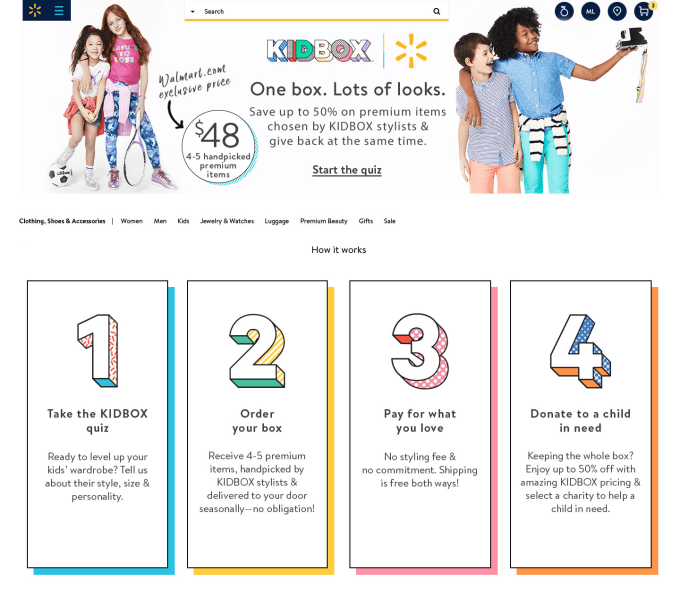
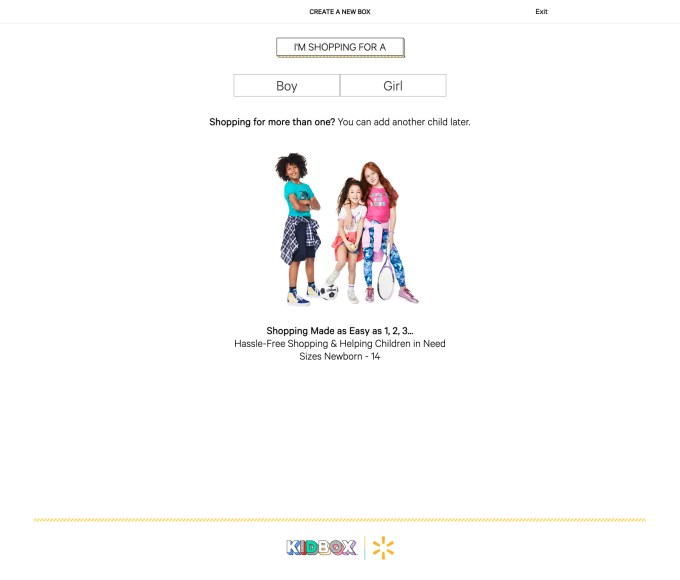
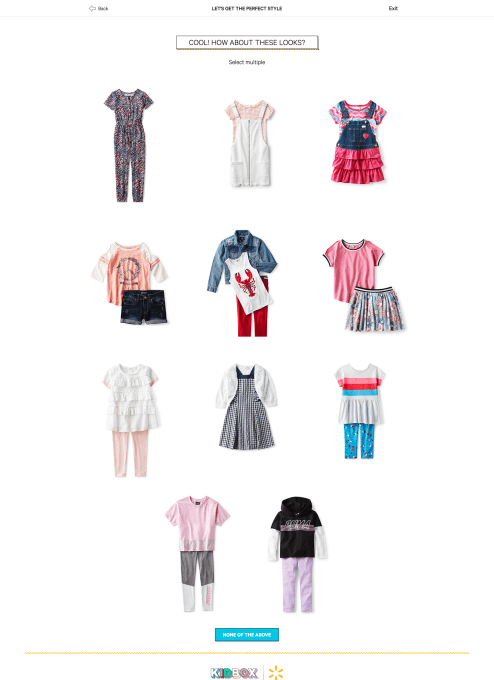
Walmart is getting into subscription-based fashion with today’s announcement of a partnership with Kidbox — a sort of “StitchFix for kids” where parents receive a personalized, curated box of children’s clothing on a seasonal basis. The deal will see Kidbox offered to Walmart.com’s online shoppers, where they can fill out a short style quiz, then receive their box of four to five fashion items for around $48 — or 50 percent the retail prices of the bundled items.

The boxes are available in Sizes 0 through 14 for girls and 0 through 16 for boys, and include styles like sweaters, denim, dresses, graphic tees, and more — based on whatever is seasonally appropriate. Kidbox today also has relationships with over 120 fashion brands, including BCBG, Butter Super Soft, C&C California, Puma, and others.

Like other subscription fashion box businesses, Kidbox last year launched its own private labels, too, based on its understanding of consumer trends and interests. To determine what will sell, the company leverages data it gleams from things like the initial style survey, customer feedback, and by noting which items are most purchased or most returned, among other factors.

“Walmart has done a lot over the past year to establish itself as a go-to retailer for all things fashion, and we’re honored to partner with the retailer to expand its kids’ assortment online, while also saving parents time and offering them the value and convenience of a stylebox,” said Miki Berardelli, Kidbox CEO, in a statement. “At Kidbox, we pride ourselves on understanding kids’ fashion preferences while also creating moments for them to learn about the importance of giving back,” she added.

For Walmart, the partnership allows the retailer to enter into the subscription-based fashion businesses without having to build out its own service from the ground-up. Nor does it have to figure out the logistics involved with something like its own version of Amazon’s Prime Wardrobe, which heavily promotes in-house brands, but can be difficult to use since you can only shop Prime Wardrobe apparel — not all of Amazon Fashion.

Walmart also sees Kidbox as a way to expand its growing children’s apparel assortment, which has added more than 100 brands over the last year, including Betsey Johnson, Kapital K, Levi’s, Limited Too and The Children’s Place. More broadly, it wants to further increase its investment in online fashion  — whether that’s by hosting high-end retail like Lord & Taylor; offering branded storefronts like those from Bonobos or Nike; doing celeb collabs like those with Sofia Vergara, Drew Barrymore, Ellen DeGeneres, Kendall & Kylie; or by acquiring  fashion brands like ModCloth, ShoeBuy, ELOQUII, and others.

Walmart Kidbox shipments will also contribute to the subscription businesses’ “give back” program, where each box purchased translates to clothing given to a child in need, in partnership with Delivering Good.

“We are thrilled to partner with Kidbox to introduce our first kids’ subscription apparel service offering premium fashion brands at a substantial savings,” said Denise Incandela, Head of Fashion, Walmart U.S. eCommerce. “Over the last year, we have significantly expanded our portfolio of kids’ fashion brands as part of our broader effort to establish Walmart.com as a destination for fashion. Our partnership with KIDBOX enables us to round out our offering with additional national and premium kids’ brands.”

The partnership with Walmart follows Kidbox’s raise last year of $15.3 million in Series B funding to expand and scale its business. Canvas Ventures led the round, which saw participation from existing investors Firstime Ventures and HDS Capital, plus new strategic partners Fred Langhammer, former CEO of The Estée Lauder Companies Inc., and The Gindi Family, owners of Century 21 department stores.

Kidsbox isn’t the only subscription fashion box business to turn to traditional retail in recent months. This February, Kidbox rival Rockets of Awesome took a $12.5 million investment from Foot Locker, which will sell Rockets of Awesome merchandise on its own website and in its Kids Foot Locker stores.

Kidbox also competes with StitchFix, which has its own kids’ line and Amazon Prime Wardrobe, which lets customers shop for girls, boys or baby, in addition to adult apparel.


16 Apr 2019

Security flaw in EA’s Origin client exposed gamers to hackers

Electronic Arts has fixed a vulnerability in its online gaming platform Origin after security researchers found they could trick an unsuspecting gamer into remotely running malicious code on their computer.

The bug affected Windows users with the Origin app installed. Tens of millions of gamers use the Origin app to buy, access and download games. To make it easier to access an individual game’s store from the web, the client has its own URL scheme that allows gamers to open the app and load a game from a web page by clicking a link with origin:// in the address.

But two security researchers, Daley Bee and Dominik Penner of Underdog Security, found that the app could be tricked into running any app on the victims computer.

“An attacker could’ve ran anything they wanted,” Bee told TechCrunch.

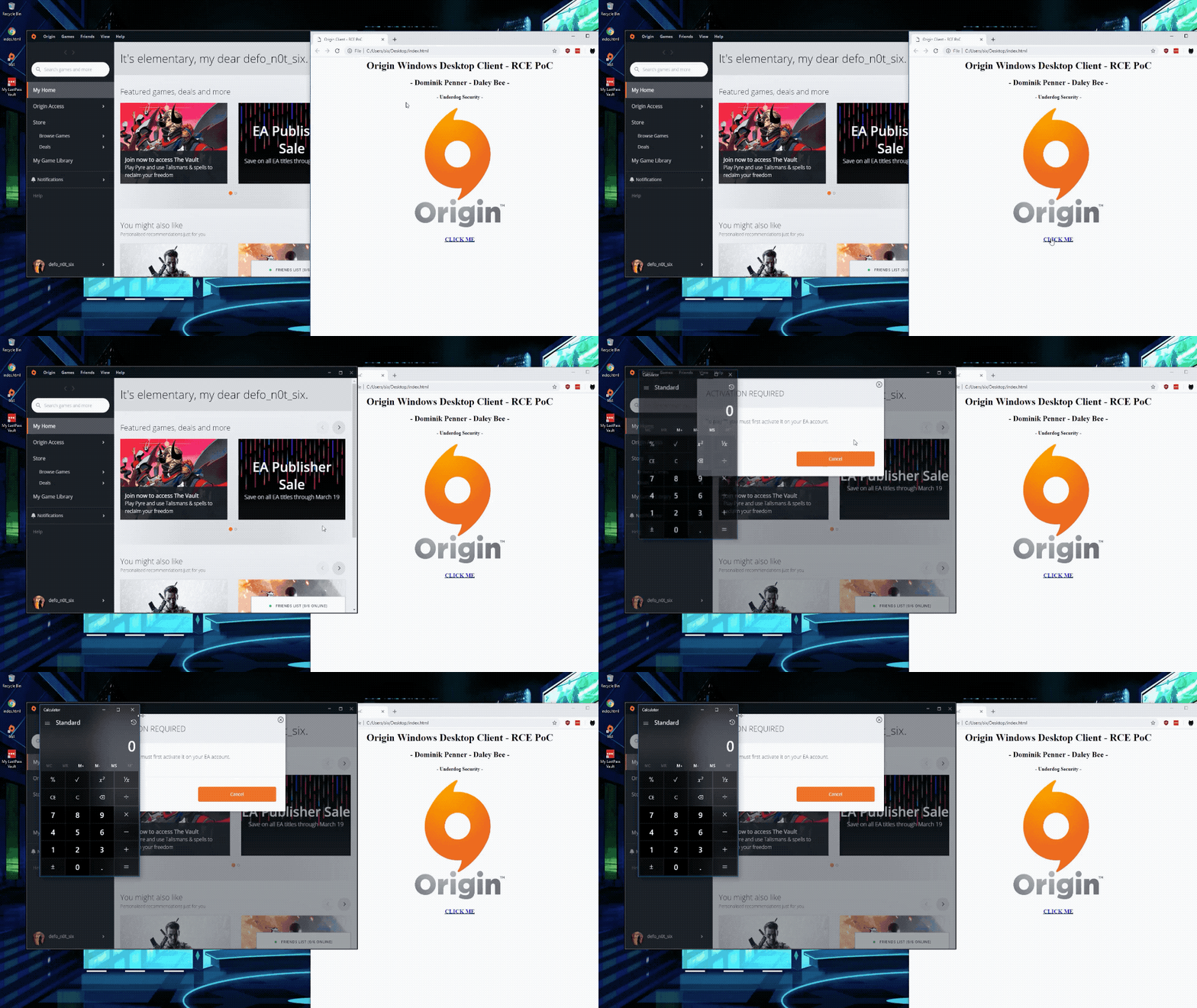
‘Popping calc’ to demonstrate a remote code execution bug in Origin. (Image: supplied)

The researchers gave TechCrunch proof-of-concept code to test the bug for ourselves. The code allowed any app to run at the same level of privileges as the logged-in user. In this case, the researchers popped open the Windows calculator — the go-to app for hackers to show they can run code remotely on an affected computer.

But worse, a hacker could send malicious PowerShell commands, an in-built app often used by attackers to download additional malicious components and install ransomware.

Bee said a malicious link could be sent as an email or listed on a webpage, but could also triggered if the malicious code was combined with a cross-site scripting exploit that ran automatically in the browser.

It was also possible to steal a user’s account access token using a single line of code, allowing a hacker to gain access to a user’s account without needing their password.

EA spokesperson John Reseburg confirmed a fix was rolled out Monday. TechCrunch confirmed the code no longer worked following the update.

Origin’s macOS client wasn’t affected by the bug.

16 Apr 2019

Alibaba will let you find restaurants and order food with voice in a car

Competition in the Chinese internet has for years been about who controls your mobile apps. These days, giants are increasingly turning to offline scenarios, including what’s going on behind the dashboard in your car.

On Tuesday, Alibaba announced at the annual Shanghai Auto Show that it’s developing apps for connected cars that will let drivers find restaurants, queue up and make reservations at restaurants, order food and eventually complete a plethora of other tasks using voice, motion or touch control. Third-party developers are invited to make their in-car apps, which will run on Alibaba’s operating system AliOS.

Rather than working as standalone apps, these in-car services come in the form of “mini apps,” which are smaller than regular ones in exchange for faster access and smaller file sizes, in Alibaba’s all-in-one digital wallet Alipay . Alibaba has other so-called “super apps” in its ecosystem, such as marketplace Taobao and navigation service AutoNavi, but the payments solution clearly makes more economic sense if Alibaba wants people to spend more while sitting in a four-wheeler.

There’s no timeline for when Alibaba will officially roll out in-car mini apps but it’s already planning for a launch, a company spokesperson told TechCrunch.

Making lite apps has been a popular strategy for China’s internet giants operating super apps that host outside apps, or “mini-apps”; that way users rarely need to leave their ecosystems. These lite apps are known to be easier and cheaper to build than a native app, although developers have to make concessions like giving their hosts certain level of access to user data and obeying rules as they would with Apple’s App Store. For in-car services, Alibaba says there will be “specific review criteria for safety and control” tailored to the auto industry.

alios cars alibaba

Photo source: Alibaba

Alibaba’s move is indicative of a heightened competition to control the operating system in next-gen connected cars. For those who wonder whether the ecommerce behemoth will make its own cars given it’s aggressively infiltrated the physical space, like opening its own supermarket chain Hema, the company’s solution to vehicles appears to be on the software front, at least for now.

In 2017, Alibaba rebranded its operating system with a deep focus to put AliOS into car partners. To achieve this goal, Alibaba also set up a joint venture called Banma Network with state-owned automaker SAIC Motor and Dongfeng Peugeot Citroen, which is the French car company’s China venture, that would hawk and integrate AliOS-powered solutions with car clients. As of last August, 700 thousand AliOS-powered SAIC vehicles had been sold.

Alibaba competitors Tencent and Baidu have also driven into the auto field, although through slightly different routes. Baidu began by betting on autonomous driving and built an Android-like developer platform for car manufacturers. While the futuristic plan is far from bearing significant commercial fruit, it’s gained a strong foothold in self-driving with the most mileage driven in Beijing, a pivotal hub to test autonomous cars. Tencent’s car initiatives seem more nebulous. Like Baidu, it’s testing self-driving and like Alibaba, it’s partnered with industry veterans to make cars, but it’s unclear where the advantage lies for the social media and gaming giant in the auto space.