
Category: UNCATEGORIZED

16 Apr 2019

ZenGo wants to become the crypto wallet for the masses

KZen is about to release ZenGo, a mobile app to manage your cryptocurrencies securely and more easily. There are already countless of crypto wallets out there, but the startup thinks they’re all either too complicated or too insecure.

If you own cryptocurrencies, chances are they’re sitting on an exchange, such as Coinbase or Binance. If somebody manages to log in to your account, nothing is stopping them from sending those assets to other wallets and stealing everything.

Worse, if somebody hacks an exchange, they could potentially divert cryptocurrencies from that exchange’s wallets. In other words, leaving your cryptocurrencies on an exchange means you give your assets to that exchange and hope they properly take care of them.

On the other end of the spectrum, you can manage your private keys yourself and rely on a hardware wallet from Ledger and Trezor. The learning curve is too hard for many people. And if you don’t follow instructions properly, you might end up losing access to your wallet or accidentally sharing private keys.

Enough about other wallets, let’s talk about ZenGo. Former TechCrunch editor Ouriel Ohayon and his team think the perfect wallet app involves a smartphone you own paired with ZenGo’s servers.
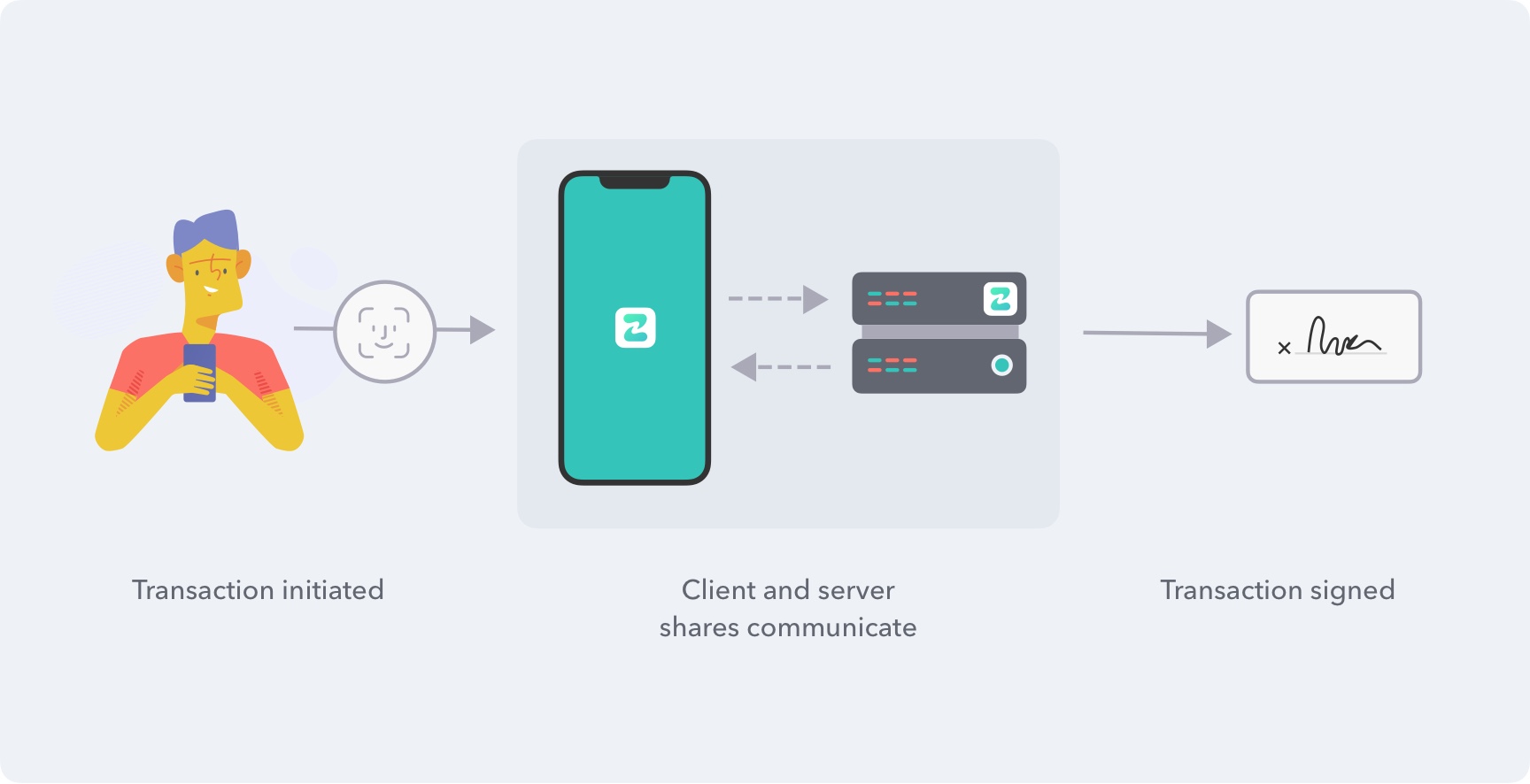
The company uses threshold signatures, which means that you need both ZenGo’s servers and your smartphone to initiate a transaction. If you lose your device, you can recover your funds. But the startup can’t access your cryptocurrencies on its own.

Behind the scene, ZenGo still uses public and private keys, but everything is completely transparent for the end user. You don’t even need to know what a private key is.

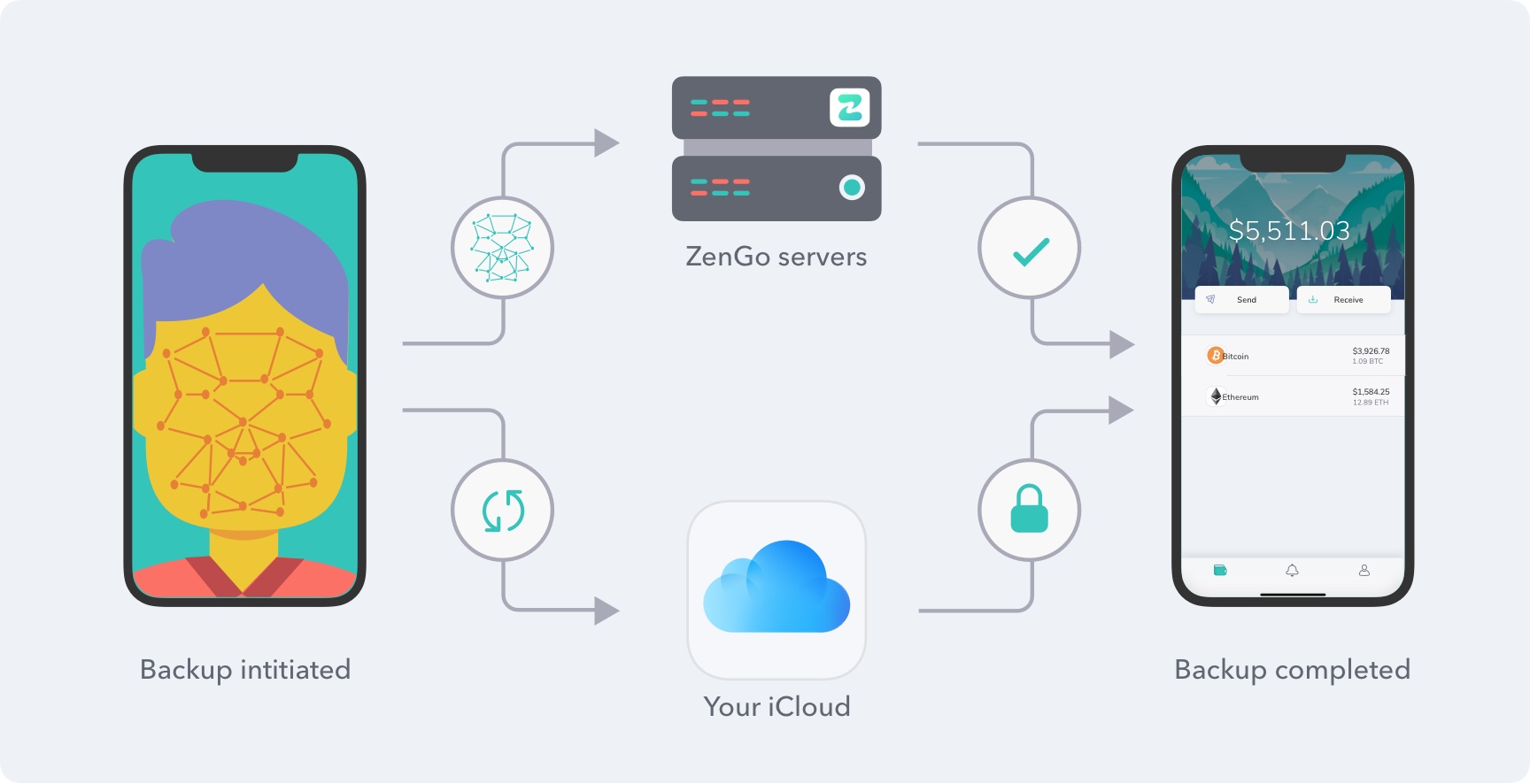
When you set up your wallet, the private key is split in two parts and stored in multiple ways — one part is on your smartphone, the other is on the servers. You need both parts to sign a transaction. If you back up your device part to ZenGo’s servers, you can recover all parts in case you lose your device for instance.

ZenGo can’t directly access the second part on its own because it is encrypted using a decryption code that is stored on your iCloud account. But accessing your iCloud is not enough — if you want to recover your wallets, you need to prove your identity.

That’s why the company stores a 3D biometric face map to let you restore your wallets on a new device. The company partners with ZoOm so that you can create a face map from any smartphone with a selfie camera.
The security model has been open-sourced and I hope many security experts will try and find vulnerabilities. That’s the only way you can know for sure that it’s a secure system.

All of this sounds complicated, but most users won’t even realize what’s happening. I tried the app and it’s a well-designed mobile app. Right now, it only supports Bitcoin and Ethereum but more assets are on the way. The company tracks your public addresses to notify you when you receive funds.

The app isn’t available just yet. It should launch as a beta this week and arrive in the stores pretty soon.


16 Apr 2019

Logitech’s new remote ditches the touchscreen for Alexa

Logitech has a long history of serving AV nerds with its advanced line of universal remotes. In an age of eight million set top boxes, dongles and video on demand services, the Harmony line has done a good job streamlining users’ needs into a single device.

As the name suggests, the Harmony Express isn’t designed for as serious a crowd as its predecessors. In fact, the new remote skips the more advanced stuff like touchscreens, in order to let Alexa do the heavy lifting.

Amazon’s smart assistant can be used to perform your standard array of tasks, like turning devices on and off, launching apps and going to specific channels. You can also do all of the regular non-remote Alexa stuff, like listening to news and controlling smart home devices. There’s a built-in mic and speaker, so you can converse with the assistant.

It’s a bit of a gamble. You never really know how much you’re going to want to use your voice to control a set until you actually try it. In fact, it’s a pretty minimalist product. Aside from the large Alexa button up top, there are a total of nine buttons on the device. That’s not a lot when it comes to all of the things it’s programmed to control.

It’s also $250, which will make it an even harder sell as the company attempts to triangulate the target audience for the device.

Certainly it’s good news for Amazon, in its quest to put Alexa on everything. Here’s Alexa VP Pete Thompson, “We’re thrilled to see Logitech simplifying the home theater experience by bringing the convenience of Alexa to its Harmony Express remote. With Alexa built-in, you can easily search and navigate content, control smart devices, access thousands of skills, and more – all you need is your voice.”

The remote starts shipping today.

16 Apr 2019

Google expands its container service with GKE Advanced

With its Kuberntes Engine (GKE), Google Cloud Google has long offered a managed service for running containers on its platform. Kubernetes users tend to have a variety of needs, but so far, Google only offered a single tier of GKE that wasn’t necessarily geared toward the high-end enterprise users the company is trying to woo. Today, however, the company announced a new advanced edition of GKE that introduces a number of new features and an enhanced financially backed SLA, additional security tools and new automation features. You can think of GKE Advanced as the enterprise version of GKE.

The new service will launch in the second quarter of the year and hasn’t yet announced pricing. The regular version of GKE is now called GKE Standard.

Google says the service builds upon the company’s own learnings from running a complex container infrastructure internally for years.

For enterprise customers, the financially backed SLA is surely a nice bonus. The promise here is 99.95% guaranteed availability for regional clusters.

Most users who opt for a managed Kubernetes environment do so because they don’t want to deal with the hassle of managing these clusters themselves. With GKE Standard, there’s still some work to be done with regard to scaling the clusters. Because of this, GKE Advanced includes a Vertical Pod Autoscaler that keeps on eye on resource utilization and adjusts it as necessary, as well as Node Auto Provisioning, an enhanced version of cluster autoscaling in GKE Standard.

In addition to these new GKE Advanced features, Google is also adding existing GKE security features like the GKE Sandbox and the ability to enforce that only signed and verified images are used in the container environment.

The Sandbox uses Google’s gVisor container sandbox runtime. With this, every sandbox gets its own user-space kernel, adding an additional layer of security. With Binary Authorization, GKE Advanced users can also ensure that all container images are signed by a trusted authority before they are put into production. Somebody could theoretically still smuggle malicious code into the containers, but this process, which enforces standard container release practices, for example, should ensure that only authorized containers can run in the environment.

GKE Advanced also includes support for GKE usage metering, which allows companies to keep tabs on who is using a GKE cluster and charge them according.


16 Apr 2019

Douglas Rushkoff on “Team Human” and fighting for our place in the future

The ethics of technology is not a competition. But if aliens happened to descend upon our planet right this moment, Arrival-style, demanding to speak with our top tech ethicist, Douglas Rushkoff would be a reasonable option.

Rushkoff — a prolific writer, broadcaster, and filmmaker once named by MIT as “one of the world’s ten leading intellectuals,” recently published a new book, Team Human, that certainly would be a strong contender for tech ethics ‘book of the year’ thus far. Team Human is both an intellectual history of the technologies (including social technologies) of the past millennium or two and an effective rallying cry for humanity at a time when many of us have rightly become far too cynical to stomach most rallying cries on most topics.

Douglas Rushkoff

If nothing else, you’ll see below that Rushkoff wins, hands down, the competition for most Biblical references in one of my TechCrunch interviews thus far. He ends our conversation, however, echoing Felix Adler, the late 19th-century founder of the Ethical Culture movement — Adler, like me, was essentially secular clergy — who famously said, “the place where people meet to seek the highest is holy ground.”

I don’t know if readers of this piece will have a transcendent experience reading it, secular or otherwise, but if you want to spend meaningful time with one of the world’s greatest living thinkers on technology and ethics, please proceed below.

Table of Contents

  1. “Celebration of being human”

  2. The collective human agenda

  3. Algorithms and creativity

  4. Fear, the past and pushing forward

  5. Capitalism, UBI and future order

Reading time for this article is 24 minutes (6,050 words)


“Celebration of being human”

Greg Epstein: I loved Team Human and I’m excited for TechCrunch readers to learn about it. First, how would you summarize the argument?

Douglas Rushkoff: I see [the book] less as an argument than as an experience. I’m from this old fashioned author community that thinks of books less as about whatever data or information might be in them and more about what happens to you. A book is almost more like a poem or a piece of art, or a movie that takes you through an experience. The experience I’m trying to convey is celebration of being human. To reacquaint people with their essential human dignity.

But really, the book is arguing we too easily reverse the figure and ground between us and our tools, or us and our institutions. Then we end up trying to conform to them rather than have them serve us. This time out, it might be particularly dangerous since we’re empowering technologies with the ability to search out and leverage human exploits. These are powerful tools. It’s not just some advertising agency trying something and then retooling every quarter. It’s algorithms trying things and retooling in real-time to activate our brainstem and thwart our higher processes.

16 Apr 2019

Waymo launches robotaxi app on Google Play

Waymo is making its ride-hailing app more widely available by putting it on the Google Play store as the self-driving car company prepares to open up its service to more Phoenix residents.

The company, which spun out to become a business under Alphabet, launched a limited commercial robotaxi service called Waymo One in the Phoenix area in December. The Waymo One self-driving car service, and accompanying app, was only available to Phoenix residents who were part of its early rider program, which aimed to bring vetted regular folks into its self-driving minivans.

Technically, Waymo has had Android and iOS apps for some time. But interested riders would only gain access to the app after first applying on the company’s website. Once accepted to the early program program, they would be sent a link to the app to download to their device.

The early rider program, which launched in April 2017, had more than 400 participants the last time Waymo shared figures. Waymo hasn’t shared information on how many people have moved over to the public service except to say “hundreds of riders” are using it.

Now, with Waymo One launching on Google Play, the company is cracking the door a bit wider. However, there will be still be limitations to the service.

Interested customers with Android devices can download the app. Unlike a traditional ride-hailing service like Uber or Lyft this doesn’t mean users will get instant access. Instead, potential riders will be added to a waitlist. Once accepted, they will be able to request rides in the app.

These new customers will first be invited into Waymo’s early rider program before they’re moved to the public service. This is an important distinction because early rider program participants have to to sign non-disclosure agreements and can’t bring guests with them. These new riders will eventually be moved to Waymo’s public service, the company said. Riders on the public service can invite guests, take photos and videos and talk about their experience.

“These two offerings are deeply connected, as learnings from our early rider program help shape the experience we ultimately provide to our public riders,” Waymo said in a blog post Tuesday.

Waymo has been creeping toward a commercial service in Phoenix since it began testing self-driving Chrysler Pacifica minivans in suburbs like Chandler in 2016.

The following year, Waymo launched its early rider program. The company also started testing empty self-driving minivans on public streets that year.

Waymo began in May 2018 to allow some early riders to hail a self-driving minivan without a human test driver behind the wheel. More recently, the company launched a public transit program in Phoenix focused on delivering people to bus stops and train and light-rail stations.

16 Apr 2019

Twitter to launch a ‘hide replies’ feature, plus other changes to its reporting process

In February, Twitter confirmed its plans to launch a feature that would allow users to hide replies that they felt didn’t contribute to a conversation. Today, alongside news of other changes to the reporting process and its documentation, Twitter announced the new “Hide Replies” feature is set to launch in June.

Twitter says the feature will be an “experiment” — which means it could be changed or even scrapped, based on user feedback.

The feature is likely to spark some controversy, as it puts the original poster in control of which tweets appear in a conversation thread. This, potentially, could silence dissenting opinions or even fact-checked clarifications. But, on the flip side, the feature also means that people who enter conversations with plans to troll or make hateful remarks are more likely to see their posts tucked away out of view.

This, Twitter believes, could help encourage people to present their thoughts and opinions in a more polite and less abusive fashion, and shifts the balance of power back to the poster without an overcorrection. (For what it worth, Facebook and Instagram gives users far more control over their posts, as you can delete trolls’ comments entirely.)

“We already see people trying keep their conversations healthy by using block, mute, and report, but these tools don’t always address the issue. Block and mute only change the experience of the blocker, and report only works for the content that violates our policies,” explained Twitter’s PM of Health Michelle Yasmeen Haq earlier this year. “With this feature, the person who started a conversation could choose to hide replies to their tweets. The hidden replies would be viewable by others through a menu option.”

In other words, hidden responses aren’t being entirely silenced — just made more difficult to view, as displaying them would require an extra click.

Twitter unveiled its plans to launch the “Hide Replies” feature alongside a host of other changes it has in store for its platform, some of which it had previously announced.

It says, for example, it will add more notices within Twitter for clarity around tweets that breaks its rules but are allowed to remain on the site. This is, in part, a response to some users’ complaints around President Trump’s apparently rule-breaking tweets that aren’t taken down. Twitter’s head of legal, policy and trust Vijaya Gadde recently mentioned this change was in the works, in an interview with The Washington Post.

Twitter also says it will update its documentation around its Rules to be simpler to understand. And it will make it easier for people to share specifics when reporting tweets so Twitter can act more swiftly when user safety is a concern.

This latter change follows a recent controversy over how Twitter handled death threats against Rep. Ilhan Omar. Twitter left the death threats online so law enforcement could investigate, according to a BuzzFeed News report. But it raised questions as to how Twitter should handle threats against a user’s life.

More vaguely, Twitter states it’s improving its technology to help it proactively review content that breaks rules before it’s reported — specifically in the areas of those who dox users (tweet private information), make threats and other online abuse. The company didn’t clarify in depth how it’s approaching these problems, but it did acquire an anti-abuse technology provider Smyte last year, with the goal of better addressing the abuse on its platform.

Donald Hicks, VP Twitter Services, in a company blog post, hints Twitter is using its existing technology in new ways to address abuse:

The same technology we use to track spam, platform manipulation and other rule violations is helping us flag abusive Tweets to our team for review. With our focus on reviewing this type of content, we’ve also expanded our teams in key areas and geographies so we can stay ahead and work quickly to keep people safe. Reports give us valuable context and a strong signal that we should review content, but we’ve needed to do more and though still early on, this work is showing promise.

Twitter also today shared a handful of self-reported metrics that paint of picture of progress.

This includes the following: today, 38 percent of abusive content that’s enforced is handled proactively (note: much content still has no enforcement action taken, though); 16 percent fewer abuse reports after an interaction from an account the reporter doesn’t follow; 100K accounts suspended for returning to create new accounts during Jan. – March 2019, a 45 percent increase from the same time last year; a 60 percent faster response rates to appeals requests through its in-app appeal process, 3x more abusive accounts suspended within 24 hours, compared to the same time last year; and 2.5x more private info removed with its new reporting process. 

Despite Twitter’s attempts to solve issues around online abuse (an area people now wonder may never be solvable), it still drops the ball in handling what should be straightforward decisions.

Twitter admits it still has more to do, and will continue to share its progress in the future.

16 Apr 2019

Apple could build macOS feature to use your iPad as extra Mac display

According to a report from 9to5mac’s Guilherme Rambo, Apple is working on a feature that would let you pair your iPad with your Mac to turn your iPad into a secondary Mac display. That feature codenamed Sidecar could ship with macOS 10.15 this fall.

If you’ve been using Luna Display or Duet Display, you’re already quite familiar with this setup. Those third-party hardware and software solutions let you turn your iPad into an external display. You can then extend your Mac display, move windows to your iPad and use your iPad like an external display.

And it sounds like Apple wants to turn those setups into a native feature. It could boost iPad sales for MacBook users, and MacBook sales for iPad users.

Apple wants to simplify that feature as much as possible. According to 9to5mac, you would access it from the standard green “maximize” button in the corner of every window. You could hover over that button and send the window to an iPad.

By default, apps will be maximized on the iPad and appear as full screen windows. Maybe you’ll be able to send multiple windows and split your display between multiple macOS apps, but that’s still unclear.

Graphic designers are going to love that feature as you’ll be able to use the Apple Pencil. For instance, you could imagine sending the Photoshop window to your iPad and using your iPad as a Wacom tablet.

Sidecar will also be compatible with standard external displays. It should make window management easier as you’ll be able to send windows to another display in just a click.

Finally, 9to5mac says that Apple is also working on Windows-like resizing shortcuts — you could drag a window to the side of the screen to resize it to half of the screen for instance.

16 Apr 2019

Sony shares some details about the PlayStation 5

Lead architect for the PlayStation 4 and PlayStation Vita Mark Cerny gave a lengthy interview to Wired’s Peter Rubin and shared some details about Sony’s next-gen console — the console that is likely to be called the PlayStation 5.

The next PlayStation will be based on an AMD architecture just like the PlayStation 4 and PlayStation 4 Pro. The custom made CPU will be based on the third-generation AMD Ryzen CPU line. It’ll feature eight 7nm cores.

As for the GPU, Sony plans to use a custom version of AMD Radeon’s Navi GPUs. While AMD is supposed to unveil this new generation of GPUs in the coming months, Cerny says that the next-gen PlayStation GPU will support ray tracing.

Those chips should also lead to a jump in audio performance. You can expect better 3D audio support if you have a set of speakers or headphones that support this kind of stuff.

The PlayStation 5 will also ship with SSD hard drives by default. This is a key differentiating factor between PC games and console games. Spinning hard drives lead to endless loading screens.

Opting for an SSD changes everything. For instance, Cerny says that fast-travel in Spider-Man running on a PlayStation 4 Pro takes approximately 15 seconds, while it takes less than a second on a next-generation PlayStation devkit.

On the hardware front, Cerny also said that the PlayStation 5 will have a BluRay drive to read physical games. And you’ll also be able to play PlayStation 4 games on the new console.

Based on the interview, it’s unclear whether Sony wants to launch a second-generation PlayStation VR headset. But if you already bought a VR headset, it’ll be compatible with the future PlayStation.

Sony is skipping E3 this year, which means that we won’t hear more about the PlayStation 5 for a while. The company will most likely launch the new console in 2020.

16 Apr 2019

Why it just might make sense that Salesforce.com is buying Salesforce.org

Yesterday, Salesforce .com announced its intent to buy its own educational/non-profit arm, Salesforce.org for $300 million. On its face, this feels like a confusing turn of events, but industry experts say it’s really about aligning educational and non-profit verticals across the entire organization.

Salesforce has always made a lot of hay about being a responsible capitalist. It’s something it highlights at events and really extends with the 1-1-1 model that it created, which gives one percent of profit, time and resources (product) to education and non-profits. Its employees are given time off and are encouraged to work in the community. Salesforce.org has been the driver behind this, but something drove the company to bring Salesforce.org into the fold.

While it’s easy to be cynical about the possible motivations, it could be a simple business reason, says Ray Wang, founder and principal analyst at Constellation Research. As he pointed out, it didn’t make a lot of sense from a business perspective to be running two separate entities with separate executive teams, bookkeeping systems and sales teams. What’s more, he said there was some confusion over lack of alignment and messaging between the Salesforce.com education sales team and what was happening at Salesforce.org. Finally, he says because Salesforce.org couldn’t issue Salesforce.com stock options, it might not have been attracting the best talent.

“It allows them to get better people and talent, and it’s also eliminating redundancies with the education vertical. That was really the big driver behind this,” Wang told TechCrunch.

Tony Byrne, founder and principal analyst at Real Story Group agreed. “My guess is that they were struggling to align roadmaps between the offerings (.com and .org), and they see .org as more strategic now and want to make sure they’re in the fold,” he said.

Focusing on the charity arm

Brent Leary, principal and co-founder at CRM Essentials says it’s also about keeping that charitable focus front and center, while pulling that revenue into the Salesforce.com revenue stream. “It seems like doing good is set to be really good for business, making it a potentially very good idea to included as part of Salesforce’s top line revenue numbers, Leary said.

For many, this was simply about keeping up with Microsoft and Google in the non-profit space, and being part of Salesforce.com makes more sense in terms of competing. “I believe Salesforce’s move to bring Salesforce.org in house was a well-timed strategic move to have greater influence on the company’s endeavors into the Not for Profit (NFP) space. In the wake of Microsoft’s announcements of significantly revamping and adding resources to its Dynamics 365 Nonprofit Accelerator, Salesforce would be well-served to also show greater commitment on their end to helping NFP’s acquire greater access to technologies that enable them to carry out their mission,” Daniel Newman, founder and principal analyst at Futurum Research said.

Good or bad idea?

But not everyone sees this move in a positive light. Patrick Moorhead, principal analyst and founder at Moor Insights and Strategies, says it could end up being a public relations nightmare for Salesforce if the general public doesn’t understand the move. Salesforce could exacerbate that perception, if it ends up raising prices for non-profits and education.

“Salesforce and Benioff’s move with Salesforce.org is a big risk and could blow up in its face. The degree of negative reaction will be dependent on how large the price hikes are and how much earnings get diluted. We won’t know that until more details are released,” Moorhead said.

The deal is still in progress, and will take some months to close but if it’s simply an administrative move designed to create greater efficiencies, it could make sense. The real question remains is how this will affect educational and non-profit institutions as the company combines Salesforce.org and Salesforce.com.

Salesforce did not wish to comment for this story.

16 Apr 2019

Brex, the credit card for startups, raises $100M debt round

Brex, widely known for its billboards littered across San Francisco, has secured a $100 million debt financing from Barclays Investment Bank .

The company, which provides a corporate credit card designed specifically for startups, has previously raised $215 million in equity funding at a $1.1 billion valuation in the less than two years since it graduated from the Y Combinator startup accelerator.

Debt, Brex chief executive officer Henrique Dubugras tells TechCrunch, will power the company’s next phase of growth.

“Because we raised so much equity so fast, we put a lot of it to work on the lending; this will allow us to scale way beyond our equity,” Dubugras said, adding that the company has no plans to raise additional equity funding right now: “Especially after this debt raise because now a lot of the capital that was tied up we can get back.”

This year, the company has been putting its boatload of venture capital to work, taking the necessary steps toward maturation. Recently, Brex closed its first notable acquisition, poaching the blockchain startup Elph right out of YC in a deal that closed just one week before Demo Day. The Elph team brings their infrastructure security know-how to Brex, helping the company build its next product, a credit card for large enterprises.

Brex is backed by Y Combinator Continuity, Ribbit Capital, Greenoaks Capital, DST Global, IVP, Peter Thiel and Max Levchin.

Brex, which recently launched a rewards program tailored to startups needs, doesn’t require startups to provide a personal guarantee or security deposit. The company simplifies corporate expenses by providing companies with a consolidated look at their spending and gives entrepreneurs a credit limit that’s as much as 10 times higher than what they might receive elsewhere.