Category: UNCATEGORIZED

16 Apr 2019

Electric car startup Byton loses co-founder and former CEO, reported $500M Series C to close this summer

The race is on for building and shipping more cost-effective electric cars, but today one of more ambitious startups in the field announced some significant changes that underscore some of the challenges in making that a reality. Byton, the Chinese electric car startup, today announced that Carsten Breitfeld, the former BMW executive and Byton co-founder who had been the CEO and was most recently chairman, has left the company “to start a new adventure within the start-up industry.”

To offset that news, Byton said that it is currently recruiting for a new CTO, will close its Series C funding — a $500 million round, according to this report from January — this summer, and is on track for production of its M-Byte SUV vehicle for Q4 2019. The company recently said that it is looking towards an IPO, with the business currently valued at around $4 billion and counting 50,000 customers, with half in China and half in the US.

“Thanks to our founding team and all employees we’re well on track and looking forward to delivering the M-Byte this year to customers in China, followed by the US and Europe in 2020,” said Byton co-founder and current CEO Dr. Daniel Kirchert. “Carsten helped build a strong BYTON brand and bring in the right people to take our start-up to the next level. Now we are focusing on our main goal to achieve the on-time-start-of-production of the first BYTON series production model in 2019 with our strong team and partners.” There were no comments about IPOs in today’s statement.

It’s not clear who is overseeing the technical aspects of the business in the meantime — it doesn’t appear that there had been an official CTO at the company previously, but before Byton, Breitfeld had been VP of engineering at BMW. Dick Abendroth, another BMW engineering alum, left Byton in October of last year to become CTO of OEM Continental.

Byton was originally started as Future Mobility Corporation as a joint venture between Harmony Auto, Tencent, and Foxconn, who put Breitfeld and Kirchert, pictured below left and right, in place as co-founders and leaders of the business. It has raised about $700 million to date, with the most recent round of $500 million closing in June 2018.

But there have been reports that the company was running out of money since the end of last year, balancing the capital intensiveness of building new vehicle technology and new vehicles as a startup (no small feat considering that its competitors are some of the biggest companies in the world), with the fact that the company now employs some 1,600 people — a good portion of which were cherry picked from existing automotive companies and are therefore expensive.

Byton is not the only electric car company that swerving to try to avoid unexpected roadblocks in its growth. Tesla earlier this year cut its workforce to streamline its own production, and it has been making many sudden decisions on its retail strategy in an effort to cut costs.

For the new generation of vehicles, it’s not just all-electric technology that is tricky to build in a cost-effective and efficient way, but the fact these investments are being balanced against other major initiatives around vehicle software, and in particular autonomous technology.

Many believe that the industry is heading inevitably towards self-driving vehicles, but nright now we’re far from that and the development of the features poses a lot of safety and other hurdles and a completely picture of how it will look is still a moving target. Byton, for its part, is currently working with a third party, Aurora, for self-driving tech for its vehicles.

We have contacted Byton with questions about who is acting as CTO at the company currently, and if it can provide any more details on the Series C or valuation, and we will update this post as we learn more.


16 Apr 2019

Scranos, a new rootkit malware, steals passwords and pushes YouTube clicks

Security researchers have discovered an unusual new malware that steals user passwords and account payment methods stored in a victim’s browser — and also silently pushes up YouTube subscribers and revenue.

The malware, Scranos, infects with rootkit capabilities, burying deep into vulnerable Windows computers to gain persistent access — even after the computer restarts. Scranos only emerged in recent months, according to Bitdefender with new research out Tuesday, but the number of its infections has rocketed in the months since it was first identified in November.

“The motivations are strictly commercial,” said Bogdan Botezatu, director of threat research and reporting at Bitdefender, in an email. “They seem to be interested in spreading the botnet to consolidate the business by infecting as many devices as possible to perform advertising abuse and to use it as a distribution platform for third party malware,” he said.

Bitdefender found the malware spreading through trojanized downloads that masquerade as real apps, like video players and e-book readers. The rogue apps are digitally signed — likely from a fraudulently generated certificate — to prevent getting blocked by the computer. “By using this approach, the hackers are more likely to infect targets,” said Botezatu. Once installed, the rootkit takes hold to maintain its presence and phones home to its command and control server to download additional malicious components. The second-stage droppers inject custom code libraries in common browsers — Chrome, Firefox, Edge, Baidu, and Yandex to name a few — to target Facebook, YouTube, Amazon, and Airbnb accounts, gathering data to send back to the malware operator.

“The motivations are strictly commercial… they are looking at advertising fraud by consuming ads on their publisher channels invisibly in order to pocket the profit.” Bitdefender's Bogdan Botezatu

Chief among those is the YouTube component, said Bitdefender. The malware opens Chrome in debugging mode and, with the payload, hides the browser window on the desktop and taskbar. The browser is tricked into opening a YouTube videos in the background, mutes it, subscribes to a channel specified by the command and control server and click ads.

The malware “aggressively” promoted four YouTube videos on different channels, the researchers found, turning victim computers into a de facto clickfarm to generate video revenue.

“They are looking at advertising fraud by consuming ads on their publisher channels invisibly in order to pocket the profit,” said Botezatu. “They are growing accounts that they have been paid to grow and helping inflate an audience so they can grow specific ‘influencer’ accounts.”

Another downloadable component allows the malware to spam a victim’s Facebook friend requests with phishing messages. By siphoning off a user’s session cookie, it sends a malicious link to an Android adware app over a chat message.

“If the user is logged into a Facebook account, it impersonates the user and extracts data from the account by visiting certain web pages from the user’s computer, to avoid arousing suspicion by triggering an unknown device alert,” reads the report. “It can extract the number of friends, and whether the user administrates any pages or has payment information in the account.” The malware also tries to steal Instagram session cookies and the number of followers the user has.

Other malicious components allow the malware to steal data from Steam accounts, inject adware to Internet Explorer, run rogue Chrome extensions, and collect and upload a user’s browsing history.

“This is an extremely sophisticated threat that took a lot of time and effort to set up,” said Botezatu. The researchers believe the botnet has tens of thousands of devices ensnared already — at least.

“Rootkit-based malware shows an unusual level of sophistication and dedication,” he said.

16 Apr 2019

Billionaire François-Henri Pinault just pledged more than 100 million euros to rebuild the Notre Dame Cathedral

The Notre Dame Cathedral in Paris has been saved after fire broke out in the early hours of Monday evening, but not before extensive damage was inflicted on the 856-year-old building, with much of its roof collapsing into itself, along with its main spire.

The fire had blazed for for eight hours before firefighters were able to largely contain it, including saving its two iconic rectangular towers and many of its precious relics, including the Crown of Thorns, said to have been worn by Jesus Christ before the crucifixion. Still, as French President Emmanual Macron said outside the cathedral once it was nearly extinguished, “The worst has been avoided, but the battle isn’t fully won yet . . .We will rebuild the cathedral together,” Macron said, adding that France planned to start international fundraising campaign to raise money for the renovations.

Thankfully, he may have a major head start on that campaign, thanks to billionaire François-Henri Pinault, who has already pledged more than 100 million euro to rebuild the cathedral. According to the AFP, Pinault said in a statement that he plans to provide the money through his family’s investment firm, Artemis, and that he hopes the money will help church officials “completely rebuild Notre Dame.”

Pinault own the French luxury group Kering, which oversees the luxury fashion brandsGucci and Saint Laurent, among others.

Years ago, Pinault talked with TechCrunch about his early love of computer science, and about having interned at Hewlett Packard as a software developer.

At the time, he also said he’s helped start Soft Computing, a company launched in Paris in 1984 by fellow students of Pinault, Eric Fischmeister and Gilles Venturi, who later took the company public and, in December of last year, sold a majority stake in the business to ad giant Publicis.

An active philanthropist, Pinault has seemingly steered around much of the startup world, though he has made very occasional investments, including writing an early check to the online shopping platform Fancy. and more recently providing funding to Muzik, an L.A.-based maker of so-called smart headphones that raised $70 million from investors last May.

16 Apr 2019

Journalist Carole Cadwalladr says ‘the gods of Silicon Valley’ have broken democracy

On the same day that she became a Pulitzer Prize finalist for her work bringing the Cambridge Analytica scandal to light, journalist Carole Cadwalladr took the stage at TED to “address you directly, the gods of Silicon Valley.”

Cadwalladr began her talk by recounting a trip she took after the Brexit referendum, back to her hometown in South Wales.

She recalled feeling “a weird sense of unreality” walking around a town filled with new infrastructure funded by the European Union, while being told by residents that the EU had done nothing for them. Similarly, she said they told her about the dangers of immigration, even though they lived in a town with “one of the lowest rates of immigration in the country.”

Cadwalladr said she began to understand where those sentiments were coming from after her story ran, and someone contacted her about scary, misleading ads about Turkey and Turkish immigration that they’d seen on Facebook . Cadwalladr, however, couldn’t see those ads, because she wasn’t targeted, and Facebook offered no general archive of all ads that had run on the platform.

Eventually, the pro-Brexit campaign was found guilty of breaking British election laws by breaching campaign spending limits to fund ads on Facebook. And Facebook subsequently began building that archive of ads.

Meanwhile, Cadwalladr said her interest in these issues led her to Christopher Wylie, whose whistleblowing about Cambridge Analytica’s use of Facebook user data helped prompt broader scrutiny of the social network’s privacy practices.

Cadwalladr described Wylie as “extraordinarily brave,” particularly since Cambridge Analytica repeatedly threatened them with legal action. The final threat, she said, came a day before publication, and it came from Facebook itself.

“It said that if we published, they would sue us,” Cadwalladr said. “We did it anyway. Facebook, you were on the wrong side of history on that, and you are in the wrong side of history in this.”

The “this” in question is what she characterized as a failure by the social media platforms to fully reckon with the extent to which they’ve become tools for the spread of lies and misinformation. For example, she pointed to CEO Mark Zuckerberg’s refusal thus far to appear before parliaments around the world that have asked him to testify.

Calling out executives like Facebook’s Sheryl Sandberg, Alphabet/Google’s Larry Page and Sergey Brin and Twitter’s Jack Dorsey (who’s scheduled to take the stage tomorrow morning), Cadwalladr insisted that the stakes could not be higher.

“This technology you have invented has been amazing, but now it’s a crime scene, and you have the evidence,” she said. “It is not enough to say that you will do better in the future, because to have any hope of stopping this from happening again, we have to know the past.”

She went on to declare that the Brexit vote demonstrates that “liberal democracy is broken.”

“This is not democracy,” Cadwalladr said. “Spreading lies in darkness, paid for with illegal cash from God knows where — it’s subversion, and you are accessories to it.”

And for those of us who don’t run giant technology platforms, she added, “My question to everybody else is: Is this what we want? To let them get away with it, and to sit back and play with our phones as this darkness falls?”

16 Apr 2019

JD founder cautions logistics business must tighten belt

Alibaba’s arch-foe JD.com has long prided itself on owning and controlling its logistics services: couriers are treated as in-house staff and paid a basic income. But that will end soon as costs keep piling up for the ecommerce giant.

In an internal letter sent to the staff on Monday, JD founder and chief executive Richard Liu said the company will scrap basic salary for couriers as net loss amounted to 2.8 billion yuan ($420 million) in 2018 at JD’s logistics unit.

“The main reason is we had too few orders externally and too high a cost internally,” said Liu. “You all know that the last two years have been quite difficult for the company. We have been in the loss for more than ten years. If losses continue, JD Logistics only has two years of runway left with its capital raised.”

“I don’t think any of our delivery brothers want the company to go bankrupt,” Liu added.

JD Logistics became a standalone business in 2017 and subsequently raised billions of dollars from investors. JD still owns an 81.4 percent stake in the logistics arm, which was valued at around $13.5 billion at the time it raised $2.5 billion in February 2018.

Going forward, JD Logistics will continue to pay social insurances on behalf of its couriers, whose income is now based on the number of packages they handle. Liu assured that the old basic pay accounted for just 10 percent of the delivery staff’s total income so his goal is not to cut but boost salary for them, and eventually for JD Logistics as well.

But couriers are feeling the heat. Monthly pay used to average 7,000 yuan ($1,043) to 8,000 yuan, a Shenzhen-based courier told TechCrunch. Under the new scheme, he and his regional colleagues are earning 5,000 yuan to 6,000 yuan. Liu said in the letter that it’s “up to the couriers” to vie for better salaries, but it’s unclear how they can secure more packages in practice. JD said it has no comment on the issues addressed in Liu’s letter.

JD delivery staff are assigned on a regional basis. Assuming the number of parcels that go out of a region stays relatively constant, couriers can’t do much to boost their piecework wage. Already, some couriers have devised cheats that involve mailing parcels to themselves and rejecting them at delivery in order to jack up income, TechCrunch has learned.

JD Logistics

Photo source: JD Logistics via Weibo

China’s express delivery market, like many other fledgling industries, is a relentless race that sees players offer heavily subsidized prices for customers to stay competitive. JD is going against companies like Alibaba that enlist a consortium of third-party contracted couriers rather than hiring their own to keep costs down.

JD’s fourth-quarter cost of revenues grew 20.7 percent to $16.8 billion, mainly driven by expenses related to logistics services alongside its online direct sales business, the company’s earnings report revealed. The Amazon-like service is finding ways to bulk up revenues by opening its logistics service to third-party clients as well as expanding overseas.

“It’s just a matter of time that JD will remove couriers’ minimum income. It can’t increase the price for customers, so it’s passing the cost to the couriers,” said Alex Cheong, founder and chief executive of Web2Ship, a service that enables price comparisons across different express shipping services, told TechCrunch.

“In China, the only thing [courier companies] can play is the volume game. There’s this mentality that as volume goes up, companies will get more efficient, and costs will lower. But growth is actually slowing,” Cheong warned.

The income restructuring at JD’s logistics arm comes amid a widespread layoff across the parent company to remove low-performers, or what Liu labeled as “slackers.” JD is namechecked as one of China’s internet companies working 9 am to 9 pm, 6 days a week, or “996”, a demanding schedule that has prompted an online protest.

JD denied that it practices the “996” routine though it sees itself as “a competitive workplace that rewards initiative and hard work” which is consistent with its “entrepreneurial roots,” a JD spokesperson told TechCrunch earlier.

The ecommerce titan has long promoted its in-house logistics arm as offering “quality” service, so it remains to see how the removal of basic income will affect couriers’ morale. But one thing is for sure. Under the piece rate system, JD knows its exact labor cost per unit and avoids paying for employees’ idle time.

16 Apr 2019

Ro, a direct-to-consumer online pharmacy, reaches $500M valuation

Venture capitalists have valued direct-to-consumer telehealth business Ro at $500 million with an $85 million Series B financing, sources confirm to TechCrunch.

The fresh round of funding comes seven months after Ro — widely known for its men’s health brand Roman, a cloud pharmacy for erectile dysfunction — made headlines with an $88 million Series A. 

Ro didn’t immediately respond to a request for comment.

The company’s outsized Series A, led by FirstMark Capital, was used to launch and scale its second digital health brand, “Zero,” a treatment plan meant to help men and women quit smoking. Zero sells a $129 kit complete with a month’s worth of prescription cessation medication Bupropion, nicotine gum and access to an app used to track progress.

Its latest infusion of capital will likely be used in part to support its third personalized health brand, Rory, a purveyor of women’s health products the business unveiled last month. Targeting menopausal women, Rory offers six products treating four conditions — including prescription medication and supplements for hot flashes, over-the-counter treatments for insomnia, prescription vaginal estrogen cream and an all-natural water-based lubricant for vaginal dryness and Latisse, which helps grow eyelashes — which are available for purchase and direct-to-consumer delivery.

“Right now, we have [millions] of women experiencing menopause,” Rory co-founder Rachel Blank told TechCrunch last month. “They are walking around and frankly, their vagina hurts and they are uncomfortable. Really, what we are building at Rory is a lot of the educational content around this to let women know they have choices and they can take control during this phase of life where they feel like their bodies are rebelling against them.”

When asked whether Ro was fundraising to bolster the new effort, Blank, a former investor at Ro-backer General Catalyst, declined to comment. Curiously, a source with knowledge of Ro’s fundraising said there was no mention of the imminent launch of its women’s brand, Rory, in its pitch to VCs earlier this year.

Ro was started by a trio of entrepreneurs: Rob Schutz, Saman Rahmanian and chief executive officer Zachariah Reitano in 2017. Reitano had previously co-founded a Y Combinator -backed startup called Shout, Rahmanian is a co-founder of the WeWork-acquired business Managed by Q, and Schutz worked as the vice president of growth for Bark&Co before building Ro.

The startup initially launched under the name Roman, which became its flagship brand when the business adopted the umbrella name Ro last year. Roman offers men a $15 online doctor’s consultation, which, if they are an appropriate candidate, gives them access to an instant prescription for Viagra, Cialis or generic drugs that can be filled at Roman’s in-house cloud pharmacy.

In a 2017 interview with TechCrunch’s Josh Constine, Reitano said he began experiencing ED at 17-years-old: “I think in a good way I’ve become numb to the embarrassment,” he said. “I remember the embarrassment of having the condition with no solution, and that’s much worse than sharing the fact that I had it and was able to fix it myself.”

Ro has previously raised $91.1 million in venture capital funding, hitting a valuation of $154 million with its Series A, according to PitchBook. Its investors include Initialized Capital, Box Group and Slow Ventures, as well as angels like Y Combinator partner Aaron Harris, Benchmark’s Scott Belsky and the chief executives of Casper, Code Academy and Pill Pack.

Founded just two years ago, Ro was amongst the first of a new cohort of men’s health businesses supported by VCs. Hims, one of the leading brands in the space, has similarly landed big rounds of capital from top-tier investors. Most recently, Hims brought in $100 million at a $1 billion valuation from an undisclosed growth-stage fund.

Several other companies, including Numan, Manual and Thirty Madison, have raised capital to support men with hair loss treatments and ED medications delivered to discreetly their doorsteps, among other products.

16 Apr 2019

New registrations for electric vehicles doubled in U.S. since last year

Electric vehicles, still a small percentage of the total automotive market in the U.S., are beginning to gain ground, according to analysis by IHS Markit.

There were 208,000 new registrations for electric vehicles in the U.S. last year, more than double the number filed in 2017, IHS said Monday.

That growth in EVs was heavily concentrated in California as well as nine other states that have adopted the Zero Emission Vehicle program. California was the first to launch the ZEV program‚ a state regulation that requires automakers to sell electric cars and trucks there. Connecticut, Maine, Maryland, Massachusetts, New Jersey, New York, Oregon, Rhode Island and Vermont are also ZEV states.

California accounted for nearly 46 percent, or 95,000, of new EV registrations in 2018, IHS said. California has 59 percent of market share of registered electric vehicles in the U.S.

Those numbers are expected to push even higher over the next two years as more electric vehicles come on the market and an increasing number existing EV owners stick with the technology.

More than 350,000 new EVs will be sold in the US in 2020.  Those figures will give EVs a still tiny 2 percent share of the total U.S. fleet. By 2025, that figure is expected to rise to more than1.1 million vehicles sold or a 7 percent share, according to recent IHS Markit.

The Tesla’s Model 3 is the top selling all-electric in the U.S. so far this year, followed by the Chevy Bolt, Tesla Model X, Tesla Model S and the Nissan Leaf, according to estimates by Inside EVs. More EVs are just now coming onto the market, or about to in the coming months , including the Kia Niro EV and Hyundai Kona EV. Startup Rivian expects to start production in 2020.

“A rapid increase in EV nameplates is the catalyst behind the projected growth throughout the next decade,” Devin Lindsay, IHS Markit powertrain analyst said in a statement. “While relatively successful models such as the Tesla Model 3 mature in the market, other traditional automakers will be rolling out not just one EV as we have seen in the past, but multiple models off dedicated EV platforms.”

IHS found that loyalty rates for EVs have also increased with nearly 55 percent of all new EV owners who returned to market during the fourth quarter of 2018 acquiring (purchasing or leasing) another EV, up from 42 percent in the prior quarter.

16 Apr 2019

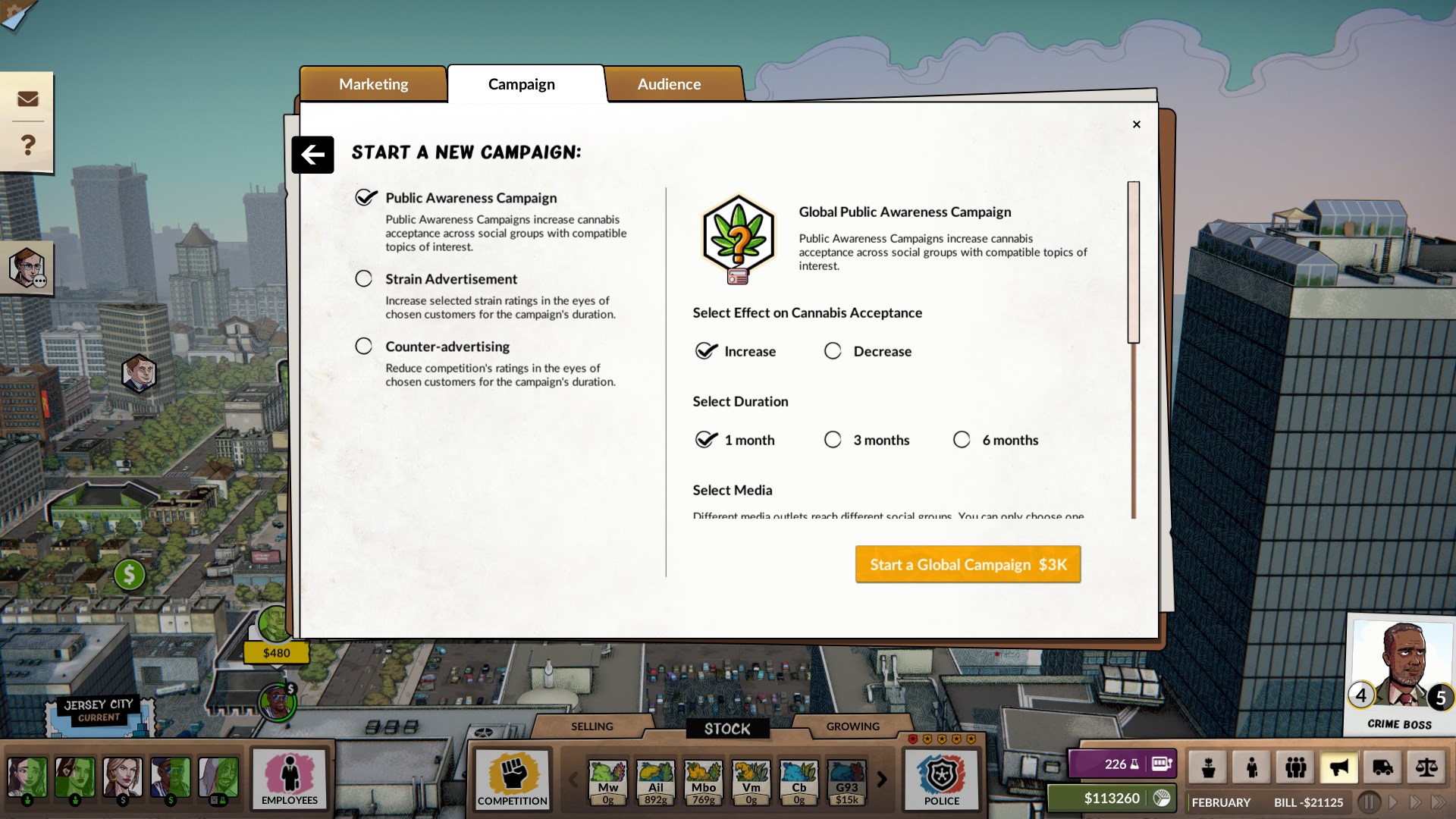
Chilly reception for marijuana tycoon game shows games industry’s backwards stance on drugs

Intense and graphic violence is something we’ve come to simply expect from games, but sexual and other adult themes are still largely taboo — including, as publisher Devolver Digital is learning, drugs. Even if the game in question is a relatively serious tycoon-type look at the current (and legal!) business of selling weed.

Devolver is no stranger to controversy; it has published and helped develop dozens of games and many of them have featured the kind of graphic violence that sets off those who still see the medium as a corruptive, fundamentally debased one. And to be fair, the likes of Hotline Miami aren’t going to change any minds.

But for the company’s first original commissioned IP, it had the idea of assembling a game in the popular “tycoon” genre, but focused on the emerging and popular sector of growing marijuana.

Obviously this is somewhat controversial, but the plant is legal in many states and countries already and on its way in plenty of others. This isn’t the time or place for a full evaluation of the scheduling system and the war on drugs, but it suffices to say that it is a complex and interesting business ecosystem that’s teetering on the edge of widespread acceptance. That makes it a bit edgy, but also fresh and relevant — perfect, Devolver thought, to build a game around. So they made Weedcraft, Inc.

Unfortunately, the company’s co-founder Mike Wilson told me the other day, they underestimated how square the gaming industry is.

“This is definitely the hardest game I’ve had to market, and that’s saying something,” Wilson told me. “It has been a fucking nightmare. The fact that we’re still so afraid of a topic like weed instead of the murder simulators you can market any time, anywhere, it’s shocking.”

Console game stores were reluctant to even carry it, and warned Devolver that it would never be featured, which is a death sentence for a game’s discoverability. They couldn’t get ads approved on Facebook or Instagram, and the person who submitted them even had his account suspended. And just this week, streamers trying out the game on YouTube had their videos demonetized.

The only stores that didn’t buck were Steam, which is largely content-agnostic, and GOG, a popular DRM-free storefront.

Why, though? This isn’t a game about smoking blunts or cutting dime bags with oregano to sell to middle school kids.

Well, it is a little pro-legalization.

“This isn’t a pro-legalization game. This is a tycoon game. You don’t do drugs in the game!” said Wilson. “You can play as a totally legal, scrupulous businessperson. We did all this research with like, dispensaries, geneticists, lawyers, we were worried about cultural sensitivity with the subject matter, things like how much more black people get jailed for it. We wanted it to be representative of all the social issues involved. It’s kind of like doing a game about booze in the prohibition era — like, what an interesting industry to study, right?”

It’s not that the companies involved here — Microsoft, Sony, YouTube and so on — are applying some invisible rules. The rules are there; when I contacted YouTube for comment, they pointed me to the list of guidelines for “advertiser-friendly content.” And plain as day there’s the one about drugs: “Video content that promotes or features the sale, use, or abuse of illegal drugs, regulated drugs or substances, or other dangerous products is not suitable for advertising.”

It’s just a bit weird to me still that we have this backwards, puritan approach to this stuff. Think of how much vile garbage is on YouTube and how the most popular games in the world glorify guns and death. But a recreational drug legal in many places and generally well thought of, not to mention a massive and growing business — that’s beyond the pale.

I understand YouTube doesn’t want people doing bong-clearing competitions, and console makers want to appear family-friendly so they don’t lose that teen and tween market. But surely we can be adults about this.

Gaming is maturing to be an interactive storytelling medium that encompasses serious issues, but the industry is holding itself back by its squeamishness about adult themes. And that feeds into the puritanical objections from misguided commentators, who go nuts over romancing an alien in Mass Effect or the ridiculous “Hot Coffee” thing in GTA, but don’t acknowledge the sophisticated storytelling of Return of the Obra Dinn, or subversive commentary of Papers, Please, or the impressive period recreation of an Assassin’s Creed.

Drugs are a complex and controversial topic. I get that some people want to stay hands-off. But when that hands-off stance doesn’t apply to graphic violence, sexism, and other sore spots, it comes off as prudish and hypocritical.

15 Apr 2019

Science fiction author Gene Wolfe has died

Gene Wolfe, author of “The Book of the New Sun” and other acclaimed works of science fiction and fantasy, died Sunday at the age of 87.

According to Locus, his death came after a long struggle with heart disease.

While Wolfe was never quite as famous as some of his peers, his writing was loved intensely by his fans. Ursula Le Guin, for example, called him “our Melville,” while Michael Swanwick described him as “the greatest writer in the English language alive today.”

That level of praise (and comparisons between his best-known work and James Joyce’s “Ulysses”) might seem hyperbolic — unless you’ve actually read his best novels and stories. To some, Wolfe’s writing represents science fiction’s strongest claim toward creating capital-L Literature.

The four-volume “Book of the New Sun,” published between 1980 and 1983, remains his best-known single work. It tells the story of Severian, a wandering torturer on Earth (“Urth”), billions of years in the future. The writing in “New Sun” is evocative and tricky, with an unreliable narrator obliquely explaining Wolfe’s far-future setting.

Wolfe’s reputation for density and difficulty may have scared some readers away, but it’s also encouraged careful rereading and enthusiastic exegesis from his most devoted readers. And this reputation undersells the pleasure of  Wolfe’s writing.

Decoding his best stories is fun, just as it’s fun to explore the vast city of Nessus in “The Shadow of the Torturer.” He could also use that talent for subtlety to craft an unsettling horror story like “The Tree Is My Hat,” or an equally unsettling character study like “The Death of Doctor Island.” (The reason why Wolfe wrote the latter story, and the similarly titled “The Doctor of Death Island” and “Death of the Island Doctor,” is one of my favorite bits of science fiction trivia.)

And then there’s “Forlesen,” a surreal afterlife fantasy that somehow compresses an entire lifetime of office drudgery into a single day. In the end, the titular character asks, “I want to know if it’s meant anything. If what I’ve suffered — if it’s been worth it.”

The answer? “No. Yes. No. Yes. Yes. No. Yes. Yes. Maybe.”

15 Apr 2019

Hulu buys back AT&T’s minority stake in streaming service now valued at $15 billion

Hulu has paid $1.43 billion to buy AT&T’s minority stake in the streaming video company.

The companies announced Monday that the transaction valued Hulu at $15 billion. As a result, AT&T’s 9.5 percent stake in Hulu was worth $1.43 billion.

The valuation is two-thirds higher than last November when Disney reported in a regulatory filing that the streaming video company was worth $9.26 billion. Hulu is owned through by Hulu LLC, a joint venture of Disney and Comcast. Disney now has a 67 percent ownership of Hulu, which it gained, in part, through its $71 billion acquisition of 21st Century Fox. Comcast has a 33 percent stake in Hulu.

AT&T, which has been hinting about selling its minority stake in Hulu since November, will use proceeds from this transaction, along with additional planned sales of non-core assets, to reduce its debt.

“We thank AT&T for their support and investment over the past two years and look forward to collaboration in the future. WarnerMedia will remain a valued partner to Hulu for years to come as we offer customers the best of TV, live and on demand, all in one place,”  Hulu CEO Randy Freer said in statement.

AT&T acquired the 9.5 percent percent stake in the service by way of WarnerMedia, as a result of its Time Warner acquisition.

AT&T and Hulu were increasingly looking like competitors, not partners. AT&T has its own streaming services, including cord-cutter friendly live TV service DirecTV Now, more lightweight WatchTV and another upcoming direct-to-consumer service that will launch later this year and leverages its WarnerMedia properties.

This new AT&T streaming service. which will work across devices, will launch into beta in Q4 2019, AT&T has said. The service is expected to expand over time to include third-party content through partnerships.