Category: UNCATEGORIZED

12 Apr 2019

Facebook taps Peggy Alford for its board, Reed Hastings and Erskine Bowles to depart

Facebook’s board is undergoing its biggest shakeup in memory. On Friday, the company announced that Peggy Alford would be nominated to join the company’s board of directors.

“Peggy is one of those rare people who’s an expert across many different areas — from business management to finance operations to product development,” Facebook CEO Mark Zuckerberg said of the change. “I know she will have great ideas that help us address both the opportunities and challenges facing our company.”

Alford, currently Senior Vice President of Core Markets for PayPal, will become the first black woman to serve on Facebook’s board. She previously served as the Chief Financial Officer of the Chan Zuckerberg Initiative, Mark Zuckerberg and Priscilla Chan’s massive charitable foundation.

Facebook announced some serious departures along with the news of Alford’s nomination. Longtime Facebook board members Reed Hastings and Erskine Bowles will leave the board, marking a major shakeup for the board’s composition. Both Hastings, the CEO of Netflix, and Bowles, a former Democratic political staffer, have served on the board since 2011. Both men have been critical of Facebook’s direction in recent years. Hastings in particular has clashed with fellow board member Peter Thiel over his support for the Trump administration.

Alford’s nomination will come to a vote at Facebook’s May 30 shareholder meeting.

“What excites me about the opportunity to join Facebook’s board is the company’s drive and desire to face hard issues head-on while continuing to improve on the amazing connection experiences they have built over the years,” Alford said of her nomination. “I look forward to working with Mark and the other directors as the company builds new and inspiring ways to help people connect and build community.”

12 Apr 2019

IAM Robotics puts a unique spin on warehouse automation

Before robots get to do the fun stuff, they’re going to be tasked with all of the things humans don’t want to do. It’s a driving tenet of automation — developing robotics and AI designed to replace dull, dirty and dangerous tasks. It’s no surprise, then, that warehouses and fulfillment centers have been major drivers in the field.

Earlier this week, we reported that Amazon would be acquiring Canvas, adding another piece to its portfolio, adding to the 100,000 or so robotics it currently deploys across 25 or so fulfillment centers. Even Boston Dynamics has been getting into the game, acquiring a vision system in order to outfit its Handle robot for the warehouse life.

Like so much of the robotics world, Pittsburgh is a key player in the world of automation. IAM Robotics is one of the more compelling local entrants in the space. We paid the company a visit on a recent trip to town. Located in a small office outside of the city, the startup offers a unique take on the increasingly important pick and place robotics, combining a robotic arm with a mobile system.

“What’s unique about IAM robotics is we’re the only ones with a mobile robot that is also capable of manipulating objects and moving things around the warehouse by itself,” CEO Joel Reed told TechCrunch. “It doesn’t require a person in the loop to actually physically handle things. And what’s unique about that is we’re empowering machine with AI and computer vision technologies to make those decisions by itself. So it’s fully autonomous, it’s driving around, using its own ability to see.”

The startup has mostly operated quietly, in spite of a $20 million venture round led by KCK late last year. After a quick demo in the office, it’s easier to see how early investors have found promise in the company. Still, the demo marks a pretty stark contrast from the Bossa Nova warehouse where we spent the previous day.

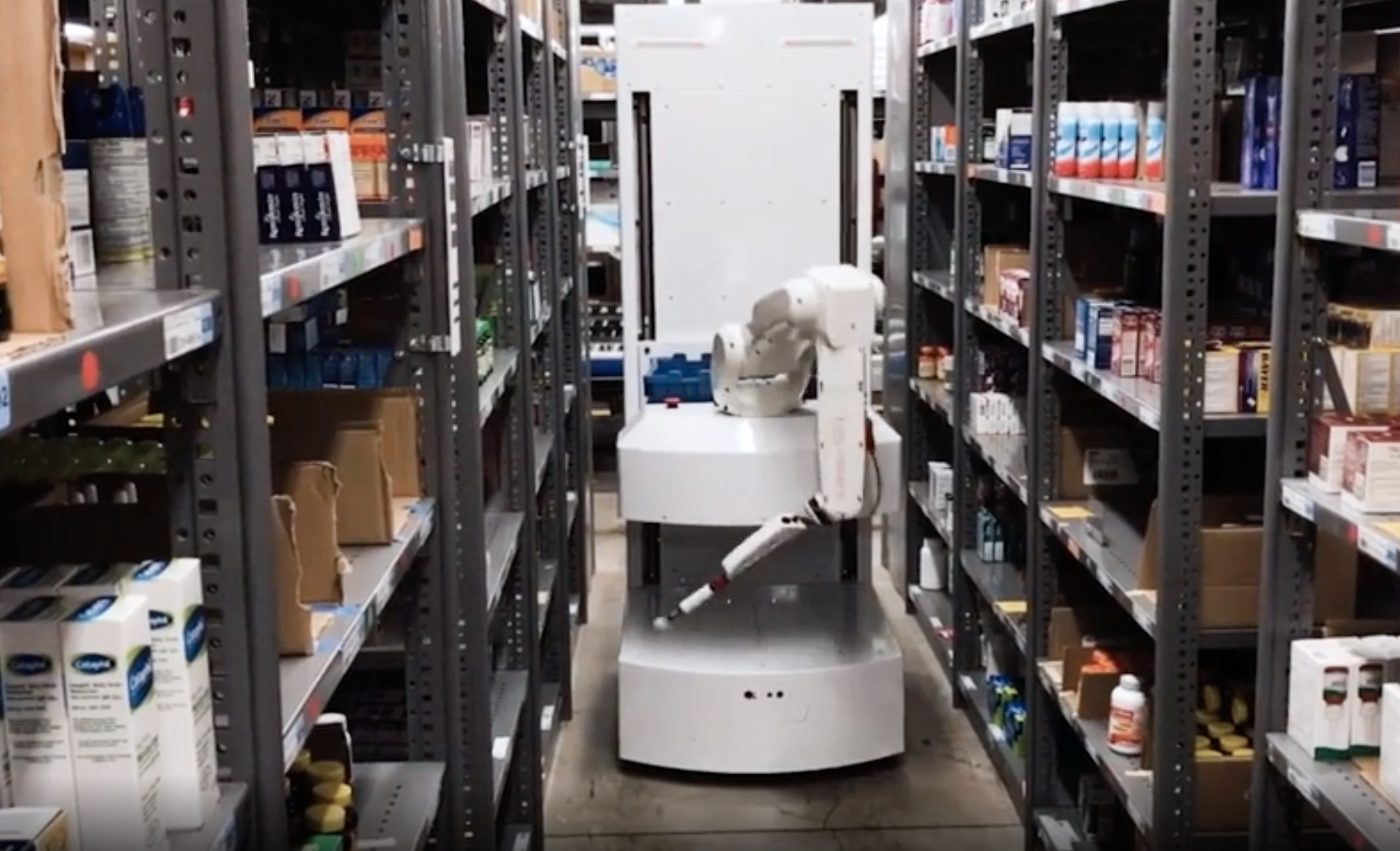
There are a couple of small rows of groceries in a corner of the office space, a few feet away from where the rest of IAM’s staff is at work. A pair of the company’s Swift robots go to work, traveling up and down the small, makeshift aisle. When the robot locates the desired product on a shelf, a long, multi-segmented arm drops down, positioning itself in front of a box. The suction cup tip attaches to the product, then the arm swivels back around to release it into a bin.

Used correctly, the Swift could help companies staff difficult-to-fill positions, while adding a layer of efficiency in the warehouse. “Our customers or prospective customers are looking to automate to both reduce costs, but also to alleviate this manual labor shortage,” says Reed. “So we have a younger generation that’s just more interested in doing jobs like gig economy jobs, drive for Uber, Lyft, those kinds of things, because they can make more money than they could in working at a warehouse.”

12 Apr 2019

Facebook accidentally shipped VR hardware with ‘Big Brother Is Watching’ inscribed on components

In the almost weekly tradition of Facebook talking about something embarrassing they did on a Friday, the company is now fessing up to the fact that thousands of their next-gen virtual reality headset controllers have “easter-egg” messages inscribed on internal components that weren’t meant to be on non-prototype editions.

“Tens of thousands” of unreleased consumer units have the phrases “This Space For Rent” and “The Masons Were Here.” written while some of the developer units have “Hi iFixit! We See You!” and, perhaps most embarrassing, ‘Big Brother Is Watching’ inscribed internally.

The admission was made by Facebook head of VR product Nate Mitchell in a set of tweets.

The company is gearing up for the releases of two new virtual reality products, the $399 standalone Oculus Quest VR system and the $399 PC-tethered Oculus Rift S. Despite being geared towards pretty different audiences, the systems will both share the same Touch controllers that this “issue” affects.

For the most part this is just kind of dumb and funny, it’s a bit embarrassing for a finished hardware product to have phrases with a conspiratorial slant inside of them, but it’s also affecting buyers in zero meaningful ways since it’s not visible unless you pry it open, which you have limited reason to do unless you are indeed iFixit.

That said, it’s better that they come clean rather than have consumers or developers pry their headsets open to find some of these phrases. For a company with so many privacy screw-ups in the past year, having your big hardware releases ship to some developers with ‘Big Brother is Watching” inscribed inside isn’t the best look though.

12 Apr 2019

OpenStack Stein launches with improved Kubernetes support

The OpenStack project, which powers more than 75 public and thousands of private clouds, launched the 19th version of its software this week. You’d think that after 19 updates to the open-source infrastructure platform, there really isn’t all that much new the various project teams could add, given that we’re talking about a rather stable code base here. There are actually a few new features in this release, though, as well as all the usual tweaks and feature improvements you’d expect.

While the hype around OpenStack has died down, we’re still talking about a very active open-source project. On average, there were 155 commits per day during the Stein development cycle. As far as development activity goes, that keeps OpenStack on the same level as the Linux kernel and Chromium.

Unsurprisingly, a lot of that development activity focused on Kubernetes and the tools to manage these container clusters. With this release, the team behind the OpenStack Kubernetes installer brought the launch time for a cluster down from about 10 minutes to five, regardless of the number of nodes. To further enhance Kubernetes support, OpenStack Stein also includes updates to Neutron, the project’s networking service, which now makes it easier to create virtual networking ports in bulk as containers are spun up, and Ironic, the bare-metal provisioning service.

All of that is no surprise, given that according to the project’s latest survey, 61 percent of OpenStack deployments now use both Kubernetes and OpenStack in tandem.

The update also includes a number of new networking features that are mostly targeted at the many telecom users. Indeed, over the course of the last few years, telcos have emerged as some of the most active OpenStack users as these companies are looking to modernize their infrastructure as part of their 5G rollouts.

Besides the expected updates, though, there are also a few new and improved projects here that are worth noting.

“The trend from the last couple of releases has been on scale and stability, which is really focused on operations,” OpenStack Foundation executive director Jonathan Bryce told me. “The new projects — and really most of the new projects from the last year — have all been pretty oriented around real-world use cases.”

The first of these is Placement. “As people build a cloud and start to grow it and it becomes more broadly adopted within the organization, a lot of times, there are other requirements that come into play,” Bryce explained. “One of these things that was pretty simplistic at the beginning was how a request for a resource was actually placed on the underlying infrastructure in the data center.” But as users get more sophisticated, they often want to run specific workloads on machines with certain hardware requirements. These days, that’s often a specific GPU for a machine learning workload, for example. With Placement, that’s a bit easier now.

It’s worth noting that OpenStack had some of this functionality before. The team, however, decided to uncouple it from the existing compute service and turn it into a more generic service that could then also be used more easily beyond the compute stack, turning it more into a kind of resource inventory and tracking tool.

Then, there is also Blazer, a reservation service that offers OpenStack users something akin to AWS Reserved Instances. In a private cloud, the use case for a feature is a bit different, though. But as some of the private clouds got bigger, some users found that they needed to be able to guarantee resources to run some of their regular, overnight batch jobs or data analytics workloads, for example.

As far as resource management goes, it’s also worth highlighting Sahara, which now makes it easier to provision Hadoop clusters on OpenStack.

In previous releases, one of the focus areas for the project was to improve the update experience. OpenStack is obviously a very complex system, so bringing it up to the latest version is also a bit of a complex undertaking. These improvements are now paying off. “Nobody even knows we are running Stein right now,” Vexxhost CEO Mohammed Nasar, who made an early bet on OpenStack for his service, told me. “And I think that’s a good thing. You want to be least impactful, especially when you’re in such a core infrastructure level. […] That’s something the projects are starting to become more and more aware of but it’s also part of the OpenStack software in general becoming much more stable.”

As usual, this release launched only a few weeks before the OpenStack Foundation hosts its bi-annual Summit in Denver. Since the OpenStack Foundation has expanded its scope beyond the OpenStack project, though, this event also focuses on a broader range of topics around open-source infrastructure. It’ll be interesting to see how this will change the dynamics at the event.

12 Apr 2019

Harry Potter, the Platform, and the Future of Niantic

What is Niantic? If they recognize the name, most people would rightly tell you it’s a company that makes mobile games, like Pokémon GO, or Ingress, or Harry Potter: Wizards Unite.

But no one at Niantic really seems to box it up as a mobile gaming company. Making these games is a big part of what the company does, yes, but the games are part of a bigger picture: They are a springboard, a place to figure out the constraints of what they can do with augmented reality today, and to figure out how to build the tech that moves it forward. Niantic wants to wrap their learnings back into a platform upon which others can build their own AR products, be it games or something else. And they want to be ready for whatever comes after smartphones.

Niantic is a bet on augmented reality becoming more and more a part of our lives; when that happens, they want to be the company that powers it.

This is Part 3 of our EC-1 series on Niantic, looking at its past, present, and potential future. You can find Part 1 here and Part 2 here. The reading time for this article is 24 minutes (6,050 words)

The platform play

After the absurd launch of Pokémon GO, everyone wanted a piece of the AR pie. Niantic got more pitches than they could take on, I’m told, as rights holders big and small reached out to see if the company might build something with their IP or franchise.

But Niantic couldn’t build it all. From art, to audio, to even just thinking up new gameplay mechanics, each game or project they took on would require a mountain of resources. What if they focused on letting these other companies build these sorts of things themselves?

That’s the idea behind Niantic’s Real World Platform. This platform is a key part of Niantic’s game plan moving forward, with the company having as many people working on the platform as it has on its marquee money maker, Pokémon GO.

There are tons of pieces that go into making things like GO or Ingress, and Niantic has spent the better part of the last decade figuring out how to make them all fit together. They’ve built the core engine that powers the games and, after a bumpy start with Pokémon GO’s launch, figured out how to scale it to hundreds of millions of users around the world. They’ve put the work into figuring out how to detect cheaters and spoofers and give them the boot. They’ve built a social layer, with systems like friendships and trade. They’ve already amassed that real-world location data that proved so challenging back when it was building Field Trip, with all of those real-world points of interest that now serve as portals and Pokéstops.

Niantic could help other companies with real-world events, too. That might seem funny after the mess that was the first Pokémon GO Fest (as detailed in Part II). But Niantic turned around, went back to the same city the next year, and pulled it off. That experience — that battle-testing — is valuable. Meanwhile, the company has pulled off countless huge Ingress events, and a number of Pokémon GO side events calledSafari Zones.” CTO Phil Keslin confirmed to me that event management is planned as part of the platform offering.

As Niantic builds new tech — like, say, more advanced AR or faster ways to sync AR experiences between devices — it’ll all get rolled into the platform. With each problem they solve, the platform offering would grow.

But first they need to prove that there’s a platform to stand on.

Harry Potter: Wizards Unite

Niantic’s platform, as it exists today, is the result of years of building their own games. It’s the collection of tools they’ve built and rebuilt along the way, and that already powers Ingress Prime and Pokémon GO. But to prove itself as a platform company, Niantic needs to show that they can do it again. That they can take these engines, these tools, and, working with another team, use them for something new.

12 Apr 2019

Matt Cutts on solving big problems with lean solutions at the US Digital Service

Updating the federal government’s digital infrastructure seems like a Herculean task akin to cleaning out the Augean stables. Where do you even start shoveling? Former Googler and current head of the U.S. Digital Service Matt Cutts says it’s not quite that hard — but he’s had to leave his Silicon Valley startup outlook at the door.

“In the Valley and San Francisco, they’re geared to move fast and break things. And that’s fantastic to explore a space,” Cutts told me in an interview. “But the government has to move purposefully and fix things. It’s more about finding the right decision, achieving consensus, creating good communication.”

The USDS is a small (and actively recruiting) department that takes on creaking interfaces and tangled databases of services for, say, veteran benefit management or immigration documentation, buffing them to a shiny finish that may save their users months of literal paperwork.
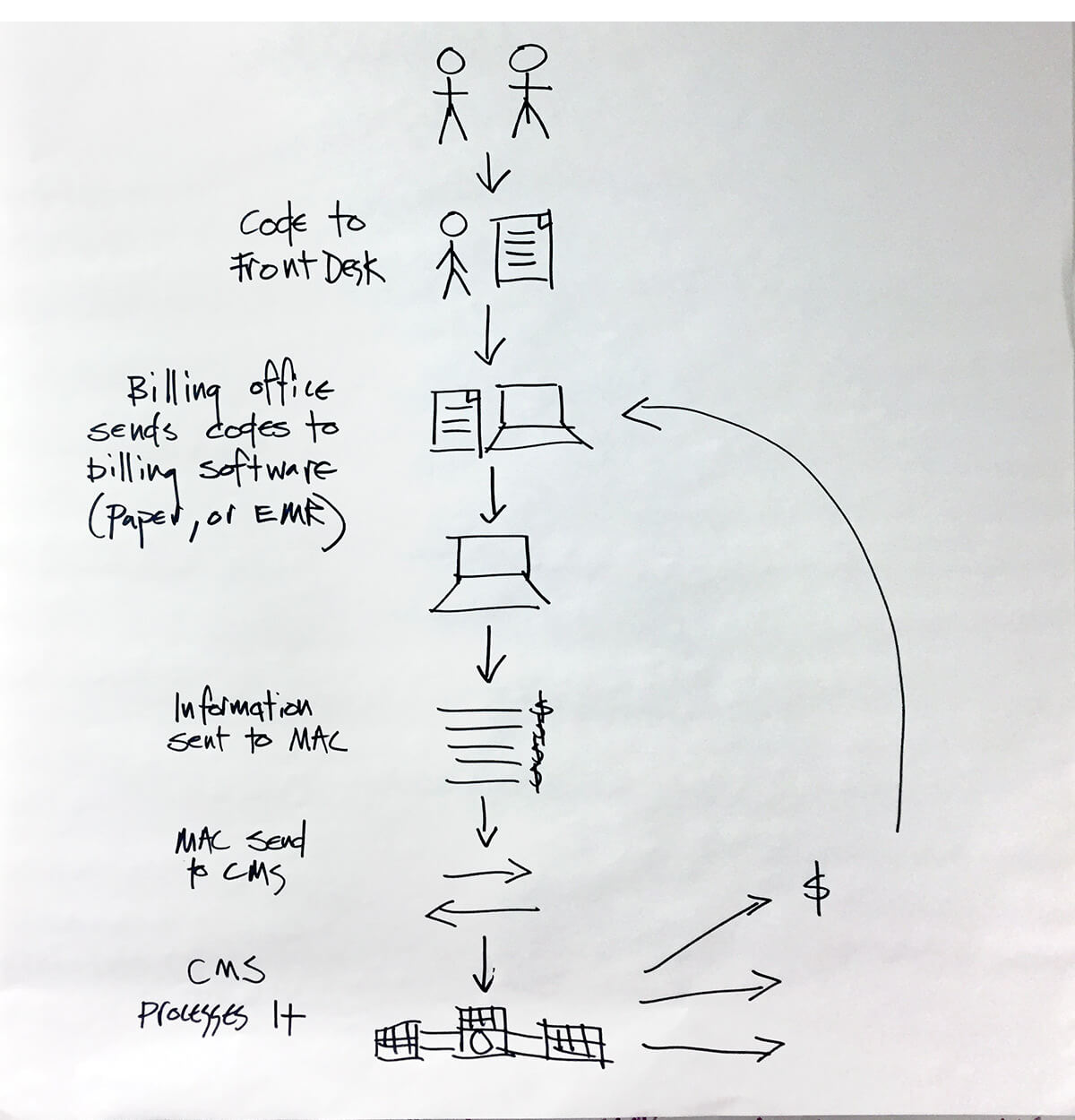
Some notes from the USDS’s work on modernizing the Medicare payment system.

Recently, for instance, the USDS overhauled VA.gov, which is how many veterans access things like benefits, make medical appointments, and so on. But until recently it was kind of a mess of interconnected sub-sites and instructional PDFs. USDS interviewed a couple thousand vets and remade the site with a single login, putting the most-used services right on the front page. Seems obvious, but the inertia of these systems is considerable.

“Oftentimes we build a front end and it still talks to an abysmal, or maybe antiquarian, system in the back end,” Cutts said. “VA.gov required a special version of Internet Explorer!”

There are always paper alternatives, but those can be so slow and clunky that they might take three or four months to complete, and can be so complex that people will hire a lawyer to do them rather than risk further delay. These are ostensibly free and open services available to all vets — but they weren’t in practice. And there were accessibility problems all over the place, Cutts noted, which is especially troubling with a disability-heavy population like veterans.

These projects are often short-term, putting modern web and backend standards to work and handing the results off to the agency or department that requested it. The USDS isn’t built for long-term support but acts as a strike team putting smart solutions in place that may seem obvious in startup culture but haven’t yet become standard operating procedure in the capitol.

The work they do is guided by impact, not politics, which is likely part of the reason they’ve managed to avoid interference by the Trump administration, which has treated many other Obama-era initiatives like pests to be exterminated. Yet the nature of the work is in a way fundamentally progressive, in that it is about bottom-up accessibility and helping under-represented or unprivileged groups.

For instance, they’ve been hard at work on immigration issues that would expedite both asylum seekers and seasonal farm workers at the Mexican border. That’s a political live wire right now, even if the decision to do it was strictly based on helping a large population frustrated by outdated digital tools.

The new farmers.gov, built for the Department of Agriculture, vastly streamlines the H-2A visa application process, centralizing documentation and services that were previously spread across several other major departments and websites. That’s unarguably a good thing, but like anything relating to immigration and foreign labor it is possible it could get swept up in the partisan twister. Fortunately that doesn’t seem to have happened.

The new, improved and simplified farmers.gov provides app integration and straightforward design.

“The fact is we get good support,” Cutts said when I asked him about the current political environment. It may not be loud in that support, but quiet actions like appointing former USDS officials and engineers to important roles within administration are common, he said.

There are plenty of other programs looking to modernize federal as well as state systems, he pointed out; it’s a rising tide and it’s lifting a lot of boats.

“I signed up for a three month tour, and that was three years ago,” he said. “It’s really a whole civic tech movement here, there are a ton of people sort of holding hands and working together. There’s also stuff happening at the state and local level, at the international level, from the UK to Estonia and Singapore — everyone’s starting to realize this matters.”

Recruitment, however, is more difficult than he’d like, perhaps partly because of self-imposed hiring practices made to reflect the diversity of the country.

“We get the best results when we represent all of America,” said Cutts. “So I go to Microsoft and Ann Arbor, regular events, but also like, Lesbians Who Tech or Grace Hopper Fest.”

Still, startups and big tech companies regularly poach talent or otherwise lure them away. “They’re just better at recruiting,” he said. And there’s some kind of fundamental disconnect at work, too, perhaps the comfortable contempt many young people have for the government — but he suggested that those seeking to do good might want to do a more serious evaluation of the tech landscape.

“I joined Google because I wanted to make the world a better place,” he said. “But if you look at the #metoo movement, how the tech industry has been acting lately… everyone at those companies has to ask that question, am I really having that impact?”

If you’re not sure, you might consider doing a tour at the USDS. They’re launching products and helping people just like startups aim to do, but they’re beholden to ordinary citizens in need, not investors. That sounds like a step up to me.


12 Apr 2019

Trump, FCC unveil plan to accelerate 5G rollout

In a press conference today in the White House’s Roosevelt Room, the President laid out a number of initiatives focused on helping accelerate the U.S. role in the 5G race.

“This is, to me, the future,” Trump said, opening the press conference flanked by Ajit Pai, Ivanka Trump and a room full of communications representatives in cowboy and hard hats.

“It’s all about 5G now,” Trump told the audience. “We were 4G and everyone was saying we had to get 4G, and then they said before that, ‘we have to get 3G,’ and now we have to get 5G. And 5G’s a big deal and that’s going to be there for a while. And at some point we’ll be talking about number six.”

The apparently off script moment echoed Trump’s recent call on Twitter for the U.S. to get 6G technology “as soon as possible.” There’s something to said for the spirit, perhaps, but it’s probably a little soon to be jumping the gun on a technology that doesn’t really exist just yet.

Trump used the opportunity to downplay earlier rumors that the government might be building its own 5G network, instead promoting a free market method, while taking a shot at the government’s capabilities. “In the United States, our approach is private sector driven and private sector led,” he added. “The government doesn’t have to spend lots of money.”

In recent months, however, both the administration and the FCC have been discussing ways to make America more competitive in the race to the soon-to-be-ubiquitous cellular technology. Earlier today, the FCC announced plans to hold the largest spectrum auction in U.S. history, offering the bands up to wireless carriers. The planned auction is set to kick off on December 10.

“To accelerate and incentivize these investments, my administration is freeing up as much wireless spectrum as needed,” Trump added, echoing Pai’s plans.

Earlier today Pai and the FCC also proposed a $20.4 billion fund design to help connect rural areas. The Chairman said the commission believes the fund could connect as many as four million small businesses and residences over the course of the next decade.

The focus is understandable, of course. 5G’s value will go far beyond faster smartphone, providing connections for a wide range of IoT and smart technologies and potentially helping powering things like robotics and autonomous vehicles. The technology will undeniably be a key economic driver, touching as of yet unseen portions of the U.S. workforce.

12 Apr 2019

Nancy Pelosi warns tech companies that Section 230 is ‘in jeopardy’

In a new interview with Recode, House Speaker Nancy Pelosi made some notable comments on what by all accounts is the most important law underpinning the modern internet as we know it.

Section 230 is as short as it is potent, so it’s worth getting familiar with. It states “No provider or user of an interactive computer service shall be treated as the publisher or speaker of any information provided by another information content provider.”

When asked about Section 230, Pelosi referred to the law as a “gift” to tech companies that have leaned heavily on the law to grow their business. That provision, providing tech platforms legal cover for content created by their users, is what allowed services like Facebook, YouTube and many others to swell into the massive companies they are today.

Pelosi continued:

“It is a gift to them and I don’t think that they are treating it with the respect that they should, and so I think that that could be a question mark and in jeopardy… I do think that for the privilege of 230, there has to be a bigger sense of responsibility on it. And it is not out of the question that that could be removed.”

Expect to hear a lot more about Section 230. In recent months, a handful of Republicans in Congress have taken aim at the law. Section 230 is what’s between the lines in Devin Nunes’ recent lawsuit accusing critics for defaming him on Twitter. It’s also the extremely consequential subtext beneath conservative criticism that Twitter, Facebook and Google do not run “neutral” platforms.

While the idea of stripping away Section 230 is by no means synonymous with broader efforts to regulate big tech, it is the nuclear option. And when tech’s most massive companies behave badly, it’s a reminder to some of them that their very existences hinge on 26 words that Congress giveth and Congress can taketh away.

Whatever the political motivations, imperiling Section 230 is a fearsome cudgel against even tech’s most seemingly untouchable companies. While it’s not clear what some potentially misguided lawmakers would stand to gain by dismantling the law, Pelosi’s comments are a reminder that tech’s biggest companies and users alike have everything to lose.

12 Apr 2019

Nancy Pelosi warns tech companies that Section 230 is ‘in jeopardy’

In a new interview with Recode, House Speaker Nancy Pelosi made some notable comments on what by all accounts is the most important law underpinning the modern internet as we know it.

Section 230 is as short as it is potent, so it’s worth getting familiar with. It states “No provider or user of an interactive computer service shall be treated as the publisher or speaker of any information provided by another information content provider.”

When asked about Section 230, Pelosi referred to the law as a “gift” to tech companies that have leaned heavily on the law to grow their business. That provision, providing tech platforms legal cover for content created by their users, is what allowed services like Facebook, YouTube and many others to swell into the massive companies they are today.

Pelosi continued:

“It is a gift to them and I don’t think that they are treating it with the respect that they should, and so I think that that could be a question mark and in jeopardy… I do think that for the privilege of 230, there has to be a bigger sense of responsibility on it. And it is not out of the question that that could be removed.”

Expect to hear a lot more about Section 230. In recent months, a handful of Republicans in Congress have taken aim at the law. Section 230 is what’s between the lines in Devin Nunes’ recent lawsuit accusing critics for defaming him on Twitter. It’s also the extremely consequential subtext beneath conservative criticism that Twitter, Facebook and Google do not run “neutral” platforms.

While the idea of stripping away Section 230 is by no means synonymous with broader efforts to regulate big tech, it is the nuclear option. And when tech’s most massive companies behave badly, it’s a reminder to some of them that their very existences hinge on 26 words that Congress giveth and Congress can taketh away.

Whatever the political motivations, imperiling Section 230 is a fearsome cudgel against even tech’s most seemingly untouchable companies. While it’s not clear what some potentially misguided lawmakers would stand to gain by dismantling the law, Pelosi’s comments are a reminder that tech’s biggest companies and users alike have everything to lose.

12 Apr 2019

HQ Trivia replaces Quiz Daddy Scott Rogowsky

Quiz Khalifa aka Host Malone aka Trap Trebek aka HQ Trivia’s Scott Rogowsky has been pushed out of the live mobile gaming startup. The two split due to disagreements about Rogowsky attempting to take a second full-time job hosting sports streaming service DAZN’s baseball show ChangeUp while moving to only hosting HQ on weekends, TMZ first reported. HQ wanted someone committed to their show.

Now HQ co-founder and CEO Rus Yusupov confirms to TechCrunch that Rogowsky will no longer host HQ Trivia. He tells me that the company ran a SurveyMonkey survey of its top players and they voted that former guest host Matt Richards rated higher than Rogowsky. Yusupov says HQ is excited to have Richards as its new prime time host. It’s also putting out offers to more celebrity guests to host for a few shows, a few weeks, or even a whole season of one of its time slots.

The departure could still shake HQ’s brand since Rogowsky had become the defacto face of the company. But he was also prone to talking a lot on the air and promoting himself, sometimes in ways that felt distracting from the game. Rogowsky has also been using HQ’s brand to further his standup comedy career, splashing its logo on advertising for his shows like this one below at a casino where “The centerpiece is a live trivia competition”, he told WPTV5.

TechCrunch had predicted that Rogowsky might depart if he wasn’t properly compensated with equity in HQ Trivia that would only vest and earn him money if he stuck around. The damage to HQ could worsen if he’s scooped up by Facebook, Snapchat, or another tech company to build out their own live video gaming shows.

HQ Trivia provided this statement on Rogowsky’s exit:

“We continue to build an incredible company at HQ Trivia, from drawing hundreds of thousands of players to the platform daily, to increasing the size of the prize, to attracting strong talent. We’ve come a long way since Scott Rogowsky’s first trivia game and we’re grateful for everything he’s done for the platform. This is a team that creates products for talent to really shine—we’re just getting started at HQ Trivia, and as he makes his next move, wanted to take a minute to thank him for being part of our journey.”

Yusupov tells me he’s excited about exploring new hosts, noting that Richards in a person of color who brings more diversity to HQ’s lineup. Richards is a standup comic who has appeared on CBS’ 2 Broke Girls, Nickelodeon’s School of Rock and was a voice-over host for game show Trivial Takedown on FUSE. Yusupov says the team feels jazzed about the new creative opportunities beyond Rogowsky, though the CEO says he appreciates all that its former host contributed.

Richards will have the tall task of trying to revive HQ’s popularity. It climbed the app store charts to become the #3 top game and #6 overall app in January 2018, and peaked at 2.38 million concurrent players in March 2018. But it’s been on a steady decline since, falling to the #585 overall app in August, and it dropped out of the top #1500 last month according to App Annie.

Exhaustion with the game format, so many winners splitting jackpots to just a few dollars per victor, and laggy streams have all driven away players. The introduction of a new Wheel Of Fortune-style HQ Words game in August hasn’t stopped the decline. And the tragic death of HQ co-founder and former CEO Colin Kroll may have impeded efforts to turn things around. There’s a ton of pressure on the company after it raised $23 million, including a $15 million round at a $100 million valuation.

Even if HQ Trivia fades from the zeitgeist, it and Rogowsky will have inspired a new wave of innovation in what it means to play with our phones.