Category: UNCATEGORIZED

12 Apr 2019

This little translator gadget could be a traveling reporter’s best friend

If you’re lucky enough to get travel abroad, you know it’s getting easier and easier to use our phones and other gadgets to translate for us. So why not do so in a way that makes sense to you? This little gadget seeking funds on Kickstarter looks right up my alley, offering quick transcription and recording — plus music playback, like an iPod Shuffle with superpowers.

The ONE Mini is really not that complex of a device — a couple microphones and a wireless board in tasteful packaging — but that combination allows for a lot of useful stuff to happen both offline and with its companion app.

You activate the device, and it starts recording and both translating and transcribing the audio via a cloud service as it goes (or later, if you choose). That right there is already super useful for a reporter like me — although you can always put your phone on the table during an interview, this is more discreet and of course a short-turnaround translation is useful as well.

Recordings are kept on the phone (no on-board memory, alas) and there’s an option for a cloud service, but that probably won’t be necessary considering the compact size of these audio files. If you’re paranoid about security this probably isn’t your jam, but for everyday stuff it should be just fine.

If you want to translate a conversation with someone whose language you don’t speak, you pick two of the 12 built-in languages in the app and then either pass the gadget back and forth or let it sit between you while you talk. The transcript will show on the phone and the ONE Mini can bleat out the translation in its little robotic voice.

Right now translation online only works, but I asked and offline is in the plans for certain language pairs that have reliable two-way edge models, probably Mandarin-English and Korean-Japanese.

It has a headphone jack, too, which lets it act as a wireless playback device for the recordings or for your music, or to take calls using the nice onboard mics. It’s lightweight and has a little clip, so it’s probably better than connecting directly to your phone in many cases.

There’s also a 24/7 interpreter line that charges two bucks a minute that I probably wouldn’t use. I think I would feel weird about it. But in an emergency it could be pretty helpful to have a panic button that sends you directly to a person who speaks both the languages you’ve selected.

I have to say, normally I wouldn’t highlight a random crowdfunded gadget, but I happen to have met the creator of this one, Wells Tu, at one of our events and trust him and his team to actually deliver. The previous product he worked on was a pair of translating wireless earbuds that worked surprisingly well, so this isn’t their first time shipping a product in this category — that makes a lot of difference for a hardware startup. You can see it in action here:

He pointed out in an email to me that obviously wireless headphones are hot right now, but the translation functions aren’t good and battery life is short. This adds a lot of utility in a small package.

Right now you can score a ONE Mini for $79, which seems reasonable to me. They’ve already passed their goal and are planning on shipping in June, so it shouldn’t be a long wait.

12 Apr 2019

Juul launches a pilot program that tracks how Juul devices get in the hands of minors

Juul Labs is today launching a pilot for its new Track & Trace program, which is meant to use data to identify exactly how Juul devices wind up in the hands of minors.

Juul vaporizers all have a serial number down at the bottom, by the Juul logo. However, it wasn’t until recently that Juul had the capability to track those serial numbers through every step of the process, from manufacture to distribution to retail to sale.

With Track & Trace, Juul is calling upon parents, teachers and law enforcement officials to come to the Juul Report web portal when they confiscate a device from a minor and input the serial number. Each time a device is input in the Track & Trace system, Juul will open an investigation to understand how that minor wound up with that device.

In some cases, it may be an issue with a certain retail store knowingly selling to minors. In others, it may be a case of social sourcing, where someone over 21 years of age buys several devices and pods to then sell to minors.

Juul will then take next steps in investigating, such as talking to a store manager about the issue. It may also enhance its secret shopper program around a certain store or distributor where it sees there may be a spike in sale/distribution to youth to identify the source of the problem. To be clear, Track & Trace only tracks and traces the devices themselves, and does not use personal data about customers. It’s also worth noting that Juul Labs has increased

Juul isn’t yet widely publicizing Track & Trace (thus, the “Pilot” status), but it is focusing on Houston as a testing ground with banner ads targeted at older individuals (parents, teachers, etc.) pointing them to the portal. Of note: the ad campaign is geofenced to never be shown in or around a school, hopefully keeping the program a secret from young people illegally using Juul.

The company wants to learn more about how people use the portal and test the program in action before widening the campaign around Track & Trace. That said, the Report portal is not limited to Houston residents — anyone who confiscates a Juul can report it through the portal and trigger an investigation.

“It’s important to note that the pilot is an opportunity for us to learn how the technology is working and optimize the technology,” said Chief Administrative Officer Ashley Gould. “It’s not just at the retailer level. It’s a whole process through the supply chain to track that device and find out if everyone who is supposed to be scanning it is scanning it, and the software that we’ve created to track that serial number through the supply chain to the retail store is working. The only way we’re going to know that is when someone puts in the serial number and we see if we have all the data we need to track it.”

According to Juul, every device in production will be trackable in the next few weeks. In other words, Juul vapes that are years old are likely not fully traceable in the program, but those purchased more recently should work with the system.

Juul has been under scrutiny from the FDA and a collection of Republican Senators due to the device’s rise in popularity among young people. Outgoing FDA Commissioner Scott Gottlieb has called it “an epidemic” and enforced further restrictions on sales of e-cig products.

Juul has also made its own effort, removing non-tobacco and non-menthol flavored pods from all physical retail stores, enhancing their own purchasing system online to ensure online buyers are 21+ and not buying in bulk, going after counterfeits and copycats posing as Juul products, and exiting its Facebook and Instagram accounts.

But Juul Labs also committed to build technology-based solutions to prevent youth use of the product. Cofounder and CPO James Monsees told TechCrunch at Disrupt SF that the company is working on Bluetooth products that would essentially make the Juul device as smart as an iPhone or Android device, which could certainly help lock out folks under 21.

However, the Track & Trace program is the first real technological step taken by the e-cig company. And it’s been an expensive one. The company has spent more than $30 million to update its packaging, adjust printing standards, changing manufacturing equipment, and integrate the data and logistics software systems.

For now, Track & Trace is only applicable to Juul vaporizers, but it wouldn’t be shocking to learn that the company was working on a similar program for its Juul Pods. 

12 Apr 2019

With a new CEO and fresh funding from Upfront, healthy prepared food delivery service Territory looks to grow

With a new chief executive officer and $4 million in fresh funding from investors including the Los Angeles-based investment firm, Upfront Ventures, Territory Foods is poised for growth.

The company recently hired powerhouse executive Abby Coleman, the former vice president of marketing and strategy at Quidsi and head of e-commerce at Diapers.com as its new chief executive and is now looking to expand its footprint and unique approach to meal delivery beyond its current geographies.

The company uses a proprietary food recommendation engine to determine its subscribers’ personal preferences to deliver them meals that are more tailored to their individual tastes.

Territory also employs a unique business model, leveraging local chefs to prepare meals according to menus designed by the company.

The distributed workforce of gig chefs allows the company greater flexibility in planning, preparing, and distributing its meals, according to Coleman.

A lifelong vegetarian and mother of two vegetarian daughters, the 39-year-old Coleman actually began her business in the food services industry as a caterer before moving on to leadership positions at Kraft Foods and Mondelez International before taking on the vice presidential role at Quidsi.

“My coming on board was really a response to a decision that the board and Patrick [Smith] made that it was time to scale the business,” says Coleman. 

With the new cash the company intends to expand its footprint in locations beyond its hubs in major cities on the East and West coasts (and Texas), including: Baltimore, Dallas/Ft. Worth, Los Angeles, San Francisco, and the Washington metropolitan area.

There’s plenty of opportunity for growth considering that the market for healthy eating and personalized food is roughly $702 billion, according to the company. In 2018, one out of every three Americans reported to following some kind of healthy eating protocol with the percentage highest among 18-34 year olds, according to information provided by Territory.

“It’s rare to see businesses like Territory that hit major trends at the right time with the right product,” said Kara Nortman, Partner at Upfront Ventures. “Territory has been able to consistently punch above its weight with a very smart economic model and a product that consumers love, and we couldn’t be more excited to lean into this business with Abby and her team. Abby’s passionate knowledge of food and superb ecommerce skills combine to make her the perfect leader for Territory’s next phase of growth.”

Indeed, the company’s methodical approach to growth has been a strength that has led it to profitability in core markets like Los Angeles and Washington, Coleman says.

Territory wrings efficiency out of its network of chefs, which has a high retention rate and allows the company to act in an asset light way. Chefs are paid to prepare the meals, but provide the ingredients themselves and work as contractors rather than employees. They pocket the difference between the cost of the ingredients they use and the price they’re paid by Territory to prepare the meals.

Coleman says the business model leverages the excess capacity caterers have while offering them the opportunity to tailor their meals to suit local market tastes.

And just because the chefs are given a bit of free rein doesn’t mean that there’s any lack of quality control, Coleman says. “The emphasis is on the quality control that a product is up to our standards,” according to Coleman. 

Meals are $10.95 and are designed around the needs of customers — ranging from paleo, whole 30, keto, and vegetarian options. Now, Coleman is looking to aggressively expand the flexibility and menu options available to customers.

“It’s more like a restaurant and we’re going to have an entirely new menu next week,” Coleman says. “We create over 400 new dishes a year.”

Despite the woeful performance of public companies like Blue Apron, prepared food companies are still attracting investor attention and interest — especially if they’re married with a pitch to health-conscious consumers targeting a specific diet.

Territory Foods has raised $20 million to date, including the new cash from Upfront Ventures and Lewis & Clark, while Trifecta, another purveyor of prepared foods has raised $2.6 million. And the giants are still around as well, the companies like Plated, HelloFresh, Home Chef (owned by Kroger Foods), and Sun Basket, which have raised over $500 million combined.


12 Apr 2019

Watch the first trailer for ‘Star Wars: The Rise of Skywalker’

Hot on the heels of announcing the details of the upcoming Disney+ streaming service (which will feature plenty of Star Wars content), Disney and Lucasfilm just released the first trailer for “Star Wars: The Rise of Skywalker.”

The unveiling came at the end of a panel at this year’s Star Wars Celebration event in Chicago, where the title of the movie (previously only known as “Star Wars Episode IX”) was finally revealed.

While on-stage, director J.J. Abrams and Lucasfilm President Kathleen Kennedy talked about filming after the death of Carrie Fisher. They’d already announced that they will not be using CGI to try to bring Fisher’s character Leia Organa back to life — but she will be a part of “The rise of Skywalker,” using previously unused footage from “The Force Awakens.”

“The craziest part is how not crazy it feels,” Abrams said. “Princess Leia lives in this film in a way that is kind of mind-blowing to me.”

Abrams and Kennedy were then joined by new and old cast members on-stage, including Billy Dee Williams, who is (finally!) returning as Lando Calrissan. Williams said it was “highlight” of his career to be in the new film — and to work with the 52-year-old Abrams, who he described “a beautiful young man.”

Abrams emphasized the idea that while “The Rise of Skywalker” is the final installment on the Skywalker Saga and the culmination of a nine-film story, it also has to work as its own film, and he said “This movie, it’s about this new energy and what they’ve inherited, the light and the dark.”

Abrams added that these characters will be facing “the greatest evil,” becoming cagey once Colbert asked him who or what that evil is. But the trailer ends with the familiar laugh of Emperor Palpatine (villain of the original films), and as soon as the lights went up, Palpatine actor Ian McDiarmid was on stage.

“Star Wars: The Rise of Skywalker” will be released on December 20, 2019.

12 Apr 2019

Daily Crunch: Uber files to go public

The Daily Crunch is TechCrunch’s roundup of our biggest and most important stories. If you’d like to get this delivered to your inbox every day at around 9am Pacific, you can subscribe here.

1. Uber files for IPO

Uber has filed its S-1, setting the stage for the transportation company to go public next month. The company will list on the New York Stock Exchange under the symbol “UBER.”

Uber had already disclosed most of the financial information released yesterday, but among the tidbits revealed: It spent $457 million on self-driving and flying car R&D last year.

2. Disney+ streaming service launches on November 12, with a price of $6.99 per month

Executives also offered the first look at what they said is a “working prototype” of the Disney+ service, which will also be the exclusive streaming home of “The Simpsons.”

3. Nintendo Labo VR review

In comics form!

4. Apple’s iOS will now confirm you meant to subscribe to that app

Apple has added another step to prevent users from accidentally signing up for an iOS app’s subscription — or, from being tricked into it by a scammy app not playing by the rules.

5. The chat feature may soon return to Facebook’s mobile app

That’s according to researcher Jane Manchun Wong, who discovered an unreleased feature that brings limited chat features back into the core social networking app.

6. CEO Jennifer Tejada just took PagerDuty public; we talked about the roadshow, the IPO and what comes next

“The vision doesn’t change,” Tejada said. “We intend to do exactly what we’ve been doing, which is to provide the best real-time operations platform available to companies as they undergo digital transformation to meet the growing demands of their customers.”

7. Twin astronaut study suggests interplanetary travel may not be a health risk

The human body “remains robust and resilient” after almost a year in space, according to a long-term, multi-institutional study of twins, one of whom lived aboard the International Space Station for 340 days while the other remained on Earth.

12 Apr 2019

Verified Expert Lawyer: Adam Zagaris

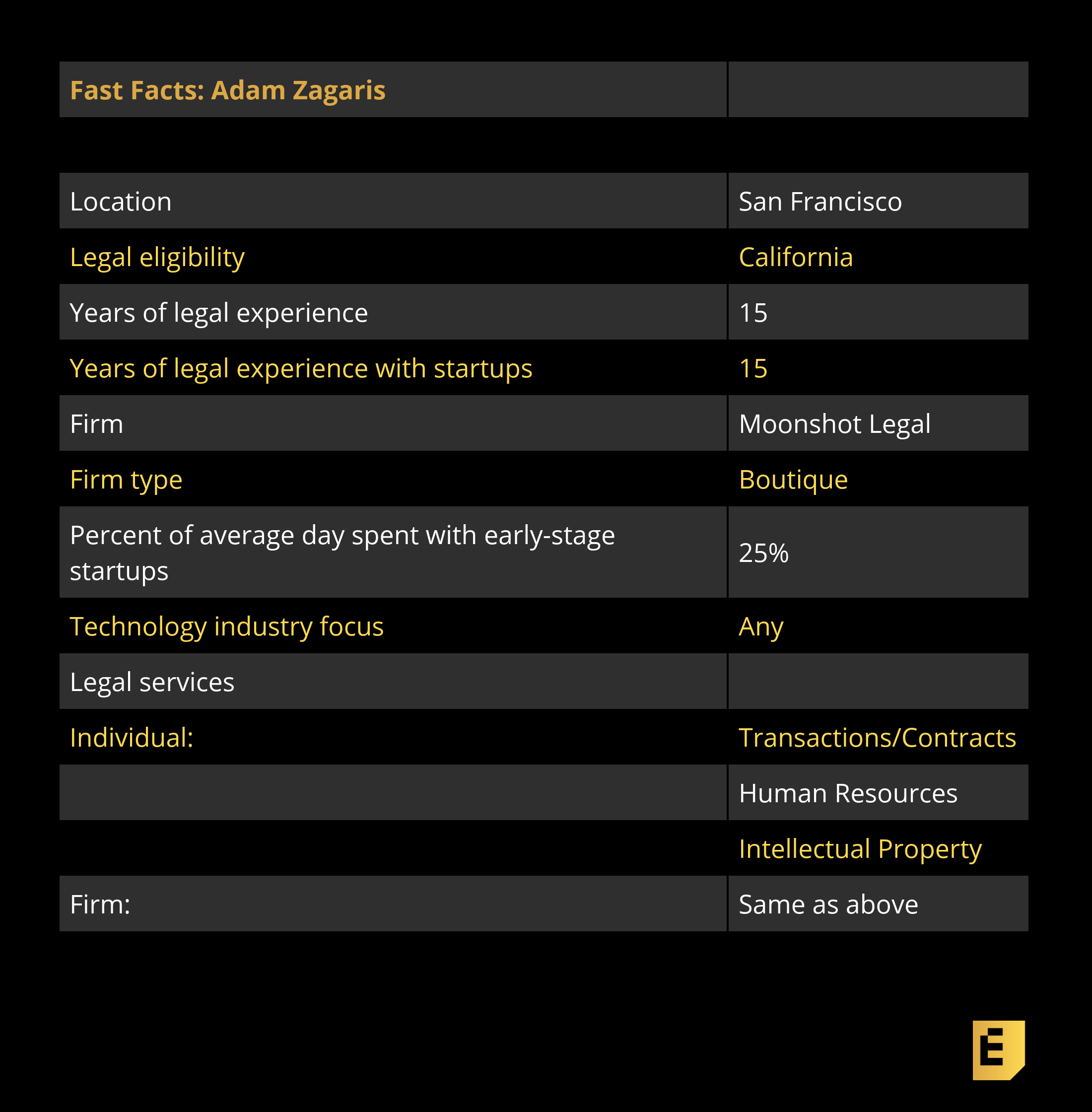
Adam Zagaris prides himself in being an outside general counsel who helps startups get day-to-day paperwork done efficiently and well — particularly when they are facing off against tough bigger partners. Although he started his career at big Silicon Valley law firms, he has built a streamlined practice at Moonshot Legal in recent years that covers everything from contracts and terms to intellectual property and human resources. 

He gives his no-holds-barred view of his practice and the startup world in the interview below, followed by recommendations from many dozens of startup leaders — he’s racked up one of the highest tallies among the hundreds of lawyers we’ve had recommended in our survey.


On negotiating

“Representing startups for almost 15 years, my job as going head-to-head with the big dogs of the world, making sure that my clients — in a strategic, creative way — get deals done. When you work with clients that often have less leverage than counter-parties, it takes a creative approach to get deals done. For example, if they have a hundred points they would like to get in a contract but it will slow deals down, miss quarters or kill deals, I help them focus on a dozen or two points — what they really need — and then help them get those wins.”

On common startup mistakes:

“There are two general mistakes I see clients making these days (and both are largely the fault of attorneys). First, clients are often afraid to ‘get legal involved’. Attorneys are often viewed as obstacles to getting business done. Second, founders often view legal work as commoditized. Some clients would rather download random contracts off a Google search and negotiate themselves – rather than call an attorney. Both of these mistakes are the fault of attorneys – not founders. It is incumbent on attorneys to help move business forward. This is done by creating clear alignment (both practical and optical) of legal services with business interests. It is on us to help clients understand we are here to help move the ball forward, not to simply stand in the way over-lawyering and saying “no”. In addition, the value we bring to the table is often critical but not immediately apparent. We need to better educate clients on this.”

On his approach:

“If it wasn’t for Adam and the recommendations he made who knows where the company would have been.” Tyler Smith, Sacramento, CEO, SkySlope

“My practice style is deal-centric and pragmatic. I am not here to “over-lawyer”, always say “no” and send clients big bills. Strategic advice and creative negotiations and solutions give provide win-wins. With the increasing speed of technology and marketplace competition, an attorney needs to be a facilitator not an obstacle. So whether my clients want to close deals, resolve disputes or otherwise move business forward, my job is getting that done. Period. And having worked exclusively with startups for over a decade, I understand their needs and pain points. My clients want (and with me have) legal representation that shares their paradigm, keeps bills lean and helps them crush their goals. We’re in this together.”
Below, you’ll find more founder reviews about Adam, the full interview, and more details about his pricing and fee structures.

This article is part of our ongoing series covering the early-stage startup lawyers who founders love to work with, based on this survey and our own research. The survey is open indefinitely so please fill it out if you haven’t already. If you’re trying to navigate the early-stage legal landmines, be sure to check out our growing set of in-depth articles, like this checklist of what you need to get done on the corporate side in your first years as a company.

The Interview


Eric Eldon: I’d just like to hear about how you got into working with startups. Anything that you can tell me about your clients, and the kind of things you focus on with a new practice.

Adam Zagaris: Sure, absolutely. I started my career at Wilson Sonsini, and was there for a year in the IT litigation department. Decided I didn’t want to be a litigator. Some of the best attorneys (and people) I know are litigators. But when you are a litigator, clients really don’t want to call you. If they call you it often means shit is going sideways. As a transaction attorney clients want to call me, I help get deals done and what I do means they make money, have solid contracts that will diligence well down the road with investors and potential acquirers, etc. So I joined Gunderson Dettmer’s technology transactions group. Hands down the best group of attorneys I have ever know.

For the 15 years that I was at Gunderson Dettmer, my career focused on the transactional side of the law. I tell clients I essentially handle all the day-to-day things companies deal with. SaaS deals, licensing deals, marketing arrangements, contractor agreements, partnerships, etc. I’m the lawyer you call every day to get shit done, move deals across the line. I also handle privacy matters, such as creating privacy policies, as well as dealing with soft intellectual property and HR matters. Anything you would do that does not fall squarely on the corporate side of the line, such as financings, is something I would handle or can help advise on to possibly avoid bringing in outside specialty counsel. I’m the boots on the ground lawyer. As such, clients often view me as outside general counsel.

Also, many startups do not have the internal contract processes that large companies have. People are moving fast and wearing different hats. So I also help them streamline processes and wear different hats myself where I can. Last week I helped a client beta test a product. I will do everything I can to help do the heavy lifting to help free up bandwidth for clients. Clients want to focus on building their business, not worrying about legal matters.

Eric Eldon: Gotcha. It sounds like you’re more on the sort of contract side with some company formation and financing, and some compensation and HR. Is that right? Do you have any specific challenges that you want to use as an example that you helped a company navigate through?

Adam Zagaris: Look, the ultimate challenge is this: I have only represented startup companies my entire career, and whether they’re sort of larger stage or the smaller stage. Representing startups for almost 15 years, my job as going head-to-head with the big dogs of the world, making sure that my clients — in a strategic, creative way — get deals done. When you work with clients that often have less leverage than counter-parties, it takes a creative approach to get deals done. For example, if they have a hundred points they would like to get in a contract but it will slow deals down, miss quarters or kill deals, I help them focus on a dozen or two points — what they really need — and then help them get those wins. Again, many clients often have little to no leverage, but we will still get wins. I tell clients to trust my approach and they all learn, with no exception, it works. Period.

Eric Eldon: What’s the biggest problem that you see founders making? What are the biggest mistakes you see them make when they come in the door and you decide to work with them?

Adam Zagaris: One is, everybody plays a lawyer on TV, okay. People think they know what they’re doing, and they pull some contracts off of Google. I have clients, and they send me license agreements they printed off Google. Contracts that have all sorts of issues. Issues that can lead to contract disputes or cause valuation issues.

The reason that’s a problem is not their fault. It’s our fault, because lawyers, for a long time, have charged a lot and made their clients think they should be thankful, feel blessed, to work with lawyers. There’s this backlash where now they view, you know, clients view some types of legal work as commoditized. They think they can do it themselves, and that’s because, in the greater scheme of things the arrogance, and the inefficiency and the cost of some lawyers has driven people in the opposite direction. This is a small minority of lawyers, but some bad apples as they say. It’s our job, or at least I think it’s my job, to make sure that. I’m in the customer service business. To make sure that my clients are okay coming to me with things. Make sure they want to come to me. My clients know I’m going to strategic, creative, business-oriented and efficient and not rack up bills. They know I have their best interests in mind and am on their side of the table. I’m lucky to represent my clients.

Eric Eldon: Could you tell me more about your billing structure? Like, flat fee, upfront stuff, delayed.

Adam Zagaris: My practice is based on radical, flexible fee transparency. My billing rate is favorable and given my practice style and experience, there are levels of efficiency on top of that. For smaller clients, to the extent I can, I charge flat fees for certain types of deals and handling things like reviewing forms. For larger clients (30 plus employees), I can do the same thing. But for some larger clients, I work on a subscription fee basis (not a retainer, rather a flat fee with no overage). Based on an estimate of how many hours they will likely need in a given calendar quarter. I come up with that estimate in close conjunction with the client. For example, if I think they will 30 hours a quarter I will charge a flat fee based on that. Again, it is not a retainer so there is no overage, They can come to me as much as they want. This greatly helps reduce friction for their deal cycles. For example, sales teams do not have to funnel everything through the CFO to see if they can spend legal fees handling something. With a flat fee, the teams come directly to me. Removes a level of abstraction. I can tell you the funnel point (CFO or CRO or whoever) greatly appreciates it. Frees up bandwidth for them to do they their real work. In short, I am flexible in how I work with clients. Some engagements also have an equity component.

Founder reviews


“Adam is extremely dedicated to the companies he represents, and has legal and practical abilities that allow him to steer companies and other clients through choppy waters. He is an asset to any organization.” — A startup operations manager based out of India

“Adam was instrumental in streamlining our contract/MSA process for new clients and providing a lightweight template that sped up our sales cycle. This past year, in part to these improvements and others, we have quadrupled our client base.” — A startup sales and marketing executive in San Francisco

“Proficient at sales contract negotiation.” — A startup sales executive in Seattle

“Adam has tremendous work ethic and is always on 24/7. At the end of the quarter last year, he was able to efficiently prioritize MSA redline reviews and help us get all our deals across the line. Could not recommend him enough.” — Jason Plank, Campbell CA, Senior Director of Sales, Clari

Licensing agreement for a Lighting Design Company to use core coding for an app on a profit share basis. May sound straightforward but in the lighting world this is complete new territory.” — A startup marketing executive in London

“All MSA, EULA agreements for SaaS service” — A startup sales executive in Indiana

“We recently started working with Adam. He’s running point on our commercial contract negotiations. Adam’s been a great mix of business-minded legal advice. I look forward to working with him more.” — David Blonski, Mountain View CA, CFO, Elementum

“Adam is able to get deals done.  We were able to take a typical legal negotiation of contracts from weeks to days with Adam.  He has a fast turnaround and is reasonable about when to push back and what to push back on. Very pragmatic.” — A startup COO in Ann Arbor

“Adam has been masterful with handling our contracts.” — A startup sales executive in Mountain View

“MSA’s, NDAs, etc” — A startup sales executive in New York

“Turnaround time, flexible and creative solutions to complex problems, deep understanding of challenges that growth stage and startup companies face.” — Colby DeRodeff, California, Entrepreneur

“Last minute contract review/negotiations, Adam is always available.” — Troy Pearson, Redwood City,  Sales Professional, Anomali

“Adam is clear and concise. He is authoritative without being confrontational. He knows international law and fights to ensure contracts work for both parties. He does not stand in the way of doing business.” — Richard Betts, UK, Sales and Business Development, Anomali

“Adam is an amazing asset to the Usermind team. His professional yet insightful creativity on the Legal front in helping us close business is not something you often see.  As the leader of our Sales team, with 20 years of experience, I see Adam as an extension and key component to the team.” — Derek Yammarino, Dallas, Texas, VP of Sales, Usermind

“I lean on Adam for ALL of our contracts and agreements, which is a lot. He is always incredibly responsive and flips revisions back same day, sometimes same hour.  It really helps drive our business and close deals faster.” — A startup sales director based out of Washington D.C.

“Adam is great at handling all aspects of business contracts and IP needs at Clari. Very responsive professional and is great to work with. I highly recommend Adam!” — A sales director at a startup in San Francisco

“Adam has been instrumental in helping my team with contract negotiation and legal advice on a multitude of very complex agreements with some of the largest banks in the world.” — Bill Diamond, New York NY, Director, Anomali

“Adam is fast and thorough. He turns around complex contracts quickly and without issues.” — A VP of Engineering for a San Francisco-based startup.

“Extremely quick turnaround on legal documents.  Professional communicator with an ability to understand the legalities of issues while also providing layman terms to provide a clear understanding to all parties.” — A startup sales executive in Redwood City

“Updating our standard contracts and reviewing/editing negotiated contracts” — A startup CEO in Irvine

“Runs our legal department. Is a game. Changer when comes to contract negotiations.” — A startup  L&D Director in Redwood City

“Adam always leads with what’s in the best interest of his client and is extremely responsive. He asks great questions so that we can consider all angles and possible outcomes. He has always impressed me.” — A startup sales manager in Dallas

“Adam helped us create a very important license agreement that protects our customer’s data and revenue share relationships.” — Joshua Adragna, Bay Area, VP of Sales, Flowhub

“Adam has a great legal mind and is good about weighing risk against value in a way that helps all parties achieve a win. In my experience legal resources often present serious constraints on sales negotiations, but not Adam. He is hands-on and informative, arming a young, growing sales team with insight and understanding, arming the team a working knowledge of the legal process so we/they are legal conversant with the customer.” — Adam Wainwright, Sunnyvale CA, Sr. Sales Director, Clari

“Adam worked with us to create SLAs for our clients, ranging from creating standardized templates to use with small, privately-held brands to custom agreements and several rounds of legal review with large public companies. We have received feedback from our clients regarding how easy it was to work with Adam during the legal review process.” — A customer success manager for a startup in San Francisco

“Adam has provided rapid and practical negotiation of SaaS MSAs with customers, while protecting his client in the important respects, and helpful input on a miscellaneous variety of IP and HR questions, for my company, which is a later stage private venture-backed SasS company in San Francisco.  I joined the company as General Counsel in 2017 and Adam was an existing provider at that time. I worked very closely with him as I got up to speed on the business and legal landscape at the company.” — General counsel for a startup in San Francisco

“Quick turnaround times on key issues related to customer contracts, NDAs, vendor contracts. Very accessible to pick up the phone and ask any legal question. Make sure he gets us the help we need.” — A co-founder and CEO of a California based startup

“Adam is a genius in regards to intellectual property and transactions. [He] is unlike any traditional lawyer. He’s worked with the best on the corporate side yet he’s always had his pulse and heart with founders. He’s early on the curve of anything and everything upcoming, he’s creative in how he structures partnerships, he’s always focused on the best outcome for companies that expect growth and he’s ultimately also a good person. Fun to be around and makes legal things — which founder types are usually less excited about — a learning experience. There’s very few deals I wouldn’t want Adam’s unique insights on, he sees things most people don’t, can think of issues or resolutions in advance, and is a powerhouse for finding others in his network. Adam is also an entrepreneur himself with side investments or investments in the past so he’s certainly a go-to contact to have.” — Desiree Cachette, The Netherlands, Managing Director, Cachette Capital

“When we first started with Adam over 5 years ago he did all of our contract work — any contracts and corporate documentation for the sales team, all corporate government contracts, NDA’s, privacy policies and employment contracts. Adam was truly our legal arm, acting almost as an employee of the company doing all legal work. In the early days, we went through a big trademark and patent suit with a billion dollar company and Adam helped and worked to get things done along with another firm. If it wasn’t for Adam and the recommendations he made who knows where the company would have been.” — Tyler Smith, Sacramento CA, CEO, SkySlope

“Adam is the best in the business. He is quick, thorough and excellent at exceeding timelines.” — Tom Gwynn, Bay Area, Sr. Director of Sales, Anomali

“Helped with legal terms and contracts, was always timely and responsive.” — A startup sales director in Seattle

“Impeccable knowledge in IP and Contracts” — A Maryland based startup sales director

Helped achieve great results with a startup employment contract” — Head of talent for a startup in San Francisco/Seattle

“Adam is there to look at any sort of document whenever needed to get a deal done. It’s hard to find a lawyer who is both diligent in their work and quick when turning around documents at a fast-paced startup. He is a true rockstar!” — A sales representative for a startup in San Francisco

“All Samba TV contracts pass through Adam’s hands. He is a driving force behind our ability as a business to establish a commercial relationship quickly and effectively.  Adam’s experience and expertise with enterprise level contract negotiations where his ability to navigate and simplify what are often complex terms and conditions is an invaluable asset to our business.” — Abel Negus, San Francisco CA, Senior Director of Platform And Data Partnerships, Samba TV

“Excellent turn time on MLAs from fortune 500 companies.” — A VP of sales for a startup in New York.

“Meticulous work and quick response.” — Marc Leblanc, Canada, Sales, Anomali

“Knowledgeable of the law, but also of what terms are market.” — A California-based attorney.

“Adam has been instrumental in many of the global partnership deals that we have closed in record time in the past 18 months. His response time is bar none and I can always depend on him to deliver against extreme deadlines. I have not worked with any lawyer before that brings his depth of understanding and pragmatic approach in dealing with differences that seem insurmountable at the outset. Looking forward to another exciting year of working with Adam to forward our new and prospective global partnerships.” — Pierre Joubert, San Francisco CA, Managing Director: Global OEM Partners Business Development, Samba TV

“Adam is one of the most strategic corporate lawyers I’ve ever worked with. He can quickly identify key issues with any contract and help negotiate an outcome that aligns as closely with one’s goals as possible. He attacks each project with a very sounds understanding of relative bargaining position and has vast experience given his history of working with or on the other side of nearly every major tech company in the Bay Area. Adam is also extremely responsive and efficient. I can’t recommend anyone above Adam.” — A New York-based SVP of Business and Corporate Development

“Very quickly created IP licensing agreement, mutual NDAs, and related docs.” — Startup director of product marketing in San Jose

“Fantastic support on SLAs, MSAs, and IP reviews.” A startup business development executive in Washington D.C.

“He helps us negotiate and win complex deals.” Barrett Foster, San Jose CA, Chief Revenue Officer, Wrike

“I’ve had the benefit of working alongside Adam Zagaris over the last 3+ years and he’s been a consummate professional. Adam’s ability to quickly respond to clients concerns and produce work exhibits without requiring multiple iterations make him indispensable to any team. Additionally, Adam is an incredible human being with great interpersonal skills that make him enjoyable to engage with.” — A San Francisco based corporate development executive

“Helped us avoid a potentially catastrophic trademark complication and guided our rebrand trademarking effort.” A co-founder and CEO of a San Francisco based startup

“Adam is vital to our ability to scale.  He has consistently demonstrated expertise and efficiency in getting deals done.” Brian Cody, Sunnyvale CA, Sales Enablement Lead, Clari

“Adam is essential to our company’s success. He is both a strategic legal and business-side advisor on key deals. He isolates the issues that matter and negotiates very well. He’s great to work with, thoughtful, reliable, direct, and responsive.” — A startup COO in San Francisco

“Adam has a “get it done” attitude and pragmatism  Coupled. with his deep legal acumen, that mindset enables us to efficiently get business contracts completed with large, sophisticated companies that traditionally move very slowly. Minimizing the back and forth iterations is critical to expediting the contractual process. Adam’s extensive contracting experience within the technology and consulting space enables him to know when to press and when to yield.” Head of alliances for a startup in Mountain View

“NDAs, contracts, special-case agreements” — A technology management executive in San Francisco

“Adam helped make sure we were protecting our users and intellectual property with the right agreements and contracts in place. He also provided expert guidance on navigating conflicts of interest.” Carlo Tapia, Sacramento CA, Founder, Vested Yeti

“Adam has helped us close deals at a rate we have never seen from other attorneys. He doesn’t needlessly spin the wheels or waste time in negotiations. Client GCs have emailed us after deals have closed saying how happy they were to work with Adam. Highly recommend for any startup looking for someone that has a deep background in business contracts and IP.” — A startup co-founder and CTO in San Francisco

“Adam’s ability to negotiate deals, no matter the structure or country, is legendary. His understanding of M&A and IP, to compliment his deal-making, is outstanding as well – He is one of those rare Lawyers who is a “Whisperer” around all disciplines.” — A VP of business development for a startup in New York

“Many contracts turned from typical language to prose that people could and would use themselves.” — A VP of Engineering, Operations, & InfoSec for a Seattle-based startup.

“When I don’t know what to do, I call Adam. He has been a great lawyer and trusted advisor and we wouldn’t have been able to grow at the pace we did without his help/advisory.  He drafted/negotiated a multi-million contract on our behalf, wrote all our privacy/terms of service agreements, created contractor agreements, advised on structure strategy, and much more. He gets the startup mentality and moves quickly with no BS. Highly recommended.” — Jeremy O’Briant, San Francisco CA, CEO, Torch


12 Apr 2019

Listen to us talk about ‘undercorns,’ IPOs and what going public is really about

Hello and welcome back to Equity, TechCrunch’s venture capital-focused podcast, where we unpack the numbers behind the headlines.

Kate and Alex were here yesterday to dig into the Uber IPO filing; for today’s episode, we put that aside and discussed everything else that happened this week. Lucky for us, for the second half of our Thursday podcast-a-thon, the excellent Phil Libin joined us. He was the perfect guest for an IPO-heavy week.

You may know Libin as a co-founder of Evernote, or part of General Catalyst, a venture shop. What’s he up to now? We took the time to let him explain it, so listen up and you’ll find out.

This week we talked about a few other IPO results, including what’s going on with Lyft’s stock price (it’s going down and Uber’s expected IPO price range isn’t helping) in the wake of the company’s own hugely successful IPO (in terms of capital raised). Lyft may be losing altitude due simply to hype wearing off but at least now we understand how important its first earnings call will be.

We turned next to Pinterest, the buzzy visual search engine that’s now being called an ‘undercorn.’ We didn’t spend too much time mocking the phrase, interestingly, instead, our guest explained his philosophical stance on IPOs, in general. He spoke for a while and Alex and Kate nodded their heads in agreement. They especially agreed with his claim that companies shouldn’t have to sacrifice culture for profits, amen!

Staying on the IPO theme, PagerDuty was next. It’s IPO performance has been huge, and big, and impressive. And in a wave of appreciation towards everyone who has listened to the show for a long time, we did not spend 14 minutes arguing about IPO pricing. You’re welcome!

We ended with Kate doing a rapid-fire review of all the venture capital funds that announced closes this week because there were a lot, including Slow Ventures, Defy.VC and Texas’s LiveOak Venture Partners .

If you’re already itching for more Equity, we have a feeling next week will be another heavy news week with Pinterest and Zoom’s IPO on the docket.

Equity drops every Friday at 6:00 am PT, so subscribe to us on Apple PodcastsOvercast, Pocket Casts, Downcast and all the casts.

12 Apr 2019

Password manager Dashlane closes on $30M, adds former Spotify CMO to board

Dashlane, a popular password manager and all-round identity management solution, has raised another $30 million in funding, the company announced today. The funding – this time a round of debt financing from Hercules Capital – follows prior investment from FirstMark Capital, Rho Ventures, Bessemer Venture Partners, TransUnion and Silicon Valley Bank.

The company is also expanding its board with the addition of Seth Farbman, a former CMO for Spotify and Gap.

Farbman spent nearly four years at Spotify as its Chief Marketing Officer, exiting that position in January 2019. During his time there, Spotify grew to over 200 million monthly actives. He now joins Dashlane as the password management app has topped over 10 million users – a milestone it hit last June. The service is now available in 11 languages and used today in 180 countries worldwide.

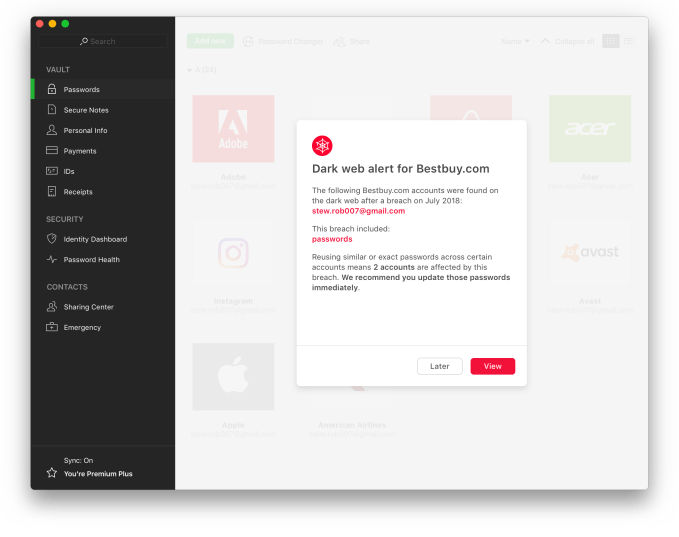
Dashlane has also been expanding its product to include new features like Dark Web monitoring, which alerts users if their information is being passed around by hackers on the far reaches of the internet; and has added a VPN and identify theft protection. The goal with these features is to make Dashlane more than just a password management app, and to better differentiate itself from rivals like 1Password or LogMeIn’s Lastpass.

“I am excited to join the board of Dashlane, a company with the right vision for the internet at the right time,” said Seth Farbman, in a statement. “I see many of the same attributes in Dashlane, as I did in Spotify, when I first joined—a best-in-class product that its customers love, a diverse and capable team focused on growth and innovation and powerful macro trends that put the wind at the company’s back. Technology is meant to empower people and make their lives easier, and that is at the very core of what Dashlane does,” he said.

Password managers like Dashlane are today less of a “nice to have” option, and more of a “must” as data breaches and additional security measures – like complex passwords combined with 2FA – have become routine. It’s a lot for the average web user to keep up with, and native solutions like Apple’s Keychain aren’t often enough. That’s why it’s useful to have a program that helps to automate password changes, track compromised accounts, identify weak passwords, and more.

People, broadly, are also more aware of their online privacy these days. That’s thanks, in part, to news coverage of Facebook’s privacy gaffes, security breaches, as well as the changes to the way sites collect and use personal data, as required by Europe’s GDPR.

“When we look back 10 years from now, 2018 will be remembered as the year of GDPR, Facebook revelations, and the year that regulators, the press – and most importantly, public opinion – really started to look at the entire issue of digital privacy and identity differently,” said Emmanuel Schalit, CEO of Dashlane.

Dashlane doesn’t share all its metrics, but claims 90 percent revenue growth year-over-year.

To date, Dashlane has raised over $100 million in venture funding. However, with 10M+ users, it’s still behind some competitors. LastPass, for instance, announced 16.8 million users in 2018. 1Password’s website, meanwhile, claims “millions” of individual users and 40,000 businesses – a number that implies it reaches a large number of employees, thanks to its b2b deals. And of course it still has to convince people who use the built-in password features of today’s browsers that it’s worth having a more complete solution, rather than just a tool to remember passwords.


12 Apr 2019

Chris Dixon is coming to talk crypto — and much more — at Disrupt SF

It’s 2019, and most institutional money managers are still taking a wait-and-see approach to crypto assets, concerned in part about market manipulation schemes and other nefarious actors. Though a growing number of top establishments is beginning to kick the tires — Harvard just made its first bet on a crytpo currency, following an investment last year by Yale into the cryptocurrency fund Paradigm, and two U.S. pension funds got into the game in February — it’s happening more slowly than adherents would like.

One of these early and abiding crypto believers, famously, is Chris Dixon, a native Ohioan and now general partner at Andreessen Horowitz (a16z) who studied philosophy at Columbia before launching two startups: SiteAdvisor, an internet security company that warned web users of security threats and was acquired by McAfee in 2006, and later Hunch, a recommendation technology company that was acquired by eBay in 2011.

Along the way, Dixon became a prolific seed stage investor — one whose bets were notable enough that in 2012, a16z pulled him into the fold as a general partner. Almost immediately afterward, Dixon began studying, and publishing his thoughts about, digital assets, whose potential seemed to capture his attention in a way that other technologies had not.

That fascination hasn’t waned in the least. Instead, Dixon, along with fellow a16z general partner Katie Haun, has gone all in on crypto, leading a $300 million crypto fund that Andreessen Horowitz spun out last year.

Now, we’re thrilled to announce that Dixon is coming to Disrupt SF (October 2-4) for a rare fireside chat to discuss where we are as a society in terms of crypto adoption — and what will it take for realize true believers’ broader vision for how ubiquitous it will become and why.

As Dixon suggested during a16z’s annual innovation summit in November, it’s time to start moving seeing crypto as a kind of religion, with different factions and sects and rituals, and into the mainstream. As he told the founders and investors gathered at the time, crypto is “the fourth big wave in my lifetime.” But “there’s a lot of evangelizing to do” to get there.

During our sit-down, we’ll talk with Dixon about the moment he fell in love with the technology, whether he has had doubts along the way, and how he see the tech world moving beyond known issues with infrastructure, scalability, usability and challenges with governance.

In a nutshell, we’ll talk about why he’s so confident that the investment phase will evolve into the utility phase and eventually into the open financial system — and we’ll talk about when.

If you care about understanding crypto and the ways it may well impact you sooner than you might imagine, you definitely won’t want to miss Dixon’s appearance. We know we can’t wait for it.

Disrupt SF runs October 2 to October 4 at the Moscone Center. Tickets are available at our Super Early-Bird rates here.

12 Apr 2019

Disney shares are up after the big reveal of its streaming service

Investors seem to think that Disney is on the right track with its plans for the new streaming service, Disney+.

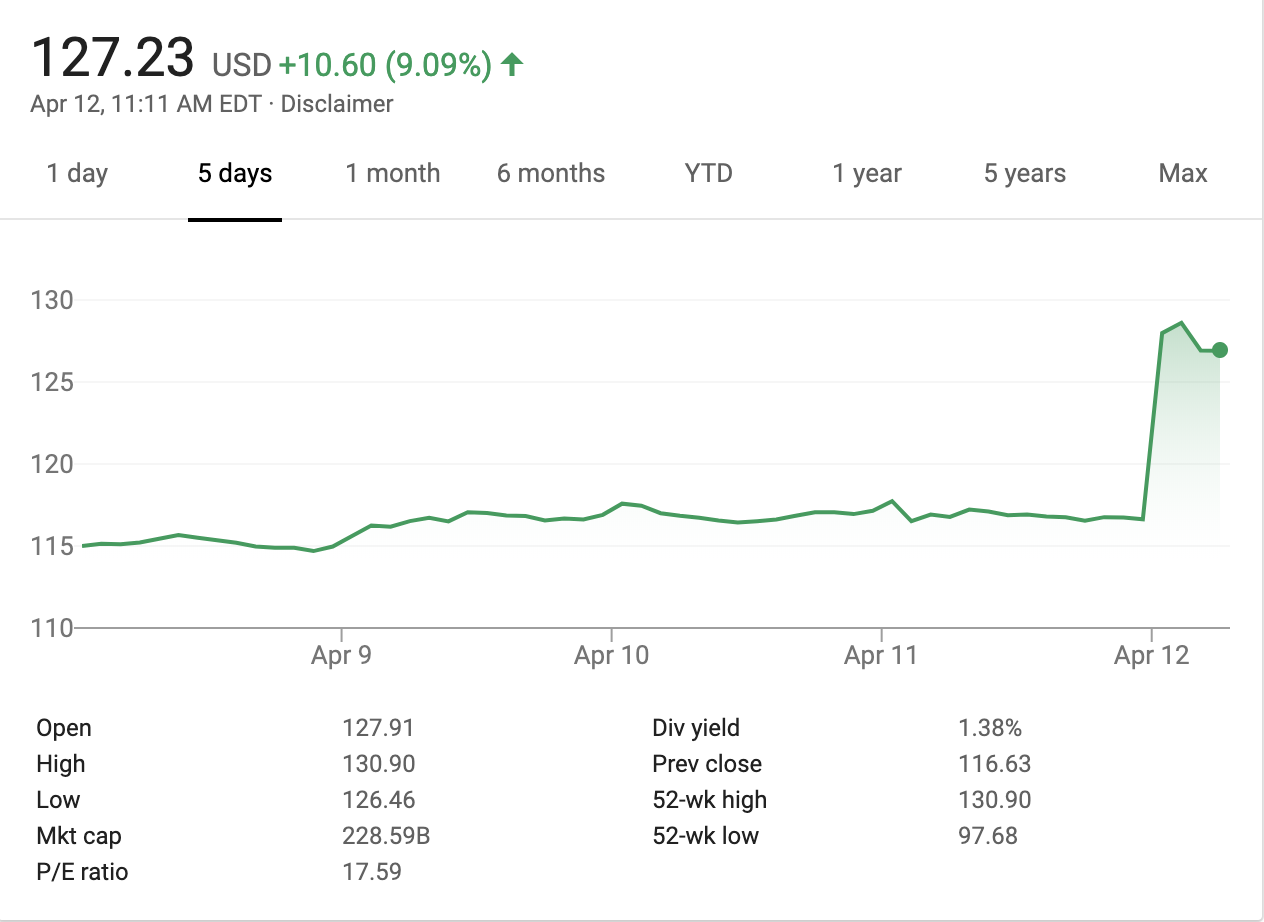
On the heels of yesterday’s announcement of the streaming service’s November 12 launch date and slate of programming, Disney’s stock price is currently up 9% to $127.23 in morning trading on the New York Stock Exchange.

Ending months of speculation about what would and wouldn’t be included in a streaming package from the mouse house, yesterday’s “investor day”, satisfied public market investors that Disney’s run at the current king of streaming video, Netflix, would be credible.

Netflix shares were down slightly in morning trading, around 3.5% — or roughly $13 — to $354.50.

For stock market watchers, the big question was going to be pricing and on that front, Disney’s service didn’t disappoint. Although the streaming offering from Disney’s entertainment juggernaut was more about moving cash out of one pocket instead of another for most American consumers, as Matthew Ball, a media analyst and the former head of strategy at Amazon Studios, pointed out on Twitter.

American households already spend around $2.8 billion per year renting and buying Disney video — averaging around $24 per year for every household or 40 million annual subscriptions, Ball wrote.

While the market may be setting up the new entertainment landscape as a Netflix versus Disney battle there are important differences between the two and both are likely to thrive in the new era of streaming entertainment.

The companies that are most likely to be challenged by the streaming offerings from Netflix and Disney are AT&T’s Warner Media and CBS/Viacom .

Within Warner Media, layoffs and restructuring in the wake of the company’s acquisition by AT&T, along with the end of the network’s mega-hit “Game of Thrones”, could have serious consequences on its ability to compete as the company rolls out its own (partially ad-supported) streaming service.

Meanwhile, CBS and Viacom are still reeling from the scandal that brought down chief executive Les Moonves — although Viacom’s acquisition of PlutoTV gives the company some breathing room with a free streaming video and on demand option.

As paid services proliferate, the walls around intellectual property will only grow higher. Entertainment companies are all going to vie for more exclusive offerings and that means artists and creators will win as these companies pay more for quality entertainment that they can make exclusively to lock in subscribers. It’ll be a delicate dance between monetizing intellectual property on other platforms and keeping things behind a gate to bring in customers.

Especially as deep-pocketed companies like Apple and Amazon have their own designs on streaming entertainment.

Right now, investors and consumers seem to think that a Disney+ subscription is definitely worth the price of admission. How many other tickets consumers are willing to pay for is another question.