Category: UNCATEGORIZED

12 Apr 2019

Amazon teams with FIRST for robotics education grants

Earlier this week, Amazon confirmed that it would be acquiring Canvas, a little known Colorado based startup that creates autonomous driving systems for warehouse fulfillment. It’s the latest in a long line of moves that finds the company looking seriously at automation for the future of retail plans.

Last year, the company announced the launch of Amazon Future Engineer, a program designed facilitate STEM education in classrooms. To help launch the program, Amazon is with STEM non-profit FIRST to create a series of robotics grants specifically targeted underrepresented populations.

The plan kicks off with 100 schools in 21 states, starting in fall of this year. The program features support for FIRST robotics teams and teacher education, along with an additional $10,0000 in funding and a tour of local fulfillment centers. The company says it currently has more than 100,000 robots deployed across its warehouses.

“Amazon is helping FIRST in our goal to make robotics teams and programs available in every school,” FIRST founder Dean Kamen said in a release tied to the news. “In FIRST, every kid on every team can go pro. They gain a hands-on learning pathway in technology, computer science and engineering that propels them forward and inspires innovation.”

Earlier this year, the company announced that would be be investing in New York area classrooms, ahead of the (since abandoned) launch of its HQ2.

12 Apr 2019

Homeland Security warns of security flaws in enterprise VPN apps

Several enterprise virtual private networking apps are vulnerable to a security bug that can allow an attacker to remotely break into a company’s internal network, according to a warning issued by Homeland Security’s cybersecurity division.

An alert was published Friday by the government’s Cybersecurity and Infrastructure Security Agency following a public disclosure by CERT/CC, the vulnerability disclosure center at Carnegie Mellon University.

The VPN apps built by four vendors — Cisco, Palo Alto Networks, Pulse Secure, and F5 Networks — improperly store authentication tokens and session cookies on a user’s computer. These aren’t your traditional consumer VPN apps used to protect your privacy, but enterprise VPN apps that are typically rolled out by a company’s IT staff to allow remote workers to access resources on a company’s network.

The apps generate tokens from a user’s password and stored on their computer to keep the user logged in without having to reenter their password every time. But if stolen, these tokens can allow access to that user’s account without needing their password.

But with access to a user’s computer — such as through malware — an attacker could steal those tokens and use them to gain access to a company’s network with the same level of access as the user. That includes company apps, systems and data.

So far, only Palo Alto Networks has confirmed its GlobalProtect app was vulnerable. The company issued a patch for both its Windows and Mac clients.

Neither Cisco nor Pulse Secure have patched their apps. F5 Networks is said to have known about storing since at least 2013 but advised users to roll out two-factor authentication instead of releasing a patch.

CERT warned that hundreds of other apps could be affected — but more testing was required.

12 Apr 2019

Bird will launch electric scooters in 50+ European cities

Bird is gearing up to launch in more than 50 additional cities throughout Europe this spring.

Bird began its expansion into Europe less than one year ago. Today, Bird operates its scooters in Paris, Brussels, Vienna, Zurich and other European cities. This launch will increase its European fleet size more than ten-fold.

“World class brands and companies have the perfect formula of economics and the ability to grow and scale,” Bird CEO Travis VanderZanden said in a statement. “As we expand Bird’s global footprint, we will demonstrate unmatched innovation, commitment to riders, neighborhoods and cities and operational excellence while generating an explosive run rate. This formula will drive great impact and progress on our mission to make our cities and communities more livable.”

This comes about one month after Bird laid off between four to five percent of its workforce. The layoffs were part of Bird’s annual performance review process and only affected U.S.-based employees. Those laid off were eligible for severance, including health and medical benefits.

Bird has raised more than $400 million in funding to date and is reportedly in the midst of raising an additional $300 million.

12 Apr 2019

Apple’s iOS will now confirm you meant to subscribe to that app

Apple has added another step to prevent users from accidentally signing up for an iOS app’s subscription – or, from being tricked into it by a scammy app not playing by the rules. The company recently rolled out a subscription confirmation dialog box that pops up as one final step to ensure you meant to opt in to the subscription being offered.

The change to iOS was first spotted by app developer David Barnard on Twitter and reported by Apple news site 9to5Mac.

The new confirmation box is a welcome addition, considering how many users were accidentally subscribing – particularly those with Touch ID-based phones who were trying to exit to the Home screen. Instead, they were giving the app permission to sign them up by placing their finger on the Home button, which triggered the Touch ID authentication process.

The update also arrives following several changes Apple has made to subscriptions in recent months to address problems around scammy subscriptions.

A good number of developers – especially those in the Utility category – were using sneaky tricks to tap into the subscription craze to bank thousands and even millions of dollars per year. Some apps would intentionally confuse users with their design, or make promises of “free trials” that converted in only a few days, or used other misleading tactics to get users to subscribe.

This left many consumers feeling they had been duped into paying, and a host of angry App Store reviews followed. The scams could have had a broader impact on the subscription economy, if Apple had allowed them to go unchecked, as consumers would have become wary of ever signing up for anything, as a result.

That would have been a problem, given how subscriptions have become a big business for the App Store. According to one forecast, they are poised to grow to $75.7 billion by 2022, in fact.

However, Apple has since begun to crack down on bad actors while also making subscriptions easier to manage by iOS users.

In January, it rolled out new developer guidelines to more clearly spell out what is and is not allowed; and in February it updated iOS to reduce the number of steps it took to get to your subscriptions, so you could more quickly and easily cancel them.

Now, the new dialog box will ensure that users understand they’re opting in to a paid subscription, with a message that reads:

“Confirm Subscription. The subscription will continue unless canceled in Settings at least one day before a subscription period ends.” 

Apple didn’t formally announce the change, but it appears to have rolled out sometime in the last week, reports say.

12 Apr 2019

African e-commerce startup Jumia’s shares open at $14.50 in NYSE IPO

Pan-African e-commerce company Jumia listed on the New York Stock Exchange today, with shares beginning trading at $14.50 under ticker symbol JMIA. This comes four weeks after CEO Sacha Poignonnec confirmed the IPO to TechCrunch and Jumia filed SEC documents.

With the public offering, Jumia becomes the first startup from Africa to list on a major global exchange.

In an updated SEC filing, Jumia indicated it is offering 13,500,000 ADR shares, for an opening price spread of $13 to $16 per share, representing 17.6 percent of all company shares. The IPO could raise up to $216 million for the internet venture.

Since the original announcement (and reflected in the latest SEC docs), Mastercard Europe pre-purchased $50 million in Jumia ordinary shares.

The IPO creates another milestone for Jumia. The company became the first African startup unicorn in 2016, achieving a $1 billion valuation after a funding round that included Goldman Sachs, AXA and MTN.

There’s a lot to breakdown on Jumia’s going public. The company is often dubbed the “Amazon of Africa,” and like Amazon, Jumia comes with its own mixed buzz. Jumia’s SEC F-1 prospectus offers us more insight into the venture, and perhaps any startup from Africa, thus far.

About Jumia

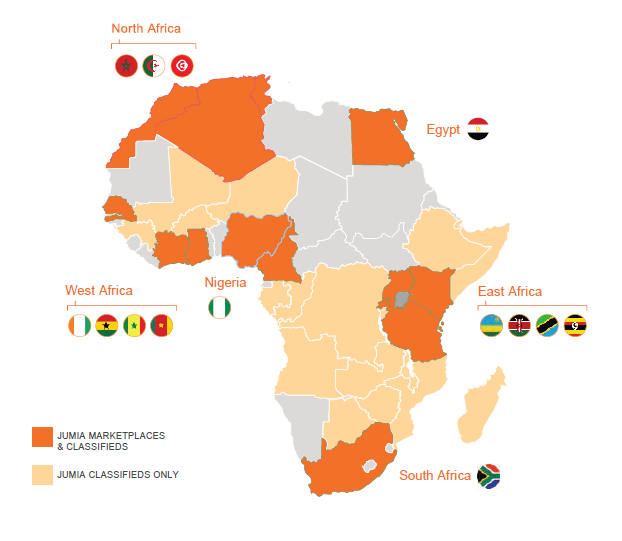
Founded in Lagos in 2012 with Rocket Internet  backing, Jumia now operates multiple online verticals in 14 African countries. Goods and services lines include Jumia Food (an online takeout service), Jumia Flights (for travel bookings) and Jumia Deals (for classifieds). Jumia processed more than 13 million packages in 2018, according to company data.
Jumia’s original co-founders included Nigerian tech entrepreneurs Tunde Kehinde and Raphael, but both departed in 2015 to form other startups in fintech and logistics.

Starting in Nigeria, the company created many of the components for its digital sales operations. This includes its JumiaPay payment platform and a delivery service of trucks and motorbikes that have become ubiquitous with the Lagos landscape. Jumia has extended this infrastructure as an e-commerce fulfillment product called Jumia Services.

Jumia has also opened itself up to Africa’s traders by allowing local merchants to harness Jumia to sell online. The company has over 80,000 active sellers on the platform using the company’s payment, delivery, and data-analytics services, Jumia Nigeria CEO Juliet Anammah told TechCrunch a previously.

The most popular goods on Jumia’s shopping site include smartphones, washing machines, fashion items, women’s hair care products, and 32-inch TVs, according to Anammah.

Jumia an African startup?

Like Amazon, Jumia brings its own mix of supporters and critics. On the critical side, there are questions of whether it’s actually an African startup. The parent for Jumia Group is incorporated in Germany and current CEOs Jeremy Hodara and Sacha Poignonnec are French.

On the flipside, original Jumia co-founders (Kehinde and Afeodor) are African. The company is headquartered (and also incorporated) in Africa (Lagos), operates exclusively in Africa, pays taxes on the continent, employs 5,128 people in Africa (page 125 of K-1), and the CEO of its largest country operation (Nigeria) Juliet Anammah is Nigerian.

The Africa authenticity debate often shifts into questions of a Jumia diversity deficit, which is of course important from Silicon Valley to Nairobi. The company’s senior management and board is a mix of Africans and expats. Golden State Warriors basketball player and tech investor Andre Iguodala joined Jumia’s board this spring with a priority on “diversity and making sure the African culture is in the company,” he told TechCrunch.

Can Jumia turn a profit?

The Jumia authenticity and diversity debates will no doubt roll on. But the biggest question—the driver behind the VC, the IPO, the founders, and the people buying Jumia’s shares—is whether the startup can generate profits and ROI.

Obviously some of the world’s top venture investors, such as Jumia backers Goldman, AXA, and Mastercard, think so. But for Jumia skeptics, there are the big losses. The company has generated years and years of losses, including negative EBITDA of €172 million in 2018 compared to revenues of €139 that same year.

To be fair to Jumia, most startups (e-commerce startups in particular) rack up losses for years before getting into the black. And operating in a greenfield sector in Africa—where it had to create much of the surrounding infrastructure to do B2C online sales—has presented higher costs for Jumia than e-commerce startups elsewhere.
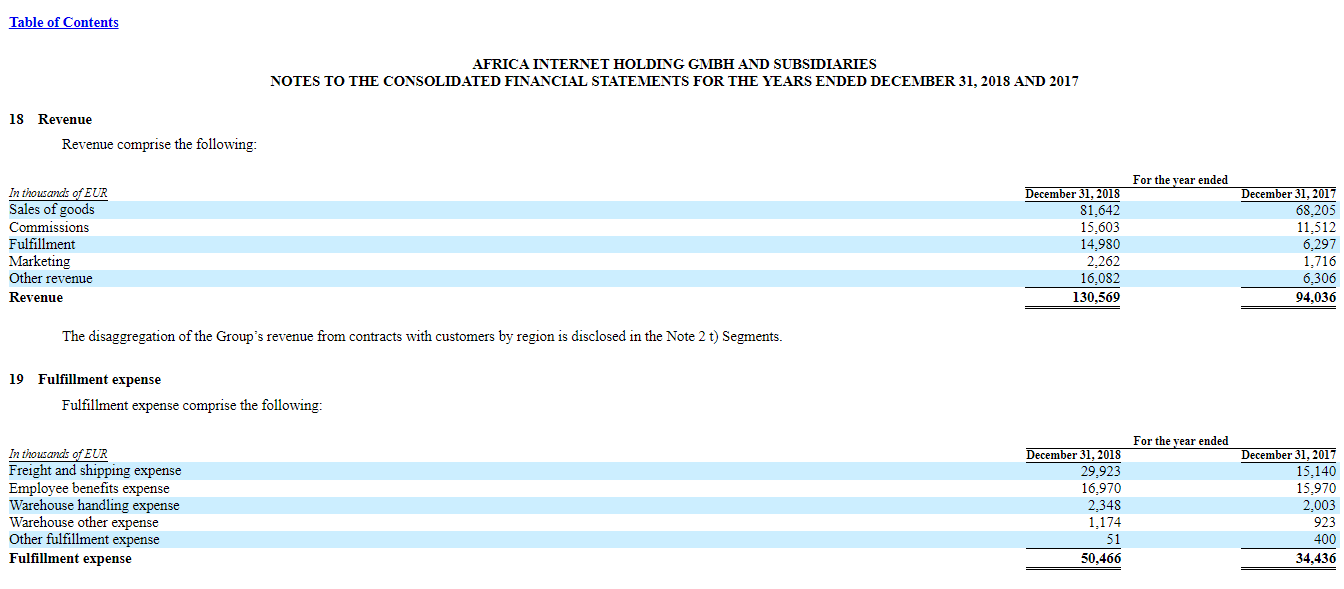
On the prospects for Jumia’s profitability, two things to watch will be Jumia’s fulfillment expenses and a shift to more revenue from its non-goods-delivery services, which offer lower unit costs and higher-margins. Per Jumia’s SEC F-1 index (see above) freight and shipping make up over half of its fulfillment expenses.

So Jumia has not turned a profit but its revenues have increased steadily, up 11 percent to €93.8M (roughly $106.2 million) in 2017 and up again to €130M (or $147 million) in 2018. If the company boosts customer acquisition and lowers fulfillment costs—which could come from more internet services revenue and platform investment with IPO capital—it could close the gap between revenues and losses. This reflects the equation for most e-commerce startups. With the IPO Jumia will have to publish its first full public financials in 2019, which will provide a better picture of profitability prospects.

Jumia’s IPO and African e-commerce?

There’s is, of course, a bigger play in Jumia’s IPO. One connected to global e-commerce and the future of online retail in Africa.

Jumia going public comes as Africa’s e-commerce landscape has seen its share of ups and downs, notably several failures in DealDey shutting down and the distressed acquisition of Nigerian e-commerce hopeful Konga.com.

As for the big global names, Alibaba has talked about Africa expansion, but for the moment has not entered in full.

Amazon  offers limited e-commerce sales on the continent, but more notably, has started offering AWS services in Africa.

And this week, DHL came on the scene launching its Africa eShop platform with 200 global retailers on board, in partnership with MallforAfrica’s Link Commerce fulfillment service.

Competition to capture Africa’s digitizing consumer markets—expected to spend $2 billion online by 2025, according to McKinsey—could get fierce, with more global entries, acquisitions, and competition on fulfillment services all part of the mix.

And finally, the outcome of Jumia’s IPO carries weight even for its competitors. “Many things, like business decisions and VC investments across Africa’s e-commerce sector are on on hold,” an African e-commerce exec told TechCrunch on background.

“Everyone’s waiting to see what happens with Jumia’s IPO and how they perform,” the exec said.

So the share-price connected to NYSE ticker sign JMIA could reflect not just investor confidence in Jumia, but investor confidence in African e-commerce overall.


12 Apr 2019

The chat feature may soon return to Facebook’s mobile app

Facebook upset millions upon millions of users five years ago when it removed chat from its core mobile app and forced them to download Messenger to communicate privately with friends. Now it looks like it might be able to restore the option inside the Facebook app.

That’s according to a discovery from researcher Jane Manchun Wong who discovered an unreleased feature that brings limited chat features back into the core social networking app. Wong’s finding suggests that, at this point, calling, photo sharing and reactions won’t be supported inside the Facebook app chat feature, but it remains to be seen if that is simply because it is currently in development.

It is unclear whether the feature will ship to users at all since this is a test. Messenger, which has over 1.3 billion monthly users, will likely stick but this change would give users other options for chatting to friends.

We’ve contacted Facebook for comment, although we’re yet to hear back from the company. We’ll update this story with any comment that the company does share.

As you’d expect, the discovery has been greeted with cheers from many users who were disgruntled when Facebook yanked chat from the app all those years ago. I can’t help but wonder, however, if there are more people today who are content with using Messenger to chat without the entire Facebook service bolted on. Given all of Facebook’s missteps over the past year or two, consumer opinion of the social network has never been lower, which raises the appeal of using it to connect with friends but without engaging its advertising or newsfeed.

Wong’s finding comes barely a month after Facebook CEO Mark Zuckerberg sketched out a plan to pivot the company’s main focus to groups and private conversation rather than its previously public forum approach. That means messaging is about to become its crucial social graph, so why not bring it back to the core Facebook app? We’ll have to wait and see, but the evidence certainly shows Facebook is weighing the merits of such a move.

12 Apr 2019

Backer of Musical.ly, Grindr and Opera to invest $50M in self-driving startup Pony.ai

A games publisher in China is following the path of its larger peer Tencent to back a wide spectrum of startups for financial gains. Beijing Kunlun Wanwei, or Kunlun, announced in a filing this week that it plans to inject $50 million into autonomous driving startup Pony.ai in exchange for a 3 percent stake.

Pony.ai confirmed the investment with TechCrunch in an email response, adding that the money contributes to its pre-B round of financing. The startup last pocketed $102 million that valued it at nearly $1 billion. It’s raised $214 million in total fundings to date according to data from CrunchBase.

Shanghai-listed Kunlun has its bets on one of China’s most aggressive smart driving companies. Pony.ai, co-founded by James Peng, formerly a leader in Baidu’s self-driving division, was only second to Baidu in total autonomous miles driven in Beijing last year (although by a large margin).

While neither Kunlun nor Pony.ai provided an inkling of possible strategic collaboration between them, next-gen vehicles have become a much sought-after space for hosting entertainment content, and without a doubt that includes video games.

Few outside China’s internet industry know of Kunlun, which has over the years been squeezed by industry leaders Tencent and NetEase . The 11-year-old company has, however, gradually earned its reputation as a savvy investor. Led by Zhou Yahui, a shrewd investor himself, Kunlun has backed companies that broadened distribution channels for its gaming titles. Other fundings appear more tangential. Here’s a taste of Kunlun’s lucrative portfolio:

Musical.ly: Kunlun laid out $20 million for Musical.ly and cashed out $41.08 million when Bytedance acquired Musical.ly in 2017, according to a filing. Musical.ly is now part of the popular short video app TikTok.

Inke: Back in 2016, Kunlun invested 68 million yuan ($10 million) in live streaming company Inke. By 2017 it had sold all its stakes in the startup and was poised to cash out a total of 824 million yuan ($123 million) after the transaction completed, according to a filing. Inke is the currently third-largest live streaming app by monthly active devices in China, says data from iResearch.

Opera: Kunlun was part of a consortium that acquired the web browser in 2016 when it shelled out $600 million in investment. Through the consortium, Kunlun now owns a 48 percent stake in Opera, which floated on Nasdaq in 2018.

Grindr: Kunlun paid $93 million for a 60 percent stake in Grindr, the popular dating app for gay, bisexual, transgender and queer users, back in 2016 and completed the buyout with $152 million in fundings in 2018. Kunlun is reportedly looking to sell Grindr after the Committee on Foreign Investment in the United States decided its ownership of the dating app may threaten national security.

Qudian: Kunlun owned a 19.2 percent stake in Qudian when the micro-lender became one of the first Chinese fintech companies to list on Nasdaq. Kunlun has since been selling its stakes through a gradual exit and Zhou recently told analysts that his firm was expected to make around 2 billion yuan ($300 million) in profit from the Qudian investment.

12 Apr 2019

Naspers-owned PayU doubles down on India with $70M deal to buy Wibmo

PayU, the Naspers-owned payments company that competes with the likes of PayPal but focuses mainly on emerging markets, has made an acquisition to expand its business in India. It has acquired Wibmo, a startup based out of the US (Cupertino, to exact) that mostly operates in India. PayU is paying $70 million for the startup, bringing the total its invested in building its business to $500 million in the last two months.

The deal had previously been reported by Economic Times last month, and it speaks to ongoing consolidation.

“This is a strategic acquisition for PayU that combines our merchant network and Wibmo’s leadership in digital security,” Aakash Moondhra, Chief Financial Officer at PayU Global, told TechCrunch in an interview. “PayU is very bullish on India as a market.”

A Citi report issued late last year valued PayU’s India unit at $2.5 billion, and that’s no accident given the level of investment that the company has made.

PayU acquired Citrus for $130 million in 2016, and it has also made investments in Indian fintech startups that include PaySense and Zest Money. Elsewhere in the world, its deal-making has included investments in Creditas in Brazil, Germany’s Kreditech, U.S-based Remitly — which operates remittance worldwide — and Zooz in Israel.

Another key area for the business in India has been a move away from a wallet-based approach to financial services. PayU shuttered its wallet apps in India at the beginning of last year, and instead went after services that include credit and deferred payment options. The business also has its core payment gateway service.

Naspers itself is doubling down on India, where it has backed unicorns Swiggy, food delivery service that recently raised a $1 billion round, and education service Byju’s, which pulled in $540 million, with major deals announced in recent months.

More to follow