Category: UNCATEGORIZED

10 Apr 2019

Streetwear marketplace Bump raises $7.5M

Bump, the Y Combinator-backed marketplace for streetwear, is announcing that it has raised $7.5 million in Series A funding.

Bump’s Jack Ryder told me that even before starting the company, he and his co-founder Sam Howarth were active in buying and selling streetwear and sneakers — but he admitted that it took several tries before the startup found the right model. (He described a previous iteration, involving a reverse marketplace where people post the items they’re interested in buying, as “the world’s worst idea.”)

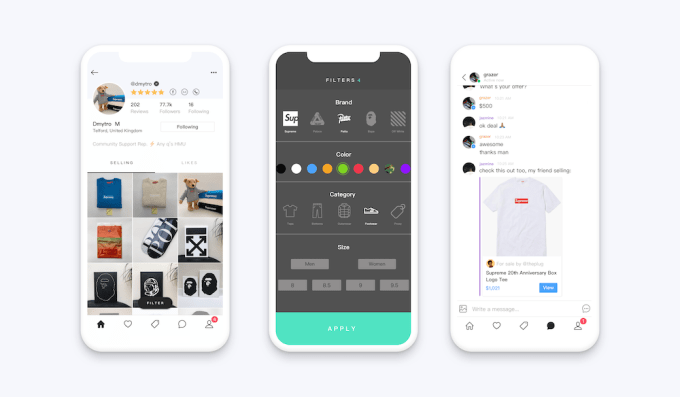
Now, however, Ryder said Bump has nearly 2 million registered users. It allows them to buy and sell jackets, T-shirt, sneakers and more among themselves. They can sort through the marketplace based on brand, color and size, and can chat one-on-one or in groups.

The startup it relies on moderators and crowdsourcing to determine when a listing looks fake — apparently there have been issues with less than 2 percent of listings in the app, and Ryder said most of the time it’s just young, inexperienced sellers “who didn’t understand how to ship the item.”

Ryder sees Bump’s social side as the real opportunity for growth. While he said the startup still has “tons of room in streetwear to keep going,” he suggested that the “bigger and more important mission” is to turns online shopping into “a multi-player experience.”

Bump screenshot

“There’s tons of places where you can buy streetwear online … but the real unique thing about Bump was the social side,” he said. “The average age of our users is 15 years old — that’s actually way younger than the demographic of people interested in sneakers and streetwear. The problem we’re solving isn’t making it easier to buy streetwear; it’s how teenagers, how Gen Z shops with their friends online.”

Ryder said that when he was at YC, he was told to shy away from the idea of social shopping, because there’s “almost like a graveyard” of failed startups. In his view, however, those startups were just “adding a like button or adding a follow button,” rather than really bringing the social and shopping experiences together.

Meanwhile, Instagram and other social networks have been adding shopping capabilities, but he said they face the need to juggle different kinds of content and users.

“We think people are getting a way better shopping experience [on Bump], just because it’s a marketplace first,” Ryder said.

With the new round, Bump plans to relocate from New York to London, where it already employs some contractors, and where Ryder and Howarth were initially based.

The funding was led by e.ventures, with the firm’s Brendan Wales joining the Bump board. Kleiner Perkins, Y Combinator and undisclosed angel investors also participated.

“Having been early investors in both Farfetch and TheRealReal, we have seen firsthand how luxury and streetwear have converged over the past five years,” said Wales said in a statement. “Bump is at the intersection of both, with a social product that enables Gen Z buyers and sellers of high-end streetwear to transact globally in a peer-to-peer fashion. Jack and Sam of Bump, exemplify founder authenticity for this category, and we are grateful to be partnering with the entire team going forward.”

10 Apr 2019

Online used car startup Shift adds another $40M, snags COO in road to IPO

Online used car startup Shift Technologies has tacked on another $40 million in equity funding, hired a new COO with Amazon and Enjoy roots and scaled up its engineering staff — all in the past several months — as the company aims to double its revenue this year.

The recent activity, along with what executives have told TechCrunch is a diligent focus on unit economics, is all directed toward a larger objective to take the company public sometime in 2021.

Shift, which is based in San Francisco, serves car buyers and sellers. The company, founded in 2013, has built a software platform that lets customers shop for cars, get financing and schedule test drives. Car owners can use the platform to sell their vehicle, as well. Shift says any car it buys must pass a “rigorous” 150+ point inspection.

Shift generated $135 million in revenues in 2018. The company is projecting revenues between $220 million and $240 million in 2019, Shift co-CEO Toby Russell told TechCrunch.

An IPO is an aspirational goal, but one both Russell and founder George Arison believe is achievable. They both pointed to Carvana, an online used car company that went public in 2017.

“Given Carvana’s trailing revenue of $350 million when they went public as a benchmark, we’d be well-positioned for IPO if we can hit $300 million to $400 million,” Russell said. “There’s nothing in stone yet, and IPOs depend on a lot of factors like market conditions, but that benchmark is where we’ll be positioning ourselves in the next two years.”

Carvana is often regarded as Shift’s closest competitor — although the two companies have distinct differences. Shift’s inventory is broader, allowing cars as old as 10 years on the platform and with up to 120,000 miles. Carvana focuses on newer cars between 0 and four years in age. Shift also emphasizes its test drives as a differentiator.

Shift’s biggest competitor is the traditional used car business, Russell contends. There are 35,000 new and used car dealers in the U.S., most of which are mom-and-pop shops, responsible for about 15 million transactions each year. Then there are private-party sales between individuals, Russell notes.

“This super-fragmented environment creates a lot of opportunity for growth for Carvana, Shift, Lithia, CarMax, etcetera, much like Walmart, Target and Amazon all grew over the last two decades,” Russell told TechCrunch.

New COO

To get there, Shift has hired a new COO, Sean Foy. The company also raised additional equity as it tries to hire more engineers and other employees and scale up its technology platform.

Foy comes to Shift from Enjoy Technologies, where he was head of operations. He was previously director of operations for Kindle, Fire, Echo and Amazon Devices working out of Amazon’s Lab 126 in Sunnyvale.

Shift is counting on Foy’s expertise to grow the business and leverage the technology platform, all while maintaining or improving the customer experience. In short, using technology to make it easier for the customer to buy or sell a car without making the process overly cumbersome or intimidating because of the technology.

“One of the things that Bezos (Jeff Bezos, Amazon CEO) used to say all the time when we were building Kindle was the technology should disappear, you should not get in the way of the experience of reading a book,” Foy said. “And it feels the like the same here; we don’t want this to be a technology-heavy process for the buyer, we want to stay as frictionless as possible so that we can attract more and more people onto the the site rather than going to traditional dealerships and giving them a much better experience. So it’s really about removing friction from the product.”

New funds

Shift announced in September that it had raised more than $140 million in equity and debt in a Series D round. The round, which consisted of about $70 million in debt and $71 million in equity, was led by automotive retailer Lithia Motors. Bryan DeBoer, CEO and president of Lithia, joined Shift’s board of directors.

An additional $40 million in equity has since come in, bringing the total raise of the Series D round to $180 million. This new capital brings Shift’s total financing of equity and debt to more than $300 million.

All of the new capital came from new investors, primarily large institutional investors, according to Shift.

Shift has already put some of that capital to work. The company said back in September it planned to invest in its technology platform and scale its engineering staff from 35 to more than 80 people by the end of 2019. As of early April, Shift employed 54 engineers. Another nine (all new graduate hires) will start over the summer.The company employs 450 people.

10 Apr 2019

Online used car startup Shift adds another $40M, snags COO in road to IPO

Online used car startup Shift Technologies has tacked on another $40 million in equity funding, hired a new COO with Amazon and Enjoy roots and scaled up its engineering staff — all in the past several months — as the company aims to double its revenue this year.

The recent activity, along with what executives have told TechCrunch is a diligent focus on unit economics, is all directed toward a larger objective to take the company public sometime in 2021.

Shift, which is based in San Francisco, serves car buyers and sellers. The company, founded in 2013, has built a software platform that lets customers shop for cars, get financing and schedule test drives. Car owners can use the platform to sell their vehicle, as well. Shift says any car it buys must pass a “rigorous” 150+ point inspection.

Shift generated $135 million in revenues in 2018. The company is projecting revenues between $220 million and $240 million in 2019, Shift co-CEO Toby Russell told TechCrunch.

An IPO is an aspirational goal, but one both Russell and founder George Arison believe is achievable. They both pointed to Carvana, an online used car company that went public in 2017.

“Given Carvana’s trailing revenue of $350 million when they went public as a benchmark, we’d be well-positioned for IPO if we can hit $300 million to $400 million,” Russell said. “There’s nothing in stone yet, and IPOs depend on a lot of factors like market conditions, but that benchmark is where we’ll be positioning ourselves in the next two years.”

Carvana is often regarded as Shift’s closest competitor — although the two companies have distinct differences. Shift’s inventory is broader, allowing cars as old as 10 years on the platform and with up to 120,000 miles. Carvana focuses on newer cars between 0 and four years in age. Shift also emphasizes its test drives as a differentiator.

Shift’s biggest competitor is the traditional used car business, Russell contends. There are 35,000 new and used car dealers in the U.S., most of which are mom-and-pop shops, responsible for about 15 million transactions each year. Then there are private-party sales between individuals, Russell notes.

“This super-fragmented environment creates a lot of opportunity for growth for Carvana, Shift, Lithia, CarMax, etcetera, much like Walmart, Target and Amazon all grew over the last two decades,” Russell told TechCrunch.

New COO

To get there, Shift has hired a new COO, Sean Foy. The company also raised additional equity as it tries to hire more engineers and other employees and scale up its technology platform.

Foy comes to Shift from Enjoy Technologies, where he was head of operations. He was previously director of operations for Kindle, Fire, Echo and Amazon Devices working out of Amazon’s Lab 126 in Sunnyvale.

Shift is counting on Foy’s expertise to grow the business and leverage the technology platform, all while maintaining or improving the customer experience. In short, using technology to make it easier for the customer to buy or sell a car without making the process overly cumbersome or intimidating because of the technology.

“One of the things that Bezos (Jeff Bezos, Amazon CEO) used to say all the time when we were building Kindle was the technology should disappear, you should not get in the way of the experience of reading a book,” Foy said. “And it feels the like the same here; we don’t want this to be a technology-heavy process for the buyer, we want to stay as frictionless as possible so that we can attract more and more people onto the the site rather than going to traditional dealerships and giving them a much better experience. So it’s really about removing friction from the product.”

New funds

Shift announced in September that it had raised more than $140 million in equity and debt in a Series D round. The round, which consisted of about $70 million in debt and $71 million in equity, was led by automotive retailer Lithia Motors. Bryan DeBoer, CEO and president of Lithia, joined Shift’s board of directors.

An additional $40 million in equity has since come in, bringing the total raise of the Series D round to $180 million. This new capital brings Shift’s total financing of equity and debt to more than $300 million.

All of the new capital came from new investors, primarily large institutional investors, according to Shift.

Shift has already put some of that capital to work. The company said back in September it planned to invest in its technology platform and scale its engineering staff from 35 to more than 80 people by the end of 2019. As of early April, Shift employed 54 engineers. Another nine (all new graduate hires) will start over the summer.The company employs 450 people.

10 Apr 2019

AI dumbos, Niantic, mobility, design, and Google Next

Tomorrow: Google Cloud Next conference call

Join TechCrunch’s enterprise mavens Frederic Lardinois and Ron Miller as they discuss what’s happening on the ground and at the (I am sure, very exciting) parties this week at Google Cloud Next in SF. They will talk live tomorrow at 1pm EDT / 10am PDT, and be sure to check your inbox one hour before for the dial-in information.

When to ditch that nightmare customer

No, we are not “firing” any Extra Crunch members — yet. But multi-time founder Joe Procopio has a strong view that not only should you identify your worst customers, you should fire them, stat. Here’s a preview of his personal journey learning this fundamental tenet of startups:

10 Apr 2019

Instagram now demotes vaguely “inappropriate” content

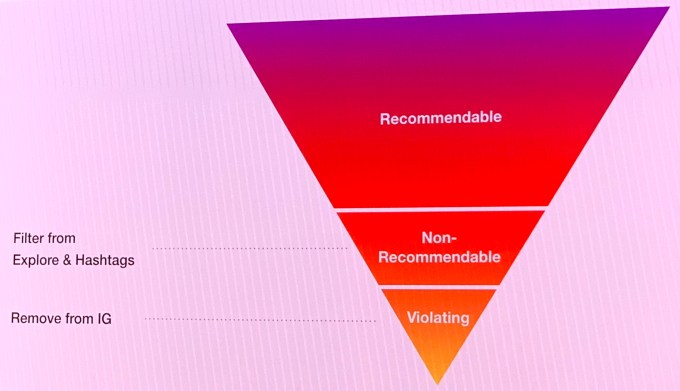
Instagram is home to plenty of scantily-clad models and edgy memes that may start to get fewer views starting today. Now Instagram says “We have begun reducing the spread of posts that are inappropriate but do not go against Instagram’s Community Guidelines”. That means if a post is sexually suggestive, but doesn’t depict a sex act or nudity, it could still get demoted. Similarly, if a meme doesn’t constitute hate speech or harassment, but is considered in bad taste, lewd, violent, or hurtful, it could get fewer views.

Specifically, Instagram says “this type of content may not appear for the broader community in Explore or hashtag pages” which could severely hurt the ability of creators to gain new followers. The news came amidst a flood of “Integrity” announcements from Facebook to safeguard its family of apps revealed today at a press event a the company’s Menlo Park headquarters.

“We’ve started to use machine learning to determine if the actual media posted is eligible to be recommended to our community” Instagram’s Product Lead for Discovery Will Ruben said. Instagram is now training its content moderators to label borderline content when they’re hunting down policy violations, and Instagram then uses those labels to train an algorithm to identify.

These posts won’t be fully removed from the feed, and Instagram tells me for now the new policy won’t impact Instagram’s feed or Stories bar. But Facebook CEO Mark Zuckerberg’s November manifesto described the need to broadly reduce the reach of this “borderline content”, which on Facebook would mean being shown lower in News Feed. That’s policy could easily be expanded to Instagram in the future. That would likely reduce the ability of creators to reach their existing fans, which can impact their ability to monetize through sponsored posts or direct traffic to ways they make money like Patreon.

Today Facebook’s Henry Silverman explained that “As content gets closer and closer to the line of our Community Standards at which point we’d remove it, it actually gets more and more engagement. It’s not something unique to Facebook but inherent in human nature.” The borderline content policy aims to counteract this incentive to toe the policy line. Just because something is allowed on one our apps doesn’t mean it should show up at the top of News Feed or that it should be recommended or that it should be able to be advertised” said Facebook’s head of News Feed Integrity Tessa Lyons. ”

This all makes sense when it comes to click bait, false news, and harassment which no one wants on Facebook or Instagram. But when it comes to sexualized but not explicit content that has long been uninhibited and in fact popular on Instagram, or memes or jokes that might offend some people despite not being abusive, this is a significant step up of censorship by Facebook and Instagram.

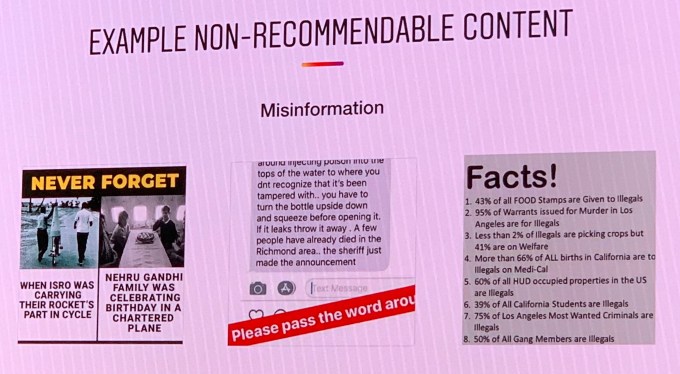
Creators currently have no guidelines about what constitutes Borderline Content — there’s nothing in Instagram’s rules or  terms of service that even mention non-recommendable content or what qualifies. The only information Instagram has provided was what it shared at today’s event. The company specficied that violent, graphic/shocking, sexuall suggestive, misinformation, and spam content can be deemed “non-recommendable” and therefore won’t appear on Explore or hashtag pages.


Instagram denied an account from a creator claiming that the app reduced their feed and Stories reach after one of their posts that actually violates the content policy taken down.

One female creator with around a half-million followers likened receiving a two-week demotion that massively reduced their content’s reach to Instagram defecating on them. “It just makes it like, ‘Hey, how about we just show your photo to like 3 of your followers? Is that good for you? . . . I know this sounds kind of tin-foil hatty but . . . when you get a post taken down or a story, you can set a timer on your phone for two weeks to the godd*mn f*cking minute and when that timer goes off you’ll see an immediate change in your engagement. They put you back on the Explore page and you start getting followers.”

As you can see, creators are pretty passionate about Instagram demoting their reach. Instagram’s Product Lead on Discovery Will Ruben said regarding the feed/Stories reach reduction: No, that’s not happening. We distinguish between feed and surfaces where you’ve taken the choice to follow somebody, and Explore and hashtag pages where Instagram is recommending content to people.”

The questions now are whether borderline content demotions are ever extended to Instagram’s feed and Stories, and how content is classified as recommendable, non-recommendable, or violating. With artificial intelligence involved, this could turn into another situation where Facebook is seen as shirking its responsibilities in favor of algorithmic efficiency — but this time in removing or demoting too much content rather than too little.

Given the lack of clear policies to point to, the subjective nature of deciding what’s offensive but not abusive, Instagram’s 1 billion user scale, and its nine years of allowing this content, there are sure to be complaints and debates about fair and consistent enforcement.

10 Apr 2019

Watch SpaceX’s historic Falcon Heavy Launch and triple landing attempt here

It’s finally launch day for the Falcon Heavy’s first mission, and SpaceX’s heavy-duty rocket platform is due to take off at 3:35 Pacific time. The launch will take a major communications satellite into orbit, and as an encore all three of the first stages will attempt to return to Earth and make soft landings. Success means the inauguration of a new era in spaceflight.

Falcon Heavy was first tested last February, with a dummy payload of a Tesla Roadster and a mannequin dubbed “Starman,” now somewhere past the orbit of Mars. Since then the rocket has gained a few improvements, including a reinforced center core that should help enable it to return safely.

In addition to taking an enormous satellite to orbit, SpaceX will be attempting to recover all three first stages and the fairing that covers the payload as well. The side stages will be guiding themselves to Landing Zone 1 and 2 nearby the launch complex, while the center core, having traveled much further, will land on the Autonomous Spaceport Drone Ship Of Course I Still Love You. Other boats will attempt to catch both pieces of the falling fairing.

It bears mentioning here that not only are there essentially no launch vehicles in Falcon Heavy’s class, but certainly none that can autonomously return to Earth and be used again. SpaceX is very far out ahead of the competition here, though the next few years will see new entrants in the field. But this will be a first for several reasons.

The 230-foot assembly, all brand new rockets (rather than reused), is currently standing up at Launch Complex 39A, the site of many historic launches, from Apollo to Space Shuttle. T-0 is this evening at 6:35 local time in Cape Canaveral. You can watch it live below or at the SpaceX webcast site.

The important events we’ll be on the watch for will occur roughly as follows, in approximate minutes and seconds after takeoff:

  • 1:09 after launch: Max-Q, the point at which the launch vehicle is under the most strain. As reliable as rockets have become, every launch is a white-knuckler until after this point.
  • 2:30: BECO, or booster engine cutoff, when the side cores shut off and detach.
  • 3:31: MECO, or main engine cutoff, when the central core shuts down and detaches from the second stage, which ignites a few seconds afterwards. The fairings will detach about 30 seconds later.
  • 7:51: Side cores descend at LZ for landing.
  • 8:48: Second stage first burn concludes and cruise phase begins.
  • 9:48: Main core descends at drone ship for landing.
  • ???: Fairing descends over ocean to be caught. Timing is unclear on this, but it probably will be a few minutes after the main core lands.
  • 27:34: Second stage second burn begins, lasting 1:26.
  • 34:02: Arabsat-6A detaches from launch vehicle and continues under its own power. At this point SpaceX will have completed its mission, though it will take some time for the satellite to arrive at its geosynchronous orbit.

We’ll be watching too, and will update this post with any relevant new info.

10 Apr 2019

The definitive Niantic reading guide

In just a few years, Niantic has evolved from internal side project into an independent industry trailblazer. Having reached tremendous scale in such a short period of time, Niantic acts as a poignant crash course for founders and company builders. As our EC-1 deep-dive into the company shows, lessons from the team’s experience building the Niantic’s product offering remain just as fresh as painful flashbacks to the problems encountered along the way.

As we did for our Patreon EC-1, we’ve poured through every analysis we could find on Niantic and have compiled a supplemental list of resources and readings that are particularly useful for getting up to speed on the company.

Reading time for this article is about 9.5 minutes. It is part of the Extra Crunch EC-1 on Niantic. Feature illustration by Bryce Durbin / TechCrunch.

I. Background: The Story of Niantic

Google-Incubated Niantic, Maker of Ingress, Stepping Out on Its Own | August 2015 | In August of 2015, Niantic announced that it would spin out from Google and become an independent company. As discussed in WSJ’s coverage of the news, Niantic looked at the spin out as a way to accelerate growth and collaborate with the broader entertainment ecosystem.

10 Apr 2019

Netflix partners with Sirius XM on new comedy channel, ‘Netflix is a Joke’

For the first time, Netflix is making its content available to another subscription media service. The company announced today it will bring segments from its popular stand-up specials, plus other original content, to Sirius XM’s new comedy station called “Netflix is a Joke,” beginning on April 15, 2019.

The station will be offered on Sirius XM’s Channel 93, and will offer highlights from Netflix stand-up specials, comedy talk shows, and other original programming, says Netflix.

This includes content from big names like Adam Sandler, Aziz Ansari, Bill Burr, Chris Rock, Dave Chappelle, Ellen DeGeneres, Gabriel Iglesias, Jerry Seinfeld, John Mulaney, Ken Jeong, Ricky Gervais, Sarah Silverman, Sebastian Maniscalco, Trevor Noah, Wanda Sykes, and others.

The channel will also introduce its own original daily show, filmed at Sirius XM’s new L.A. studios, where famous celebs and comedians will drop by to discuss pop culture and other hot topics of the day.

The deal with Sirius XM represents a notable milestone for Netflix, as it’s hasn’t before partnered with another subscription-based media company to reach a new audience with its content. It likely chose to do so in this case because Sirius XM isn’t a direct competitor. Plus, the radio platform could serve to promote Netflix’s programming to a valuable target demographic – those willing to pay for access to original content.

In addition to the clips and segments from Netflix shows, Sirius XM listeners will also be the first to hear new material from top comics, before their Netflix specials launch on the streaming service.

“Netflix Is A Joke Radio on SiriusXM will be an audio extension of our award-winning stand-up comedy on Netflix,” said Netflix Chief Content Officer Ted Sarandos, in a statement. “We are thrilled to feature some of the greatest and funniest performers in the world with highlights from Netflix shows as well as original programming that further celebrates the art of comedy, and we are excited to do this in partnership with SiriusXM.”

The channel is now one of several comedy stations offered on Sirius XM, along with Kevin Hart’s Laugh Out Loud Radio Channel, Comedy Central Radio, Raw Dog Comedy, Jeff & Larry’s Comedy Roundup, and Sirius XM Comedy Greats, for example.

It also arrives shortly after Sirius XM announced another new station to capitalize on its Pandora merger: Pandora NOW, the first station to stream across both services.

Similarly, the new Netflix station will also stream content that’s available elsewhere. That’s a bit of a shift from Sirius XM’s earlier model where it focused largely on exclusives, to one that acknowledges the power another big-name brand can bring to its service.

“SiriusXM is delighted to become the audio home for Netflix’s blockbuster comedy programming,” said Scott Greenstein, President and Chief Content Officer, SiriusXM, in a release. “Netflix has established itself as the unrivaled video source for stand-up, attracting the biggest names in the industry as well as break-out newcomers, and we’re eager to deliver SiriusXM subscribers access to their star-studded library, new specials, and original live shows,” he added.

10 Apr 2019

The 6 most important announcements from Google Cloud Next 2019

Google is hosting its annual Cloud Next developer conference in San Francisco this week. While the event is still in full swing, with a mystery concert capping off most of the programming tonight, the flood of news has now subsided, so here is our list of the most important announcements from the event.

Anthos

What is it? Anthos is the new name of the Google Cloud Services Platform, Google’s managed service for allowing enterprises to run applications in their private data center and in Google’s cloud. Google decided to give the service a new name, Anthos, but also expanded support to AWS and Azure, its competitors’ cloud platforms. This will allow enterprises to use a single platform, running on Google’s cloud, to deploy and manage their applications on any cloud. Enterprises will get a single bill and have a single dashboard to manage their applications. All of this, unsurprisingly, is powered by containers and Kubernetes.

Why does it matter? It’s still highly unusual for the big cloud competitors to launch a product that allows users to run applications on other platforms. The money, after all, is in charging fees for compute time and storage allocations. Google argues that this is something its customers want and that it solves a real problem. Google, however, is also chasing its competitors and looking for ways to differentiate its approach from them. I don’t think we’ll see AWS and Azure react with similar tools, but if they do, it’s a good thing for their customers.

Open-source integrations into the Google Cloud Console

What is it? Google announced that it would deeply integrate the products of a number of open-source companies into its cloud and essentially make them first-party services. These partners are Confluent, DataStax, Elastic, InfluxData, MongoDB, Neo4j and Redis Labs, with others likely to follow over time.

Why does it matter? These integrations are a boon for Google Cloud customers who are likely already using some of these services. They’ll get a single bill and access to support from these companies, all while managing the services from a single console. The subtext here, though, is a bit more complicated and reveals Google’s approach to open source and puts it into contrast with AWS. Many of the companies that are participating here are highly critical of AWS’s treatment of open source and quite public about it. Google is working with them while the perception is that AWS simply uses the code and doesn’t give back.

Google’s AI Platform

What is it? Google sees its AI prowess as one of its main differentiators in its fight against AWS, Azure and Co. The company already offered a wide range of AI tools, ranging from developer tools and services for advanced data scientists to AutoML, a service that can automatically train models and doesn’t require a PhD. The new AI Platform offers an end-to-end solution for more advanced developers that allows them to go from ingesting data to training and testing their models, to putting them into production. The platform can also use pre-built models.

Why does it matter? AI (and machine learning) is the major focus for all big cloud providers, but the developer experience leaves lots of room for improvement. Having an end-to-end solution is obviously a major step forward here and opens up the promise of machine learning to a wider range of potential users.

Your Android phone is now a security key

What is it? Instead of using a physical security key to enable two-factor authentication, you’ll now be able to use any Android 7+ phone as a security key, too. You set it up in your Google Account and your phone will then use Bluetooth (but without the hassle of creating a Bluetooth connection) to provide your second factor. For now, this only works with Chrome, but Google hopes to turn this into a standard that other browsers and mobile operating system vendors will also support. Google also recommends you still use a regular key as a backup for that inevitable day when you lose your phone.

Why it matters? Two-factor authentication is inherently safer than just using a login and password. Systems that use SMS and push-notifications are still vulnerable to phishing attacks while security keys — and this new Android-based system uses the same standards as existing keys — prevent this by ensuring that you are on a legitimate site. This new system takes the hassle out of using a physical key and may just convince more people to use two-factor authentication.

Google Cloud Code

What is it? Cloud Code is a set of plugins and extensions for popular IDE’s like IntelliJ and VS Code. The general idea here is to provide developers with all of the necessary tools to build cloud-native applications — all without having to deal with any of the plumbing work and configuration that comes with that. Using Cloud Code, developers can simply write their applications like before, but then package them as cloud-native apps and ship them to a Kubernetes cluster for testing or production.

Why does it matter? Writing cloud-native apps is complicated and usually involves writing complex configuration files. Cloud Code ideally makes all of this so easy that it’ll be far easier for developers — and the companies that employ them — to make this move to a modern infrastructure.

Google Cloud aims at retailers

What is it? The news here is that Google is launching a vertical solution that’s squarely aimed at retailers. That doesn’t sound all that earth-shattering, does it? But Google Cloud plans to offer more of these specialized solutions over time.

Why does it matter? Google Cloud CEO Thomas Kurian told us that customers are asking for these kinds of integrated solutions that package some of the companies existing tools into integrated solutions that these enterprises can deploy. This is essentially the first time it is doing so (with maybe the exception of healthcare), but it’ll likely offer more of these over time and they could become a major factor in growing the platform’s user base.

Bonus

We also got a chance to sit down with Google Cloud’s new CEO Thomas Kurian to put some of the announcements into context and talk about his vision for Google Cloud going forward.


10 Apr 2019

How to stop robocalls spamming your phone

No matter what your politics, beliefs, or even your sports team, we can all agree on one thing: robocalls are the scourge of modern times.

These unsolicited auto-dialed spam calls bug you dozens of times a week — sometimes more — demanding you “pay the IRS” or pretend to be “Apple technical support.” Even the now-infamous Chinese embassy scam, recently warned about by the FBI, has gained notoriety. These robocallers spoof their phone number to peddle scams and tricks — but the calls are real. Some 26 billion calls in 2018 were robocalls — up by close to half on the previous year. And yet there’s little the government agency in charge — the Federal Communications Commission — can do to deter robocallers, even though it’s illegal. Although the FCC has fined robocallers more than $200 million in recent years but collected just $6,790 because the agency lacks the authority to enforce the fines.

So, tough luck — it’s up to you to battle the robocallers — but it doesn’t have to be a losing battle. These are the best solutions to help keep the spammers at bay.

YOUR CARRIER IS YOUR FIRST CALL

Any winds of change will come from the big four cell giants: AT&T, Sprint, T-Mobile, and Verizon (which owns TechCrunch).

Spoofing happens because the carriers don’t verify that a phone number is real before a call crosses their networks. While the networks are figuring out how to fix the problem — more on that later — each carrier has an offering to help prevent spam calls.

Here are what they have:

AT&T‘s Call Protect app, which requires AT&T postpaid service, provides fraud warnings, and spam call screening and blocking. Call Protect is free for iOS and Android. AT&T also offers Call Protect Plus for $3.99 a month which offers enhanced caller ID services and reverse number lookups.

Sprint lets customers block or restrict calls through its Premium Caller ID service. It costs $2.99 per month and can be added to your Sprint account. You can then download the app for iOS. A Sprint spokesperson told TechCrunch that Android users should have an app preinstalled on their devices.

T-Mobile doesn’t offer an app, but provides a call screening to alert customers to potentially scammy or robocalled incoming calls. (Image: Farknot_Architect/Getty Images)

T-Mobile already lets you know when an incoming call is fishy by displaying “scam likely” as the caller ID. Better yet, you can ask T-Mobile to block those calls before your phone even rings using Scam Block. Customers can get it for free by dialing #632# from your device.

Verizon‘s Call Filter is an app that works on both iOS — though most Android devices sold through the carrier already have the app preinstalled. The free version detect and filter spam calls, while its $2.99 a month version gives you a few additional features like its proprietary “risk meter” to help you know more about the caller.

There are a few caveats you should consider:

  • These apps and services won’t be a death blow to spam calls, but they’re meant to help more than they hurt. Your mileage may vary.
  • Many of the premium app features — such as call blocking — are already options on your mobile device. (You can read more about that later.) You may not need to pay even more money on top of your already expensive cellular bill if you don’t need those features.
  • You may get false positives. These apps and services won’t affect your ability to make outbound or emergency calls, but there’s a risk that by using a screening app or service you may miss important phone calls.

WHAT YOU CAN DO

You don’t have to just rely on your carrier. There’s a lot you can do to help yourself.

There are some semi-obvious things like signing up for free to the National Do Not Call Register, but robocallers are not marketers and do not follow the same rules. You should forget about changing your phone number — it won’t help. Within days of setting up my work phone — nobody had my number — it was barraged with spam calls. The robocallers aren’t dialing you from a preexisting list; they’re dialing phones at random using computer-generated numbers. Often the spammers will reel off a list of numbers based off your own area code to make the number look more local and convincing. Sometimes the spoofing is done so badly that there are extra digits in the phone numbers.

Another option for the most annoying of robocalls is to use a third-party app, one that screens and manages your calls on your device.

There are, however, privacy tradeoffs with third-party apps. Firstly, you’re giving information about who calls you — and sometimes who you call — to another company that isn’t your cell carrier. That additional exposure puts your data at risk — we’ve all seen cases of cell data leaking. But the small monthly cost of the apps are worth if it means the apps don’t make money off your data, like serving you ads. Some apps will ask you for access to your phone contacts — be extremely mindful of this.

The three apps we’ve selected balance privacy, cost and their features.

  • Nomorobo has a constantly updated database of more than 800,000 phone numbers which lets the app proactively block against spammy incoming calls while still allowing legal robocalls through, like school closures and emergency alerts. It doesn’t ask for access to your contacts unlike other apps, and can also protect against spam texts. It’s $1.99 per month but comes with a 14-day free trial. Available for iOS and Android.
  • Hiya is an ad-free spam and robocall blocker that powers Samsung’s Smart Call service. Hiya pulls in caller profile information to tell you who’s calling. The app doesn’t automatically ask for access to your contacts but it’s an option for some of the enhanced features, though its privacy policy says it may upload them to its servers. The app has a premium feature set at $2.99 per month after a seven-day trial. Available for iOS and Android.
  • RoboKiller is another spam call blocker with a twist: it has the option to answer spam calls with prerecorded audio that aims to waste the bot’s time. Better yet, you can listen back to the recording for your own peace of mind. The app has more than 1.1 million numbers in its database. RoboKiller’s full feature set can be found on iOS but is slowly rolling out to Android users. The app starts at $0.99 per month. Available for iOS and Android

You may find one app better than another. It’s worth experimenting with each app one at a time, which you can do with their free trials.

WHAT YOUR PHONE CAN DO FOR YOU

There are some more drastic but necessary options at your disposal.

Both iOS and Android devices have the ability to block callers. On one hand it helps against repeat offenders, but on the other it’s like a constant game of Whac-a-Mole. Using your in-built phone’s feature to block numbers prevents audio calls, video calls and text messages from coming through. But you have to block each number as they come in.
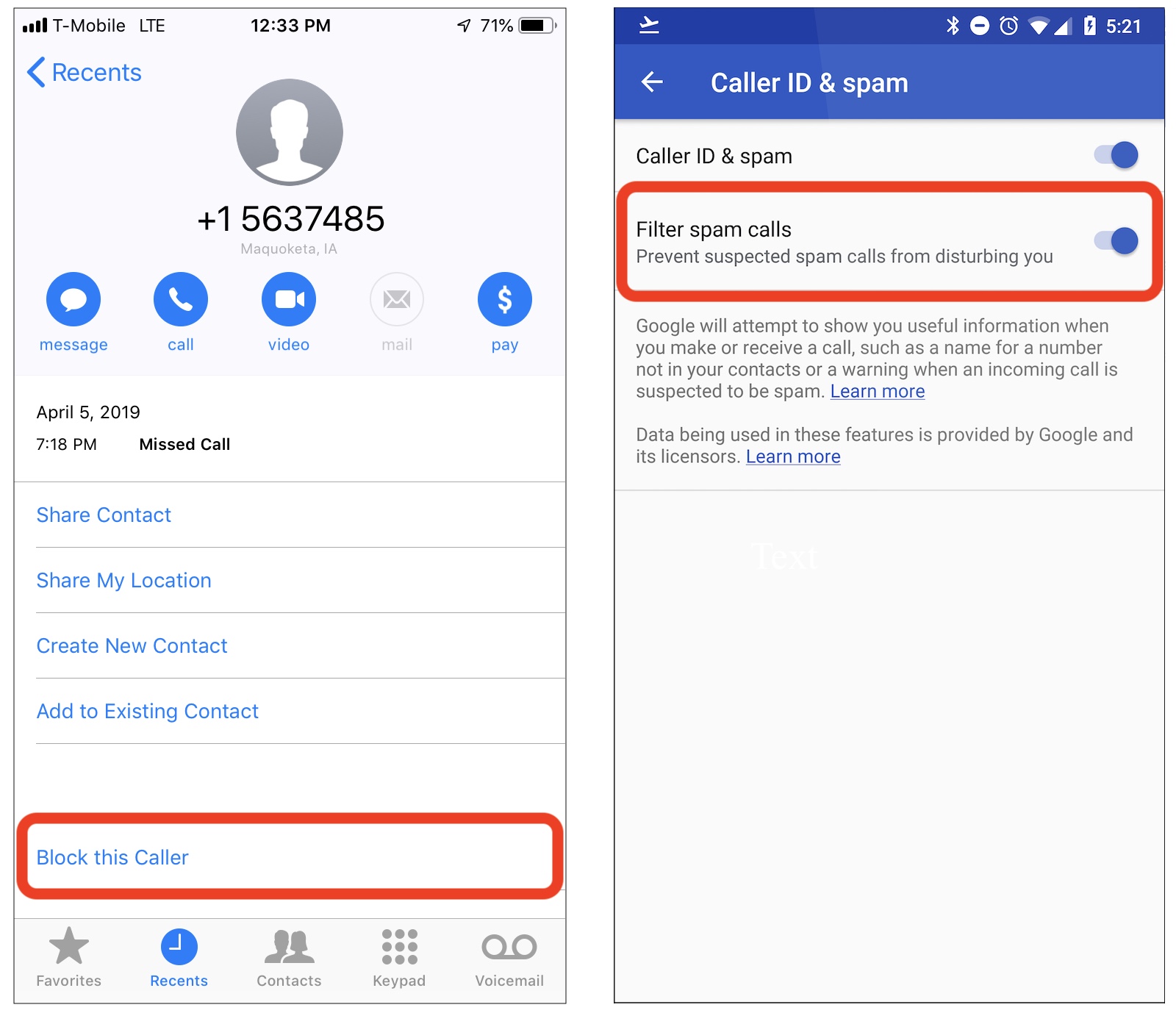
How to block spam calls on an iPhone (left) and filter spam calls on Android (right).

Some Android versions are different, but for most versions you can go to Settings > Caller ID & Spam and switch on the feature. You should be aware that incoming and outgoing call data will be sent to Google. You can also block individual numbers by going to Phone > Recents and tapping on each spam number to Block and Report call as spam, which helps improve Google spam busting efforts.

iPhones don’t come with an in-built spam filter, but you can block calls nonetheless. Go to Phone > Recents and tap on the information button next to each call record. Press Block this caller and that number will not be able to contact you again.

You can also use each device’s Do Not Disturb feature, a more drastic technique that blocks calls and notifications from bugging you when you’re busy. This feature for both iOS and Android block calls by default unless you whitelist each number.
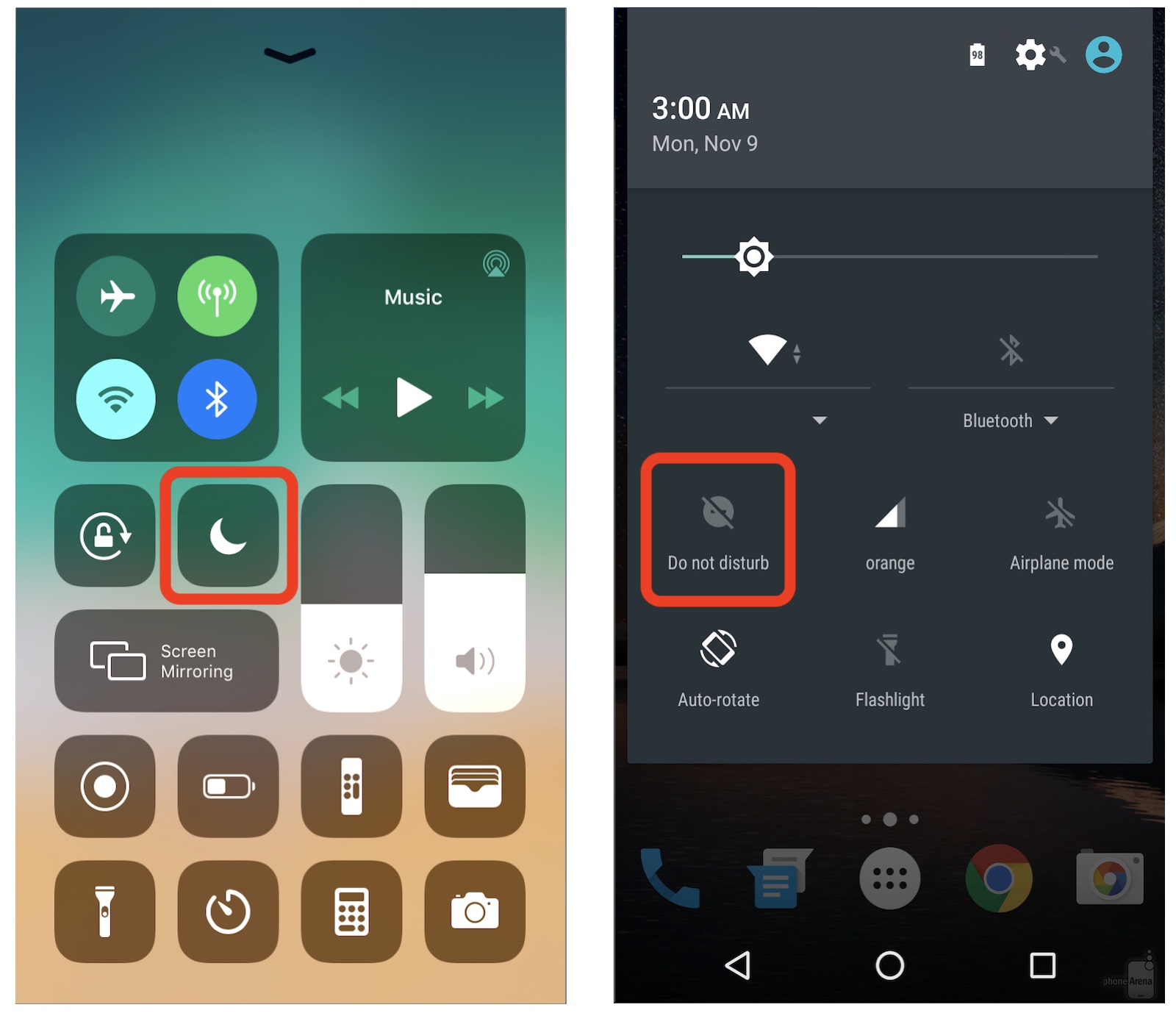
How to enable Do Not Disturb on an iPhone (left) and Android (right).

In Android, swipe down from the notifications area and hit the Do Not Disturb icon, a bubble with a line through it. To change its settings, long tap on the button. From here, go to Exceptions > Calls. If you want to only allow calls from your contacts, select From contacts only or From starred contacts only for a more granular list. Your phone will only ring if a contact in your phone book calls you.

It’s almost the same in iOS. You can swipe up from your notifications area and hit the Do Not Disturb icon, shaped as a moon. To configure your notifications, go to Settings > Do Not Disturb and scroll down to Phone. From here you can set it so you only Allow Calls From your contacts or your favorites.

WHAT THE REGULATORS CAN DO

Robocalls aren’t going away unless they’re stamped out at the source. That requires an industry-wide effort — and the U.S. just isn’t quite there yet.

You might be surprised to learn that robocalls aren’t nearly as frequent or as common in the Europe. In the U.K., the carriers and the communications regulator Ofcom worked together in recent years to pool their technical and data sharing resources to find ways to prevent misuse on the cell networks.

Collectively, more than a billion calls have been stopped in the past year. Vodafone, one of the largest networks in Europe, said the carrier prevents around two million automated calls from reaching customers each day alone.

“In the U.K., the problem has been reduced by every major operator implementing techniques to reject nuisance calls,” said Vodafone’s Laura Hind in an email to TechCrunch. “These are generally based on evidence from customer complaints and network heuristics.”

Though collaboration and sharing spam numbers is important, technology is vital to crushing the spammers. Because most calls nowadays rely in some way on voice-over-the-internet, it’s easier than ever to prevent spoofed calls. Ofcom, with help from privacy regulator the Information Commissioner’s Office, plans to bring in technical solutions this year to bring into effect caller authentication to weed out spoofed spam calls.

The reality is that there are solutions to fix the robocall and spammer problem. The downside is that it’s up to the cell carriers to act.

Federal regulators are as sick of the problem as everyone else, ramping up the pressure on the big four to take the situation more seriously. Earlier this year, the Federal Communications Commission chairman Ajit Pai threatened “regulatory intervention” if carriers don’t roll out a system that properly identifies real callers.

One authentication system would make call spoofing nearly impossible. Known as Secure Telephone Identity Revisited (STIR) and Signature-based Handling of Asserted Information Using Tokens (SHAKEN), the system relies on every phone number having a digital signature which, when checked against the cell networks, will prove you are a real caller. Once the system rolls out, every outbound call will sends a cryptographically signed message to the carrier which only it can open, proving the identity of the caller. The carrier then approves the call and patches it through to the recipient. This happens near-instantly.

The carriers have so far promised to implement the protocol, though the system isn’t expected to go into effect across the board for months — if not another year. So far only AT&T and Comcast have tested the protocol — with success. But there is still a way to go.

Until then, don’t let the spammers win.

Cybersecurity 101 - TechCrunch