Category: UNCATEGORIZED

10 Apr 2019

Cashierless Amazon Go stores are planning to accept cash

Amazon Go convenience stores will begin to accept cash, according to a report this morning from CNBC, which Amazon confirmed. The retailer didn’t say when cash would be added to existing stores as a payment option, however, only that it was planned. The issue with the cashierless, automated Amazon Go stores is that they require customers to use a stored bank or credit card associated with their Amazon account to make a purchase. This can be discriminatory towards the un-banked and under-banked, who typically pay with cash.

CNBC points out also the change comes at a time when many cities are enacting legislation that would ban cashless stores – that is, stores in some markets will be required to accept cash, as a means of catering to the unbanked who account for around 8.4 million (6.4%) of U.S. households.

Philadelphia last month became the first store to ban cash, the report notes, followed by the state of New Jersey. Other cities are considering this, as well, including New York, San Francisco and Chicago.

Amazon may be trying to get ahead of the legislation by working to accept cash in its cashierless stores before these laws spread across the U.S.

But it remains to be seen how Amazon will implement cash payments. Will it actually staff its cashierless stores with a cashier, or will it go the self-checkout route, where a machine takes the cash payment through inserted bills and then dispenses change?

In either case, the need to accept cash payments could dampen the store’s performance, as it could create lines and bottlenecks in the stores and slow the stores high performance. If self-checkout machines were used, there’s overhead in stocking them with cash, maintenance, and helping customers when they inevitably break down. But a dedicated cashier could mean an expanded headcount, and the costs associated with additional employees.

According to one analysis, Amazon Go’s Seattle Store has been generating 4 to 5 the number of inventory turns per year compared to typical retailers, and its annual sales per square foot of the selling area was $2,700. These figures are expected to grow as more customers shop the stores, along with other tweaks Amazon may make to drive more sales. But this level of performance is possible because of the automation.

CNBC caught wind of Amazon’s plans through a tip from an insider who sent the site a recording of an Amazon employee meeting, where Amazon’s senior vice president of physical stores, Steve Kessel, was responding to a question about the “discrimination and elitism” at Amazon Go stores.

The retailer confirmed his response, where he said Amazon was “planning additional payment mechanisms.” Specifically, Amazon said customers would be able to check out, pay with cash, and receive change.


10 Apr 2019

Here’s the first image of a black hole

Say hello to the black hole deep inside the Messier 87, a galaxy located in the Virgo cluster some 55 million light years away. It may seem underwhelming at first, but it’s one of four images of the supermassive spacetime deforming structure — marking the first time such an object has been photographed.

The shots were captured using combination of eight radio observatories spread out along four continents, creating what MIT refers to as a “virtual, Earth-sized telescope.” There’s light surrounding the object — a so called “ring of fire.” True to its name, the black hole’s shadow is the dark region in the center. That, mind you, is the spot where gravity’s pull is so strong not even light can escape.

“This black hole is much bigger than the orbit of Neptune, and Neptune takes 200 years to go around the sun,” Geoffrey Crew, research scientist MIT’s Haystack Observatory said in a statement. “With the M87 black hole being so massive, an orbiting planet would go around it within a week and be traveling at close to the speed of light.”

In fact, the blackhole is massive, even by blackhole standards. “It has a mass 6.5 billion times that of the Sun,” Prof Heino Falcke, of Radboud University in the Netherlands told the BBC. “And it is one of the heaviest black holes that we think exists. It is an absolute monster, the heavyweight champion of black holes in the Universe.”

The light surrounding the object is much brighter than that of surrounding galaxies, allowing it to be captured at such an incredible distance.

10 Apr 2019

For true transparency around political advertising, U.S. tech companies must collaborate

In October 2017 online giants Twitter, Facebook, and Google announced plans to voluntarily increase transparency for political advertising on their platforms. The three plans to tackle disinformation had roughly the same structure: funder disclaimers on political ads, stricter verification measures to prevent foreign entities from posting such ads, and varying formats of ad archives.

All three announcements came just before representatives from the companies were due to testify before Congress about Russian interference in the 2016 election and reflected fears of forthcoming regulation, as well as concessions to consumer pressure.

Since then, the companies have continued to attempt to address the issue of digital deception occurring on their platforms.

Google recently released a white paper detailing how it would deal with online disinformation campaigns across many of its products. In the run-up to the 2018 midterm elections, Facebook announced it would ban false information about voting. These efforts reflect an awareness that the public is concerned about the use of social media to manipulate their votes and is pushing for tech companies to actively address the issue.

These efforts at self-regulation are a step in the right direction — but they fall far short of providing the true transparency necessary to inform voters about who is trying to influence them. The lack of consistency in disclosure across platforms, indecision over issue ads, and inaction on wider digital deception issues including fake and automated accounts, harmful micro-targeting, and the exposure of user data are major defects of this self-governing model.

For example, individuals looking at Facebook’s ad transparency platform are currently able to see information about who viewed an ad that is not currently available on Google’s platform. However, on Google the same user can see top keywords for advertisements, or search political ads by district, which cannot be done on Facebook.

With this inconsistency in disclosure across platforms, users are not able to get a full picture of who is trying to influence them, which prevents them from being able to cast an informed vote.

One hundred cardboard cutouts of Facebook founder and CEO Mark Zuckerberg stand outside the US Capitol in Washington, DC, April 10, 2018. Advocacy group Avaaz is calling attention to what the groups says are hundreds of millions of fake accounts still spreading disinformation on Facebook. (Photo: SAUL LOEB/AFP/Getty Images)

Issue ads pose an additional problem. These are public communications that do not reference particular candidates, focusing instead on hot-button political issues such as gun control or immigration. Issue ads cannot currently be regulated in the same way that political communications that refer to a candidate can due to the Supreme Court’s interpretation of the First Amendment.

Moreover, as Bruce Flack, Twitter’s General Manager for Revenue Product, pointed out in a blog post addressing the platform’s impending transparency efforts, “there is currently no clear industry definition for issue-based ads.”

In the same post, Flack indicated a potential solution, writing, “We will work with our peer companies, other industry leaders, policy makers and ad partners to clearly define [issue ads] quickly and integrate them into the new approach mentioned above.” This post was written 18 months ago, but no definition has been established—possibly because tech companies are not collaborating to systemically confront digital deception.

This lack of collaboration damages the public’s right to be politically informed. If representatives from the platforms where digital deception occurs most often — Facebook, Twitter, and Google — were to form an independent advisory group that met regularly and worked with regulators and civil society to discuss solutions to digital deception, transparency and disclosure across the platforms would be more complete.

The platforms could look to the example set by the nuclear power industry, where national and international nonprofit advisory bodies facilitate cooperation among utilities to ensure nuclear safety. The World Association of Nuclear Operators (WANO) connects all 115 nuclear power plant operators in 34 countries in order to facilitate the exchange of experience and expertise. The Institute of Nuclear Power Operations (INPO) in the U.S. functions in a similar fashion but is able to institute tighter sanctions since it operates at the national level.

Similar to WANO and INPO, an independent advisory group for the technology sector could develop a consistent set of disclosure guidelines — based on policy regulations put in place by government — that would apply evenly across all social media platforms and search engines.

These guidelines would hopefully include a unified database of ads purchased by political groups as well as clear and uniform disclaimers of the source of each ad, how much it cost, and who it targeted. Beyond paid ads, the industry group could develop guidelines to increase transparency for all communications by organized political entities, address computational propaganda, and determine how best to safeguard users’ data.

Additionally, if the companies were working together, they could set up a consistent definition of what an issue ad is and determine what transparency guidelines should apply. This is particularly relevant given policymakers’ limited authority to regulate issue ads.

Importantly, working together regularly would allow platforms to identify technological advances that might catch policymakers by surprise. Deepfakes — fabricated images, audio, or video that purport to be authentic — represent one area where technology companies will almost certainly be ahead of lawmakers’ expertise. If digital corporations were working together as well as cooperating with government agencies, they could flag new technologies like these in advance and help regulators determine the best way to maintain transparency in the face of a rapidly changing technological landscape.

Would such collaboration ever happen? The extensive aversion to regulation shown by these companies indicates a worrying preference towards appeasing advertisers at the expense of the American public.

However, in August 2018, in advance of the midterm elections, representatives from large tech firms did meet to discuss countering manipulation on their platforms. This followed a meeting in May with U.S. intelligence officials, also to discuss the midterm elections. Additionally, Facebook, Microsoft, Twitter, and YouTube formed the Global Internet Forum to Counter Terrorism to disrupt terrorists’ ability to promote extremist viewpoints on those platforms. This shows that when they are motivated, technology companies can work together.

It’s time for Facebook, Twitter, and Google to put their obligation to the public interest first and work together to systematically address the threat to democracy posed by digital deception.


10 Apr 2019

Restaurant website builder BentoBox raises $16.4M

BentoBox, which helps restaurant owners build mobile-friendly websites, has raised $16.4 million in Series B funding.

This might not seem like the biggest opportunity, particularly since consumers are connecting with restaurants in so many other places online — reading reviews on Yelp, making reservations on OpenTable, ordering delivery on GrubHub and so on. But founder and CEO Krystle Mobayeni said that’s exactly why BentoBox is important.

“Unfortunately, the technology that has over time become more important in dining out has [also] threatened restaurants’ business models,” Mobayeni told me. “Restaurants have lost that direct relationship with their guests, which is the most important thing in hospitality.”

So BentoBox started out with restaurant websites because it’s “the only place online where they had control,” she said. Since then, it’s also added features allowing those restaurants to push the content and information from their websites to other platforms like Google and Facebook.

Mobayeni also said that it’s crucial for BentoBox to be a revenue generator for restaurants, rather than just another cost. So it charges a straightforward subscription fee (rather than taking a transaction fee that eats into a restaurant’s already-thin margins), and it’s added potential moneymakers to the website platform, like selling gift cards, booking private events and taking orders for catering.

BentoBox – Our Mission from BentoBox on Vimeo.

In fact, Mobayeni said restaurants are already looking at the catering feature and “wanting to use that as on-demand online ordering.”

“That’s a really easy leap for us to make, because we have a lot of that technology built already,” she said.

BentoBox says it works with more than 4,000 restaurants across all 50 states and in 16b countries, including Union Square Hospitality Group, Eleven Madison Park and José Andrés’ Think Food Group.

The company has now raised a total of $23.6 million, according to Crunchbase. The new round was led by Threshold Ventures (formerly DFJ Venture) with participation from Bullpen Capital, Haystack and Female Founders Fund, as well as restaurateur Will Guidara of Make it Nice and Eleven Madison Park.

“Krystle and her team have demonstrated impressive growth driven by their keen sense of how the restaurant industry is evolving as well as a deep understanding for how these customers use technology in their day-to-day operations,” said Threshold’s Chirag Chotalia in a statement.

Besides adding on-demand ordering, Mobayeni said the new funding will allow BentoBox to start working with larger restaurant chains, and to build more features, like a point-of-sale and reservation system for restaurants.

“Really our vision over time is to power every interaction between the restaurant and their guest,” she said. “We want to continue to help restaurants drive revenue through their most popular revenue streams — ordering online and booking — and doing that in a way that the restaurant owns.”

10 Apr 2019

Esports org OverActive Media gets investment from The Weeknd

OverActive Media, the company that owns Splyce esports org and the Overwatch League’s Toronto Defiant team, have announced that The Weeknd (real name: Abel Tesfaye) has invested in the company.

In the world of esports, OAM is a big organization — the Toronto-based company, which launched in 2017, has teams in the League of Legends European Championship, Overwatch League, Call of Duty World League, Rocket League, Starcraft and Smite. OAM is one of only five esports orgs in the world with permanent slots both in League of Legends and the Overwatch League.

If you have no idea what I’m talking about, here’s a look at one of the Toronto Defiant’s recent Overwatch League games.

The terms of the investment were not disclosed, but it would appear that The Weeknd will be contributing to some marketing efforts and building brand awareness around Splyce and the Toronto Defiant.

“Abel’s standing in the music industry will provide our Toronto Defiant and Splyce brands the opportunity to reach more fans and engage new audiences,” said OAM CEO and president Chris Overholt.

The release also mentions that Toronto Defiant fans will see “unique joint efforts” with The Weeknd throughout the 2019 Overwatch League seasons.

Here’s what The Weeknd had to say, via the release:

As a big esports fan, I am really excited to be involved in this project. I am looking forward to collaborating with OverActive Media in unique and innovative ways.

The Weeknd is not the first musical artist to invest in an esports org. Drake and Scooter Braun invested in esports company 100 Thieves in October of 2018.

10 Apr 2019

Review: The $199 Echo Link turns the fidelity up to 11

The Echo Link takes streaming music and makes it sound better. Just wirelessly connect it to an Echo device and plug it into a set of nice speakers. It’s the missing link.

The Link bridges the gap between streaming music and a nice audio system. Instead of settling for the analog connection of an Echo Dot, the Echo Link serves audio over a digital connection and it makes just enough of a difference to justify the $200 price.

I plugged the Eco Link into the audio system in my office and was pleased with the results. This is the Echo device I’ve been waiting for.

In my case the Echo Link took Spotfiy’s 320 kbps stream and opened it up. The Link creates a wider soundstage and makes the music a bit more full and expansive. The bass hits a touch harder and the highs now have a new-found crispness. Lyrics are clearer and easier to pick apart. The differences are subtle. Everything is just slightly improved over the sound quailty found when using an Echo Dot’s 3.5mm output.

Don’t have a set of nice speakers? That’s okay, Amazon also just released the Echo Link Amp, which features a built-in amplifier capable of powering a set of small speakers (read the review here).

Here’s the thing: I’m surprised Amazon is making the Echo Link. The device caters to what must be a small demographic of Echo owners looking to improve the quality of Pandora or Spotify when using an audio system. And yet, without support for local or streaming high resolution audio, it’s not good enough for audiophiles. This is for wannabe audiophiles. Hey, that’s me.

Review

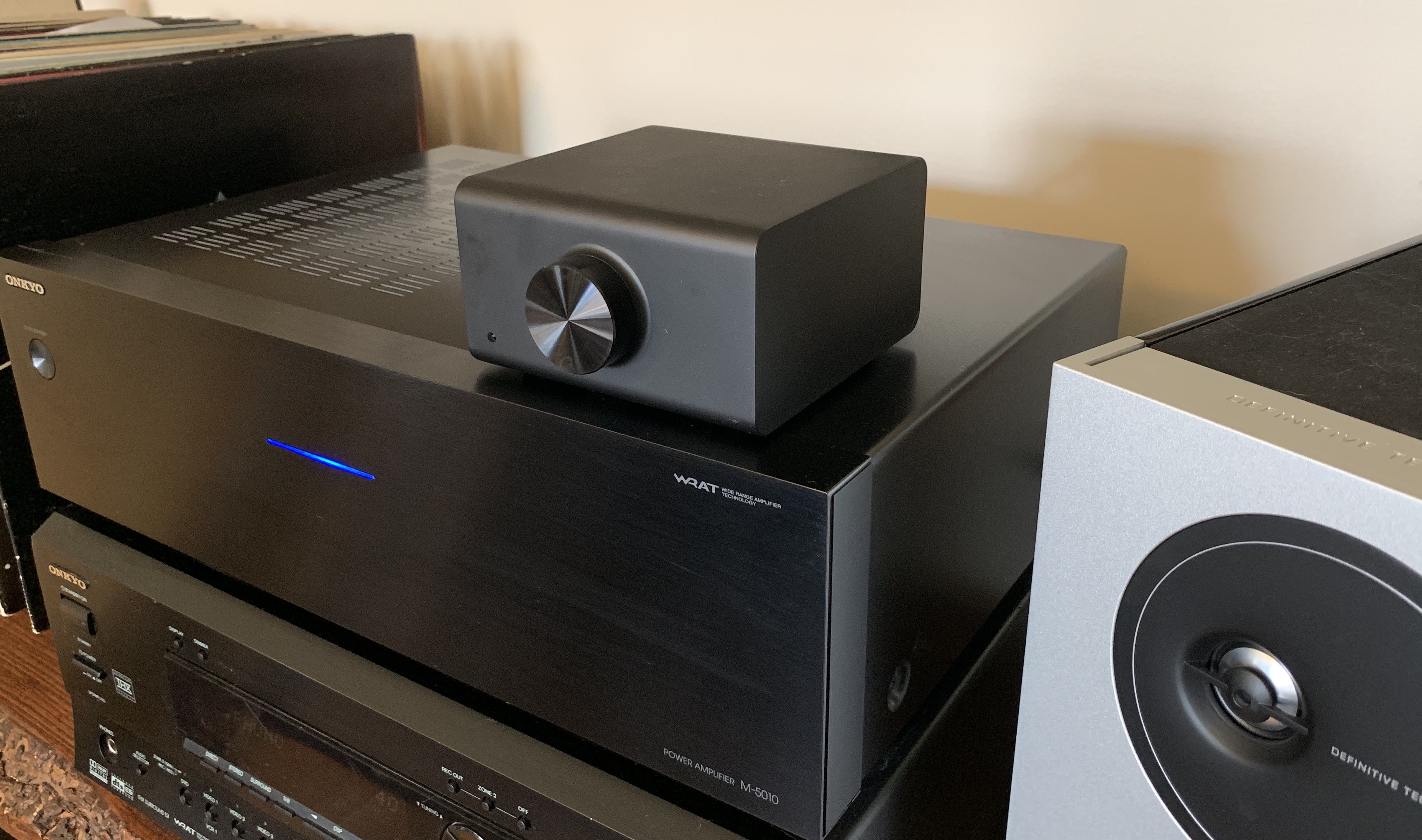
There are Echo’s scattered throughout my house. The devices provide a fantastic way to access music and NPR. The tiny Echo Link is perfect for the system in my office where I have a pair of Definitive Technology bookshelf speakers powered by an Onkyo receiver and amp. I have a turntable and SACD player connected to the receiver but those are a hassle when I’m at my desk. The majority of the time I listen to Spotify through the Amazon Echo Input.

I added the Onkyo amplifier to the system last year and it made a huge difference to the quality. The music suddenly had more power. The two-channel amp pushes harder than the receiver, and resulted in audio that was more expansive and clear. And at any volume, too. I didn’t know what I was missing. That’s the trick with audio. Most of the time the audio sounds great until it suddenly sounds better. The Echo Link provided me with the same feeling of discovery.

To be clear the $200 Echo Link does not provide a night and day difference in my audio quality. It’s a slight upgrade over the audio outputted by a $20 Echo Input — and don’t forget, an Echo device (like the $20 Echo Input) is required to make the Echo Link work.

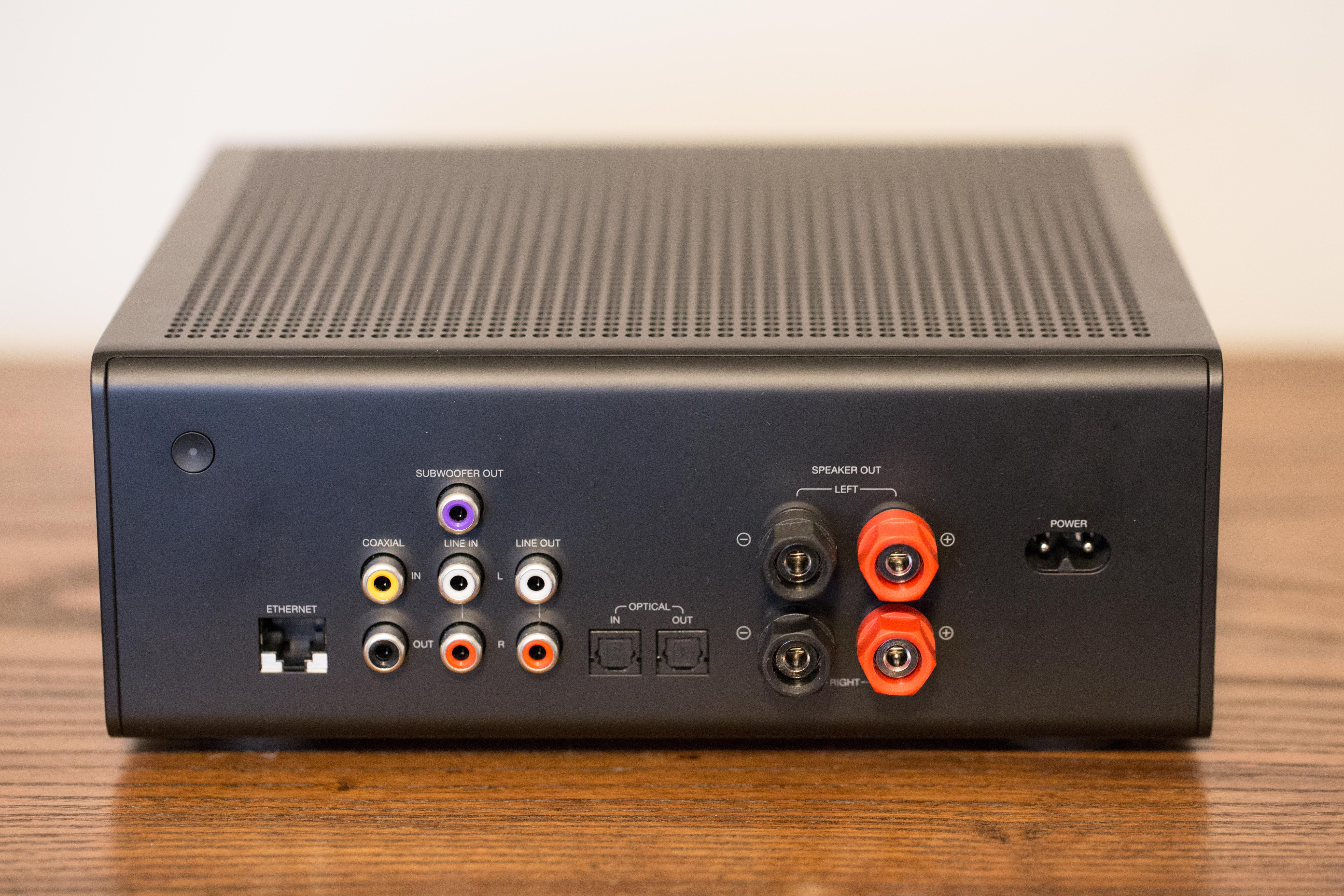
The Echo Link provides the extra juice lacking from the Echo Input or Dot. Those less expensive options output audio to an audio system, but only through an analog connection. The Echo Link offers a digital connection through Toslink or Digital Coax. It has analog outputs that’s powered by a DAC with a superior dynamic range and total harmonic distortion found in the Input or Dot. It’s an easy way to improve the quality of music from streaming services.

The Echo Link, and Echo Link Amp, also feature a headphone amp. It’s an interesting detail. With this jack, someone could have the Echo Link on their desk and use it to power a set of headphones without any loss of quality.

I set up a simple A/B test to spot the differences between a Link and a Dot. First, I connected the Echo Link with a Toslink connection to my receiver and an Echo Input. I also connected an Echo Dot through its 3.5mm analog connection to the receiver. I created a group in the Alexa app of the devices. This allowed each of the devices to play the same source simultaneously. Then, as needed, I was able to switch between the Dot and Link with just a touch of a button, providing an easy and quick way to test the differences.

I’ll leave it up to you to justify the cost. To me, as someone who has invested money into a quality audio system, the extra cost of the Echo Link is worth it. But to others an Echo Dot could be enough.

It’s important to note that the Echo Link works a bit differently than other Echo devices connected to an audio system. When, say, a Dot is connected to an audio system, the internal speakers are turned off and all of the audio is sent to the system. The Echo Link doesn’t have to override the companion Echo. When an Echo Link is connected to an Echo device, the Echo still responds through its internal speakers; only music is sent to the Echo Link. For example, when the Echo is asked about the weather, the forecast is played back through the speakers in the Echo and not the audio system connected to the Echo Link. In most cases this allows the owner to turn off the high-power speakers and still have access to voice commands on the Echo.

The Echo Link takes streaming music and instantly improves the quality. In my case the improvements were slight but noticeable. It works with all the streaming services supported by Echo devices, but it’s important to note it does not work with Tidal’s high-res Master Audio tracks. The best the Echo Link can do is 320 kbps from Spotify or Tidal. This is a limiting factor and it’s not surprising. If the Echo Link supported Tidal’s Master Tracks, I would likely sign up for that service, and that is not in the best interest of Amazon which hopes I sign up for Amazon Music Unlimited.

I spoke to Amazon about the Echo Link’s lack of support for Tidal Master Tracks and they indicated they’re interested in hearing how customers will use the device before committing to adding support.

The Link is interesting. Google doesn’t have anything similar in its Google Home Line. The Sonos Amp is similar, but with a built-in amplifier, it’s a closer competitor to the Echo Link Amp. Several high-end audio companies sell components that can stream audio over digital connections yet none are as easy to use or as inexpensive as the Echo Link. The Echo Link is the easiest way to improve the sound of streaming music services.

10 Apr 2019

Review: The $299 Echo Link Amp adds Alexa to any speaker

The Echo Link Amp is designed to give Echo owners options. Instead of settling for the sound from a couple of Echo speakers, this amp lets owners use a set of nice bookshelf speakers. Best yet, this replaces a large receiver generally needed to power speakers.

At $299 the Echo Link Amp lives in a curious spot. It’s less expensive and smaller than a traditional home audio system. Yet it’s more expensive than smaller desktop amps with a similar power rating.

Like it’s little brother the $199 Echo Link, the $299 Echo Link amp requires another Echo device. The Link and the Link Amp lack a microphone, which is needed to talk to the system. These two products are, if you will, the missing link between Alexa and better sound.

There are less expensive ways to replicate a lot of the Echo Link Amp’s feature set. There are a handful of small and powerful amps available for around $50 that can take audio from an Echo Dot and power a set of speakers. I use a $30 Lepai amp to power a set of Yamaha outdoor speakers on my deck. I used this system to test the Echo Link Amp.

Review

It’s finally nice outside here in Michigan. The sun is out and the leaves are budding. I’m writing this from my deck where I have two Yamaha speakers connected to a small amp and an Echo Dot, which are mounted the floorboards. It’s the best. I can yell requests to the Dot from my fire pit. The Dot and $30 amp have survived two Michigan winters, too.

This is the perfect use case for the Echo Link Amp though I’m sure Amazon will disapprove of the placement outside. That’s okay.

Like when I tested the Echo Link, I enlisted the help of another Echo product to make switching between the audio sources a bit easier. Using an AV switcher I was able to connect everything simultaneously and press a button to switch between the sources. I cued up some summer BBQ music and stepped back remote in hand.

There wasn’t a difference.

The $30 amp had the same bass response, vocal reproduction and soundstage as the $300 Echo Link Amp. On paper the Echo Link Amp has more power but in practice that power did not result in a difference with these outdoor speakers. I disconnected everything and this time plugged the speakers directly into the amps. Nothing changed. Hank Jr. sounded the same. For better or worse, of course.

I tried the system on a set of old Infinity speakers and had the same results. The sound had the same fidelity. On both systems the highs were just as high and the lows were just as low. The quality had the same, admittedly, lack of punch but sounded good enough to blast Kenny Chesney throughout my yard.

The $299 Echo Link Amp shares a lot with the $199 Echo Link. The main difference, as the name suggests, is the amp. The Link Amp has the ability to drive a set of speakers where the Link needs to be connected to an amplifier. I found the Echo Link to be a fantastic addition to a home audio setup. The $199 device provides a digital connection lacking on other Echo devices and I found it to improve the audio quality of streaming services.

The Echo Link Amp, however, is a touch disappointing but at the same time very proficient at its job. Buyers are paying for the ease of use more than the quality of the amplifier. It’s clever too. If the connected Echo Dot is asked a question, it responds with the answer. This lets the owner to turn off the amplifier and still retain access to Alexa. Only when the owner asks the Echo to play audio does it offload the task to the powered speakers.

With a series of inputs, the Echo Link Amp can easily serve several roles including as a 2.1 channel home theater receiver.

The Echo Link Amp is a lovely device even though I find the audio quality lacking when compared to less expensive amps. It’s clever and I’m surprised Amazon is selling the device. While the rest of the Echo product line is a mass market play, the Echo Link and Echo Link Amp are designed for a smaller market. The Echo Link Amp features a set of functions unavailable on any other Echo device and the easiest way to add Alexa to a set of speakers.

10 Apr 2019

CleverTap lands $26M for its mobile-focused customer marketing service

CleverTap, an India-based startup that lets companies track and improve engagement with users across the web, has pulled in $26 million in new funding thanks to a round led by Sequoia India.

Existing investor Accel and new backer Tiger Global also took part in the deal, which values CleverTap at $150-$160 million, the startup disclosed. The deal takes CleverTap to around $40 million from investors to date.

Founded in 2015 and based in Mumbai, CleverTap competes with a range of customer experience services, including Oracle Cloud. Its service covers a range of touchpoints with consumers, including email, in-app activity, push notifications, Facebook, WhatsApp (for business) and Viber. Its service helps companies map out how their users are engaging across those vectors, and develop “re-engagement” programs to help reactive dormant users or increase engagement among others.

The company says its SDK is installed in over 8,000 apps and it some of the public clients it names include Southeast Asia-based duo Go-Jek and Zilingo, Hotstar in India and struggling U.S. startup Fandango . With a considerable customer base in Asia, CleverTap puts a particular focus on mobile because many of these markets are all about personal devices.

“Asia is mobile-first and massively growing,” CleverTap CEO and co-founder Sunil Thomas told TechCrunch in an interview. “A lot of engagement in this [part of the] world is timely… we were sort of born physically on the east side of the world, so we got to scale with all these diverse set of devices.”

That stands to benefit CleverTap as it seeks to grow market share outside of Asia, and in markets like the U.S. and Europe where mobile is — right now — just one part of the marketing and customer engagement process. The company believes that engagement by mobile has a long way to develop there.

“Engagement [in the West] is still email-heavy and not really timely,” Thomas said. “Whereas the East thinks of it as ‘Hey, let’s be proactive… instead of a user coming in to hunt for information, can I provide it when I think he or she will need it?'”

Of course, mobile push and in-app notifications can be easily abused.

Most people will know of an app on their phone — or perhaps once on their phone — that falls into that category. So, how does a company know what is too much or what isn’t enough?

“As long as you use push or in-app as an extension of your brand, then I think it’s extremely useful,” explained Thomas. “After all, this is a really competitive world; it isn’t just your app out there — if you can make your brand count when this person isn’t in your app, that’ll help you.”

More broadly, Thomas argued that CleverTap brings data to the table which, ultimately, “changes the whole context in real time.” So a customer can really look holistically at their online presence and figure out what is working, and with which users. In real terms, when used to acquire new users online, he said he believes that CleverTap typically doubles registration conversions and triples the buying rate.

“The cost of acquisition to first purchase is what we really effect,” said Thomas. “It’s that moment you get a new person into your house.”

CleverTap has just opened an office in Singapore, and it plans to add a location in Indonesia before the end of the year. Both of those expansions are centered around business development, with some customer support. Already, according to Thomas, the company is looking to grow in Europe while it is weighing the potential to enter Latin America in a move that could include a local partnership.

The CleverTap CEO is also considering raising more money towards the end of the year, when he believes that the company can push its valuation as high as $400 million.

“That’s very doable based on revenue growth,” he said. “We think that the revenue will demand that valuation.”

10 Apr 2019

Innovation Endeavors debuts Deep Life, an incubator focused on intersection of life science and computer science

Innovation Endeavors, the fund backed by Google’s Eric Schmidt, has for years now been taking a novel approach to working on difficult and still-evolving problems like cybersecurity and food shortages: it sets up incubators that bring together different stakeholders to identify, develop and fund ways of tackling these issues. Today, Innovation unveiled the latest of these: a new project called Deep Life, which aims to identify tricky problems in the world of life sciences, and figure out how to use computer science — specifically innovations in areas like machine learning — to help fix them.

Target areas will include therapeutics, diagnostics and industrial life sciences in biology, chemistry and other fields; and Deep Life will provide startups with “investment capital across all stages of growth; access to experts, including scientists and decision-makers; proprietary data sets; early feedback on product; identification of market needs; initial customers and potential partners. In exchange for their startup support, Deep Life member organizations gain access to emerging technologies and hard-to-find talent,” according to a blog post introducing the new project penned by Innovation Endeavors’ co-founder Dror Berman.

Deep Life will unveil the first fruits of its efforts during a pitch day on May 30, and it’s accepting applications for places as of right now.

Alternately called an “ecosystem” and “collective”, Deep Life — in the words of Berman — is “taking inspiration” from Farm2050 and Team8, the two other incubators that the firm helped create in past years. The model is to bring in a number of big names and then — in addition to building on ideas — then fund startups to productise them. Eventually, they are spun out as independent companies that get acquired (here and here) or continue to operate independently.

As with these two other incubators, Deep Life is harnessing collective knowledge from a number of existing stakeholders in the life sciences ecosystem. The list includes LEO Pharma, Danish pharmaceutical company focusing on pioneering dermatology; Mount Sinai HospitalNovozymes, a producer of industrial enzymes and microorganism for a broad range of industries; Schmidt Futures; Clalit Health Services & Research Institute in Israel; and academics, entrepreneurs and others, including Aviv Regev, a computational biologist and Faculty Chair of the Broad Institute of MIT and Harvard.

Additionally, Innovation Endeavors says that it will be tapping learnings from startups it has already backed, including Bolt Threads, Color, Freenome, GRO Biosciences, Karius, Vicarious Surgical, Viz.ai and Zymergen.

In all, it’s not clear how much funding is going into Deep Life, and whether the two lists above also become financial backers of the project. Separately, Innovation Endeavors last summer announced a $333 million fund and plans to contribute a sizeable amount of backing itself to Deep Life, from what I understand.

The intersection between tech and life sciences is, of course, not a completely new area. Tech has been a cornerstone of how science has developed and how applications of it are delivered, for example in medicine.

What’s a little different here is the much closer focus on the role that tech is playing in the very germination of ideas and building knowledge, rather than just enabling the efficient operation of a service.

Among the areas that Deep Life tells me it hopes to cover are the use of experimental design (active learning) to uncover biological knowledge; generating datasets that are more effective than current approaches; the application of simple measurements to generate complex, high-content readouts through generative models; combining data modalities (e.g., molecular and imaging based complex phenotypes); simplifying data readouts to help predict outcomes (using AI); adding to the molecular vocabulary of cells, host organisms and their subcomponents; and building data platforms for biology growing from distributed, asynchronous efforts into an open source whole.

10 Apr 2019

DroneBase raises capital and partners with FLIR Systems to train pilots on thermal imaging tech

Publicly traded sensor technology developer, FLIR Systems, is investing in a strategic round of funding for the outsourced drone imaging company, DroneBase.

The two companies are also partnering to provide FLIR’s thermal imaging technology and training services to DroneBase’s stable of pilots.

Terms of the investment were not disclosed.

“Our investment in DroneBase helps expand the adoption of FLIR thermal imaging technology by putting it in the hands of more pilots who fly drones every day,” said Jim Cannon, the president and chief executive of FLIR, in a statement. “DroneBase’s enterprise pilot network will receive training by professional thermographers, enabling DroneBase to offer specialized thermal inspection services for customers on a wider scale, and creating an opportunity for FLIR to incorporate additional service offerings through DroneBase in the future.”

Los Angeles-based DroneBase has contracted pilots to complete over 100,000 commercial missions in over 70 countries for residential and commercial real estate, insurance, telecommunications, construction and media companies, according to a statement.

Through FLIR’s Infrared Training Center, FLIR and DroneBase will develop a specialized training program that will be certified exclusively by DroneBase

“Through FLIR’s strategic investment in DroneBase, we are now able to offer scalable thermal solutions to enterprises of any size,” said Dan Burton, founder and chief executive of DroneBase, in a statement. “This access to valuable data will allow stakeholders to make better decisions about their most critical assets. Like myself, many DroneBase pilots relied on FLIR products when they served in the military. This integration will offer military veterans a chance to work with FLIR again and leverage their training in their civilian lives.”