Category: UNCATEGORIZED

08 Apr 2019

New iPhones sport three-camera arrays in latest rumors

One thing we count on for sure in this unpredictable world of ours: the will, indeed, be new iPhones. Another thing that’s looking — at the very least — pretty likely is the inclusion of a three-camera array. A number of different rumors from different sources are currently circling around the addition of a third lens for 2019 models.

New reports from “reliable sources” in the Chinese supply chain (by way of 9 to 5 Mac by way of Macotakara, a Japanese Apple blog) have the three-camera system popping on on models with 6.1 inch and 6.5 inch OLED screens, marking another real estate for the base level model of the flagship.

The larger camera configuration (which may well induce minor trypophobia among some users) is said to be a driving factor in the decision to increase screen size). We’re still very much in the “grain of salt” portion of the Apple rumor cycle, through as 9 to 5 notes, the source has had a solid track record with these sorts of rumors before.

All of that, one assumes, would also come with a price increase for the handset, which has been pushing the $1,000 mark for a couple of years now. And all of this in a year when the company’s still not quite ready to pull the trigger on 5G. All signs currently point to a 2020 date on that one.

08 Apr 2019

Europe to pilot AI ethics rules, calls for participants

The European Commission has announced the launch of a pilot project intended to test draft ethical rules for developing and applying artificial intelligence technologies to ensure they can be implemented in practice.

It’s also aiming to garner feedback and encourage international consensus building for what it dubs “human-centric AI” — targeting among other talking shops the forthcoming G7 and G20 meetings for increasing discussion on the topic.

The Commission’s High Level Group on AI — a body comprised of 52 experts from across industry, academia and civic society announced last summer — published their draft ethics guidelines for trustworthy AI in December.

A revised version of the document was submitted to the Commission in March. It’s boiled the expert consultancy down to a set of seven “key requirements” for trustworthy AI, i.e. in addition to machine learning technologies needing to respect existing laws and regulations — namely:

  • Human agency and oversight: “AI systems should enable equitable societies by supporting human agency and fundamental rights, and not decrease, limit or misguide human autonomy.”
  • Robustness and safety: “Trustworthy AI requires algorithms to be secure, reliable and robust enough to deal with errors or inconsistencies during all life cycle phases of AI systems.”
  • Privacy and data governance: “Citizens should have full control over their own data, while data concerning them will not be used to harm or discriminate against them.”
  • Transparency: “The traceability of AI systems should be ensured.”
  • Diversity, non-discrimination and fairness: “AI systems should consider the whole range of human abilities, skills and requirements, and ensure accessibility.”
  • Societal and environmental well-being: “AI systems should be used to enhance positive social change and enhance sustainability and ecological responsibility.”
  • Accountability: “Mechanisms should be put in place to ensure responsibility and accountability for AI systems and their outcomes.”

The next stage of the Commission’s strategy to foster ethical AI is to see how the draft guidelines operate in a large-scale pilot with a wide range of stakeholders, including international organizations and companies from outside the bloc itself.

The Commission says the pilot phase will launch this summer. It’s asking companies, public administrations and organisations to sign up to its forum on AI, the European AI Alliance, and receive notification when the pilot starts.

Members of its AI high-level expert group will also present and explain the guidelines to relevant stakeholders in Member States. Members of the group are due to present their work in detail during the third Digital Day in Brussels tomorrow.

Here’s how the Commission explains its plan for the pilot in an official communication on “building trust in human-centric artificial intelligence”:

This work will have two strands: (i) a piloting phase for the guidelines involving stakeholders who develop or use AI, including public administrations, and (ii) a continued stakeholder consultation and awareness-raising process across Member States and different groups of stakeholders, including industry and service sectors:

  1. (i)  Starting in June 2019, all stakeholders and individuals will be invited to test the assessment list and provide feedback on how to improve it. In addition, the AI high- level expert group will set up an in-depth review with stakeholders from the private and the public sector to gather more detailed feedback on how the guidelines can be implemented in a wide range of application domains. All feedback on the guidelines’ workability and feasibility will be evaluated by the end of 2019.
  2. (ii)  In parallel, the Commission will organise further outreach activities, giving representatives of the AI high-level expert group the opportunity to present the guidelines to relevant stakeholders in the Member States, including industry and service sectors, and providing these stakeholders with an additional opportunity to comment on and contribute to the AI guidelines.

Commenting in a statement, VP for the Digital Single Market, Andrus Ansip, said: “The ethical dimension of AI is not a luxury feature or an add-on. It is only with trust that our society can fully benefit from technologies. Ethical AI is a win-win proposition that can become a competitive advantage for Europe: being a leader of human-centric AI that people can trust.”

“Today, we are taking an important step towards ethical and secure AI in the EU,” added Mariya Gabriel, commissioner for Digital Economy and Society, in another supporting statement. “We now have a solid foundation based on EU values and following an extensive and constructive engagement from many stakeholders including businesses, academia and civil society. We will now put these requirements to practice and at the same time foster an international discussion on human-centric AI.”

Following the pilot phase, in early 2020, the Commission says the expert AI group will review the assessment lists for the key requirements, building on feedback received. It says it will then build on the review — evaluating the outcome and proposing any next steps.

By fall 2019 it also intends to launch a set of networks of AI research excellence centres. Networks of digital innovation hubs are also slated to be set up with a goal of fostering discussions between Member States and stakeholders to develop and implement a model for data sharing and making best use of common data spaces.

The plans fall under the Commission’s AI strategy of April 2018, which aims to increase public and private AI investments to at least €20BN annually over the next decade, making more data available, fostering talent and ensuring trust.

08 Apr 2019

Klaviyo raises $150M Series B after building company the old fashioned way

Klaviyo, a Boston-based email marketing firm founded in 2012, went about building its email marketing business the old fashioned way. First it built a profitable company, then it went looking for funding to accelerate the growth. Today, it announced a massive $150 million Series B with the entire sum coming from Summit Partners.

The company had raised just $8.5 million before today’s announcement. Co-founder Andrew Bialecki wrote in a blog post announcing the funding that they decided to bootstrap for the first several years because they felt it was the right way to build a business — that, and they had no idea to raise money.

“We came from families that started small businesses from scratch and ran them for decades. They may not have been huge, but they were real, lasting businesses. We wanted to try to build something like that. The second reason is much less idealistic. We had no idea how to raise money,” he wrote in the blog post.

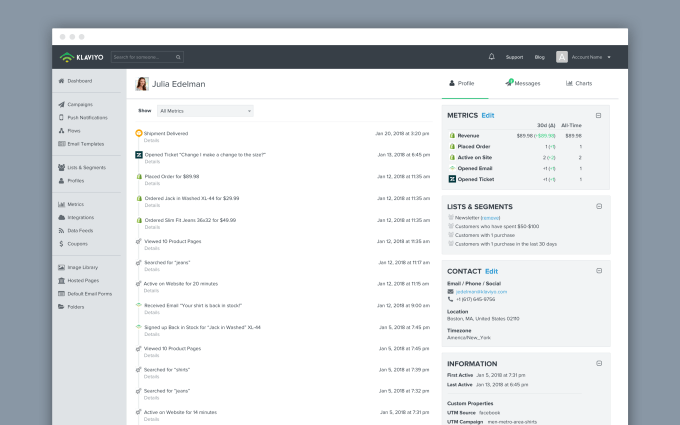
What is the company doing to warrant such a huge investment? It has created an email marketing platform, which in and of itself is not that special, but what the company has done that it feels is different is build a platform where the data lives with the messaging. This enables them to build highly customized messages quickly.

Screenshot: Klaviyo

Bialecki says that there are two problems with email marketing tools today. The first is they aren’t really very smart. Most companies are still sending the same message to everyone, regardless whether they are a new customer or a repeat one. Secondly, while they are probably measuring things like open rates and click-through rates, most platforms aren’t measuring the most important metric of all, and that’s revenue generated as a result of the email campaign.

To be fair, many companies are building highly customized email marketing campaigns based on analytics. In fact, he admits that many people ask if this isn’t a solved problem. Clearly, there are many companies selling email marketing solutions, but he says his company’s approach is different. “Our point of view is that there’s a ton of noise about this, a lot of marketing about marketing companies saying they solve these problems, but they don’t actually,” he said.

He believes the reason for that is simple “They just don’t store all the customer data themselves. They delegate that job to data warehouses, customer data platforms or some other [platforms]. Then they try to connect them up and it’s a really bad experience.”

He said having all the data stored on the company’s platform lets their users respond much more quickly to changing situations and to deliver email that’s more personalized and in context of the user’s actual experience.

Michael Medici, a managing director at Summit Partners, who is joining the company board as part of this investment, says the company is a combination of product vision and technical expertise. “Klaviyo continues to change the playing field in commerce, allowing companies of all sizes to harness the power of data-driven customer engagement activity to grow sales – and the results are impressive,” he said in a statement.

The company is growing in leaps and bounds. It currently has 12,000 customers. To put that into perspective, it had just 1000 at the end of 2016 and 5000 at the end of 2017.

The company certainly understands that marketing is just one channel, but the goal up until now was to concentrate on email marketing, and get that right. Moving forward with the big investment, the company can accelerate growth and expand the platform into other areas like mobile and websites.

“We think the big change coming is to own all of those channels. Right now, businesses are forced to choose between going through some intermediary like Google or Facebook for ads, or selling on a marketplaces like Amazon. If you’re a consumer business, we think you can go directly to customers,” he said.

He adds, “Our mentality is that we’re going to be a self sustaining business, and we want to be here for decades.” With this kind of money, it certainly has the run way to be around for the foreseeable future.

08 Apr 2019

Sources: Y Combinator’s growth fund to back challenger bank Monzo

Just 5 months after announcing £85 million in Series E funding, Monzo is already gearing up to raise additional funding, which would almost double its valuation.

As reported in the Sunday Times yesterday, the U.K. challenger bank is close to raising £100 million in further funding in a new round led by an unnamed U.S. investor. If the deal goes through, it will reportedly give Monzo a pre-money valuation of £2 billion, up from £1 billion in October.

Now TechCrunch has learned that the new U.S. backer is Y Combinator.

According to multiple sources within investor circles both sides of the pond, the Silicon Valley accelerator and venture capital fund plans to invest in Monzo out of its growth fund, the vehicle it typically uses to double down on fast-growing companies within its alumni.

Notably, Monzo isn’t a graduate of YC. However, Monzo co-founder Tom Blomfield’s previous startup, the payments company GoCardless, did go through the accelerator program, making Blomfield himself an alumni.

Monzo declined to comment. Y Combinator couldn’t be reached at the time of publication and I’ll update this post should I hear back.

Meanwhile, the news that Y Combinator is lining up to invest in Monzo makes a lot of sense in a number of ways beyond Blomfield’s previous ties to the accelerator. The challenger bank already boasts a plethora of U.S. investors, such as U.S. venture capital firm General Catalyst, Thrive Capital and Stripe.

And, as TechCrunch reported exclusively, Monzo has quietly begun working on a U.S. launch. This is includes setting up a small team states-side to begin laying the groundwork to bring a version of Monzo to North America, which will initially be powered by a U.S. banking partner while Monzo works on the necessary regulatory licenses to go it alone.

Monzo continues to grow at a clip here in the U.K., too. To date, the challenger bank claims more than 1.2 million customers since it launched in 2015.

08 Apr 2019

Viber users can now get local numbers in the US, UK and Canada for inbound voice and SMS

Viber, the messaging app owned by Rakuten that a year ago said it had 1 billion registered users, has added another feature in its longer-term efforts to add more stickiness to its service, while also bringing in a little more revenue to the business: users now have the option of subscribing to have “local numbers” that can receive phone calls and SMS messages as if those calls and messages are being sent to mobile numbers in specific regions.

Viber Local Number, as the service is called, is available to anyone globally but for now the numbers you can register are in the US, UK and Canada, with more countries getting added soon. We’re asking which area codes in the US will be covered at launch, and what the roadmap is for subsequent countries.

Viber said that the first 10,000 people to sign up will be able to pay $1.99 per month indefinitely for the service. Otherwise, it’s being priced at $4.99/month, and according to a FAQ on its site, you pay either by way of Apple’s in-app payments service, Google Play or (if you’re on Android) via a credit card direct with Viber itself. You access the option to get the number by way of the “more” tab on the app.

Viber Local Number will sound fairly familiar to people who have used other messaging apps and VoIP services.

Skype, for one, has offered the option of getting a local number in a specific region, both to make and receive calls, for years. There have also been companies that have stepped into the feature gap between the existence of the capability and Viber yet to launch anything of its own. One that I found offering a local number feature for Viber, Freezvon, has an even wider range of countries listed for local numbers than the three that Viber currently offers.

We’ve asked Viber why it’s taken it so long for it to launch this, and also whether third-party services like these are partners for Viber Local Number, or conversely whether Viber will allow them to continue to operate in competition with its own offering. We will update this post as and when we learn the answers.

As with these other services, Viber Local Number is aimed at business people or others who want to offer customers or partners a local number in a particular region to call them, when they themselves might not be in that region. To note: that use case is only valid in countries where users are not required to show proof of residency before taking numbers.

In another possible application, if you are a person who wants to share a number with people but have that inbound traffic not mix with your other inbound calls, this would be a cheaper and more flexible way of handling that without paying for a fully-functional separate phone number. Similarly, those who are living abroad but want to give their family and friends back home a cheaper way to contact them would also be potential users.

“The new Viber Local Number enriches our users in a way that makes Viber the most powerful communication app out there,” says Viber CEO, Djamel Agaoua, in a statement. “We are excited to offer people new ways to be closer and more relevant to what matters and is important to them. From expats who need a local phone number that connects them back home, to global business owners who want overseas clients to feel they are located nearby, this new feature gives them a local presence no matter where they are.”

To be clear, it looks like Viber Local Number is focused only on inbound calls — there is no detail in Viber’s FAQ about pricing for outbound calls, nor even whether these would be possible.

But, the company already has a service called Viber Out that allows users to make calls from their Viber accounts to numbers outside of Viber itself. Viber Local Number sits within Viber Out as a product, and it seems that this is the main option for now but whether those outbound calls will register with your Viber Local Number is not clear. We’ve asked about this, too, and will update as we learn more.

In earlier years of its life as an “over the top” messaging app, Viber was a close competitor to WhatsApp, WeChat, Facebook’s Messenger, Line and others tapping into the smartphone boom with more flexible ways to contact people that transcended stingy SMS allowances with way more features on top of the basic ability to send texts.

When Rakuten acquired Viber for $900 million just weeks before Facebook announced its acquisition of WhatsApp for $19 billion, the two respectively had 300 million and 450 million monthly active users. Now, WhatsApp and Messenger have well over 2 billion monthly active users combined, while Viber never puts out MAU figures.

Indeed, more recently, Viber has arguably stagnated as a go-to messaging service, overtaken in users and features by its rivals. That the company does not give out updated user numbers doesn’t help its image, either.

But under new CEO Agaoua — an ad-tech veteran who joined in February 2017 — the company has been working on a number of new efforts around chatbots and other features that tie the app closer with Rakuten’s e-commerce roots and wider footprint of other holdings. In that regard, today’s announcement — given that it’s turning on functionality that arguably Viber should have added years ago — feels like an important move, enabling essential feature that lays the groundwork for potentially more to come.

08 Apr 2019

Fleetsmith lands $30M Series B to grow Apple device management platform

Fleetsmith launched in 2016 with a mission to manage Apple devices in the cloud. It simplified an IT activity that had previously been complex with help from Apple’s Device Enrollment Plan. Over the last year, the startup has beefed up its offering considerably, and today it announced a $30 million Series B round led by Menlo Ventures.

Tiger Global Management, Upfront Ventures and Harrison Metal also participated. Under the terms of the deal Naomi Pilosof Ionita, a partner at Menlo will join the company board. Her colleague Matt Murphy will become a board observer. With today’s announcement, the startup has now raised over $40 million, according to data supplied by the company.

Company co-founder and CEO Zack Blum says the original mission was about solving a pain point he and his co-founders were feeling around finding a modern approach to managing Apple devices. “From a customer perspective, they can ship devices directly to their employees. The employee unwraps it, connects to WiFi and the device is enrolled automatically in Fleetsmith,” Blum explained.

He says that this automated approach, combined with the product’s security and intelligence capabilities means that IT doesn’t have to worry about devices being registered and up-to-date, regardless of where an employee happens to be in the world.

It has moved from solving that problem for SMBs to having a broader mission for companies of all sizes, especially those with distributed work forces, who can benefit from enrolling in this automated fashion from anywhere. Once enrolled, companies can push security updates to all of the company’s employees and force updates if desired (or at least send strong reminders to avoid updating in the middle of a client meeting).

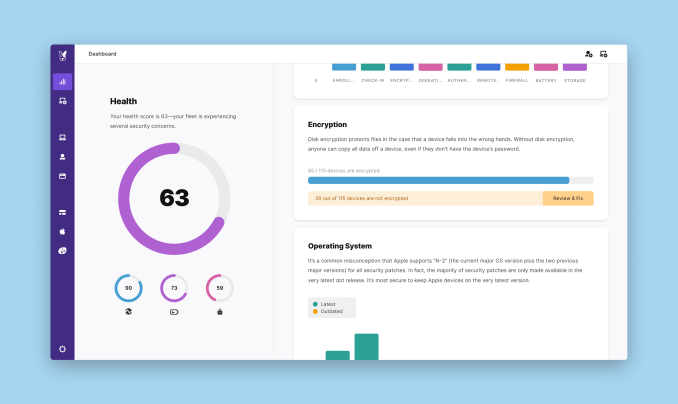
Over the last year, the company developed a dashboard for IT to monitor all of the devices under its management, including providing an overall health score with any potential problems it has found. For example, there may be a number of MacBook Pros without disk encryption enabled.

The dashboard ties into the identity management component of Office 365 and G Suite.  IT can import the employee directory into the dashboard from either tool, and employees can sign into Fleetmsith with either set of credentials, providing a quick way to manage all of employees in an organization.

Screenshot: Fleetsmith

Fleetsmith has also set up a partner program with Managed Service Providers (MSPs) to expand its reach further. MSPs manage IT for SMBs and building a relationship with these types of companies can help it expand much more quickly.

The approach seems to be working as the company has 30 employees and 1500 customers. With the new cash in pocket, it intends to hire more people and continue building out the product’s capabilities, while expanding beyond the US to markets overseas.

08 Apr 2019

Kabbage raises a record $700 million in debt for its SMB loans platform

Loan platform Kabbage — which offers quick assessment and approvals for small business loans using machine learning algorithms that pull data from dozens of sources — has closed another large securitization as it continues to grow its operations. The company said has closed an asset-backed securitization of $700 million, which it says it the largest transaction of its kind for an online lending platform focused on small businesses.

Valued at over $1.2 billion after raising a big round from Softbank in 2017, the company has been picking up momentum in recent years, through its own direct-to-business proposition as well as through white-label services and partnerships such as the recent deal it struck with Alibaba to offer loans to merchants buying on its platform.

Kabbage says it has now loaned more than $6.5 billion to over 170,000 small businesses on its platform since it was founded in 2009. The pace is accelerating for Kabbage: it loaned out $2 billion in 2018 and has already loaned out $600 million so far this year.

Kabbage — its name is a play on the slang word for “money” — has to date raised $940 million in debt funding, with some $4.2 billion in securities overall. As with a previous $500 million securitization it issued in 2017, this tranche is being issued by Kabbage Asset Securitization LLC, a fully-owned subsidiary of the company. (It has raised around $500 million in equity as well, with other backers in addition to SoftBank including BlueRun Ventures, Mohr Davidow Ventures, ING, Santander and more.)

Kabbage said that the majority of the proceeds from this $700 securitization is being used to pay down “an existing asset-backed securitization transaction” (it doesn’t specify which). But the generally strong outlook for the company on its basic business model has meant that the terms under which Kabbage borrows continue to improve, meaning the terms under which it has to pay back the money also continue to get more favorable.

It notes that the most senior class of the five-tranche transaction earned a AA(sf) rating from Kroll Bond Rating Agency, “the highest ABS rating earned by a small business online lending platform for a three-year facility,” and that the transaction reduces the company’s cost of funds compared to its existing ABS by more than 100 basis points.

“The new ABS and AA(sf) rating is a testament to Kabbage’s proven and real-time approach to responsibly provide credit access to small businesses,” said Kabbage CFO Scott Rosenberg in a statement. “The new transaction positions the company for continued milestone growth as small businesses accessed more than $2 billion through Kabbage last year and more than $600 million already in the first quarter of 2019.”

08 Apr 2019

Pinterest sets IPO range at $15-17, valuing it up to $9.2B vs previous valuation of over $12B

After dropping its IPO filing two weeks ago, today Pinterest, the social media platform where people can discover and share ideas and content through grids of “pinned” images, filed an updated S-1 where it set the price range at $15-17 per share for a sale of 75 million shares. At this range, the company will raise between $1.125 billion and $1.275 billion, valuing Pinterest at $9 billion at the higher end (or $9.19 billion if you add in the greenshoe, which would raise $1.466 at the top end if the full allocation is taken).

That is a tough (or, you might argue, conservative) picture, as the range values Pinterest more than $3 billion below than its last valuation of around $12.3 billion, when it raised as a private startup in 2017. In social media Pinterest competes against the likes of Facebook for sharing ideas and links, and in e-commerce it also a plethora of competitors, including Amazon, eBay and more.

The underwriters for Pinterest’s IPO are Goldman Sachs, JP Morgan and Allen & Co.

The San Francisco-based company will trade under the ticker symbol “PINS” on the New York Stock Exchange.

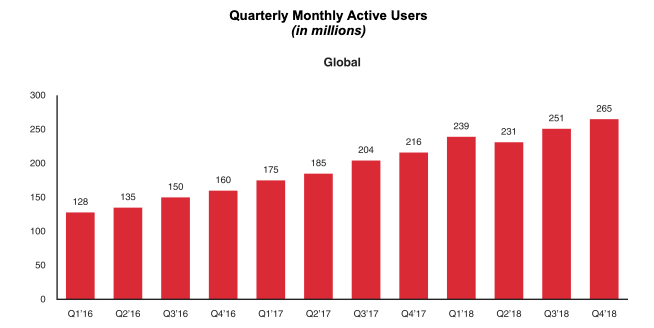
In the original S-1 it revealed that it had revenue of $755.9 million in the year ending December 31, 2018, up from $472.8 million in 2017. It has roughly doubled its monthly active user count since early 2016, hitting 265 million late last year. The company’s net loss, meanwhile, shrank to $62.9 million last year from $130 million in 2017.

In total, Pinterest has posted $1.525 billion in revenue since 2016.

Pinterest has raised $1.5 billion to date and was last valued at $12.3 billion, in 2017. Its investors include Bessemer Venture PartnersAndreessen Horowitz, FirstMark Capital, Fidelity and SV Angel.

For some context, in September 2018 the company reported that it had 250 million monthly active users across desktop and mobile apps, up 25 percent on the year before, with more than half coming from outside the US. It had been estimated that Pinterest generated around $700 million in ad revenue in 2018, up 50 percent on the year before as it launched new formats and options for marketers.

Originally the company filed confidentially to go public after retaining Goldman Sachs and JP Morgan to lead its listing. Filing confidentially is a route that startups can opt to take if their annual revenues are less than $1 billion, so that they can go through the back-and-forth of preparing for their IPO outside of the public eye (and consequent scrutiny that this might bring to these startups’ often less traditional business lines and business models).

Pinterest’s move to go public now amidst a rush of tech IPOs, although not all listings have been rosy. After early and strong trading in its debut, Lyft saw a big dip, although it seems to slowly be climbing back up to its debut pricing again.

Additional reporting Jon Russell

08 Apr 2019

UK sets out safety-focused plan to regulate Internet firms

The UK government has laid out proposals to regulate online and social media platforms, setting out the substance of its long-awaited White Paper on online harms today — and kicking off a public consultation.

The Online Harms White Paper is a joint proposal from the Department for Digital, Culture, Media and Sport (DCMS) and Home Office.

It follows the government announcement of a policy intent last May, and a string of domestic calls for greater regulation of the Internet as politicians have responded to rising concern about the mental health impacts of online content.

The government is now proposing to put a mandatory duty of care on platforms to take reasonable steps to protect their users from a range of harms — including but not limited to illegal material such as terrorist and child sexual exploitation and abuse which will be covered by further stringent requirements under the plan.

The approach is also intended to address a range of content and activity that’s deemed harmful.

Examples providing by the government of the sorts of broader harms it’s targeting include inciting violence and violent content; encouraging suicide; disinformation; cyber bullying; and inappropriate material being accessed by children.

Content promoting suicide has been thrown into the public spotlight in the UK in recent months, following media reports about a schoolgirl whose family found out she had been viewing pro-suicide content on Instagram after she killed herself.

The Facebook -owned platform subsequently agreed to change its policies towards suicide content, saying it would start censoring graphic images of self-harm, after pressure from ministers.

Commenting on the publication of the White Paper today, digital secretary Jeremy Wright said: “The era of self-regulation for online companies is over. Voluntary actions from industry to tackle online harms have not been applied consistently or gone far enough. Tech can be an incredible force for good and we want the sector to be part of the solution in protecting their users. However those that fail to do this will face tough action.

”We want the UK to be the safest place in the world to go online, and the best place to start and grow a digital business and our proposals for new laws will help make sure everyone in our country can enjoy the Internet safely.”

In another supporting statement Home Secretary Sajid Javid added: “The tech giants and social media companies have a moral duty to protect the young people they profit from. Despite our repeated calls to action, harmful and illegal content – including child abuse and terrorism – is still too readily available online.

“That is why we are forcing these firms to clean up their act once and for all. I made it my mission to protect our young people – and we are now delivering on that promise.”

Children’s charity, the NSPCC, was among the sector bodies welcoming the proposal.

“This is a hugely significant commitment by the Government that once enacted, can make the UK a world pioneer in protecting children online,” wrote CEO Peter Wanless in a statement.

For too long social networks have failed to prioritise children’s safety and left them exposed to grooming, abuse, and harmful content.  So it’s high time they were forced to act through this legally binding duty to protect children, backed up with hefty punishments if they fail to do so.”

Although the Internet Watch Foundation, which works to stop the spread of child exploitation imagery online, warned against unintended consequences from badly planned legislation — and urged the government to take a “balanced approach”.

The proposed laws would apply to any company that allows users to share or discover user generated content or interact with each other online — meaning companies both big and small.

Nor is it just social media platforms either, with file hosting sites, public discussion forums, messaging services, and search engines among those falling under the planned law’s remit.

The government says a new independent regulator will be introduced to ensure Internet companies meet their responsibilities, with ministers consulting on whether this should be a new or existing body.

Telecoms regulator Ofcom has been rumored as one possible contender, though the UK’s data watchdog, the ICO, has previously suggested it should be involved in any Internet oversight given its responsibility for data protection and privacy. (According to the FT a hybrid entity combining the two is another possibility — although it reports that the government remains genuinely undecided on who the regulator will be.)

The future Internet watchdog will be funded by industry in the medium term, with the government saying it’s exploring options such as an industry levy to put it on a sustainable footing.

On the enforcement front, the watchdog will be armed with a range of tools — with the government consulting on powers for it to issue substantial fines; block access to sites; and potentially to impose liability on individual members of senior management.

So there’s at least the prospect of a high profile social media CEO being threatened with UK jail time in future if they don’t do enough to remove harmful content.

On the financial penalties front, Wright suggested that the government is entertaining GDPR-level fines of as much as 4% of a company’s annual global turnover, speaking during an interview on Sky News…

Other elements of the proposed framework include giving the regulator the power to force tech companies to publish annual transparency reports on the amount of harmful content on their platforms and what they are doing to address it; to compel companies to respond to users’ complaints and act to address them quickly; and to comply with codes of practice issued by the regulator, such as requirements to minimise the spread of misleading and harmful disinformation with dedicated fact checkers, particularly during election periods.

A long-running enquiry by a DCMS parliamentary committee into online disinformation last year, which was continuously frustrated in its attempts to get Facebook founder Mark Zuckerberg to testify before it, concluded with a laundry list of recommendations for tightening regulations around digital campaigning.

The committee also recommended clear legal liabilities for tech companies to act against “harmful or illegal content”, and suggested a levy on tech firms to support enhanced regulation.

Responding to the government’s White Paper in a statement today DCMS chair Damian Collins broadly welcomed the government’s proposals — though he also pressed for the future regulator to have the power to conduct its own investigations, rather than relying on self reporting by tech firms.

“We need a clear definition of how quickly social media companies should be required to take down harmful content, and this should include not only when it is referred to them by users, but also when it is easily within their power to discover this content for themselves,” Collins wrote.

“The regulator should also give guidance on the responsibilities of social media companies to ensure that their algorithms are not consistently directing users to harmful content.”

Another element of the government’s proposal is a “Safety by Design” framework that’s intended to help companies incorporate online safety features in new apps and platforms from the start.

The government also wants the regulator to head up a media literacy strategy that’s intended to equip people with the knowledge to recognise and deal with a range of deceptive and malicious behaviours online, such as catfishing, grooming and extremism.

It writes that the UK is committed to a free, open and secure Internet — and makes a point of noting that the watchdog will have a legal duty to pay “due regard” to innovation, and also to protect users’ rights online by paying particular mindful not infringe privacy and freedom of expression.

It therefore suggests technology will be an integral part of any solution, saying the proposals are designed to promote a culture of continuous improvement among companies — and highlighting technologies such as Google’s “Family Link” and Apple’s Screen Time app as examples of the sorts of developments it wants the policy framework to encourage.

Although such caveats are unlikely to do much to reassure those concerned the approach will chill online speech, and/or place an impossible burden on smaller firms with less resource to monitor what their users are doing.

“The government’s proposals would create state regulation of the speech of millions of British citizens,” warns digital and civil rights group, the Open Rights Group, in a statement by its executive director Jim Killock. “We have to expect that the duty of care will end up widely drawn with serious implications for legal content, that is deemed potentially risky, whether it really is nor not.

“The government refused to create a state regulator the press because it didn’t want to be seen to be controlling free expression. We are skeptical that state regulation is the right approach.”

UK startup policy advocacy group Coadec was also quick to voice concerns — warning that the government’s plans will “entrench the tech giants, not punish them”.

“The vast scope of the proposals means they cover not just social media but virtually the entire internet – from file sharing to newspaper comment sections. Those most impacted will not be the tech giants the Government claims they are targeting, but everyone else. It will benefit the largest platforms with the resources and legal might to comply – and restrict the ability of British startups to compete fairly,” said Coadec executive director Dom Hallas in a statement. 

“There is a reason that Mark Zuckerberg has called for more regulation. It is in Facebook’s business interest.”

UK startup industry association, techUK, also put out a response statement that warns about the need to avoid disproportionate impacts.

“Some of the key pillars of the Government’s approach remain too vague,” said Vinous Ali, head of policy, techUK. “It is vital that the new framework is effective, proportionate and predictable. Clear legal definitions that allow companies in scope to understand the law and therefore act quickly and with confidence will be key to the success of the new system.

“Not all of the legitimate concerns about online harms can be addressed through regulation. The new framework must be complemented by renewed efforts to ensure children, young people and adults alike have the skills and awareness to navigate the digital world safely and securely.”

The government has launched a 12-week consultation on the proposals, after which it says it will set out the action it will take in developing its final proposals for legislation.

Last month a House of Lords committee recommended an overarching super regulator be established to plug any gaps and/or handle overlaps in rules on Internet platforms, arguing that “a new framework for regulatory action” is needed to handle the digital world.

Though the government appears confident at this stage that an Internet regulator will be able to navigate any legislative patchwork and keep tech firms in line on its own.

The House of Lords committee was another that came down in support of a statutory duty of care for online services hosting user-generated content, suggesting it should have a special focus on children and “the vulnerable in society”. And there’s no doubt the concept of regulating Internet platforms has broad consensus among UK politicians — on both sides of the aisle.

But how to do that effectively and proportionately is another matter.

We reached out to Facebook and Google for a response to the White Paper.

Commenting on the Online Harms White Paper in a statement, Rebecca Stimson, Facebook’s head of UK public policy, said: “New rules for the internet should protect society from harm while also supporting innovation, the digital economy and freedom of speech. These are complex issues to get right and we look forward to working with the Government and Parliament to ensure new regulations are effective.”

Stimson also reiterated how Facebook has expanded the number of staff it has working on trust and safety issues to 30,000 in recent years, as well as claiming it’s invested heavily in technology to help prevent abuse — while conceding that “we know there is much more to do”.

Last month the company revealed shortcomings with its safety measures around livestreaming, after it emerged that a massacre in Christchurch, New Zealand which was livestreamed to Facebook’s platform, had not been flagged for accelerated review by moderates because it was not tagged as suicide related content.

Facebook said it would be “learning” from the incident and “re-examining our reporting logic and experiences for both live and recently live videos in order to expand the categories that would get to accelerated review”.

In its response to the UK government White Paper today, Stimson added: “The internet has transformed how billions of people live, work and connect with each other, but new forms of communication also bring huge challenges. We have responsibilities to keep people safe on our services and we share the government’s commitment to tackling harmful content online. As Mark Zuckerberg said last month, new regulations are needed so that we have a standardised approach across platforms and private companies aren’t making so many important decisions alone.”


08 Apr 2019

Veratrak wants to digitise the pharmaceutical supply chain

Veratrak, a London-based startup that aims to digitise the pharmaceutical supply chain, has picked up £1 million in seed funding. Leading the round is Force Over Mass, with participation from Seedcamp, Ascension Ventures, Blockchain Valley Ventures, and Truesight Ventures.

A number of individual investors have also backed the young company. They include ex-Head of Corporate Strategy for Microsoft, Charlie Songhurst, current EVP of Operations at Vectura Group and previous Vice President of Global Supply Chain at Baxter, Tony Fitzpatrick, and Antonin de Fougerolles, CEO of Evox Therapeutics.

Launched in August 2018, Veratrak offers a “document collaboration and workflow management platform” targeting the pharmaceutical industry. The SaaS enables organisations to on-board both internal and external partners to verify, authenticate, review, and sign-off on “critical documentation” related to various stages of the supply chain. These span the production, packaging, shipping and dispensing of medicine.

Specifically, users can communicate with supply chain partners at different organisations seamlessly, and chronologically execute the steps required to release a product to market.

Noteworthy, the Veratrak platform using blockchain technology to create what it calls an “iron-clad audit trail” of all document events, and in doing so claims to reduce the regulatory burden on Veratrak customers.

The overall result, claims Veratrak, is increased visibility for supply chain partners, and the ability to better react and adjust to events — which ultimately leads to better care for patients.

“There are a variety of cloud-based document management services operating in other industries, however, they are not regulatory compliant for the pharmaceutical industry,” says Veratrak co-founder and CEO Jason Lacombe.

“From the inception of Veratrak, we have built our software to be GAMP 5 compliant, to the highest security and quality standards, and have worked alongside users at pharmaceutical and life sciences companies to test our solution and provide feedback on what we are building”.

Meanwhile, Lacombe says the focus of blockchain companies to date has been on “serialisation” and getting companies ready to meet the European and U.S.’s track and trace regulations. “We chose to enter the market via the document sharing use-case, and not the serialisation use-case, because the serialisation space is already crowded with blockchain,” he adds.

A classic SaaS play, Veratrak charges customers a monthly per head license fee. The pricing is volume-based depending on the number of licenses that an organisation purchases.

“We also offer all our paying customers free guest licenses to invite on their external partners to collaborate on document workflows,” explains Lacombe. “This creates some significant network effects and virality. We have seen this work well with other companies like Docusign that invite collaborators via email to sign documents”.