Category: UNCATEGORIZED

08 Apr 2019

TrickerBot malware attacks are ramping up ahead of Tax Day

A powerful data-stealing malware campaign with a tax theme is on the rise to target unsuspecting filers ahead of Tax Day.

TrickBot, a financially motivated trojan, infects Windows computers through a malicious Excel document sent by a specially crafted email. Once infected, the malware targets vulnerable devices on the network and combs for passwords and banking information to send back to the attacker. The collected information can be used to steal funds for fraud. The ever-expanding malware is continually developed to collect as many credentials as possible.

By stealing tax documents, the scammers can also file fraudulent end-of-year tax forms to reap the returns. The Internal Revenue said fraudsters scammed the agency out of more than $1.6 million in fraudulent returns during the 2016 tax year.

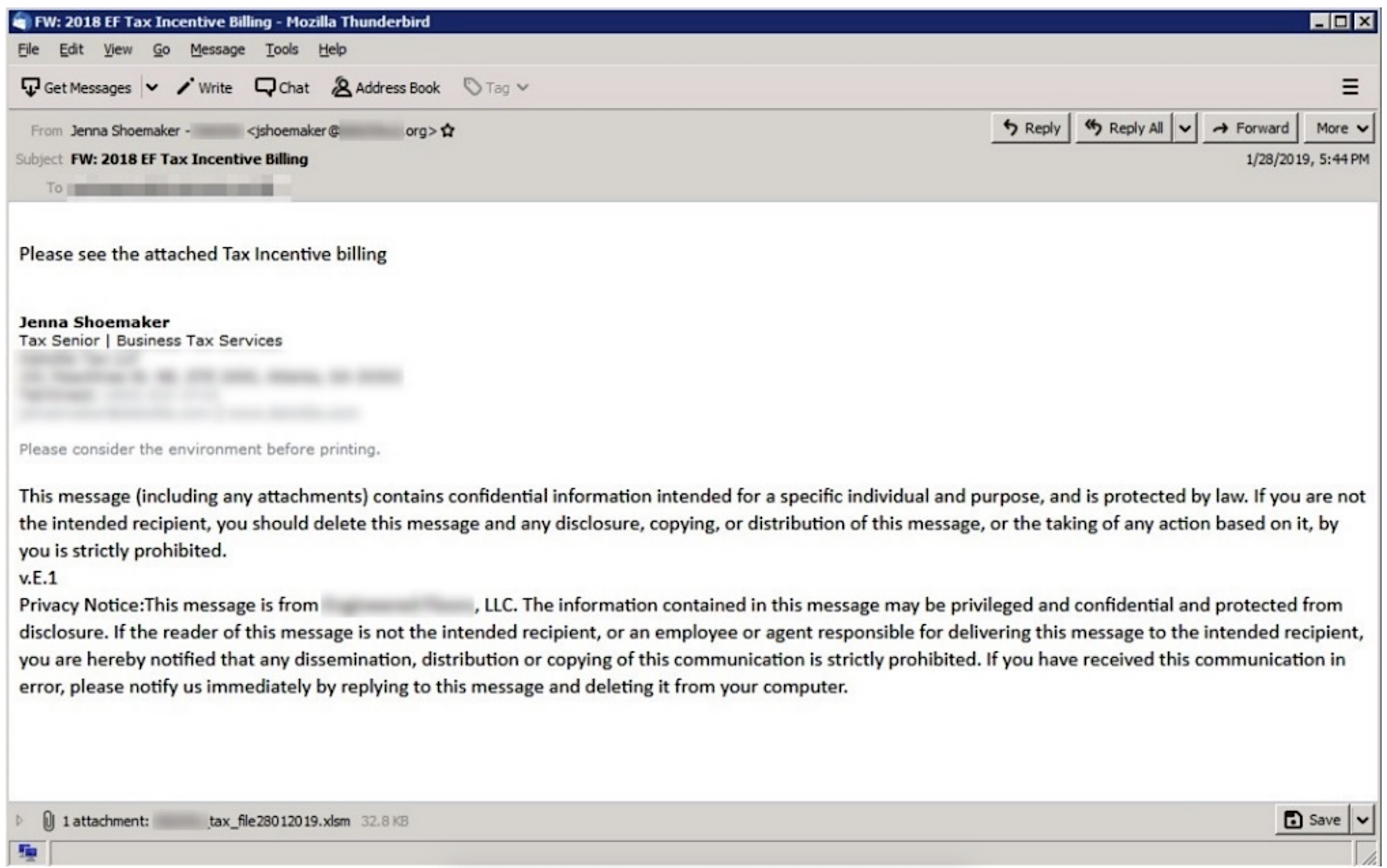
IBM X-Force researchers say the attackers have begun impersonating emails from three of the largest accounting and payroll providers, including ADP and Paychex, by registering similar-looking domains — known as domain squatting.

One of the spoofed emails impersonating a payroll provider. (Image: supplied)

“We believe this campaign to be highly targeted in its efforts to infiltrate US organizations, with the hallmarks of the TrickBot Trojan gang,” said Limor Kessem, global executive security advisor at IBM. “Since it emerged in 2016, we’ve seen that TrickBot’s operators focus their efforts on businesses and, therefore, manage distribution in ways that would look benign to enterprise uses: through booby-trapped productivity files and fake bank websites.”

Where TrickBot traditionally focused on business banking and high-value accounts with private banking and wealth management firms, the malware in recent years has expanded to hit cryptocurrency sites and owners.

“This is not a threat of the past,” said Kessem. “Based on our research, not only is TrickBot one of the most prominent organized crime gangs in the bank fraud arena, we also expect to see it maintain its position on the global malware chart, unless it is interrupted by law enforcement in 2019.”

The malware continues to grow, IBM said. Its backend infrastructure has at least 2,400 command and control servers with hundreds of configurations and versions, with infections most common in the U.S. and U.K. — seen as high value regions.

“As cybercriminal gangs of this level continue to gain steam, it’s increasingly important for businesses and consumers to be more aware of their own activity online, even when they’re doing something as simple as clicking on a link in an email,” said Kessem. “Email is an incredibly easy way for an attacker to interact with potential victims, posing as a trusted brand to infiltrate devices and eventually your networks,” she said.

Tax Day is April 15.

08 Apr 2019

No, Go-Jek isn’t valued at $10 billion… yet

Southeast Asian media is ablaze with discussion of the latest “decacorn” — $10 billion-valued startup — in the region after Go-Jek reportedly hit the milestone, but the Indonesia-based company is being prematurely anointed.

Two sources close to Go-Jek told TechCrunch that the ride-hailing firm’s current valuation is just shy of the $10 billion mark — I reported it as $9.5 billion in January at the first close of Go-Jek’s newest funding round — despite a report from Bloomberg which suggests that it is. In fact, if you dig into the details, it becomes clear that the Bloomberg story, and the dozens of media that have re-reported it, are wide of the mark.

The Bloomberg story cites New York-based intelligence and analytics firm CB Insights, which lists Go-Jek among the 19 decacorns that exist on the planet. There’s no source for the valuation and, since CB Insights aggregates data from media — whose job it is to develop sources and dig up private information — it appears that the $10 billion valuation can be traced to reports around that Go-Jek round earlier this year.

When reporting the first close of the round — which Go-Jek said was “over $1 billion” — some media, including Reuters, reported that the deal gave Go-Jek a valuation that sits between $9 billion-$10 billion. There’s been no further update on the round, sources told TechCrunch it remains ongoing, and so there’s no specific investment/update that would trigger a new valuation.

Instead, it seems that CB Insights has used the $10 billion upper ceiling cited by media as the valuation of Go-Jek. That’s interesting because CB Insights lists Grab, Go-Jek’s rival, at a valuation of $11 billion despite the fact that Grab’s valuation reached $14 billion via its recent $1.46 billion investment from SoftBank’s Vision Fund.

Neither company officially announced a valuation, but figures for both were leaked to press via sources. It remains unclear, then, why CB Insights is using an unverified number for one but not the other.

Why is this piece of pedantry necessary on TechCrunch.com?

Good question. The fact that media can build a story around a piece of information that hasn’t been verified first is troubling. In this case, it is just a valuation number without many serious ramifications — Go-Jek is going to be valued at $10 billion one day… just not now — but that unsubstantiated information can become published as fact, shows that basic due diligence is missing and sometimes you shouldn’t believe everything that you read.

Go-Jek didn’t provide comment for the Bloomberg story, no doubt the company was delighted to have been christened Southeast Asia’s second $10 billion startup. I imagine a little press around that will help Go-Jek with its current fundraising and, ironically, in turn help it to become Southeast Asia’s second $10 billion startup.

08 Apr 2019

China’s Source Code Capital raises $570M as it builds a powerful investor network

Source Code Capital, the venture capital firm that’s backed some of China’s most prominent tech unicorns and boasts a network of high-profile investors and founders, announced Monday it has closed a new $570 million fund as it continues to hunt down early to mid-stage companies.

The latest close catapults Source Code’s capital under management to $1.5 billion and 3.5 billion yuan divided between six funds. Investors in the new fund, according to the company, span major pensions, sovereign wealth funds, college endowments, charities, private equity firms, among other institutions.

Source Code was founded in 2014 by Cao Yi, who studied computer science at China’s prestigious Tsinghua University and later became vice president at Sequoia Capital China, stints that might have helped him spot high-potential startups early on. To date, Source Code has backed close to 150 startups, including up-and-comers Bytedance, the TikTok parent that’s now the world’s most valuable startup; food delivery leader Meituan Dianping, which listed in Hong Kong last year; micro-credit provider Qudian, whose New York IPO marked one of the biggest for a Chinese fintech company that year; Mogu, a Tencent-backed fashion ecommerce site that floated on the Nasdaq last year; just to name a few.

With the new money, Source Code will continue to back businesses focused on the global market, “internet plus” or “AI plus” sectors, the last two of which are buzzwords in China pertaining to upgrading traditional sectors using the internet and artificial intelligence.

The fresh capital will also enable Source Code to bring more overseas investors into its peer and mentor alliance Ma Hui, which directly translates to “Code Club.” The thinking behind the community is akin to the investor network a16z has nurtured to channel support and resources between investors and portfolio companies. Ma Hui’s class of 30 big-name limited partners count Bytedance founder Zhang Yiming and Meituan founder Wang Xing.

“The goal of Source Code is to look for, invest in, and serve the best businesses in emerging economies. These companies and entrepreneurs are diligently working to let mass consumers eat better, wear better, live better, play better, access more inclusive finance and better transportation… among other ways to live a better life,” said Cao in a statement.

“[Our goal is] also to help enterprises across the board to grow sales, cut procurement and logistics costs, improve working capital turnover, unleash the potential of talents, and increase their global competitiveness… among other know-how to run a sustainable business,” the managing partner added.

08 Apr 2019

European VC firm Octopus Ventures launches £83M growth fund

Octopus Ventures, the European venture capital firm that’s part of Octopus Group, is launching an £83 million growth fund to further invest in its most promising portfolio companies.

The new fund, which is backed by a number of undisclosed institutional investors rather than individual investors, brings the total Octopus Ventures’ various funds has under management to over £1 billion. Taken as a whole, it also means the VC firm now invests between £250,000 and £20 million in startups at various stages of growth.

Headquartered in London and New York, but with Venture Partners also in San Francisco, Shanghai and Singapore, Octopus Ventures has backed over 100 companies to date. They include allplants, Elvie, Depop, Big Health, Graze.com, Eve, Magic Pony, Secret Escapes, Sofar Sounds, Swiftkey, Swoon Editions, tails.com and Zoopla Property Group.

Meanwhile, the new growth fund coincides with a new strategy for Octopus Ventures more broadly, and will see the VC focus on three key areas: fintech, health tech, and industry 4.0.

In the firm’s own words:

  • The Future of Money: Seeking pioneering entrepreneurs who want to improve the way society interacts with money and risk by building products that will transform payments, investments, markets and insurance.

  • The Future of Health: Healthcare will soon be the world’s biggest industry and we back the teams revolutionising health and wellness through patient-driven medicine, clinical decision tools, digital health and disease prevention technologies.

  • The Future of Industry: Focused on the bleeding edge technologies that will drive the next industrial revolution. These include advanced manufacturing, materials, Internet of Things, robotics and artificial intelligence, as well as those technologies which will keep a fully digitally connected society secure.

Below follows an email Q&A with Alliott Cole, CEO of Octopus Ventures, where we discuss the growth fund’s premise and timing, the new investment focus for Octopus Ventures, industrial competition in Europe, America and China, and — of course — the thorny issue of Brexit.

TC: What’s the thinking behind raising a dedicated later-stage fund and why now?

AC: We have been fortunate to back some really talented entrepreneurs who have gone on to build sizeable, successful companies in recent years. Companies like Zoopla, Secret Escapes, Swiftkey, Tails.com, Cazoo, Big Health require capital to build teams and to accelerate growth, and so it makes perfect sense to us for continue to back them as they progress through the initial stages of company formation to the later stages of growth.

TC: Is this new dedicated follow on fund also a sign of how high European valuations are right now, in the sense that it is designed to ensure Octopus Ventures doesn’t get too diluted in future rounds?

AC: We manage around £800m in an evergreen venture fund which invests close to £200m a year into Seed and Series A, with a focus on the future of money, health and industry. This makes Octopus one of the most active venture investors in Europe.

Because this fund is evergreen it is a great vehicle to take a very long-term view on investing and can be far more patient than a more traditional limited life venture fund which normally will invest for 3-4 years and then look to exit in the next 4-6 years.

Our latest growth fund will invest in the best performing companies out of this venture fund when the founders are comfortable with their product market fit, and are ready to scale to the next level.

TC: Did Brexit come into your thinking here or complicate things with regards to raising this new fund?

AC: You can’t ignore Brexit entirely, clearly, but I wouldn’t say it was a significant hurdle. We are backing genuinely pioneering entrepreneurs with the talent and ambition to radically disrupt their industries. That’s where we see the big opportunity for this fund, and I don’t think Brexit changes that.

For the most part, entrepreneurs we are investing in are looking to make their own “dent in the Universe” and while they are starting their journey in London and the U.K., their ambitions will lead them to build for an international audience. This is why we have an office in New York, and Venture Partners on the ground in Silicon Valley, Singapore and Beijing.

TC: More broadly, what would be your favoured outcome for the U.K. and Brexit?

AC: When you speak to the entrepreneurs and founders in our portfolio, it’s clear that availability of talent is one of the critical issues. So from that perspective, while I’m sure members of our team have their own views, we are agnostic in terms of the outcome so long as our portfolio companies continue to have access to the talent they need to grow and scale. That said, I wholeheartedly believe the U.K. and London will continue to be a global leader in innovation and entrepreneurship regardless of the outcome.

TC: Looking at “the future of money” aspect of Octopus Ventures’ new strategy, what specific opportunities do you see left in fintech? It seems that we are mainly past the first phase where various financial services have been unbundled from the banks and made more consumer friendly, while there are a number of platform plays, including some neo banks or banking appS, seeking to re-bundle these services in a more consumer-centric way. So, what’s left or next?

AC: The opportunities in financial technology are many and diverse. It is certainly true that we have seen the start of consumer banking services being unbundled, but whether we have reached a new point at which this market will re-integrate is by no means clear to me.

Outside of consumer banking, we are really excited by the opportunity in the insurance sector. Despite it being ten times the size of the banking sector it has only received one tenth of the funding. It’s an area where incumbents are paralysed by regulation, legacy technology and bureaucracy meaning they are unable to effectively tackle emerging opportunities themselves, so we see a huge opportunity in this space. As we invest in teams like Bought By Many, DeadHappy and ByMiles, we’re starting to go deeper and learn more about these industries.

TC: The second aspect is “the future of health”. What do you see as the biggest obstacles in this space (e.g. regulation, the different way healthcare is funded etc.) and also the biggest opportunities?

AC: Innovation in health, quite rightly, has a number of unique constraints which can make it more challenging for companies to start and scale quickly. These are both regulatory and commercial in nature – for instance a medical commissioning group can introduce the best digital health therapeutic but if the nurses on the front line in a GP surgery are unaware of the benefits, then these businesses may be overlooked and a great product will struggle to find its way into the hands of the patients.

Some of the biggest opportunities lie in areas where there is far-reaching demand, but this demand is simply not being filled due to stigma or taboo. Take Elvie for example, it is brilliant to see a fem-tech company designing and distributing pelvic floor trainers and breast pumps. The impact it has made in the market in such a short time is remarkable. Equally Big Health, with its initial focus on insomnia, will have a broader application to anxiety, depression and stress – all linked to mental wellbeing.

TC: Lastly, “the future of industry” — or industry 4.0 — is an increasingly common theme within VC and arguably a European strength. Do you think that is true, and if so, why?

AC: Europe, despite what people may think, still boasts a strong manufacturing hub. In fact, the European Union ranks second in the world in manufacturing output, secondly only to China, and ahead of the U.S., according to data from the World Bank. European manufacturing is also relatively high-tech compared to other countries. When you combine this with its ability to educate top talent – we produce more PhDs per capita than any other country in the world – it provides a fuel that drives development and productivity improvements in the industrial sector.

Having the perfect crucible of manufacturing expertise, experience, and existing business combined with top technical talent, results in a combination which naturally leads to Europe being considered a place to look at for ‘the’ Future of Industry. What we’ve historically lacked is the funds to back the emerging winners in this space – but things are changing here.

We have also enjoyed investing in some harder technologies – early on we backed William T-P at True Knowledge, which was acquired by Amazon and now has become the backbone of Alexa, the machine learning and artificial intelligence companies Swiftkey (acquired by Microsoft) and Magic Pony (acquired by Twitter).

TC: With that said, are we more likely to see multibillion dollar industry 4.0 companies coming out of Europe, America or China?

AC: Looking ahead, this is very hard to call, as in reality, industry is blooming across all three areas, and it is likely that we will see multibillion-dollar industry 4.0 companies from Europe, America and China.

In Europe, London leads the way in unicorns, hosting 17 start-ups that have broken the $1bn valuation barrier since 2010. We expect to see many more from London, and indeed the rest of Europe as they expand and grow across the continent. That being said, we cannot ignore the huge potential China offers in this space. According to the World Bank, China are the world leaders in manufacturing output, with a huge 40% of their GDP coming from manufacturing in 2017. Chinese companies have been setting themselves to take Industry 4.0 by storm for a while now, so to ignore the market potential of China would be nothing short of naïve. The same, however, could be said for the U.S. With the likes of American companies Apple and Amazon becoming the first trillion-dollar businesses last year, they too cannot be ruled out.

The truth is that increasing numbers of companies across the globe are heading for that multibillion-dollar status, and I think industry 4.0 is likely to boom across the three continents sooner than we expect.


08 Apr 2019

Grab plans to raise $6.5B this year to fund an acquisition spree in Southeast Asia

Always be raisin’. That appears to be the motto of Southeast Asia’s ride-hailing companies Grab and Go-Jek.

Fresh from closing a near-$1.5 billion raise from SoftBank’s Vision Fund as part of a huge, multi-billion Series H deal, Grab said today that it plans to raise $6.5 billion in capital this year alone to amp up its battle with Go-Jek, which recently raised $1 billion of an ongoing Series F round.

A spokesperson for Grab told TechCrunch that the $6.5 billion will include additional money into that Series H deal, but also other investments that could include debt funding. The money announced so far this year — that $1.48 billion from the Vision Fund — is included in that $6.5 billion goal, the Grab rep explained, so that means Grab is aiming to raise a further $5 billion in 2019.

Yes, that’s right, five billion dollars of additional capital!

Grab’s Series H has already swollen to $4.5 billion, to give you an idea of its cash pile right now. Grab’s valuation is around $16 billion, according to sources, and it has raised $7.5 billion to date.

While the money will no doubt go towards ‘growth’ — and particularly to develop Grab’s ‘super app’ strategy of offering more than just rides in its app — Grab said that it plans to make “at least 6 investments or acquisitions” in Southeast Asia this year.

That acquisitive approach would be unprecedented for Southeast Asia, a region of few tech exits despite its growing potential. That is beginning to change with the rise of Grab and Go-Jek, local companies that are buying up smaller startups to add tech and expertise under that aforementioned ‘super app’ strategy, which is aimed at expanding to become the on-demand app of choice for Southeast Asia’s 600 million consumers.

But still, half a dozen deals will bring even more liquidity to Southeast Asia’s startup ecosystem and help VCs turn some of their paper valuations into actual transactions and value for their funds and LPs.

Grab spent $100 million on Indonesia-based Kudo in 2017, while Go-Jek has been more acquisitive with more than half a dozen deals under its belt, including the purchase of three fintech startups in 2017 and, most recently, Philippines-based wallet Coins for $72 million.

Grab CEO and co-founder Anthony Tan put out an interesting statement that specifically notes SoftBank President Masayoshi Son’s apparently unwavering support for his business. He also dropped some shade on Go-Jek, which has only expanded beyond its home in Indonesia over the last six months, with a claim that Grab will soon be four-times bigger than its arch rival.

Here’s Tan’s statement in full:

I met Masayoshi-san last week where he gave his unlimited support to power our growth. The support from strategic investors like SoftBank and others, will allow us to grow very aggressively this year across our verticals of payments, transport and food. At our current growth rates, we expect to be four times bigger than our closest competitor in Indonesia and across the region by the end of the year. As we grow to become the leading super app in Southeast Asia, we see massive opportunities to expand our business and continue to serve our customers, driver-partners and merchants across Southeast Asia.

Acquisitions aside, there’s a lot happening within Grab. The company is mulling a move to spin out its financial services unit, with PayPal and Ant Financial among the interested parties it is talking to, as TechCrunch reported last month.

08 Apr 2019

Facebook co-founder Eduardo Saverin’s B Capital makes $406M first close of new fund

B Capital, the VC firm from Facebook co-founder Eduardo Saverin, has made the first close of its second fund.

The firm has closed out $406 million in initial capital, according to a filing lodged with the FCC last month. The document doesn’t include details of a target raise or which LPs have committed. Saverin came to prominence as a co-founder of Facebook, but he has rebuilt himself as an investor with a particular focus on Asia.

B Capital is a relatively new entrant but already this new fund represents an upsized raise, even without the final close. B Capital’s first fund closed $360 million last February with consulting firm BCG a major backer from the get-go. The firm pitches itself as a bridge between the corporate world and quality startups, an area where its BCG alliance no doubt carries significant weight.

The firm is based out of Southeast Asia — where Saverin has lived since renouncing his U.S. citizenship in 2011 — but it investors globally and has a San Francisco office. Its focus covers financial services, insurance, health, industrial, transportation and “consumer enablement.” To date, B Capital has invested in 19 startups, according to its website, and those include scooter startup Bird, insurance-focused CXA — which raised $25 million last month — Indian fintech startup Mswipe — which announced a $30 million round last week — and logistics firm NinjaVan.

Saverin has also made investments via his family fund, Velos, but its involvement has tapered down since B Capital launched.

08 Apr 2019

The Wing poaches Snap’s comms director

Women-focused co-working space The Wing has hired Rachel Racusen as vice president of communications. Racusen has been the director of communications at Snap, the developer of Snapchat, since late 2016.

Racusen’s exit represents the latest in a series of departures at the “camera company.”

Earlier this year, the company’s chief financial officer Tim Stone stepped down. Shortly after, The Wall Street Journal reported that Snap had fired its global security head Francis Racioppi after an investigation uncovered that he had engaged in an inappropriate relationship with an outside contractor. Snap CEO Evan Spiegel reportedly asked the company’s HR chief Jason Halbert to step down as a result of the investigation’s findings.

Racusen worked under Snap’s chief communications officer Julie Henderson, who had joined late last year from 21st Century Fox.

Racusen has a history in politics similar to several other executives at The Wing. Ahead of her Snap tenure, she served as the associate communications director under President Barack Obama . Before that, she was a vice president at MSNBC and the public affairs firm SKDKnickerbocker, where The Wing co-founder and chief executive officer Audrey Gelman worked prior to launching her business.

Four months after closing a $75 million Series C, The Wing is making two other key additions to its management team. The company has brought on Nickey Skarstad as vice president of product and Saumya Manohar as general counsel. Skarstad joins from Airbnb, where she was a product lead on the Airbnb Experiences team. Saumya Manohar spent the last three years as Casper’s vice president of legal.

Backed by Sequoia Capital, Upfront Ventures, NEA, Airbnb, WeWork and others, The Wing has raised more than $100 million to date.

“We’re thrilled to be bringing this group of seasoned and talented women to build out our executive team,” Gelman said in a statement. “The Wing is the perfect home for leaders who thrive on fast growth and want to combine their social values with their work practice.”

08 Apr 2019

The team behind Baidu’s first smart speaker is now using AI to make films

The HBO sci-fi blockbuster Westworld has been an inspiring look into what humanlike robots can do for us in the meatspace. While current technologies are not quite advanced enough to make Westworld a reality, startups are attempting to replicate the sort of human-robot interaction it presents in virtual space.

Rct studio, which just graduated from Y Combinator and ranked among TechCrunch’s nine favorite picks from the batch, is one of them. The “Westworld” in the TV series, a far-future theme park staffed by highly convincing androids, lets visitors live out their heroic and sadistic fantasies free of consequences.

There are a few reasons why rct studio, which is keeping mum about the meaning of its deliberately lower-cased name for later revelation, is going for the computer-generated world. Besides the technical challenge, playing a fictional universe out virtually does away the geographic constraint. The Westworld experience, in contrast, happens within a confined, meticulously built park.

“Westworld is built in a physical world. I think in this age and time, that’s not what we want to get into,” Xinjie Ma, who heads up marketing for rct, told TechCrunch. “Doing it in the physical environment is too hard, but we can build a virtual world that’s completely under control.”

rct studio

Rct studio wants to build the Westworld experience in virtual worlds. / Image: rct studio

The startup appears suitable to undertake the task. The eight-people team is led by Cheng Lyu, the 29-year-old entrepreneur who goes by Jesse and helped Baidu build up its smart speaker unit from scratch after the Chinese search giant acquired his voice startup Raven in 2017. Along with several of Raven’s core members, Lyu left Baidu in 2018 to start rct.

“We appreciate a lot the support and opportunities given by Baidu and during the years we have grown up dramatically,” said Ma, who previously oversaw marketing at Raven.

Let AI write the script

Immersive films, or games, depending on how one wants to classify the emerging field, are already available with pre-written scripts for users to pick from. Rct wants to take the experience to the next level by recruiting artificial intelligence for screenwriting.

At the center of the project is the company’s proprietary engine, Morpheus. Rct feeds it mountains of data based on human-written storylines so the characters it powers know how to adapt to situations in real time. When the codes are sophisticated enough, rct hopes the engine can self-learn and formulate its own ideas.

“It takes an enormous amount of time and effort for humans to come up with a story logic. With machines, we can quickly produce an infinite number of narrative choices,” said Ma.

To venture through rct’s immersive worlds, users wear a virtual reality headset and control their simulated self via voice. The choice of audio came as a natural step given the team’s experience with natural language processing, but the startup also welcomes the chance to develop new devices for more lifelike journeys.

“It’s sort of like how the film Ready Player One built its own gadgets for the virtual world. Or Apple, which designs its own devices to carry out superior software experience,” explained Ma.

On the creative front, rct believes Morpheus could be a productivity tool for filmmakers as it can take a story arc and dissect it into a decision-making tree within seconds. The engine can also render text to 3D images, so when a filmmaker inputs the text “the man throws the cup to the desk behind the sofa,” the computer can instantly produce the corresponding animation.

Path to monetization

Investors are buying into rct’s offering. The startup is about to close its Series A funding round just months after banking seed money from Y Combinator and Chinese venture capital firm Skysaga, the startup told TechCrunch.

The company has a few imminent tasks before achieving its Westworld dream. For one, it needs a lot of technical talent to train Morpheus with screenplay data. No one on the team had experience in filmmaking, so it’s on the lookout for a creative head who appreciates AI’s application in films.

rct studio

Rct studio’s software takes a story arc and dissects it into a decision-making tree within seconds. / Image: rct studio

“Not all filmmakers we approach like what we do, which is understandable because it’s a very mature industry, while others get excited about tech’s possibility,” said Ma.

The startup’s entry into the fictional world was less about a passion for films than an imperative to shake up a traditional space with AI. Smart speakers were its first foray, but making changes to tangible objects that people are already accustomed to proved challenging. There has been some interest in voice-controlled speakers, but they are far from achieving ubiquity. Then movies crossed the team’s mind.

“There are two main routes to make use of AI. One is to target a vertical sector, like cars and speakers, but these things have physical constraints. The other application, like Alpha Go, largely exists in the lab. We wanted something that’s both free of physical limitation and holds commercial potential.”

The Beijing and Los Angeles-based startup isn’t content with just making the software. Eventually, it wants to release its own films. The company has inked a long-term partnership with Future Affairs Administration, a Chinese sci-fi publisher representing about 200 writers, including the Hugo award-winning Cixin Liu. The pair is expected to start co-producing interactive films within a year.

Rct’s path is reminiscent of a giant that precedes it: Pixar Animation Studios . The Chinese company didn’t exactly look to the California-based studio for inspiration, but the analog was a useful shortcut to pitch to investors.

“A confident company doesn’t really draw parallels with others, but we do share similarities to Pixar, which also started as a tech company, publishes its own films, and has built its own engine,” said Ma. “A lot of studios are asking how much we price our engine at, but we are targeting the consumer market. Making our own films carry so many more possibilities than simply selling a piece of software.”

08 Apr 2019

The team behind Baidu’s first smart speaker is now using AI to make films

The HBO sci-fi blockbuster Westworld has been an inspiring look into what humanlike robots can do for us in the meatspace. While current technologies are not quite advanced enough to make Westworld a reality, startups are attempting to replicate the sort of human-robot interaction it presents in virtual space.

Rct studio, which just graduated from Y Combinator and ranked among TechCrunch’s nine favorite picks from the batch, is one of them. The “Westworld” in the TV series, a far-future theme park staffed by highly convincing androids, lets visitors live out their heroic and sadistic fantasies free of consequences.

There are a few reasons why rct studio, which is keeping mum about the meaning of its deliberately lower-cased name for later revelation, is going for the computer-generated world. Besides the technical challenge, playing a fictional universe out virtually does away the geographic constraint. The Westworld experience, in contrast, happens within a confined, meticulously built park.

“Westworld is built in a physical world. I think in this age and time, that’s not what we want to get into,” Xinjie Ma, who heads up marketing for rct, told TechCrunch. “Doing it in the physical environment is too hard, but we can build a virtual world that’s completely under control.”

rct studio

Rct studio wants to build the Westworld experience in virtual worlds. / Image: rct studio

The startup appears suitable to undertake the task. The eight-people team is led by Cheng Lyu, the 29-year-old entrepreneur who goes by Jesse and helped Baidu build up its smart speaker unit from scratch after the Chinese search giant acquired his voice startup Raven in 2017. Along with several of Raven’s core members, Lyu left Baidu in 2018 to start rct.

“We appreciate a lot the support and opportunities given by Baidu and during the years we have grown up dramatically,” said Ma, who previously oversaw marketing at Raven.

Let AI write the script

Immersive films, or games, depending on how one wants to classify the emerging field, are already available with pre-written scripts for users to pick from. Rct wants to take the experience to the next level by recruiting artificial intelligence for screenwriting.

At the center of the project is the company’s proprietary engine, Morpheus. Rct feeds it mountains of data based on human-written storylines so the characters it powers know how to adapt to situations in real time. When the codes are sophisticated enough, rct hopes the engine can self-learn and formulate its own ideas.

“It takes an enormous amount of time and effort for humans to come up with a story logic. With machines, we can quickly produce an infinite number of narrative choices,” said Ma.

To venture through rct’s immersive worlds, users wear a virtual reality headset and control their simulated self via voice. The choice of audio came as a natural step given the team’s experience with natural language processing, but the startup also welcomes the chance to develop new devices for more lifelike journeys.

“It’s sort of like how the film Ready Player One built its own gadgets for the virtual world. Or Apple, which designs its own devices to carry out superior software experience,” explained Ma.

On the creative front, rct believes Morpheus could be a productivity tool for filmmakers as it can take a story arc and dissect it into a decision-making tree within seconds. The engine can also render text to 3D images, so when a filmmaker inputs the text “the man throws the cup to the desk behind the sofa,” the computer can instantly produce the corresponding animation.

Path to monetization

Investors are buying into rct’s offering. The startup is about to close its Series A funding round just months after banking seed money from Y Combinator and Chinese venture capital firm Skysaga, the startup told TechCrunch.

The company has a few imminent tasks before achieving its Westworld dream. For one, it needs a lot of technical talent to train Morpheus with screenplay data. No one on the team had experience in filmmaking, so it’s on the lookout for a creative head who appreciates AI’s application in films.

rct studio

Rct studio’s software takes a story arc and dissects it into a decision-making tree within seconds. / Image: rct studio

“Not all filmmakers we approach like what we do, which is understandable because it’s a very mature industry, while others get excited about tech’s possibility,” said Ma.

The startup’s entry into the fictional world was less about a passion for films than an imperative to shake up a traditional space with AI. Smart speakers were its first foray, but making changes to tangible objects that people are already accustomed to proved challenging. There has been some interest in voice-controlled speakers, but they are far from achieving ubiquity. Then movies crossed the team’s mind.

“There are two main routes to make use of AI. One is to target a vertical sector, like cars and speakers, but these things have physical constraints. The other application, like Alpha Go, largely exists in the lab. We wanted something that’s both free of physical limitation and holds commercial potential.”

The Beijing and Los Angeles-based startup isn’t content with just making the software. Eventually, it wants to release its own films. The company has inked a long-term partnership with Future Affairs Administration, a Chinese sci-fi publisher representing about 200 writers, including the Hugo award-winning Cixin Liu. The pair is expected to start co-producing interactive films within a year.

Rct’s path is reminiscent of a giant that precedes it: Pixar Animation Studios . The Chinese company didn’t exactly look to the California-based studio for inspiration, but the analog was a useful shortcut to pitch to investors.

“A confident company doesn’t really draw parallels with others, but we do share similarities to Pixar, which also started as a tech company, publishes its own films, and has built its own engine,” said Ma. “A lot of studios are asking how much we price our engine at, but we are targeting the consumer market. Making our own films carry so many more possibilities than simply selling a piece of software.”

07 Apr 2019

Sinemia faces consumer pushback and a class action suit over a battery of complaints

When Sinemia first came across our radar, the company was happily riding the wave of anti-MoviePass publicity. With its chief competition in the midst of what looked to be a historic collapse, Sinemia happily grabbed headlines as a what looked to be more stable alternative for movie ticket subscriptions.

Last July, at the height of MoviePass’ meltdown, we asked Sinemia co-founder and CEO Rifat Oguz how he planned to avoid a similar fate. “By not providing unlimited tickets, but providing two tickets for $9.99 with more flexible options and features, we might not have grown as fast as MoviePass, but we’ve grown more sustainably,” he answered, happy to contrast the two companies.

Another key difference between the two competitors is that Sinemia isn’t public, so any struggles it’s had over the past year have largely been out of the public eye. Not entirely, however. Not in the age of social media. As I noted in a piece last week, every Sinemia story that’s run on this site, no matter how minor, has been bombarded with a deluge of Twitter criticism.

It’s a wide-ranging laundry list of complaints at first glance. Sinemia’s Twitter support team appears to be working overtime to address them, but the sheer number of critical responses is unlike anything I’ve seen doing this job.

The primary complaints generally fall into three separate, but sometimes overlapping, categories.

  1. Hidden fees
  2. Cancellations without refunds
  3. Widespread app problems

Earlier this week, we spoke to Oguz about the service’s ongoing issues. It was a short call, squeezed between meetings the executive was running to at CinemaCon in Las Vegas this week.

“As CEO, I can say, we’re still learning,” he said in a humble tone. “I think we’re learning in a way.

As we spoke, Sinemia issued sent us a press release noting the launch of “two new customer service websites.” It’s not the kind of announcement companies tend to brag about in PR emails, but it seems clear the sheer volume of negative feedback has caused Sinemia to be more proactive in highlighting the steps it’s taking to address its very vocal, angry subscribers.

It echoes a move made by the company last week, when it sent its announcement of a new $15-a-month Always Unlimited plan accompanied by a lengthy “Account Termination Media Alert” that outlined its aggressive moves in March to cancel accounts over “fraudulent activity and/or misuse of the service.”

Like MoviePass before it, Sinemia began a process of terminating accounts en masse for violations of terms and generally gaming the system. In a statement last week, the service gave the following reasons as cause for potential account termination.

  • Unauthorized use of the Sinemia card/cardless outside of its intended purposes, resulting in fraudulent financial activity. For example, this could be purchasing concessions at the theater instead of a movie ticket.
  • Using multiple Sinemia accounts on the same device.
  • Not checking in at the theater before or after your movie.
  • Seeing the same movie more than three times.
  • Creating multiple Sinemia accounts for the same person.
  • Sharing one’s Sinemia membership to buy tickets for other people. This includes not only people buying tickets and selling to others but also people sharing their own tickets with friends and family members.
  • Manipulation of location data resulting in deceptive ticket purchases. For example, faking GPS data on a phone.
  • Reasonable suspicion of fraud and/or abuse.

But while cancellation complaints do appear to have accelerated last month, the truth is that negative feedback against the service dates back further. In late February, Pennsylvania law firm Chimicles Schwartz Kriner & Donaldson-Smith filed a class action suit in Delaware (not to be confused with the on-going patent dispute with MoviePass), the state in which the now largely Los Angeles and Turkey-based company was incorporated.

The 50-page filing doesn’t mince words, with statements like, “Sinemia fleeces consumers with an undisclosed, unexpected, and not-bargained-for processing fee each time a plan subscriber goes to the movies using Sinemia’s service.”

Benjamin F. Johns, a partner and plaintiff in the case against Sinemia, told TechCrunch that the firm has received more than 2,000 complaints from current or former Sinemia subscribers.

“I’ll be very transparent about our litigation strategy: we want to certify a class consisting of all of the Sinemia consumers who were harmed in the same way by the same defective conduct, and then get the case in front of a jury as quickly as possible,” the lawyer said in a statement to TechCrunch. “We think our clients and the thousands of others like them have compelling stories to tell, and we look forward to having an opportunity to present it in court.”

Asked whether the 2,000 number sounded high, Oguz simply responded, “No. It’s a small number if you compare it with our user base.” Because it’s not a publicly traded company, Sinemia is not required to disclose such numbers, and the executive didn’t offer much in the way of specifics, only saying that it has “grown almost 50 percent month over month for the last 15 months.”

Orguz did address growing customer complaints around Sinemia’s app. Like many of the other ongoing issues with the service, complaints run the gamut. The most commonly cited, however, involve things like double charges, error messages and frequent pop-ups explaining that the app is “down for maintenance.”

According to users, these kinds of issues have the tendency to pop up when trying to purchase tickets to popular features like Captain Marvel and Us. Orguz discussed the maintenance issues in a recent interview with IndieWire that the publication describes as, “at times[…]contentious,” adding that he “express[ed] surprise” upon hearing some of these complaints read back to him.

The tone of our own conversation was ultimately a bit less combative than that interview, with Orguz admitting that Sinemia’s app has been experiencing issues. “Yeah,” he answered, agreeing to the premise that the app’s problems appear to be “pretty widespread.”

It’s for that reason, he explained, that Sinemia is launching two independent service websites to address the problems with the app and accoount terminations. “We are taking it seriously,” he insisted. “We are looking at every comment. We didn’t found the company a year ago. It started about five years ago. We are taking every negative comment very seriously.”

At the very least, a pending lawsuit and months of wall-to-wall customer complaints on Twitter and Reddit do appear to have moved the needle somewhat. Just how much and how Sinemia will approach disgruntled users going forward remains to be seen. But like MoviePass before it, it’s hard to shake the notion that so much negative publicity has left an irreparable mark on the company just as it started to make a name for itself — not to mention a sea of irate consumers in its wake.

Fittingly, Orguz’s comments echo those of Ted Farnsworth. In our recent interview, the CEO of MoviePass parent Helios and Matheson suggested that the service was a victim of its own success, growing the service faster than its staff could ultimately manage.

Similarly, Orguz told us, “Our subscriber numbers have grown more than expected. Even after last August, we weren’t expecting to go that much, that fast. When we’re growing, we’re also improving ourselves, and we’re trying to find a way to maintain and to sustain.”

But as difficult as managing that success may have been for the company, its greatest challenge is still ahead of it: convincing thousands of disgruntled fans — and possibly a courtroom — that its worst days are behind it.