Category: UNCATEGORIZED

05 Apr 2019

Snap is channeling Asia’s messaging giants with its move into gaming

Snap is taking a leaf out of the Asian messaging app playbook as its social messaging service enters a new era.

The company unveiled a series of new strategies that are aimed at breathing fresh life into the service which has been ruthlessly cloned by Facebook across Instagram, WhatsApp, and even its primary social network. The result? Snap has consistently lost users since going public in 2017. It managed to stop the rot with a flat Q4, but resting on its laurels isn’t going to bring the good times back.

Snap has taken a three-pronged approach: extending its stories feature (and ads) into third-party apps and building out its camera play with an AR platform, but it is the launch of social games that is the most intriguing. The other moves are logical and they fall in line with existing Snap strategies, but games is an entirely new category for the company.

It isn’t hard to see where Snap found inspiration for social games — Asian messaging companies have long twinned games and chat — but the U.S. company is applying its own twist to the genre.

05 Apr 2019

Cybercrime groups continue to flourish on Facebook

You might be surprised what you can buy on Facebook, if you know where to look. Researchers with Cisco’s Talos security research team have uncovered a wave of Facebook groups dedicated to making money from variety of illicit and otherwise sketchy online behaviors, including phishing schemes, trading hacked credentials and spamming. The 74 groups researchers detected boasted a cumulative 385,000 members.

Remarkably, the groups weren’t even really trying to conceal their activities. For example, Talos found posts openly selling credit card numbers with three-digit CVV codes, some with accompanying photos of the card’s owner. According to the research group:

“The majority of these groups use fairly obvious group names, including “Spam Professional,” “Spammer & Hacker Professional,” “Buy Cvv On THIS SHOP PAYMENT BY BTC ??,” and “Facebook hack (Phishing).” Despite the fairly obvious names, some of these groups have managed to remain on Facebook for up to eight years, and in the process acquire tens of thousands of group members.”

Beyond the sale of stolen credentials, Talos documented users selling shell accounts for governments and organizations, promoting their expertise in moving large sums of money and offering to create fake passports and other identifying documents.

The new research isn’t the first time that Facebook users have been busted for dealing in cybercrime. In 2018, Brian Krebs reported 120 groups with a cumulative 300,000-plus members engaged in similar activities, including phishing schemes, spamming, botnets and on-demand DDoS attacks.

As Talos researchers explain in their blog post, “Months later, though the specific groups identified by Krebs had been permanently disabled, Talos discovered a new set of groups, some having names remarkably similar, if not identical, to the groups reported on by Krebs.”

Cybercrime groups are yet another example of the game of enforcement whack-a-mole that Facebook continues to play on its massive platform. At the social network’s scale — and without the company dedicating sufficient resources to more comprehensive detection methods — it’s difficult for Facebook to track the kinds of illicit or potentially harmful behaviors that flourish in unmonitored corners of its sprawling platform.

“While some groups were removed immediately, other groups only had specific posts removed,” Talos researcher Jaeson Schultz wrote. “Eventually, through contact with Facebook’s security team, the majority of malicious groups was quickly taken down, however new groups continue to pop up, and some are still active as of the date of publishing.”

05 Apr 2019

The Roku Channel adds support for HBO just in time for ‘Game of Thrones’

Just days ahead of the return of “Game of Thrones,” Roku has forged a deal with HBO which now gives the media device maker the ability to sell the premium channel as a subscription through its dedicated content hub, The Roku Channel. Originally a destination for free and ad-supported movies and TV, The Roku Channel in January rolled out a significant update that put it in more direct competition with Amazon Channels with the launch of premium subscriptions.

Now, alongside the free content, Roku users can choose to subscribe to premium channels like Showtime, Starz, EPIX, and others – including, as of this week, HBO. Those channels’ content can then be streamed directly through The Roku Channel itself on TVs as well as within Roku’s updated mobile app.

When The Roku Channel’s subscription platform made its debut earlier this year, HBO was one of the biggest names to come up missing, along with Netflix and Hulu.

But Netflix and Hulu don’t tend to allow subscriptions through third-party platforms like The Roku Channel (or, more recently, via Apple TV+). HBO, however, does. The premium channel and home to “Game of Thrones” is available as an add-on across a range of streaming services and a la carte TV providers – including The Roku Channel’s biggest competitor, Amazon Prime Video Channels. 

Without HBO in The Roku Channel, users who wanted to stream one of TV’s biggest shows would have to leave Roku’s hub and navigate back to the Roku home screen where they could access HBO directly through its dedicated Roku app. That was bad news for Roku as it’s trying to keep users’ viewing activity centralized and contained in one spot, in order to promote the ad-supported fare that helps Roku make money.

Roku says users can now opt into a free 7-day HBO trial in The Roku Channel, which then converts to a $14.99 per month subscription if the trial isn’t cancelled.

Those who subscribe to HBO through The Roku Channel won’t be able to login to HBO’s standalone apps, HBO NOW or HBO Go, but will instead watch its content through Roku’s hub, where its programs are featured alongside Roku’s over 10,000 free movies and TV episodes.

Like other Roku Channel subscriptions, HBO will appear on users’ one monthly bill.

For consumers, keeping all your add-on TV subscriptions in one place makes it easier to track what you’re paying for, and simplifies the cancellation process when you’re ready to adjust your cord cutting mix.

05 Apr 2019

Boomplay, a Spotify-style music and video streaming service for African music and Africa, raises $20M

While Spotify dukes it out with Apple and other big tech names to target high-end users in mostly developed markets, a startup out of China has raised some money to expand its music streaming business in the massive but still nascent market of Africa.

Boomplay, a service founded by Transsnet — a joint venture between Chinese phone maker Transsion and Chinese consumer apps giant NetEase — has raised $20 million in outside funding as it looks to break into more sub-Saharan countries and continue to build up its database of music tracks.

The company currently has some 5 million music tracks and additionally videos on its platform — with a huge emphasis on African artists — with 42 million monthly active users, some 85 percent of which are on the African continent (primarily Nigerial, Ghana, Kenya and Tanzania), and adding on average about 2 million users each month, a mix of paid and free subscribers, the latter seeing ads when they use the service.

Relatively speaking, this is just a small dent in the African market, which has around 1.2 billion inhabitants.

The funding is coming from Chinese investors Maison Capital and Seas Capital, with other undisclosed investors. Boomplay is not disclosing its valuation, but Phil Choi, the head of international partnerships at Boomplay, confirmed that it was up on its previous round and that the company has raised $25.5 million to date — modest numbers, considering the hundreds of millions that have been poured into Spotify, Deezer and many other streaming services, but a size that fits what is still a very nascent target market.

“The board feels it’s better to be a stable company and work at a slower pace rather than taking on more funding and going too fast,” Choi added.

The Apple Music of Africa?

Some have described Boomplay as the Spotify of Africa (the same description one of its local competitors, Spinlet, also gets), but I think it sounds more like the Apple Music of Africa.

The company got its start in 2015 when Transsion — the biggest supplier of phones to the African market, with about a 40 percent share at the moment, a mix of feature and smartphones, says Choi — decided to build mobile data services that it could sell to consumers to make its mobile phones more attractive, and to potentially make a little extra service margin on top of hardware sales.

It turned to NetEase — one of the big Chinese mobile content developers that publishes games, has its own music service, and more (it even has its own Tik Tok clone, Vskit, pronounced “V-skit”) — in 2017 to help develop it and other content services, which were tightly integrated into the phone’s platform. In 2017 they formed a JV to run it called Transsnet. Boomplay — which also offers video and entertainment news (another Apple parallel) — is now a partially-owned subsidiary of Transsnet; it does not disclose the size of its stake.
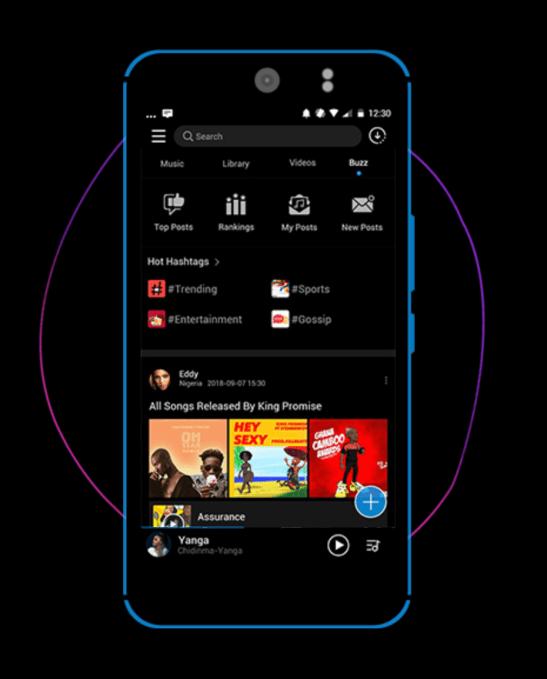
The service still benefits from Transsion’s large market share, but it has also published mobile apps for Android and iOS that tap users on a wider range of smartphones.

And it’s also tapping an international growth opportunity, specifically by marketing itself to Africans that have emigrated to other parts of the world and continue to listen to music from the continent.

“Music has no borders, and we’re committed to providing a rich and high-quality music experience for all users – not just in Africa, but around the world,” said Boomplay CEO Joe He. “This investment will help us do just that, by fostering cultural interchange and helping people communicate through the universal language of music.”

Boomplay’s rise in Africa, meanwhile, comes at a time when streaming services that dominate in other parts of the world, such as Spotify and Apple Music, have yet to really break into the African continent. Spotify launched its first service in Africa in the continent’s most developed market — South Africa — in March 2018 and has yet to expand to more countries, while Apple — with its premium pricing — has by Choi’s estimate has sold less than 1 million iPhones in the region, which limits its potential growth.

Boomplay’s growth has — predictably — mirrored that of the handsets where it is preinstalled, but notably covers a number of countries in the sub-Saharan region, as well as a strong range of local music alongside more international tracks, by way of deals with large labels like Universal Music and Warner Music.

The role that China has played in developing tech in Africa has been an interesting one. It started years ago when Chinese companies like ZTE — looking for growth outside their home market — were winning big deals to build telecoms infrastructure at a time when tele-density on the continent was the lowest in the world. Rather than building fixed-line infrastructure, they built mobile infrastructure, and that eventually led to a wave of Chinese OEMs, making cheap feature and smartphones, becoming some of the biggest handset suppliers. “The Chinese government has really pushed investing in Africa since they see a lot of potential there,” Choi said.

Despite the very homegrown nature of the arts in Africa — specifically in areas like music and cinema — the development of services like Boomplay to deliver that content has been a natural progression in China’s wider tech growth in the region.

But if you follow the African market, you know that despite the big potential — of that 1.2 billion inhabitants, the average age is 21, Choi said, a great market for streaming music services — the economy is still underdeveloped, which hinders significant growth.

In the case of Boomplay, that translates to not just to adding more users in countries that rank as some of the poorest in the world, but in getting them efficient ways to pay if they do want to do so.

“We’ve seen healthy growth, but one of the problems is that there isn’t really a sustainable or efficient mobile payment system,” Choi noted. Processing payments, he said, “takes really long and can be unreliable, for example, halfway through a transaction, errors may occur.” He said the company already accepts Mpesa, one of the key mobile payment services that was originally founded in Kenya, along with other payment methods, but the plan is to add more to that soon.

Longer term, Choi said that will likely lead to more funding being raised. Wether that comes from China again or elsewhere will be interesting to watch. “Chinese investors see Africa as the China of 10 years ago,” he said, “so they feel they can apply the same models to it, and bring it up to being a very prosperous region.”

“Africa is full of opportunity, from its young demographics to its vibrant culture, and Boomplay sits in the middle of all of that greatness,” said Tony Li, Managing Director of Maison Capital, in a statement. “Boomplay has incorporated NetEase’s experience in the music streaming business with Transsion’s expertise in local operations, and in doing so Boomplay became the dominant player in the region in a very short period of time. As more of Africa comes online, we are confident that Boomplay will continue to be a major force in business and culture.”


05 Apr 2019

Daily Crunch: The corporate fallout of the Bezos divorce

The Daily Crunch is TechCrunch’s roundup of our biggest and most important stories. If you’d like to get this delivered to your inbox every day at around 9am Pacific, you can subscribe here.

1. MacKenzie Bezos giving ex-husband Jeff 75 percent of Amazon stock, voting control

MacKenzie Bezos noted in a tweet that her 26-year marriage to Amazon CEO Jeff Bezos has been formally dissolved. She added that she will be giving the executive all interest in the Bezos-owned Washington Post and privatized space company, Blue Origin.

The deal also finds MacKenzie giving her ex 75 percent of their joint Amazon stock, with Jeff also retaining voting control in her remaining 25, “to support his continued contributions with the teams of these incredible companies.”

2. Google pulls the plug on AI council that included Heritage Foundation leader

Critics questioned the inclusion of Kay Coles James, leader of the right-wing think tank the Heritage Foundation, on the eight-person panel. In response, the company has apparently chosen to drop the whole thing.

3. Snapchat launches Mario Party-style multiplayer games platform

The Snap Games platform lets you play real-time, multiplayer games while texting and talking with your friends. The platform is based on Snap’s secret late-2017 acquisition of Australian game studio PrettyGreat.

4. EU goes after Valve for ‘geo-blocking’ Steam activation codes

“In a true Digital Single Market, European consumers should have the right to buy and play video games of their choice regardless of where they live in the EU,” said Commissioner Margrethe Vestager in a statement.

5. Amazon reportedly readying its Alexa-powered answer to AirPods

A report from Bloomberg details the upcoming hardware, which sounds a lot like AirPods: a pair of small wireless in-ear buds, a case that doubles as a charger and built-in controls and a mic so you can control your music, talk to friends and ask Alexa things on the go.

6. Nintendo is bringing Zelda and Mario into virtual reality

Nintendo’s Labo VR kit may just be a little cardboard experiment, but Nintendo is taking a chance on throwing its most beloved titles into the headset.

7. The uncertain future of shared electric scooters

The rise of electric scooters is often compared to the rise of ride hailing, but there are some key differences at play. (Extra Crunch subscription required.)

05 Apr 2019

The Google Assistant on Android gets more visual responses

About half a year ago, Google gave the Assistant on phones a major visual refresh. Today, the company is following up with a couple of small but welcome tweaks that’ll see the Assistant on Android provide more and better visual responses that are more aligned with what users already expect to see from other Google services.

That means when you ask for events now, for example, the response will look exactly like what you’d see if you tried the same query from your mobile browser. Until now, Google showed a somewhat pared-down version in the Assistant.

[gallery ids="1808356,1808354,1808357,1808355"]

Also — and this is going to be a bit of a controversial change — when the Assistant decides that the best answer is simply a list of websites (or when it falls back to those results because it simply doesn’t have any other answer), the Assistant used to show you a couple of boxes in a vertical layout that were not exactly user friendly. Now, the Assistant will simply show the standard Google Search layout.

Seems like a good idea, so why would that be controversial? Together with the search results, Google will also show its usual Search ads. This marks the first time that Google is showing ads in the Assistant experience. To be fair, the Assistant will only show these kinds of results for a very small number of queries, but users will likely worry that Google will bring more ads to the rest of the Assistant.

Google tells me that advertisers can’t target their ads to Assistant users and won’t get any additional information about them.

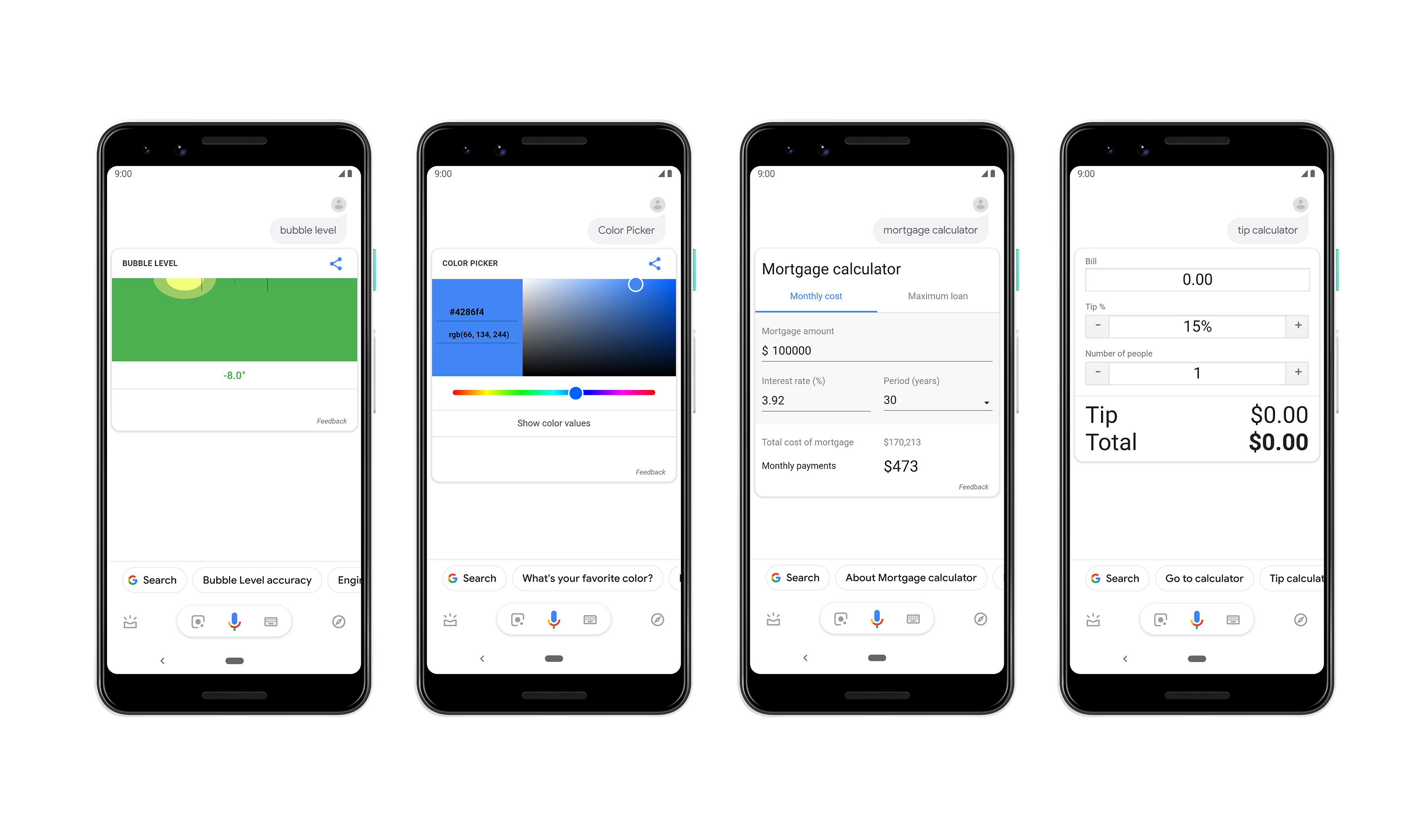
The Assistant will now also show built-in mortgage calculators, color pickers, a tip calculator and a bubble level when you ask for those. Also, when you ask for a stock quote, you’ll now see a full interactive graph, not just the current price of the quote.

These new features are rolling out to Android phones in the U.S. now. As usual, it may take a bit before you see them pop up on your own phone.

05 Apr 2019

Landed raises $7.5 million Series A to help teachers buy homes

Teachers are notoriously underpaid and buying homes is notoriously expensive. This is where Landed, which just raised a $7.5 million Series A round led by Initialized Capital, comes in.

Landed helps educators buy homes by providing them with down payment assistance. That’s because many teachers leave their jobs due to a lack of stable housing. In Berkeley, Calif., for example, more than half of the school district’s employees reported they considered leaving because of the high costs of housing.

“Our mission is to help these people build financial security and help them remain committed to their communities,” Landed co-founder Alex Lofton said. “We try to stay flexible to peoples realities. We don’t require people to buy in any particular city.”

To date, Landed has helped more than 200 educators buy homes in the San Francisco Bay Area, Denver and Seattle.

Currently, the maximum amount of support Landed gives is $125,000 in the Bay Area, but Lofton says people generally take less than that. Unlike some of the city-run housing programs, there’s no income restriction with Landed.

“A lot of people we work with make a bit too much money to qualify for those programs,” Lofton said.

Landed, which manages the funds it sets up, offers down payment assistance in exchange for a cut of the home’s appreciated value. Landed, Inc., which is a licensed real estate brokerage, gets money on every transaction that occurs while Landed’s fund.

Given the influx of new cash into the SF Bay Area via IPOs from tech companies, Landed expects the market to become more challenging.

“With all of these economic booms In a market that’s already really supply-constrained with housing, it will be even more challenging,” he said.

While that’s surely discouraging to potential homebuyers, Landed is prepared to expand into additional markets and diversify where it offers support.

“[IPOs] will affect us but it won’t end our mission,” Lofton said. “For the community that we’re a part of, in our backyard, it does make us all here a bit nervous.”

With the funding, Landed will be able to expand to more cities and serve educators beyond K-12.

“I’ve followed the team at Landed for several years in their mission of providing more equitable access to homeownership to some of the most important community members – our educators and teachers,” Initialized Capital Partner Kim Mai-Cutler* said in a statement. “Not only is Landed attacking a profound issue affecting teacher retention in metros and school districts throughout the country, this is a promising market opportunity to build a trusted brand and institution to help essential professionals achieve their lifetime financial goals.”

*Kim-Mai Cutler is a former colleague of mine, but this relationship had no bearing on coverage.

05 Apr 2019

Peter Kraus dishes on the market

During my recent conversation with Peter Kraus, which was supposed to be focused on Aperture and its launch of the Aperture New World Opportunities Fund, I couldn’t help veering off into tangents about the market in general. Below is Kraus’ take on the availability of alpha generation, the Fed, inflation vs. Amazon, housing, the cross-ownership of US equities by a few huge funds and high-frequency trading.

Gregg Schoenberg: Will alpha be more available over the next five years than it has been over the last five?

To think that at some point equities won’t become more volatile and decline 20% to 30%… I think it’s crazy.

Peter Kraus: Do I think it’s more available in the next five years than it was in the last five years? No. Do I think people will pay more attention to it? Yes, because when markets are up to 30%, if you get another five, it doesn’t matter. When markets are down 30% and I save you five by being 25% down, you care.

GS: Is the Fed’s next move up or down?

PK: I think the Fed does zero, nothing. In terms of its next interest rate move, in my judgment, there’s a higher probability that it’s down versus up.

05 Apr 2019

How I Podcast: The Moth’s Dan Kennedy

The beauty of podcasting is that anyone can do it. It’s a rare medium that’s nearly as easy to make as it is to consume. And as such, no two people do it exactly the same way. There are a wealth of hardware and software solutions open to potential podcasters, so setups run the gamut from NPR studios to USB Skype rigs.

We’ve asked some of our favorite podcast hosts and producers to highlight their workflows — the equipment and software they use to get the job done. The list so far includes:

Bullseye’s Jesse Thorn
Ben Lindbergh of Effectively Wild
My own podcast, RiYL

This week, we’ve enlisted a host who straddles the line between pro-level public radio recordings and home studios. These days, Dan Kennedy is probably best known as the host of the podcast version of The Moth Radio Hour. For more than 20 years, The Moth has featured some of the most engaging, funny and thought-provoking names in long-form storytelling. The series’ latest collection of stories, The Moth Presents Occasional Magic: True Stories About Defying the Impossible, is out now.

Kennedy is also an author whose work has been published in McSweeney’s GQ and various other publications. He is also the author of several books, including “Loser Goes First: My Thirty-Something Years of Dumb Luck and Minor Humiliation,” “Rock On: An Office Power Ballad” and “American Spirit: A Novel.”

I don’t record The Moth Podcast here at home. We record that at the office studio downtown, or at Argot Studios, and we’ve had a ton of great producers over the years — Whitney Jones, Laura Haden, Timothy Lou Ly, Paul Ruest, Julia Purcell, to name a few. Home is where I record everything else in my world; audio versions of my McSweeney’s pieces for their Patreon site; freelance production and voice-over work for clients — usually cable networks; demos for new podcast ideas like this limited series idea me and some friends in L.A. pitched to Panoply and Audible and wherever else that might end up.

My rig here at home is a Rode NT 1000 mic, through an Onyx Blackjack, into Hindenburg Journalist. Super straightforward. I know a lot of people like SM58s and Yetis, but I’m in love with that Rode. I still have a Presonus TubePre, but I never use it anymore. There’s an old blue Anvil road case here that’s followed me through three or four apartments; the tomb of old gear from over the years — Oxygen midi controllers, old Line6 stuff, iRigs… When stuff finally breaks or becomes incompatible, that’s where it goes. I’m amazed by how much you can do at home now.

I came up through community radio in Seattle back in the day, 400 watts that would maybe reach to Kent on a good morning. You had to reserve the production studio at night if you wanted to record personal stuff. Or maybe you had one friend with a rack of preamps and reverb, a decent mic and a Tascam Portastudio, and you had to bring your ideas to their house and try to get something done. Now you can pretty much record anything at home and distribute it worldwide. It’s a very cool time to be making things.

05 Apr 2019

Skype now supports up to 50 group call participants, topping rivals

Skype is capitalizing on Apple’s struggles with Group FaceTime to attract attention to its own group calling features. Today, the company announced it’s doubling the number of people who can simultaneously participate in a group audio or video call. It now supports as many as 50 people at once, up from 25, previously.

With the expanded support for more participants, Skype tops the abilities of other popular messaging apps like WhatsApp, Google Hangouts and Instagram, and instead competes more directly with enterprise-grade calling solutions like Zoom, for example, which supports up to 100 or even 1,000 participants, depending on the plan, with up to 49 webcams displayed in its gallery view.

Skype isn’t as robust, but offers something in between an enterprise platform and consumer apps.

Skype also one-ups Facebook Messenger, which allows 50 people to join a chat but limits the screen to show  only the speaker after more than a half-dozen people join in. On Skype, participants are shown in bubbles across the top of the screen and the end-user can choose whose feed they want to focus on in a multi-paned main window.

Notably, Skype’s update also puts it ahead of Apple’s FaceTime which now supports up to 32 people on group calls as of iOS 12.1.

But Group FaceTime has experienced some issues in recent months. A teenager found a security bug that allowed users to eavesdrop before calls were picked up. Apple disabled the feature, fixed the bug, then re-enabled Group FaceTime with February’s release of iOS 12.1.4. But the update also introduced a change to how the app works, as it required users have to have at least 3 people on a FaceTime call to begin with before they could use the “Add Person” button.

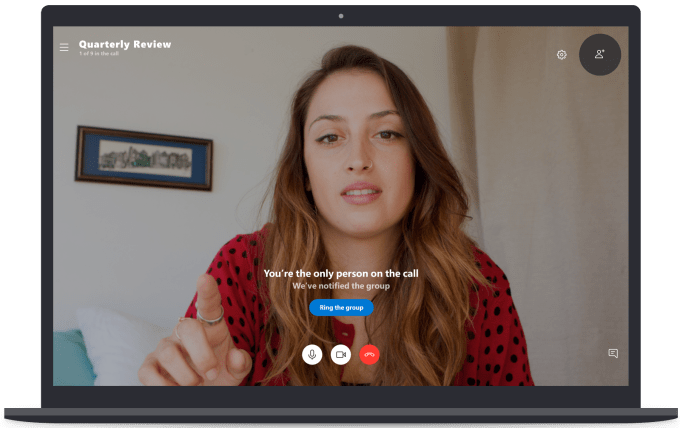
Skype, on the other hand, is simplifying how video calls start with the new release.

For groups under 25 participants, you can just ring the entire group at once, the company says.

And for larger calls, Skype added a notification option to replace ringing as the default. That means participants get a less obstructive, ping-style alert to join the call.

To use these new features, you’ll need to download the latest version of Skype.