
Category: UNCATEGORIZED

05 Apr 2019

Twitter’s latest test focuses on making conversations easier to follow by labeling tweets

Twitter continues to experiment with ways to make conversations on its platform easier to follow. In addition to its prototype app twttr, which is testing threaded replies, the company also recently tested labeling replies to highlight those from the “original tweeter” – meaning it would show when the person who first tweeted a post then replied within the conversation thread. Now, Twitter is changing up this labeling system again.

On Thursday, the company said a new test was rolling out which would instead label the “original tweeter” as “Author” – a term that’s a bit more straightforward .

“Original tweeter” had been a nod to the commonly used term”original poster,” which designates the person who started a conversation on an internet message board or online forum. But if the goal was to make Twitter easier to understand for those who are less tech-savvy, “original tweeter” may have been more confusing if they weren’t familiar with that reference.
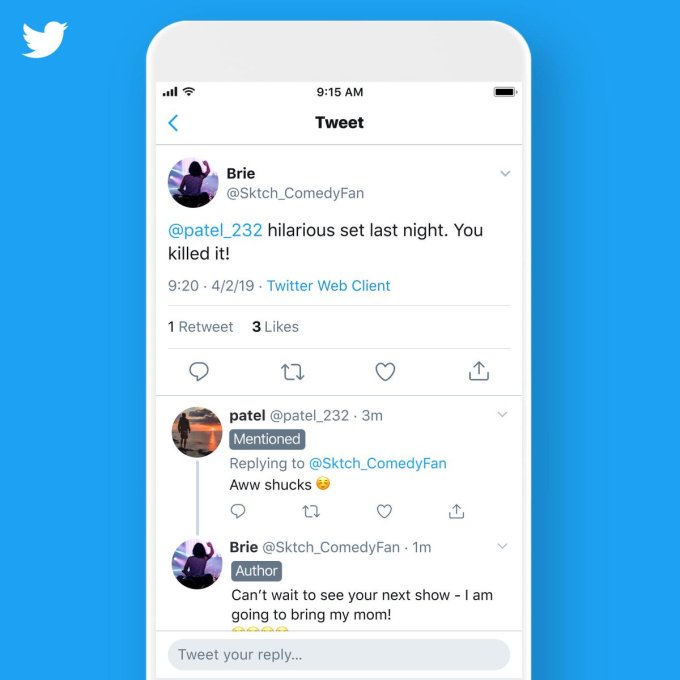
In addition, Twitter is also now adding two new labels, “Mentioned” and “Following,” which will be added to other important tweets in conversation threads.

“Mentioned” will be added to any tweet posted by someone who the original tweeter…err, Author…had referenced in their first tweet. The “Following” label, meanwhile, will be added to tweets from those Twitter users you’re following, as a way to catch their replies when scrolling through long threads.

Oddly, these are the same sort of features that Twitter is trying out on its twttr prototype as well, but in a different way. In the invite-only testing app, the original poster is highlighted using a thin gray line next to their tweet, while those you’re following is a brighter blue.

Twitter’s larger goal here is to better design its app for longer discussions. However, the labels also can help in specific scenarios where the replies to a tweet include posts from a lot of parody accounts. Often, parody accounts have adopted usernames and profile pics to resemble that of the person they’re poking fun at – sometimes inadvertently confusing users and, other times, to blatantly troll or spam.

Despite the usefulness of features like labels, these sorts of minor changes feel like an odd thing for Twitter to focus its attention on, when users’ main demands are still an edit button and for the company to deal with abuse and harassment.

On the latter front, Twitter was recently spotted working on a “Hide Tweet” feature. While more controversial than a new label, a hide tweet button would have the potential to impact user behavior, as it allows a poster to hide the replies they didn’t like. As a result, those following a conversation would have to click a button to view these hidden replies. In other online forums, knowing that a trolling or unhelpful comment would be downvoted or removed has helped to stem bad user behavior and encourage better conversations. The feature, however, could be used to silence dissenting opinions, which some people don’t like.

If Twitter won’t roll out an edit button, experiments around dealing with trolls through product features would probably be more useful than continually tweaking Twitter’s extra little flourishes.
05 Apr 2019

AeroGarden maker says hackers stole months of credit card data

Bad news for home gardeners: criminals might have your credit card data.

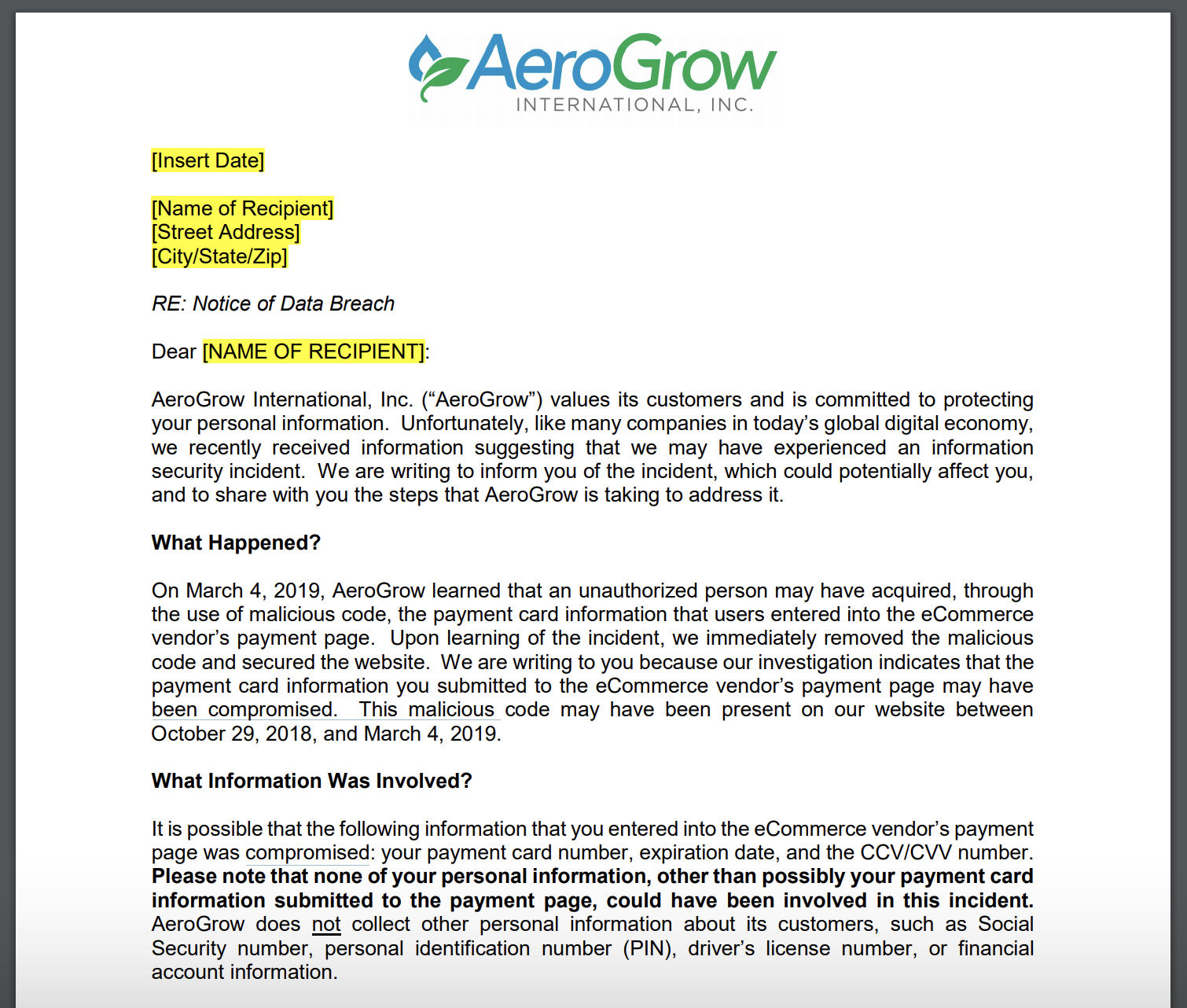
AeroGrow, the maker of the at-home garden kit AeroGarden, said in a letter to customers that its website had credit card scraping malware for more than four months.

The company said anyone who bought something through its website between October 29, 2018 and March 4, 2019 had their credit card number, expiration date and card verification value — also known as a security code — stolen by the malware. In most cases, that’s all someone would need to make fraudulent purchases,

A letter to customers, as submitted to the California attorney general’s office. (Screenshot: TechCrunch)

It’s the latest in a string of high-profile malware attacks targeting websites in the past year. Attackers will find a vulnerability often in the website running a company’s shopping cart and inject code that scrapes credit card data once it is entered into the form on the site. That data gets siphoned off and sent to a server controlled by the attacker. Because the code is running on the page, there’s no discernible or obvious way to tell if a website is affected.

One of the more well-known hacker groups includes Magecart, a collective of different hackers of varying skillsets, which attack websites large and small. In the past year, the hacker groups have targeted Ticketmaster, British Airways, and consumer electronics giant Newegg — and many more.

AeroGrow didn’t say how many customers were affected. We’ve reached out and will update if we hear back.

05 Apr 2019

Relativity, the 3D printed rocket manufacturer, inks multi-year contract with Telesat

Relativity, the Los Angeles-based manufacturer fo 3D printed rockets, has signed its first public commercial contract with Telesat, the longtime vendor of satellite services for telecommunications and business information. 

The deal marks the first agreement between a major satellite operator and an entirely venture-backed company in the “New Space” industry and is a huge win for Relativity’s low cost rocket manufacturing platform.

Relativity’s first launch of its Terran 1 rocket, the first fully 3D printed rocket built using Relativity’s proprietary printing technology, is slated for the end of 2020.

The company already has a launch site at Cape Canaveral in Florida and a test facility at NASA’s Stennis Space Center right on the Mississippi-Louisiana border. It’s currently in the process of acquiring a launch site in California that will expand its launch capabilities for customers, according to Relativity chief executive, Tim Ellis.

Relativity’s launch services come in at around $10 million for a 1,250 kilogram payload to low earth orbit, Ellis said. That’s about $10 million to $20 million less than it would cost to launch a similar payload on the Indian PSLV rocket or European Ariane rocket.

The company keeps costs low by relying heavily on automation and metal 3D printing technology at almost every step of the design and manufacturing process for its launch vehicles. Instead of taking 18 months to build, Relativity claims that it can make its rockets in 60 days with hundreds of components instead of the hundreds of thousands of parts that comprise a traditionally manufactured launch vehicle.

Telesat was certainly convinced by the company’s pitch.

“Early in our LEO program we decided that, in addition to working with outstanding leaders in satellite manufacturing and launch services who we know well, Telesat should also include NewSpace companies whose technologies and manufacturing methods offer lower costs and greater flexibility for deploying our constellation,” said Dave Wendling, Telesat’s chief technology officer. “Relativity is just such a company with their metal 3D printing, use of robotics and other advances. Telesat continues to establish a world-class supplier team to construct, deploy and operate our global LEO network and we are very pleased to welcome Relativity to the Telesat LEO program.”

With the revelation yesterday of Amazon’s plans to create a satellite network of its own, Telesat may be relying on Relativity’s services for more launches — since Blue Origin, Bezos’ own rocket company may have its hands full launching satellites for its sister company.

“It’s comparable in magnitude to when SES first signed with SpaceX back in early Falcon 9 days,” says Ellis of his company’s first public contract. “We’ve been working with their team for a very long time vetting our capabilities and our progress.”

The company has done 136 engine tests and has received its avionics systems, which are currently being tested now.

As for the overall industry, Ellis says it’s still the earliest days for NewSpace companies.

“We’re still in the phase of laying fiber in the ground,” Ellis says. “As far as space infrastructure and network..it’ll follow the path of the internet… the application layers will get built on top of that.”


05 Apr 2019

EU goes after Valve for ‘geo-blocking’ Steam activation codes

Seemingly the sole government body policing tech platforms, the ole’ European Union, is now taking aim at desktop gaming’s biggest storefront, Steam, and its creator Valve.

The commission sent a “Statements of Objections” to Valve and five other video game publishers, raising a fuss over the companies’ habits of “geo-blocking” purchases, i.e. prohibiting users from using game activation codes purchased outside their country of residence.

Furthermore, the suit takes aim at Bandai Namco, Focus Home, Koch Media and ZeniMax for coming to agreements with game distributors including Valve that prevented consumers in some EU member states from being able to download titles that were available in other regions.

The commission claims these companies’ actions are in breach of EU antitrust rules.

“In a true Digital Single Market, European consumers should have the right to buy and play video games of their choice regardless of where they live in the EU. Consumers should not be prevented from shopping around between Member States to find the best available deal. Valve and the five PC video game publishers now have the chance to respond to our concerns,” Commissioner Margrethe Vestager said in a statement.

As Valve’s multitude of online defenders have note, there are some reasons why “geo-blocking” might make sense. Pushing regional sales can help game developers find audiences in new markets while keeping bread-and-butter markets paying full price to subsidize the rest. Keeping prices uniform across the globe can leave developers in a tricky position when it comes to finding the ideal price point.

It seems likely that these companies will look to make nice with the EU and keep their practice moving along elsewhere.

We have reached out to Valve for comment.

h/t: Owen Williams


05 Apr 2019

Lotame pitches an ‘unstacked’ approach to selling data tools

Lotame is unveiling what it says is a new approach to the data management business, with what it calls an “unstacked” strategy.

Adam Solomon, a former Time Inc. and Viacom executive who recently joined Lotame as chief marketing officer, said this new strategy is illustrated by the launch of Data Stream, which allows publishers and marketers to combine their first party data with Lotame’s device graph connecting consumer data across devices.

The company offered these capabilities before, but Solomon said Data Stream allows Lotame to break it out as an individual product, separate from a larger data management platform.

“Very specifically, what we’re doing is decoupling products and services from the broader platform to solve business challenges for our customers,” said CEO Andy Monfried.

Solomon added that as Lotame customers face an increasingly complicated data landscape, the company has been doing more specialized work with individual clients. So it’s created a product strategy (and catchy marketing term) based on that work.

“Now we’ve taken those bespoke, solutions-oriented features and productized them,” Solomon said. “Instead of a DMP, we really have an unbundled collections of technologies, where we can license individual components of our platform.”

Solomon said a DMP can basically be broken down into four areas: data ingestion at the center (that’s where Data Stream sits), audience segmentation, analytics and a data marketplace. The strategy is to create products focused on each of those areas.

Monfried contrasted this approach with the larger marketing clouds, which he said are trying to sell customers “the full stack of all their products.”

“What we say to clients is, ‘We don’t want to replace a full stack from Adobe or Salesforce, it if makes sense [for] your business,'” he said. “But there are opportunities to augment, or specific tasks they need to solve for.”

In the announcement, IBM Audience Application Lead Tanya Cross described Lotame’s approach as “essential for a large global organization like ours,” adding, “It allows us to pick and choose the right tools for our data needs, giving us the ability to create more informed marketing campaigns and improve our business results.”

05 Apr 2019

New Celonis tool moves process mining vendor into customer experience

Celonis created the idea of process mining, the act of automating the understanding and improvement of internal processes. But understanding the process in and of itself only gets you so far. Ultimately, companies need to use that information to improve the customer experience and a new operational layer announced today could help them do that.

When we think about managing the customer experience, we tend to look at the consumer-facing app or the website. If that isn’t working right, or there is unnecessary friction in the buying process, then then you can lose the customer.

But Celonis co-CEO and co-founder Alexander Rinke says that eliminating friction at the front end of the process is only part of the equation. If there is a problem anywhere in the delivery system from the manufacturer or warehouse to back-end systems, then that kind of friction can be just as problematic he says.

“Where process mining really helps is it reveals where there’s friction. The biggest challenge companies face is that there’s a ton of operational friction. Things get stuck. Things get delivered late. Customer promises get broken,” he said.

Part of what makes Amazon work so well isn’t just that customers can easily place orders on a website or app, but also that Amazon has figured out how to pick the order and get it to the customer in the promised amount of time. If there were any delays in that process, people wouldn’t gravitate toward Amazon as much as they do.

But most companies don’t have the operational excellence of Amazon and that’s where Celonis thinks it can help — by identifying the bumps in the operational road and finding ways to smooth those out in an automated fashion. “Initially, we sold a product for discovery, laying the land, understanding what’s going on in complex companies. And now we see more and more companies moving into operationalizing these insights, so acting on them, fixing things that are broken, and wanting to automate these fixes,” Rinke explained.

The company’s answer to this is the Beta of Workflow Engine, a tool that is designed to help companies improve that operational flow. As it describes it, “The no-code, point-and-click workflow allows business analysts to arrange process steps and connect process flows across systems.” It includes templates out of the box for common tools like SAP, Oracle, Salesforce.com, ServiceNow, Jira, etc.

He says as an example, a company may have switched to electronic payments, but it’s finding customers aren’t moving with them. They can use the tool to identify those customers and offer a discount on their next order if they pay electronically without bothering the folks who are already doing it.

The company also announced a new tool to help connect easily to SAP systems. As Rinke points out, there are hundreds of these systems running the back-end (finance, inventory, HR, etc.) at companies all over the world. It’s not always easy to connect to them because of their age and complexity.

To that end, the company revealed it has bought Banyas, a tool designed to help automate workflow from SAP systems, and one that should fit in nicely with the company’s vision to automate and understand process flows across large organizations.

Celonis was founded in 2011. Today it has over 700 employees, and has raised almost $78 million.

05 Apr 2019

The future of a16z, Lyft’s sinking stock and another IPO to watch

Hello and welcome back to Equity, TechCrunch’s venture capital-focused podcast, where we unpack the numbers behind the headlines.

This week your humble Equity squad (Kate Clark, Alex Wilhelm) were stoked to take on as much as we could with what little time we had. We kicked off with a speed round that turned out to not be very quick and then dug into the biggest news of the week.

The Not-So-Speed-Round:

  • Affirm raised $300 million at nearly $3 billion valuation. The round marks another win for Max Levchin’s company and is another point on the board for the PayPal mafia.
  • Clearbanc announced a new campaign to rapidly back 2,000 e-commerce businesses with $1 billion, called “The 20-Min Term Sheet.”
  • Rippling raised $45 million, making for both an interesting financing story and a redemption arc, packaged neatly alongside a few dozen million dollars. Parker Conrad is part of the Rippling team, meaning whatever the company does will court attention.
  • The femtech sector is on pace to hit $1 billion in investment this year — finally — with organic tampon retailer Cora being the latest startup in the space to garner the attention of VCs.
  • And finally, we took a brief look at the world of corporate venture capital; a few notes: Okta has a new $50 million fund, Chevron has a $90 million fund, Intel Capital has been busy and more. Seems like every corporation wants to get into the game, or get in bigger.

After all that, we turned to Forbes’ big Andreessen Horowitz cover story. There was a lot to unpack. Long story short, a16z has given up its status as a venture capital firm and registered all 150 of its employees as financial advisors. Curious what that means and why it matters? We were too, so we found answers.

Next, we turned back to the newly public Lyft. Since its IPO, Lyft’s stock price has taken quite the dive. Now, Lyft is back to its IPO price, which we think means it priced its IPO quite well. Still, where’d all the bullish Lyft investors go and why are so many people shorting the stock? We answer these questions and discuss what the falling numbers mean for other IPO-ready unicorns.

Next up was a look into the Jumia IPO, which Alex wrote about here. We need to pay more attention to startups outside the U.S., like Jumia, an African e-commerce platform. So listen to our plea. We want to hear from you! Email us at alex@Crunchbase.com or kate.clark@techcrunch.com if you have suggestions.

Finally, the Midas List. Does it matter? Why are we talking about it? Why do lists exist? Who’s on top? Who’s not? Who’s sad? Who cares? And more questions left unanswered.

Equity drops every Friday at 6:00 am PT, so subscribe to us on Apple PodcastsOvercast, Pocket Casts, Downcast and all the casts.

05 Apr 2019

Nintendo is bringing Zelda and Mario into virtual reality

Nintendo’s Labo VR kit may be a little cardboard experiment, but Nintendo is taking a chance on throwing its most beloved titles into the headset. Today, the company announced that they will be adding support to play

Though Legend of Zelda: Breath of the Wild seems to just be gaining VR viewer support, Super Mario Odyssey is actually getting some new content alongside the updates which adds a trio of new mini-games. Both games are getting this update for free later this month on 4/25.

This is a very strange choice for Nintendo to make, given what an assuredly cruddy experience this will surely be. It made enough sense with the Labo experiences, because those are designed to be fast and fun, tech specs be damned. But when Nintendo suggests tossing yourself into a 50-hour epic like Breath of the Wild, they’re offering you a tacit endorsement that you’ll be able to play these games in VR for a while.

I doubt this will be the case. That being said, I haven’t tested out virtual reality Breath of the Wild but something tells me that Mario or Zelda in glorious 360p per eye resolution doesn’t make for the game of a lifetime.

There’s also no evidence that you’re going to have any sort of different point-of-view perspective that they’ve enabled gameplay for so you’ll still be playing in third-person which is likely going to be a bit uncomfortable if the camera is automatically shifting while your head remains stationary.

It’s hard to rake Nintendo over the coals for giving users this experience for free, but I hope people don’t rush out to buy the Labo VR kits just for this, because I’ve got some doubts they’ll like what they get.

05 Apr 2019

TikTok’s next ambitious goal is to discover future music stars

TikTok needs a lot of music. A lot. The short-form video service began life as a lip-synching app in China, where it’s called Douyin, and although other categories of content, like skits and life hacks, later took off, music remains a key element to the app as its users in the hundreds of millions grow accustomed to soundtracking their video clips.

And TikTok, a Vine-like app that has amassed about 1 billion downloads around the world, is getting serious about securing good music for its content creators. The app just launched an initiative to scout music talents in Japan and South Korea after a similar program kicked off in China, where its parent, the world’s most valuable startup Bytedance, is based.

Called Spotlight, the audition will take place digitally via TikTok. Artists submit their work to the app, and winners will eventually get introduced to the company’s 21 label partners and publishers, which could lead to recording opportunities. In turn, TikTok users can pick from the fresh batch of music to spice up their work.

People already have access to a massive catalog of copyrighted song snippets that TikTok builds up by partnering with studios worldwide. In China alone, the app claims to have inked deals with over 800 label companies, including big names like Universal Music Group and Warner Music Group. Alternatively, users can also upload their own soundtracks.

Music marketers have pounced on short-form video apps like TikTok and Vine to promote artists. Unlike music streaming apps that are designed for consumption, TikTok, which has a social component to it, allows two-way interaction between artists and fans, who can lip-synch, hand-dance and remix their idols’ songs often as part of the platform’s hashtag challenges. Indeed, many artists, including Korea’s boy band BTS and girl band Blackpink, have embraced TikTok to promote new releases.

TikTok bills Spotlight as a program that will “discover and support the growth of independent artists.” Beyond marketing aid and access to music execs, it’s unclear how the platform plans to share with the artists any financial gains they help to produce. We’ve reached out to TikTok for more information and will update the story if we hear back.

While viral songs on TikTok can bring attention to the artists behind, the focus is not always on the music, which is meant to do service to the 15-second clip. A song catches on often because it’s an earworm, or that it suits a particular meme, not necessarily in virtue of how “good” the music is.

05 Apr 2019

Samsung’s upcoming Q1 earnings are going to be ugly

It’s that time again folks, Samsung has reported guidance for its upcoming Q1 quarter — and things don’t look good.

Samsung is forecasting that revenue for the quarter will reach 51-53 trillion KRW ($44.87-$46.63 billion), which would represent a drop of around 15 percent on one year previous. The Korean tech giant reported a record operating profit in Q1 2018 — $13.76 billion — but this time around that is forecast to fall by a whopping 60 percent for the current quarter of business. According to Bloomberg, that would be the company’s worst slump for four years.

Following a record year is never going to be easy, but the forecast Q1 2019 operating profit of 6.1-6.3 billion KRW — around $5.5 billion — represents a pretty steep 43 percent drop on the previous quarter. That’ll give Samsung shareholders plenty to worry about.

The company’s pre-earnings guidance doesn’t go into details on the predictions, but last year’s record profits were largely down to the success of its consumer handset business and also a strong market for memory chips. There have been plenty of warning signs that those good times might not last.

Samsung itself played down those impressive Q1 2018 results multiple warnings on the future — my colleague Brian Heater pointed out that the words “slowing growth” appeared seven times in Samsung’s announcement at the time — due to concerns around the company’s display panel business and a slowing growth within the general smartphone industry.

As we well know, analyst reports show that people are buying fewer phones for a range of reasons. That’s one explanation for Apple’s multi-device approach which pushes its top-of-the-range model to well beyond the $1,000-mark. Slowing growth means a need to extract more revenue from the most loyal users, to thus increase the overall average selling price (ASP).

Samsung has long played in the mid-tiers — where it is up against tough competition from the likes of Xiaomi, Oppo, Huawei and others from China — but it’ll be interesting to see if it shifts its top-end approach.

We’ll know more when the company releases its full Q1 earnings report later this month so stayed tuned.