Category: UNCATEGORIZED

03 Apr 2019

Red Points closes $38M Series C for its ‘antivirus’ SaaS for brands

Barcelona-based Red Points has closed a $38 million Series C led by Summit Partners. Existing investors Northzone, Mangrove, Eight Roads Ventures and Banco Sabadell also participated in the funding round which follows a $12M Series B last year.

The company’s software as a service platform targets brands wanting to protect products and their reseller network from cheap online fakes and/or piracy, with both physical branded goods and copyrighted digital content covered by Red Points’ brand protection tech.

It automates the detection and sending of infringement notifications using marketplace scanning and machine learning powered image recognition that’s capable of spotting potential fakes at scale, combined with customizable rules that let brands prioritize and automate enforcement actions.

“The whole process is automated from detection to enforcement,” CEO Laura Urquizu tells us. “To the companies that we help we usually say that we are like an antivirus. Because we are there the counterfeiters move to other brands, other companies, other places. So in order to keep it clean it’s very important to counter with an act — or with a technology like ours — in order to have, let’s say, the Internet and the marketplaces and the social networks as clean as possible.”

Commenting in a supporting statement, Steffan Peyer, principal at Summit Partners, added: “Brands around the world are facing an unprecedented rise in online IP infringement. Red Points is a category-leader, offering an intelligent and robust technology platform that is purpose-built to address this growing pain point. With differentiated technology and a strong leadership team, we believe that Red Points is well positioned to accelerate its growth and further solidify its leadership in the Brand Intelligence market.”

Detecting and acting on online sales of fake goods still makes up the lion’s share of Red Points’ business, accounting for around 70% vs 30% dealing with digital copyright infringements. “We started with digital content and then we really made a very interesting decision to put our efforts a lot in brand protection and fake products. This is where the platform that we developed is very strong,” says Urquizu.

She notes for example that the software helps brands track sellers to highlight adjacent issues related to illegal sales, such as underpricing in specific geographies.

Analytics around IP threats is another core element of the SaaS proposition. “Another very important functionality is all the data that we are able to bring to our clients. Their own data and data that we produce related to the vertical, related to other clients etc.

“Customers use this IP ‘threat intelligence’ for various use-case — such as to see where most of the counterfeiting is happening and on which platforms fakes are being distributed. That way they can also implement their own strategies related to those specific platforms or to those specific countries. They also understand who are the top sellers infringing — so they can also take legal action against them.”

“Counterfeiting is everywhere, everywhere,” adds Urquizu, discussing the scale of the online fakes problem for brands. “All platforms, all social networks are affected. And of course when something is trendy it is affected. We see it in the brands that are offering new gadgets that are very trendy. Immediately they get the problem of counterfeiting and with platforms and social networks the more trendy the better it’s a place for counterfeiting to use it as a playground.”
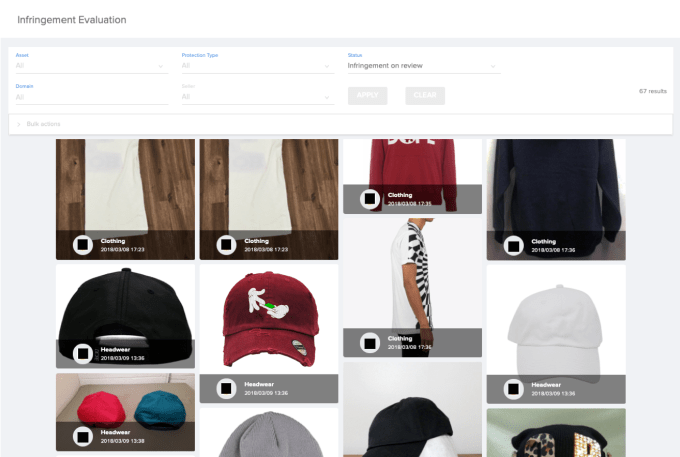
Red Points is now detecting more than 500,000 incidents of illegal products and/or content per month for 550+ customers. That’s up from 300+ customers when we spoke to Red Points last year.

Customers include makers of branded goods in verticals such as fashion, design, toys and accessories, as well as media companies on the digital IP side. It names the likes of Bang & Olufsen, MVMT and DOPE among its client base.

Newer growth verticals for the business include electronics and industrial machines. “We are growing at an average pass of 40 new clients monthly at this moment,” adds Urquizu.

On the enforcement front, she says the platform takes “hundreds of thousands” of enforcement actions on behalf of its paying customers each month. (A year ago it was reporting 200k+ removals per month so it appears to no longer be breaking that metric out.)

Overall, business growth rate exceeded 100% for 2018, with the U.S. making up a large chunk of the bump following the opening of a New York office just over a year ago. Urquizu says the market now accounts for around half its business.

A big focus for the Series C funding is ramping up sales and marketing in the U.S. “A lot of our growth comes from U.S. and we just started so what we want to do is we want to increase our presence and our footprint.”

Even so, Urquizu says the company has no plans to move its HQ out of Europe. “The U.S. office is gonna grow. It is growing… We started only last year and it was March/April. Now we are more than 20 people in U.S. already. And we’re going to continue growing this year there… But we think that for us the technological and product teams they can be sitting here in Barcelona very well because talent is really good here. And we find that from here we can really serve very well to the rest of the world.”

“Every month we are really growing very, very nicely,” she adds. “Now we have way over $10M of revenues so I would like to continue doubling these revenues yearly.”

The new funding will go on more R&D, too. Or “progressing on everything we do, finding new issues that we can solve, bringing a lot of more data and insights to the clients”, as Urquizu puts it.

On the competitive front, she reluctantly names veteran U.S. firm MarkMonitor, saying it provides some of the same services — while arguing there are big differences of approach.

“The technology we are providing to our clients, to the market, and to companies it’s very new, very innovative and very different to anything that is out there,” she claims. “The one very different thing is we have been able to automate the process from detection to enforcement using machine learning and artificial intelligence.”

Asked about a controversial digital copyright reform proposal — which was approved by the European parliament last week and shifts liability for copyright infringements committed by their users onto major platforms, Urquizu is untroubled.

She sees rising awareness of problems of piracy and counterfeiting as good news for a business that makes its money from companies paying it to get fakes taken down.

“What we think is that this kind of new legislation usually takes a large time until it has an impact so the real impact we will see in a couple of years, more or less,” she suggests, before adding: “We always see these kind of things as an opportunity for us. Because currently there’s so much that can be done against this issue — and also whatever helps us to bring awareness to brands and companies, we always think it’s very, very positive.

“These kind of things really support what we do because it makes the companies and the brands aware that something has to be done. So we always also have a very big collaboration with platforms, with the social networks, so for us we always see it as an opportunity to grow altogether.”
03 Apr 2019

Run.AI raises $13M for its distributed machine learning platform

Tel Aviv’s Run.AI, a startup that is building a new virtualization and acceleration platform for deep learning, is coming out of stealth today. As a part of this announcement, the company also announced that it has now raised a total of $13 million. This includes a $3 million seed round from TLV Partners and a $10 million Series A round led by Haim Sadger’s S Capital and TLV Partners.

It’s no secret that building deep learning models take a hefty amount of GPU power or access to specialized AI chips. Run.AI argues that the virtualization layers that worked so well for in the past don’t quite cut it for training today’s AI models.

“We believe that we’re only scratching the surface of the full potential of deep learning,” Run.AI CEO and co-founder Omri Geller told me. “But the computational infrastructure needs of deep learning are a totally different ballgame. […] The rise of deep learning is triggering a new era of compute.”

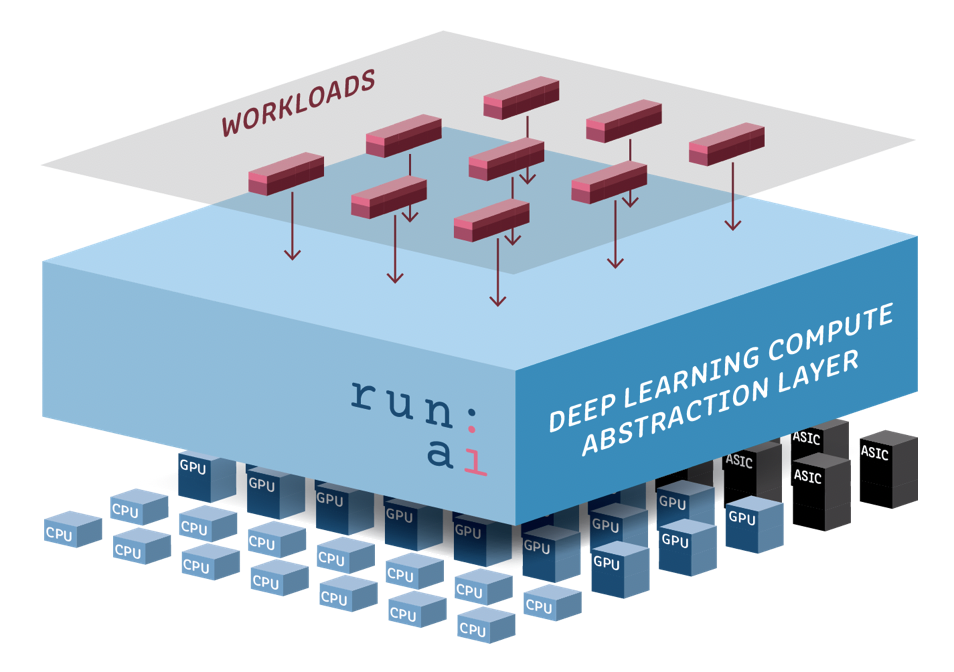
Traditionally, Geller argues, virtualization was all about being generous and sharing the resources of a single machine for workloads that typically only run for a short time or use a small amount of resources. Deep learning workloads, however, are very different and are essentially selfish in that they want to take over all the available compute resources of a given machine. These training sessions also typically run for hours or days. At its core, what Run.AI offers is a new virtualization layer for distributed machine learning tasks that can across a large number of machines.

“We built a compute abstraction layer that bridges the gap between the new form of workloads and the new hardware that is evolving,” said Geller. “By using this abstraction layer, we can achieve 100x faster compute using distributed computing. We can double the resource utilization of the hardware and we can bring to companies the control over time and cost regarding deep learning.” That’s 100x faster than using a single resource, though that’s a bit aspirational as Geller also tells me that the team is seeing about a 10x speedup in production right now, though he’s confident that the team will get to 100x over time. Either way, though, the promise here is that the service will allow you to optimize the utilization of your deep learning workloads.

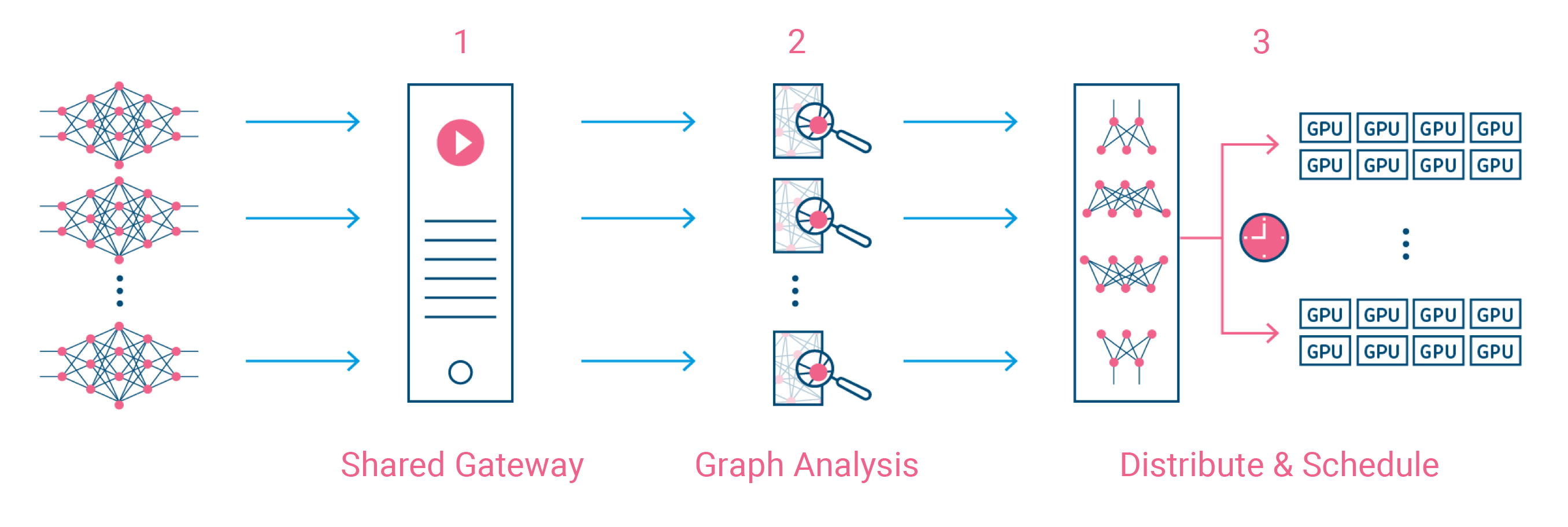
That’s only one part of the company’s solution, though. In addition, the company’s tools also analyze the model in order to break it down into smaller models that can then run in parallel across these servers. With that, the service can understand how many resources a workload would need and what machines to best send the given workloads to. In doing this, the system takes into account everything from available compute resources to network bandwidth, as well as the data pipeline and size.

The company also argues that this allows it to train large models that are bigger than the individual GPU memory capacity of a single machine.

There’s a financial aspect to this, too, because users can determine whether they want the service to prioritize cost savings over training speed, for example. The platform supports both private and public cloud deployments. In private clouds, cost savings are obviously less of a factor but the premise of increased utlization of the existing hardware investment will likely be a draw for many of these users.

The company, which was founded by Geller, Dr. Ronen Dar and Prof. Meir Feder, was founded in 2018. While still in stealth, it signed a number of early customers and opened a U.S. office. 

03 Apr 2019

Adobe Dimension CC can now render images in the cloud

Adobe today announced the latest release of Dimension, the company’s 2D and 3D compositing tool and one of the newest members of its Creative Cloud suite. The two highlights of the new release are cloud rendering, which is now in beta, and the ability to import substance materials from Allegorithmic’s Substance Designer.

Cloud Rendering in Dimension is the feature with the widest implications for both the way Adobe thinks about the cloud and its longterm business. Users can use this new feature to offload the rendering process from their own machine and send it to the cloud. Generating 3D content takes a lot of compute power, after all, especially when you get to the point where you want to create a high-res final product. While most modern laptops and desktops have enough horsepower to render these images, it’ll take a lot of resources and may tie up your computer for a while (and get your fans spinning).

To do this, Adobe needs to pay for the cloud resources, though, and that’s not cheap. So to use this feature, all Creative Cloud users will get 15 free rendering credits. Each render will cost between one to three credits, depending on the quality of the image.For now, those 15 credits is all you’ll get, though. There’s no way to buy more credits during the beta and while Adobe says that it wants to continue giving users free renders after the beta period is over, the company isn’t saying how many credits subscribers will get or sharing its pricing structure for buying credits yet.

During the beta, image sizes are limited to 2000×2000 and Adobe will also denoise the image for free.

It’s easy to see how Adobe could take this technology and apply it to other compute-heavy processes like video renders.

The addition of Allegorithmic support doesn’t come as a surprise. After all, Adobe acquired the company, which builds tools for creating textures and materials for game creators, visual effects artists and designers, in January. Dimension now supports Substance’s native file format and because these materials are based on parameters, it’s easy to adapt them to the specific scene they are in.

Other new features include improvements to high-res graphics on top of 3D models (think a logo you want to place on a 3D bottle). Previously, those often looked a bit pixelated, but now, they’ll remain in a higher resolution. In addition, Dimension now also supports CC Libraries, Adobe’s service for sharing assets across its Creative Cloud tools, which ensures that as you edit an image in Photoshop, for example, that updated image is immediately available in Dimension now, too.

03 Apr 2019

Google Assistant can now talk like John Legend

It’s pretty clear why Google opted not to announce this news on Monday, along with those new Gmail additions. When the company first mentioned at I/O that musician John Legend’s voice would be coming to Assistant, honestly, we weren’t sure if the company was joking.

Today, however, that feature becomes as reality — if you want it. If you say “Hey Google, talk like a Legend,” or go into Assistant’s setting, you can swap out your default voice for him. The singer went into the studio to record a select number of features, including answers to queries like:

  • “Are you John Legend?”
  • “What’s your favorite type of music?”
  • “Who is Chrissy Teigen?”
  • “Tell me a joke.”

Legend’s voice is only available for select content, including some “Easter eggs.” Other questions will be answered by the standard Assistant voice. Along with his recordings, Google utilized its WaveNet deep neural network technology to fine to Legend’s voice for Assistant.

Google says “cameo voices” are among Assistant’s most requested features. As such, I wouldn’t be too surprised to hear more from them in the near future.

03 Apr 2019

Developers – sign up to hack at the TC Hackathon at VivaTech

The search is on for the most creative, talented and inspired developers, coders, hackers and programmers. It’s time to put your mad skills to the test and your reputation on the line — hackathon style. We’re returning to the Expo Porte de Versailles in Paris to host TechCrunch Hackathon at VivaTech 2019 on May 17-18. Even better — it doesn’t cost a thing to compete. C’est incroyable! Get your free ticket now before they’re gone.

This hackathon is open to everyone — across Europe and beyond. If you have an idea for an app that’s been keeping you up at night, now’s your time to make it happen. Join the hundreds of other like-minded techies, form ad-hoc teams and build something great using BeMyApp, the official Hackathon platform.

Teams will have just 24 sugar-, caffeine- and energy-drink-fueled hours to birth their creations, and it’ll be an exhausting thrill ride. In this addled, sleep-deprived state, you’ll get just 60 seconds to present your product to the panel of esteemed Hackathon judges.

Yeah, it’s grueling, but it’s also seriously fun. You get to go head-to-head with other coders at the top of their game, and it’s an invaluable opportunity to share ideas, learn new skills and network with your community.

TechCrunch Hackathon judges assign each team a score between 1 – 5. The team with the highest score walks away with major bragging rights and a €5,000 cash prize. All teams that earn a three or higher will receive two tickets to VivaTech 2020 and two tickets to TC Disrupt Berlin 2019 in December.

And, like every awesome TechCrunch Hackathon, you can win top-quality swag, cash prizes and other cool stuff from our sponsors like EDHEC. They will be handing out their own €5,000 cash prize for the project that addresses this challenge the best:

Making an impact can have different meanings, and we believe that one of them is about improving how we support student’s careers. Have you ever asked yourself “have I chosen the right studies and the right career for me?”

According to the French Ministry of Higher Education, 150.000 french students decide to change their degree course. Participating in the TC Hackathon at VivaTech is a great way to solve this issue through innovation. So let’s help them find the path that suits them best for their future career!

Stay tuned! We’ll be announcing more sponsored challenges and prizes soon.

The TechCrunch Hackathon at VivaTech 2019 takes place at the Expo Porte de Versailles in Paris on May 17-18. What the heck are you waiting for? Tickets are free, but supplies are limited. When they’re gone — poof — that’s it. Sign up for the hackathon now while you still can. Nous sommes ravis de vous voir à Paris!

03 Apr 2019

Wayve claims ‘world first’ in driving a car autonomously with only its AI and a SatNav

Projects like Google’s Waymo, Uber, Cruise and Aurora are developing autonomous vehicles by throwing engineers at the problem, basing most of their platforms on rule-based systems that try to pre-empt and deal with every edge case, whilst also peppering the cars with more sensors to capture more data. This can work in relatively controlled environments but has the drawback of not being able to flexibly adapt in real-time to fast-changing situations.

Despite all this investment and many years of development, no one has yet been able to launch a commercial autonomous car service. It’s just very hard to hand-engineer. What’s required is not more eyes but better coordination. The simple answer — as it is to almost everything these days — would be to throw AI at the problem, and that’s what many startups, which lack the engineering and hardware muscle of the big players, are trying to do.

We reported on UK start-up Wayve last year when it announced its existence, but they had nothing to show for their claims.

Now they say they do, and the results are not only fascinating but might also be genuinely innovative.

In fact, they are claiming a “world first” in demonstrating that a car working on their machine-learning platform can drive on roads it’s never seen before during training, and without an HD map of its environment. Other systems, like Waymo’s, rely on maps and rules to drive. Theirs, says Wayve, does not.

Additionally, it’s also revealed that it’s been testing its platform on the Jaguar I-PACE SUV, which won the 2019 European Car of the Year. Interestingly, this is also a car which has been used by Waymo in some tests.

Alex Kendall, Co-Founder & CTO tells me: “Our cars learn to drive from data with machine learning. Every time a safety driver intervenes and takes over, the car learns to drive better. We don’t tell the car how to drive, rather it learns to drive from experience, example and feedback, just like a human. This is more safe and scalable than any other approach today.”

Emerging out of research from the University of Cambridge, Wayve has already undertaken extensive testing on public UK roads.

Kendall says: “The traditional approach used by all our competitors relies on HD-maps, expensive sensor suites and hand-coded rules that tell the car how to drive. We have built a system that learns end-to-end with machine learning. It is the first in the world to drive on urban roads it has never been on before. It uses compute/sensors which cost less than 10% of competitors.”

Bold claims. But a video today revealed on their site shows their system driving on public roads in Cambridge, UK, driving on roads it has never been on before using a sat-nav route map and basic cameras.

“We don’t tell the car how to drive with hand-coded rules: everything is learned from data. This allows us to navigate complex, narrow urban European streets for the first time. End-to-end deep learning,” says Kendall.

“Our model learns both lateral and longitudinal control (steering and acceleration) of the vehicle with end-to-end deep learning. We propagate uncertainty throughout the model. This allows us to learn features from the input data which are most relevant for control, making computation very efficient. In fact, everything operates on the equivalent of a modern laptop computer. This massively reduces our sensor & compute cost (and power requirements) to less than 10% of traditional approaches,” he says.

Assuming other independent observers can confirm these claims, it looks like a UK startup just leap-frogged the entire autonomous car space.

For now Wayve is being coy about it’s investors, saying only that Professor Zoubin Ghahramani, Chief Scientist of Uber, is an investor.

03 Apr 2019

Onfido, which verifies IDs using AI, nabs $50M from SoftBank, Salesforce, Microsoft and more

Security breaches, where malicious hackers obtain snippets of information that then get used to impersonate individuals in order to gain access to individuals’ and businesses’ sensitive financial and other private information, have become par for the course in the world of digital services. More than 2.7 billion records were  breached in a single incident this year in the US, and overall the damage from incidents like these potentially runs into the trillions of dollars globally.

Today, a startup called Onfido, which uses AI techniques combined with human verifiers to efficiently verify people are who they say they are when using digital services — is today announcing $50 million in funding to help address that ongoing — and growing — problem.

The funding comes on the heels of some very strong growth for the startup, which was founded in London but now operates most of its business out of San Francisco. In an interview, founder and CEO Husayn Kassai said that more than half of its customers, and most of its new growth, is coming out of the US.

Onfido uses computer vision and a number of other AI-based technologies to verify against some 4,500 different types of identity documents, using techniques like “facial liveness testing,” to see patterns invisible to the human eye, now has 1,500 businesses as customers, primarily in categories like marketplaces and communities, gaming and financial services, including companies like Remitly, Zipcar and Europcar; and in the last year, it had sales growth of 342 percent. Kassai said that it has to date verified “tens of millions” of IDs.

The money — a Series C2, technically — is coming from a group that includes top strategic tech investors. The round is being co-led by SoftBank Investment (SBI) and Salesforce Ventures, with M12Capital (the new name for Microsoft Ventures), FinVC and other unnamed new and previous investors are also participating. That’s a signal not just of how the biggest companies in that sector today are grappling with this problem, but also what approach they are using to solve it.

For SoftBank, the investment is separate from the Vision fund, founder and CEO Husayn Kassai noted, but it’s notable that a lot of the businesses that have been backed out of that fund — companies like Didi, Uber, Oyo, Lemonade, and others — fundamentally rely on people trusting that they are handling personal details securely while also carefully vetting suppliers on the platform (meaning, they need and use services like Onfido’s).

Meanwhile, both Microsoft and Salesforce have extensive enterprise businesses that could see multiple benefits from working with an identity verification provider, not just for their own purposes, but as a service that is sold on to its customers as part of a larger identity management and security offering.

The company is not revealing its valuation but has raised around $100 million to date and Kassai confirmed that it was an upround, with “a lot of happy investors.”

“We have strong metrics, and we have a long way to go in our growth,” he added.

There are a lot of companies today offering services to help offer secure services to authenticate users, for example, to help them log on to their work accounts or to access their online banking services. Onfido’s business focuses on the first step in all of this — customer onboarding — specifically around services geared towards consumers.

The opportunity that has opened up for it has been the result of more than just a rise in breaches. There’s also been a growing realization that a lot of the existing services that had been used for verification are simply not fit for purpose: either they too have been breached — as in the case of some of the bigger credit agencies like Equifax — or are not realistically efficient enough for how many online services run today, such as in the case of in-person verifications. Onfido claims that its system can make a verification in 15 seconds.

“Fraud is rising and not going anywhere,” Kassai said. “And the problem is that there are a dozen other companies that have not done a good enough job to detect it so far.” While no service is perfect — Onfido says that its “risk exposure” is 0.19 percent — he says that the advantage of building its service on top of AI means that the algorithms use every experience to continue honing its accuracy. “What we learn from one client gets applied everywhere,” he notes.

“There has never been a more important time for companies to build trust with their customers by showing they are one step ahead of fraudsters,” said Frank van Veenendaal, the ex-vice chairman of Salesforce, who is joining the board with this round. “I believe Onfido has the unique opportunity to transform the digital identity market and deliver robust and scalable authentication-as-a-service, similar to how Salesforce transformed customer relationship management.”

03 Apr 2019

OpenGamma raises $10M in a growth funding round led by Dawn Capital

Over ten years ago, OpenGamma emerged as one of London’s new breed of FinTech startups, launching an open source analytics and risk management platform for the financial services industry. Its open architecture allowed financial services firms to develop analytics applications aimed at traders and risk managers. This open-source approach was designed to disrupt the proprietary software platforms.

Today it’s taken that vision to a new level, become something of a leader in derivatives analytics, and announced that it has raised $10 million in growth funding led by early-stage fintech and B2B software VC Dawn Capital. Existing investors Accel, CME Ventures and ex-SunGuard CEO and angel investor Cristóbal Conde also participated.

According to CrunchBase, OpenGamma has now raised a total of $50.2M in funding over 9 rounds. This included a debt financing in 2014, and rounds which included FirstMark Capital in New York, angel Lawrence Lenihan, and a strategic investment from NEX Group.

Peter Rippon, CEO of OpenGamma, explained: “Regulation has created new opportunities for firms like OpenGamma. We work with key market infrastructure providers, including CME Group, Eurex, JSCC as well as top tier banks, to ensure we have access to the models needed to solve a key industry problem: the rising cost of trading derivatives.”

With new regulation forcing firms to post billions in capital to take market positions with significant increases over the next couple of years, OpenGamma’s analytics solutions allows banks, hedge funds and asset managers to reduce the cost of trading derivatives.

The company claims that it has experienced a 300% increase in recurring revenues in the last 12 months, as well as a geographical expansion across the globe – doubling both the business’ customer base and team.

The new funding will enable OpenGamma to continue its growth strategy as it expands its teams in London, New York and Singapore.

Josh Bell, General Partner at Dawn Capital, said: “As regulation continues to drive up the cost of trading derivatives, efficient use of capital has become essential for financial institutions to maintain their business models. Top-tier global investment banks and asset managers are all turning to OpenGamma for support, attracted by the depth, coverage and speed of deployment of OpenGamma’s analytics platform.”

03 Apr 2019

Container security startup Aqua lands $62M Series C

Aqua Security, a startup that helps customers launch containers securely, announced a $62 million Series C investment today led by Insight Partners.

Existing investors Lightspeed Venture Partners, M12 (Microsoft’s venture fund), TLV Partners and Shlomo Kramer also participated. With today’s investment, the startup’s investments since inception now total over $100 million, according to the company.

Early investors took a chance on the company when it was founded in 2015. Containers were barely a thing back then, but the founders had a vision of what was coming down the pike and their bet has paid off in a big way as the company now has first-mover advantage. As more companies turn to Kubernetes and containers, the need for a security product built from the ground up to secure this kind of environment is essential.

While co-founder and CEO Dror Davidoff says the company has 60 Fortune 500 customers, he’s unable to share names, but he can provide some clues like five of the world’s top banks. As companies like that turn to new technology like containers, they aren’t going to go whole hog without a solid security option. Aqua gives them that.

“Our customers are all taking very dramatic steps towards adoption of those new technologies, and they know that existing security tools that they have in place will not solve the problems,” Davidoff told TechCrunch. He said that most customers have started small, but then have expanded as container adoption increases.

You may thank that an ephemeral concept like a container would be less of a security threat, but Davidoff says that the open nature of containerization actually leaves them vulnerable to tampering. “Container lives long enough to be dangerous,” he said. He added, “They are structured in an open way, making it simple to hack, and once in, to do lateral movement. If the container holds sensitive info, it’s easy to have access to that information.”

Aqua scans container images for malware and makes sure only certified images can run, making it difficult for a bad actor to insert an insecure image, but the ephemeral nature of containers also helps if something slips through. DevOp can simply take down the faulty container and put a newly certified clean one quickly.

The company has 150 employees with offices in the Boston area and R&D in Tel Aviv in Israel. With the new influx of cash, the company plans to expand quickly, growing sales and marketing, customer support and expanding the platform into areas to cover emerging areas like serverless computing. Davidoff says the company could double in size in the next 12-18 months and he’s expecting 3x to 4x customer growth.

All of that money should provide fuel to grow the company as containerization spreads and companies look for a security solution to keep containers in production safe.

03 Apr 2019

Crypto exchange Liquid says it is now valued at over $1 billion following new investment

Crypto has a new unicorn after exchange Liquid announced today it has raised capital from investors at a valuation of more than $1 billion as it goes after expansion opportunities.

The company said the capital will be put to work expanding into new markets and offering new services, including — potentially — a platform for security tokens.

Liquid isn’t commenting in much detail about this new financing, but here’s what we do know: it’s Series C round that remains ongoing albeit with an undisclosed amount so far. The company named two investors that are already in, they are IDG Capital — which includes exchange KuCoin, wallet Imtoken and Coinbase among its crypto portfolio — and Bitmain, the Bitcoin mining giant that recently put off a potential IPO in Hong Kong.

Liquid CEO Mike Kayamori told TechCrunch that the plan is to add more investors.

“This round will be purely strategic,” he said in an interview. “We want to get traditional, mainstream [investors] on board.”

Kayamori said the company is making the round public to be transparent with regulators, but he declined to reveal exactly how much has been raised or the exact valuation. The announcement may well spur addition interest in the round from prospective investors.

This isn’t the first time that Liquid has visited public markets for capital. It has raised some $20 million from investors that include JAFCO, SBI, B Dash Ventures, Mistletoe and ULS Group. The company also held an ICO for Quoine, its parent company, which raised $100 million in 2017. The sale created Quoine’s Quash token and it meant that the company was the first Japan regulated exchange to run an ICO. Quash, which is ranked as the 102nd highest crypto token based on ‘coin market cap,’ was largely used to provide liquidity to the exchange.

The company has around 340 staff and offices in Japan, Singapore, Vietnam and the Philippines. One of Liquid’s key messages is that it is publicly in favor of regulation. The exchange doesn’t have anything like the same trading volume as the biggest players like Binance (which took in VC funding last year) — Coinmarketcap.com ranks it as the 60th largest exchange with $56 million traded in the last 24 hours; Binance stands third with $2.6 billion — but its focus on being regulatory compliant is likely what appeals to investors.

Indeed, Binance — a continued reference because it is widely acknowledged as the world’s biggest exchangeleft Japan last year without being regulated, opting instead to locate its HQ in Malta. Liquid, however, is one of more than 10 exchanges that was licensed to operate in Japan, which is a large crypto trading market and the first country to regulate crypto significantly.

Mike Kayamori, chief executive officer of Quoine, speaks during the Money20/20 Asia Conference in Singapore, on Tuesday, March 19, 2019. [Photographer: Nicky Loh/Bloomberg/Getty Images]

Liquid is planning to take its work in Japan and do the same in other markets. Singapore, where it has an office, is next on the list. Kayamori said the company “well through” on the process of getting a Capital Markets Services (CMS) license with plans to also apply for a virtual currency license. That would allow Liquid to offer a range of exchange services that could include derivatives, fiat currency ramps, security tokens, stablecoins and more, according to Kayamori.

That’s some way away for now, however, as Singapore is still finalizing its exchange regulation plans. But Kayamori expects that other markets in Southeast Asia, which are already working on regulation, will also become expansion opportunities for Liquid.

“We do it the right way… we want to work with regulators and banks,” he said. “We need to play where we’re strong and that’s Asia — we have a global strategy but we are focused on Asia right now.”

Aside from direct expansion, Kayamori said Liquid may explore acquisitions, investments or partnerships in markets, particularly in Asia, where it sees demand and can identify companies on the ground that are equipped to serve consumers.

Liquid is hiring across the board, according to Kayamori, who said that there aren’t plans to introduce a decentralized exchange service — which theoretically disintermediates the exchange in peer-to-peer trades — as Binance has done this year. Instead, he argued that the company may look to introduce decentralization around settlements and other parts of its exchange processes.

“From an exchange perspective, we believe it needs to be a hybrid,” he said.