Category: UNCATEGORIZED

02 Apr 2019

Streaming accounted for nearly half of music revenues worldwide in 2018

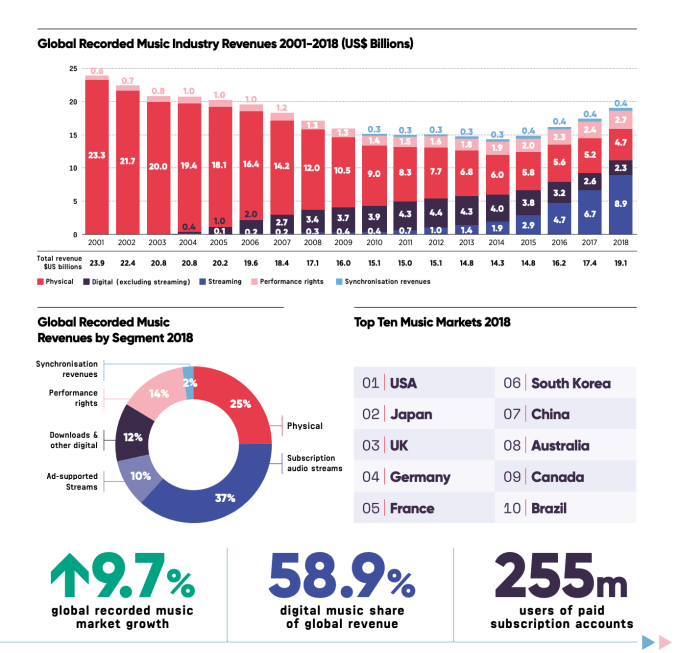
The scales are about to tip in favor of streaming music becoming the number one driver of global recorded music revenues – a shift that appears to be on track for sometime this year. According to a new industry report, global recorded music revenues jumped 9.7 percent in 2018 to reach $19.1 billion – up from $17.4 billion in 2017. Streaming music revenues, in particular, now account for nearly half (47%) of global revenue, thanks to a sizable 32.9 percent jump in paid streaming last year. This brought streaming revenues to $8.9 million in 2018, and puts them on track for a further jump in 2019.

This is the fourth consecutive year of growth for the global music market, and the highest rate of growth since IFPI – the music industry trade group behind the new report – first started tracking the market in 1997.

Paid streaming accounted for the majority of streaming’s contribution to revenues, with a 37 percent share of the market versus ad-supported streaming’s 10 percent share.

At year-end, there were 255 million users of paid subscription streaming accounts, the report found.

Meanwhile, physical disks dropped 10.1 percent over the past year, to account for 24.7 percent of revenues. Within that segment, vinyl is still growing – it posted its 13th consecutive year of growth, to reach a 3.6 share of the market. But it couldn’t make up for the fact that physical format revenue, overall, still declined.
As consumers drop physical disks, they continued to turn to digital.

Digital revenues grew by 21.1 percent in 2018 to reach $11.2 billion – which represents the first time they’ve crossed the $10 billion mark, the report noted. Within this category, streaming grew by 34 percent to reach $8.9 billion (~$7 billion was paid subscription streaming), while downloads declined 21.2 percent to 7.7 percent of the market.

In 38 markets, digital makes up more than half of revenues, the report said.

Revenues from performance rights and synchronization revenue (the use of music in TV, movies, games and ads), represented a 14 percent and 2.3 percent share of the total music market, respectively.

North America, in particular, posted another year of double-digit revenue growth with a 14 percent jump, with strong streaming growth (33.4%) offsetting the physical revenue declines (-22%).

Asia and Australia overtook Europe to become the second largest global region for revenues with 11.7 percent growth. And Latin America was the fastest growing region with 16.8 percent growth.

In order, the top markets by revenue were: the U.S., Japan, the U.K., Germany, France, South Korea, China, Australia, Canada, and Brazil.

 

02 Apr 2019

Anaxi launches feeds to help developers manage their notifications

Anaxi, the software development tool that helps developers get a better view of their projects in Jira and GitHub, is launching a small but nifty addition to its iOS and web apps today that allows developers to cut down on the steady stream of notifications and updates those services create.

The company, which was founded by former Apple engineering manager and Docker EVP of product development Marc Verstaen and former CodinGame CEO John Lafleur, rightly argues that tools like GitHub and Jira weren’t really made for personal productivity. Developers waste a lot of time going through updates and tickets in Jira, for example, some of which may be relevant and timely, while others are only distractions. In the end, you end up constantly switching context from ticket to ticket, which tend to be grouped in chronological order, and you may still miss important information.

Anaxi also argues that having a Slackbot constantly emit notifications for every new event only creates more distractions. “As a result, more and more developers turn off those notifications to avoid interruptions,” the team writes. “But then, you’re back to square one with all notifications being in chronological order.”

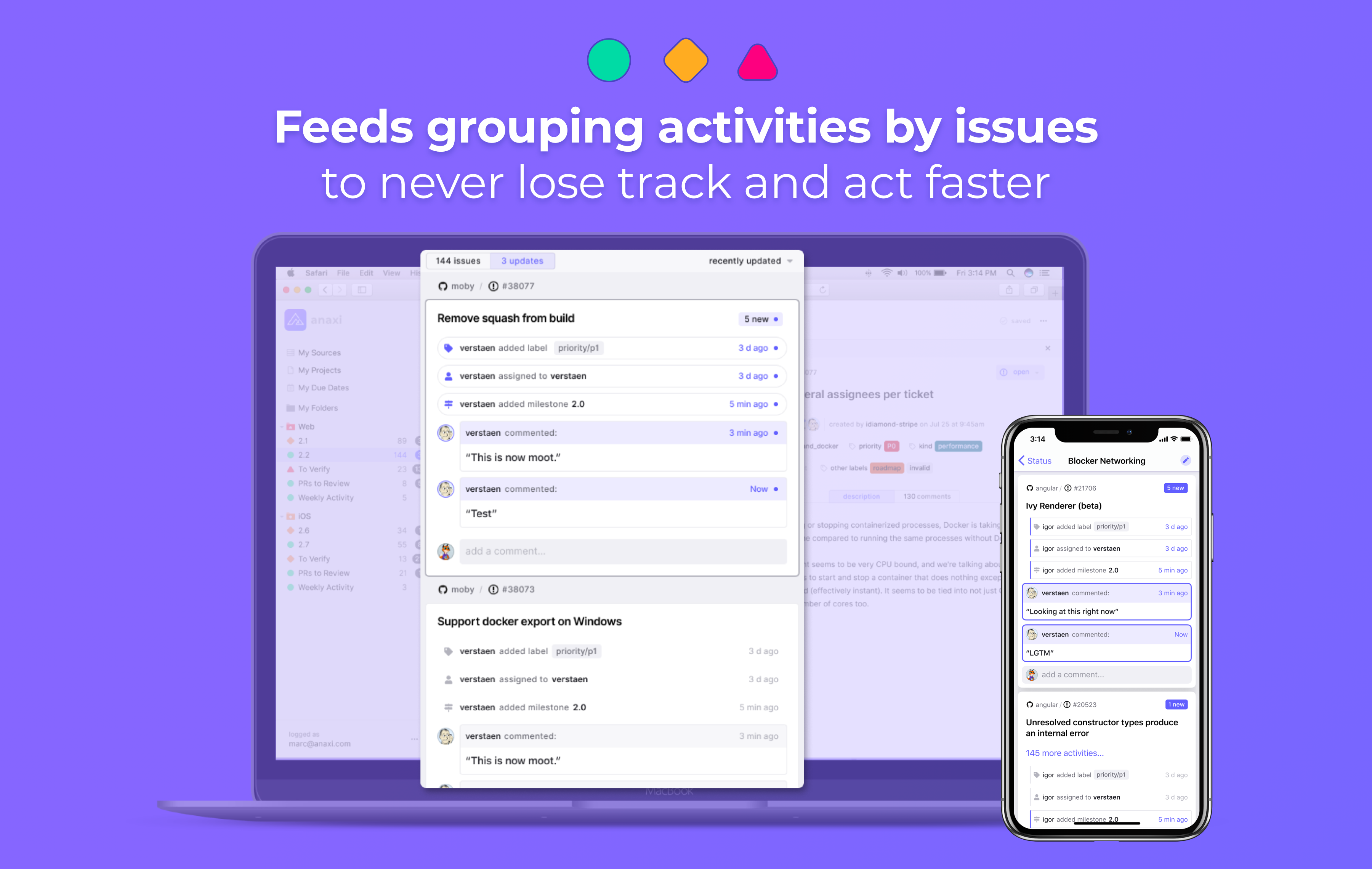
The way the team is trying to bring more clarity into this process is through feeds. The idea here is to allow developers to create dedicated feeds for whatever they need to focus on — maybe that’s a sprint or a single component of an app they are working on. That way, whatever you are looking at in Anaxi is relevant to your work because you can create filters based on issue, priority, status and any other label you want to track. From inside Anaxi, you can then also comment on tickets.

Anaxi first launched last September. At the time, it was an iOS-only service, but the team has since launched a web client, too. While the service does cache some data locally, no information is ever shared with Anaxi itself. Instead, the service pulls its data directly from the services it supports. The team is considering some server-side features, though, to maybe use machine learning to prioritize tickets or perform other more advanced analytics. As Verstaen and Lafleur tell me, though, this will be very transparent to users — and is also still a while out. In the near future, the team is more focused on adding support for GitHub Enterprise users and Jira Server, which will open up the service to more enterprise users.

02 Apr 2019

WordPress says iOS app bug exposed account tokens to third-parties

WordPress said it’s fixed a bug in its iOS app that inadvertently exposed account tokens to third-party sites.

In an email to customers seen by TechCrunch, the content management giant said it “uncovered an issue with the WordPress iOS application with how it handles security credentials.” The company has disconnected affected accounts from the app “as a precaution.”

Although no usernames and passwords were involved, the app in some cases inadvertently sent sensitive account tokens to third-parties.

These account tokens are small bits of code that allow you to stay logged into an app or service without having to enter your password every time. But if leaked or stolen, an account token can give anyone access to your account without needing your password.

After reaching out to Automattic, the company’s parent, we’ve gained some additional clarity. In short, the bug was found in how images were fetched from private WordPress sites hosting images by other sites. If a private WordPress site had a post or a page with an image hosted on Flickr, for example, the app would send along a WordPress account token to Flickr when fetching the image.

That’s not how it’s meant to work. That meant account tokens could appear in the logs of third-party companies, which could expose unscrupulous individuals to target WordPress accounts. That said, the risk to accounts is minimal and users shouldn’t be overly worried. For peace of mind, you can change your WordPress password which should refresh and rotate your account tokens.

“Our engineers discovered this bug in the iOS app and we have no indication it was ever exploited,” said a WordPress spokesperson in an email to TechCrunch. “The first affected version was released in January 2017, and version 11.9.1 released on March 15, 2019 fixed the issue.”

WordPress didn’t immediately say how many customers were affected, only that it emailed all WordPress iOS users with private sites to reset their account tokens. The company’s Android app was not affected.

Users should update their app as soon as possible.

02 Apr 2019

Arizona Beverages knocked offline by ransomware attack

Arizona Beverages, one of the largest beverage suppliers in the U.S., is recovering after a massive ransomware attack last month, TechCrunch has learned.

The company, famous for its iced tea beverages, is still rebuilding its network almost two weeks after the attack hit, wiping hundreds of Windows computers and servers and effectively shutting down sales operations for days until incident response was called in, according to a person familiar with the matter.

More than 200 servers and networked computers displayed the same message: “Your network was hacked and encrypted.”

Notices posted around the office told staff to hand in their laptops to IT staff. “Do not power on, copy files, or connect to any network,” read the posters. “Your laptop may be compromised.”

It took the company another five days before the company brought in incident responders to handle the outbreak, the source said. Many of the back-end servers were running old and outdated Windows operating systems that are no longer supported. Most hadn’t received security patches in years.

The source said they were “surprised” an attack hadn’t come sooner given the age of their systems.

A day after the attack hit, staff found the backup system wasn’t configured properly and were unable to retrieve the data for days until the company signed an expensive contract to bring in Cisco incident responders. A spokesperson for Cisco did not immediately comment. The company’s IT staff had to effectively rebuild the entire network from scratch. Since the outbreak, the company has spent “hundreds of thousands” on new hardware, software and recovery costs.

“Once the backups didn’t work, they started throwing money at the problem,” the person said.

The ransomware infection, understood to be iEncrypt (known as BitPaymer) per a screenshot seen by TechCrunch, was triggered overnight on March 21, weeks after the FBI contacted Arizona to warn of an apparent Dridex malware infection. The FBI declined to comment, but the source said incident responders believed Arizona’s systems had been compromised for at least a couple of months.

The ransom note asked to email the attacker “to get the ransom amount.” There’s no known decryption tool for iEncrypt.

Dridex is delivered through a malicious email attachment. Once the implant installs, the attacker can gain near-unfettered access to the entire network and can steal passwords, monitor network traffic and deliver additional malware. With help from international partners, the FBI took down the password-stealing botnet in 2015, but the malware continues to pose a threat. More recently, Dridex has been used to deliver ransomware to victims.

Kaspersky said two years after the takedown that the malware is “still armed and dangerous.”

Incident responders seem to believe Arizona’s earlier Dridex compromise may have led to the subsequent ransomware infection.

“Initially, Dridex was used to steal credentials to enable wire fraud, but since 2017 it is more commonly observed running more targeted and higher value operations,” said Adam Meyers, vice president of intelligence at security firm CrowdStrike. He said the company has “observed this malware being used to deploy enterprise ransomware, which we call ‘Big Game Hunting.’ ”

The ransomware also infected the company’s Windows-powered Exchange server, knocking out email across the entire company. Although its Unix systems were unaffected, the ransomware outbreak left the company without any computers able to process customer orders for almost a week. Staff began processing orders manually several days into the outage.

“We were losing millions of dollars a day in sales,” the source said. “It was a complete shitshow.”

The company still has a ways to recover from the ransomware attack. The source put the figure at “about 60 percent up-and-running,” but the company’s security awareness has improved.

A spokesperson for Arizona Beverages did not respond to an email requesting comment. Phone lines to the company did not appear to be functioning. We sent several messages to senior executives via LinkedIn prior to publication but did not hear back.

It’s the latest in an uptick in high-profile ransomware events in recent weeks.

Last year, German manufacturer KrausMaffei was also said to be hit on November 21 by the same iEncrypt ransomware, based off a leaked screenshot of the ransom note. Similar initial ransomware infections have been connected to later ransomware attacks. Trend Micro said in December that Dridex and other malware families like Emotet were linked. Weeks before Arizona’s outbreak, a local Georgia county was hit by a similar ransomware attack.

02 Apr 2019

eBay to shut down the eBay Commerce Network, its third-party ad network, on May 1

As eBay continues to restructure its business, it’s shuttering one of the efforts it had made to expand its commercial footprint outside its own marketplace and walled garden. The company announced today that on May 1 it will be shutting down the eBay Commerce Network — a network that it ran across some 2,000 publishers for merchants to advertise products that matched content people browse on those third-party sites — as it puts more of an emphasis on some of its other advertising efforts, namely affiliate marketing and advertising on eBay itself.

“Thank you for your partnership with eBay Commerce Network,” the company said in a statement. “We’ve been proud to see our platform evolve over the past two decades. We want to continue providing customers with the best possible selling and buying experience. As a result, we are focusing on business that complements our core marketplace and discontinuing eBay Commerce Network effective May 1st, 2019. We are committed to enhancing our advertising portfolio throughout 2019 and hope you consider exploring our advanced core advertising and affiliate marketing opportunities.”

The company explained in a Q&A that it will be issuing refunds to merchants who had any balance remaining in their accounts, as well as paying out any balances to publishers, from the middle of May. There are also other products that will stay online and eBay is also suggesting them as alternatives. They include Promoted Listings and, for publishers, the eBay Partner Network, which covers 1 billion+ listings on eBay.

eBay Commerce Network first emerged in 2013, as a rebrand of Shopping.com, a comparison shopping site it bought back in 2005 for $620 million. In 2013, adtech had started to take off as a big growth area, and with Shopping.com having diversified into building a network for third-party sites, eBay saw an opportunity to double down on it.

For now, it looks like Shopping.com will remain online, although we are catching up with eBay later and will update this post with more details as we learn them.

There are many ways that retailers can target would-be shoppers online these days after they’d indicated an interest in a particular product — from Google Shopping, to retargeting networks and more. Collectively the scale of these operations can be vast. In that regard, the eBay Commerce Network, which Ecwid estimated gives “access” to 250 million consumers globally through operations in France, Germany, United Kingdom, Australia and USA was a relatively modest effort.

It was also built around the use of third-party data — collected from outside eBay — and eBay has in the recent years made a bigger strategic shift from third-party to first-party data.

(That’s something that others have also done, although for different reasons: Facebook last year discontinued Partner Categories, a third-party data-based ad targeting service, in the wake of the Cambridge Analytica scandal.)

We have reached out to eBay and will update this post as we learn more.

02 Apr 2019

Home buying and selling platform Perch raises $220M in debt and equity

Perch, a home-buying and selling platform, has raised $220 million in a combination of equity ($20M) to fund operations and debt ($200M) to finance home purchasing. The equity investment was led by existing investors FirstMark Capital, with participation from Accomplice and Juxtapose. Perch declined to disclose the debt lender in the deal.

Perch was founded in September of 2017 by Court Cunningham and Phil DeGisi.

The premise of Perch is to focus on the largest segment of home buyers on the market, which Perch calls “dual trackers.” These buyers are also in the process of selling their current home at the same time.

This is a generally difficult and taxing process that forces people to choose between the uncertainty of a huge investment without having sold their current home or moving into a short-term rental indefinitely until they find the right new home. The alternative is to make an offer to purchase the new home contingent upon the sale of their current home, which tends to be an unattractive proposition for sellers, according to Perch.

Perch solves this for clients by making an offer on their homes that is valid for six months, and then helping them to find a new home. Perch also conducts the closing on both homes in the same day.

There is a certain amount of risk associated with this business model considering the fluctuation of the housing market, but that doesn’t seem to be an issue for investors of Perch or their competition. Looking at the way it works now, however, it’s hard to imagine that tech won’t have gotten a strong foothold within the real estate industry over the next few decades.

Which explains the huge influx of cash going to companies the industry calls “iBuyers,” such as RedFin, Zillow, Opendoor, and OfferPad. Opendoor recently filed to raise $200 million at a $3.7 billion valuation in February, while OfferPad closed a Series C that brings total equity and debt raised to $975 million.

Perch, however, doesn’t consider itself an iBuyer.

“An iBuyer will buy your house for you at a certain price in an easy and convenient transaction,” said cofounder and CEO Court Cunningham, referencing the offerings of Perch’s competition. “It adds a lot of value, but that’s a feature of a complete offering, not the offering in and of itself.”

In short, Perch wants to tie together the three branches of home buying and selling — closing, title, and mortgage — for the 60 percent of the market comprised by “dual trackers.”

For now, Perch is squared away on the closing and title portion of the process, offering e-closing and e-notary to let users complete the transaction from the comfort of their own home. The company plans to offer its own mortgage brokerage service to customers at some point this year, and though it’s not on the roadmap anytime soon, Cunningham said he isn’t closed off to the idea of Perch becoming an underwriter somewhere down the line.

Not only will mortgages add a new revenue stream for Perch, but Cunningham sees the convenience of having everything in one place as a huge opportunity for customer acquisition.

02 Apr 2019

Streaming service Quibi snags Snap and Pandora vet Tom Conrad as Chief Product Officer

Jeffrey Katzenberg’s upcoming mobile streaming service Quibi had added another notable name to its roster of executive talent. The company announced it has hired Tom Conrad, previously VP of product at Snap (maker of Snapchat), and a co-creator of Pandora, where he served at Chief Technology Officer. At Quibi, Conrad will be Chief Product Officer, which will see him leading product, user research and customer support.

The news of Conrad’s hire was first reported by Variety on Monday, which also noted Conrad had served on Quibi’s board since late 2018 and was officially hired as CPO on March 25. He will report to Quibi CEO Meg Whitman in his new role.

Conrad will play a big part in Quibi’s success (or lack thereof, if it doesn’t fare well!), as a significant aspect to the service is to be the app’s mobile design. Unlike modern streaming services like Netflix, Quibi aims to offer short-form, high-quality video cut into smaller pieces for easy consumption on a smartphone. At this year’s SXSW, Whitman explained the Quibi advantage noting how the technology it’s using will allow the company to do “full-screen video seamlessly from landscape to portrait.”

At Quibi, Conrad’s understanding of streaming services, thanks to his time at Pandora, and apps favored by young users, thanks to his role at Snap, will surely come into play.

Conrad had left Snap in 2018 at a critical time for the popular social app. Its massive redesign had just rolled out, and was destroyed by early user reviews, with the majority giving the update 1 or 2 stars when it hit. The design was later rolled back. However, Snap CEO Evan Spiegel was the product decision maker – Conrad was more involved in terms of execution. That experience, however, may have given Conrad insight into what doesn’t work for the young Gen Z crowd, as much as what does.

The executive also spent a decade at Pandora, as CTO and EVP of Product, which saw him leading the teams that designed, developed and maintained the Pandora apps across platforms – including web, mobile, and other consumer electronics devices, as well as automotive. While Quibi is focused on being a mobile streaming app, it’s hard to imagine a streaming service that refuses to ever go cross-platform – especially since the majority of viewing of today’s streaming service viewing takes place on a television. (Even when it’s the streaming service from YouTube.)

With its billion-dollar backing from investors, Quibi has been able to snag several big names for its exec ranks, in addition to its CEO Meg Whitman, and now Conrad.

In March, the company said it landed top CAA agent Jim Toth (married to power producer Reese Witherspoon, by the way). Toth’s clients at CAA included Matthew McConaughey, Robert Downey Jr., Scarlett Johansson, Jamie Foxx, Zoe Saldana, Chris Evans, Salma Hayek, Zooey Deschanel and Neil Patrick Harris.

Quibi also hired former DC and Warner Bros. exec Diane Nelson to run operations. Nelson had served as president of DC Entertainment since 2009, and helped spearhead development of the DC Universe movies and shows.

In addition, the streaming service itself has already been signing big-name talent for its content, including Catherine Hardwicke, Antoine Fuqua, Guillermo del Toro, Sam Raimi and Lena Waithe. It’s also working with Steph Curry’s production company and most recently announced – awkward alert? – a show detailing Snapchat’s founding, focused on Evan Spiegel’s rise.

Image credit: Conrad, via Crunchbase

02 Apr 2019

Daily Crunch: Walmart partners with Google (again)

The Daily Crunch is TechCrunch’s roundup of our biggest and most important stories. If you’d like to get this delivered to your inbox every day at around 9am Pacific, you can subscribe here.

1. Walmart partners with Google on voice-enabled grocery shopping

Walmart is rolling out a new voice ordering capability, Walmart Voice Order, which works across Google Assistant-powered platforms, including Google’s smart speakers and displays, smartphones, smartwatches and more.

Two years ago, Walmart and Google partnered on voice-based shopping through Google Home devices. However, Walmart disappeared from Google Express’ marketplace this January, and was more recently said to be testing an online grocery voice application with a small number of VIP customers ahead of a spring launch.

2. Microsoft teams up with BMW for the IoT-focused Open Manufacturing Platform

The platform is supposed to encourage more collaborative IoT development in the manufacturing sector, focusing on smart factory solutions and building standards in areas like machine connectivity and on-premise systems integration.

3. Valve Index VR headset is launching on June 15

We thought we’d have to wait another few weeks to hear about Valve’s plans for its first virtual reality headset, but the company (accidentally?) seems to have let a few details and images slip regarding its high-powered contender to consumer VR headsets built by Oculus and HTC.

MIAMI, FL – MAY 10: A customer carries his Whole Foods Market bag as the company appointed five new directors to its board and replaced its chairman on May 10, 2017 in Miami, Florida. (Photo by Joe Raedle/Getty Images)

4. Amazon again slashes Whole Foods prices, doubles Prime member weekly deals

Walmart wasn’t the only grocery company to make news in the last 24 hours. With this wave of price cuts, produce is an area of specific focus, as Walmart lowers prices on seasonal items, including greens, tomatoes, tropical fruits and more.

5. Email client Spark lands on Android

Every time we’ve written about Spark, we get many comments asking when the app would be available on Android. The answer is today.

6. New book looks inside Apple’s legal fight with the FBI

The book, “Tim Cook: The Genius Who Took Apple to the Next Level” by Leander Kahney, offers a first-hand view from former staff about how Apple battled an unprecedented legal order demanding the company undermine the security of its flagship product.

7. Pokémon GO and the April Fools’ joke that made billions

This is Part 2 of our EC-1 series on Niantic, looking at its past, present and potential future. (Extra Crunch subscription required.)

02 Apr 2019

Expert Panel: What even IS “tech ethics”?

It’s been a pleasure, this past month, to launch a weekly series investigating issues in tech ethics, here at TechCrunch. As discussions around my first few pieces have taken off, I’ve noticed one question recurring in a number of different ways: what even IS “tech ethics”? I believe there’s lots of room for debate about what this growing field entails, and I hope that remains the case because we’re going to need multiple ethical perspectives on technologies that are changing billions of lives. That said, we need to at least attempt to define what we’re talking about, in order to have clearer public conversations about the ethics of technology.

Fortunately, I was recently able to gather a group of three whipsmart thinkers who are each emerging as leaders in the tech ethics field, and who each do “big-picture” work, looking at the (enormous) field as a whole rather than being limited to knowledge of a single narrow technology or sector. As you’ll see below, none of the three offers a one-size-fits-all definition of tech ethics, which is a good indicator of why their perspectives are particularly trustworthy. If you want to understand a field this big and this new, always look to the kind of thoughtful, introspective leaders you’ll find below, rather than settling for quick and easy answers.

Kathy Pham is a computer scientist, product leader and serial founder whose work has spanned Google, IBM, Harris Healthcare Solutions, and the federal government at the United States Digital Service at the White House, where she was a founding product and engineering member. As a Fellow at the Harvard Berkman Klein Center, Kathy co-leads the Ethical Tech Working Group and focuses on ethics and social responsibility with an emphasis on engineering culture, artificial intelligence, and computer science curricula. Kathy also is a Senior Fellow and Adjunct Faculty at the Harvard Kennedy School of Government.


Hilary Cohen, a former Program Strategist at the Obama Foundation and analyst at McKinsey & Company, is currently leading a new initiative on Ethics and Technology at Stanford University’s Center for Ethics in Society. She recently managed the process of creating a popular new, team-taught Stanford course, “Ethics, Public Policy, and Technological Change.”


Jessica Baron holds a Ph.D. in History and Philosophy of Science and is a prolific and widely read freelance writer and educator on the ethics of technology, among other issues. I am a big fan of her regular tech ethics writing, for Forbes.


When ethics and tech collide

Greg Epstein: Thank you all so much for joining me. I have been really looking forward to this conversation, because I find myself after a year of somewhat immersing myself in the subject, still trying to figure out exactly what tech ethics actually is.

02 Apr 2019

Densify announces new tool to optimize container management in the cloud

Densify, a Toronto company that helps customers optimize their cloud resources to control usage and spending, announced a new tool today specifically designed to optimize container usage in the cloud.

Company CEO Gerry Smith, says that as containerization proliferates, it’s getting more difficult to track and control cloud infrastructure resource usage as software development and deployment happens with increasing speed.

“The whole basis upon which people buy and use cloud and container resources has become wildly expensive because of the lack of a resource management system,” Smith said.

The Densify solution looks at the consumption and for ways to cut costs and usage. “We have analytics in the cloud, any of various common cloud services that you can connect to, and then we use machine learning to analyze the resources and your cloud and container consumption,” he said.

Densify continuously make recommendations on how to make better use of resources and to find the cheapest computing, whether that’s reserved instances, spot instances or other discounted cloud resources.

What’s more, it can help you identify whether you are providing too few resources to accommodate the number of containers you are deploying, as well as too many.

This may sound a bit like what Spotinst and Cloudyn, the company Microsoft bought a couple of years ago, do in terms of helping control costs in the cloud, but Smith says, for his company it’s more about understanding the resources than pure cost.

“We look at ourselves as a resource management platform. So what we do is characterize the applications, demands of CPU and all the other resources, and use machine learning to predict what it’s going to need at any any given minute, at any given day of a week of the year, so that we can then better predictively match the right supply,” Smith explained.

It’s providing information about each container at a highly detailed level including “what’s running, what resources are being allocated, and the true utilization of an organization’s Kubernetes environment at a cluster, namespace and container level,” according to the company. All of this information should help DevOps teams better understand the resources required by their container deployments.

The company has actually been around since 2006 under the name Cirba. In its early guise it helped companies manage VMware installations. In 2016, it pivoted to cloud resource management and changed the company name to Densify. It has raised around $60 million since inception, with about half of that coming after the company changed to Densify in 2016.

The company is based in Toronto, but has offices in London and Melbourne as well