Category: UNCATEGORIZED

02 Apr 2019

Beating back bears, Bitcoin briefly balloons beyond $4,900

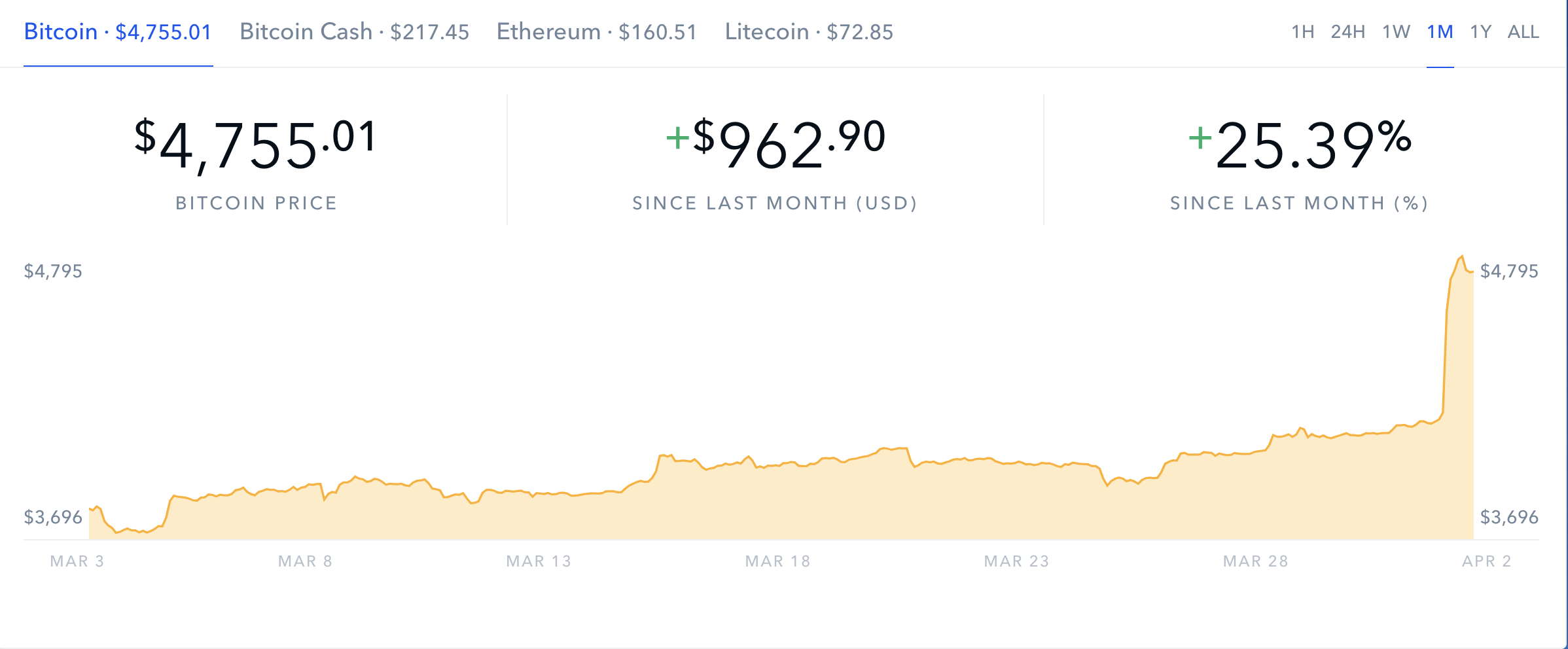
Bitcoin went on a tear in early morning trading earlier today, popping up to above $4,900 and reminding some investors of the good old days of 2017.

The currency is still trading up above 15% at $4,782.60, which is a healthy jump for the cryptocurrency (which had languishing at around $4,000 for the past three months). Indeed the price was up over 25% over the previous month, according to Coinbase .

Bitcoin’s surge also sent the other top cryptocurrencies, including Ethereum and Litecoin soaring.

No one can quite pin down the reason for the currency’s surge, given the string of bad news that has unspooled around the cryptocurrency business in the past few weeks.

Despite an April Fool’s Day article to the contrary, the Securities and Exchange Commission still has not approved an exchange traded fund that would track to the cryptocurrency. And one of the big public offerings which was supposed to showcase the strength of the market seems to be shelved as Bitmain has not renewed its application for a public listing on the Hong Kong Stock Exchange.

One analyst had a simple reason for the Bitcoin price surge, a big, $100 million order for the cryptocurrency that was placed overnight and spread across the U.S. exchanges Coinbase and Kraken and Luxembourg’s Bitstamp .

“There has been a single order that has been algorithmically-managed across these three venues, of around 20,000 BTC,” Oliver von Landsberg-Sadie, chief executive of cryptocurrency firm BCB Group, told Reuters in an interview.

02 Apr 2019

Brain Corp debuts an autonomous delivery robot for factories and retail

Admittedly, Brain Corp. sounds a bit like an evil corporation in some superhero comic, but the San Diego-based startup has generated some serious funding in recent years, including a $114 million Series C, led by Soft Bank back in 2017.

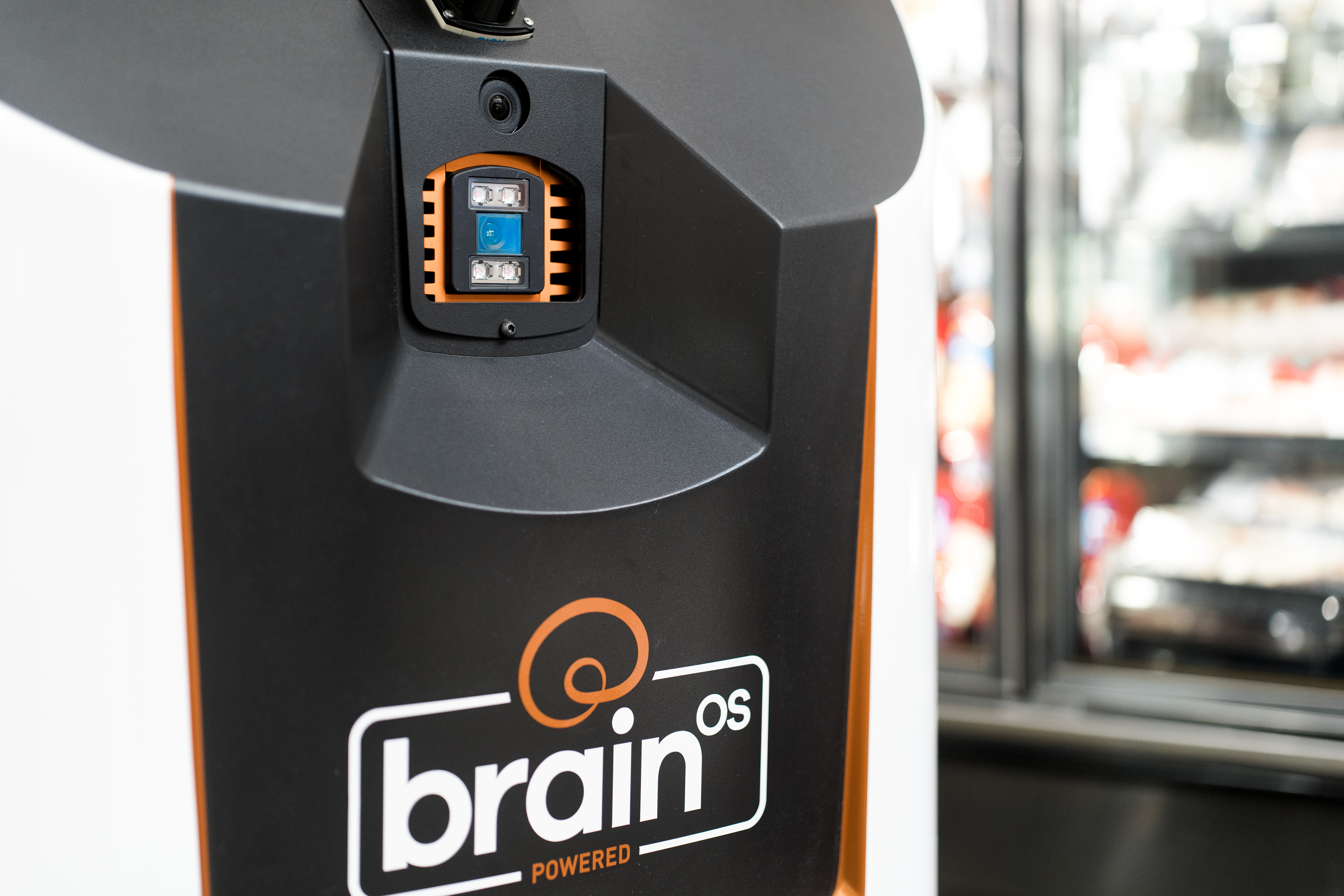
The company’s been putting that money to work, announcing today the launch of an in-store autonomous delivery robot. AutoDelivery, which is currently still “proof of concept” is built on the startup’s own BrainOS navigation platform, which is currently powering products from a number of companies, including Tennant, Minuteman, ICE, Nilfisk and SoftBank Robotics.

Brain Corp.’s system is an interesting one designed to fulfill a fairly wide range of case uses, from stores, to factories and warehouses. That could mean everything from inventory stocking to delivery fulfillment. It’s a massive business and one positioned to get even larger in coming years, with products from Amazon Robotics and Fetch to Playground Ventures-supported Canvas, which offers up a similarly autonomous robot for factory settings.

Heck, even Boston Dynamics is getting in on the space these days, with its recent acquisition of Kinema Systems.

The Brain Corp system appears to have some of the competition beat with its ability to tow carts, which could make it useful in a retail setting like the one in the above video. It also sports a touch screen, so employees can input directions directly, forming a different relationship with human employees than products like Bossa Nova’s inventory checking robot.

The robot is still early stages, making its debut at next week’s ProMat show in Chicago. The company expects a commercial launch early next year.

02 Apr 2019

Mobileye CEO Amnon Shashua at TC Sessions: Mobility on July 10

Mobileye, the Israeli-based automotive sensor company acquired by Intel in 2017for $15.3 billion, is one of the companies at the center of the emerging world of autonomous vehicle technology.

We’re excited to announce co-founder, president and CEO of Mobileye Amnon Shashua — who also is a senior vice president at Intel — will participate in TechCrunch’s inaugural TC Sessions: Mobility, a one-day event on July 10, 2019 in San Jose, Calif., that is centered around the future of mobility and transportation.

Shashua, who holds the Sachs chair in computer science at the Hebrew University of Jerusalem, co-founded Mobileye in 1999. He has published more than 120 papers in the field of machine learning and computational vision, holds more than 45 patents, and has founded three startups in the fields of computer vision and machine learning in his career.

Mobileye’s vision chips and software interprets data from a camera to anticipate possible collisions with cars, people, and other objects. These computer vision chips, which are in advanced driver assistance systems (ADAS), are used by at least two dozen automakers, including Audi and BMW. Today, more than 30 million vehicles have Mobileye technology.

These days, Mobileye is working on more than just ADAS. The company plans to launch an autonomous vehicle platform in 2021.

Shashua’s vision for the company and future cities also includes using Mobileye sensors for mapping as well. In his view, using maps can improve operations between businesses and cities, which will in turn, help bring us closer to the realization of smart cities and safer roads.

The company announced at CES 2019 that it reached an agreement with Ordnance Survey to help the U.K. mapping agency bring high-precision location data to businesses in the country. Under the agreement, Mobileye’s sensors will be retrofitted onto Ordnance’s utility fleets to collect volumes of location data on road networks and roadside infrastructure. The collected data is then cross-referenced with existing geospatial data sets to develop accurate maps of Britain’s roads and surrounding areas.

TC Sessions: Mobility will present a day of programming with the best and brightest founders, investors and technologists who are determined to inventing a future Henry Ford might never have imagined. In case you missed it, Nuro  co-founder and CEO Dave Ferguson was our first announced guest for TC Sessions: Mobility.

TC Sessions: Mobility aims to do more than highlight the next new thing. We’ll dig into the how and why, the cost and impact to cities, people and companies, as well as the numerous challenges that lie along the way, from technological and regulatory to capital and consumer pressures.

Early-Bird tickets are now on sale — save $100 on tickets before prices go up.

Students, you can grab your tickets for just $45.

02 Apr 2019

How Japan’s new imperial era broke the internet in a very tiny way

Emperor Akihito of Japan is abdicating and passing the office to his son, Crown Prince Naruhito, and as part of the transition comes a new gengo, or era name: “Reiwa.” It’s loaded with meaning and subtext, but because of the way text is sent and displayed over the internet, the name can’t really be displayed properly. Unicode has issued an update making it possible, but for now there’s just no character representing it.

Now, to be clear, you can definitely type out the kanji for it, 令和, and that’s totally fine (though there are some technical hiccups there too). But gengo get combined single characters for certain situations and contexts. For comparison, the current (soon to be former) era, Heisei, can be written 平成 but has a combined-character name as well: ㍻. Sure, it’s just the two pieces squished together, but they’re squished together in an important, official way.

Without getting too deep into the history or politics of Japanese imperium, the country has a sort of internal calendar with eras corresponding to the (largely symbolic) rule of a given emperor. It’s a big deal, used in official documents and such, but also shorthand for referring to an era — “oh, that was in Heisei year 10” or the like, the way we might say, “the last year of the Clinton presidency.” I’m probably doing it wrong, but you get the idea.

The interesting part about this practice — well, there are many interesting parts, but the most interesting for our purposes today — is that these gengo are all essentially invented from scratch. And because of the nature of how the Japanese language is written, that means that there’s essentially no way to display the name properly online!

Unicode is basically a big (around 120,000 entries long) set of codes that correspond to the actual letters and images we want to type or send. So when I write “Hey! ?” you see the same thing on your end that I see on my end. But how can there be a symbol for something that’s kept secret until its official debut, and which is assembled from parts of other Japanese words into a single brand-new character? It’s a bit like announcing they were adding a new letter to the alphabet.
This is the first time an era change has occurred in the modern computing era, so there isn’t really any precedent, as the organization noted last year in anticipation of the event. The only thing Unicode is really able to do is reserve the space for the incoming character and give it a placeholder graphic showing its code: ㋿. (What you see in the box, assuming you view this before the character is added, is “32FF,” part of the code.)

In a way that’s all Unicode needs to do; it’s now up to designers to put together the actual character as it will be displayed in their font. And those updates will have to go out to servers and devices individually. But that can’t be done instantly, of course — and in the meantime any headline online with the new name in it by definition can’t show it! It’s a fascinating little quandary.

As for the name itself, it has produced some tumult as people argue over the linguistic and literary subtext; the intricacies of the Japanese script and the history of the syllables and how they are represented make a variety of interpretations possible, with different political and philosophical connotations. Nick Kapur’s breakdown is the best I’ve seen, getting to the heart of what makes Reiwa uniquely difficult to translate yet setting out the meanings clearly.

It’s a unique challenge in many ways and one for which the internet is uniquely unsuited. Soon we’ll have the character and any slight inconvenience created by the delay between announcement and the ability to properly display it will be forgotten, but it’s always interesting when the world throws a curveball at systems we take for granted.

Hopefully we’ll have everything tidied up by the time the Reiwa era officially begins on May 1.

02 Apr 2019

RIP Google+

That’s it for Google+, Google’s failed social network that once tried to take on Facebook and Twitter. As scheduled, the company has now started deleting user accounts and their data.

Chances are, you’re not going to feel all that sad about the end of Google+ since you probably haven’t used it for years. But if you’re feeling a bit nostalgic, here’s a little chronology of some of our coverage over the years.

2011

2012

2013

2014

2015

2016

2018

02 Apr 2019

DOJ reportedly warns Academy about changing Oscar rules to exclude streaming

It seems that the Department of Justice has thoughts on whether Netflix movies should be eligible for Oscars.

Variety reports that the DOJ has sent the Academy of Motion Picture Arts and Sciences a letter expressing concern about potential changes to the eligibility requirements for the awards.

Why is this something the DOJ would worry about? Apparently the letter says, “In the event that the Academy — an association that includes multiple competitors in its membership — establishes certain eligibility requirements for the Oscars that eliminate competition without procompetitive justification, such conduct may raise antitrust concerns.”

This comes after Netflix’s “Roma” was seen as a frontrunner for this year’s Best Picture award. And although it ultimately lost out to “Green Book,” the movie still took home Oscars for Best Director, Best Foreign Language Film and Best Cinematography.

Director Steven Spielberg is reportedly pushing for changes to the Oscar rules, perhaps by creating a requirement that movies play exclusively in theaters for four weeks in order if they want to be eligible.

Spielberg hasn’t said anything publicly about these reports, and movie executive Jeffrey Katzenberg claimed that Spielberg told him, “I absolutely did not say that.” But it’s spurred a broader discussion about Netflix’s impact on the film business, and seems to have prompted Netflix to declare in a tweet, “We love cinema” — while also highlighting some of the ways the service makes movies more accessible.

Variety says the Academy confirmed that it has received a letter. Its Board of Governors will hold its annual award rules meeting on April 23.

We’ve reached out to the DOJ and the Academy for comment and will update if we hear back.

02 Apr 2019

Twitter now lets users appeal violations within its app

Twitter today announced a new feature that will allow users to appeal a tweet that’s in violation of Twitter’s rules directly within the Twitter app. When users post content in violation of Twitter’s guidelines, that tweet can be flagged or reported, resulting in an account suspension or lockout. Before, users would have to visit an online form to appeal Twitter’s decision.

Accounts can be suspended for a range of activity including spam, being a fake account, security risks (like hacked accounts), and abusive tweets or behavior such as sending threats or impersonating other accounts. (The latter which Twitter itself recently did as a joke. Ha ha ha. How hilarious to send 2FA codes over DM!)

Now, instead of having to locate the online form to start an appeal, users can instead choose to appeal the tweet in violation from within the Twitter app itself.

Twitter claims it’s now able to get back to people 60 percent faster, as a result.

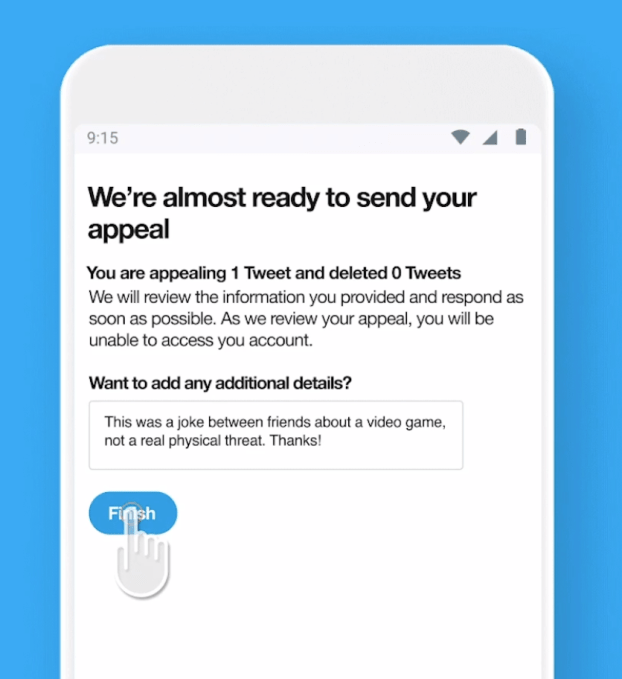
The new process involves Twitter displaying the tweet in violation and the reason why it determined the tweet broke its rules, along with a description of the rule in question and a link to the policy. On the next screen, users can either choose to remove the tweet that violates Twitter’s rules or they can appeal the violation.

Of course, an appeal doesn’t immediately restore access to your Twitter account, if suspended – you’ll still have to wait for Twitter’s ruling. If that goes on for too long, you can return to cancel the appeal and just delete the tweet instead at any time to regain access to your account.

But if you proceed to appeal the tweet, you can explain why the tweet was mistakenly flagged.

In an example Twitter showed off today, a user posted what appeared to be a violent threat but was really just an inside joke about a video game, they explained.

The addition is a small change to the larger and much more complex process of handling the tweets that are in violation of Twitter’s rules. That’s an area where Twitter has been heavily criticized as it has been unable to get a handle on rampant harassment and abuse despite evolving its rules and policies to cover a range of bad behavior.

In an effort to better explain its decisions, the company recently said it will develop new ways to label tweets that violated its abuse terms, so those who come across them have a better understanding of the context when those tweets aren’t taken down. For example, tweets posted by public figures that aren’t direct violent threats – but are in “the public interest” –  might remain, but be labeled.

Twitter also changed the way it displayed reported tweets, so people could understand why enforcement actions had been taken.

And it’s working on more dramatic changes to its app – like giving users the ability to hide the @replies they don’t like.

02 Apr 2019

How to handle dark data compliance risk at your company

Slack and other consumer-grade productivity tools have been taking off in workplaces large and small — and data governance hasn’t caught up.

Whether it’s litigation, compliance with regulations like GDPR, or concerns about data breaches, legal teams need to account for new types of employee communication. And that’s hard when work is happening across the latest messaging apps and SaaS products, which make data searchability and accessibility more complex.

Here’s a quick look at the problem, followed by our suggestions for best practices at your company.

Problems

The increasing frequency of reported data breaches and expanding jurisdiction of new privacy laws are prompting conversations about dark data and risks at companies of all sizes, even small startups. Data risk discussions necessarily include the risk of a data breach, as well as preservation of data. Just two weeks ago it was reported that Jared Kushner used WhatsApp for official communications and screenshots of those messages for preservation, which commentators say complies with recordkeeping laws but raises questions about potential admissibility as evidence.

02 Apr 2019

Boston Dynamics acquires a 3D vision startup in bid to put its robots to work

Last week’s Handle video was different than past Boston Dynamics releases. Sure, it showcased the same sort of impressive robotics that have made every video from the company a viral hit, but this one took a very different approach than other recent releases: It put the robot to work.

There were some clear aesthetic differences: the robot appeared a bit larger, and its two arms were swapped out for a single, overhead limb with several suction cups attached. The key differentiator, however, was a relatively mundane setting, in which Handle was moving boxes on and off of pallets and conveyor belts.

Now we’ve got a little more insight into why the company was showcasing its latest creation in a warehouse setting. Today Boston Dynamics announced its first major acquisition: a Bay Area-based startup called Kinema Systems. The company develops 3D imagine solutions for pick-and-place logistics.

The acquisition is telling. Over the last few years, Boston Dynamics was acquired by Alphabet and then sold to SoftBank. Somewhere along the way, it seems clear that the idea of monetization was impressed upon it.

“I think Google planted the seed,” CEO Marc Raibert tells TechCrunch. “And all of the other robotics companies near us were much more focused on applications and product than we were. So we’ve been turning that corner. It’s been a consistent thing. It’s not like we got to SoftBank and they hit us with a hammer and suddenly said, ‘make products.’ They’ve been extremely enthusiastic about our R&D work, too. It feels good to do both.”

Boston Dynamics will take a two-pronged approach, moving forward. The company will continue to push the boundaries of what robotics can do, with products like Atlas, while it looks for real-world applications for other products, including Handle and SpotMini, which it announced last year at TechCrunch’s Robotics event it would begin to commercialize. That product, it seems, is still due out in 2019.

Unlike many other startups in the robotics category, however, Kinema has actually had a product on the market. Kinema describes the Pick as “the world’s first Deep-learning 3D Vision systems for industrial robots.” Notably, the Pick’s suction cup-sporting arm bears more than a passing resemblance to the Handle’s newly redesigned limb.

As part of the deal, the robotic arm is being rebranded as the Boston Dynamics Pick System, as seen in the above video. The company will continue to sell and support the system, meaning that it officially beats the Spot Mini to market at Boston Dynamics’ first commercialized product. The addition of a redesigned Handle appears to find Boston Dynamics looking to build out a logistics ecosystem, something that has the potential to compete with warehouse robotics companies like Fetch or even Amazon Robotics. 

“One of the things that’s exciting about the Kinema acquisition is that they’ve already been in the product environment that’s very specific to warehouses and logistics,” Michael Perry, Boston Dynamics’ VP of Business Development tells TechCrunch. “They’ve already been through the process of figuring out what are some of the site-specific issues we need to incorporate into our design. Everything from comms to perception to safety. All of these different factors are now filtering into the design of the robot.”

Kinema’s technology will be utilized for Handle to start. Raibert notes that the wheeled robot is the closest Boston Dynamics has come thus far to developing a purpose-driven commercial robot from the ground up.

“We did a first design of Handle where we were doing what we always do,” says Raibert. “We were trying out a new form and seeing what we can make it do. We were excited because it was so dynamic. But it was really a no-application-in-mind exploration. But then, after we had it and started to think about it, it clearly dovetailed with some logistics thinking we’d been doing. And we did redesign it after that with logistics in mind.”

Another key thing Kinema brings to the table is location. The company’s Mountain View location will serve as Boston Dynamics’ first West Coast offices. “Through this [acquisition],” Perry adds, “we’ll be establishing our presence in the Bay Area for hiring a wide variety of hardware and software specialists.”

02 Apr 2019

Google’s anti-trans controversy is the latest case of big tech overcorrecting to the right

Google just smoothed over one spat with the LGBT community, but it’s already well into the next one.

Last week, in an effort to monitor the ethical development of artificial intelligence and presumably to assuage public concern, Google launched an eight person advisory group dedicated to the task.

Controversially, Google included Heritage Foundation President Kay Cole James among the technologists and domain specialists on its newly-minted Advanced Technology External Advisory Council (ATEAC).

The inclusion of leadership from the Heritage Foundation, a hyper-conservative think tank with vehemently anti-LGBT views and a deep track record of advocating for climate change denialism in the service of the oil and gas industry, would seem to be an odd fit for an AI council if not a downright puzzling one.

While the group’s less scientific views alone would seem to fly in the face of much of Google’s cutting edge, scientifically-grounded work, the inclusion of a figure openly dedicated to fighting against the rights of the transgender community is causing the company’s latest culture conflagration.

A group calling itself Googlers Against Transphobia denounced the company’s decision to include James in a petition:

“In selecting James, Google is making clear that its version of “ethics” values proximity to power over the wellbeing of trans people, other LGBTQ people, and immigrants. Such a position directly contravenes Google’s stated values. Many have emphasized this publicly, and a professor appointed to ATEAC has already resigned in the wake of the controversy.

Following the announcement, the person who took credit for appointing James stood by the decision, saying that James was on the council to ensure “diversity of thought.” This is a weaponization of the language of diversity. By appointing James to the ATEAC, Google elevates and endorses her views, implying that hers is a valid perspective worthy of inclusion in its decision making. This is unacceptable.”

The group has called on Google to remove James from the council, arguing that trans people are disproportionately vulnerable to technologies like AI, a problem compounded by the perspective of an advisor incapable of seeing trans people as people — one who casually called transgender women “biological males” just a few weeks ago. At the time of writing, 1,437 Googlers had signed the petition. When reached for comment about the Heritage Foundation’s presence on the ATEAC, Google declined to provide insight on the choice.

Beyond James, the ATEAC includes a behavioral economist, a mathematician, a natural language researcher, the CEO of a drone company focused on energy and defense (some have objected to this as well), an AI ethics specialist, a digital ethicist, and William Joseph Burns, a former diplomat and current president of the Carnegie Endowment for International Peace, a formally nonpartisan though practically left-leaning think tank. The decision to loop in James is presumably an effort to counterbalance Burns, but the man’s bipartisan reputation and observable failure to be as far left as James is right undermines that particular argument.

Google’s choice to honor the Heritage Foundation by seeking its counsel on one of the sector’s most high-stakes issues epitomizes big tech’s ongoing fear of looking out of step with the right. To that end, companies like Google, Twitter and Facebook have often over-corrected to the right and continue to do so.

It took Facebook two years to realize that white nationalism is just an expedient synonym for white supremacist values rather than a harmless form of pride akin to American pride or Basque separatism. Last month, Jack Dorsey appeared on the Joe Rogan Experience, a clearinghouse where fringe conspiracy theorists and far-right hate mongers can launder their views without the threat of critical thinking or a proper interrogator.

Meanwhile, Apple takes an admirable leadership stance on issues of identity, particularly around LGBTQ issues, but its CEO Tim Cook is still happy to take a seat next to President Trump, whose administration has taken aggressive steps to limit the rights of transgender Americans again and again. Surely the fact that Trump invited the company to repatriate the 94% of its total cash holdings previously stashed outside the United States at a deep discount had nothing to do with Cook’s ongoing courtship.

Unfortunately, tech’s underlying fear of being “found out” as liberal and its obsession with a misguided notion of ideological balance is enough for many tech companies to court extreme viewpoints that don’t fall anywhere near the middle. More unfortunate yet, disingenuous grifters wait in the wings to devour every scrap of validation that falls their way, ready to clamber up these companies’ own platforms with their outsized soapboxes, shouting until the Overton window inches their way.

It’s increasingly clear that anything goes in Silicon Valley’s craven attempts to placate opportunists on the right — both within Congress and without — so long as that corporate cognitive dissonance keeps the lobbying wheels greased.