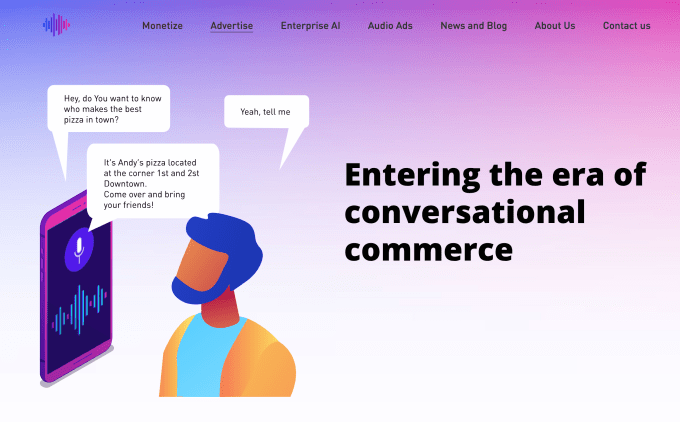
Radio ads broadcast a message to listeners, but Pandora’s new voice ads will allow listeners to respond by speaking aloud – either to get more information about the product being advertised, or to skip the ad if it’s not of interest. The company confirmed it has an agreement to test interactive voice ads where listeners engage by speaking back to the ad. The test will be powered by the San Francisco-based ad tech company, Instreamatic, and will launch into beta sometime later this year.
Unlike web and mobile ads – which can be measured through things like impressions and clicks – traditional audio ads aren’t clickable. That means advertisers don’t know for sure how many people who heard the ad later went seek out more information, or make a purchase.
Interactive voice ads could change that. And they arrive at a time when consumers have grown comfortable interacting with voice assistants, including those on smart speakers like the Amazon Echo, as well as on smartphones, as with Siri on iPhone.
Instead of simply airing an advertiser’s message, an interactive voice ad could ask the listener if they want to learn more about the product. For example, an ad about a new smartphone could include a verbal call-to-action inviting listeners to learn about its features. The listener would respond out loud to the ad to get more information. Of they could respond negatively to skip the ad.
In addition, Instreamatic claims its voice ads platform are powered by AI technologies that allow customers to say more than just “yes” or “no” when interacting with an advertisement. Using technology like machine learning and natural language understanding, the ads understand user intent – and this ability improves the more customers engage with them.
For Pandora, the idea is that its advertisers could target listeners at times they aren’t typically able to respond – like when they’re out running, at the gym, driving or cooking, for example. They aren’t then able to click or tap on ads, or otherwise engage with the advertiser content.
While Instreamatic made an announcement about its deal with Pandora for interactive voice ads, it’s not the only way Pandora is targeting this market.
“Pandora is deeply investing in voice advertising and is driving the market forward by facilitating an ecosystem,” said Eric Picard, Pandora VP, Ad Product Management.
“Pandora is building a comprehensive voice solution across our consumer-facing offerings with advertising services on top of it to enable our own ‘first party’ offering as well as ‘third party vendors’ such as Instreamatic and AdsWizz to plug in. Our expectation is that the buy-side – advertisers and agencies – are going to want to do ‘build-once-buy-everywhere’ solutions for voice ads just like they have for other markets, and Instreamatic is the first company focused on supporting buy-side voice ads across publishers,” he explained.
Instreamatic launched five years ago as a digital audio ad network, but has grown its suite of tools to now include voice-activated ads. The company has made other deals for this format, including with free music platform Audiomack; one of Russia’s largest radio groups, Gazprom-Media Radio; and European radio company Global’s DAX, which will allow advertisers to insert ads with verbal prompts into streaming apps like TuneIn and AccuRadio.
Pandora, however, is a notable customer win – and one that could prove out the viability of voice-activated ads on a sizable user base.
Currently, Pandora has an agreement to test the format with Instreamatic and plans to support other third-party vendors like Adswizz in the future. Picard says he’s not aware of any scaled solutions for interactive voice ads beyond these two companies at this time.
That means publishers will need to either provide their own voice solution or rely on these vendors, if they want to participate.
Pandora isn’t sharing further details about its voice-enabled ads strategy, but will likely go more in-depth when the tests launch in order to fill in the blanks for potential advertisers.
“The age of voice has arrived, yet there’s remained a stark need for meaningful consumer engagement – and measurable metrics – in the audio ad space,” said Stas Tushinskiy, CEO, Instreamatic.ai, in a statement. “We believe Instreamatic provides the ideal ad platform to serve this marketplace. We’re excited to be engaged with Pandora to bring this AI-enabled technology to its listeners and advertisers, and prepared to scale these new experiences very quickly once deployed.”
In the six weeks since we launched Extra Crunch, we’ve seen that readers and subscribers really want the latest practical tips and warnings about building a company — from the people on the cutting edge.
So we want to feature subject-matter experts, writing about what they learn from working with startup clients.
You may remember, however, that the Crunch Network for contributors came to a necessary end a couple of years ago, in favor of an invite-only process for guest columns. It “had gotten a bit overrun,” as my colleagues memorably wrote at the time, “with pieces that we strongly suspected were ghost-written by PR or really had no business being given the platform.”
Today, we are inviting people who do key work with startups to apply, if you are one of those people and you have ideas for articles that might be a great fit for Extra Crunch and/or TechCrunch.
Just get in touch at ec_columns@techcrunch.com
Successful columns will include a big, actionable insight that is derived from the author’s professional experience, and reinforced by data and anecdotes they can provide.
Here are some of the many insidery topics that we want to go deeper on with the right columnists: growth marketing, legal issues, recruiting, M&A, and company culture and inclusion.
Here are early examples to illustrate what we are looking for:
There is no word count limit, although we encourage you to go long if you have a lot to say — take your readers as seriously as they take you. The range is typically 1500-2500 words.
Come prepared to go through an editing process with us, since our goal is to be significantly better than what one can find elsewhere on the internet.
We are happy to discuss re-publication rights.
While our focus is the Extra Crunch audience, some topics will be best served by some combination of free and paywalled articles.
We love one-off articles but we love regular contributions even more.
If all this sounds right for you, please get in touch at ec_columns@techcrunch.com
In the six weeks since we launched Extra Crunch, we’ve seen that readers and subscribers really want the latest practical tips and warnings about building a company — from the people on the cutting edge.
So we want to feature subject-matter experts, writing about what they learn from working with startup clients.
You may remember, however, that the Crunch Network for contributors came to a necessary end a couple of years ago, in favor of an invite-only process for guest columns. It “had gotten a bit overrun,” as my colleagues memorably wrote at the time, “with pieces that we strongly suspected were ghost-written by PR or really had no business being given the platform.”
Today, we are inviting people who do key work with startups to apply, if you are one of those people and you have ideas for articles that might be a great fit for Extra Crunch and/or TechCrunch.
Just get in touch at ec_columns@techcrunch.com
Successful columns will include a big, actionable insight that is derived from the author’s professional experience, and reinforced by data and anecdotes they can provide.
Here are some of the many insidery topics that we want to go deeper on with the right columnists: growth marketing, legal issues, recruiting, M&A, and company culture and inclusion.
Here are early examples to illustrate what we are looking for:
There is no word count limit, although we encourage you to go long if you have a lot to say — take your readers as seriously as they take you. The range is typically 1500-2500 words.
Come prepared to go through an editing process with us, since our goal is to be significantly better than what one can find elsewhere on the internet.
We are happy to discuss re-publication rights.
While our focus is the Extra Crunch audience, some topics will be best served by some combination of free and paywalled articles.
We love one-off articles but we love regular contributions even more.
If all this sounds right for you, please get in touch at ec_columns@techcrunch.com
In the six weeks since we launched Extra Crunch, we’ve seen that readers and subscribers really want the latest practical tips and warnings about building a company — from the people on the cutting edge.
So we want to feature subject-matter experts, writing about what they learn from working with startup clients.
You may remember, however, that the Crunch Network for contributors came to a necessary end a couple of years ago, in favor of an invite-only process for guest columns. It “had gotten a bit overrun,” as my colleagues memorably wrote at the time, “with pieces that we strongly suspected were ghost-written by PR or really had no business being given the platform.”
Today, we are inviting people who do key work with startups to apply, if you are one of those people and you have ideas for articles that might be a great fit for Extra Crunch and/or TechCrunch.
Just get in touch at ec_columns@techcrunch.com
Successful columns will include a big, actionable insight that is derived from the author’s professional experience, and reinforced by data and anecdotes they can provide.
Here are some of the many insidery topics that we want to go deeper on with the right columnists: growth marketing, legal issues, recruiting, M&A, and company culture and inclusion.
Here are early examples to illustrate what we are looking for:
There is no word count limit, although we encourage you to go long if you have a lot to say — take your readers as seriously as they take you. The range is typically 1500-2500 words.
Come prepared to go through an editing process with us, since our goal is to be significantly better than what one can find elsewhere on the internet.
We are happy to discuss re-publication rights.
While our focus is the Extra Crunch audience, some topics will be best served by some combination of free and paywalled articles.
We love one-off articles but we love regular contributions even more.
If all this sounds right for you, please get in touch at ec_columns@techcrunch.com
It’s the morning of March 31st, 2014, and the Google Maps team is about to release its April Fools’ Day gag to the world.
It wasn’t the first time this team had goofed around with an April Fools’ day joke. Google, as a whole, goes wild on April 1st. Maybe it’s for the resulting publicity. Maybe it’s to make the brand seem a little more fun. Maybe it’s to give employees a creative outlet that doesn’t seem so mission critical. It’s probably a mix of all three.
Google has used the first of April to “launch” everything from morse code keyboards, to AI-powered garden gnomes, to a translator for talking with your pets. They’ve “announced” that the company would be switching to Comic Sans as the default font across all of its products, and once spent the day suggesting that, despite whatever you might be searching for on YouTube, you probably meant to search for Sandstorm by Darude.
Most of the gags come and go (excluding Gmail, of course, which everyone thought was a joke thanks to its April 1st launch timing.) In most cases, everything is reset back to normal and everyone moves on.
This one would be a bit different. Within the next few hours, the wheels would be in motion for the product that became Pokémon GO.
This is Part 2 of our EC-1 series on Niantic, looking at its past, present, and potential future. If you haven’t read it, you can find Part 1 here. The reading time for this article is 31 minutes (7,900 words)
The Joke That Inspired It All
By April 2014, Niantic was still over a year away from its spinout of Google. At this point, it’s still Niantic Labs, an “autonomous unit” operating under Google’s roof.
They’d launched Field Trip, which proved to the team that there was something to this idea of focusing around real world points of interest, but didn’t seem to keep people coming back. They’d followed up with their first game, Ingress, which had a dedicated following but hadn’t made them very much money.
“Niantic was trying to figure out what was next, and what we should do.”
That’s Masashi (or “Masa”) Kawashima. He runs Niantic’s operations in Asia, having joined to grow Ingress in Japan at a time when the country was around 25th on the list by playerbase. Nowaday’s it’s number one or two, depending on which phone platform we’re talking about. His passion for Niantic’s games runs deep; he rarely stops smiling when talking about them. Every question I ask is answered with a story, and each one is packed with a million details. At no point am I tempted to stop him.
Soaring college tuition prices have left Americans drowning in debt without a correspondingly enhanced set of professional skills to show for it. In the past 11 years, US student debt has increased by 157% and 1 in 10 borrowers are over 90 days delinquent.
Universities are incentivized to be unaffordable and don’t have a direct financial interest in the outcomes of their students. The average budget for career services at colleges is $90,000 including salaries, with only one career counselor for every 2,900 students on average.
Income share agreements (ISAs) have been developed as a financing model that could reshape the way education programs operate by aligning interests while expanding access to those programs and limiting payments only to what graduates can afford.
Lambda School may be the most notable startup advancing this model, having closed a $30 million Series B in January. But ISAs are neither simple to implement nor uncontroversial in policy circles.
Automattic, the company behind WordPress.com, WooCommerce and Jetpack, is launching a new suite of products focused on the future of work — Happy Tools. Automattic is a remote company with over 850 employees working from 68 countries. And the company has built a bunch of products over the years to communicate, collaborate and work.
With Happy Tools, Automattic plans to turn those internal tools into actual products. The first product is Happy Schedule, a scheduling service that Automattic is using to deliver 24/7 customer support.
“Ideas about releasing our internal tools have been kicking around Automattic for years, but it’s been about finding the right moment and the right product to lead with,” Automattic product lead for Happy Tools Matt Wondra told me. “When we started building Happy Schedule a year ago we realized that designing a tool for our own scheduling needs also filled a clear gap in the [workforce management] landscape.”
“No other product out there gave us the flexibility and visibility we needed to comfortably schedule a globally distributed team. Since it was a greenfield internal project, we could engineer it from the ground up with public release in mind. And it just made sense to launch Happy Tools first into an industry we know so well — customer support.”
Happy Schedule is a modern web app and it should feel more like Google Calendar instead of some SAP product. For instance, you can click and drag your mouse to create an event — no need to input a start time and an end time.
But this is just a start. Automatic plans to launch more products over time so that you can work more efficiently as a remote team. The company is using a software-as-a-service approach and it costs $5 per user per month to access Happy Tools.
It’s interesting to see that Automattic is promising a suite of products from day one. It won’t just be a bunch of different products. When you subscribe to Happy Tools, you should be able to access multiple products that work together, just like a G Suite subscription lets you access Gmail, Google Calendar, Google Drive, etc. This strategy will improve engagement and stickiness over time.
French startup ManoMano is raising a new funding round of $125 million (€110 million). The company operates an e-commerce website and marketplace focused on home improvement and gardening.
ManoMano is part of the great unbundling of general e-commerce platforms. By focusing on a vertical in particular, the company can provide a large product offering, competitive prices and better customer service.
The platform has generated $450 million (€400 million) in gross merchandise value last year. France is still its main market, but the company plans to become the dominant home improvement platform in Europe.
According to an interview in JDN, ManoMano plans to take a page out of Amazon’s playbook and expand its Mano Fulfillment service. As the name suggests, ManoMano plans to manage products from third-party retailers and take care of logistics.
More recently, ManoMano launched a B2B service with a few advantages for professional workers.
Eurazeo Growth, Aglaé Ventures and Bpifrance are participating in today’s funding round, with existing investors CM-CIC, Partech Ventures, Piton and General Atlantic also participating.
While some sat out on April Fools’, a number of big tech companies embraced the opportunity to waste time this way.
So without any further ado, here are the April Fools’ pranks from around the web:
The good
1) Google Tulip
Google Tulip, in my humble opinion, is Google’s best April Fools’ joke this year. It’s a product that lets you communicate with tulips (they’re making progress with cacti, which just want to be left alone, it would appear).
The premise itself is par for the course on April Fools’ day — the perfect mix of mildly plausible and “but why?” — but a few of the comedic touches on the video really make this prank shine.
If the bit at the :54 mark doesn’t tickle you, then I fully respect your opinion but we are very different people and I doubt we could ever be real friends.
2) Shutterstock stock IRL
This happens to be one of my favorite April Fools’ jokes from a tech company this year. Shutterstock is unveiling ‘plans’ to build the world’s largest physical library, called stock IRL, which would host “shelves upon shelves upon shelves” of stock photos, watermarked videos and music tracks.
Best line: “Because sometimes innovation means moving backwards.”
Sometimes, the idea itself can be an obvious prank as long as it’s executed well. It doesn’t hurt that Shutterstock does a pretty solid job marketing its actual product here, either.
This one is elegant and delightful. Spotify has transformed your Discover Weekly playlist to feature disco hits, or disco takes on non-disco hits. I’ve been listening to mine this morning and it’s solid. Oh, and the playlist is called Discocover Weekly.
Lovely.
4) Duolingo Push
The best way to learn a language is to practice every day. So Duolingo is introducing a more effective way to remind you with Duolingo Push.
“We’re taking push notifications out of your phone and into the real world! Duo the Owl will literally show up to remind you to practice. It’s the green-glove treatment you’ve always wanted.”
5) Google Maps Snake
If this is a prank, it’s an incredibly generous and sweet prank that never hurt anyone. Google has put the classic Snakes game into the Google Maps app, for both iOS and Android, as well as on a standalone site for folks who don’t have the app.
It’s fun and simple and makes me wonder why this nostalgic little Easter Egg can’t live in the Google Maps app forever and for always.
(I died for that ^^ screenshot. You’re welcome.)
6) ProductHunt IPO
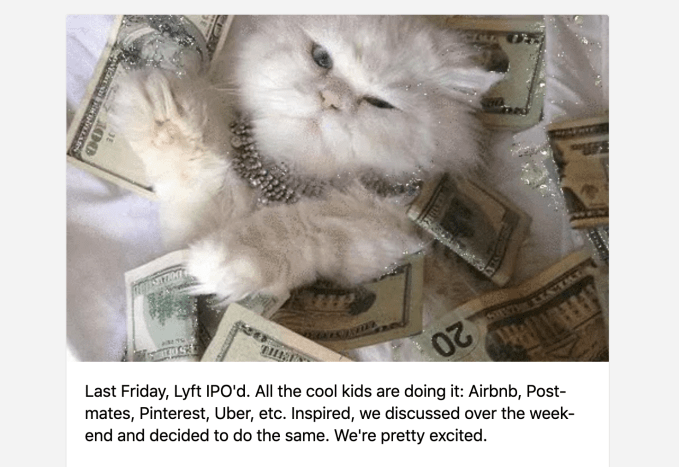
ProductHunt joked that it’s going public simply as a result of peer pressure. It also highlighted some of the April Fools’ pranks coming through on its own platform, including a SideDoor into college admission and a monstrous USB hub.
7) Waymo Pet
It’s exactly what you think it is. Waymo Pet is an autonomous car service exclusively for pets. The real beauty in this April Fools’ joke is in the details — the idea of Waymo employees overthinking the interior of a car based on the type of pet that may be riding in it is relatively humorous.
Best line: “Research shows us that cats love laser pointers.”
The not so good
1) Adobe Capture
Adobe wonders what would happen if designers could spark a memory through the smell of a particular ad or logo. Heralding the arrival of this hellscape is Adobe Capture, which uses Adobe Scent-sei technology to give users the ability to capture scents in the real world (through the camera?) and preview scents via the phone’s charging port.
Don’t shoot the messenger. It gets both better and worse from here.
2) General Cat-A-List
General Catalyst has spruced up their landing page with loads of cat gifs, powered by Giphy. Yes, General Catalyst is an investor in Giphy.
“We took this process seriously. To best convey that we sit at the cutting edge of all things new, bright and shiny, we spitballed our way through design-thinking sessions and administered Rorschach tests across the firm. We concluded that our brand should land at the intersection of tech + fun. What could illustrate tech-enabled fun better than the cat gif?”
3) Google Files Screen Cleaner:
Google is adding a new Screen Cleaner feature to the Files app. To clean it from the inside out. According to the video, the features uses “a smudge detector API” to identify imperfections, along with” geometric dirt models” and a “haptic micromovement generator” to sh-sh-shake it off.
And because they already committed, the team at Google decided to double down and say that the Screen Cleaner also uses micro vibrations to create a non-stick shield around your phone. Cause why not?
The Echo-like device (but also with a holographic display, for some reason) offers in-game coaching (insults), a rage converter (which translates your screamed profanities into words of encouragement for your inept teammates), and the Troll Destroyer (using internet-sourced facts to take down trolls on forums). Those are just a few of the features of the RON AI personal assistant, which feels a bit too bonkers to be funny.
“A” for effort, though.
5) 1Password
1Password just went for it today with the introduction of the 1Password Password Book, which is just a journal where you write down your passwords.
The landing page touts the book’s features, vacillating between pros and cons like “It’s Super Private” and “You can share your passwords.” Of course, analog password storage isn’t the worst way to store your passwords, especially if those passwords are strong in the first place and you’re keeping your Password Book in a safe place.
Alas, the Password Book is just a prank.
6) OnePlus Warp Car
The OnePlus #WarpCar is coming. Are you ready to say goodbye to gasoline? #NeverSettle
For years, rumors swirled that Apple might be working on a car. For April Fools’, the smartphone newcomer OnePlus teased an upcoming electric vehicle called the OnePlus Warp.
Shrug.
7) Razr Ping
Gaming hardware company Razr took some inspiration from Apex Legends, the hottest new game on the market. Razr Ping hypothetically lets people ping real-world objects with their smartphone, similar to the non-verbal comms system in Apex Legends.
Low-key, though, that comms system may very well be the exemplar for other games and even non-gaming platforms. Just not in the way Razr imagines here, obviously.
8) Roblox Console
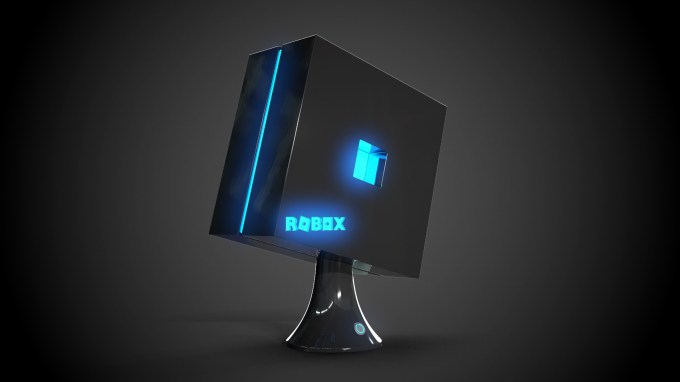
I’m not entirely sure what Roblox is doing here with the introduction of the first Roblox gaming console, offering “a new way to make your dreams a reality in stunning, 8K ultra-high definition graphics and at greater than 120 frames per second.”
“Deep underground in a secret laboratory, our engineers developed a groundbreaking processor that could distill imagination into a concentrated source of infinite energy,” reads the blog post. “That energy is what fuels the unbelievable technology in Robox.”
If it’s supposed to be funny, I don’t get it.
9) Roku PressPaws Remote
According to Roku, 72 percent of their users said they thought their dogs would enjoy TV more if they could control what’s on. Thus, the PressPaws Remote.
“This paws-specific remote could be a huge untapped market for us,” says Lloyd Klarke, director of product management for the Roku Pet Division. The remote has shortcut buttons shaped like paws, because the buttons are the only real barrier between a dog’s ability to master the TV remote.
10) SodastreamME
And then there’s such a thing as trying too hard. Sodastream presents the SodasteamME, which was built in partnership with astronaut Scott Kelly and allows folks to power their Sodastream with their own burps.
We may never know why.
11) Stack Overflow
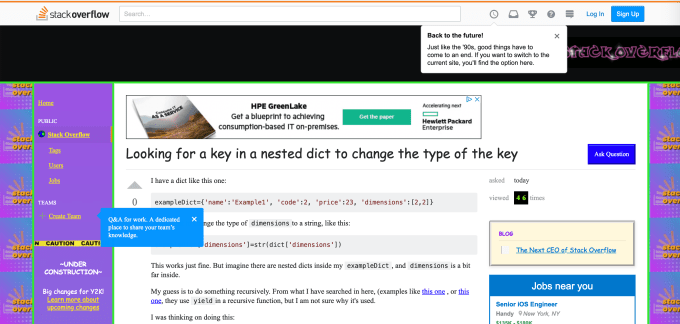
StackOverflow also went for a simple prank, taking the entire website back to the early days o the internet, complete with Comic Sans typeface. It’s jarring. You can check it out here.
It’s funny because it’s true? On March 29, Tinder teased a new Height Verification Badge (HVB), which would force users to verify their age by taking a photo of themselves standing next to any commercial building. Remember, this is three full days before April 1.
The blog post has at least one typo, and some questionable language. (Exhibit A: “Did it ever occur to you that honesty is what separates humans from sinister monsters? Of course not.”) There is also, however, some hint of truth. (Exhibit B: “Only 14.5% of the U.S. male population is actually 6’ and beyond. So, we’re expecting to see a huge decline in the 80% of males on Tinder who are claiming that they are well over 6 feet.”)
For a minute, we couldn’t decide if it was real or not. But Tinder has confirmed that this is an April Fools’ prank.
13) T-Mobile Phone BoothE
If you’re still here, we’re done. T-Mobile’s sacrificial lamb in this blood bath of a ‘holiday’ is the T-Mobile Phone BoothE, which is a soundproof phone booth.
Of note: T-Mobile CEO John Legere was an active participant in this prank, which raises concerns, but then again that’s sort of his style.
Mailgun, an email API delivery service, announced today that it was selling a majority stake in the company to private equity firm Thoma Bravo. The companies did not share terms, but this is the second owner in the company’s 8+ year history.
Mailgun provides API services for building email functionality into applications. It has over 150,000 customers today using its APIs, according to data provided by the company.
In a blog post announcing the investment, CEO William Conway said the new money should help the company expand its capabilities and accelerate the product roadmap, a common refrain from companies about to be acquired.
“We will be investing millions in the development of products you can use to enhance your deliverability, gain more insights into your emails and deliver an unparalleled experience for your customers. We’re also doubling down on customer success and enablement to ensure our customers have exactly what they need to scale their communications,” Conway wrote in the blog post.
The company, which was founded in 2010 and was a part of the Y Combinator Winter 2011 cohort, has had a complex history. Rackspace acquired it in 2012 and held onto it until 2017 when it spun out into a private company. At that point, Turn/River, another private equity firm, invested $50 million in the company. After today’s deal, Turn/River will maintain a minority ownership stake in Mailgun.
Mailgun typically competes with companies like MailChimp and SendGrid. Thoma Bravo has a history buying enterprise software companies. Most recently, it bought a majority stake in enterprise software company Apttus. It also has investments in SolarWinds, SailPoint and Blue Point Systems.
Thoma Bravo did not respond to a request for comment before publishing.


 (@mims)