Category: UNCATEGORIZED

01 Apr 2019

Facebook asks for public input about its plans for a content oversight board

In November, Facebook announced its plans to create an external content oversight board that would serve as something of a “supreme court” for Facebook’s more controversial content policy decisions. The company took the first steps in January to describe how this content review board would function with the release of a draft charter. Today, Facebook is opening up a public consultation process to help it answer more questions around the Oversight Board’s design.

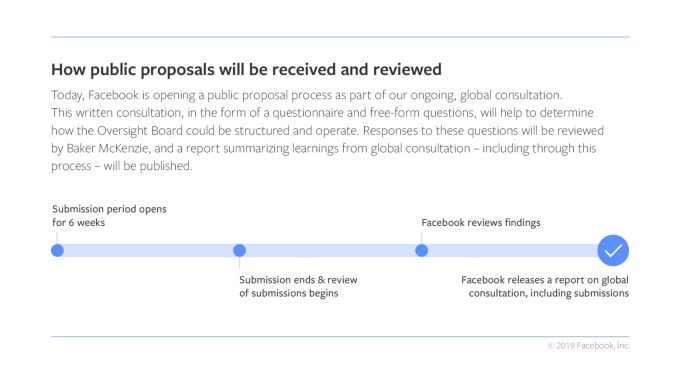
Over the next six weeks, Facebook says it will accept submissions from the public about its plans.

Public submissions will include two parts: a questionnaire and free-form questions.

The latter will focus on gathering input around membership, case decisions and governance. The questionnaire portion, however, is a more straightforward user survey where participants are asked to vote on various aspects (many already detailed in the draft charter) – like how many total members should the board have, how long they should serve, how they should gain their positions, what their makeup should be in terms of background, professional experience, views and diversity, among other things.
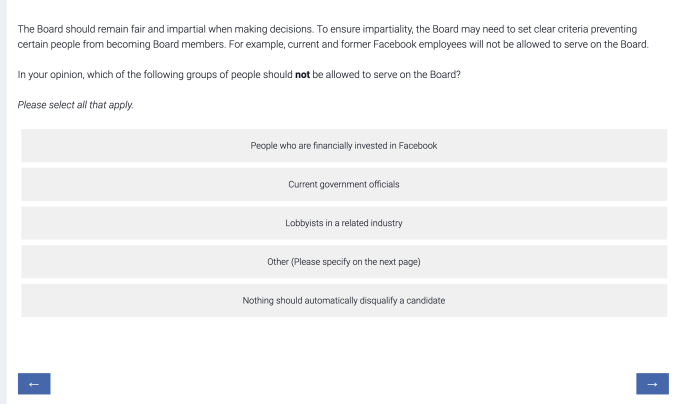
It also asks the public to weigh in on how the Oversight Board will make decisions on cases, with questions about how their rulings will impact policy, what subject matter experts they can consult, whether they should review written opinions from those the case affects, the precedent set by prior rulings, and more.
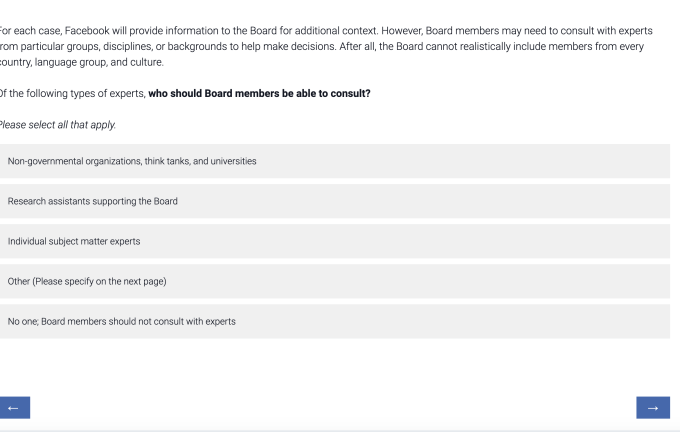
Some of these questions are simpler to answer, while others may give survey respondents pause.

For example, one asks if it’s more important for the board to dedicate more time and research to each case or if it should prioritize making more decisions each year?

While obviously all cases reviewed should be well-researched, if you believe Facebook’s board should resemble the U.S. courts system, then there should be guidance around how long its board members have to make a decision. Otherwise, it could see some of the toughest content policy decisions tied up in never-ending deliberations, with the board citing “more research is needed” to rule. That wouldn’t be fair to those whose content is held hostage in the meantime. But the question doesn’t allow for this level of nuance – so you’d need to take to the essay portion to share this position.

However, anyone can take the survey portion of the questionnaire and can choose to skip the essay section if they don’t have more to add.

Facebook says it has partnered with the firm Baker McKenzie, which will help it review the submissions. The responses will be summarized in a report published in June.
For Facebook, the launch of an independent review board allows the company to further distance itself from controversial policy decisions.

As we noted in January, decision-making around content removals is an area where Facebook has repeatedly and publicly failed, and with disastrous consequences. The company has been widely criticized for how it handled issues like the calls to violence that led to genocide in Myanmar and riots in Sri Lanka; election meddling from state-backed actors from Russia, Iran and elsewhere; its failure to remove child abuse posts in India; the weaponization of Facebook by the government in the Philippines to silence its critics; Facebook’s approach to handling Holocaust denials or conspiracy theorists like Alex Jones; and more.

The board’s creation will not only take the pressure off Facebook to make these decisions, it’s also an admission of sorts that Facebook agrees it’s not able to handle this level of responsibility any longer.

Those interested in sharing their own thoughts around the review board can go here for the survey.
01 Apr 2019

Tinder fills Chief Product Officer position with hiring of Ravi Mehta

Tinder today announced it has hired Facebook vet Ravi Mehta as its new Chief Product Officer, as the company continues to shift Tinder’s focus to the younger demographic still enjoying the “single lifestyle.” Mehta’s background includes over 20 years in the industry, including time at Facebook, TripAdvisor, and Microsoft. Most recently, Mehta had served as Product Director for Youth Engagement at Facebook.

This role involved research into how Gen Z spends time online and helped Facebook identified product opportunities to serve this demographic. While there, Mehta was involved in Facebook’s launch of the short-form video app Lasso, which aims to be Facebook’s TikTok rival. He also worked on the launch of Facebook Polls and aided with his team’s M&A strategy.

Prior to Facebook, Mehta worked at TripAdvisor leading product development for the Hotels, Attractions, and Restaurants verticals–and launched instant booking. He led user experience teams across a number of areas, including mobile, personalization, search & discovery, trip planning, maps, and user-generated content; and directed the international market development and localization teams.

His other experience includes time at Viximo (acquired by Tapjoy), AdvisorNow, Microsoft and the Boston Consulting Group.

At Tinder, Mehta fills the role vacated by Brian Norgard in November 2018.

Norgard had joined Tinder through an acquisition in 2014, where he originally served as head of revenue before being promoted to the chief product role in late 2016. At the time of his departure, Norgard said he wanted to get back to his entrepreneurial roots and invest in early stage companies.

Tinder had not announced an interim CPO.

Mehta’s hiring comes at a time when Tinder parent Match Group is further diversifying its portfolio of dating apps.

With its full acquisition of relationship-focused Hinge, the company is now focusing Tinder more so on a young, 20-something user base – those who aren’t ready to settle down, but are rather enjoying being single and dating more casually. As part of this shift, Tinder now runs a lifestyle publication, “Swipe Life,” that publishes stories about dating styles, plus those about travel, food, and other trends.

It has also invested more heavily in product features catering to a younger demographic, like Tinder U and its related features like Spring Break mode and Rivals Week. And Tinder is now targeting activities often favored by young people, like music festivals and parties, with last year’s launch of Swipe Surge.

“Tinder’s product innovation brought an entire new generation to the category and now millions of people across the globe are connecting, dating, and starting relationships. It has become a social phenomenon and the go-to app when you are single. As we enter the next chapter of product innovation and international growth, we are excited to have Ravi’s perspective and experience at Tinder,” said Tinder CEO Elie Seidman, in a statement about the hiring.

“Tinder is one of the rare products that’s had a fundamental impact on how people around the world meet and connect. And there’s so much more to do. I’m looking forward to joining Elie’s team and hitting the ground running,” said Mehta.

Mehta has an M.B.A. from MIT’s Sloan School of Management, and a B.S. in Computer Engineering from Boston University.

01 Apr 2019

German LinkedIn rival Xing is rebranding as ‘New Work’ acquires recruitment platform Honeypot for up to $64M

Xing, the business networking platform that has been described as Germany’s answer to LinkedIn, has made an acquisition to beef up its recruitment business ahead of a rebrand of the business as “New Work.” The company has acquired Honeypot, a German startup that has built a job-hunting platform for tech people, for up to €57 million ($64 million). Xing tells us that Honeypot is its biggest acquisition to date.

The figure includes the acquisition (€22 million) plus a potential earn-out of up to €35 million if certain targets are met in the next three years.

Xing said that it plans to rebrand as New Work in the second half of 2019, bringing together a number of other assets it has acquired and built over the years.

“This acquisition is an excellent addition to our New Work portfolio,” Thomas Vollmoeller, CEO at Xing, said in a statement. “Honeypot focuses on candidates by helping them to find a job matching their individual preferences… With subsidiaries and brands such as kununu and HalloFreelancer, Xing is far more than just a single network. New Work is the umbrella spanning all our business activities.” Xing said that all the smaller companies will keep their branding.

Xing already offered job listings as part of its platform, with 20,000 businesses as customers; but Honeypot will add a few different things to the mix.

First, it will give Xing more traction specifically in the tech vertical, since Honeypot first started out in 2015 targeting developers although it later expanded to other tech jobs.

Second, Honeypot’s structure is a natural fit for a social recuitment platform: as with a lot of social recruiting, Honeypot lets recruiters use platforms, profile pages and social graphics to find and approach candidates, rather than candidates reaching out in response to specific opportunities.

Honeypot adds additional features to help make this process more accurate and less of a waste of time on both sides. Those doing the recruiting have to provide specific details around salary and, say, programming languages required, as part of their outreach. On the other side, individuals go through a “brief expertise check” to vet them, and they too have to be a bit more specific on what they can and what they want to do, and what they want to earn, to help weed out opportunities that might not be suitable.

Third, the acquisition will help Xing make a bigger push into building its profile outside of Germany into more of Europe, as New Work.

This is no small thing. Xing years ago was considered a would-be rival to LinkedIn. But — and this was perhaps even more true in the past, and Xing was founded in 2003 — scaling startups to be global players out of Europe can be a challenge, even more so when there is a formidable direct competitor growing quickly as well.

In the end, Xing developed as a much more modest operation, relatively speaking. While LinkedIn today has some 600 million users and was acquired by Microsoft in 2016 for $26.2 billion, Xing is publicly traded and currently valued at around $2 billion (€1.81 billion), with some 15 million members.

Xing says that today Honeypot’s current emphasis is German-speaking countries and the Netherlands, which together cover some of the biggest startup hubs in Europe, including Berlin and Amsterdam.

The company is still relatively small but growing, adding 1,000 IT specialists to its books each week, with some 100,000 individuals and 1,500 businesses currently registered. Xing said that it will be investing in the company to expand to more markets in Europe, as well as to grow its business by tapping Xing’s own customer base.

Although there have been some notable exceptions like payments startup Adyen from the Netherlands, Farfetch from the UK and Spotify (originally from Stockholm, grown in London and now increasingly a US company), scaling startups in Europe has proven to be challenging.

One of the big reasons why has to do with a shortage of talent to build these companies: in Germany alone — home to the buzzy startup city of Berlin — there are 82,000 unfilled tech jobs. In other words, there is an opportunity for more user-friendly platforms to help connect those dots.

XING and Honeypot both have the vision of helping people to further their career. We want Honeypot to offer the world’s largest work-life community for IT specialists by giving candidates the power to decide on their next career step,” said Kaya Taner, CEO who founded Honeypot with Emma Tracey. “We will continue to pursue this vision with XING. Going forward, around 100,000 IT specialists from all over the world who are registered on Honeypot will be able to connect with the many first-rate employers in German-speaking countries. This will enable Honeypot to continue developing its domestic market, while also further expanding its international community.”

01 Apr 2019

In what is apparently not an April Fool’s joke, Impossible Foods and Burger King are launching an Impossible Whopper

The meat substitute manufacturer Impossible Foods and fast food giant Burger King are launching an Impossible Whopper.

According to a report in The New York Times, Burger King is launching the Impossible Whopper in stores in the St. Louis area with plans for a broader rollout later — and not as part of some elaborate April Fool’s day prank.

Burger King isn’t the first fast food chain to bring an Impossible burger to market. That’d be White Castle, which is selling Impossible sliders at stores in the Northeast.

But Burger King would certainly be the biggest slinger of ground beef to go with a meatless patty maker.

Impossible’s largest competition in the meat-substitute market, the publicly traded purveyor of purely beef free patties, Beyond Meat, has a similar deal with Carl’s Jr. for its own version of a beef-less burger.

The Silicon Valley-based Impossible Foods has been on a roll. They introduced a new version of their burger to much fanfare at the Consumer Electronics Show earlier this year, and have been locking in deals with higher-end fast casual restaurants and now large international fast food chains.

In the eight years since the company raised its first $7 million investment from Khosla Ventures, Impossible Foods has managed to amass over $389 million in financing — including a convertible note last year from the Singaporean global investment powerhouse Temasek (which is backed by the Singaporean government) and the Chinese investment fund Sailing Capital (a state-owned investment fund backed by the Communist Party-owned Chinese financial services firm, Shanghai International Group).

It remains to be seen if this is a harbinger of things to come for Burger King and whether the fast food giant will embrace other alternative meat companies like the providers of fake chicken or cellular based meat substitutes like Memphis Meats.


01 Apr 2019

Microsoft’s Surface Book 2 gets a processor boost

A quiet little update from Microsoft overnight, as the company bumped up a key spec on its 13.5-inch Surface Book 2. The 2017 two-in-one powerhouse is getting a nice little boost to Intel’s 8th gen quad-core i5 chip.

That model run $1,499 and includes 256GB of storage and 8GB of RAM. Bumping up to the 8th gen Core i7 and 512GB of storage, meanwhile, will run you $1,000 more. The 7th gen Core i5 is sticking around, meanwhile, at $200 off.

The news is a confirmation of recent rumors that the company planned to upgrade the device, though things are otherwise staying the same as previous generations. As with the other week’s Apple announcements, the news wasn’t really big enough to warrant its out big announcement. 

Notably, the company also has an event coming up in New York in a couple of weeks, though that’s expected to focus on the Surface Hub 2, which was announced last fall.

01 Apr 2019

BBC and Discovery team up on a new streaming service focused on factual programming

Discovery and BBC this morning announced an extensive,10-year content partnership deal for a new streaming service focused on natural history and factual programming. The subscription video service is expected to cost under $5 per month, and will be owned by Discovery. It will operate in all territories outside the U.K., Ireland and China when it launches in 2020.

This will make Discovery’s service the exclusive subscription video on demand (SVOD) home to series like “Planet Earth,” “Blue Planet,” “Life,” “Dynasties,” and others, in addition to future BBC-commissioned shows from BBC Studios after they air on linear TV.

These will be combined with Discovery’s lineup including “MythBusters,” Deadliest Catch,” “Unsolved History,” “Shark Week” and others, as well as hundreds of hours of BBC programming which Discovery now has the SVOD rights to stream.

In addition, Discovery and BBC Studios will again work together to fund the development of new wildlife series along with other travel, science and natural history content, for both linear and digital distribution.

The two companies also came to an agreement on how they’ll split up the shows from broadcaster UKTV, which Discovery acquired when it bought Scripps in 2018. Discovery will take control of lifestyle channels including Good Food, Home and Really to add to its existing portfolio of 16 channels in the UK.

BBC Studios, meanwhile, will take ownership of the other seven entertainment channels – Alibi, Dave, Drama, Eden, Gold, Yesterday and W – as well as the UKTV brand and digital service, UKTV Play. BBC Studios agreed to pay $225 million for the channels and assumed $91 million in debt, financed by Discovery.

Discovery will also receive an additional £10 million from UKTV, as both parties will share the existing cash on the company’s balance sheet,

“From the planets to the poles, and documenting every species in between, the world has always been part of Discovery’s DNA. It is who we are. Telling these stories is our mission and it is more important now than ever before,” said Discovery CEO David Zaslav, in a statement. “The new platform will be the first global direct-to-consumer service with the category’s most iconic IP including the Planet Earth series, future sequels and spin-offs to all existing landmark series, and new exclusive natural history and science programming coming in the future. There is tremendous value in the marketplace for these programming categories which have broad appeal and strong multi-generational engagement, and we hope to fill the void in the global marketplace for a dedicated high-quality product.”

“The BBC makes outstanding natural history and science programmes. They are ground-breaking and demonstrate the quality and depth of our know-how. It is vital that we keep investing and growing them for the future. This is our largest ever content sales deal,” BBC Director-General Tony Hall, added. “It will mean BBC Studios and Discovery will work together to take our content right across the globe through a new world-beating streaming service,” he said.

According to The WSJ, which reported on the deal this morning, Zaslav has plans for other streaming services, as well, including those focused on food, home improvement, golf and cycling.


01 Apr 2019

Android security: 0.04% of downloads on Google Play in 2018 were ‘potentially harmful apps’

Google’s Android, now 10 years old, has not been a stranger to security issues over the years. But with the mobile operating system now installed on over 2 billion devices globally, Google has been taking an increasingly firmer grip on trying to bring the problem under control. Now, the company has published its lengthy annual update to take stock on just how well that is going.

It’s a slippery slope to be sure, with the number of apps and the enterprising attempts to maliciously exploit them both growing. To wit, 0.04 percent of all downloads from Google Play were classified as potentially harmful applications (PHAs) by Google, versus 0.02 percent in 2017 — an increase in part because Google is growing the categories it’s identified and is tracking.

But Google said that new policies, such as more privacy-hardened APIs, along a wider implementation of Google Play Protect — its built-in malware scanner that comes with unforked versions of Android — have contributed to the company overall making a dent in the problem.

One area that Google singled out in the report this year was the impact that it’s having on protecting devices and users when they download and use apps from outside the Google Play store.

As this is a newer area that it’s tackling with more focus, there are more quantifiable wins to be had, and broadcasted. It didn’t provide a specific figure for how many PHAs it blocked from the Google Play store in 2018 (note that in 2017 it did disclose this: it was 700,000). But in 2018 it noted that “Google Play Protect prevented 1.6 billion PHA installation attempts from outside of Google Play.”

Notably, when it comes to apps on the Google Play store, on devices running unforked versions of Android, the dent seems to be mostly keeping the problem of potentially harmful applications at bay, while the impact on apps that are sideloaded not through Google Play has been more pronounced.

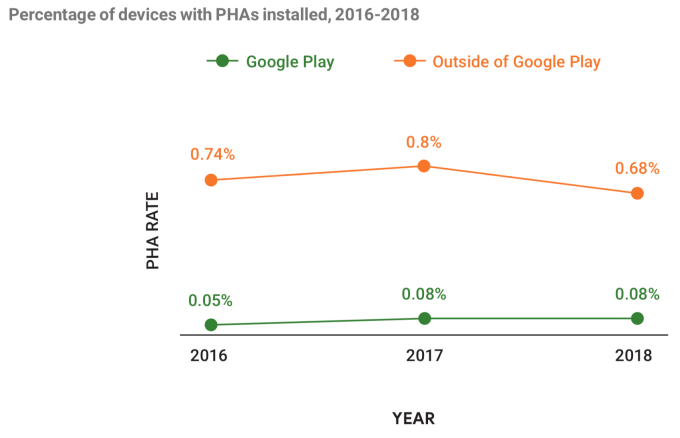
Google noted that in 2018, some 0.08 percent of devices that used Google Play exclusively for app downloads were affected by PHAs. That figure, however, is actually the same as the year before, and actually a bit higher than the year before that.

In contrast, the impact on those downloaded outside of Google Play has been more dramatic — albeit the problem is clearly a bigger one. The number detected in 2018 stood at 0.68 percent, down 15 percent from 0.8 percent a year ago (which itself also had gone up from 2016).

The chances of installing malicious apps, meanwhile, are improved if you have Google Play Protect working. Some 0.45 percent of Android devices using it, installed PHAs, down from 0.56 percent in 2017.

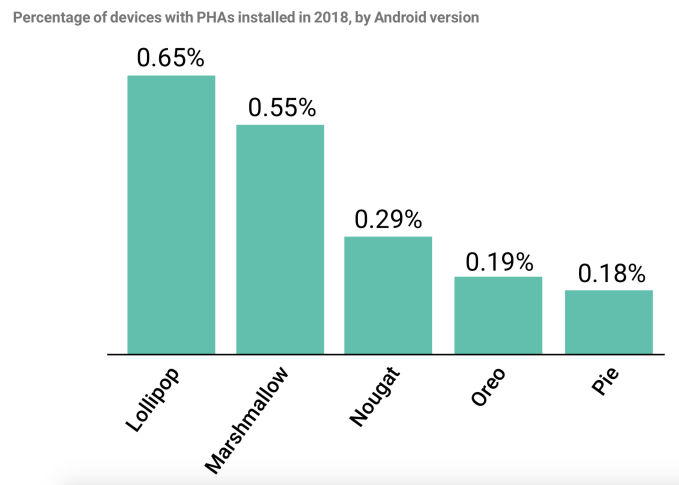
It seems also that this trend is partly down to general improvements over time across the whole Android ecosystem, with later versions of the OS showing better rates of PHA installs. Notably, however, the reduct between Oreo and Pie was only a 0.01 percentage point. It’s getting more challenging to address the problem after more drastic reductions in earlier years.

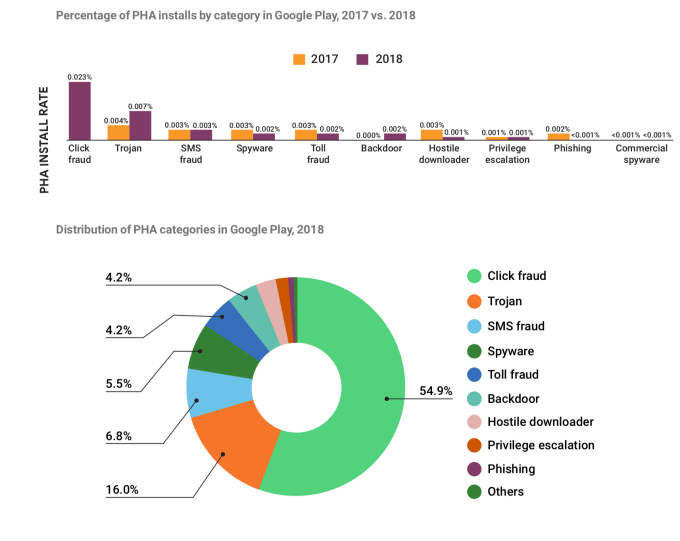
In terms of the categories that are covered by PHAs at the moment, click fraud is by far the highest category both in terms of install rates and distribution. Notably, 2018 was the first year that Google started tracking click fraud as a potentially harmful application: in the past it had been classified as a policy violation. This is one example of how it’s looking to cover more surfaces for potential vulnerabilities, but also a surprise to see that it wasn’t part of the mix before, considering how huge it is. Partly as a result of it now detecting and blocking click-fraud post recategroization, Google noted that it “expect[s] click fraud to remain a profitable fraud vector, but at a lower scale than in 2018.”


Google noted that the two biggest click fraud families were FlashingPuma and CardinalFall, and that the main target countries for click fraud attempts were the USA, Brazil and Mexico (USA and Brazil being two of Google’s biggest markets for Android).

While there are straight click fraud apps, Google notes that most are designed around other services, often something that a consumer might use daily — most commonly flashlights, music and gaming apps. In these, “an embedded SDK is executing click fraud in the background, often without the knowledge of the app developers themselves. Distributing click fraud code in this way is easily scalable and makes it easy for click fraud SDK developers to be present in the apps of hundreds or even thousands of developers,” Google notes in its report.

But even as Google gets more sophisticated and strict in how it handles third party players in its ecosystem, the problem continues to morph and find new areas to exploit.

Just last week, a report was published that highlighted how pre-installed apps — the non-Google apps that come on your device either fully installed or as a link to an install — were providing links into vast ecosystems of services that pull user data, and were difficult to remove for anyone but the most technically advanced.

Weeks before that, yet another tranche of 200 apps were identified that slipped in under the radar littered with adware (on top of another 85 apps also loaded with adware that millions of people downloaded months before). Adware isn’t the only ‘ware that has been found in Google apps: in November last year it was revealed that half a million people downloaded apps from Google Play containing malware, too.

And it was only two months ago that Google finally started to crack down and pull apps that were using legacy permissions to access users’ call logs and SMS messages. (Those permissions have been replaced by more privacy-focused APIs, but the fact is that that those permissions used to exist, and Google hadn’t stopped letting apps use them until quite recently.)

While much has been made of the open source nature of Android being one of the reasons that it’s misused in this way, another is the fact that a lot of apps are developed with open source components, and these can be ripe for exploitation. One recent report, in fact, found that no less that one in every five Android apps has vulnerabilities in it as a result of that open source usage.

While it’s misleading to think that Apple and iOS are not prey to similar kinds of exploits — they are — the fact that the Android ecosystem is simply so much bigger, and more open than the tightly controlled iOS platform, makes it an especially interesting target for malicious actors.

All these might not all be malicious in the sense of, for example, hacking financial information or disabling your device, but privacy of information and information security nonetheless go hand-in-hand. Having a grip on one leads to better control of the other.

01 Apr 2019

Airbnb confirms $150M-$200M investment in India’s OYO

Airbnb is continuing to widen its focus beyond ‘unconventional’ hotels as it gets ready for a much-anticipated IPO. Following its acquisition of HotelTonight last month, the company has picked today (April Fool’s Day) to confirm that it invested in India’s OYO — a startup that manages budget hotels and other stays.

The deal has been rumored for a couple of months and it is additional to OYO’s (then) $1 billion Series E round which was led by SoftBank’s Vision and included participation from ride-hailing duo Grab of Southeast Asia and China’s Didi Chuxing. The deal, announced last September, also included Lightspeed, Sequoia and Greenoaks Capital and it valued OYO at around $5 billion.

Neither party confirmed the size of the deal announced today, but an industry source told TechCrunch that it is between $150 million and $200 million. An OYO spokesperson declined to comment in response.

The company has now raised over $1.5 billion from investors to date including this new capital.

More than money, though, the deal is highly strategic for both sides.

Airbnb has been keen to take a larger bite out of India, which co-founder and CSO Nathan Blecharczyk previously said is one of its five fastest growing markets worldwide. In that light, the companies are exploring opportunities to collaborate which could see OYO properties — in this case more likely villas and Airbnb-like properties — listed on Airbnb’s service.

That exposure could help OYO — which stands for ‘On Your Own’ — as it looks to break into the overseas traveler market, having previously been more popular with local or regional travelers.

Finally, OYO is all the more appealing to Airbnb because it has seen impressive success in China, which represented a key part of its focus following the Series E round. Overall, OYO claims to cover close to 500,000 rooms across 13,000 hotels and 6,000 homes in eight countries: India, China, Malaysia, Nepal, the U.K, UAE, Indonesia and the Philippines.

OYO is also gunning for Southeast Asia, where it hopes an alliance with Grab can help it break into the region.

Airbnb recently checked in its 500 millionth guest and the company claims it has been profitable for the last two years. While it doesn’t give out precise financial details — that’ll change with an IPO — Airbnb claimed that Q3 2018 was its strongest quarter of business ever with “substantially more” than $1 billion in revenue during the three-month period.

It’s been a long journey for OYO, which TechCrunch first covered in 2015 when it raised $25 million. CEO and founder Ritesh Agarwal is Thiel fellow who started the company in 2012 when he was just 18. His original business, called Oravel, was an Airbnb clone that later pivoted to become OYO — it’s funny what can happen over time.

01 Apr 2019

Bringing affiliate marketing and outsourced customer acquisition to Brazil nets Escale $22.6 million

Despite not being Brazilian and having their first exposure to the country only a few years ago, the two co-founders of Escale have managed to raise $22.6 million for their company, which provides customer acquisition services to companies in telecommunications and healthcare across Brazil.

Their secret? A knowledge of search engine optimization technologies honed through side businesses the two ran back in the United States.

The state of online marketing and digital sales was so woefully bad in Brazil that co-founders Matthew Kligerman and Ken Diamond had a green field in front of them on which to build Brazil’s first true online customer acquisition service, according to Diamond.

“We fell in love with Brazil for its warm culture and natural beauty, but as consumers, we had terrible experiences acquiring the most fundamental products and services for our new lives: internet, cell phone plans, health insurance and basic banking needs,” Kligerman said in a statement.

The company’s largest customer, according to Diamond, is NET, the Brazilian cable and telecom operator. NET was the first company to sign on for Escale’s customer acquisition services, but the company’s roster of clients now includes some of Brazil’s largest companies including Bradesco, Sul America, Claro, GNDI, and Amil.

It’s that marquee client list that attracted QED Investors and Invus Opportunities to co-lead the $22.6 million round that Escale just closed. The company’s previous investors Kaszek Ventures, Rocket Internet’s GFC and Redpoint e.Ventures also participated in the funding.

Latin America is in the throes of a startup renaissance at the moment with Brazilian companies like Nubank and iFood and the Colombian company Rappi reaching billion dollar valuations. Meanwhile investors are committing more capital to the region. Softbank, for instance is Softbank committing $5 billion to a new Latin American-focused fund.

With the new funding, Escale intends to move deeper into the development of customer acquisition platforms across verticals like consumer finance, insurance, and education with comparison shopping sites and informational services (a la CreditKarma in the U.S.).

“With millions of web and cloud voice interactions every month, Escale can transform each of those interactions into data points, and continually improve its proprietary acquisition platform, ‘EscaleOS’, to create highly-intelligent, customized marketing and sales funnels, helping consumers at the right moment connect with the products and services they need,” says Nicolas Berman, a partner at Kaszek Ventures. “The more consumer interactions they have, the faster Escale’s data flywheel spins.”

01 Apr 2019

Gmail turns 15, gets smart compose improvements and email scheduling

Exactly fifteen years ago, Google decided to confuse everybody by launching its long-awaited web-based email client on April 1. This definitely wasn’t a joke, though, and Gmail went on to become one of Google’s most successful products. Today, to celebrate its fifteenth birthday (and maybe make you forget about today’s final demise of Inbox and tomorrow’s shutdown of Google+), the Gmail team announced a couple of a new and useful Gmail features, including improvements to Smart Compose and the ability to schedule emails to be sent in the future.

Smart Compose, which tries to autocomplete your emails as you type them, will now be able to adapt to the way you write the greetings in your emails. If you prefer ‘Hey’ over ‘Hi,’ then Smart Compose will learn that. If you often fret over which subject to use for your emails, then there’s some relief here for you, too, because Smart Compose can now suggest a subject line based on the content of your email.

With this update, Smart Compose is now also available on all Android devices. Google says that it was previously only available on Pixel 3 devices, though I’ve been using it on my Pixel 2 for a while already, too. Support for iOS is coming soon.

In addition to this, Smart Compose is also coming to four new languages: Spanish, French, Italian and Portuguese.

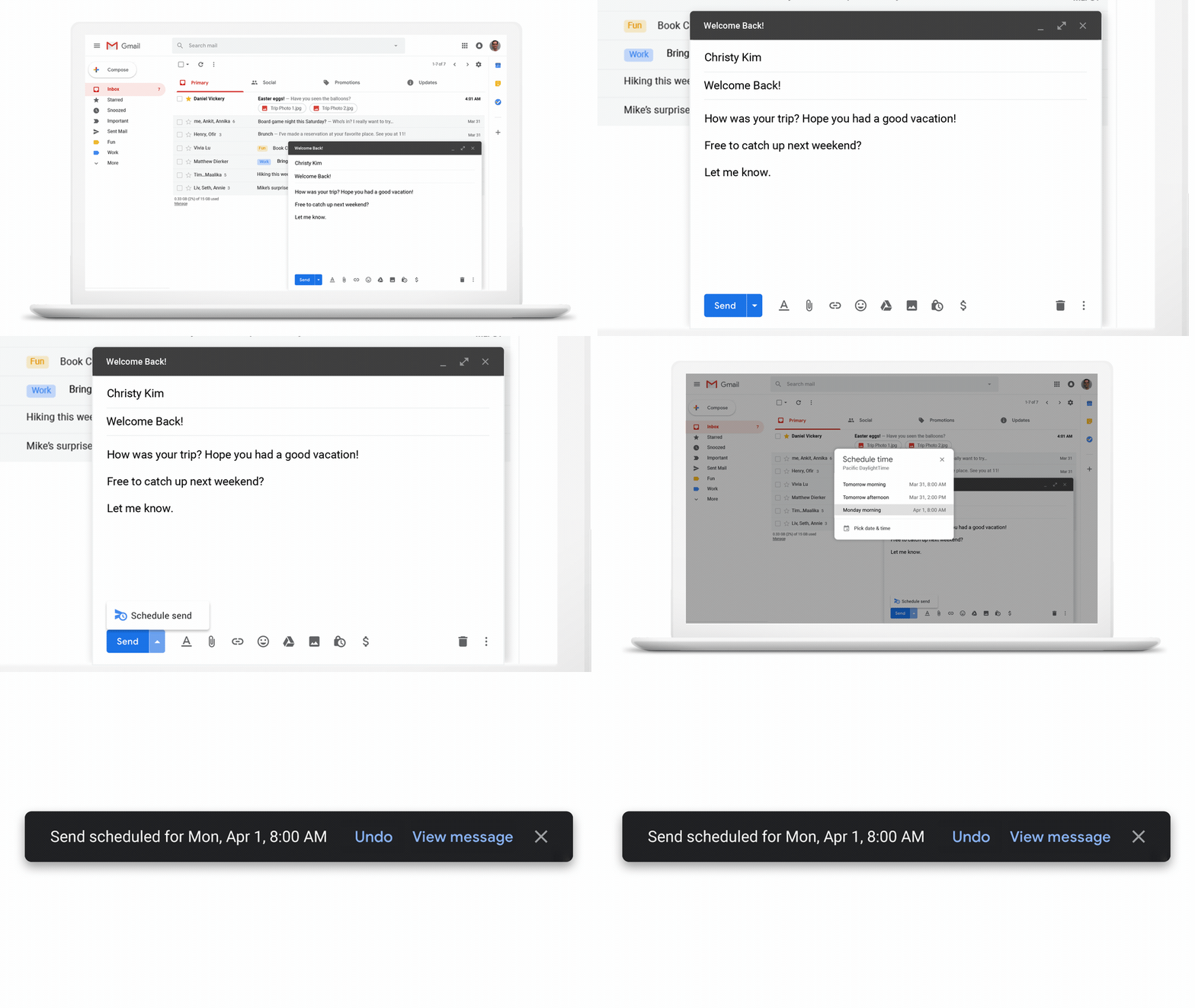
That’s all very useful, but the feature that will likely get the most attention today is email scheduling. The idea here is as simple as the execution. The ‘send’ button now includes a drop-down menu that lets you schedule an email to be sent at a later time. Until now, you needed third-party services to do this, but now it’s directly integrated into Gmail.

Google is positioning the new feature as a digital wellness tool. “We understand that work can often carry over to non-business hours, but it’s important to be considerate of everyone’s downtime,” Jacob Bank, Director of Product Management, G Suite, writes in today’s announcement. “We want to make it easier to respect everyone’s digital well-being, so we’re adding a new feature to Gmail that allows you to choose when an email should be sent.”