Category: UNCATEGORIZED

29 Mar 2019

Sinemia says canceled accounts are defense against subscriber misuse

Every time we publish a story about about MoviePass competitor Sinemia, a funny thing happens: our Twitter mentions explode. Seriously, follow the reactions to this post and see for yourself.  A number of folks have had cards canceled or have otherwise inactive accounts and are understandably not psyched.

Recently, we reached out to the company and received the following statement,

Sinemia is a FinTech company in the entertainment industry. Just like any other FinTech company, Sinemia also faces its own challenges of fraud. After conducting a detailed fraud detection analysis earlier this month, Sinemia has terminated a very small number of user accounts for fraudulent activity and misuse.

The statement goes on to explain “99 percent” of users are unaffected, and it offers “full refunds of the difference between their membership payment & fees and ticket purchases” for those who are.

This morning, the company announced a $15 a month Always Unlimited plan, which offers users one movie a day. It’s not Sinemia’s first unlimited plan, and coming after MoviePass’ move last week to bringing back its own unlimited plan, the Sinemia announcements includes the company’s by-now obligatory digs at its competitors.

But along with the plan, the company is also releasing a statement detailing the aforementioned actions around account cancelations.

The two-page statement notes says the company conducted “a detailed fraud and misuse detection analysis earlier this month,” and has removed around 3 percent of accounts due to “misuse or fraudulent activity” since the beginning of March. It’s a larger number than the 1 percent implied earlier, but still qualities as a small portion of the overall subscriber base.

“When fraud is allowed to run rampant, it can take down an entire business, a scenario in which everyone loses,” the company says. “It’s critical that all our customers use the service correctly and that we take fraud and misuse seriously. This kind of vigilance helps us combat misuse, ensuring all our customers continue to enjoy movies at affordable and sustainable prices.”

As for how the company defines “misuse or fraudulent activity,” there are a number of potential scenarios, including using multiple accounts on one device, purchasing tickets for others on one (non-family) account, scalping tickets and not checking in at a theater.

Those bits certainly sound similar to the fraudulent activity Ted Farnsworth discussed in a recent interview with TechCrunch. The CEO of MoviePass owner Helios and Matheson Analytics placed the company’s woes almost entirely at the feet of such activity.

“They would share their code,” Farnsworth told TechCrunch. “You’d have one person going to 20 movies a month, 30 movies a month. Which you know and I know, as much as we like movies, most people aren’t going to 30 movies a month.”

The executive put MoviePass subscribers’ fraudulent activity at a much higher 20 percent.

But customer complaints about Sinemia — which also include concerns about undisclosed fees — appear widespread enough to have triggered a class action suit. Filed in a Delaware court in February, the suit alleges:

Sinemia, however, has essentially become a bait-and-switch scheme: it lures consumers in by convincing them to purchase a purportedly cheaper movie subscription, and then adds undisclosed fees that make such purchases no bargain at all. Sinemia fleeces consumers with an undisclosed processing fee each time a plan subscriber goes to the movies using Sinemia’s service.

A Sinemia Support Twitter account (along with the standard Sinemia account), meanwhile, appears to be working overtime to address user complaints.

It’s hard to say ultimately how many accounts are impacted. But as with MoviePass’ troubles have shown, this sort of negative publicity can certainly leave a real impact on a company’s reputation.


29 Mar 2019

Daimler Trucks buys a majority stake in self-driving tech company Torc Robotics

Daimler Trucks just announced that it’s acquiring a majority stake Torc Robotics, a deal that will see the two companies collaborating on the development of Level 4 self-driving trucks.

Daimler Trucks is the world’s largest truck manufacturer and a division of the larger Daimler Group.

Torc, meanwhile, was founded in 2005. For most of its history, it specialized in self-driving software and sensors for commercial, industrial and military use, before recently shifting its attention to consumer vehicles. Earlier this year, it announced a partnership with public transportation company Transdev to create autonomous shuttles that connect people to transit.

The autonomous driving company is headquartered in Blacksburg, Virginia, where Torc and Daimler executives announced the deal.

Martin Daum, the member of Daimler’s board of management responsible for trucks and buses, had a statement praising the partnership as providing “the ideal combination between Torc’s expertise on agile software development and our experience in delivering reliable and safe truck hardware.”

The companies said that the partnership will see Torc working with Daimler Trucks’ developers to move into the trucking market, while maintaining the Torc name, team and facilities.

The financial terms were not disclosed. The acquisition will also need to receive regulatory approval from U.S. authorities.

“With the ever rising demand for road transportation, not the least through e-commerce, there is a strong business case for self-driving trucks in the U.S. market and I believe the fastest path to commercialization for self-driving trucks is in partnership with Daimler Trucks, the OEM market leader,” said Torc CEO Michael Fleming in a statement. “This move is in line with our mission of saving lives and represents another major milestone for Torc since crossing the finish line in the DARPA Urban Challenge 12 years ago.”

29 Mar 2019

Lyft’s IPO, Casper the friendly unicorn and WeWork’s staggering losses

Hello and welcome back to Equity, TechCrunch’s venture capital-focused podcast, where we unpack the numbers behind the headlines.

This week we had the full gang around, with Connie Loizos in the studio with Kate Clark and our guest Barrett Cohn from Scenic Advisement. Alex was on the line from Providence.

Lucky for us, news of Lyft’s IPO pricing broke right before we hit record. That shook things up a bit, but it was far better to have it break as we were getting our notes together rather than after we kicked off. Let’s start there.

Lyft is going out at $72 per share, the top-end of its boosted range. The firms fully diluted $24 billion valuation (give or take) will be supported by around $2.4 billion in new capital, giving Lyft fresh runway to continue its expensive growth strategy.

Next, we turned to podcast industry stalwart Casper. Fret not podcast fans, the D2C mattress company has $100 million more in the bank, a fresh $1.1 billion valuation and IPO plans on the horizon. That’s a pretty parcel of news, which means it should be a full-charge ahead for the newly minted unicorn.

We also discuss newly leaked Casper financials. The company, like most unicorns, is still losing money but its swelling annual revenues point to a profitable future.

From unicorn to unicorn to unicorn, we moved on to WeWork. WeWork, now known by its stage name The We Company, reported its 2018 financial performance this week and the results were amazing, twice. Amazing first in terms of growth, with revenue spiking from $886 million in 2017 to $1.8 billion in 2018. And amazing again in terms of cost, as WeWork’s net loss shot from $933 million in 2017 to $1.9 billion in 2018.

We had a chat about precisely what the firm is, with our guest arguing that WeWork isn’t a tech company at all, it’s a real estate business. We aren’t sure what the future holds for WeWork but we’re glad to have a front-row seat to the Adam Neaumann show.

Finally, investors are once again in trouble. This time the venture community is taking stripes for landing in the college admissions cheating scandal. As if we still thought this country was a meritocracy.

Regardless, your friends at Equity are glad to see you. And we’ll be back before you miss us!

Equity drops every Friday at 6:00 am PT, so subscribe to us on Apple PodcastsOvercast, Pocket Casts, Downcast and all the casts.

29 Mar 2019

Built Robotics’ massive construction excavator drives itself

I’ve never had a meeting quite like the one I had with Built Robotics.

Within about ten minutes of meeting Built’s co-founder Noah Ready-Campbell, we’re steering an 80,000 pound construction excavator around what is basically his company’s back yard.

He wants me to see what it’s like to drive one; how much skill and finesse it takes to safely and efficiently move mountains of dirt around with this massive machine. The answer? Lots.

That’s why his company wants these machines to drive themselves.

Built is taking the concepts and technology that others are using to build self-driving cars and adapting it for a whole different vertical: construction.

They’ve built a kit that retrofits existing construction equipment with hardware like LIDAR, GPS, and WiFi, giving it the ability to autonomously map and navigate its surroundings. Rather than trying to build its own dozers and excavators and fight its way into an already dominated market, Built is aiming to make a kit that works across the popular equipment already out on job sites. They sell and rent the kits to companies, then charge a usage fee whenever the machine is working in its autonomous mode.

They showed this tech at a smaller scale for the first time in 2017, implementing it into the compact track loader pictured above. Now it’s expanding into bigger equipment, including dozers (pictured below) and excavators (pictured up top). See those black boxes on top of each vehicle? That’s where all of Built’s tech lives.

Back in their office, we look out at the machines in their lot. Noah and the Built team switch the excavator into automated mode, bringing up a map of what’s just outside the window. A red border tells the machine where it’s allowed to go; if it for any reason edges past those borders, the whole machine shuts down.

Cameras on and around the vehicles are constantly checking for anyone who might stray too close. If something goes wrong and the machine starts to tip too much, or if on-board sensors detect that something is in the way underground? Power gets cut. And there’s a big red emergency stop button on the back of each machine (and a wireless button meant to stay on the operator’s desk) for good measure.

They fire up the excavator, and it starts digging away at its task. Every move the machine makes is represented on the screen. A blinking sea of dots surround the on-screen vehicle, indicating the terrain it’s sensing around itself. It’s an absolute trip, watching these machines roll around and push and dig with no humans in their cabs. It reminds me of StarCraft for some reason.

Won’t these machines take jobs from people who want them? The construction industry is in the middle of a severe labor shortage, Noah tells me. The industry seems to agree, with The Associated General Contractors of America having just this month asked Congress to support a temporary work visa program to bring more potential workers in.

But we’re not the only country facing a construction labor shortage, and it’s not one that’s likely to end soon. As BuildZoom CEO Issi Romem makes clear in this post, there aren’t enough young people entering the field to keep up.

What if instead of one vehicle per operator, each operator could oversee an automated fleet of two, or three, or five? They could give the machines a map of what they needed dug, fire them up, and only step in the cab when theres something the machines can’t do. It won’t solve the shortage, but it might help fill the gaps.

It’s still early days for Built. It’s built a research fleet of seven vehicles, and they’re coming up on their 10th completed construction project; all in all, their fleet has about 6,000 hours of operating time. But they should be good to keep rolling for a whole lot longer, with the company having $100 million dollars in contracts now signed.

This is Noah’s second startup. He sold his first startup, a clothing resale site called Twice, to eBay in 2015.

29 Mar 2019

Huawei books $8.8B profit for 2018 as consumer devices become top moneymaker

Despite an ongoing tussle with the U.S. government, signs look positive for Huawei. The Chinese firm just released its end of year report for 2018 and profit is up 25 percent to 59.3 billion CNY, or $8.84 billion, thanks to its fast-growing smartphone and devices business.

Huawei isn’t a public company but it does release financial reports that are audited by KPMG. The big takeaway from its latest financials is that it has become a hardware company — that’s to say that revenue from consumer devices overtook Huawei’s core telecom business, which involves selling networking gear to carriers.

Overall revenue for 2018 was 721 billion CNY, or $107.4 billion, which represented a 19.5 increase year-on-year.

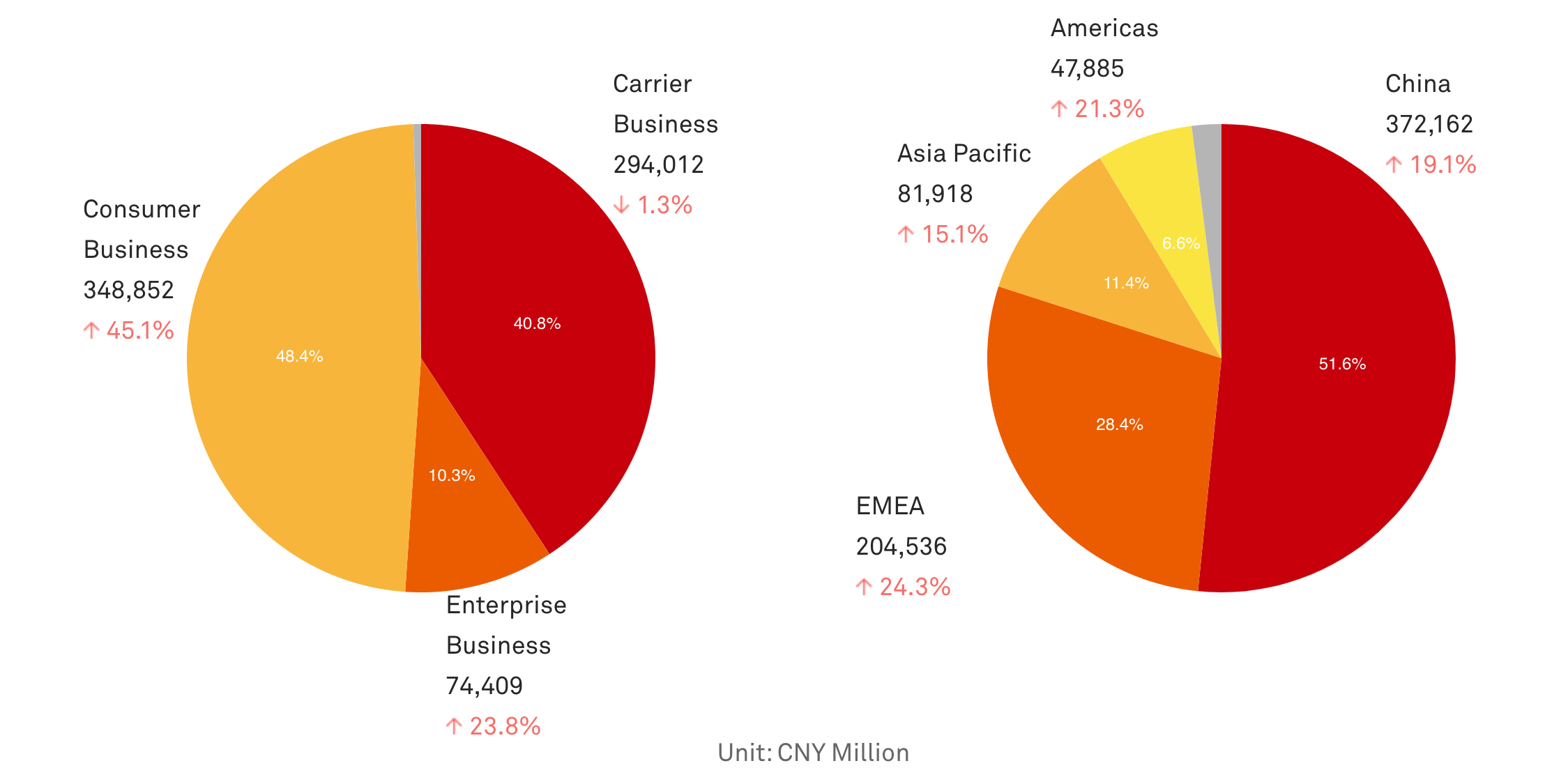
Huawei said revenue from its consumer business rose by 45 percent to reach 349 billion CNY ($52 billion), with its carrier business dropping 1.3 percent to 294 billion CNY, or $43.8 billion. Enterprise services is the third revenue bucket, and that accounted for the remaining 74.4 billion CNY.

The company is, unsurprisingly, still reliant on China, which accounted for 52 percent of its revenue in 2018 although Huawei saw stronger growth from other global markets. Its business in the Americas, however, lags that of Europe and The Middle East and Asia Pacific in terms of revenue, and that isn’t likely to change soon.

Huawei’s end of year financials show its consumer devices business is now its main money-maker

Huawei is certainly riding some momentum in the consumer space, having launched its latest P30 and P30 Pro smartphones last week — which come with some very impressive camera specs — and generally climbed the smartphone sales chart. Research firm IDC said Huawei grew its shipment volumes 33.6 percent thanks to its Honor brand. The firm ranked Huawei third with 16.1 percent market share in Q4 2018.

It’s on the carrier front where Huawei is being tested hardest.

The Chinese company has fought back against a ban on its equipment in the U.S. through a lawsuit arguing that federal agencies and contractors have violated due process and acted in a way that is unconstitutional. Still, the U.S. concern around national security has been fortified by a U.K. government report released this week which claimed there are “significant technical issues” around adopting its telecom network kit.

The report, prepared for the National Security Advisor of the UK by the Huawei Cyber Security Evaluation Centre (HCSEC) Oversight Board, said it has “not yet seen anything to give it confidence in Huawei’s capacity to successfully complete the elements of its transformation programme that it has proposed as a means of addressing these underlying defects.”

29 Mar 2019

Venezuela is losing a generation of tech talent to its humanitarian crisis

The escalating crisis in Venezuela has seen sky-high hyperinflation, widespread hunger and a large-scale exodus out of the country. The desperate circumstances have led to more than three million Venezuelans leaving the country for a better life. According to recent numbers published by the UN, Latin American countries have doled out around 1.3 million residence permits and other state authorisations to Venezuelans in need.

The impact on the country has been generational and this effect is no different when applied to its tech sector. Once considered one of the centres of wealth and innovation in Latin America, Venezuela’s capital Caracas now stands a shell of its former self, having seen a core of top talent leave for other countries on the continent.

“At the end of the day they’re going to leave,” Daniel Knobelsdorf told us about the situation in Caracas. “Eventually, the market is going to enter a phase of cannibalising itself.”

Knobelsdorf has seen the carnage in Caracas first-hand having spent much of his time within the city’s entrepreneurial circles.

Formerly an advisor to a parliamentary committee on Science, Technology and Innovation in Venezuela, Knobelsdorf is now blockchain strategist for Kruger Corp and has regularly seen Venezuela’s top tech minds–particularly among experienced candidates–find greener pastures elsewhere. “Most of the tech guys here are very junior,” he said, “By the time you get a person going full-stack or getting more senior, they’re going to be leaving for Chile.”

The crisis in Venezuela’s first major symptom was a hyper-inflating currency which not only prevented tech talent migrating from other Latin American nations, it also led to salaries stagnating for local workers; all the way from programmers to executives.

The situation has gotten so extreme that money isn’t counted anymore, it’s weighed, as the sheer amount needed to buy basic goods has lead to widespread poverty within the country.

According to a recent ENCOVI study into living conditions in Venezuela, 87 percent of the country now live under the poverty line. And despite much reporting around the so-called “boom of cryptocurrency” in Venezuela, the country’s inability to find cash for its most experienced workers has led many to look elsewhere.

Venezuela’s economy remains under the shadow of former President Hugo Chavez’s risky policies. Above, a mural in Táchira, Venezuela. Photo by Arjun Harindranath/The Bogotá Post

A 2018 Global Talent Competitiveness Index (GTCI) put out by INSEAD last year lays out the cold facts of Venezuela’s “brain drain”. Out of 119 countries, Venezuela came in at number 105 for the ability to compete for talent in specialised professions. Moreover, the country ranked poorly in its ability to attract talent from elsewhere and was at the very bottom when it came to keeping its brightest minds. The tragedy of this ranking becomes all too acute on realising that this result is despite Venezuela’s high education outcomes and highly-educated workforce.

The report also highlighted another common reality for Venezuelans: that of an uncertain security situation and the rampant rise of crime in the country. From safety while travelling on the city’s public transport, to the constant danger of muggings, many have now decided to move on from their homeland for a more secure future.

This also contributes to a larger problem — the crumbling infrastructure necessary for tech companies and professionals to continue working in the country. Venezuela was known to be one of the Latin American countries with the best internet connectivity in the past. But now, with frequent power outages and irregular coverage, many companies have looked to opt out of the country. A recent study also showed that internet speed within Caracas now stands at less than half of the average speed within Latin American countries.

A family walks towards a better life in Colombia. The crisis has led many families to leave their country, often on foot. Photo by Arjun Harindranath/The Bogotá Post

In addition to companies and multinationals having left the country as a result of the crisis, the country’s top scientific minds too have followed suit

According to a new article in Scientific American, this science “brain drain” has its roots in the Chavez regime when former President Hugo Chavez fired employees of PDVSA, Venezuela’s state-owned petroleum company, after they went on strike against his radical policies. This then led to a first wave of mass migration of the country’s scientists to the US.

Under his successor Nicolás Maduro things didn’t pick up for scientific research either, with funding all but evaporating. This trend also applied to universities where low salaries–as low as US$18 a month–have led to large scale walkouts in both public and private institutions in Venezuela.

Although many of the earlier waves of migration left for the US. Others chose Latin American countries that were more developed and willing to take in Venezuelan professionals. Jorge Pacheco was one such worker having joined as a developer at intive-FDV in Buenos Aires, as part of the company’s active recruitment of Venezuelan labour.  “The level of formation is much higher in Argentina and much more technical. It really gives us a chance to learn more by being here as all the larger companies are from Argentina,” Pacheco said.

The Argentine company, that creates software-based solutions for enterprise companies, now has 10% of its workforce originating from Venezuela and, looking more specifically for programmers for their office in Buenos Aires, intive-FDV has found the program a success in increasing the diversity of their workforce.

Although Pacheco was one of the luckier ones, others can’t immediately walk into tech jobs on leaving the country. Across the continent, many tech and science grads have had to look for what work they can find, be it teaching, driving ride-shares working at restaurants or smaller jobs like cleaning houses to get by.  

Colombia, having taken the lion’s share of Venezuelan nationals following the crisis, has seen a large influx into their informal economy. With over a million Venezuelans choosing to call their western neighbour home, it also comes as little surprise that Venezuelans would also be among Colombia’s tech ecosystem as well.

Francisco Fernandez came to, Medellin, Colombia around 18 months ago. His heart condition along with Venezuela’s failing healthcare system made the choice to leave a difficult but necessary step. His fortune came in the fact that The History Channel (Español) took him on as an animator on a remote contract, allowing him to work anywhere in the world. Like many media professionals and companies–including Latina Productions and VC Media–Fernandez chose Colombia for its ease of access to his home country.

“I’d like to go back soon,” Fernandez says. “There’s a generation that’s probably lost but I think many people in the tech sector will want to return. I know a lot of people in good positions at good companies that want to return when Venezuela gets better.”

Which is perhaps why it’s so crucial that Venezuela’s brightest minds do find firmer, safer footholds elsewhere to give Venezuela a fighting chance when it finally finds political and economic stability. Recent worrying events are likely to ramp up the mass flight from Venezuela, with their technological sector looking to suffer along with it. A turning point, when it finally arrives, will no doubt look to Venezuela’s diaspora to rebuild what has been destroyed.

29 Mar 2019

Grab is talking to Ant Financial and PayPal about spinning out its financial services business

Grab, the $16 billion-valued ride-hailing firm that acquired Uber’s Southeast Asia business last year, is in talks with Alibaba’s Ant Financial and PayPal as it considers spinning out of its financial services unit to double down on its non-transportation business, TechCrunch has learned.

The seven-year-old company’s coming-of-age moment was a deal to buy Uber’s regional business last year, but it hasn’t enjoyed the total monopoly many foresaw. Instead, it is faced with a growing challenge from rival Go-Jek, a $10 billion company backed by Google, Tencent and others, which is expanding across the region from Indonesia. In response, Grab is placing an increased focus on financial services as it seeks to become the ‘everyday app’ for consumers in Southeast Asia, where digital spending is expected to triple by 2025.

Grab Financial Group — which covers the GrabPay service and ventures that include insurance and loans — would operate independently of the core Grab business if spun out, but could start its new life with some notable allies. Grab is in early discussions with Ant Financial, Alibaba’s financial services business, and global payments firm PayPal over potential strategic investments, two sources with knowledge of talks told TechCrunch.

Grab has been heavily linked with an investment from Alibaba — having held discussions in the past — but backing Grab Financial might make more sense for the Chinese firm since it aligns with Ant Financial’s push into Southeast Asia, which has seen investments in the Philippines, Thailand and Indonesia among other markets.

A spin-out could happen in the coming months, according to one of the sources.

Deal Street Asia previously reported that Ant, which operates Alibaba’s hugely successful Alipay service and other financial ventures, would invest in Grab’s financial services unit.

“We don’t comment on rumors or speculation,” a PayPal spokesperson told TechCrunch.

“We don’t comment on market rumors and speculation,” a Grab spokesperson told TechCrunch.

A spokesperson for Ant Financial declined to comment.

The move would cap a busy recent period for Grab, which earlier this month announced a $1.48 billion investment from SoftBank’s Vision Fund, a deal that TechCrunch first reported on in December. That financing took Grab’s ongoing Series H round to $4.5 billion. We previously reported that it could close out at around $5 billion and Grab has confirmed that it is still raising capital for the round. It’s important to note that the spin-out of Grab Financial Services would not be directly related to the round.

Headed by long-time Grab executive Reuben Lai, Grab Financial Services is — as the name suggests — focused on building out fintech and payment services for the ride-hailing firm as part of its ‘super app’ strategy. That’s designed to take Grab from merely being a transportation app, in the purest sense of what Uber and its rivals began as, and develop it into a daily app for Southeast Asia’s 600 million-plus consumers.

Beyond the obvious areas like transportation and food delivery, Grab has added its own payment service — in addition to rides, GrabPay covers online and offline merchants in selected markets in Southeast Asia — and teamed up with partners to add SME loans, insurance, cross-border transfers and more. Internally, Grab sees its financial platform as ‘glue’ that can keep its core app sticky for users whilst helping build new revenue streams and business lines beyond transportation — which, as we all know, is a highly capital intensive industry.

“This year is all about doubling down on financial services and really executing on that,” Lai told TechCrunch in an interview on the sidelines of the Money2020 event in Singapore this month, where Grab announced new insurance and loans products. Right now, many of those financial products are limited to Singapore, but Lai said Grab plans to offer its suite of financial services across the region over time.

Reuben Lai, senior managing director at Grab Financial Group, speaks during the Money20/20 Asia Conference in Singapore, on Tuesday, March 19, 2019. [Photographer: Nicky Loh/Bloomberg/Getty Images]

Lai spent three years as Grab’s chief of staff and head of business development before moving to lead Grab Financial Group a year ago. He claimed that Grab, which says it has e-money licenses in Southeast Asia’s six largest countries, is “the largest payments ecosystem” in the region. Grab doesn’t provide figures for the volume of its payment flows.

Beyond financial services, Grab is courting third parties in content, services and other verticals with the lure of adding their businesses to its app, which claims over 130 million downloads in Southeast Asia. Grab Platform — as the initiative is called — has added video service HOOQ, China’s Ping An Good Doctor, travel firm Booking.com, e-grocer HappyFresh, and others.

Southeast Asian consumers could be forgiven for a feeling of deja vu. Grab’s super app strategy is reminiscent of that of Go-Jek, its chief rival in the region post-Uber, which successfully built a dominant position in its native Indonesia using a ‘constellation’ of services that included GoPay and other on-demand services. Go-Jek’s financial services unit remains part of the overall business, but it’ll be interesting to see whether that changes as it scales up.

Unlike Grab, which expanded across the region before fanning out into new verticals beyond transport, Go-Jek built its reputation in Indonesia before launching in new markets for the first time last year. Go-Jek has moved into Vietnam, Singapore and Thailand using core transportation services. It remains to be seen whether, or indeed when, those new markets will get the financial services and other offerings that Go-Jek serves up in Indonesia.

29 Mar 2019

Tencent-backed news app Qutoutiao nabs $171M from Alibaba

The race to give Chinese users their daily dose of news intensifies as Qutoutiao, a rival to TikTok parent Bytedance, net an installment of sizable backing.

Alibaba is injecting $171 million in a convertible loan to Qutoutiao, the three-year-old news and video aggregation startup, according to an announcement released Thursday. The transaction will convert into about 11.4 million shares of Qutoutiao at a price of $15 per American depositary shares, representing about 4 percent of Qutoutiao. The deal arrived just six months after Qutoutiao raised $84 million in a downsized initial public offering through Nasdaq.

TechCrunch has reached out Qutoutiao for more details on its new funding and will update the story if we hear back.

Qutoutiao, which means “Fun headlines” in Chinese, runs a news app that feeds users content based on their past habit and an e-book reading app for those with a longer attention span. The Shanghai-based company is among a handful of startups alongside ecommerce challenger Pinduoduo that are piling into the largely untapped, smaller cities outside China’s major urban centers of Beijing and Shanghai for growth.

The fresh capital will make Qutoutiao one of the unusual Chinese tech startups with backings from both Alibaba and Tencent, the arch-foes that compete in many realms. The other companies that have enjoyed fundings from both heavyweights include car-hailing service Didi Chuxing and youth-focused media company Bilibili.

Alibaba’s support is also a significant boost for Qutoutiao as it fights a relentless battle with Bytedance, a growing threat to China’s tech veterans. Unlike most of China’s emerging startups, Bytedance has not taken fundings from Baidu, Alibaba and Tencent, collectively known as the “BAT” to acknowledge their dominance in the Chinese internet.

Bytedance has had a history of hostility with social media leader Tencent while it has been more pally with Alibaba the e-commerce giant, which agreed to facilitate ecommerce sales for Bytedance influencers.

Bytedance runs an empire of popular new media products that include short-form video app Douyin and news distribution platform Jinri Toutiao. TikTok, which is the international version of Douyin, is turning heads across the globe including in the United States and has reportedly spurred a Facebook clone.

Battling in the relentless Chinese market has come at huge costs for Qutoutiao, which sees itself spending heavily on marketing to collect and retain users. While its 2018 revenues jumped 484 percent to $440 million, net loss soared to $283 million in the year compared to just $14.3 million in the previous period. But the startup is ready to spend more as it works on a new app that could take on Douyin in China’s blossoming short-form video market.

29 Mar 2019

Google pulls controversial anti-gay religious app from the Play Store

The same day the Human Rights Campaign downranked the company in its index of the best LGBTQ-friendly employers, Google decided to yank a controversial app accused of promoting conversion therapy from the Play Store.

On that list, known as the Corporate Equality Index, the HRC, a prominent LGBTQ rights organization, included a footnote that it was aware of the conversion therapy-style app by Living Hope Ministries in the Google Play Store. The app’s removal was first reported by Axios. TechCrunch confirmed that links to the Living Hope Ministries app are no longer functional.

“… Conversion therapy can lead to depression, anxiety, drug use, homelessness, and suicide,” the HRC wrote in its index. “Pending remedial steps by the company to address this app that can cause harm to the LGBTQ community, the [Corporate Equality Index] rating is suspended.”

TechCrunch has reached out to Google for details about its decision and what specific rules the Living Hope Ministries app was found to violate.

Living Hope Ministries, based in Arlington, Texas, denies that it promotes conversion therapy, an institutionally denounced practice in which a usually religious group tries to “correct” an individual’s same-sex attraction. Living Hope Ministry’s website states that it “speaks to thousands of people each year about how they, as Christ-followers, might respond redemptively to those who are struggling with same gender attraction.” The group also notes that it specializes in supporting the “wives of men who struggle with same gender attractions.”

Apple pulled the Living Hope Ministries app in December after facing public pressure and a campaign against the app by the organization Truth Wins Out. Amazon soon followed suit, but the app remained live in Google Play until today.

29 Mar 2019

The FT is buying another media startup: Deal Street Asia

Fresh from picking up a majority stake in Europe-based The Next Web, the Financial Times is buying another tech blog. The newspaper, which was founded in 1888, is adding Singapore-based Deal Street Asia to its roster with a deal expected to close in April, according to three sources with knowledge of discussions.

Founded in 2014 by Indian journalists Joji Thomas Philip and Sushobhan Mukherjee, Deal Street Asia mixes Asia startup news with updates from Asia’s financial markets and business verticals. It has around a dozen reporters across Southeast Asia and India, as well as a license to use content from wires. Its investors include Singapore Press Holdings, Vijay Shekhar Sharma, the founder of Alibaba-backed Paytm, the Singapore Angel Network and Hindustan Times, the Indian media firm that operates Mint, which is a Deal Street Asia content partner.

The company never disclosed its total fundraising, although TechCrunch wrote about an undisclosed round that closed in late 2015.

The deal is led by Nikkei, the Japanese parent of the FT, which has agreed to buy at least one-third of Deal Street Asia, one source told TechCrunch, but the total stake could reach 51 percent (as was the case with The Next Web) depending on which investors decide to sell. A separate source said the investment is worth at least $5 million. That would represent a positive return for all investors with early backers potentially banking 4-5X. That’s a pretty handsome result for an investment in a media business, which are often efforts to spark an ecosystem or at least include a lower expectation on a return.

“The FT is not involved in plans to acquire Deal Street Asia,” an FT spokesperson told TechCrunch.

Deal Street Asia declined to comment. At the time of writing, Nikkei’s press department had not responded to a request for comment that was sent yesterday at 20:31 Japanese time.

TechCrunch understands that the deal for Deal Street Asia will be similar to that of The Next Web. That’s to say that one of the primary interests is adding the company’s events business to its roster to help to break into the conference scene in Southeast Asia.

Deal Street Asia’s events are targeted at a business crowd. For example, its main summit in Singapore in September costs upwards of $1,000 and features senior executives from the likes of DBS, Grab, Sea, GGV, Allianz and IFC.

The startup uses a subscription business for its website, which is priced upwards of $89 for three months of complete access. Its paywall is a selective one that keeps some stories locked for subscribers, whilst others are left open for all readers.

Deal Street Asia’s upcoming Asia PE-VC Summit takes place in Singapore in September

This far from it for the FT in terms of deals. TechCrunch understands that the company is actively seeking acquisition and investment opportunities in media startups across the world. Beyond augmenting its existing events business, one source told TechCrunch that the FT is considering a new media subscription business which could bundle some of its acquisitions together. That’s very much an ongoing work in progress as seeks additional deals to plump up that potential subscription offering.

Aside from The Next Web and Deal Street Asia, the FT has acquired content startup AlphaGrid, intelligence service GIS Planning and research firm Longitude. The FT itself was bought by Nikkei from previous owner Pearson for $1.3 billion in 2015.

Disclaimer: The author is a former employee of The Next Web