Category: UNCATEGORIZED

29 Mar 2019

Investment platform Ellevest raises $33M Melinda Gates’ Pivotal Ventures, Valerie Jarrett & PayPal

Ellevest, a digital investment platform specifically focused on helping women meet their financial goals, has raised an additional $33 million in a new round led by Rethink Impact and PSP Growth. The funding includes a handful of notable, new investors including Melinda Gates’s investment fund Pivotal Ventures; PayPal; Wynn Resorts co-founder Elaine Wynn; former Google and Alphabet chairman Eric Schmidt; former top aide to President Obama, Valerie Jarrett; Gingerbread Capital, founded by Linnea Roberts; and Mastercard.

The startup was founded by former Citigroup CFO Sallie Krawcheck, and launched in May 2016 at TechCrunch Disrupt NY after having previously raised its $10 million in seed funding.

As Krawcheck explained at the time, women were in need of a financial platform that took into account specifics related to their lives – like the fact that their salary arc over a lifetime is different from men, because women typically live longer; or because there are salary differentials between women’s and men’s pay; as well as other factors that some women face – like choosing to take time off from a career to focus on children.

Women also have a different approach to investing, at times. Some may be more risk “aware,” then end up holding onto money as cash for longer – which isn’t always the best move in terms of creating wealth. Ellevest speaks to women in terms they can relate to without “dumbing it down,” Krawcheck says.

Following its 2016 launch, Ellevest raised a $34.6 million Series A in 2017.

Today, the company says it has clients in all 50 states and Puerto Rico, and their average age is 34. It didn’t disclose how many customers it has, however.

Ellevest also recently launched a new product, Ellevest Private Wealth Management, designed for high net worth clients, which now has $100 million in assets under management. Another newer feature is its Premium Service offering, which connects clients with executive coaches and certified financial planner pros.

Speaking in a TV interview with CNBC, Krawcheck said the company’s suite appeals to a range of women at different financial stages.

“The response to what we’re doing has been so great. We started with digital investing, then high net worth women said ‘I want in,'” and women who weren’t ready to invest said ‘I want in,'” she said. “So the more we can help women get in financial control, the stronger our mission, the stronger our economy.”

“When the status quo isn’t meeting women’s needs, it deserves to be disrupted, and that’s what this platform created by women for women aims to do,” said Melinda Gates, in a statement. “Women’s lives and realities are different than men’s, and I think we’ll see more and more of a demand for products designed to reflect that. This is an important market opportunity that Ellevest is well-positioned to tap into.”

Ellevest says it plans to use the capital to accelerate its growth by investing further into its technology, expanding its product categories, and its financial education offerings.

“I’m so pleased to support Ellevest as it leads the way to help women become financially stronger and meet their money goals,” said Valerie Jarrett, co-chair of the United State of Women, in a statement. “When women are stronger financially, that means a stronger economy and a stronger society. We need this change right now.”




28 Mar 2019

Facebook’s handling of Alex Jones is a microcosm of its content policy problem

A revealing cluster of emails leaked to Business Insider offers a glimpse at how Facebook decides what content is objectionable in high profile cases. In this instance, a group of executives at Facebook went hands on in determining if an Alex Jones Instagram post violated the platform’s terms of service or not.

As Business Insider reports, 20 Facebook and Instagram executives hashed it out over the Jones post, which depicted a mural known as “False Profits” by the artist Mear One. Facebook began debating the post after it was flagged by Business Insider for kicking up anti semitic comments on Wednesday.

The company removed 23 of 500 comments on the post that it interpreted to be in clear violation of Facebook policy. Later in the conversation, some of the UK-based Instagram and Facebook executives on the email provided more context for their US-based peers.

Last year, a controversy over the same painting erupted when British politician Jeremy Corbyn argued in support of the mural’s creator after the art was removed from a wall in East London due what many believed to be antisemitic overtones. Because of that, the image and its context are likely better known in the UK, a fact that came up in Facebook’s discussion over how to handle the Jones post.

“This image is widely acknowledged to be anti-Semitic and is a famous image in the UK due to public controversy around it,” one executive said. “If we go back and say it does not violate we will be in for a lot criticism.”

Ultimately, after some back and forth, the post was removed.

According to the emails, Alex Jones’ Instagram account “does not currently violate [the rules]” as “an IG account has to have at least 30% of content violating at any given time as per our regular guidelines.” That fact might prove puzzling once you know that Alex Jones got his main account booted off Facebook itself in 2018 — and the company did another sweep for Jones-linked pages last month.

Whether you agree with Facebook’s content moderation decisions or not, it’s impossible to argue that they are consistently enforced. In the latest example, the company argued over a single depiction of a controversial image even as the same image is literally for sale by the artist elsewhere on both on Instagram and Facebook. (As any Facebook reporter can attest, these inconsistencies will probably be resolved shortly after this story goes live.)

The artist himself sells its likeness on a t-shirt on both Instagram and Facebook and numerous depictions of the same image appear on various hashtags. And even after the post was taken down, Jones displayed it prominently in his Instagram story, declaring that the image “is just about monopoly men and the class struggle” and decrying Facebook’s “crazy-level censorship.”

It’s clear that even as Facebook attempts to make strides, its approach to content moderation remains reactive, haphazard and probably too deeply preoccupied with public perception. Some cases of controversial content are escalated all the way to the top while others languish, undetected. Where the line is drawn isn’t particularly clear. And even when high profile violations are determined, it’s not apparent that those case studies meaningfully trickle down clarify smaller, everyday decisions by content moderators on Facebook’s lower rungs.

As always, the squeaky wheel gets the grease — but two billion users and reactive rather than proactive policy enforcement means that there’s an endless sea of ungreased wheels drifting around. This problem isn’t unique to Facebook, but given its scope, it does make the biggest case study in what can go wrong when a platform scales wildly with little regard for the consequences.

Unfortunately for Facebook, it’s yet another lose-lose situation of its own making. During its intense, extended growth spurt, Facebook allowed all kinds of potentially controversial and dangerous content to flourish for years. Now, when the company abruptly cracks down on accounts that violate its longstanding policies forbidding hate speech, divisive figures like Alex Jones can cry censorship, roiling hundreds of thousands of followers in the process.

Like other tech companies, Facebook is now paying mightily for the worry-free years it enjoyed before coming under intense scrutiny for the toxic side effects of all that growth. And until Facebook develops a more uniform interpretation of its own community standards — one the company enforces from the bottom up rather than the top down — it’s going to keep taking heat on all sides.

28 Mar 2019

WeWork backs New York tech clubhouse Betaworks Studios

Betaworks Studios, the brainchild of New York City seed-stage venture capital fund Betaworks, has amassed the support of WeWork, or The We Company, as they now call themselves.

JLL Spark Ventures and the co-working giant have led co-led a $4.4 million investment in the membership-based co-working club described as a supportive community for builders. Launched in 2018, Betaworks Studios offers entrepreneurs, artists, engineers and creatives a place to work on projects and accumulate a network, similar to a WeWork hub.

Betaworks Ventures, which filed today to raise a $75 million sophomore fund, and BBG Ventures have also participated in the funding for Betaworks Studio, which previously raised a pre-seed round led by BBG.

Founded in 2008 by John Borthwick, Betaworks operates an investment fund, an accelerator and builds companies internally with spinouts including Giphy, Digg and Bit.ly. The idea for Betaworks Studios was to expand its resources and network to the greater entrepreneurial community.

Borthwick brought on Daphne Kwon, the former chief financial officer of Goop, to run the studio arm, which charges $2400 per year or $225 per month.

Betaworks says its studio has hosted some 9,000 people for meetings and speaking events. It currently has only one club location in New York City’s Meatpacking District but plans to open additional studios with the fresh cash.

28 Mar 2019

Facebook launches searchable transparency library of all active ads

Now you can search Facebook for how much Trump has spent on ads in the past year, which Pages’ ads reference immigration, or what a Page’s previous names were. It’s all part of Facebook’s new Ads Library launching today that makes good on its promise to increase transparency after the social network’s ads were used to try to influence the 2016 US presidential elections.

Facebook’s Ads Archive previously only included ads related to politics or policy issues, but now shows all active ads about anything as well as inactive political and issue ads. It also now shows Page creation dates, mergers with other Pages, Page name changes, and where a Page is managed from — all of which will be visible on a new Page Transparency tab on all Pages. The Library also displays Pages’ total political ad in the past week or since May 2018. And in mid-May Facebook will move to offering daily downloadable Ad Library reports instead of weekly ones as it currently does.

The improved transparency could allow researchers, government investigators, journalists, or anyone play watchdog to ensure ads aren’t being misused to spread misinformation, suppress voting, exacerbate polarization, or otherwise be sketchy.

Facebook is also expanding researchers’ and developers’ programmatic access to Ad Library API which was previously in closed beta. Now anyone with a Facebook developer account who goes through the Identity Confirmation process and agrees to the platform terms of service can use software to sift through and spot trends in the data. To prevent another Cambridge Analytica situation, Facebook tells TechCrunch it will impost rate limits on the API, but won’t disclose them to ensure bad actors can’t toe the line. When asked how else Facebook would safeguard the API given people don’t necessarily abide by the TOS, __ told me “this is why we have the Identity Verification process in place. we want to know the identity of someone accessign the data so if they do abuse our platform terms of service . . . we have the ability to revoke access.”

28 Mar 2019

Watch Rocket Lab’s first launch of 2019 lift a DARPA experiment into orbit

Rocket Lab, the Kiwi operation working on breaking into the launch industry with small but frequent launches, has its first launch of the year today, due to take off in just a few minutes. Tune in below!

The company recently, after the numerous delays endemic to the launch industry, made its first real commercial launches, which spurred a $140 million investment. It is now working on increasing launch cadence and building enough rockets to do so.

Rocket Lab CEO Peter Beck was on stage at Disrupt SF not long ago talking about the new space economy. I thought it was a great discussion. (But then, I was the moderator, so how could it not be?)

The client for today’s launch is DARPA, which has opted to use smaller launch providers for a series of experiments and deployments. Onboard the Electron rocket today is the “RF Risk Reduction Deployment Demonstration, or R3D2. It’s an experimental antenna made of “a tissue-thin Kapton membrane” that will deploy from its small package to a full 7 feet across once in orbit.

The earliest opportunities for the launch were well over a week ago, but in this business, delays are expected. But all the little warning lights are off and the weather is fine, so we should be seeing R3D2 heading skyward in a few minutes.

You can watch the whole thing live below. I’ll update the post if there are any major updates.

28 Mar 2019

Lightning Motorcycles unveils Strike e-moto, with up to 200 mile range

Lightning Motorcycles finally unveiled the electric vehicle it had been teasing for months.

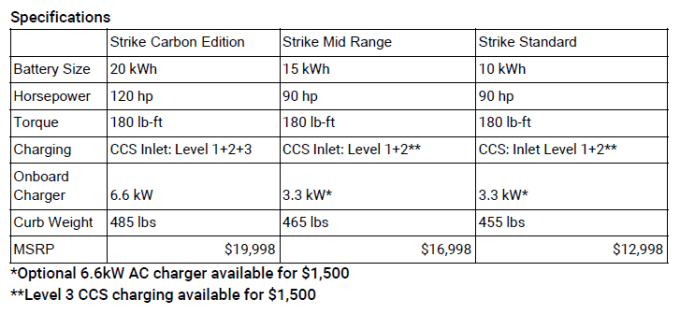
With a $12,000 to $19,000 price range, the Strike electric motorcycle has options with a 200 mile range, 150 mph top speed, and 35 minute DC fast charge times.

The new machine has a more upright riding position and friendlier price-tag than Lightning’s debut LS-218 — a $38,888, 218 mph superbike touted as the world’s fastest production street motorcycle.

With the LS-218, Lightning had previously hung its helmet on a niche (and lower sales volume) hyper-performance market.

The startup previewed the Strike as a model that would offer wider market appeal and accessibility from a rider and price-point.

This comes in a year where EV startups are facing more competition on specs and pricing, and big motorcycle manufacturers will feel more pressure to go electric.

The Strike offers 3 variants and price ranges, with its $19,998 Carbon sporting a 20 kWh battery, the highest range of up to 200 miles, and 150 mph top speed. The base $12,998 Standard Strike has half the battery power, a highway/city range of 70 to 100 miles, and top speed of 135 mph.

Lightning has been offering peeks, and taking orders for the Strike, for several months now. Deliveries begin in July.

For the last several years, e-motorcycle startups have worked to produce models that close gaps on price, distance, charge-times and performance with gas-motorcycles. They’ve also carried hopes to rejuvenate new motorcycles sales with a younger generation.

The U.S. motorcycle industry has been in pretty bad shape since the recession. New sales dropped by roughly 50 percent since 2008, with sharp declines in ownership by everyone under 40. The exception is women, who have become the only growing motorcycle ownership segment.

None of the big name producers — Honda, Kawasaki, Suzuki, BMW—have offered a production electric street motorcycle in the U.S. Harley Davidson will enter the market this summer with its $29,000 LiveWire, which brings 3 second, 0-60 mph acceleration and 110 mile range. HD has also indicated it plans a full electric pivot, with additional e-motorcycles in the pipeline, as well as e-bicycles and scooters.

Another California startup, Zero Motorcycles, has found the widest market and model breadth, with prices starting at $8,000 on its FX model. Zero upped its game recently, unveiling a new 110 horsepower, $18,000 SR/F model with a 200 mile range, one hour charge capability, and top speed of 124 mph.

Then there’s Italy based Energica, an e-moto startup catering to the high-performance motorcycle market and marketing heavily in the U.S. The company draws R&D and support from lead investor, CRP Group, an Italian company with engineering roots supporting Formula-1 and NASCAR.

As the company looks to compete, there are two things to follow with Lightning’s new Strike. The first is the its capital position and revenue growth vis-a-vis its new, lower-priced model.

Like Tesla (in the four-wheeled world), e-moto startups, such as Zero, have struggled with their burn rates and several have ultimately forced to close down. These include Brammo,  Mission Motorcycles, and, more recently,  Alta Motors—a California EV venture backed by $45 million in VC that ceased operations in October.

Little is known about how Lightning is capitalized (Crunchbase tracks only $50K in VC) or how it’s financing the new, lower-priced Strike—as an e-moto startup with lesser sales volume than Zero and less R&D support than Energica.

That leads to thing-to-watch number-two: whether the riding (or non-riding) public takes to the Strike’s new design, performance, and price mix.

During the e-moto’s teaser phase, where little about the Strike design was revealed, I’d actually expected Lightning to debut something that was less sport-bike and more of an upright e-moto—closer to Zero’s new SR/F—with appeal to both beginners and experienced riders looking to go electric.

The sport-bike platform positions the Strike more as a competitor to Energica’s premium $22K race-inspired EGO. That’s further away from the mass-market riding audience Lightning previewed as a target for its new motorcycle.

Time, sales, and the ability for the startup to attract new VC will determine whether Lightning’s new bike will electrify would-be buyers.

28 Mar 2019

Mars helicopter bound for the Red Planet takes to the air for the first time

The Mars 2020 mission is on track for launch next year, and nesting inside the high-tech new rover heading that direction is a high-tech helicopter designed to fly in the planet’s nearly non-existent atmosphere. The actual aircraft that will fly on the Martian surface just took its first flight and its engineers are over the moon.

“The next time we fly, we fly on Mars,” said MiMi Aung, who manages the project at JPL, in a news release. An engineering model that was very close to final has over an hour of time in the air, but these two brief test flights were the first and last time the tiny craft will take flight until it does so on the distant planet (not counting its “flight” during launch).

“Watching our helicopter go through its paces in the chamber, I couldn’t help but think about the historic vehicles that have been in there in the past,” she continued. “The chamber hosted missions from the Ranger Moon probes to the Voyagers to Cassini, and every Mars rover ever flown. To see our helicopter in there reminded me we are on our way to making a little chunk of space history as well.”

Artist’s impression of how the helicopter will look when it’s flying on Mars.

A helicopter flying on Mars is much like a helicopter flying on Earth, except of course for the slight differences that the other planet has a third less gravity and 99 percent less air. It’s more like flying at 100,000 feet, Aung suggested.

It has its own solar panel so it can explore more or less on its own.

The test rig they set up not only produces a near-vacuum, replacing the air with a thin, Mars-esque CO2 mix, but a “gravity offload” system simulates lower gravity by giving the helicopter a slight lift via a cable.

It flew at a whopping 2 inches of altitude for a total of a minute in two tests, which was enough to show the team that the craft (with all its 1,500 parts and four pounds) was ready to package up and send to the Red Planet.

“It was a heck of a first flight,” said tester Teddy Tzanetos. “The gravity offload system performed perfectly, just like our helicopter. We only required a 2-inch hover to obtain all the data sets needed to confirm that our Mars helicopter flies autonomously as designed in a thin Mars-like atmosphere; there was no need to go higher.”

A few months the Mars 2020 rover has landed, the helicopter will detach and do a few test flights of up to 90 seconds. Those will be the first heavier-than-air flights on another planet — powered flight, in other words, rather than, say, a balloon filled with gaseous hydrogen.

The craft will operate mostly autonomously, since the half-hour round trip for commands would be far too long for an Earth-based pilot to operate it. It has its own solar cells and batteries, plus little landing feet, and will attempt flights of increasing distance from the rover over a 30-day period. It should go about three meters in the air and may eventually get hundreds of meters away from its partner.

Mars 2020 is estimated to be ready to launch next summer, arriving at its destination early in 2021. Of course in the meantime we’ve still got Curiosity and Insight up there, so if you want the latest from Mars, you’ve got plenty of options to choose from.

28 Mar 2019

DoorDash launches a new program highlighting immigrant and refugee business owners

DoorDash launched a new initiative today called Kitchens Without Borders, which it says is designed to promote business owners who are immigrants and refugees.

It’s starting out with 10 restaurants in the San Francisco Bay Area: Besharam, Z Zoul Cafe, Onigilly, Los Cilantros, Sabores Del Sur, West Park Farm & Sea, Little Green Cyclo, Afghan Village, D’Maize, and Sweet Lime Thai Cuisine.

The entrepreneurs behind each of these businesses is profiled on the Kitchens Without Borders site. Their restaurants will also get promoted within the DoorDash app, and they’ll receive $0 delivery fees for up to six weeks.

A DoorDash spokesperson told me the initial 10 participants were selected from 60 applicants, and that the program will be expanding to include other restaurants across the country in the coming months.

This announcement comes a month after DoorDash announced that it had raised another $400 million in funding. The company also drew criticism earlier this year for its driver compensation practices.

In a blog post, CEO Tony Xu said he has a personal connection to the program:

For one, I’m an immigrant. I moved to this country from China when I was five, and my mom ran a Chinese restaurant with the purpose of creating a better life and fulfilling her dream of becoming a doctor. I worked alongside her as a dishwasher and saw firsthand what it takes to make it in this country. Over the course of 12 years, she eventually saved up enough money to become the doctor that she wanted to be and opened up a medical clinic, which she has now been running for the past 20 years.

28 Mar 2019

The two forces reshaping the landscape of shipping and logistics

The shipping and logistics space is being rapidly transformed by technology. Innovations in this space span the way buyers and sellers transact (digital freight brokerages), the way goods are monitored during shipment (sensor-enabled real-time monitoring) and the manner in which risk is managed (novel approaches to pricing insurance). With diverse opportunities like these, it is no surprise that this is a space ripe for significant disruption.

And yet technology is not the only force driving change. Regulators are taking a fresh look at the lives of workers in the gig economy, often concluding that many folks classified as independent contractors ought to be treated as employees. As we will see, this is causing a sharp uptick in the creation of small-motor carriers. At the same time, oddly enough, driver scarcity is forcing innovators in the shipping and logistics space to think very hard about how to entice new drivers into the market.

Two forces — driver scarcity and regulation — are working in unison to forge the shipping and logistics space of tomorrow. Before we dive into precisely how this is happening, let me introduce the dramatis personnae in this ecosystem:

  • Shippers — These are the folks who have goods that need to be moved from point A to point B.
  • Carriers — These are the folks who shippers hire to load goods on a truck and move them from point A to point B. I will use carriers and small-motor carriers as interchangeable terms.
  • Brokers — These are the people who connect shippers with carriers, often doing the hard work of making sure that carriers are properly licensed and have the appropriate levels of insurance.
  • FMCSA — Federal Motor Carrier Safety Administration, the body responsible for facilitating safety programs, licensing motor carriers and ensuring compliance with a wide range of shipping and transportation rules and regulations.  

A tale of software and shipping

28 Mar 2019

Lyft prices IPO at top of range

Lyft raised more than $2 billion Thursday afternoon after pricing its shares at $72 apiece, the top of the expected range of $70 to $72 per share, per reports. This gives Lyft a fully-diluted market value of $24 billion.

The company will debut on the Nasdaq stock exchange Friday morning, trading under the ticker symbol “LYFT.”

The initial public offering is the first-ever for a ride-hailing business and represents a landmark liquidity event for private market investors, who had invested billions of dollars in the San Francisco-based company. In total, Lyft had raised $5.1 billion in debt and equity funding, reaching a valuation of $15.1 billion last year.

Lyft’s blockbuster IPO is unique for a number of reasons, in addition to being amongst transportation-as-a-service companies to transition from private to public. Lyft has the largest net losses of any pre-IPO business, posting losses of $911 million on revenues of $2.2 billion in 2018. However, the company is also raking in the largest revenues, behind only Google and Facebook, for a pre-IPO company. The latter has made it popular on Wall Street, garnering buy ratings from analysts prior to pricing.

Uber is the next tech unicorn, or company valued north of $1 billion, expected out of the IPO gate. It will trade on the New York Stock Exchange in what is one of the most anticipated IPOs in history. The company, which reported $3 billion in Q4 2018 revenues with net losses of $865 million, is reportedly planning to unveil its IPO prospectus next month.

Next in the pipeline is Pinterest, which dropped its S-1 last week and revealed a path to profitability that is sure to garner support from Wall Street investors. The visual search engine will trade on the NYSE under the symbol “PINS.” It posted revenue of $755.9 million last year, up from $472.8 million in 2017. The company’s net loss, meanwhile, shrank to $62.9 million last year from $130 million in 2017.

Other notable companies planning 2019 stock offerings include Slack, Zoom — a rare, profitable pre-IPO unicorn — and potentially, Airbnb.

Updating.