Year: 2018

26 Apr 2018

Teradyne snatches up robot maker MiR in $272M deal

Teradyne, a prosaic-sounding but flush company that provides automated testing equipment for industrial applications, has acquired the Danish robotics company MiR for an eye-popping $148 million, with $124 million on the table after meeting performance goals.

MiR, which despite the lowercase “i” stands for Mobile Industrial Robots, does what you might guess. Founded in 2013, the company has grown steadily and had a huge 2017, tripling its revenues to $12 million after its latest robot, the MiR200, received high marks from customers.

MiR’s robots are of the warehouse sort, wheeled little autonomous fellows that can lift and pull pallets, boxes, and so on. They look a bit like the little ones that are always underfoot in Star Wars movies. It’s a natural fit for Teradyne, especially with the latter’s recent purchase of the well known Universal Robotics in a $350 million deal in 2015.

Testing loads of electronics and components may be a dry business, but it’s a booming one, because the companies that test faster ship faster. Any time efficiencies can be made in the process, be it warehouse logistics or assisting expert humans in sensitive procedures, one can be sure a company will be willing to pay for them.

Teradyne also noted (the Robot Report points out) that both companies take a modern approach to robots and how they interact and must be trained by people — the old paradigm of robotics specialists having to carefully program these things doesn’t scale well, and both UR and MiR were forward thinking enough to improve that pain point.

The plan is, of course, to take MiR’s successful technology global, hopefully recreating its success on a larger scale.

“My main focus is to get our mobile robots out to the entire world,” said MiR CSO and founder Niels Jul Jacobsen in the press release announcing the acquisition. “With Teradyne as the owner, we will have strong backing to ensure MiR’s continued growth in the global market.”

26 Apr 2018

Teradyne snatches up robot maker MiR in $272M deal

Teradyne, a prosaic-sounding but flush company that provides automated testing equipment for industrial applications, has acquired the Danish robotics company MiR for an eye-popping $148 million, with $124 million on the table after meeting performance goals.

MiR, which despite the lowercase “i” stands for Mobile Industrial Robots, does what you might guess. Founded in 2013, the company has grown steadily and had a huge 2017, tripling its revenues to $12 million after its latest robot, the MiR200, received high marks from customers.

MiR’s robots are of the warehouse sort, wheeled little autonomous fellows that can lift and pull pallets, boxes, and so on. They look a bit like the little ones that are always underfoot in Star Wars movies. It’s a natural fit for Teradyne, especially with the latter’s recent purchase of the well known Universal Robotics in a $350 million deal in 2015.

Testing loads of electronics and components may be a dry business, but it’s a booming one, because the companies that test faster ship faster. Any time efficiencies can be made in the process, be it warehouse logistics or assisting expert humans in sensitive procedures, one can be sure a company will be willing to pay for them.

Teradyne also noted (the Robot Report points out) that both companies take a modern approach to robots and how they interact and must be trained by people — the old paradigm of robotics specialists having to carefully program these things doesn’t scale well, and both UR and MiR were forward thinking enough to improve that pain point.

The plan is, of course, to take MiR’s successful technology global, hopefully recreating its success on a larger scale.

“My main focus is to get our mobile robots out to the entire world,” said MiR CSO and founder Niels Jul Jacobsen in the press release announcing the acquisition. “With Teradyne as the owner, we will have strong backing to ensure MiR’s continued growth in the global market.”

26 Apr 2018

Tesla’s Autopilot VP is leaving for Intel

Tesla’s VP of Autopilot and low-voltage hardware, Jim Keller, is leaving the company, Electrek first reported.

In a statement to TechCrunch, Tesla said it appreciates “his contributions to Tesla and wish the best,” a spokesperson said.

“Tesla is deeply committed to developing the most advanced silicon in the world and we plan to dramatically increase our investment in that area while building on the world-class leadership team we have in place,” the spokesperson said.

Keller’s plan is to head to Intel, where he’ll be an SVP working on developing microprocessors. His first day will be April 30, according to Intel.

“I had a great experience working at Tesla, learned a lot, and look forward to all the great technology coming from Tesla in the future. My lifelong passion has been developing the world’s best silicon products,” Keller said in an Intel press release. “The world will be a very different place in the next decade as a result of where computing is headed. I am excited to join the Intel team to build the future of CPUs, GPUs, accelerators and other products for the data-centric computing era.”

At Tesla, Pete Bannon will serve as Keller’s replacement. Bannon is a former Apple chip engineer who helped design Apple’s A5-AP chips. Meanwhile, Tesla Director of AI and Autopilot Vision will have “overall responsibility” for Autopilot software, Tesla said.

It’s worth noting Tesla’s Autopilot software has been under scrutiny following a fatal crash in Mountain View last month. The National Transportation Safety Board and National Highway Traffic Safety Administration are currently conducting investigations pertaining to the crash, which Tesla said involved Autopilot.

26 Apr 2018

Mozilla Hubs is a super-simple social chat room for robots

The socially networked web is frightening enough, but maybe chatting with some friendly robots will ease the tension.

Today, Mozilla showed off a preview of Hubs, a dead-simple social WebVR experience that users can dive into with a couple of clicks, share a URL and meet up with other people across platforms, including mobile, desktop and VR.

It’s not Second Life, or even Facebook Spaces; it’s pretty low-key. You’re just a humble robot hanging with other robots who are hopefully your friends.

It’s admittedly kind of hilarious how childish so many of these social apps for VR look right now. It’s pretty much due to the marriage of PS1-level graphics and a Club Penguin social schema. The thing that’s really being tested here isn’t a lifelike approach to detail or nifty interface cues, it’s the bare-bones simplicity of getting people into a social environment together and facilitating connections.

The broader issues that Mozilla is tackling here are the same ones others are, though Mozilla is starting its efforts with a heavy approach to cross-platform compatibility by building Hubs entirely on WebVR. Mozilla says Hubs has support for all of the major VR headsets out now. Having the web as the backbone for the service is something that’s easy to take for granted, but with most social VR experiences requiring app stores and downloads, the idea of using a URL to dive into a social environment is oddly unique.

Even when compared to VR itself, WebVR is in its earliest stages, but Mozilla is continuing to experiment and attract other developers to it. This is just a preview of Hubs; the company has plans to bring some new avatar systems and tools for developing custom spaces inside it soon.

26 Apr 2018

Amazon is now selling home security services, including installations and no monthly fees

Amazon’s made a slew of acquisitions in the area of smart home services, and now it’s offering a product that brings them together under one roof — your roof.

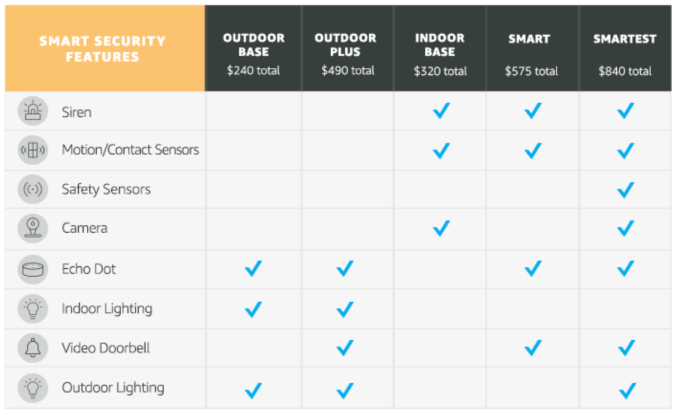
Amazon has quietly launched a portal offering home security services — which include all the equipment you would need and in-person visits from Amazon consultants to advise and install the kit. The packages are being sold in five price tiers, at a flat fee — no monthly service contracts, a significant disruption of how many home security services are sold today.

The least expensive, $240 for Outdoor Base, gives you an Echo Dot plus indoor and outdoor lighting designed “to make it look like you’re home” The most expensive tier, $840 for Smartest, includes an alarm siren, motion sensors, safety sensors, a camera, and Echo Dot, the lighting and a video doorbell — potentially rolling in previous security launches from the company like Amazon Key and Cloud Cam. All include two visits from Amazon employees to consult you and help with the installation.
The Last July it emerged that Amazon was quietly working on its own answer to Best Buy’s Geek Squad — offering repairs and installations of home WiFi, smart home devices, Alexa installations, and other hardware-related services.

Amazon never appeared to confirm it at the time, but that service now officially seems to be called “Smart Home Services” and it has expanded to Washington, Oregon, California, Arizona, Texas, Nevada, North Carolina, Georgia, Illinois, New Jersey, Washington D.C. and Florida.

The security offering we are describing here — which was initially flagged to us by a reader — falls under that general banner, and it is being promoted at the top of the Smart Home Services homepage.

Giving consumers the option of a more full-service security offering, beyond selling alarms and other devices a la carte, makes sense for a couple of reasons.

The first is that while there are some early adopters who might like the challenge of installing these services themselves, there will be many middle and later adopters who will not be interested in facing that learning curve. Amazon has positioned itself in the smart home security space as more than just a reseller of third-party devices — although it sells those, too — with acquisitions of the smart doorbell startup Ring and the smart camera and doorbell startup Blink.

The second is that most often, home security systems are coupled with service installations it in your home that include maintenance contracts, so if Amazon hopes to eat up some of that market, it needs to offer something comparable to the market.

It’s an interesting development also of the company’s wider strategy to move into selling services, beyond physical products — one of Amazon’s various efforts to diversify its business by targeting different categories of commerce and different demographics.

Another foray into human-powered services was its Thumbtack-style competitor Amazon Home Services, a marketplace it launched back in 2015 for finding tradespeople and other freelance service providers like masseurs and language tutors. (Notably, Amazon makes a big deal in its security pages of using Amazon employees to install its security systems.)

Earlier this month, it also emerged that Amazon was stealing a march on Apple in smart homes, specifically by inking deals with smart home builders, who were opting for Amazon as their preferred supplier for consulting and installing such services for their home buyers.

A report in The Information noted that one such home builder, Lennar, was “prioritizing Amazon” in its recommendations, while still working with Apple, in part because of the former company’s stronger efforts to integrate with more third-party products, giving buyers a wider range of choices.

Ramping up into security services fits with this, too. Lennar, as it happens, is directly linked now on Amazon’s security homepage, but to be clear, the offering is not exclusive to Lennar homeowners.

We’ve asked Amazon about the security service pages, and the company has acknowledged the question but still has not replied. We’ll update this post as and if we learn more.


26 Apr 2018

The Roku Channel expansion is basically confirmed

Roku essentially confirmed its plans to bring its free, ad-supported “The Roku Channel” streaming service to a wide number of non-Roku hardware platforms, with an update to its Privacy Policy. As first spotted by Variety, the new policy has users agreeing to or opting out of being served personalized ads on “non-Roku OTT devices” (over-the-top devices) like “third-party Smart TVs, set top boxes, media streaming devices, and gaming consoles.”

The company’s plans to start streaming The Roku Channel to other devices had already been reported, but not officially confirmed. Those plans became real last month, when Roku announced it would launch The Roku Channel on select Samsung Smart TVs this summer. However, Roku didn’t confirm then what other platforms, if any, would also gain access to the channel in the months ahead.

But clearly, it’s going to be quite a few – including, potentially, those from its hardware competitors who also make their own “media streaming devices.”

Roku still isn’t confirming which devices or when, but did admit the privacy policy is a hint of what’s to come.

“We don’t have any announcements right now regarding further distribution of The Roku Channel,” a Roku spokesperson said. “We updated privacy policy in anticipation of activities,” they added.

The idea with The Roku Channel is to create another revenue stream for the company that’s not tied to hardware sales.

This is a direction Roku has been heading for some time, by increasing its focus on its software platform. It has been licensing out its OS to other TV manufacturers – like Insignia, which sells its Roku TVs at Best Buy. (That happens to be the same retailer that just teamed up with Amazon to sell its Fire TV Edition sets, too.)

The Roku Channel ships with the Roku OS, but it can also be broken off and distributed on its own.

Currently, The Roku Channel aggregates the free content on Roku, alongside TV and movies from deals Roku has done itself with studios like Lionsgate, MGM, Paramount, Sony Pictures Entertainment and Warner Brothers. Just this week, Roku added live news to its channel, too, via partnerships with Cheddar, PeopleTV and a brand-new streaming news service called ABC News Live.

With The Roku Channel, Roku is no longer just a media player platform – it’s a streaming service, as well.

The ad-supported channel could find traction on other hardware devices, where users today turn to free apps like Vudu (Vudu Movies on Us), Crackle, and Tubi TV to find free content.

Roku’s pitch to advertisers is its ad personalization technology, but users are able to opt out of this targeting through the form here, it seems.

The relevant part of the new privacy policy is below:

Roku may show you personalized ads on non-Roku OTT devices such as third party Smart TVs, set top boxes, media streaming devices, and gaming consoles. To opt out of receiving personalized ads from Roku on third party OTT devices at the IP address listed below, click Submit. We associate your opt out choice with the IP address you are currently using; if you access third party OTT devices from a different IP address and wish to opt out, you will need to opt out while connected to that different IP address.

26 Apr 2018

Microsoft finally embraces the squirt gun emoji

It was just a matter of time. Microsoft confirmed this week that it’s following the industry’s lead, transforming its gun emoji into the water squirting variety. The company unveiled its design for a new, benign firearm that looks like cross between a martian ray gun and Super Soaker.

In a tweet revealing the new emoji, the company said it had evolved the design “to reflect our values and the feedback we’ve received.” The changes come as a response to growing concerns around gun violence in the U.S. The software giant is the last of the major tech firms to fall in line with a movement that includes Apple, WhatsApp, Samsung, Twitter and, most recently, Google and Facebook.

Notably, Microsoft actually had a far less realistic take on the gun emoji until a few years back, but it swapped its sci-fi ray gun out for a revolver, citing concerns over cross-platform consistency. “Our intent with every glyph is to align with the global Unicode standard, and the previous design did not map to industry designs or our customers’ expectations of the emoji definition,” the company said at the time.

Of course, consistency is key here, with regards to intent. Sending someone a playful squirt gun only to have it viewed as a real firearm (or vice versa) is a recipe some serious emoji misunderstanding. Unfortunately for Microsoft, that initial change arrived just as Apple was switching to a squirt gun, a move that helped set this whole recent trend. So much for sticking to its guns.

Microsoft has not indicated when the emoji will change over in Windows 10.

26 Apr 2018

One week left for Disrupt SF ’18 super early-bird prices

Your chance to get the best price on passes to Disrupt San Francisco 2018 — September 5-7 at Moscone Center West — is disappearing faster than affordable housing in the Bay Area. Right now, you can save up to $1,800 on Super Early-Bird pricing, but that sweet deal ends one week from today on May 3. Get your passes right here.

Why take the time and spend the money to attend Disrupt? Simply put, it’s the mother ship. It’s where tech founders, investors, hackers, leaders, makers and shapers gather to push and expand tech boundaries. Disrupt SF 2018 is our biggest Disrupt ever, with three program-packed days across four unique stages, interactive workshops, world-class speakers, Q &A Sessions and more than 1,200 startups — and that’s just the tip of the tech iceberg.

We’ll have an amazing array of speakers covering the most critical tech topics of the day on the Disrupt stages. Cryptocurrency, for example, is just one white-hot topic, and you won’t want to miss founder and former EIC Michael Arrington (of Arrington XRP Capital, a $100 million digital asset management firm in blockchain-based capital markets) and CEO Brad Garlinghouse (of Ripple, a payment services company) as they discuss the evolution of cryptocurrencies.

In Startup Battlefield, you’ll see a curated cohort of pre-Series A startups compete for a $100,000 prize (yup, we doubled the prize money — and we still don’t take an equity cut). Maybe yours will be one of them; you’ll never know unless you apply. Try our new application hub, which founders can also use to apply for TC Top Picks and Startup Alley.

Ah yes, Startup Alley. The exhibit floor where more than 1,200 startups from around the world display their tech talent, products and services to thousands of attendees and more than 400 media outlets. It’s an extraordinary networking experience, to say the least.

You must apply to purchase a Startup Alley Exhibitor Package that includes one exhibit day, three Disrupt SF Founder passes (if you apply before July 25), access to CrunchMatch (our investor-to-startup matching platform), use of the Startup Alley exhibitor lounge, access to the Disrupt press list and a chance to be selected as one of the Startup Battlefield Wildcard companies.

While you’re at it, be sure to apply to be chosen as a TC Top Pick. TechCrunch editors will choose 60 startups — five from each of these 12 tech tracks: AI, AR/VR, Blockchain, Biotech, Fintech, Gaming, Healthtech, Privacy/Security, Space, Mobility, Retail or Robotics. Those 60 companies will each receive one free Startup Alley Exhibitor Package, plus a three-minute Showcase Stage interview with a TechCrunch editor and a boat-load of social media attention.

We’ve added another new twist: our Virtual Hackathon — yup, the TechCrunch Hackathon has gone virtual and global. It’s the place where thousands of tech developers, designers and dreamers from around the world can join forces and create something altogether new to solve real-world problems.

Yikes, that’s a lot to cover, and we haven’t even mentioned the world-class networking and after parties. Disrupt San Francisco 2018 takes place September 5-7. If your vision’s Disrupt-sized, then you need to be there. Get your passes right here.

If you are interested in sponsoring this event, fill out this form to be contacted by our sponsorship team.

26 Apr 2018

Twitch solidifies its lead with viewership up 21% in Q1, while YouTube Gaming drops

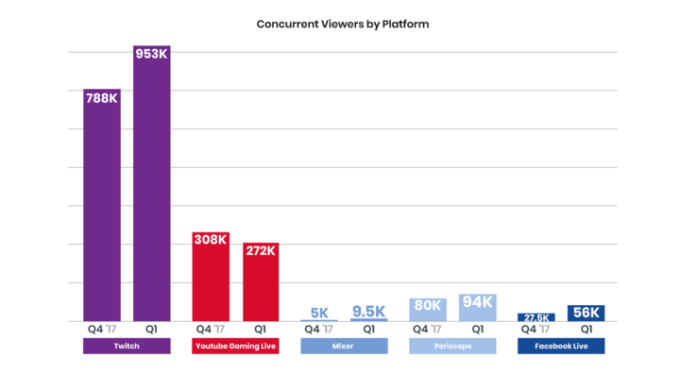
Twitch further solidified its lead in the game streaming market in the first quarter of the year, with gains in both average concurrent viewership and peak concurrent viewership, while the number two streaming site, YouTube Gaming, saw losses on both fronts. According to a new report from Streamlabs, which has visibility into the market thanks to its software platform used by hundreds of thousands of streamers, Twitch viewership was up by 21 percent in the quarter, growing from 788K average concurrent viewers in Q4 2017 to 953K in Q1.

Meanwhile, YouTube Gaming dropped 12 percent from 308K average concurrent viewers to 272K during that same time.

Other streaming services also saw gains, but their viewership numbers are much smaller.

Facebook, for example, grew viewership by 103 percent to reach 56K average concurrent viewers, Periscope grew 18 percent to 94K, and Microsoft’s Mixer grew 90 percent to 9.5K. (Microsoft’s real figures are likely much higher, however, because Streamlabs can’t track Mixer’s viewership on Xbox – which is most of it. Streamlabs is also missing some of Facebook Live’s viewership, as it can’t track private live streams only shared with friends.)

It’s no surprise that Twitch has a killer quarter, however.

The company announced in February it saw a record-breaking 388,000 concurrent viewers tune into a stream by Dr. Disrespect. This milestone was then blown out of the water the following month when Ninja played Fortnite with Drake and Travis Scott, reaching 628,000 concurrent viewers.

But even without these special events, Twitch has been growing.

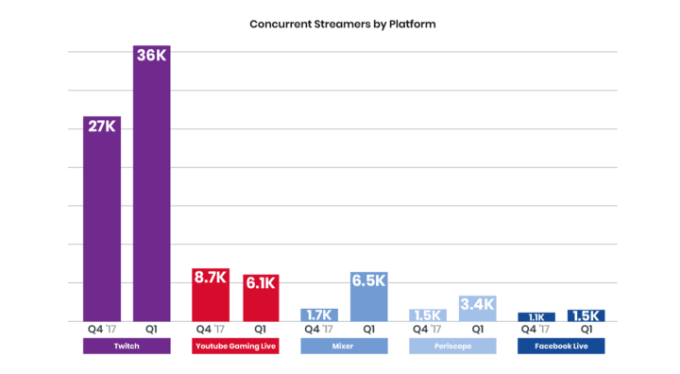
It also saw a 33 percent increase in average concurrent streamers in Q1, going from 27K to 36K. Mixer and Periscope gained as well, up 282 percent and 126 percent, respectively. But YouTube Gaming dropped by 13 percent on this metric, going from 8.7K average concurrent streamers in Q4 2017 to 6.1K in Q1.

As Twitch grew, streamers made more money, too, Streamlabs found.

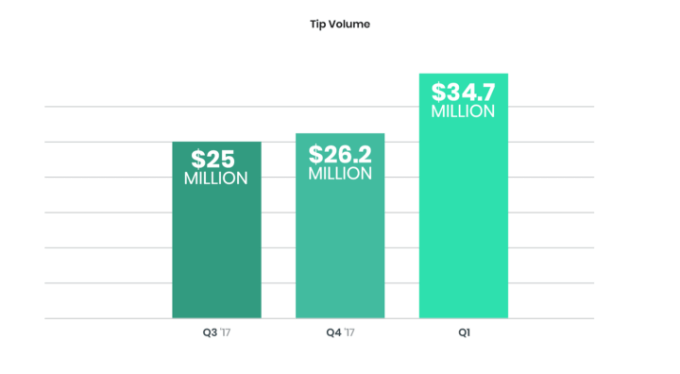
It claims to have seen the biggest quarter ever in Streamlabs tipping volume, rising 33 percent to $34.7 million, up from $26.2 million in the prior quarter. (Keep in mind this is tipping that takes place through Streamlabs software – the total tipping volume across platforms will be even higher.)

The company chalks up these gains to a variety of factors, including streamers’ more professional-quality videos, streams from games with huge audiences like Fortnite, growth of non-game streams, and more.

Streamlabs’ full report, here, also delves into its own gains in terms of traction, as well as the breakdown of the quarter’s most popular games.

26 Apr 2018

Dropbox rolls out a templates tool for its Paper online document service

As Dropbox looks to woo larger and larger businesses with its strategy of building simpler collaboration tools than what’s on the market, it’s making some moves in its online document tool Paper to further reduce that friction today.

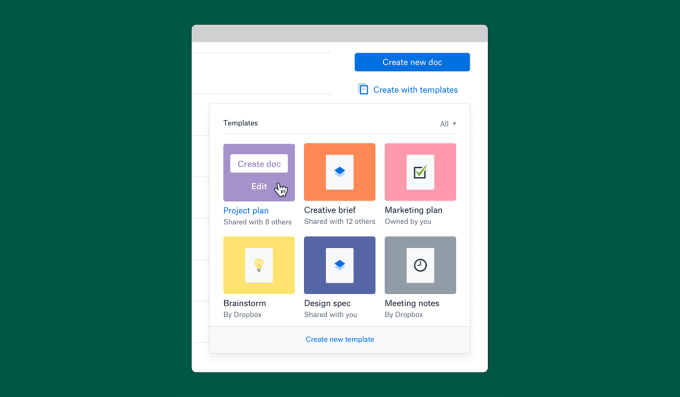
Dropbox said it was rolling out a new tool for Dropbox Paper that allows users to get a paper document up and running through a set of templates. It may seem like something that would be table stakes for a company looking to create an online document tool like Google Docs, but figuring out what Paper’s core use cases look like can take a lot of thinking and user research before finally pulling the trigger. Dropbox at its heart hopes to have a consumer feel for its products, so preserving that as it looks to build more robust tools presents a bigger challenge for the freshly-public company.

The templates tool behaves pretty much like other tools out there: you open Dropbox Paper, and you’ll get the option to create a document from a number of templates. Some common use cases for Dropbox Paper include continuous product development timelines and design specs, but it seems the company hopes to broaden that by continuing to integrate new features like document previews. Dropbox Paper started off as a blank slate, but given the number of options out there, it has to figure out a way to differentiate itself eventually.

The company said it’s also rolling out a number of other small features. That includes a way to pin documents, launch presentations, format text and insert docs and stickers. There’s also a new meeting widget and increased formatting options in the comments section in Paper. Finally, it’s adding a number of small quality-of-life updates like viewing recent Paper docs by alphabetical order and the ability to unsubscribe to comment notifications and archive docs on iOS, as well as aggregating to-do lists across docs.

Dropbox went public earlier this year to dramatic success, immediately getting that desired “pop” and more or less holding it throughout the past month or so as one of the first blockbuster IPOs of 2018. There have been a wave that have followed since, including DocuSign, and it’s one of a batch of several enterprise companies looking to get out the door now that it appears the window is open for investor demand for fresh IPOs.

Paper, to that end, appears to be a key piece of the puzzle for Dropbox. The company has always sought to be a company centered around simple collaboration tools, coming from its roots as a consumer company to start. It’s an approach that has served it — and others, like Slack — well as the company looks to expand more and more into larger enterprises. While it’s been able to snap up users thanks to its simpler approach, those enterprise deals are always more lucrative and serve as a stronger business line for Dropbox.

Dropbox will have to continue to not only differentiate itself from Google Docs and other tools, but also an emerging class of startups that’s looking to figure out ways to snap up some of the core use cases of online document tools. Slite, for example, hopes to capture the internal wiki and note-taking portion of an online doc system like Google Docs. That startup raised $4.4 million earlier this month. There’s also Coda, a startup that’s looking to rethink what a document looks altogether, which raised $60 million. Templates are one way of reducing that friction and keeping it feeling like a simple document tool and hopefully getting larger businesses excited about its products.