Chargify, the payment management service owned by Scaleworks, has added revenue forecasting tools to its software as a service offering.
The company’s new revenue forecasting tools uses historical data and month-over-month performance pulled from a company’s billing platform.
The company says its new tool can cut forecasting down from two months to as little as two minutes.
With a suite of billing and revenue management tools, Chargify already has a good window into previous performance. And the company hopes those forecasting tools can help businesses benchmark their revenue progress.
Using the new forecasting tool, companies can pull baseline metrics from historical growth and churn data looking at three-, six-, or twelve-month averages to understand how historical trends could affect businesses, the company said.
Beyond forecasting, the toolkit from San Antonio-based Chargify will save the projections and automatically trigger benchmark tracking to actual performance alongside the baseline forecast.
Amperity announced today that it’s acquiring another company in the customer data business, Custora.
Amperity co-founder and CEO Kabir Shahani told me that Custora’s technology complements what Amperity is already offering. To illustrate this point, he said that customer data tools fall into three big buckets: “The first is know your customer, the second is … use insights to make decisions, the third is … activate the data and use it to serve the customer.”
Amperity’s strength, Shahani said, is in that first bucket, while Custora’s is in the second. So with this acquisition (Amperity’s first), the existing Amperity technology will become the Amperity Customer 360, while Custora is rebranded as Amperity Insights.
The products can still be used separately, but Custora CEO Corey Pierson argued that they’re particularly powerful together.
“The stronger you actually know your customer, the stronger you have your customer 360 profile, the better those insights are,” Pierson said. “When we sit on top of Amperity, every insight we produce is more valuable to our customers.”
Shahani said Pierson and the rest of his team will be joining Seattle-based Amperity, with Custora’s New York office becoming the combined company’s East Coast headquarters.
The financial terms of the acquisition were not disclosed. According to Crunchbase, Custora previously raised a total of $20.3 million in funding.
Shopify continues to expand beyond its core e-commerce platform with a new product called Shopify Email.
Shopify’s chief product officer Craig Miller and director of product for marketing technology Michael Perry gave me a quick demo of the product yesterday; Miller argued that they’ve created “the first email product designed for ecommerce.”
That means it’s integrated with a merchant’s store on Shopify, allowing them to easily pull their brand assets into their emails, along with product content and listings. They can also see whether those emails actually lead to customers to add products to their carts/purchase them. And they can create customer segments based on the data in Shopify.
“What we’re really proud of here is, we become the expert for them,” Perry said. “Most people we’ve surveyed don’t understand the value of segmentation, so we’ve taken the liberty of assembling the right list to add value for them.”
Shopify Email is currently available as an early access test for a limited group of merchants, ahead of a broader rollout next year. Miller said it will be free for these initial merchants, with general pricing to be announced later.
“The common thread among all of [our new products] is to help brands sell directly to their customers,” Miller said. “There’s been a lot of talk lately about direct-to-consumer, but that’s something we’ve doing for a decade and a half without calling it that.”
Shopify continues to expand beyond its core e-commerce platform with a new product called Shopify Email.
Shopify’s chief product officer Craig Miller and director of product for marketing technology Michael Perry gave me a quick demo of the product yesterday; Miller argued that they’ve created “the first email product designed for ecommerce.”
That means it’s integrated with a merchant’s store on Shopify, allowing them to easily pull their brand assets into their emails, along with product content and listings. They can also see whether those emails actually lead to customers to add products to their carts/purchase them. And they can create customer segments based on the data in Shopify.
“What we’re really proud of here is, we become the expert for them,” Perry said. “Most people we’ve surveyed don’t understand the value of segmentation, so we’ve taken the liberty of assembling the right list to add value for them.”
Shopify Email is currently available as an early access test for a limited group of merchants, ahead of a broader rollout next year. Miller said it will be free for these initial merchants, with general pricing to be announced later.
“The common thread among all of [our new products] is to help brands sell directly to their customers,” Miller said. “There’s been a lot of talk lately about direct-to-consumer, but that’s something we’ve doing for a decade and a half without calling it that.”
Companies continue to refine digital diagnostic tools for in-home healthcare at a rapid clip and the latest to launch is an at-home test for urinary tract infections from the Los Angeles-based startup Scanwell Health.
The company was founded by Stephen Chen, who literally grew up in the diagnostics testing business. His family had built one of the largest manufacturers of urinalysis testing in the country and Chen’s earliest memories of work are standing on an assembly line putting together pregnancy tests.
“I come from a family that manufactures pee-tests,” says Chen. “I was born into the business.”
Through this window into the market, Chen knew that there was a way to circumvent the time consuming process of booking a doctor’s visit to get a test scheduled and performed. “These tests have been sold into doctors’ offices and hospitals and I always thought you could make these tests more accessible,” says Chen.
Working with a team of technologists, Chen built a software product that can provide the same analysis of a test kit using a smartphone’s camera and an app that would have been performed in a brick and mortar diagnostics testing facility.
“The core chemistry is a traditional diagnostics kit that has been used by the healthcare systems for many years,” he says. “We’ve taken that standalone box and moved it to the smartphone.”
Just like a traditional test, a chemically treated strip reacts with a urine sample and then the company’s application uses computer vision technology to assess the results.
Scanwell Health chief executive, Stephen Chen
So far, Scanwell is the first company to receive clearance from the Food and Drug Administration for its tests, and the only company to receive clearance to be sold over the counter, according to Chen. The test has been cleared
Through its partnership with Lemonaid Health, a telemedicine provider for consultations with nurse practitioners and physicians, customers can get diagnosed using the Scanwell app and receive a consultation and a course of treatment all from the comfort of their home. The tests cost $15 for a pack of three and the consultation with Lemonaid is another $25. That’s compared with roughly $150 for a visit to an urgent care center.
For Scanwell, it’s the culmination of a three year journey to bring their first diagnostic test to market. The company first submitted its product to the Food and Drug Administration for approval in 2015. While Chen waited for clearance from the FDA, he launched Petnostics to build out a user base and test the product in the less stringent world of veterinary health.
Sales from the Petnostics product helped bootstrap the company through its first few years of development and get its first product onto the market. Now, Scanwell is ready to expand, says Chen.
The company has a test for chronic kidney disease in the works through a collaboration with Kaiser Permanent and the Chronic Renal Insufficiency Cohort Study to improve screening for and monitoring chronic kidney disease at home. Using urinalysis testing to screen for excess proteins, the company is hoping it can help identify CKD in more people earlier, allowing for earlier interventions and the potential to avoid costly medical procedures down the road.
“We believe in the power of telehealth and what it can do,” says Chen. “What’s missing is the diagnostics piece. When you go into a doctor’s office you talk to a doctor and they get your symptoms. We’re focused on translating as many of these diagnostics as possible and you can pair with telehealth.”
Helping the company move along its journey are a clutch of well-positioned investors including the Y Combinator accelerator and institutional investors like Founders Fund, Mayfield, DCM, Version One, and Joe Montana’s Liquid 2 Ventures fund.
“This funding from an incredible group of investors, together with the national launch of our test and app, are exciting milestones that will allow us to realize our vision of making reliable, convenient at-home testing available to millions of people,” said Chen, in a statement. “Our partnership with Lemonaid is only the beginning. We have a number of additional diagnostic tests in the pipeline that have the potential to change the way we diagnose and treat infections and monitor chronic diseases. We look forward to working with additional partners to bring these tests to people across the country.”
One of the most interesting sessions at Adobe MAX is traditionally the Sneaks keynote, where engineers from the company’s various units show off their most cutting-edge work. Sometimes, those turn into products. Sometimes they don’t. These days, a lot of the work focuses on AI, often based on the Adobe Sensei platform. This year, the company gave us an early look at Project Sweet Talk, one of the featured sneaks of tonight’s event.
The idea here is pretty straightforward, but hard to pull off: take a portrait, either a drawing or a painting, identify the different parts of the face, then animate the mouth in sync with a voice-over. Today, Adobe’s Character Animator (which you may have seen on shows like The Late Show with Stephen Colbert) does some of that, but it’s limited in the number of animations, and the result, even in the hands of the best animators, doesn’t always look all that realistic (as far as that’s possible for the kind of drawings you animate in the product). Project Sweet Talk is far smarter. It analyzes the voice-over and then uses its AI smarts to realistically animate the character’s mouth and head.
The team, lead by Adobe Researcher Dingzeyu Li, together with Yang Zhou (University of Massachusetts, Amherst) and Jose Echevarria and Eli Schectman (Adobe Research), actually fed their model with thousands of hours of video of real people talking to the camera on YouTube. Surprisingly, that model transferred really well to drawing and paintings — even though the faces the team worked with, including pretty basic drawings of animal faces, don’t really look like human faces.
“Animation is hard and we all know this,” Li told me. “If we all know that if we want to align a face with a given audio track, it is even harder. Adobe Charter Animator already has a feature called ‘compute lip sync’ from scene audio,’ and that shows you what the limitations are.” The existing feature in Character Animator only moves the mouth, while everything else remains static. That’s obviously not a very realistic look. If you look at the examples embedded in this post, you’ll see that the team smartly warps the faces automatically to make them look more realistic — all from a basic JPG image.
Because it does this face warping, Project Sweet Talk doesn’t work all that well on photos. They just wouldn’t look right — and it also means there’s no need to worry about anybody abusing this project for deepfakes. “To generate a realistic-looking deepfake, a lot of training data is needed,” Li told me. “In our case, we only focus on the landmarks, which can be predicted from images — and landmarks are sufficient to animate animations. But in our experiments, we find that landmarks alone are not enough to generate a realistic-looking [animation based on] photos.”
Chances are, Adobe will build this feature into Character Animator in the long run. Li also tells me that building a real-time system — similar to what’s possible in Character Animator today — is high on the team’s priority list.
Ford wants the world to take notice of its plans for electric vehicles. And what better way than to build an all-electric Mustang fastback with a six-speed manual transmission?
And that has us angry over here because it’s a gigantic tease of a prototype that will never make it into production. Or least that’s what Ford is saying.
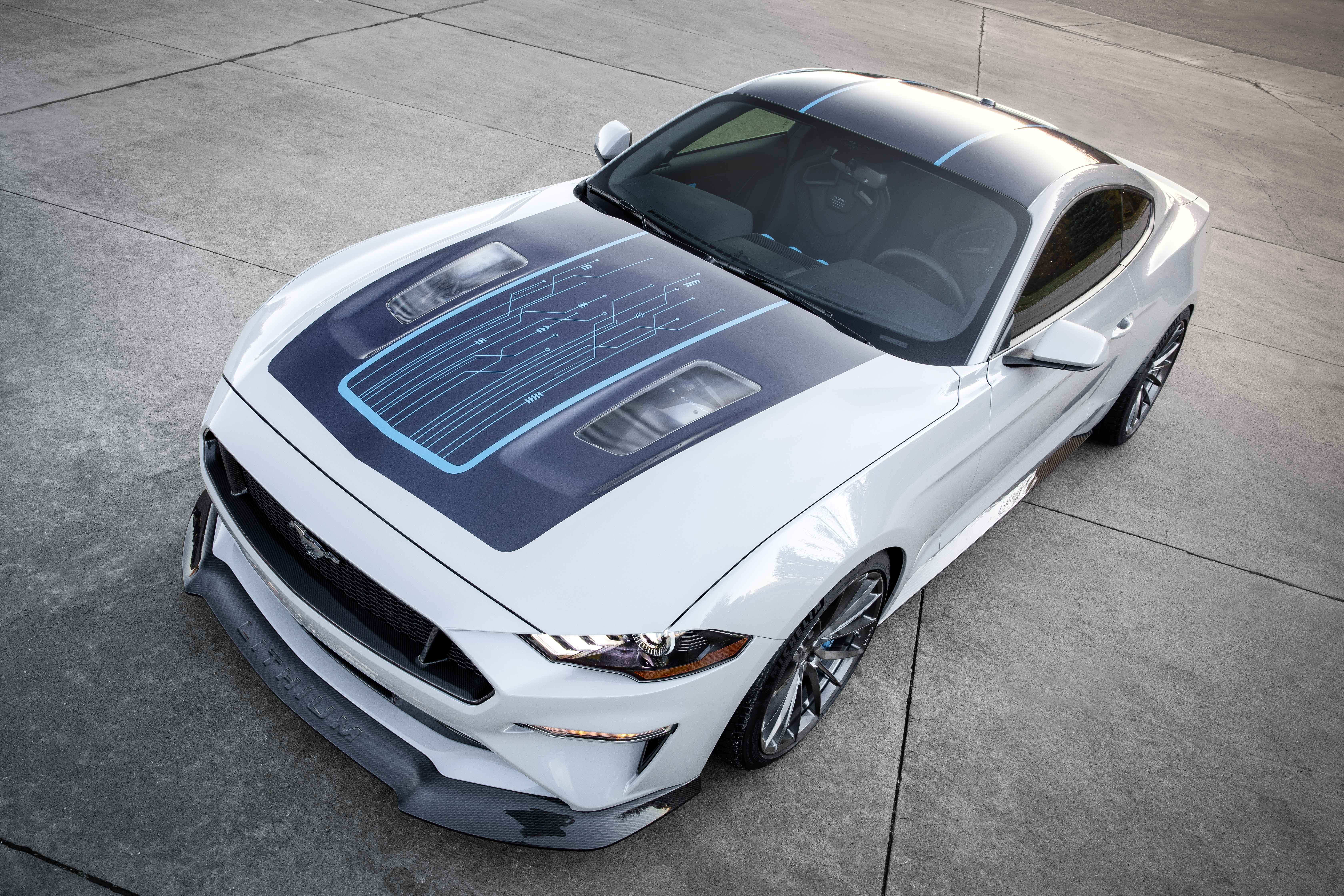
Ford and Webasto revealed Tuesday the “Mustang Lithium” high-performance battery electric vehicle at the Specialty Equipment Market Association (SEMA) trade show in Las Vegas. The vehicle is a one-off, meaning this won’t hit the marketplace anytime soon, if ever.
Ford does say this electrified Mustang is more than just a prototype. It’s also a testbed for battery and thermal management technologies Webasto and Ford are creating for the growing e-mobility automotive segment. So maybe there is a chance?
The vehicle has a Phi-Power dual-core electric motor and dual power inverters powered by an 800-volt Webasto battery system. The package produces 900 horsepower and 1,000 pound-feet of torque, ensuring its muscle car status. The vehicle has a custom carbon fiber body components, a 1.0-inch lowered stance and 20-inch staggered fitting forged wheels, according to Ford.
Ford highlights the manual transmission as the “unique” twist. And it is. Electric vehicles have single-speed gearboxes. There is really no logical reason to have a manual gearbox. For those who still love the three-pedal action though, an electric vehicle with a manual gearbox makes all the sense in the world.
The 800-volt battery system is also worth noting. The Porsche Taycan is considered the first production vehicle equipped with a system voltage of 800 volts as opposed to the usual 400 volts found in most electric cars.
Ford’s use of 800 volts might hint at what battery systems might turn up in its production electric vehicles. This more robust system should allow for faster charging. For instance, Porsche credits its 800-volt system in the Taycan for allowing it to charge from 5% to 80% in 22.5 minutes with a maximum charging power of up to 270 kw.
Ford didn’t reveal battery range. But it offered up a few other specs, including that it has four modes that apply a controlled amount of torque for different driving modes. The modes are Valet, Sport, Track and Beast. The vehicle also has an in-dash 10.4-inch touchscreen display.
“Ford has made no secret of the fact that we are electrifying our most popular nameplates,” Hau Thai-Tang, Ford’s Chief Product Development and Purchasing Officer, said in a statement. “This one-off Mustang prototype is a great opportunity for us, together with Webasto, to showcase to our customers what a new electrified powertrains can do for performance in a car they already know and love.”
Ford historically backed hybrid technology. And while hybrids are still part of the mix, Ford has placed more emphasis on the development and production of all-electric vehicles. In 2018, the company said it will invest $11 billion to add 16 all-electric vehicles within its global portfolio of 40 electrified vehicles through 2022. That portfolio will include an all-new Mustang-inspired fully electric SUV in 2020 with range of 300 miles and an all-electric F-150 in a few years, according to Ford.
Ford unveiled in September at the Frankfurt Motor Show a range of hybrid vehicles as part of its plan to reach sales of 1 million electrified vehicles in Europe by the end of 2022.
There’s a new kind of ad coming to YouTube . Google announced today the launch of Shopping ads on YouTube, which lets brands advertise their products and services right in the YouTube home feed and search results. For example, if a user searches for “Puma shoes review,” a Shopping ad may offer a row of suggested products at the top of the page before the video results.
The ads may also appear as a carousel between the videos on the homepage.
Puma is a debut advertiser for the new shopping ad product, but the video site will soon fill with these sorts of product suggestions.
“Consumers are continuing to watch more content on the YouTube platform and we want to be where they are, to reach and engage them,” said Rick Almeida, Vice President of eCommerce at Puma Group, in a statement about its new YouTube ads. “This new opportunity will enable Puam to extend our shopping strategy into a new property and inspire consumers,” he added.
As Google explains, the ads can be shown to YouTube users based on their interests.
To continue the Puma example, the user wouldn’t necessarily have to type in “Puma” to encounter an ad for the running shoes — simply expressing an interest in running could have them coming across ads from Puma or any other retailers offering running apparel.
Like the Shopping ads that appear elsewhere across Google’s platform — including Search, Shopping, partner websites, and the Google Display Network — the YouTube Shopping ads will match to user’s interest not by using keywords but rather on the product details and information the brand submits through the Merchant Center.
The idea to leverage YouTube as a new platform for visual advertising comes at a time when other social networks — like Instagram, Pinterest, and even TikTok — are making it easier for users to shop products from their apps. Pinterest has been working to capture shopper interest earlier on in the journey, then track the path from visual inspiration and pinning all the way through to purchase.
But YouTube hadn’t yet fully capitalized on its ability to direct its audience to specific products, rather focusing on Discover ads that would include a visual and a few lines of text, but not necessarily a unique product.
Google says advertisers already using standard Shopping campaigns today and who are opted in to YouTube on Display Network, will be immediately able to run YouTube Shopping ads.
The new ads are only one of several changes YouTube announced today. It also said its video ads will now be more interactive, giving users actionable information like store location, interest forms, and additional calls-to-actions to help drive more conversions. It’s also rolling out sitelink extensions for TrueView for action ads that will allow viewers to navigate to additional landing pages, like those for holiday catalogs, store hours and more. These will come in the months ahead.
Elsewhere on Google, Showcase Shopping ads are expanding to Google Images where users will be able to explore a larger selection of products from a brand.
Google had announced its plans to bring new ad products to YouTube back in May, when it revamped the Google Shopping product following the closure and rebranding of Google Express.
As a part of that larger update, the company mentioned a variety of ways it would be connecting the YouTube audience more directly with brands and products — including through its highly-visual Showcase Shopping ads and via Shopping Actions, which allow for purchases right from Google’s platforms.
The larger goal with the new ads is to appeal to users with more visual imagery, as today’s web users no longer just search Google.com and click on the links that return.
The motorcycle industry is shifting to electric. Harley Davidson signaled the trend this year, becoming the first big gas manufacturer to release a street-legal e-motorcycle in the US, the LiveWire.
But before Harley’s EV pivot, California based startup Zero Motorcycles had been selling e-motos for years.
“We’re an electric motorcycle and power-train manufacturer founded in 2006 in Santa Cruz, California…we’re sold in over 30 countries,” Zero CEO Sam Paschel told TechCrunch.
“Fundamentally we aim to transform and elevate the motorcycling experience and by doing that we expect to make a huge dent in transforming transportation globally.”
Toward that aim, Zero recently released the all-new 2020, SR/F — a $19K high-performance e-motorcycle and competitor to Harley Davidson’s $29K LiveWire.
TechCrunch took an SR/F home to experience going full e-moto. The biggest distinction between e-motorcycles — versus gas two-wheelers — is lightning acceleration and uninterrupted forward movement.
Zero’s SRF has a magnet motor and one gear — with no clutch or shifting — and fewer mechanical parts to put the 14.4 kWh battery’s 140 ft-lbs of torque to the pavement.
You simply twist and go.
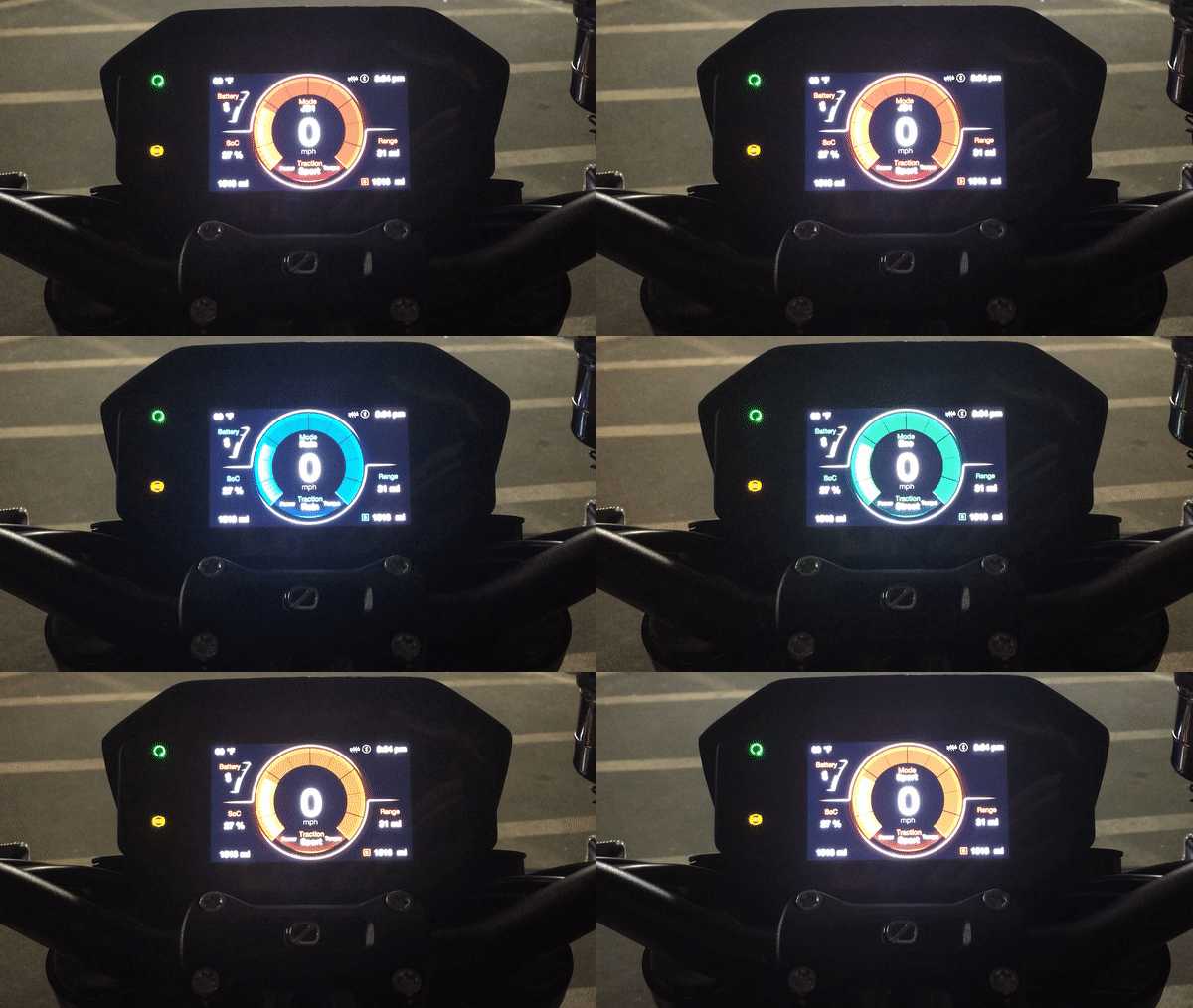
The SR/F is a fully digital, IoT motorcycle that syncs to a smartphone and the cloud to monitor charge status or adjust performance. It has preset riding modes — Eco, Street, Sport, and Rain — for different combinations of power and range. The EV also allows for customized riding modes dialed in via smartphone.
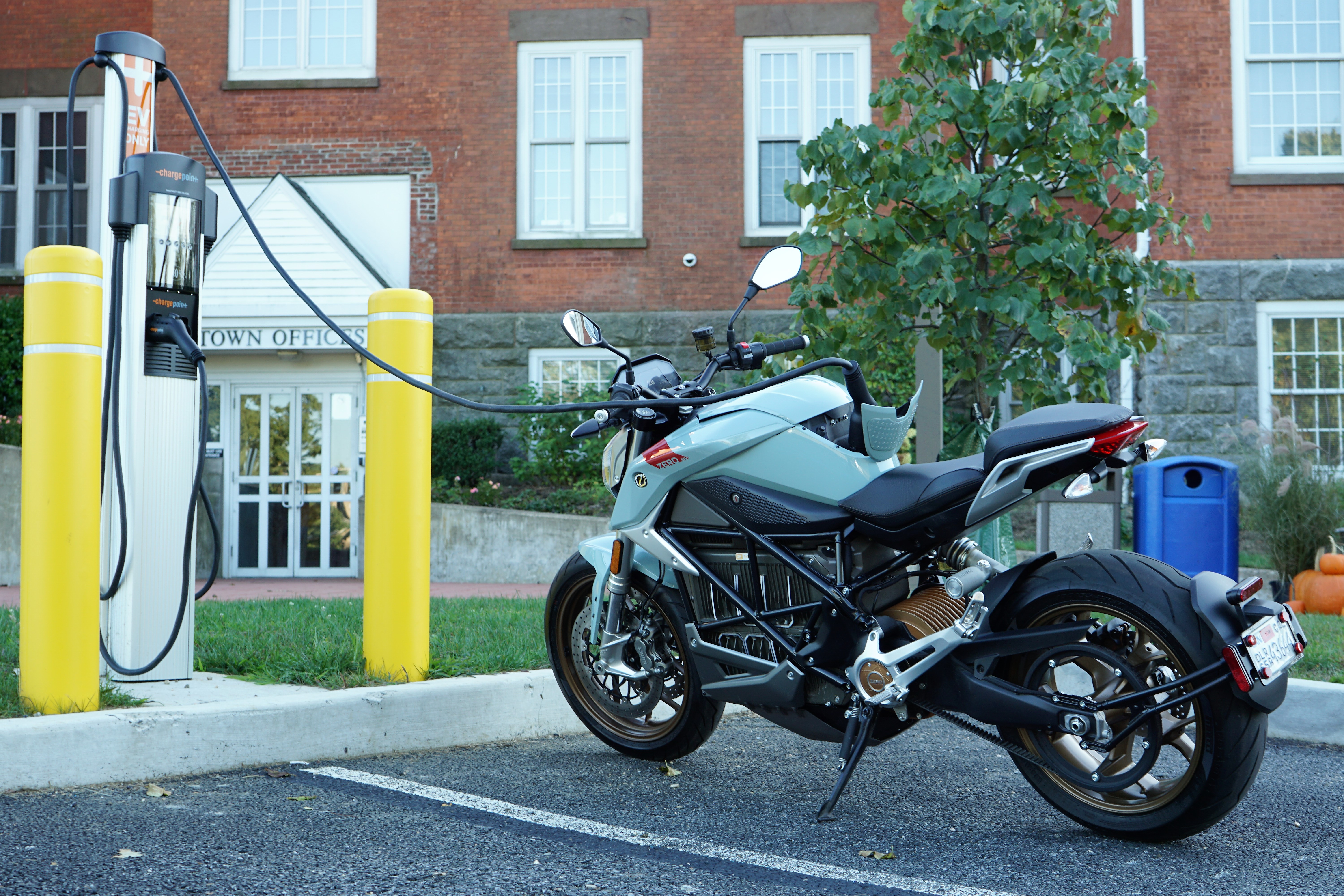
One can power Zero’s sporty e-moto from a household outlet or use fast-charging networks — like ChargePoint — for a full battery in around 80 minutes.
Zero’s SR/F has a range of up to 161 miles in the city, where it can recharge itself marginally through regenerative braking. For a combination of city, highway, an sport riding, I averaged around 100 miles a charge, alternating between riding modes.
On performance, Zero’s new sport-entry hauls ass. Going 0 to 60 at full power on the new SR/F is a rush, while 60 to 100 speed is so fast it’s downright frightening. Overall, the e-moto’s acceleration is stronger and more constant than internal combustion machines, with no emissions and little sound.
Zero’s CEO Sam Paschel thinks the distinct electric motorcycle experience can convert gas riders
“We have what we consider enthusiasts…These are people that are avid motorcycle riders…What we find with them is they throw a leg over a Zero…have an electric motorcycle experience, it’s fundamentally different…They fall in love, they buy one,” he said.
Zero’s e-motos — starting at around $9K for the entry level FX — are also attracting a younger generation, according to the startup’s CEO.
“They’re an early adopter of new technology. They love the idea — whether it’s the performance elements the riding experience, green or eco elements of having electric vehicle — and we’re actually drawing them into the sport in a way that they wouldn’t have been drawn in by internal combustion,” he said.
Paschel is undaunted by Harley’s EV debut or the other big gas motorcycle manufacturers entering the E-market.
“You have a major OEM that’s launched a bike into the space that we have been defining and creating for over a decade. Of course, the nature of that relationship is fundamentally competitive,” he said.
“The question I get more often is…are we concerned? Are we worried or scared of any OEMs entering? And The answer is no. This is actually the most exciting thing that’s happened in the space in a long time,” said Paschel.
“A rising tide is going to lift all ships, and…I’m more than confident that we will capture more than our fair share of a rapidly growing market simply because this is all we do. And we spent 13 years, millions of miles, and a lot of time doing this just right.”
Both Zero and Harley are banking on e-motos to reboot a flailing U.S. motorcycle industry. New bike sales dropped 50% since 2008 — with sharp declines in ownership by everyone under 40.
Zero has worked to close gaps on price, range, charge times, and performance compared to petrol-powered motorcycles.
The startup is not alone. Italy’s Energica is expanding distribution of its high-performance e-motos in the U.S. Other competitors include California based Lightning Motorcycles and e-moto startup Fuell, with plans to release its $10K, 150 mile range Flow this year.
Of course, there’s already been some speed-bumps and market attrition, with three e-moto startups — Alta Motors, Mission Motors, and Brammo — forced to power down over the last several years.
Zero looks to its head start and proprietary technology to win in the electric conversion of motorcycles.
The company has also received partnership inquiries
“It’s not something that we are actively seeking…I will tell you that there’s a lot of inbound interest. I think people were waking up and realizing that that transition is much closer than they thought it was…We’ve had conversations from a list of OEMS, many of whom you would recognize,” said Paschel.
Still, Zero is likely to ride on alone, according to its CEO.
“Right now it’s an inherently competitive relationship with a lot of those guys, so it would have to be the right deal…But right now we’re fiercely competitive company. We’re in a competition with all these brands.”
Zero’s SR/F could be the sweet spot of tech, price, range, and performance it has been striving toward to finally go mass market and compete with those brands.
And with Zero and Harley growing e-moto market share, expect big names still on the sidelines — Honda, Ducati, Kawasaki — to debut production EVs soon.
With that, the electrification of the motorcycle industry will become another facet of the transformation of global mobility.
A glitch in the the stock trading app Robinhood is allowing users to trade stocks with excess borrowed funds, and the company doesn’t appear to have found a fix as of this writing. According to Reddit’s WallStreetBets forum, and first reported on by Bloomberg, one trader bragged about a $1 million position funded by a $4,000 deposit. Another says he accessed $50,000 worth of purchasing power, which he used to buy Apple puts. He subsequently lost that money and posted a video of the wipe-out on YouTube (below).
Asked whether the issue has been resolved, how long it has been possible for users to exploit the platform, and for more information about the number of people who’ve taken advantage of it, a Robinhood spokesperson wrote us just now a statement that suggests this is far from under control at the company, saying: “We’re aware of the isolated situations and communicating directly with customers.”
This isn’t the first misstep for Robinhood, a popular platform that caters particularly to first-time investors with its no-frills, no fees approach to investing.
In December 2018, the company — which was founded in 2013 in Menlo Park, Ca. and has raised a stunning $912 million from investors since, much of it led by DST Global — announced it was launching no-fee checking-and-savings accounts for users of its platform that would provide them with a 3% interest rate — nearly double what other financial institutions offer.
More than 850,000 people signed a waitlist, hoping to access the product, before a section on Robinhood’s app advertising the product was quietly taken down after drawing scrutiny from regulators who said the accounts, as initially designed, would not be insured by by the Securities Investor Protection Corp., also known as SIPC. (Its president further told MarketWatch that Robinood hadn’t discussed the accounts with his agency before announcing them.)
The company last month announced a new, revamped push into banking, via new cash-management accounts that pay 2.05% interest and reportedly come with the backing of the Federal Deposit Insurance Corp.
Robinhood has been clear about its ambitions to become a “full service financial institution” with every product one can find at a “local bank branch and more,” as its cofounder and co-CEO Vlad Tenev told us at an event last year. Toward that end, it has made some moves to bolster its gravitas, including naming former SEC commission Dan Gallagher to its board of directors last month and last year bringing on as CFO Jason Warnick, who’d spent two decades with Amazon previously, including as the company’s VP of finance.
Allowing unsophisticated users to borrow exponentially more than they’re entitled to, or can presumably pay back, could prove an embarrassing setback if it’s not addressed quickly — and prevented from happening again.







 One can power Zero’s sporty e-moto from a household outlet or use fast-charging networks — like
  Paschel is undaunted by Harley’s EV debut or the other big gas motorcycle manufacturers entering the E-market.
 Zero’s SR/F could be the sweet spot of tech, price, range, and performance it has been striving toward to finally go mass market and compete with those brands.