Year: 2019

28 Oct 2019

Omidyar Network CEO opens up about VC-influenced philanthropy

In 2004, eBay founder Pierre Omidyar and his wife, Pam, set aside some of the wealth they acquired after the online marketplace went public and created Omidyar Network, a philanthropic investment firm “dedicated to harnessing the power of markets,” according to an official overview.

Since then, the firm — which operates a 501(c)(3) nonprofit and an LLC — has committed $839 million in nonprofit grants and $735 million in for-profit investments. Today, 60 employees in Mumbai, London, Washington D.C. and Redwood City look for opportunities to invest and contribute across four main areas: Reimagining Capitalism, Beneficial Technology, Discovering Emergent Issues, and Expanding Human Capability.

In 2018, coinciding with a strategic shift that saw Omidyar Network spin out several of its initiatives, the firm elevated to CEO Mike Kubzansky, who had started the firm’s Intellectual Capital arm. In a wide-ranging discussion, Scott Bade spoke to Kubzansky about Omidyar Network’s origins and evolution, and his approach to venture philanthropy.

(This interview has been edited for length and clarity.)

Scott Bade: Omidyar Network has stood out because of its unique structure as both a grant-making institution and as an investor. Could you describe how Omidyar Network got started and how it evolved over the last decade and a half?

Mike Kubzansky: Pierre [Omidyar] originally started the Family Foundation. But having looked at the experience of eBay, he became frustrated that he couldn’t [achieve] the same scale of impact [that eBay had] in a conventional grant-making structure. So we converted Omidyar Family Foundation to Omidyar Network in 2004 with the fundamental insight to add to the classic 501(c)(3) structure of a foundation an LLC to enable us to invest in companies. 

Great, and by investment, how does that work? Are you a typical LP or is there a different investment thesis?

Yeah, so historically first it’s worth saying, being influenced by Silicon Valley DNA, we have typically taken a venture lens on things and typically have invested at the seed or Series A round. Again, that comes straight out of the Silicon Valley experience.

Within that, we’ve had this notion of investing across the returns continuum. In some cases, we feel you can get a fully risk-adjusted market rate return. In some cases you might be ahead of the market, or looking at a firm that’s actually having a market-level impact, in addition to a firm-level impact. In those cases we’ve been willing to take a lower rate of return, at least at entry, in terms of what we would invest in. Typically it’s been venture, part of it syndicate; we have never taken a majority share in a company. 

Before we dig deeper into the programmatic work, I want to dig deeper on your methodology. Clearly when it comes to both defining impact and figuring out how to measure it and maximize it, ON has been different from traditional philanthropy. But how do you define whether a given objective warrants either a grant or an investment or an advocacy approach?

You’ve hit on a question that we’ve spent a lot of time discussing internally. Having this flexible capital structure enables you to range across a lot of different forms of engagement in the world. So our thinking currently is – and this gets into our strategy shift – focus less on things that are easy to measure, like service delivery and financial inclusion and how many people are reached, and focus much more on upstream structural power, rules of the game, mindsets and beliefs about the underlying systems, which we think actually are at the root cause of a lot of the distress and income inequality we see in the world today. 

Thinking like venture capitalists

You talked about thinking like a venture capitalist. Does that mean that that even with your philanthropy or advocacy you take on greater risks that are a long shot at achieving, but perhaps have a high-expected value return? 

Yeah, so you’ve hit on exactly an issue that’s really important to us, which is the ability to take risk. Philanthropic money is the most risk-tolerant capital out there, whether it’s deployed for-profit or not-for-profit or on advocacy. And we view part of our role, in terms of social impact, as being risk capital for very difficult issues that society needs to take on. That mindset pervades how we think about approaching a problem.

We think about risk in a bunch of different ways: one, the ability to take on long-term issues which others may not be able to take on because they’re trying to make quarterly profits or that sort of thing. So there’s where we can take a run at some of the upstream rules of the game and checks on power, which might take time to accomplish. We [also] take it as an ability to take on difficult issues as well, not just time consuming, not just ones that have long-time horizons.

So what is your theory of change? Is your goal to be a think or do tank, is it to be an advocacy group, is it to shape norms, is it to fund pilots or some combination of that? 

Yeah, I think we are, it’s fair to say we are still working through that, but we are in the process of putting out our points of view on what we think needs to change under capitalism and under technology. So for instance, we’ve published a point of view on what we think good digital ID looks like and ought to be. 

Under the Reimagining Capitalism banner, our take is that it is going to take a mix of things. One [part is] about rebalancing structural power. For instance, working people  have not typically seen any of the gains over the last 40 years where profits and productivity have gone up very dramatically but wages have stayed stagnant. So how do you rebalance power between working people and the companies or the capital sources that are working in the economy?

And so our theory of change includes some level of, how do you change the way people understand economics – everything from how you teach economics to how you measure to result of our economy, not in GDP but perhaps in wellbeing or other formats [like] by income decile – all the way straight through to ideas about who the economy is for. 

We would argue that neoliberalism is a version of capitalism, it is not capitalism itself,  and that we can get to a better version of capitalism if we change some of these underlying beliefs and mindsets about the economy. 

… The original ethos of the Valley has tracked through to our notion that we want to see power redistributed back to people and away from concentrated sources of power. 

How has being in Silicon Valley, the mindset of being in the tech world, influenced that thesis on capitalism? 

28 Oct 2019

Max Q: International Astronautical Congress 2019 recap edition

Our weekly round-up of what’s going on in space technology is back, and it’s a big one (and a day late) because last week was the annual International Astronautical Congress. I was on the ground in Washington, D.C. for this year’s event, and it’s fair to say that the top-of-mind topics were 1) Public-private partnerships on future space exploration; 2) So-called ‘Old Space’ or established companies vs./collaborating with so-called ‘New Space’ or younger companies, and 3) who will own and control space as it becomes a resource trough, and through what mechanisms.

There’s a lot to unpack there, and I plan to do so not all at once, but through conversations and coverage to follow. In the meantime, here’s just a taste based on the highlights from my perspective at the show.

1. SpaceX aims for 2022 Moon landing for Starship

SpaceX timelines are basically just incredibly optimistic dreams, but it’s still worth paying attention to what timeframes the company is theoretically marching towards, because they do at least provide some kind of baseline from which to extrapolate actual timelines based on past performance.

There’s a reason SpaceX wants to send its newest there that early, however – beyond being aggressive to motivate the team. The goal is to use that demonstration mission to set up actual cargo transportation flights, to get stuff to the lunar surface ahead of NASA’s planned 2024 human landing.

48954138962 f3b04101c4 k 2

2. Starlink satellite service should go live next year

More SpaceX news, but significant because it could herald the beginning of a new era where the biggest broadband providers are satellite constellation operators. SpaceX COO and President Gwynne Shotwell says that the company’s Starlink broadband service should go live for consumers next year. Elon also used it this week to send a tweet, so it’s working in some capacity already.

3. NASA’s Jim Bridenstine details how startups will be able to participate in the U.S. mission to return to the Moon to stay

Bridenstine did a lot of speaking and press opportunities at IAC this year, which makes sense since it’s the first time the U.S. has hosted the show in many years. But I managed to get one question in, and the NASA Administrator detailed how he sees entrepreneurs contributing to his ambitious goal of returning to the Moon (this time to set up a more or less permanent presence) by 2024.

4. Virgin Galactic goes public

Virgin Galactic listed itself on the New York Stock Exchange today, and we got our very first taste of what public market investors think about space tourism and commercial human spaceflight. So far, looks like they… approve? Stock is trading up about 2 percent as of this writing, at least.

5. Bezos announces a Blue Origin-led space dream team

Amazon CEO Jeff Bezos got a first-ever IAC industry award during the show (it has an actual name but it seems pretty clear it’s an invention designed to fish billionaire space magnates to the stage). The award is fine, but the actual news is that Blue Origin is teaming up with space frenemies Lockheed Martin, Northrop Grumman and Draper – old and new space partnering to develop a full-featured lunar lander system to help get payloads to the surface of the Moon.

6. Rocket Lab is developing a ride-share offering for the Moon and more

Launch startup Rocket Lab has become noteworthy for being among the extremely elite group of new space companies that is actually launching payloads to orbit for paying customers. It wants to do more, of course, and one of its new goals is to adapt its Photon payload delivery spacecraft to bring customer satellites and research equipment to the Moon – and eventually beyond, too. Why? Customer demand, according to Rocket Lab CEO Peter Beck.

7. Europe’s space tech industry is heading for a boom

It seems like there’s a lot of space startup activity the world over, but Europe has possibly more than its fair share, thanks in part to the very encouraging efforts of the multinational European Space Agency. (Extra Crunch subscription required.)

28 Oct 2019

Denny’s inks deal with Beyond Meat to supply new menu item — Denny’s Beyond Burger

Denny’s signed an agreement with the plant based food manufacturer, Beyond Meat, to use Beyond’s meat replacement in a new menu item — the Denny’s Beyond Burger.

Beyond Meat and its largest rival, Impossible Foods, are engaged in a fierce competition to provide meat alternatives to some of the nation’s largest food companies, but increasingly Beyond Meat is pulling away.

In recent months the company has signed agreements with McDonald’s and Denny’s, and expanded a supply agreement with Dunkin for signature sandwiches.

The initial pilot with Denny’s will include all of the South Carolina-based restaurant chain’s Los Angeles Denny’s. At Denny’s, the . beyond burger will come with tomatoes, onions, lettuce, pickles, American cheese and a special sauce on a multigrain bun.

As part of the promotion behind the rollout of the sandwich, Denny’s in Los Angeles will give guests a free burger on Halloween night with the purchase of a sandwich. The restaurant chain (and a former employer of mine) will roll out the Beyond Burger nationwide in 2020.

“We could not be more excited to announce this game-changing partnership with Beyond Meat,” said John Dillon, chief brand officer for Denny’s, in a statement. “As a company we strive to evolve with the tastes and demands of our customers and we knew finding a plant-based option that met our incredibly high-quality standards and taste expectations was critical in staying at the top of our game. The new Beyond Burger at Denny’s offers guests a great tasting burger, and we’re delighted to launch it in Los Angeles, and will be preparing for the national rollout in 2020.”

28 Oct 2019

Even after Microsoft wins, JEDI saga could drag on

The DoD JEDI contract saga came to a thrilling conclusion on Friday afternoon, appropriately enough, with one final plot twist. The presumptive favorite, Amazon did not win, stunning many, including likely the company itself. In the end, Microsoft took home the $10 billion prize.

This contract was filled with drama from the beginning, given the amount of money involved, the length of the contract, the winner-take-all nature of the deal — and the politics. We can’t forget the politics. This was Washington after all and Jeff Bezos does own the Washington Post.

Then there was Oracle’s fury throughout the procurement process. The president got involved in August. The current defense secretary recused himself on Wednesday, two days before the decision came down. It was all just so much drama, even the final decision itself, handed down late Friday afternoon, but it’s unclear if this is the end or just another twist in this ongoing tale.

Some perspective on $10 billion

Before we get too crazy about Microsoft getting a $10 billion, 10 year contract, consider that Amazon earned $9 billion last quarter alone in cloud revenue. Microsoft reported $33 billion last quarter in total revenue. It reported around $11 billion in cloud revenue. Synergy Research pegs the current cloud infrastructure market at well over $100 billion annually (and growing).

What we have here is a contract that’s worth a billion a year. What’s more, it’s possible it might not even be worth that much if the government uses one of its out clauses. The deal is actually initially guaranteed for just two years. Then there are a couple of three-year options, with a final two-year option at the end if gets that far.

The DOD recognized that with the unique nature of this contract, going with a single vendor, it wanted to keep its options open should the tech world shift suddenly under its feet. It didn’t want to be inextricably tied to one company for a decade if that company was suddenly disrupted by someone else. Given the shifting sands of technology, that part of the strategy was a wise one.

Where the value lies

If value of this deal was not the contract itself, it begs the question, why did everyone want it so badly? The $10 billion JEDI deal was simply a point of entree. If you could modernize the DoD’s infrastructure, the argument goes, chances are you could do the same for other areas of the government. It could open the door for Microsoft for a much more lucrative government cloud business.

But it’s not as though Microsoft didn’t already have a lucrative cloud business. In 2016, for example, the company signed a deal worth almost a billion dollars to help move the entire department to Windows 10. Amazon too, has had its share of government contracts, famously landing the $600 million to build the CIA’s private cloud.

But given all the attention to this deal, it always felt a little different from your standard government contract. Just the fact the DoD used a Star Wars reference for the project acronym drew more attention to the project from the start. Therefore, there was some prestige for the winner of this deal, and Microsoft gets bragging rights this morning, while Amazon is left to ponder what the heck happened. As for other companies like Oracle, who knows how they’re feeling about this outcome.

Hell hath no fury like Oracle scorned

Ah yes Oracle; this tale would not be complete without discussing the rage of Oracle throughout the JEDI RFP process. Even before the RFP process started, they were complaining about the procurement process. Co-CEO Safra Catz had dinner with the president to complain that contract process wasn’t fair (not fair!). Then it tried complaining to the Government Accountability Office. They found no issue with the process.

They went to court. The judge dismissed their claims that involved both the procurement process and that a former Amazon employee, who was hired by DoD, was involved in the process of creating the RFP. They claimed that the former employee was proof that the deal was tilted toward Amazon. The judge disagreed and dismissed their complaints.

What Oracle could never admit, was that it simply didn’t have the same cloud chops that Microsoft and Amazon, the two finalists, had. It couldn’t be that they were late to the cloud or had a fraction of the market share that Amazon and Microsoft had. It had to be the process or that someone was boxing them out.

What Microsoft brings to the table

Outside of the politics of this decision (which we will get to shortly), Microsoft brought some experience and tooling the table that certainly gave it some advantage in the selection process. Until we see the reasons for the selections, it’s hard to know exactly why DoD chose Microsoft, but we know a few things.

First of all there are the existing contracts with DoD, including the aforementioned Windows 10 contract and a five year $1.76 billion contract with DoD Intelligence to provide “innovative enterprise services” to the DoD.

Then there is Azure Stack, a portable private cloud stack that the military could stand up anywhere. It could have great utility for missions in the field when communicating with a cloud server could be problematic.

Fool if you think it’s over

So that’s that right? The decision has been made and it’s time to move on. Amazon will go home and lick its wounds. Microsoft gets bragging rights and we’re good. Actually, this might not be where it ends at all.

Amazon for instance could point to Jim Mattis’ book where he wrote that the president told the then Defense Secretary to “screw Bezos out of that $10 billion contract.” Mattis says he refused saying he would go by the book, but it certainly leaves the door open to a conflict question.

It’s also worth pointing out that Jeff Bezos owns the Washington Post and the president isn’t exactly in love with that particular publication. In fact, this week, the White House canceled its subscription and encouraged other government agencies to do so as well.

Then there is the matter of current Defense Secretary Mark Espers suddenly recusing himself last Wednesday afternoon based on a minor point that one of his adult children works at IBM (in a non-cloud consulting job). He claimed he wanted to remove any hint of conflict of interest, but at this point in the process, it was down to Microsoft and Amazon. IBM wasn’t even involved.

If Amazon wanted to protest this decision, it seems it would have much more solid ground to do so than Oracle ever had.

The bottom line is a decision has been made, at least for now, but this process has been rife with controversy from the start, just by the design of the project, so it wouldn’t be surprising to see Amazon take some protest action of its own. It seems oddly appropriate.

28 Oct 2019

FCC proposes rules requiring telcos remove Huawei, ZTE equipment

The Federal Communications Commission said it will move ahead with proposals to ban telecommunications giants from using Huawei and ZTE networking equipment, which the agency says poses a “national security threat.”

The two-part proposal revealed Monday would first bar telecoms giants from using funds it receives from the the FCC’s Universal Service Fund, used by the agency to subsidize service to low-income households, from buying equipment from the Chinese telecom equipment makers.

The second proposal would mandate certain telecom giants remove any banned equipment they may have already installed.

In a statement, the FCC said it would offer a reimbursement program to help carriers transition to “more trusted” suppliers.

“We need to make sure our networks won’t harm our national security, threaten our economic security, or undermine our values,” said FCC chairman Ajit Pai in remarks. “The Chinese government has shown repeatedly that it is willing to go to extraordinary lengths to do just that.”

The FCC said Huawei and ZTE were already on the list of companies that pose a threat, but that the draft order would “establish a process for designating other suppliers that pose a national security threat,” potentially opening the door for new additions.

It’s the latest move by the government to crack down on technology providers seen as a potential homeland security threat. Chief among the fears are that Huawei and ZTE are subject to Chinese laws, and could be told to secretly comply with demands from Chinese intelligence services, which could put Americans’ data at risk of surveillance or espionage.

The claims first arose in 2012 following a House inquiry, which labeled the company a national security threat.

Earlier this year, the Trump administration banned federal agencies from buying equipment from Huawei and ZTE, but also Hytera and Hikvision.

Both Huawei and ZTE have long denied the allegations.

Chairman Pai said in an op-ed in the Wall Street Journal: “When it comes to 5G and America’s security, we can’t afford to take a risk and hope for the best. We need to make sure our networks won’t harm our national security, threaten our economic security or undermine our values.”

The FCC’s proposals are expected to be voted on during a meeting on November 19.

28 Oct 2019

Revolution closes its second Rise of the Rest fund with $150 million

Revolution, the investment firm cofounded 14 years ago by entrepreneur-investor Steve Case, has closed its second Rise of the Rest seed fund with $150 million in capital commitments, just like the debut fund it announced two years ago.

Rise of the Rest — which fund startups outside of the biggest U.S. tech hubs in an effort to foster innovation and momentum elsewhere — has rounded up some of the funding from institutional investors, presumably, but also numerous very wealthy individuals.

According to Forbes, which is currently hosting a summit where Case announced the new fund, some of the new fund’s backers include Jeff Bezos of Amazon, Sara Blakely of Spanx, hedge fund manager Ray Dalio, Under Armour cofounder Kevin Plank, former Tennessee governor Bill Haslam, and Apollo Global Management cofounder Joshua Harris. Some of these investors backed the first fund, too, including Bezos and Dalio.

Very notably,  Hillbilly Elegy author J.D. Vance, who ran the first fund with Case, has stepped back, and longtime Revolution investor David Hall will manage the second fund instead, reports Forbes.

Certainly, that first fund kept its investors busy, with stakes in 125 companies. Barely a week passes without a startup announcing some funding from the Rise of the Rest team.

Just last week, for example, the outfit participated in the $18 million Series A round of Aurora Insight, a three-year-old, Washington, D.C.-based startup that provides a “dynamic” global map of wireless connectivity that it monitors in real time using AI and data from sensors on satellites, vehicles, buildings, and aircraft, among others  and other objects.

Other recent checks — all in September — have gone to Zylo, a three-year-old, Indianapolis-based enterprise SaaS management platform that just raised $22.5 million in Series B funding with participation from Rise of the Rest; ZenBusiness, a four-year-old, Austin, Tex.-based software platform that recommends services like banking, lending, tax preparation to those starting small businesses and which raised $10 million in Series A funding; and Replica, a Kansas City, Ks.-based data-gathering tool created within Sidewalk Labs that maps the movement of people in cities.

28 Oct 2019

Choco raises $33.5M to bring restaurants and suppliers a modern ingredient ordering platform

Sourcing ingredients in the restaurant industry is a dirty process that still relies heavily on voicemails and fax orders. More tech-forward solutions have been pushed but getting restaurants and suppliers to uniformly sign on to a platform has been a relatively daunting challenge.

Choco is a young startup with plenty of momentum that’s aiming to attract restaurants and suppliers to their mobile ordering platform, which gives restaurants their very own food delivery app for getting ingredients from suppliers, moving them away from daily voicemail orders.

“[Leaving voicemails] a very tedious process and one that’s very prone to error but [restaurants] are going to repeat it every day,” Choco CEO Daniel Khachab tells TechCrunch. “This ‘system’ is highly inefficient and wasteful, but it’s our main competitor.”

Choco’s mobile app has an interface reminiscent of popular consumers apps with a Messenger-like chat interface for communication between suppliers and restaurants and a Postmates-like ordering list that makes ordering as easy as tapping away on one’s commonly purchased ingredients.

5d7f741ebda9c63886cffe2d 3c p 1080

There’s a big opportunity here, and Khachab has been growing the Choco team at breackneck speeds to ensure that it is the solution to beat. The 18-month-old team has 100 employees already and is announcing that they’ve closed a big $33.5 million Series A led by Bessemer Venture Partners.

Choco is in 15 cities across Europe and the U.S. and says their early customers include everyone from Michelin-starred restaurants to burger chains. The company has now raised $41 million to date. Other investors include Atlantic Labs, Target Global, Visionaries Club and Greyhound.

As the company seeks to build up a user base among suppliers and restaurants keen to build out their networks, Choco currently isn’t monetizing its users. Khachab tells me the team is developing premium subscription features that will likely focus on monetizing suppliers’ abilities to reach restaurants and communicate with them about new offerings.

Khachab sees Choco’s solutions as one that makes restaurant/suppliers relationships better but also takes a step towards solving the broader problem of food waste in the restaurant industry. Better communications and analytics that aren’t on the back of a napkin mean more precise ordering that can prevent both sides from overstocking, increasing efficiency but also preserving resources. Khachab notes that estimates say that 30-40% of food produced each year is wasted and that nearly three-quarters of that waste happens in the supply chain before consumers are involved.

The company is raising a significant Series A and has significant plans for growth, Khachab tells me by the end of next year the company hopes to grow its business by 15x.

28 Oct 2019

MIT uses shadows to help autonomous vehicles see around corners

We’re still not at the point where autonomous vehicles systems can best human drivers in all scenarios, but the hope is that eventually, technology being incorporated into self-driving cars will be capable of things humans can’t even fathom – like seeing around corners. There’s been a lot of work and research put into this concept over the years, but MIT’s newest system uses relatively affordable and readily available technology to pull off this seeming magic trick.

MIT researchers (in a research project backed by Toyota Research Institute) created a system that uses minute changes in shadows to predict whether or not a vehicle can expect a moving object to come around a corner, which could be an effective system for use not only in self-driving cars, but also in robots that navigated shared spaces with humans – like autonomous hospital attendants, for instance.

This system employs standard optical cameras, and monitors changes in the strength and intensity of light using a series of computer vision techniques to arrive at a final determination of whether shadows are being projected by moving or stationary objects, and what the path of said object might be.

In testing so far, this method has actually been able to best similar systems already in use that employ LiDAR imaging in place of photographic cameras and that don’t work around corners. In fact, it beats the LiDAR method by over half a second, which is a long time in the world of self-driving vehicles, and could mean the difference between avoiding an accident and, well, not.

For now, though, the experiment is limited: It has only been tested in indoor lighting conditions, for instance, and the team has to do quite a bit of work before they can adapt it to higher speed movement and highly variable outdoor lighting conditions. Still, it’s a promising step and eventually might help autonomous vehicles better anticipate, as well as react to, the movement of pedestrians, cyclists and other cars on the road.

28 Oct 2019

Octopus Ventures’ investment strategy includes ‘taboo’ healthcare startups

With $1.3 billion in assets under management and a $280 million early-stage fund that closed in 2018, Octopus Ventures is carving out a niche for itself in healthcare investments in the U.S., the U.K. and Asia.

One of the key members of the Octopus team is Will Gibbs, an investor with the firm since 2013, who has been one of the architects of the firm’s “Future of Health” investment strategy.

Like many healthcare investors these days, Gibbs sees major opportunity sets for investors in the space that cut across a few different disciplines. Beyond that, there are a few specific categories where he and the team at Octopus are paying special attention.

For Gibbs, three areas of interest revolve around the increasing personalization and digitization of healthcare (with patients taking more control over their diagnoses and treatments); the mobilization of technology to address issues of antimicrobial resistance and the development of new treatments for humans and animals; and, finally, the application of artificial intelligence to the practice of healthcare.

We’ve broadened health to include animal health,” says Gibbs referring to opportunities around anti-microbial health and investments in animal health. In some instances, like the application of gene therapies to healthcare, opportunities in animal health are more near-term than consumer health, he says. It’s also where Gibbs believes that the anti-microbial tech will be felt first. 

These are all multi-billion dollar markets for companies that can successfully develop technologies to address the obstacles that patients, clinicians and healthcare systems are forced to overcome.

Within these thematic areas there’s another premise that undergirds how Gibbs and his colleagues are committing capital — what the firm calls “taboo” investment themes. It’s a label that Gibbs says his portfolio companies have embraced and it covers a range of healthcare subjects that were once deemed too sensitive to discuss but that have huge potential markets.

“Taboo areas are segments where there has been institutional bias around it, and where there have been low levels of innovation and high levels of demand,” says Gibbs.

Sadly, one segment of technology development in the healthcare industry that has remained taboo, according to Gibbs, is women’s health.

That’s an area where Octopus has already seen a significant amount of success for its nascent healthcare portfolio. The firm led the first big institutional investment round in Elvie, the women’s medical device technology developer behind a hands-free breast pump and a pelvic trainer and kegel exercise device.

28 Oct 2019

Revisiting Jumia’s JForce scandal and Citron’s short-sell claims

In advance of Jumia’s November financial reporting, it’s worth revisiting the company’s second quarter results, the downside of which included some negative news beyond losses.

The Africa focused e-commerce company — with online verticals in 14 countries — did post second-quarter revenue growth of 58% (≈$43 million) and increased its customer base to 4.8 million from 3.2 million over the same period a year ago.

But Jumia also posted greater losses for the period, €67.8 million, compared to €42.3 million in 2018.

What appears to have struck the market more than revenues or losses was Jumia offering greater detail on the fraud perpetrated by some employees and agents of its JForce sales program.

This was another knock for the firm on its up and down ride since becoming the first tech company operating in Africa to list on the NYSE in April. The online retailer gained investor confidence out of the gate, more than doubling its $14.95 opening share price after the IPO.

That lasted until May, when Jumia’s stock came under attack from short-seller Andrew Left, whose firm Citron Research, issued a report accusing the company of fraud. That prompted several securities related lawsuits against Jumia.

At quick glance, Citron’s primary claim — that Jumia’s SEC filing contained discrepancies in sales figures — shares some resemblance to Jumia’s own disclosures.

The company’s share-price has suffered due to both — falling to less than 50% of its opening in April.

This has all funneled into an ongoing debate across Africa’s tech ecosystem on Jumia’s legitimacy as an African startup, given its (primarily) European senior management. Some of the most critical voices have gone so far as to support Left’s claims on Jumia’s fraud — and accept Jumia’s August admission as validation.

Sound messy and confusing? We’ll, yes, it is. But so go some IPOs.

Jumia’s info vs. Citron’s claims

Evaluating Jumia’s J-Force scandal vs. Citron’s short-sell claims is really Chartered Financial Analyst stuff. Citibank Research issued a brief rebutting Left’s claims in May and then another in August — though the firm has not made either public.

Judging by Jumia’s share-price fluctuation and chatter that continues in Africa’s tech ecosystem, there’s still confusion around both matters.

A simple exercise is to lay out the core of what Jumia has released vs. the crux of Citron Research’s claims.

On the J-Force/improper sales matter, here are excerpts of Jumia’s statement. Note that GMV is Gross Merchandise Value — the total amount of goods sold over the period: 

As disclosed in our prospectus dated April 11, 2019, we received information alleging that some of our independent sales consultants, members of our JForce program in Nigeria, may have engaged in improper sales practices. In response, we launched a review of sales practices covering all our countries of operation and data from January 1, 2017 to June 30, 2019.

Jumia did disclose this in its IPO prospectus on page 34

In the course of this review, we identified several JForce agents and sellers who collaborated with employees in order to benefit from differences between commissions charged to sellers and higher commissions paid to JForce agents. The transactions in question generated approximately 1% of our GMV in each of 2018 and the first quarter of 2019 and had virtually no impact on our 2018 or 2019 financial statements. We have terminated the employees and JForce agents involved, removed the sellers implicated and implemented measures designed to prevent similar instances in the future. The review of this matter is closed.

And finally, Jumia noted this:

More recently, we have also identified instances where improper orders were placed, including through the JForce program, and subsequently cancelled. Based on our findings to date, we believe that the transactions in question generated approximately 2% of our GMV in 2018, concentrated in the fourth quarter of 2018, approximately 4% in the first quarter of 2019 and approximately 0.1% in the second quarter of 2019. These 0.1% have already been adjusted for in the reported GMV figure for the second quarter of 2019. These transactions had no impact on our financial statements. We have suspended the employees involved pending the outcome of our review and are implementing measures designed to prevent similar instances in the future. We continue our review of this matter.

That’s the gist of Jumia’s disclosure: a small number of employees cooked some sales numbers and commissions, it was negligible to our financials, we flagged the investigation in our IPO prospectus, we took action, we ended it.

The Citron Research report Andrew Left issued to support his short-sell position made several critical claims regarding Jumia, but labeled “the smoking gun” as alleged material inconsistencies between an October 2018, Jumia investor presentation and Jumia’s April SEC Form F-1.

For the year 2017, there’s a difference of 600,000 active customers and 10,000 merchants in Jumia’s reporting between the fall 2018 investor presentation and the recent 2019 F-1, according to Citron Research. Citron also goes on to press concerns with GMV:

In order to raise more money from investors, Jumia inflated its active consumers and active merchants figures by 20-30% (FRAUD).

The most disturbing disclosure that Jumia removed from its F-1 filing was that 41% of orders were returned, not delivered, or cancelled.

This was previously disclosed in the Company’s October 2018 confidential investor presentation. This number is so alarming that is screams fraudulent activities. Instead, Jumia disclosed that “orders accounting for 14.4% of our GMV were either failed deliveries or returned by our consumers” in 2018.

TechCrunch connected with Jumia’s CEO Sacha Poignonnec and Citron Research’s Andrew Left since the August earnings reporting and disclosures.

On whether Jumia’s revelation of improper sales practices validated the fraud claims in Citron’s Brief, “It’s not the same,” Poignnonec,” told me on a call last month.

“For every one of those allegations,” he said referring to Left’s research, “there is a clear and simple answer for each of them and we have provided those,” said Poignnonec.

Where is Andrew Left on the matter? “I’m no longer short the stock” he told TechCrunch in a mail this week.

“But that does not mean the stock is a buy whatsoever,” he added — sticking to the fundamentals of his May brief.

What to make of it all?

It appears that what Jumia disclosed in its April prospectus (and added more detail to in August) does not provide one-to-one validation of the claims in Citron Research’s May report.

But then again, the entire matter — the data, the similar terminology, the multiple docs and disclosures — is still all a bit confusing.

That was evident in an exchange between Sacha Poignonnec and CNBC contributor John Fortt after Jumia’s 2nd quarter earnings call (see 1:19). Fort pressed Poignonnec on Left’s claims vs. Jumia’s admissions and still came away a bit puzzled.

The market, too, appears to be impacted by the fuzziness around Jumia’s disclosure of improper sales practices and Andrew Left’s claims.

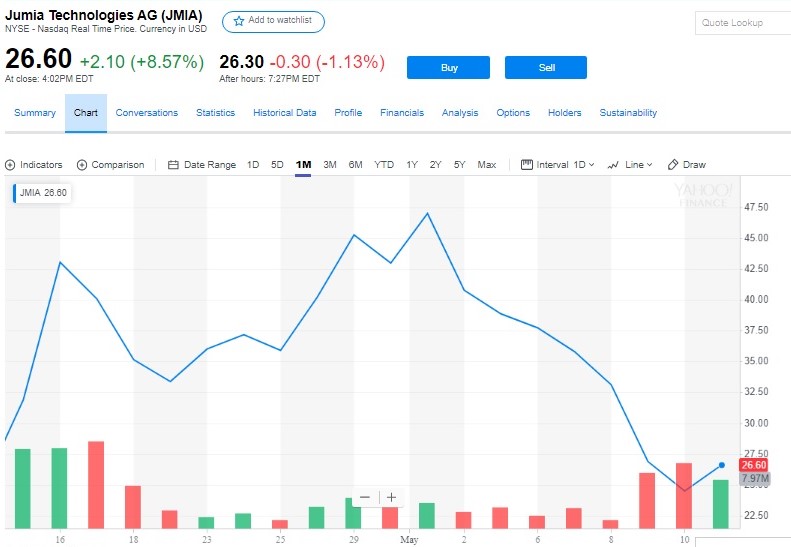
Jumia’s share price plummeted 43% the week Left released his short-sell claims, from $49 to $26.

The company’s stock price has continued to decline since Jumia’s August earnings call (and sales-fraud disclosure) to $6.52 at close Monday.
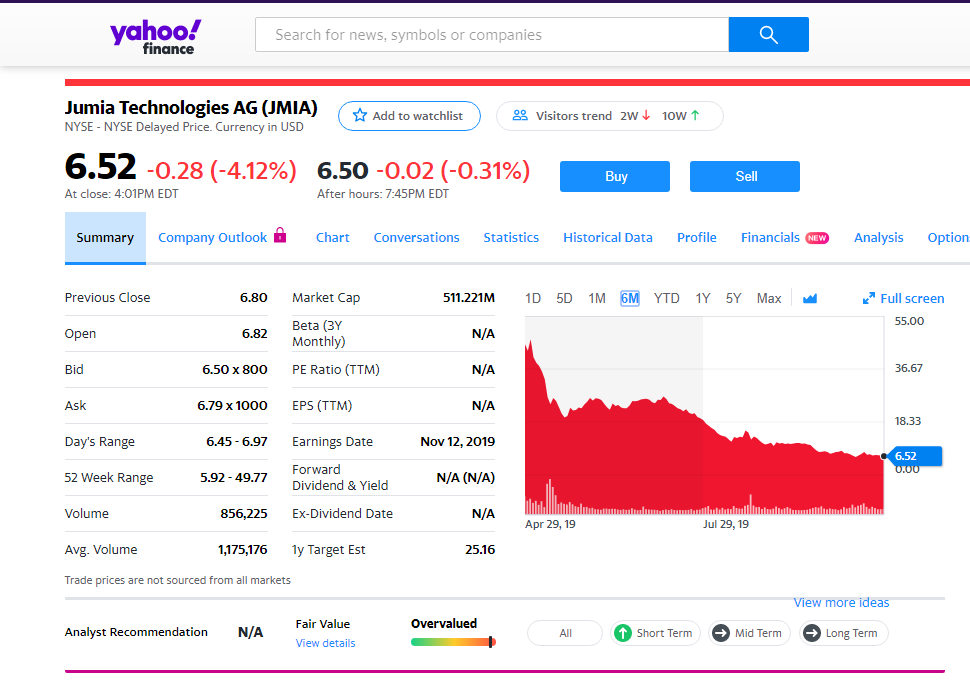
That’s 50% below the company’s opening in April and 80% below its high before Citron’s Research brief and Andrew Left’s short-sell position.

Jumia Stock Snapshot To October 28 2019

Jumia’s core investors appeared to show continued confidence in the company this month, when there wasn’t a big selloff after the IPO lockup period expired.

Even so, Jumia’s 3rd quarter earning’s call on November 12 could be a bit make or break for the company with investors given all the volatility the e-commerce venture has faced since listing and its rapid loss in value.

As a public company now, the most direct way for Jumia to revive its share-price (and investor confidence) would be demonstrating it has reduced losses while maintaining or boosting revenues.

Of course, that’s the prescription for just about any recently IPO’d tech venture.

What Jumia may want to evaluate pre-earnings call is the extent to which its own sales-fraud disclosure and Andrew Left’s allegations are still being mashed together and impacting brand-equity in Africa and investor confidence abroad.

From there it could be wise to address both head on and explain — in a way that is as easy as possible for people to understand — how the two are not the same and don’t have a bearing on Jumia’s brand or business model.