Year: 2019

10 Oct 2019

Bill McDermott steps down as SAP’s CEO

SAP today announced that Bill McDermott, its CEO for the last nine years, is stepping down immediately. The company says he decided not to renew his contract. SAP Executive Board members Jennifer Morgan and Christian Klein have been appointed co-CEOs.

McDermott, who started his business career as a deli owner in Amityville, Long Island and recently spoke at our TechCrunch Sessions: Enterprise event, joined SAP in 2002 as the head of SAP North America. He became co-CEO, together with SAP co-founder Hasso Plattner, in 2008 and the company’s sole CEO in 2014. Under his guidance, SAP’s annual revenue and stock price continued to increase.

It’s unclear why McDermott decided to step down at this point. It’s worth noting, though, that the company saw a number of defections among its executive ranks in recent months, with both SAP Successfactors COO Brigette McInnis-Day and Robert Enslin, the president of its cloud business and board member, leaving the company for Google Cloud in recent months.

Keeping an Enterprise Behemoth on Course with Bill McDermott SAPDSC00248

“SAP would not be what it is today without Bill McDermott,” said Plattner in today’s announcement. “Bill made invaluable contributions to this company and he was a main driver of SAP’s transition to the cloud, which will fuel our growth for many years to come. We thank him for everything he has done for SAP. We also congratulate Jennifer and Christian for this opportunity to build on the strong foundation we have for the future of SAP. Bill and I made the decision over a year ago to expand Jennifer and Christian’s roles as part of a long-term process to develop them as our next generation of leaders. We are confident in their vision and capabilities as we take SAP to its next phase of growth and innovation.”

Updating…

10 Oct 2019

Udacity will offer 100,000 free programming classes as part of the “Pledge to America’s Workers”

Udacity, the online education company founded by Sebastian Thrun, is launching a new scholarship initiative as part of the Pledge to America’s Workers job training initiative undertaken by the administration of President Donald Trump. 

Under the leadership of newly minted chief executive Gabe Dalporto, Udacity is committing to giving away free introductory technology training classes to 20,000 applicants every year.

The program is focused on teaching front-end web development, mobile app development, and data analytics. There are no prerequisites for applicants, but the scholarships are reserved for low-income individuals looking to learn programming skills.

This initiative is reserved for low-income individuals looking to learn the in-demand skills needed to land higher paying jobs and advance their careers.

New initiatives to train American workers in tech-related fields couldn’t come at a better time. According to McKinsey, 38.6 million people in the United States will potentially be displaced and need to change their jobs by 2030. Meanwhile companies are telling consulting organizations like Gartner that a shortage of available talent is their top concern.  

Udacity will roll out the program in two phases. The first is the 100,000 “challenge scholarships”, which provide access to the company’s introductory classes open to any skill level that require a few hours of work per week over a two-to-three month period.

These students will get access to Udacity mentors and Community Managers and have a chance to qualify for one of Udacity’s full Nanodegree programs. The top 10,000 students (based on their progress through the first phase of the program and overall contributions to the Udacity community) will have their Nanodegrees paid for.

Each Udacity Nanodegree costs $399 per-month and students typically graduate within five months. According to data from the company, roughly half of students who have gotten jobs through the Udacity program have increased their salaries by an average of 38%.

Man coding on computer at night.

Image courtesy of Getty Images/DeanDrobot

“I hope every one of these students gets a better higher paying job,” Dalporto says. “The challenge is that — as you know — education equals opportunity in this country and  so many people have been left out of the traditional education system in this country.” 

For Dalporto, the decision to launch this scholarship initiative was inspired by his experiences seeing how technology and economic transformation had hollowed the economy in his home state of West Virginia. The evolution of an automated economy changed the nature of the state — impacting everyone, not just the blue collar workers that most people think of when they worry about the risks of automation.

“We are  trying to get as broad a range  of people into these programs as possible,” says Dalporto. To that end, Dalporto says Udacity will partner with local leaders to customize the programs to specific geographies “to have the maximal impact”. 

The biggest shift for the company is to offer its introductory classes as a separate program. Typically, Udacity has used those intro courses as an onramp into its more robust Nanodegree program.

Dalporto says that the company would also consider offering certification to people who complete the initial training as a way to indicate achievement and flag skills that could be meaningful to potential employers.

“These courses  are quite full of content and they’re quite challenging. [Completing one] shows that someone has a lot of determination and critical thinking skills and logical thinking skills,” says Dalporto. “If you graduate from one of our courses or Nanodegrees it’s a high indicator that you would be successful in other types of courses.”

In all, the program will cost Udacity tens of millions of dollars, Dalporto says.

Dalporto sees the the new initiative as an extension of the company’s enterprise business. The newer business model . launched only a few years ago and already represents a third of Udacity’s revenue (growing at 100% year-over-year).

“Returning to my hometown in West Virginia, I see first-hand the hardship caused when entire industries disappear and automation displaces workers,” Dalporto wrote on the Udacity blog. “But with the right skills-based learning programs, career advancement can become accessible to absolutely everyone. I’m confident that Udacity’s tech and analytics scholarships will provide every recipient with the chance to learn new skills, launch or advance their career, and unlock their potential in careers that will remain in demand as technology continues to evolve.”

10 Oct 2019

NASA Administrator “very confident” SpaceX crew launch could happen in early 2020

NASA Administrator Jim Bridenstine was at SpaceX HQ in Hawthorne, California on Thursday, delivering an address alongside NASA astronauts Bob Behnken and Doug Hurley, who will launch aboard SpaceX’s commercial Crew Dragon capsule, and SpaceX CEO Elon Musk.

Bridenstine kicked off  with some brief remarks about the importance and priority of the crew launch mission, which he said both he and Musk are in agreement that the commercial launch of American astronauts is “the highest priority” of the various projects both his agency and SpaceX have under development.

He and Musk then went into some detail about where the program is now, and what remains to be done to get to an actual crewed flight – the first of which will be a test flight. Bridenstine’s comments essentially took 2019 off the table for this to happen, with the Administrator saying he was “very confident that in the first part of next year, we will be able to launch American astronauts on American rockets,” and that if “everything goes according to plan,” it would take place in the first quarter of 2020.

Musk noted that in order for SpaceX to have confidence in its Crew Dragon launch system’s reliability for a crewed mission, they would have to have run 10 successful drop tests using the newly developed Mark 3 parachute system for the capsule occur “in a row.” Bridenstine said that based on the current schedule, SpaceX could run as many as 10 drop tests total using the Mark 3 system between now and the end of this year.

This new Mark 3 system features much stronger lines connecting the sheets of material used in their construction, Musk said, thanks to switching to a material called ‘xylon’ away from nylon, which is three or more times stronger per the CEO. The new version also uses a new stitching pattern compared to Mark 2 for additional strength.

Both Musk and Bridenstine were keen to point out that the timelines discussed, including the 2019 target for the crewed flight that SpaceX has been working towards until now, are “not deadlines,” but are instead a “best guess” in Musk’s words, based on the current state of affairs. Said state of affairs can change quickly, and Bridenstine added that “there are still things we could learn [in testing]” that could alter the timelines later than the first part of next year.

As for Crew Dragon product, Musk said that SpaceX is ramping to a cadence of producing a new capsule around once every three or four months, a rate it hopes to achieve in order to “get in a cadence of operational flights to the space station.”

Bridenstine also addressed the tweet he posted in late September regarding SpaceX’s Starship program update (posted in full below).

“As the NASA Administrator, I have been focused on returning to realism when it comes to costs and schedules,” he said. “And a lot of our programs that not been meeting costs and schedules. And this has been developing over time. And a lot of these programs are, you know, five years old, 10 years old […] so what we’re trying to do is get back to a day where we have realistic costs and schedules, and so I was signaling, and I haven’t done it just the SpaceX, but to all of our contractors that we need more realism built into the development timelines.”

Still, Bridentstine clarified that NASA definitely supports the Starship program as well, even if it’s prioritizing Crew Dragon at the current moment. “I want people to make no mistake: NASA has an interest in seeing starship be successful,” he said, while also pointing out NASA’s recent investment in Starship via its ‘Tipping Point’ project funding.

10 Oct 2019

Elon Musk says that NASA is free to share all SpaceX IP with “anyone it wants”

SpaceX CEO joined NASA Administrator Jim Bridenstine at SpaceX HQ in Hawthorne today to provide an update on the commercial crew launch program that the company is working on with the agency. During the remarks, which detailed the current state of the program and next steps, Musk reiterated twice that the intellectual property it’s developing in working with the agency is free for NASA to share with whoever it should wish.

Early on in the Q+A portion of the event, Musk said that the learnings that SpaceX has gathered from the Crew Dragon parachute development program is free to share with anyone who wants it – SpaceX is working on its third major iteration of the parachutes it will use to ensure the Crew Capsule’s safe return to Earth.

“I’ve been very very clear with Jim that any SpaceX data should not be considered proprietary,” Musk said during the remarks. “It can be used by any of our competitors […] No charge. ”

Later on, he reiterated that what he meant was literally any of SpaceX’s IP is on the table for NASA to distribute freely as the agency sees fit.

“I want to be clear: NASA can share all of our IP with anyone that NASA wants,” Musk said. To which Bridentstine replied that the agency genuinely appreciated this freedom but that it has limits on that potential sharing to consider.

“There is IP that it is in the inters of the nation that we cannot be sharing with people, or with countries that would not have our interest at heart,” adding that this is why it’s important that the partners have all their information technology secured and protection measures in place.

10 Oct 2019

Why venture capital firms need culture experts

When Susan Fowler’s 2017 blog post shined a light on Uber’s raucous culture, outlining rampant harassment and sexism, a debate erupted. What role do the deep-pocketed investors behind the company, those who allowed it to scale to monstrous proportions, have in developing and nurturing its culture? Entrepreneurs and venture capitalists themselves wondered aloud, how involved should a venture fund be in early-stage recruiting processes and ensuring a safe environment for employees? If a culture is bad, unsafe, damaging, is it the VC’s fault?

Late-stage venture funds, for the most part, miss the opportunity to deeply impact their portfolio companies cultures. When they invest, typically large sums of capital in companies with hundreds of employees and multiple offices, the company’s culture is formed and as Uber and others have proven, rebuilding culture a decade in is no easy challenge. Early-stage funds, however, the people the write the very first check in startups, have a front row seat to decisions crucial to defining how a company operates and treats its employees in the long-term. These people, if they care to, have the power to help determine key hires and establish company values, norms and behaviors from the get-go.

This week, San Francisco-based early-stage fund True Ventures hired its first-ever vice president of culture, a move that suggests VCs are taking concrete steps toward further involving themselves in the company-building process from a D&I and hiring perspective. Madeline Kolbe joins the firm, which raised $635 million across two new funds last year, from Handshake, where she was the VP of people and talent.

“There’s a responsibility to guide the company and the founder to being the best they can be and that involves paying attention to who you’re hiring and how people are being treated,” Kolbe tells TechCrunch. “If we can come in and establish inclusive norms, my hope is that our companies will scale inclusively as well.”

Most venture capitalists are in regular communication with active investments. Early-stage investors, particularly, are very involved with building businesses, facilitating hires and scaling. But as they seek to decrease cash-burn or find product-market fit, VCs are not often very concerned with issues of diversity and inclusion, something that’s became increasingly important as companies are finally being held accountable for the diversity of their workforces.

10 Oct 2019

Autonomous trucking startup Einride eyes U.S. market with $25 million in new funding

Einride, the Swedish autonomous vehicle startup known for its futuristic pods designed to haul freight, has raised $25 million in a Series A round that will be used to fund its expansion into the United States.

The round was co-led by the EQT Ventures fund and NordicNinja VC, a  fund backed by Panasonic, Honda, Omron and the Japan Bank for International Cooperation. Other investors joining the round include Ericsson Ventures, Norrsken Foundation, Plum Alley Investments and Plug and Play Ventures. The startup has raised $32 million to date.

Einride’s self-driving vehicle isn’t quite a truck, although it’s meant to perform the same freight-hauling tasks. The company’s T-Pod electric vehicle, which was unveiled in 2017, has been running on public roads since May of this year.

Einride, which was founded in 2016, has landed several customer contracts, including logistics provider DB Schenker and supermarket chain Lidl. Einride has a commercial pilot with DB Schenker. The startup said it has also signed on “large U.S.-based retail companies,” without naming them.

The funds will be used to hire more people, invest in its software platform and expand internationally, notably the U.S., according to the company. Einride plans to open a U.S. office next year.

“Our ambition is to disrupt the transport industry and closing our series A brings us one step closer to that goal,” Einride co-founder and CEO Robert Falck. “The funding will allow us to start expanding in the U.S., deliver on our technology road map and to meet rapidly increasing customer demand.”

10 Oct 2019

NASA’s new Moon-bound spacesuit is safer, smarter, and much more comfortable

The next Americans to set foot on the Moon will do so in a brand new spacesuit that’s based on, but hugely improved from, the original Apollo suits that last went up there in the ’70s. With easier entry, better mobility, and improved communications, these won’t be nearly as clumsy or restrictive — though you still wouldn’t want to wear one around the house.

The new spacesuit, known as the Exploration Extravehicular Mobility Unit or xEMU, is still deep in development, but its features have been more or less finalized. It’s already being tested underwater, and orbital testing is scheduled for 2023.

Rather than build something completely new from the ground up, NASA engineers decided to address the (sometimes literal) pain points of a previous, proven design. As such the new suit superficially resembles the ones we saw moonwalkers bunny-hopping around the lunar surface with. But that’s because the basic design for a suit that protects you from hard vacuum and cosmic radiation is relatively straightforward.

In NASA’s words, a spacesuit is “a personalized spaceship that mimics all of the protections from the harsh environment of space and the basic resources that Earth and its atmosphere provide.” There’s only so much wiggle room there.

But while some parts may not have changed much since the old days, others are getting major improvements. First and foremost, both for safety and mission purposes, maneuverability has been upgraded in tons of ways.
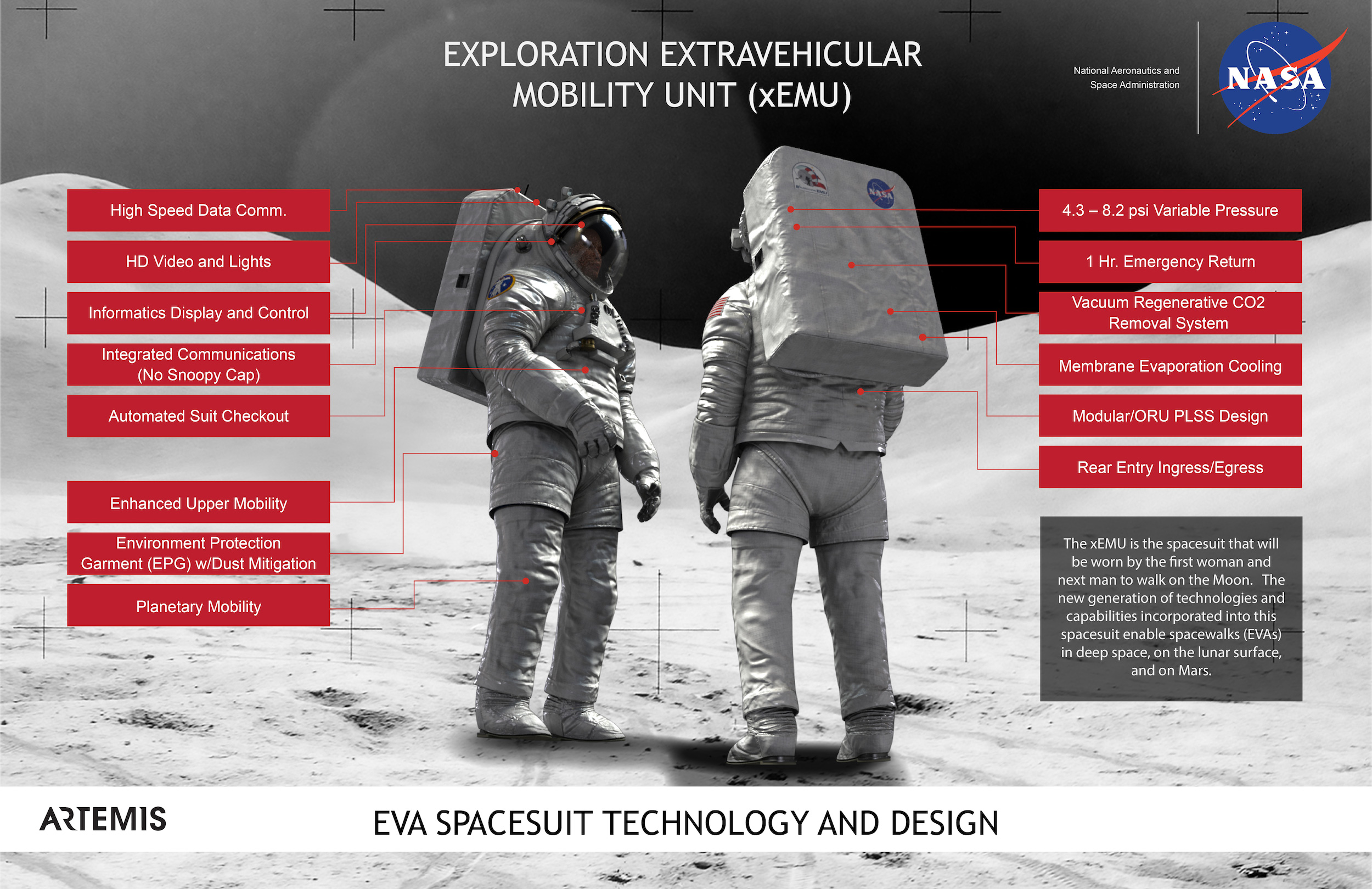
xemu suit info

Infographic showing new and updated features of NASA’s new xEMU spacesuit.

For one thing, there are altogether new joints and better ranges of motion for existing ones. The standard “astronaut stance” indicative of the inflexibility of the Apollo suits should be all but eliminated with the new freedoms afforded xEMU users. Not only will the normal range of motion be easier, but astronauts will be able to reach across their own torso or lift something clear over their head.

More flexible knees and “hiking-style” boots with flexible soles will make crouching and getting up much easier as well. It’s hard to believe we got this far without those basic capabilities.
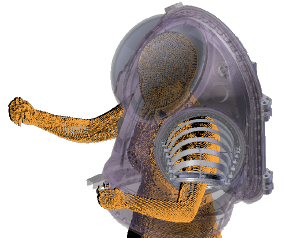
xemu digitial fit check

A 3D scan of the body (indicated by the dots) shows how various suits and parts would fit.

The fit of the suits will be vastly better as well; NASA is using anthropometry, or 3D scanning of the body, to determine exactly which pieces and fits will be best for a given astronaut.

Speaking of which, much of the suit will also be made from easily swappable, modular parts. The lower half can be switched out when doing an orbital EVA versus a surface EVA, for instance. And the helmet’s visor has a “sacrificial” protective layer that can be easily replaced with a new one if it gets damaged.

Inside the helmet, the familiar but apparently widely disliked “snoopy caps” that housed microphones and such are gone, replaced by modern voice-activiated mics and headphones that will produce much better audio quality and much less sweat.

For that matter the entire communications stack has been replaced with a new HD camera and lights, connected by a high-speed wireless data link. Live video from the Moon may be old hat, but it’s going to be a bit different from that grainy black-and-white business in 1969.

One of the most important new features is rear entry. The awkward process of donning an old-style EVA suit requires a good deal of space and help. The new ones are entered via a hatch on the back, allowing more natural placement of arm hinges and other features, and possibly changing how the suits are mounted. One can easily imagine a suit acting as a sort of airlock: you climb in the back, it seals you in, and you walk right out into space. Well, there’d probably be more to it than that, but the rear entry hatch could facilitate some cool stuff along those lines.

Although NASA is designing and certifying these suits, it may not actually make them itself. The agency called last week for input on how it might best source spacesuits from the commercial space industry.

That’s part of NASA’s decision to rely increasingly on contractors and private industry to support its 2024 Moon ambitions. Of course contractors were an essential part of the Apollo program as well, but NASA is now giving them much more leeway and may even use private launch services.

You can keep up with the latest NASA spacesuit news here of course or at the agency’s SuitUp tag.


10 Oct 2019

Apple Arcade’s black box

Apple Arcade is a new kind of App Store. One where eclectic, indie and original content can shine. A place where gamers can play without being hounded by ads or strong-armed into spending on in-app purchases. But unlike the original App Store, Apple Arcade’s marketplace is a black box. There’s no way for consumers or developers to find out if Arcade produces a breakout hit game or even which app everyone is playing right now.

That’s because Apple Arcade has ditched one of the App Store’s core components: the Top Charts.

Traditionally, the App Store’s Top Charts highlighted which games are most popular, based on downloads, velocity, and other signals Apple never disclosed. On the main App Store, users can browse these top-ranked apps and games, including both free and paid titles. And through APIs, app store intelligence firms like App Annie, Sensor Tower, and others gain access to even more data — like top grossing apps and games, for example.

However, following the Apple Arcade subscription service’s launch, these firms told TechCrunch that Apple is not exposing any of the data that providers such as themselves have typically had access to in order to generate download and revenue estimates. There is some expectation that could change in time, but it’s not clear if or when that will be.

10 Oct 2019

Steam will soon let you play local-only multiplayer games with far off friends


Co-op video games are wonderful.

Alas, it’s not always possible to get everyone in front of the same TV — and not all co-op games have online play, so playing across the Internet is out.

With that in mind, Valve has been working on something it calls “Remote Play Together” that it’s planning on rolling into its Steam game launcher later this month. By more or less tricking the game into thinking all players are in the same room, it’ll let you play generally-local-only multiplayer games with your friends remotely.

Valve published a note, first noticed by PCGamer, about the upcoming feature on its developers-only Steamworks site. The note quickly made its way to the Unity developer forums.

“Your local multiplayer games will soon be improved with automatic support for Remote Play Together on Steam,” it reads. “All local multiplayer, local co-op, and split-screen games will be automatically included in the Remote Play Together beta, which we plan to launch the week of October 21.”

The pending launch was later confirmed by Valve’s Alden Kroll:

So how does it work? If you’ve ever used PS4’s remote play (which lets you push PS4 games to your smartphone) or cast a game from your PC to an Nvidia SHIELD, it’s a bit like that… just tweaked for multiplayer. One player hosts the game on their computer; Steam sends a stream of the visuals to everyone else, capturing controller/keyboard input and sending it back to player one. As far as the game knows, everyone is sitting around the same screen.

It’s important to note, of course, that some games will almost certainly fare better than others here. While streaming tech is only getting better, it inherently introduces latency — and in plenty of games, latency kills. Hopefully Valve makes it clear to players that this is all pretty unofficial; if a game isn’t playable because of latency or anything else remote play brings into the mix, it’s not really the developer’s fault.

Valve says Remote Play Together will officially support up to 4 players in one game, and notes that the experience will only be as good as the connections of everyone involved.

10 Oct 2019

Rocket Lab’s new 5-year FAA license will help it streamline its rocket launch process

Rocket Lab has received a new 5-year Launch Operator License from the Federal Aviation Administration, which grants it permission to do multiple launches of its Electron rocket from its LC-1 launch site in New Zealand without having to seek individual clearance for each one. While not the only limiting factor, this should help Rocket Lab increase the frequency of its launches form LC-1, servicing more customers more often for commercial small satellite customers.

Until now, Rocket Lab has had to seek out a license (or multiple licenses) from the FAA for each individual rocket it flew – the company has seemingly managed that process just fine to date, but it’s an added process that probably adds a lot of time and effort to each launch attempt, even if it hasn’t directly flummoxed any mission to date.

Rocket Lab says that this will provide a “streamlined path to orbit” for its customers, however, which should make it easier for the company to operate its flexible model that is designed to work better with the shifting timelines of small sat startups and younger commercial space companies, while still ensuring that Rocket Lab’s launch capacity is used to maximum effect. Rocket Lab just recently swapped one payload for another for an upcoming launch, for example.

Rocket Lab is part of the Commercial Spaceflight Federation, an industry consortium that also includes SpaceX, Virgin Galactic, Relativity Space and others that is petitioning the FAA for reforms to regulations that would update them to better suit the current state of the commercial space business. SpaceX CEO Elon Musk recently praised the FAA as a partner that it’s been able to work with very efficiently, speaking specifically about the licensing process regarding its ongoing Starship test program.

This license isn’t tied to the agency’s overall process for licensing U.S.-based launches (LC-1 is in New Zealand, after all) but it is another indication that the current FAA is more than willing to work with younger commercial space companies to ensure they can do business in an efficient manner.