Year: 2019

07 Oct 2019

Hulu finally launches support for downloads, initially to ad-free viewers

Hulu is finally adding downloads to its streaming service, years after Netflix and Amazon Prime Video did the same. The company had promised over a year ago that it would soon roll out support for offline viewing, having developed a way to include advertising with its downloads. However, the downloads feature launching today is only available to iOS users on Hulu’s “No Ads” plan, the company says.

When reached for comment, Hulu couldn’t offer a timeline for when support would arrive on the ad-supported version of Hulu, whether those plans had been shelved, nor could it explain the delay to bring a downloads product to market.

At launch, there are “thousands” of TV shows and movies offered for offline viewing, including Hulu Originals like The Handmaid’s Tale, Shrill and The Act, as well as series like Family Guy, Desperate Housewives, This is Us, How I Met Your Mother, and ER.  In fact, the majority of the content on Hulu is available for offline viewing, as its content agreements were already negotiated to allow for downloads.

In a few cases, however, only past seasons of a TV show will be offered for download.

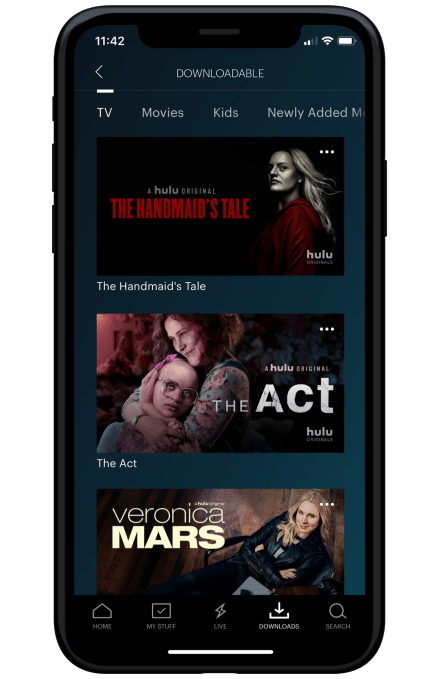
To access the content, Hulu is adding a new “Downloads” tab at the bottom of the screen. You can also browse for shows and movies to download by clicking on “See What’s Downloadable,” says Hulu.


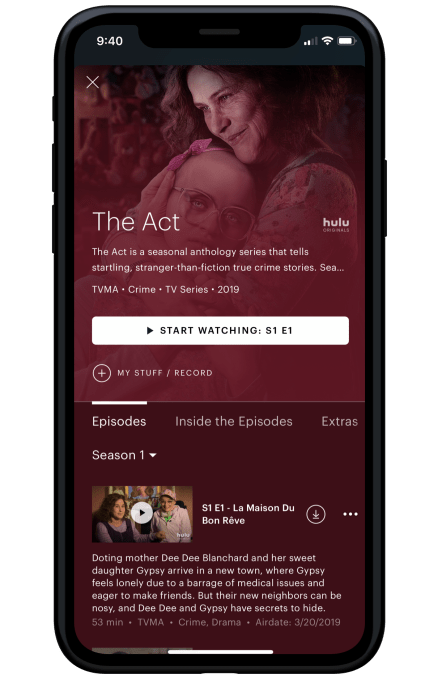
Details Page with Download

You can also search for specific titles to see if they’re offered for offline viewing. If so, a download icon will be displayed on the title’s details page.

Viewers will be able to download up to 25 titles across 5 devices, and will have up to 30 days to watch the downloaded content. After starting playback of downloaded content, viewers have 2 days to finish before the download expires. If you didn’t finish watching, you’ll have to renew the expired download while online — assuming it’s still offered on Hulu.

The feature is initially available for iOS users but Android users will get the same option “soon,” says Hulu.

Downloadable Hub

Hulu is aware that it’s extremely late to add support for offline viewing.

Most consumers today expect there to be a way to download content, ad-free, for those times they want to watch TV shows or movies without access to the internet — like when traveling by plane or underground train, for example.

Amazon Prime Video added downloads to its service way back in 2015, and Netflix followed the next year. Even smaller players in the streaming market have since added downloads, like CBS All Access did last year, and Showtime the year prior. 

Hulu had barely even touched on the topic, until recently. At the 2018 Newfronts, Hulu CEO Randy Freer told advertisers that a “downloads” feature would arrive sometime in the “2018-2019 Upfront season.” He said the feature would allow viewers to download shows with ads included, which would benefit advertisers.

Since then, there’s been no news as to why the option hadn’t yet arrived or why.

One possible explanation some people may point to is Hulu’s big executive re-organization last summer, which saw the departure of its Chief Content Officer and its SVP of Experience, among others. But the re-org didn’t really involve Hulu’s technical team, so that shouldn’t have had a significant impact. However, the company did also launch a revamped version of its consumer mobile app this summer — a change that Hulu may have decided should be prioritized ahead of adding the new Downloads functionality.

Hulu could also be struggling with the technical challenges of ad-supported downloads, perhaps. Making those ads work properly and be attributed correctly could require a longer timeframe than originally planned. And Hulu may even be reconsidering if such a product is necessary, as long as on-demand downloads are available.

The downloads feature will arrive on iOS today, but you’ll need to update your app to gain the option.


07 Oct 2019

Sequoia shares wisdom with Disrupt SF Battlefield competitors and Startup Alley Top Picks

Editor’s note: James Buckhouse is design partner at Sequoia. 

Last Tuesday, the teams competing in Startup Battlefield at Disrupt SF, as well as founders chosen as Top Picks in Startup Alley, visited Sequoia Capital’s office in San Francisco for a discussion with partners Jess Lee, Roelof Botha, Mike Vernal, Alfred Lin and James Buckhouse. The following is a partial transcript of the session, which was moderated by Buckhouse.

James Buckhouse: We partner from idea to IPO and beyond, but it’s partnering at the idea stage that we love the most — that moment when anything is possible. And it’s happened throughout Sequoia’s history. YouTube incubated in our office. Dropbox was an unreleased demo. Stripe didn’t have a single line of code. Apple was just two dudes named Steve. And so our favorite place to be is in the earliest moments.

We’re not here tonight to share with you lessons of our great wisdom on how company building ought to go. We’re here tonight to say that we understand how hard it is. And the three partners that you’ve got here to talk with tonight — Roelof BothaJess Lee and Mike Vernal — are people who have actually been in the trenches building companies themselves.

Customers

James Buckhouse: Great companies like Apple, Amazon and Zoom all have this one thing in common: customer obsession. That’s an easy thing to think about when you already have a billion customers, and you already have a bunch of money. But what do you do when you’re at the pre-seed stage and you want to be customer-obsessed but you don’t even have a product yet, let alone any customers? How do you even begin?

Jess Lee: I think at the very earliest of stages, all that really matters is product market fit. A common mistake we see is that a founder is only obsessed with the product, and then goes on to think, “I have my product. Let me go find a market that works for this,” when it should actually be the other way around. You should look at the market first, and then get to know the customers in that market by doing customer research.

There’s a great book by Erika Hall where she discusses how to ask the right questions to customers in order to really understand their pain points, their motivations and their needs. That’s a hallmark of some of the best companies that we’ve seen, even at the earliest stages. They spend a lot of time talking to customers and understanding what they want. Something we at Sequoia like to recommend when we work with seed and pre-seed-stage companies is to actually take the time to write down a set of customer personas. Who are your prototypical or your archetypes of different types of customers? In the very early days, you might think, “I know the customer. I can remember this. I don’t need to write it down.” But as soon as you add one new team member, who maybe isn’t as familiar with your customer, a lot of things get lost in translation.

For my company Polyvore, which was in the women’s fashion space, I had a lot of engineers on my team who were men and didn’t understand women’s fashion very well. I would always beat my head against the wall wondering why a feature they designed didn’t quite make sense, and it’s because we did the personas exercise a little bit too late. It made me wish we’d done it earlier. Once we had three very clear personas, I started to notice everything ran more smoothly. I found, whether it was the sales team or the engineering team, people started to clearly communicate the idea of what our customer really wanted. People made better decisions at all levels. That’s why at Sequoia we always encourage even our earliest-stage companies to write their customer research down immediately, way before they think they need it.

Product

James Buckhouse: How does an early-stage startup make sure that they’re on the right track and building the right product?

Mike Vernal: The key thing to me is actually not being data-driven; it’s much more about being hypothesis-driven. The problem is people think about product as art. But I actually think of product as being equal parts art and science. And I think the science part of it, which is really important, especially at an early stage, is being clear about what your hypotheses are, what you think is going to work, why you think it’s going to work and really sort of pressure-testing that on a logical level. And, if you are able to, actually pressure-testing it with real data.

One of Jess’s techniques, which I think is great, is the notion of fake doors. If you want to know whether something’s actually going to hum in the market, whether people are going to care about it, build a landing page for it. Build a sign-up button for it. Run a bunch of ads for it. Test a bunch of different marketing copy and see if people actually want the product. I’ve seen a bunch of companies use this to great effect.

I think that in general the mistakes people make with product is, one, being too artistic and not scientific enough about things. And then two, to Jess’s point, the most important thing before you have a product is finding product market fit. Usually, finding product market fit in a category is a function of two or three important things. Identifying those important things and testing them to get clarity around that first, then designing the full product, is way better than just starting with a masterpiece, and then slowly painting over and over the masterpiece until you get to something that is great.

James Buckhouse: For enterprise companies, Roelof, can you talk a little bit about the Sales Ready Product and Templeton compression approach?

Roelof Botha: If you go to our website and search for Sequoia Sales Ready Product or Templeton, you’ll find very useful content that we put together. The insight came from one of the best leaders that we’ve worked with, in a variety of companies, who argued to not just go for an MVP, a Minimal Viable Product, if you’re building an enterprise company, but what he termed a Sales Ready Product, an SRP.

The difference is that a Minimal Viable Product just gets over the hurdle but doesn’t convince your customer to jump out of their seats to buy your product. When we invested in Cisco in the late 1980s, the first product they shipped had so many bugs it didn’t work. But the product solved such an important need for the customer that they came back to Cisco and asked if they could fix it since they needed the product to work so badly because there was a fundamental problem in trying two networks at the time. And that to me was a Sales Ready Product. You’ve got something that, even if it’s not perfect, really solves your customer’s pain point.

And so to condense the whole theory behind this: Spend a little bit more time, probably another three months, maybe another four, five months, from when you would otherwise ship an MVP to ship an SRP. The reason it matters for an enterprise company is that your sales organization will be so much more effective. Your sales team will ramp up a curve far more steeply and you’ll get sales momentum much, much faster if you sell an SRP.

Culture

James Buckhouse: I’m going to do something a little bit unexpected here and call on Alfred in the back. Could you talk a little bit about what it was like at Airbnb, where they started with culture very early on?

Alfred Lin: Brian, Joe and Nate came and visited Zappos, where we offered tours, to see what the culture was all about (Alfred was COO of Zappos). At Zappos, we started writing down our core values a little late, when we were at about 300 people. And I told Brian, Joe and Nate that that was too late.

After that trip, they went back and wrote down their core values, before hiring their first employee. They knew that they had to create a new category. Home-sharing was not something that people really thought about. And so they needed people who were willing to champion the mission. And that was one of the first core values that they wrote down.

James Buckhouse: Oftentimes, people think that culture is the thing you do later on, once your business has grown large and suddenly you have a lot of people. But that’s not true. Culture matters a lot more than people think. And it matters earlier than people think. Jess, can you talk about your framework on core values?

Jess Lee: This is something we spend a lot of time on with seed and pre-seed companies, who think, “Oh, I already know my culture. I’ll wait to write it down later.” But it’s important to get it right up front. We encourage people to not pick too many core values. Generally, you want a framework that’s a core value and the behaviors you want that exemplify that core value. And most importantly, you need a story. You need some legendary anecdote or example from inside the company that really brings the core value to life.

To use Airbnb as an example, one of its core values is to be a cereal entrepreneur. The reason it’s cereal with a “C” is because at the time, Airbnb was running out of money. They weren’t sure they had product market fit, but they went to the Democratic National Convention to try the Airbnb idea when they were down to the wire in terms of money. In order to just get the word out about the business they made boxes of cereal that said “Obama-Os” and “Captain McCain.” It’s a good example of rolling up your sleeves and doing whatever it takes to get your business launched. Somehow, they actually managed to generate revenue that they put back into the business. The really memorable part of that is the cereal anecdote. Whatever it might be at your company, make sure that the lore lives on. That’s really what brings culture to life. It’s not just the value itself.

James Buckhouse: Roelof, can you talk a little bit about the culture at PayPal in the early days?

Roelof Botha: There are a couple of elements in that. One is this idea of intercept versus slope. For those of you that are fans of math or science, it comes naturally, but sometimes you get to hire people who have a high intercept. They have a lot of experience. In our case, we needed to hire people who knew a lot about financial services, because we as the early, young team didn’t. You hire people with intercept, but then you want people with slope. People who are going to learn very quickly. And at the end of the day, part of what made PayPal successful was that we had a good slope and we learned very, very quickly.

Our culture was very hard-working. We faced a bit of a crunch in June of 2000. We’d raised a bunch of money during the dot-com era, and then we were sitting with seven months of runway and no revenue, burning $10 million a month. It was a “you’re all-in” culture. Management meetings were on Saturdays, because that’s the kind of sacrifice we were going to make as a team to get to the other side. Culture was really important to the success of the company. We had a strong bond between us as team members because we were in the trenches. We had to figure out how to make this business work when the odds were against us and the press had given up on us.

Most people on the outside are going to think that you’re going to fail. Expect that. Don’t be surprised by that. Draw strength from that, and rally your team around your cause. You should ignore that kind of feedback.

Leadership

James Buckhouse: How do you discern a strong founding team?

Roelof Botha: My favorite, especially with companies at the seed stage, is to have no slides and to have a conversation with you about your business. What I find compelling is, the more I dig, the more excited I get, because your depth of knowledge, of understanding the problem that you’re trying to solve, shows itself. There are a lot of people who start companies for the wrong reasons, and they have very superficial knowledge. So as soon as you start to pressure test it, it’s clear that there’s no depth.

The founders who are the best are the ones that are so motivated to solve the problem they’re working on, they’ve researched everything. You would have found a simpler solution to the problem if you could, and you didn’t. That inspired you to start this company. As I ask you questions, you just have this depth of knowledge. You’ve thought about it so many levels deep. Those founders are the ones that keep coming up with new ideas, and that’s why their imitators don’t do so well. We see this in our industry. You come up with a great idea, TechCrunch writes about it, everybody around the world reads about it and now you’ve got 15 competitors in other countries going after what you’re doing. But guess what? They didn’t have the idea, you did. Since you had the original idea, you’ve thought about it more deeply and you can iterate faster than they can.

James Buckhouse: Jess, how about you? What do you look for to discern a strong founding team?

Jess Lee: I do agree, and I think different investors look for very different things. There is probably a notion of founder/investor fit to some extent. For me, I especially appreciate a unique insight and depth of understanding of that customer and that market. But on top of that, the other thing I think about is grit. I think that being a founder is so hard. I felt like I was on the struggle bus the entire time. Either we weren’t doing well, which was a struggle, or we were doing really well and then we were in a state of hyper-growth, and that’s also really hard. Your job changes underneath you every six months. Because even if you’re successful, everything that used to work for you as the CEO or founder is now broken because your team is now 50 people instead of 10.

What is it driving you, to either solve this problem or just driving you in general? Because it’s just not easy, and folks who give up too easily or came into this because they thought being a founder was going to be really cool, it’s not that cool all the time, so I look for that. Sometimes it shows up in the form being really mission-driven, and you have some burning desire to solve the problem. Sometimes it’s just that you’ve been underestimated your whole life and you’re really mad about it, and you want to prove yourself. There are a lot of different ways to suss out grit, but that’s one big thing that I look for.

One thing I also like to see, that is not a must-have but I find very compelling, is if you’re a good storyteller. I think that at the end of the day you have to convince your family that you’re not crazy for quitting your job to pursue this thing. You’ve got to convince early employees to join you when you can’t pay them any money. You’ve got to convince early-stage seed investors to take a chance on you and give you money when there is nothing there yet. And you’ve got to convince customers. Being able to tell a good story, both taking something complicated and making it sound simple, as well as being able to influence and talk about why your approach is interesting and different, not just better than the competitors. I look for that as well. I think that’s important.

One area where I do disagree with Roelof is that I do prefer to see slides. I think it showcases your storytelling ability. I look at a lot of consumer companies and your attention to design and detail is also an interesting thing that you can suss out with slides.

James Buckhouse: How about you, Mike?

Mike Vernal: If you can’t describe the business in a minute or two, then you need to keep iterating. Some bad meetings end up as the following: Someone will come in with 40 slides and want to convey all of the knowledge in the 40 slides in excruciating detail.

I think a couple of things. One is, many investors look at a lot of companies all day long so they might actually know more about your space than you might think. Then two, if you need 40 minutes to explain the business, marketing and all of these other things, then for an investor meeting that might work because you have that time scheduled, but for the random engineer you meet at a party who you want to get excited about joining your company, that’s going to be really hard.

The best pitch is when I’m two minutes in and I’m like, “I get the business. This is super interesting. Let’s ask all these questions.” The tough ones are 40 minutes of being talked at, where there is no real interaction.

Capital strategies

James Buckhouse: Different types of companies need different types of capital strategies. How do you all think about how founders ought to think about their strategy for capital?

Jess Lee: It’s really important to think about three things: First, what is the actual cash you need for your business? If you’re a pure software business you don’t usually need as much as if you’re building hardware or you’re making physical goods.

Second, what is the valuation that actually makes sense? True valuation, when you become a public company, when you do M&A, is actually a function of your free cash flow, or a multiple of your revenue, so just being able to understand in the long, long-term what is a likely five, 10-year-out valuation, and then making sure you don’t overshoot that just because you can. That’s another first principle.

The third thing is ownership. Doing the math, if you don’t need to raise a lot of money, if you don’t need to raise as many rounds, at the end of the day when ideally your company is acquired for hundreds of millions of dollars, or billions of dollars, or you IPO, what is your ownership at that moment? We have founders like Dropbox, that when they went public, Drew and Arash owned nearly 40% of the company. So you have to think — would you rather have 40% of a $10 billion company, or would you rather have 2% of a $20 billion company? That ownership at the end of the day is really important. So you have to think about those three things, which is a pretty complicated equation.

It really hit home for me when my company, Polyvore, went through the M&A process and it suddenly hit me that all the acquirers were not using funny VC math. They were looking at our cash flow and the multiple of revenue. Luckily, we hadn’t raised that much money, as I’d wanted to keep as much ownership as possible. I was optimizing for ownership for the team. Because of that, we actually had a really nice outcome, where everybody made money because we hadn’t over-raised since we didn’t need to. We were a pure software-based, capital-efficient kind of company, but I think not enough founders think about that from first principles, starting from the early days. They just look at who’s raising what, and how much they could possibly get. They want to maximize that, when in reality, it’s not actually the right way to think about it.

Roelof Botha: When you raise money, you’re recruiting a partner. I see too many companies, especially seed-stage companies, make the mistake of accepting funding from whoever shows up, when that’s probably the most expensive equity you’ll ever sell in your business. You could potentially be selling it to people that are not going to be there six months or six years from now, helping you close a candidate, helping you wrestle with an important strategic decision or helping you refine your business model. Those people aren’t going to be there, so it’s a recruiting decision. Take it seriously. It’s also important to check their references. Your investor is going to do references on you. Why aren’t you doing references on them?


07 Oct 2019

Laurel Bowden of VC firm 83North on the European deep tech and startup ecosystems

London and Tel Aviv based VC firm 83North has closed out its fifth fund at $300 million, as we reported earlier. It last raised a $250 million fund in 2017 and expects to continue the same investment mix, while tracking developments in emerging areas like healthcare AI and autonomous vehicles.

In a conversation with general partner Laurel Bowden, the veteran investor shared a few further thoughts with Extra Crunch — talking about the tech scene in Europe vs Israel, what the firm looks for in a team and tips on scaling globally.

The interview has been lightly edited for clarity. 

TechCrunch: Is Europe starting to catch up to Israel when it comes to deep tech startups?

Laurel Bowden: We clearly think we have in our portfolio some deep tech. And in other VC portfolios too — there’s clearly some deep tech [coming out of Europe]. And then on the reverse side you’ve seen more consumer-related stuff coming out of Israel. But still if you take a blanket look, we see more data infrastructure, security, storage coming out of Israel than we see in Europe — that’s for sure.

07 Oct 2019

Armenia and the technology of diaspora

It’s a tough world out there for small countries. Technology is the future, everyone knows that; but how do you claim your share of that future when you’re competing with America, China, the EU, and India?

How do you build a thriving ecosystem of tech wealth and tech education — successful international businesses whose alumni found and invest in burgeoning startups — when you face the triple threats of a small population, limited capital, and a potential brain drain? Even nations as wealthy and successful as my homeland Canada often struggle with this.

So imagine what it’s like for, say, Armenia, from which I write, a former Soviet republic turned tiny nation of three million, sandwiched between unfriendly neighbors in the Caucasus Mountains. I’m here because the Armenian government is, at obvious expense1, hosting one of the world’s seemingly countless / endless Major Tech Conferences, this time the World Congress of Information Technology, presumably in the hopes of garnering international attention for — and investment in — Armenia’s tech sector.

This may seem quixotic. Armenia styles itself as “the Silicon Valley of the former Soviet Union,” and its tech sector is successful enough to have played a prominent role in last year’s ‘velvet revolution.’ But it’s still a country of three million in a relatively obscure corner of the world. However, Armenia has a fascinating secret weapon — its diaspora.

Thanks to their homeland’s troubled 20th-century history, many more Armenians live scattered around the world than in Armenia proper, including, most famously, hundreds of thousands in Los Angeles. It is “one of the largest and most sophisticated diasporas in the world.” Obviously there’s cultural drift — but at the same time, I’m repeatedly assured it’s a rare Armenian who doesn’t have a distant friend or relative in L.A. and/or Moscow.

The effects of this unusually large and loose-knit diasporal web are significant. It leads, sometimes directly, often indirectly, to American clients, German universities, and Russian partners; to international connections to venture capitalists and startup incubators; to brain gain as well as drain. It means Armenia isn’t just a landlocked nation of three million, but the beating cultural heart of ten million, inadvertently strategically scattered across the globe. That’s a far, far stronger position.

I’ve argued before that as technology shortens and tightens the bonds between distributed communities, they’ll grow more significant, culturally, financially, and eventually politically. (And of course tech also makes entire sub-industries even possible; one of WCIT’s sponsors here is a slick and fast-growing crowdfunding marketing company, not exactly a traditional strength of the former Soviet bloc.) The Armenian diaspora is almost a natural experiment testing this theory.

This natural experiment will test whether this secret weapon will help Armenia continue to punch further and further above its weight in technology, tourism, and other diaspora-enhanced fields. If that happens, and I expect it to, it will be especially interesting to see which other distributed communities follow in its wake … and whether those will be affiliated with any nation-state at all.


1Including paying the travel costs for your correspondent. Assume unconscious bias accordingly.

07 Oct 2019

Daily Crunch: Render wins the Startup Battlefield

The Daily Crunch is TechCrunch’s roundup of our biggest and most important stories. If you’d like to get this delivered to your inbox every day at around 9am Pacific, you can subscribe here.

1. And the winner of Startup Battlefield at Disrupt SF 2019 is… Render

In the beginning, there were 20 startups. After three days of fierce competition, we now have a Battlefield champion.

That winner is Render, which has created a managed cloud platform to serve as an alternative to traditional cloud providers such as AWS, Azure and GCP. And the runner-up is OmniVis, which aims to make cholera detection as quick, simple and cheap as a pregnancy test.

2. Next Insurance raises $250M from Munich Re, becomes a unicorn

Next Insurance sells insurance products to small businesses. And Germany-based Munich Re, one of the world’s largest reinsurers, was the sole investor in its new round.

3. Roku to launch low-cost versions of its soundbar and subwoofer under Walmart’s onn brand

In September, Roku debuted the Smart Soundbar and Wireless Subwoofer, both at $180 each. The Walmart onn-branded Smart Soundbar and Wireless Subwoofer, meanwhile, will only cost $129 each.

4. No one could prevent another ‘WannaCry-style’ attack, says DHS official

Jeanette Manfra, the assistant director for cybersecurity for Homeland Security’s Cybersecurity and Infrastructure Security Agency, said at Disrupt SF that the 2017 WannaCry cyberattack was uniquely challenging because it spread so quickly: “I don’t know that we could ever prevent something like that.”

5. NASA shares 3D Moon data for CG artists and creators

The data set includes not just imagery but depth data, making it simple to build an incredibly detailed 3D map of the Moon.

6. As Sinai Ventures returns first fund, partner Jordan Fudge talks new LA focus

Fudge and co-founder Eric Reiner are centralizing the Sinai Ventures team in Los Angeles for its next fund — a bet on the rising momentum of the local startup ecosystem and their vision to be the city’s leading Series A and B firm. (Extra Crunch membership required.)

7. This week’s TechCrunch podcasts

We’ve got a new episode of Equity recorded at Disrupt, with Alex and Kate discussing why San Francisco remains a startup hub. (And keep an eye out later today for a bonus episode of Original Content.)

07 Oct 2019

Amazon introduces a Kindle for kids

While it’s true that many parents are doing their best to reduce screen time as much as possible, there’s something to be said for the Kindle Kids Edition. The best and worst thing about the device are its limitations. It’s purpose built for reading, and that’s about it.

For that reason, the Kindle line makes a lot of sense to get the kid treatment. Kids can’t really play games or get into too much trouble on the E Ink display — not any more than they’d be able to get into that the local library, at least. The Dewey Decimal system is a gateway to all sorts of shenanigans.

From the looks of it, the Kindle Kids Edition is basically a repurposing of the standard Kindle — much as Amazon did with the Echo Dot. It’s got a six-inch, 167 PPI E Ink screen with a front light, coupled with the standard weeks-long battery. The color, drop-friendly case is included in the $200 price. As is one year of FreeTime Unlimited and a two-year warrantee. There also are a slew of different kid-friendly features, including activity badges, kid wallpaper and vocabulary building tools.

A few weeks after introducing a ridiculous number of new Echo devices, the company is revealing a bunch of new kid-focused products in addition to the new Kindle. There’s a new version of the Fire 10 Kids Edition, featuring 12 hours of battery and a USB-C port — the latter of which appears to a first for these Fire devices.

FreeTime, meanwhile, will also be arriving on Fire TV, first through the Fire TV Stick, followed by Fire TV Edition smart TVs. Echo Show devices are getting access to the app, as well.

07 Oct 2019

Trump tweet gets it wrong on net neutrality ruling

President Trump this morning randomly addressed a recent court ruling on net neutrality, calling it a “great win” that will “lead to many big things including 5G.” Perhaps he didn’t read the ruling closely, because it in fact is an enormous blow to the FCC and the “unhinged” logic on which it based the rollback of net neutrality.

You can find a full analysis of the decision here, but Trump’s tweet ought to be addressed directly, because it is wrong in several ways.

First and most important, the FCC didn’t win this. Certainly it was a partial victory in that it wasn’t struck down and many of Mozilla et al’s objections were dismissed (sometimes almost flippantly). But not only were several issues, such as the legal abandonment of the Lifeline program, sent back to the FCC to be addressed, the entire Restoring Internet Freedom rule had its teeth pulled by the removal of the agency’s ability to preempt state laws.

The FCC had relied on specious arguments throughout, but one of the least convincing was that it had the authority to overrule states that had established their own, stronger net neutrality rules, as California is doing. This attempt to “create preemption authority out of thin air” was completely unjustified by any law or precedent, the court ruled, and that entire section of the new rules was struck down.

That means states can set their own rules and the FCC can’t interfere — and if a few states set strong rules, companies will likely choose to simply comply with those nationally rather than create a collection of state-specific ones. This is a huge setback for the FCC, essentially removing its authority to enforce its own rules. So are they really even rules?

Second, this wasn’t “the” big court case on net neutrality. This was a major one to be sure, but it is only the latest, and certainly not the last, in a long line of cases that have been kicking this issue back and forth for decades. In fact, circuit judge Patricia Millett, in her statement accompanying the decision, essentially said they expect it to eventually rise to the Supreme Court.

Third, it isn’t a “great win for the future and speed of the internet.” Very little will change for end users, just as very little changed in 2015 when net neutrality was established, or three years later, when it was abolished. The broadband industry has generally not let these swings of the pendulum affect its plans and investments, many of which have been in the works for years. And really, outside of some very specific circumstances like throttling, net neutrality (or the lack thereof) doesn’t affect the speed of the internet, either directly or by interfering with broadband providers.

Last, it won’t lead to 5G. 5G is a new global mobile standard that has very little to do with net neutrality and everything to do with spectrum, hardware, fiber backhaul, and things like that. The deployment of 5G has been underway for years and has been almost completely unaffected by this side of the regulatory landscape.

The net neutrality battle is far from over, but this court case made things extremely difficult for the FCC. Without the threat of being overruled, states are free to make their own net neutrality rules as strong or stronger than 2015’s. So in a way, the President was right. This is a great win and will lead to many great things — just not the way he thought.

07 Oct 2019

Apple’s MacOS Catalina is now available

For years now, Apple’s been judicious with its MacOS updates. Understandably so. Given the massive online outcry every time Facebook changes the placement of a button, it’s in UX designers’ best interest to keep changes gradual and subtle. These days, the overarching philosophy of operating system design seems to be more about guiding the user’s hand and making pronounced changes over time.

By the standard of annual consumer electronic upgrades that Apple has played a key role in perpetuating, updates to MacOS have, perhaps, been too subtle to foster the same sort of excitement. And honestly, that’s perfectly fine. If a laptop is a flashy new car, the operating system is the great steering wheel that doesn’t whiff out the window while you’re driving.

Catalina bucks the trend of recent MacOS updates a bit, in that the updates feel more pronounced. While it’s true that the underlying principles are the same, there are some fundamental changes to day-to-day applications that both impact current use and lay the groundwork for future evolutions of the desktop operating system.

The most pronounced change is the much ballyhooed death of iTunes. The name will continue to exist in some residual instances, but for most intents and purposes, iTunes is being laid to rest with Catalina. Eighteen years was a pretty good run, of course, and signs of the once mighty music application will very much live on in Apple Music. But the new operating system finds the company very much planting its flag with premium content plays, the undisputed future of Apple’s massive revenue generating machine.

That extends, of course, to the arrival of an upgraded TV app, which sets the stage for TV+ and Arcade, which also gets a handful of new arrivals to celebrate today’s public release of Catalina. Podcasts also gets its own desktop app, but for now, at least, that’s not a direct revenue source for the company. It is, however, important for the company to lay claim to the rapidly mainstreaming medium to which it indirectly gave name.

The arrival of Catalyst, meanwhile, lays the seeds for the future of Mac apps. Following the arrival of Apple’s own News, Stocks, Voice Memos and Home, the company has opened the program up to all iPad developers to easily port their apps to the desktop. In a broader sense, the move continues to blur the lines between the two operating systems, for better and worse. For Apple, however, the decision is much more pragmatic: Mac software development has stalled as iOS has boomed. This is a simple solution to help keep thing this in check.

Accessibility gets some much welcome updates, too, including much improved Voice Control, while Apple continues to add updates on the security side.

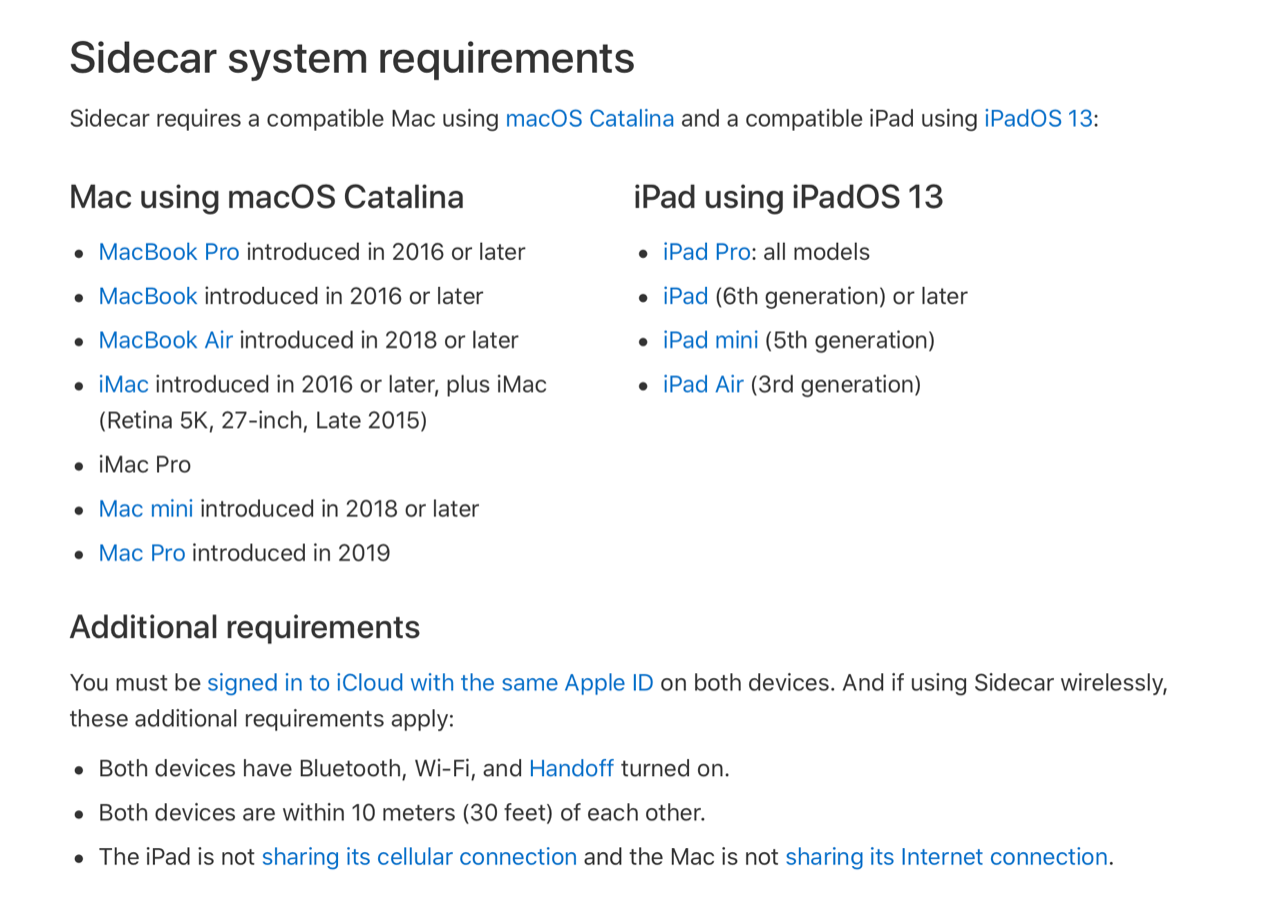
For the sake of this writeup, however, I’m going to start with the bit that gets me the most excited: Sidecar. From my own perspective, Apple tends to bury the lede in its own feature set. Though I completely understand that it’s simply not as universal an application as, say, Music, TV or (likely) Arcade. Maybe it’s because I’m just getting back from yet another work trip (we held a little event in San Francisco), but Sidecar is a legit productivity game changer for me.

Against all recommendations, I opted to run a beta of Catalina on my primary work machine. I know, I know, but when a beta drops while you’re on the road, there’s really no other option. I had some issues with the software I won’t go into here, because betas gonna beta. I surprisingly had some issues getting the feature to work again with the latest version of iPadOs and the GM of Catalina, but everything should be smooth sailing by the final release.

There’s no doubt, of course, that this is the latest bit of Sherlocking — Apple integrating its own version of a popular third-party app into the operating system. But with something like this, there’s really no competing with native support for most users. For those who need fair more nuanced use of things like Apple Pencil for, say, art making, Duet and Luna may still be worth checking out. If, like me, you just want to use the iPad as a second screen for some added real estate on the road, Sidecar’s the thing.

Enabling the feature is as simple as signing into all of your accounts: Make sure all of the relevant wireless protocols are turned on and then select the associated device from the drop-down. Your primary desktop can either be mirrored or used as an extension like a standard external monitor. The primary benefit of mirroring seems to be the ability to essentially use the screen as a touchscreen and iPad input. This should prove appealing for artists and a potential alternative to a pro tablet like the kind Wacom makes.

Screen Shot 2019 10 01 at 3.45.02 PM

For me, the second display is the thing. Hooking up the extending real estate is a big sigh of relief, making it far easier to keep multiple windows open at the same time. Having Slack open on the iPad while I use Pages and Chrome on the main desktop is a pretty significant time saver.

A small quibble: Keeping the Sidecar and display settings separate is a bit of an annoyance. The side I ultimately use for the iPad usually comes down to where I’m sitting. It would be great to be able to swap on the fly. The addition of a virtual sidebar, meanwhile, is an interesting one, but pretty redundant in mirrored mode.

All told, however, Sidecar is far and away the best addition to MacOS in recent memory.

I’m less in love with the loss of iTunes. I totally understand why Apple made the switch, and honestly, I’m a bit surprised it took them this long. I’m a long-time Spotify user with no interest in making the jump to Apple Music. I prefer the device flexibility Spotify affords. Among other things, the move to Music feels like an opportunity to constantly push users to “Try it Free.”

Music can still be used to play a locally stored song, but the move to streaming service has weaned me off of the notion of digital music ownership. Somewhere in my apartment, there’s a dusty old hard drive with hundreds of gigs of music, including weird old stuff that no one bothered to obscure the distribution rights for. Perhaps one day I’ll dive back in, but honestly it’s feeling increasingly less likely.

Screen Shot 2019 10 07 at 1.02.34 PM

The principles of Podcast should be familiar to anyone who’s ever used the mobile app. It’s all pretty simple and, like Music, focused on discovery. Separating it from Apple Music seems to imply that the company doesn’t have much interest in making huge Spotify-esque investments in the category. And for now, at least, why bother? Apple has a pretty massive head start in the space.

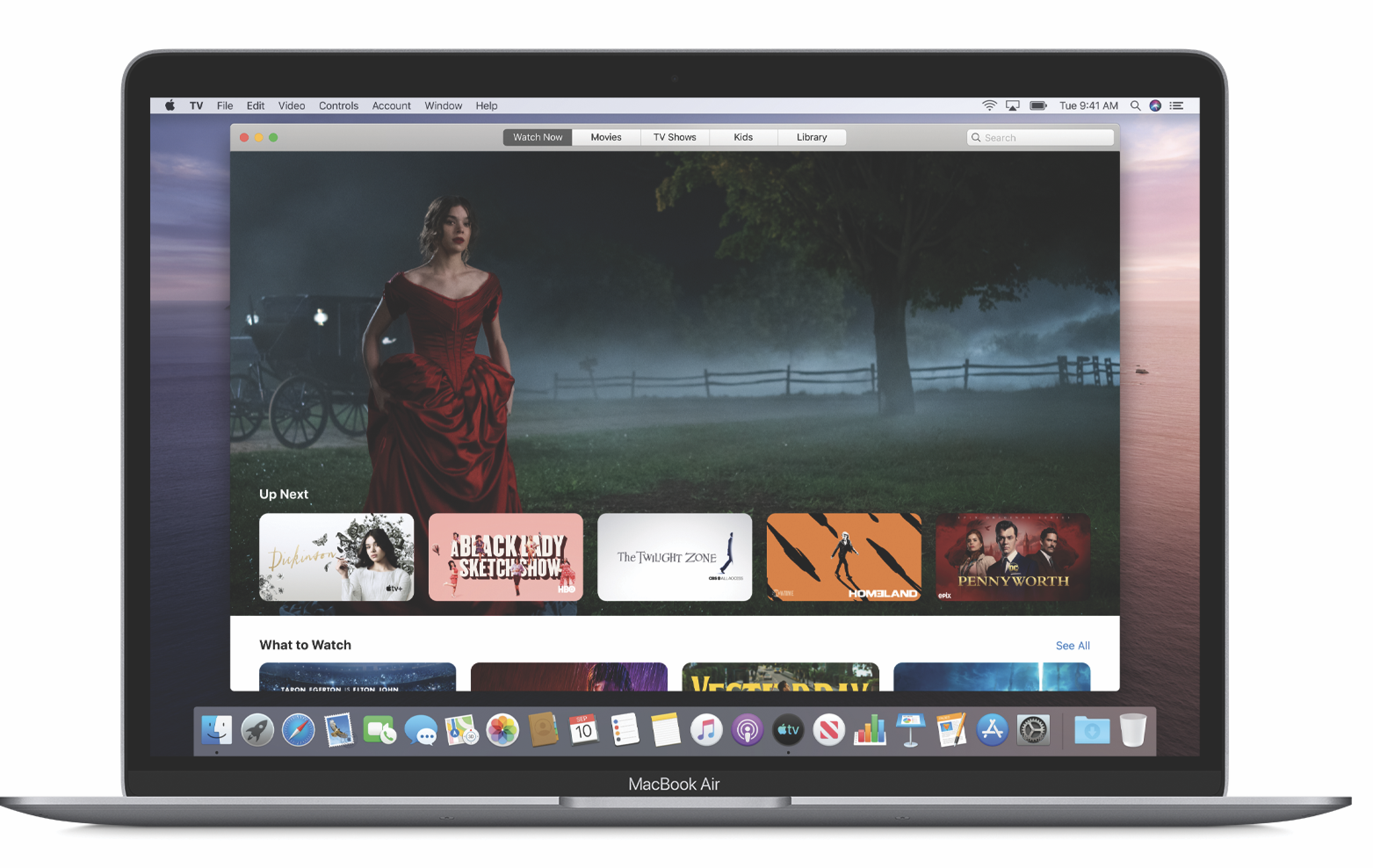
Apple TV gets a nice refresh, as well. It, too, is focused on discovery. Even more importantly for Apple’s long game, however, it lays the groundwork from TV+, which is set to arrive next month. Premium channels like HBO, Showtime and Starz have been integrated here, in a bid to become a more robust cable replacement for cord cutters. Also nice is the arrival of a dedicated Kids section with curated all ages content.

Arcade certainly isn’t what people are referring to when discussing the Mac’s long journey to becoming a more serious gaming system. And while the titles are largely designed to be played on mobile devices, those subscribing at $5 a month will no doubt welcome the ability to play on the desktop. There’s a lot to be said for the ability to take a quick work break with a round of the excellent Zelda knockoff/homage, Oceanhorn 2.

Photos adopts some key features from its mobile counterpart. AI/ML will determine and highlight your best shots, while images are categorized by days/months/years. Photo previews are large and now include live photo and video playback.

On the more pragmatic side of things, syncing and backup get some nice upgrades, now available outside of iTunes. That’s a change that certainly makes sense, with those features now accessible through the Finder. Honestly, that’s where they belong. Accessing them through iTunes always felt like a relic of the early iTunes/iPod days. This information is available directly in the main Finder sidebar.

As ever, there’s no hesitation in recommending Mac users update to the latest version of the operating system. Of course, that’s helped along by the fact that it’s a free upgrade. This is one of the more transformative MacOS updates in recent memory, and most of the new features are welcome — as I said, I’m not in love with Music for personal workflow reasons, but Sidecar is a biggie.

MacOS Catalina is now available for all users.

07 Oct 2019

Get guaranteed rent for your home from new startup Doorstead

Missing out on a month’s rent because you can’t find a tenant is a huge loss. Searching for someone to fill a home takes work, while property managers are incentivized to price your place too high leading to costly vacancies.

But new startup Doorstead wants to take on the risk and the work for you. It acts as a property manager for single-family homes but guarantees you rent at a specific rate starting in a certain number of days, even if it can’t fill the house or apartment. It also handles all the algorithmic pricing, advertising, tenant interviews, repairs, maintenance, leases, and online payments in exchange for 8% of rent. Owners just sit back and receive the money, making it much easier to profit off of distant real estate. The startup claims to earn users 3% to 9% more than other property management models.

Doorstead’s approach to the hot sector of ‘iRenting’ has attracted a $3.3 million seed round co-led by M13 and Silicon Valley Data Capital, and joined by Venture Reality Fund and SOMA Capital. They’re betting on co-founders Jennifer Bronzo, whose parents ran a construction and property management firm, and Ryan Waliany, who worked in product at Uber after his recipe platform Kitchenbowl was acquihired.

Doorstead co founders Jennifer Bronzo Ryan Waliany

Doorstead co-founders (from left): Jennifer Bronzo and Ryan Waliany

“I grew up going to job sites and learning about construction” Bronzo says. “In the recent decade, my family purchased a lot of properties in the Bay and they needed help filling capacity. I saw so many opportunities in property management because of how antiquated the industry is.” Doorstead is now operating in five cities around the San Francisco Bay Area.

As consumers grow accustomed to zero-friction services, that approach is branching into bigger and bigger sectors like the trillions paid for long-term rentals. Waliany, Doorstead’s CEO, tells me “We’re in the process of Uber’izing each step of the property management lifecycle”. The startup is hoping to become the OpenDoor of rentals

How Doorstead Works

Doorstead LogoFirst, property owners contact Doorstead and provide some basic information on the home they want to rent out. They receive a preliminary offer before the startup does an inspection and takes professional marketing photos while digging through reams of data on local pricing, availability, and demand to pick a rate its algorithm believes it can fill the home for quickly. Owners then receive a final offer agreement saying they’ll be paid $X per month starting in Y number of days (typically 21 to 45 days), with Doorstead absorbing all the risk if it can’t find a tenant.

From there, the startup does approved maintenance and cleaning as necessary, and then methodically lists the home on all the top rental platforms. It handles open house walk-throughs and runs background checks on potential tenants to find who will most reliably pay rent. Doorstead prepares a lease and gets it signed by a tenant, but even if it doesn’t, owners still get their guaranteed payments. Rent is collected online, and if a move-out or eviction is necessary, Doorstead takes care of the transition to finding a new tenant.

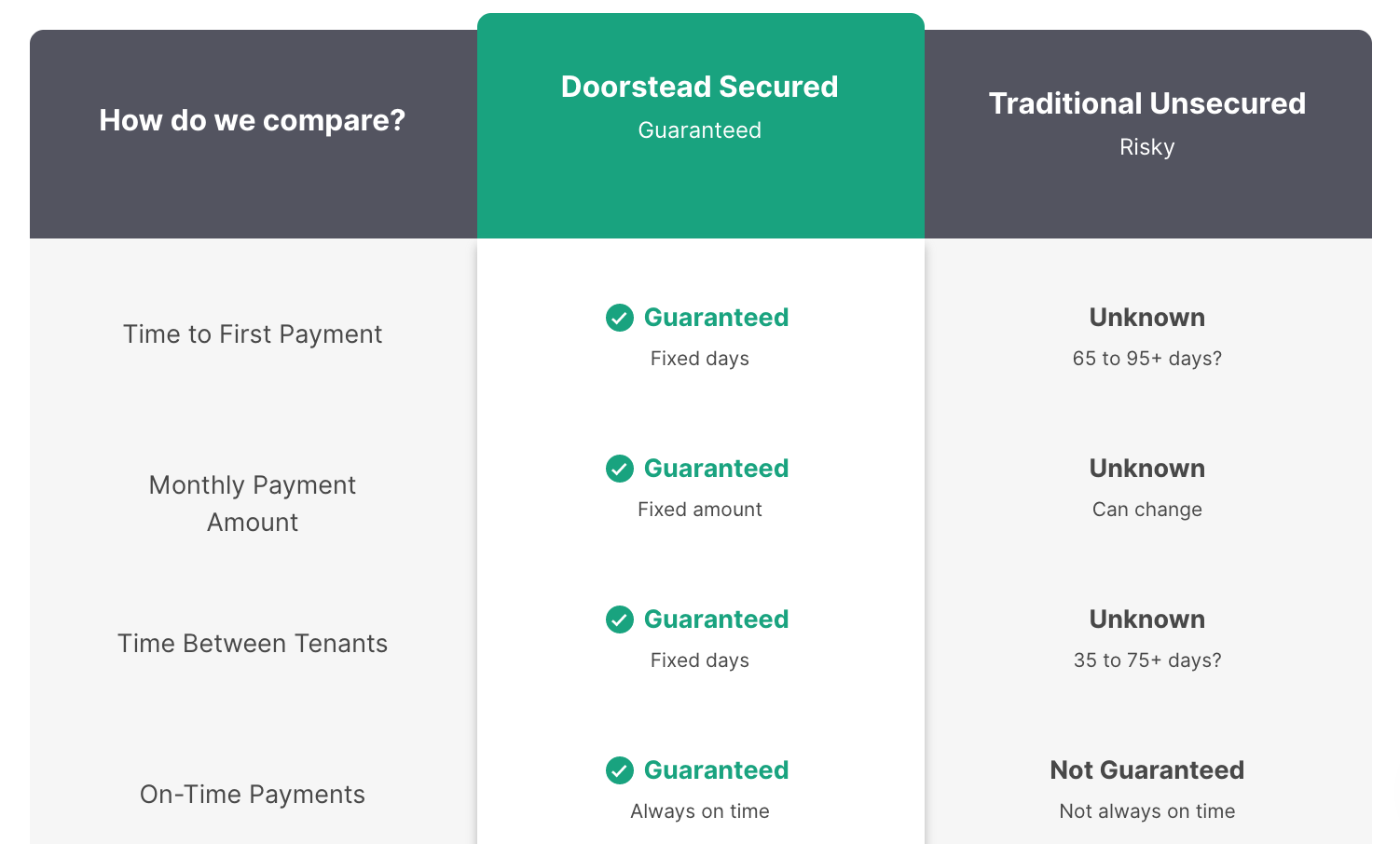
There’s plenty of margin for Doorstead to earn if can consistently fill homes faster. Most property managers charge at least 50% of the first months rent, but instead Doorstead keeps all the rent of any extra days if it fills the spot before the guaranteed due date. From there, it charges 8% of monthly rent with no tenant placement fee, which is close to or under the common 10% fee on single-family home property management. And if it manages to secure a higher rate from tenants than its guarantee, it gives 70% to the owner.

How Doorstead Works

Doorstead claims to be less risky than alternatives

“Property management incumbents have a 43-day vacancy average which leads to $86 billion in economic waste in the U.S. alone” Waliany tells TechCrunch. “This means that landlords could earn the same money and lower rents by 12% for tenants with an efficient market.”

The Rise Of iRenting

With Doorstead, even if the owner lives far away, the turn-key service lets them efficiently rent their home. That’s not only important to them, but to overcrowded cities like San Francisco that often see apartments left vacant by overseas owners because they’re too much effort to rent out. To date, Doorstead’s algorithm has allowed it to recoup 100% of its guarantees and it’s shooting to stay above 90%, while maintaining its NPS of 80.

apartment building code overlay

But if the startup is working that well, it’s only a matter of time until incumbents try to barge in.

“It would be a no brainer for Airbnb to enter this market and Zillow to open this” Waliany admits, given their existing pricing algorithms and popularity as rental destinations. But Bronzo says “the biggest barrier is the operations piece that an Airbnb and Zillow haven’t stepped into.” It would be a big departure from their lean software-based marketplaces. Other property management startups like Mynd, OneRent, and BelongHome only offer guaranteed rent once tenants are found, absolving themselves of most of the risk. They’d have to take on a more precarious business model.

What about Zeus, Sonder, and Lyric, which offer property management of homes they then use for corporate housing or as boutique hotels? “An owner of ours considered Zeus vs Doorstead and went with Doorstead because: 1) our offer was ~12% higher, and 2) they didn’t want the wear-and-tear that comes with having people move in and out of the property every few days or few months” Waliany explains. “Sonder and Lyric have 300 move-in and move outs over a 6-year period. Doorstead has ~4 move ins/outs and that results in significantly less wear-and-tear and a much easier operations to manage. Not only that, the long-term rental market is 42x larger and has 12x more addressable revenue.” Doorstead will have to build a brand and product moat to defend against inevitable direct competition.

Doorstead Rentals

iRenting is still a fresh concept so Waliany warns that “with any new business model, there will inevitably be ‘unknown unknowns’ that we cannot predict, black swan events, and things that we might only be able to learn through calculated bets.” Luckily, since it doesn’t hold the leases for very long, and home rentals typically increase in an economic downturn, Doorstead’s liability is manageable in the event of a recession or other crisis.

There are three large trillion-dollar industries – food, transportation, and housing. At Doorstead, we have an opportunity to completely redefine the housing value chain by creating a new class of property management that eliminates unnecessary vacancies. In the end, this redefinition of the value chain allows ourselves to become the Blackstone of the future” Waliany concludes. “It seems like we’re giving everyone free money.” That will prove either the startup’s downfall or a powerful growth tactic.

07 Oct 2019

Waymo is creating 3D maps of Los Angeles to better understand traffic congestion

Waymo, the autonomous vehicle company under Alphabet, has started creating 3D maps in some heavily trafficked sections of Los Angeles to better understand congestion there and determine if its self-driving vehicles would be a good fit in the city.

For now, Waymo is bringing just three of its self-driving Chrysler Pacifica minivans to Los Angeles to map downtown and a section of Wilshire Boulevard known as Miracle Mile.

Waymo employees will initially drive the vehicles to create 3D maps of the city. These maps are unlike Google Maps or Waze. Instead, they include topographical features such as lane merges, shared turn lanes and curb heights as well as road types and the distance and dimensions of the road itself, according to Waymo. That data is combined with traffic control information like signs, the lengths of crosswalks and the locations of traffic lights.

Waymo does have a permit to test autonomous vehicles in California and could theoretically deploy its fleet in Los Angeles. But for now, the company is in mapping and assessment mode. Waymo’s foray into Los Angeles is designed to give the company insight into driving conditions there and how its AV technology might someday be used.

The company said it doesn’t plan to launch a rider program like its Waymo One one currently operating in suburbs of Phoenix . Waymo One allows individuals to hail a ride in one of the self-driving cars, which have a human safety driver behind the wheel.

The self-driving car company began testing its autonomous vehicles in and around Mountain View, Calif., before branching out to other cities and weather, including Novi, Mich., Kirkland, Wash., San Francisco and more recently in Florida. But the bulk of the company’s activities have been in suburbs of Phoenix  and around Mountain View — two places with lots of sun, and even blowing dust, in the case of Phoenix.