Year: 2019

02 Oct 2019

Brex wants to replace startup bank accounts with Brex Cash

Brex, a Silicon Valley fintech darling, has lofty plans to battle big banks —and Stripe.

Code-named “Gemini,” Brex today announced a new product designed to replace and improve the functionality of traditional bank accounts. Brex Cash, as it will be known publicly, is a business cash management account integrated with the Brex Card, a corporate card for startups launched in 2018.

Brex tells us they’ve built the core banking infrastructure from scratch, allowing the company to forgo third-party processing fees and provide a much-needed tech infusion to antiquated banking systems. In partnership with Boston’s Radius Bank, Brex Cash will allow customers to send payments quickly and easily with no fees attached. Rather, Brex plans to reward its users for making or receiving payments using Brex Cash with points redeemable for cash back, travel and air miles. Customers will also receive 1.6% interest on deposits.

It’s not a bank, but in practice, it can replace a bank, says Brex co-founder and co-chief executive officer Henrique Dubugras .

“Our idea is that new businesses —the new Y Combinator companies we hope a big percent of them never open a bank account,” Dubugras tells TechCrunch.

Brex now has many similarities to a bank. What differentiates it is its lack of physical branches — it’s exclusively digital — and it’s insurance. Traditional banks are insured by the Federal Deposit Insurance Corporation (FDIC), which protects up to $250,000 per depositor. Brex Cash is backed by the Securities Investor Protection Corporation (SIPC), a nonprofit agency overseen by the U.S. Securities and Exchange Commission that insures up to $500,000 and specializes in protecting customers of brokerage firms from the loss of cash and securities.

We think we’ve won a lot of credibility. Before, who was going to give their money to a random-ass startup called Brex? -Brex co-CEO Henrique Dubugras

Additionally, Brex invests its customers’ money in a money market mutual fund of U.S. treasury bonds. “If Brex goes out of business, customers’ money will be safe,” the company writes in a press statement. “The only scenario where money could be lost is if the U.S. government defaults.”
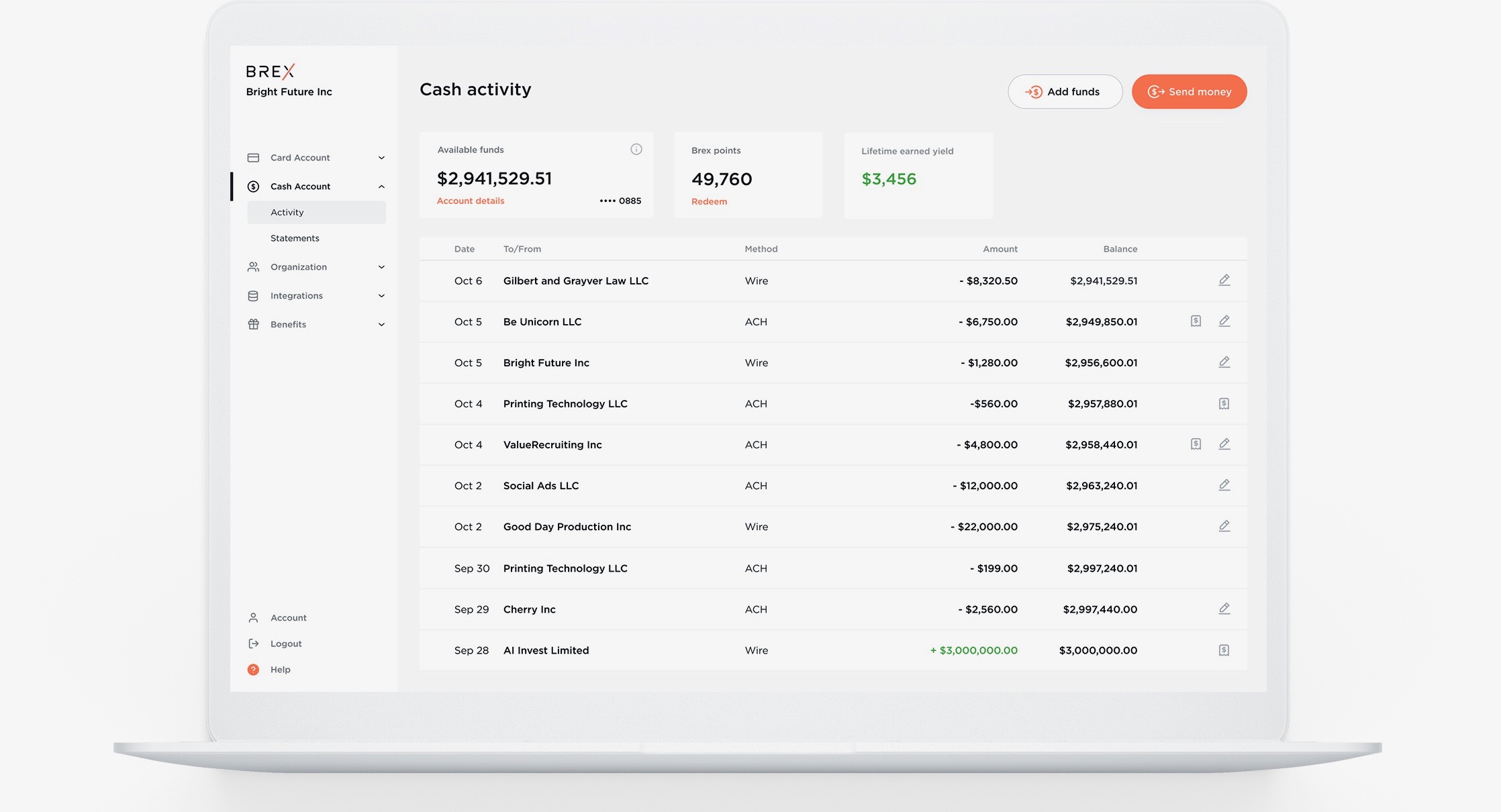
macbook white final

Brex Cash user interface

“It’s not that we are inventing this — this model exists with Fidelity,” says Dubugras. “Fidelity isn’t necessarily a bank — we are bringing that concept to businesses to give lower fees, better interest rates, better experiences and more security.”

Brex, a graduate of the winter 2017 Y Combinator cohort, has quickly become a Silicon Valley success story for the ages. The rapid adoption of its startup credit card, which doesn’t require a personal guarantee, and its ability to issue cards instantly and provide higher limits than other options on the market has attracted thousands of customers and venture capitalists. The business, led by a pair of young Brazilian repeat entrepreneurs, including Dubugras and co-CEO Pedro Franceschi, has collected more than $300 million in equity funding, including a $100 million C-2 financing that valued the company at $2.6 billion earlier this year.

“There will always be customers that are skeptical, but I think by starting out with a card, we built a lot of trust,” Dubugras said. “It was us giving them money instead of them giving us money. A few years in … We think we’ve won a lot of credibility. Before, who was going to give their money to a random-ass startup called Brex?”

In the weeks ahead of TechCrunch Disrupt San Francisco, where Dubugras announced Brex Cash on Wednesday, the CEO told TechCrunch that Brex had no immediate fundraising plans and that they were “waiting for the right time” to raise again. As for what’s next, he said the company is discussing the launch of a debit card and plans to add another 100 employees in the next year, bringing the Brex headcount to 400.

The Brex news follows the launch of Stripe Capital, a new offering from payments behemoth Stripe that will make instant loan offers to customers on its platform, and the announcement of the Stripe Corporate Card. Akin to Brex, Stripe will issue a no-fee, no interest rate credit card intended for Stripe customers. Brex and Stripe, two Y Combinator grads, will go head-to-head in a battle for customers, particularly YC grads looking for friendly financial tools.

Immediately following Stripe’s announcements, the business announced a $250 million funding at a $35 billion valuation. Brex may be following a similar playbook, announcing a major product on the heels of a large capital infusion.

Brex Cash represents a new era for the company. Though the product may be costly for Brex, it opens the business up to thousands more potential customers. Now, any startup, regardless of funding, can create a Brex account to store cash, explains Dubugras, and all companies using Brex Cash will be immediately issued a Brex corporate credit card.

“If you’re starting out, if you don’t have funding yet, you can still receive your payments using Brex,” Dubugras said. “That’s a super big deal for us.”

Brex Cash was built under product lead Ritik Malhotra, who joined the team as part of an acquisition of his startup, Elph. Brex poached the company, which was focused on blockchain infrastructure, right out of YC for an undisclosed amount. In retrospect, the deal looks much more like an acqui-hire of Malhotra, who had the digital payments infrastructure acumen necessary to complete this project.

“It’s an easy way to move money, which is the lifeblood of a business,” Malhotra tells TechCrunch of the new product.

Brex Cash is itself not a cash cow for Brex; rather, the startup makes money on purchases made on its corporate card, in which it charges the merchant, not the customer. This model is particularly beneficial when its customers are spending a lot of money, growing quickly and raising capital. In a downturn, however, this model isn’t as attractive.

Brex seems unconcerned with the possibility of an impending recession. Brex writes that even in downturns, entrepreneurs will start companies and attempt to raise money. The Brex Cash product, regardless of the economy, will help Brex better underwrite Brex Cards, as it gives them better access to a customer’s financial health.

In a battle against Stripe, Brex is at a disadvantage. At only two years old, the company may have garnered a lot of credibility in a short time but it doesn’t have the decade of experience building fintech products that Stripe has and, more importantly, it doesn’t have 10 years of customer loyalty.
02 Oct 2019

Tesla delivers a record 97,000 electric vehicles in third quarter

Tesla said Wednesday it delivered a record 97,000 electric vehicles in the third quarter, a nearly 2% increase from the previous period, but still short of analysts’ expectations.

Tesla shares fell nearly 6% in after market trading on the news.

The company reported Wednesday that it produced 96,155 vehicles in the third quarter, a 10% increase from the previous period. Tesla has shown steady improvement in its production numbers over the past several quarters. Tesla produced 86,555 vehicles in the fourth quarter of 2018 and then dropped to 77,100 in the first period of the year. Numbers rebounded to 87,048 vehicles in the second quarter of 2019.

Analysts expected Tesla to deliver 99,000 vehicles during the third quarter, according to estimates compiled by FactSet.

Despite hitting record numbers and showing the ability to push production higher, the numbers still weren’t able to meet CEO Elon Musk’s lofty targets. Musk had said in a leaked email that the company could produce 100,000 vehicles in the third quarter.

Tesla said Wednesday it received record net orders in the third quarter and are entering the fourth quarter with an increase in its order backlog. Tesla added that nearly of its Model 3 orders were received from customers who did not hold a reservation.

Here’s a look back at the past several quarters of deliveries.

Tesla delivered 95,200 vehicles in the second quarter, a dramatic pop from the company’s first quarter delivery numbers when it reported deliveries of 63,000 vehicles, nearly a one-third drop from the previous period. The low first-quarter delivery numbers signaled what was to come: wider-than-expected loss of $702 million driven by disappointing delivery numbers, costs and pricing adjustments to its vehicles.

02 Oct 2019

Mutiny creates personalized plans for B2B marketing

Mutiny, a personalized marketing startup for businesses that sell to other businesses, is taking the stage today at TechCrunch’s Startup Battlefield, where it’s announcing new funding and new features.

CEO Jaleh Rezaei told me that she and co-founder Nikhil Mathew created Mutiny to solve a problem they saw as early employees at HR services company Gusto — trying to personalize their messages to different sales prospects.

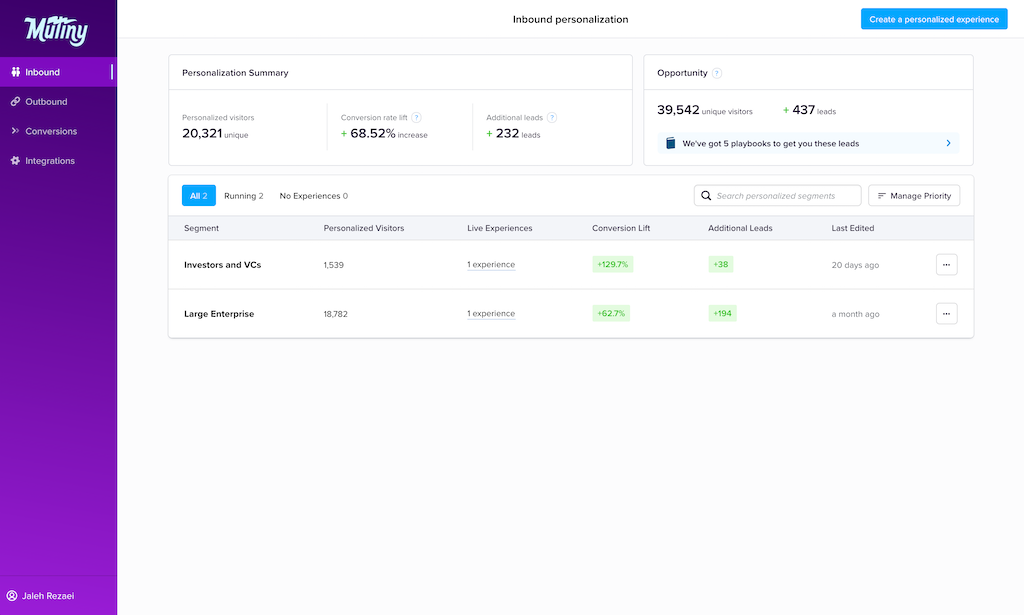
With Mutiny, they’ve built easy-to-use tools allowing marketers to show different landing pages to different customers. To do this, the product draws on pre-built data integrations to identify customer segments, then allows customers to use a visual editor to build different versions of landing pages for those segments.

“When we think about the B2B journey, it has changed quite a bit,” Rezaei said. “Today, 67% of that B2B buyer’s journey is online. Without engineering, it’s really hard to change that journey and have an impact. What’s exciting about Mutiny is we empower these great marketers to improve their customer experience without that constant dependence on technical teams.”

Mutiny was part of the Summer 2018 class at accelerator Y Combinator. Rezaei said that shortly after demo day, the startup raised $3 million in funding from Cowboy Ventures, Uncork Capital and various angel investors.

It’s since added features to support targeted, account-based marketing. Rezaei said Mutiny pulls account data from Salesforce, cleaning it up and surfacing it, so that when a prospective customer responds to your marketing, they could end up on a landing page showing their own name, title and company.

Mutiny dashboard

For example, Brex is creating landing pages for its email marketing campaigns, where each page shows the recipient’s name and company; Gusto is tailoring landing pages based on the AdWords search terms that brought a prospective customer to that page; and Amplitude is customizing landing pages based on company size and other attributes.

As a result, Mutiny says Brex has seen a 200% lift in outbound leads, while Amplitude has increased all inbound leads by more than 40%. (Other customers include Segment, Carta, TripActions and Elastic.) 

Today, Mutiny is also announcing that it will offer personalized recommendations to marketers. So if all these ideas are new to you, the product can recommend specific customer segments that you should consider personalizing for based on things like your traffic data and conversion data.

Mutiny can also create entire “playbooks,” recommending not just the segment to personalize, but what that personalized experience should look like for that segment.

“The goal of Mutiny is always to make personalization really easy and really guided,” Rezaei said.

02 Oct 2019

Render challenges the cloud’s biggest vendors with cheaper, managed infrastructure

Render, a participant in the TechCrunch Disrupt SF Startup Battlefield, has a big idea. It wants to take on the world’s biggest cloud vendors by offering developers a cheaper alternative that also removes a lot of the complexity around managing cloud infrastructure.

Render’s goal is to help developers, especially those in smaller companies, who don’t have large DevOps teams, to still take advantage of modern development approaches in the cloud. “We are focused on being the easiest and most flexible provider for teams to run any application in the cloud,” CEO and founder Anurag Goel explained.

He says that one of the biggest pain points for developers and startups, even fairly large startups, is that they have to build up a lot of DevOps expertise when they run applications in the cloud. “That means they are going to hire extremely expensive DevOps engineers or consultants to build out the infrastructure on AWS,” he said. Even after they set up the cloud infrastructure, and move applications there, he points out that there is ongoing maintenance around patching, security and identity access management. “Render abstracts all of that away, and automates all of it,” Goel said.

It’s not easy competing with the big players on scale, but he says so far they have been doing pretty well, and plan to move much of their operations to bare metal servers, which he believes will help stabilize costs further.

“Longer term, we have a lot of ideas [about how to reduce our costs], and the simplest thing we can do is to switch to bare metal to reduce our costs pretty much instantly.” He says the way they have built Render will make that easier to do. The plan now is to start moving their services to bare metal in the fourth quarter this year.

Even though the company only launched in April, it is already seeing great traction. “The response has been great. We’re now doing over 100 million HTTP requests every week. And we have thousands of developers and startups and everyone from people doing small hobby projects to even a major presidential campaign,” he said.

Although he couldn’t share the candidate’s name, he said they were using Render for everything including their infrastructure for hosting their web site and their back-end administration. “Basically all of their cloud infrastructure is on Render,” he said.

Render has raised a $2.2 million seed round and is continuing to add services to the product, including several new services it will announce this week around storage, infrastructure as code and one-click deployment.

02 Oct 2019

Look out, Robinhood. E*Trade, Schwab, Ameritrade all go zero-fee

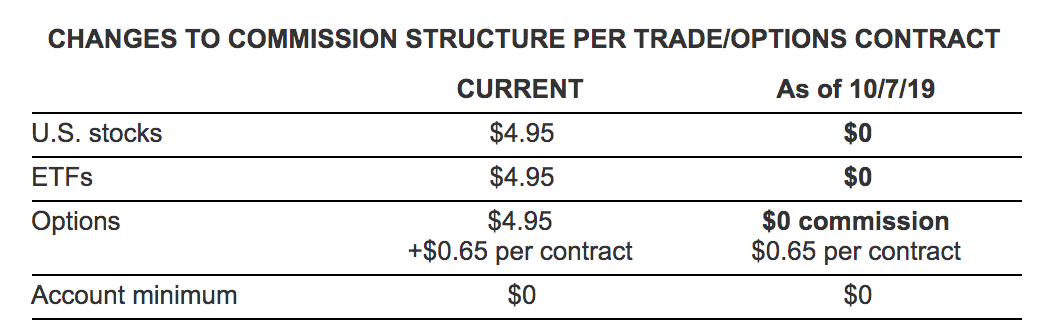
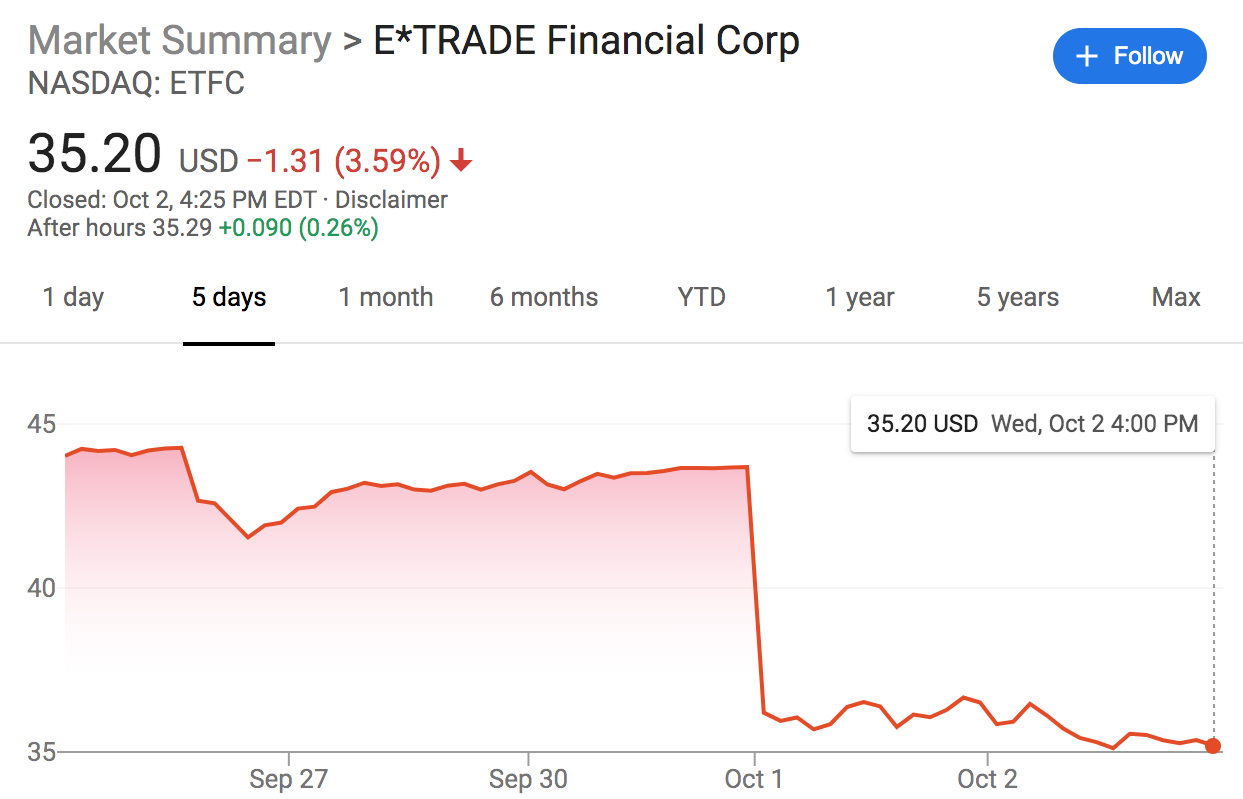
The biggest players in online stock trading all just copied Robinhood by removing their fees for stock and ETF trading. Charles Schwab announced yesterday it would drop its $4.95 fee, leading to plummeting share prices for it as well as competitors. By the end of yesterday Ameritrade announced it too would axe its $6.95 fees, and then E*Trade followed suit this morning killing off its own $6.95 fee. However, none of their share price recovered.

From yesterday before Schwab’s announcement through now, Schwab fell 12% from $41.84 to $36.54, E*Trade fell 19% from $43.69 to $35.20, and Ameritrade fell 28% from $46.70 to $33.54. Clearly investors aren’t thrilled that these financial giants are bowing to pressure from a measely startup.

ETrade Share Price

Yet the move could definitely hurt growth for the $7.6 billion-valued fintech upstart Robinhood. It’s relied on the free stock trades to pull in users that it then monetizes with its Robinhood Gold subscription to premium services including the ability to trade on margin by temporarily borrowing money from the company.

Schwab Fees

Schwab drops its fees

“The changes taking place across the brokerage industry reflect a focus on the customer that‘s been inherent to Robinhood since the beginning” said a spokesperson for the startup. “We remain focused on offering intuitively designed products that reduce barriers to our financial system, including account minimums and commission fees.”

Robinhood was hoping a high 3% interest rate checking account feature announced in December might help differentiate it from online stock brokerages. But after it prematurely launched the checking product without proper insurance, massive backlash ensued and the company announced it would shelve and rethink the idea. But that hiccup didn’t stop it from raising another $323 million this July to bring its total raised to $862 million.

02 Oct 2019

Sendmi lets you allocate part of your paycheck for remittance

Meet Sendmi, a fintech startup that is launching today in the Startup Battlefield at TechCrunch Disrupt SF. Sendmi works pretty much like a 401k or a Flexible Spending Account. But instead of saving money for later, you set it aside to send it to your family abroad.

And this mix of payroll and remittance is what sets Sendmi apart from the countless foreign exchange services out there. It could be particularly valuable for people living paycheck to paycheck as you don’t have to take money out of your bank account to send it abroad.

Sendmi wants to sell its service to companies directly. When companies choose to partner with Sendmi, they can then offer Sendmi as a perk to their employees. And there’s some form of trust between an employer and its employees.

After that, employees can make a payroll election and decide the amount of post-tax payroll that they move to their Sendmi account.

And because all funds come from your paycheck directly, Sendmi reduces exposure to money laundering mechanisms. Many services, such as TransferWise or Western Union, have to ask you where the money is coming from to make sure that it wasn’t generated from illegal activities.

You can then connect to your Sendmi account at any time from the company’s mobile app to transfer some money. Right now, Sendmi supports transfers between the U.S. and Mexico, but the startup is already working on adding support to more corridors.

Sendmi has set up partnerships in the U.S. and Mexico so that your recipient receives money in just a few minutes. Eventually, the startup wants to offer additional financial services in the Sendmi app, such as insurance services, consumer lending, etc.

The company currently has 9 employees. It is officially launching its product today, but Sendmi has been testing it with a few clients already. The startup has raised $3.1 million so far.

02 Oct 2019

Delos uses satellite imagery and AI to help homeowners in wildfire areas get insurance


If your home is in a wildfire area, insurance companies tend to not want to go anywhere near it.

But “wildfire areas” tend to be pretty broad. What if companies could evaluate the risk on a more granular level — tapping things like satellite imagery and machine learning combined with wind, weather, and topology data to more finely define the riskiest zones? Could more home owners be offered policies, and at more affordable rates?

That’s the idea behind Delos, a company presenting at the TechCrunch Disrupt SF Startup Battlefield today.

Delos itself doesn’t act as the insurer; instead, Delos acts as a Managing General Agent (or MGA) for a bunch of major carriers. They analyze regions that have been broadly swept into the “wildfire area” label, with their proprietary models looking for houses that they believe have been miscategorized. Delos reaches out to these customers, receiving a commission/profit share on any policies they sign.

The company is focusing on California first, noting that the one state accounts for half of the country’s wildfires. According to CalFire, there’s been over 5,000 fires in California in 2019 alone.

After wildfires, Delos also plans to expand to modeling hurricane risk.

Delos also regularly sends policy holders a list of things they can do to harden and protect their homes against wildfires, such as cutting back trees that overhang your home, or switching to ignition-resistant building materials. If their latest satellite imagery shows dry vegetation creeping up the hillside behind your house, they can give you a heads up of the increasing risk.

Delos map

Co-founders Kevin Stein and Shanna McIntyre both have rich backgrounds in aerospace. Kevin got an Masters in Aerospace Engineering from Stanford before working as a Mechanical Systems Engineer at Space Systems/Loral, while Shanna studied physics at Berkeley before spending 11 years as an engineer at Lockheed Martin.

Stein says that he believes about 18M homes in the US are mis-categorized.

02 Oct 2019

Traptic uses 3D vision and robotic arms to harvest ripe strawberries

At some unspecified time, somewhere down the road, Traptic would love to expand its robots to pick a wide variety of crops. For now, however, the South Bay-based team is focused solely on strawberries.

With roughly 88 percent of the fruit’s total U.S. yield occurring in California, the berries represent ample opportunity for disruption. A manual labor shortage exacerbated by tightening immigration policies has contributed to a good deal of waste. Farmers apparently lose around one-fifth of crops, due to a lack of hands.

Automation has, of course, been applied to a number of different staple crops. Things like wheat and corn are routinely harvested by machines — and have been for a long time. Strawberries and other fruits, on the other hand, present a unique challenge. They’re just too delicate for most machines, requiring instead the deft touch of human pickers.

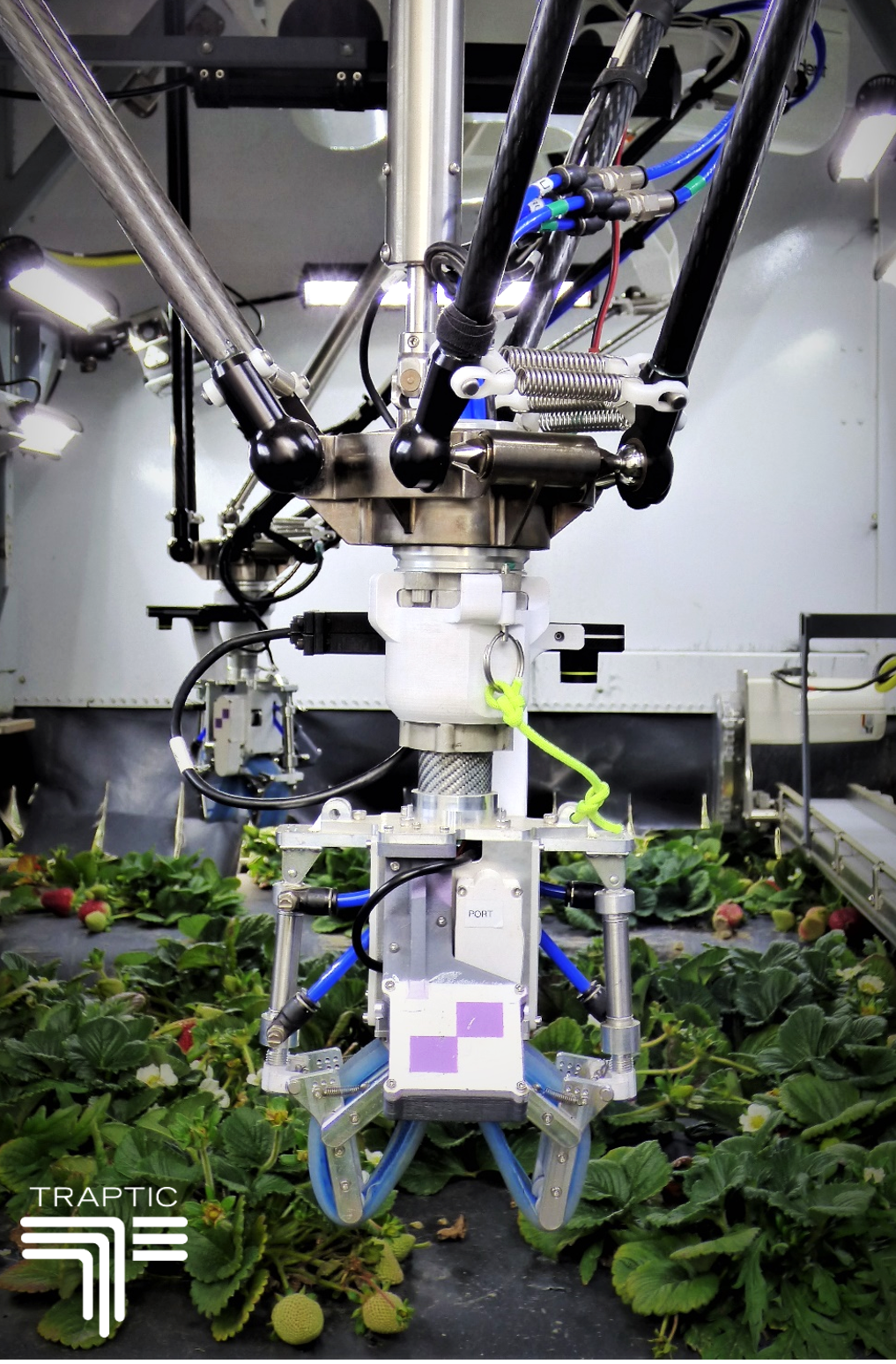
Traptic Blog Photo 3

Traptic, one of the startups competing in this year’s Disrupt Battlefield, however, is tackling the issue head on with a purpose-built robot. Comprising an off-the-shelf robotic arm and custom gripper and software, the company’s device is for the function of helping to improve strawberry yields.

The arm is housed inside a space on a cart surround on five of six sides. The vision system utilizes 3D cameras and neural networks to spot strawberries and distinguish ripe from unripe. It’s capable of determining their position within a millimeter and then goes about plucking.

The custom gripper, however, is probably the most unique element on board. Sure, there are plenty of off-the-shelf grippers available to roboticists, but for the aforementioned reasons, Traptic needed one that was rigid enough to pluck the berries, but gentle enough to not smash a ripe one in the process.

What the company ultimately settled on was a gripper that was neither fully rigid, nor soft. The metal base of the claws is augmented by rubberized bands that have enough give to conform to the fruits’ irregular shapes, while holding them snuggly enough to remove them from the plant.

Traptic’s current machine is Ceres, a large enclosure towed behind a tractor. It’s currently being tested by growers in both Northern and Southern California — distinct climates that allow for year-round strawberry growing.


To start, at least, the company anticipates that the robot will augment, rather than replace, pickers. Ultimately, however, such a device could replace human workers in the field. Traptic is certainly working to make that a tempting proposition by leasing the machine (“harvesting-as-a-service”) at a per-pound rate similar to what is currently paid out to human workers. Between a growing population and a strained workforce, however, such a promise could still be a ways away.

Traptic also has its sights set on a number of other potential crops — oranges, melons and peppers are all currently on the list.

02 Oct 2019

How Bongo, the ‘Netflix of Bangladesh’, won the local video streaming market with just $10M

Thousands of miles away from the U.S., where technology giants, cable networks, and studios are locked in an intense multi-billion dollar battle to court users to their video streaming services, a startup in Bangladesh has already won the local video streaming market.

And it did all of this in six years with just $10 million. And it’s also profitable.

Ahad Mohammad started Bongo in 2013. The on-demand video service began life as a channel on YouTube in 2014 before expanding as a standalone app to users a year later.

Of the 96 million people in Bangladesh who are online today, 75 million of them are subscribed to either Bongo’s YouTube channel or to its app, Mohammed said.

Bongo’s domination in Bangladesh is second to none in the nation. iFlix, which raised $50 million a few months ago to expand its presence in several Asian markets, and India’s Zee5 are among the players that Bongo competes with, though their market share remains tiny in comparison.

TechCrunch caught up with Mohammed to get an insight into the early days of building Bongo and what holds next for the “Netflix of Bangladesh” as it increasingly expands to international markets.

02 Oct 2019

The first details about Volvo’s upcoming electric XC40 SUV

Volvo is teasing its upcoming, and first all-electric car, with some initial sketches and a few details of the XC40 SUV. The upshot: Volvo is emphasizing a simpler design that discards some of the features found on gas-powered vehicles.

The XC40 SUV won’t have tailpipes, for instance. The traditional front grille, which is used to cool down gas-powered cars, are also gone. And then there’s the frunk — the front trunk that is found in Tesla’s electric vehicles along with a few other recent entrants.

For now, Volvo is only sharing sketches of the new car, which will debut October 16.

Take note, in the photo below, the lack of tailpipes.

Design sketch of Volvo Cars fully electric XC40 SUV 4

Volvo XC40 BEV design sketch.

In this next photo, Volvo shows off the frunk, which it says provides around 30 liters of extra load space.

Design sketch of Volvo Cars fully electric XC40 SUV 2

Here’s a more detailed look at the front of the vehicle. Gone is the traditional grille found on gas-powered Volvo vehicles.

“Without the need for a grille we have created an even cleaner and more modern face, while the lack of tailpipes does the same at the rear. This is the approach we will explore more and more as we continue down the road of electrification,” Robin Page, head of design at Volvo Cars, said in a statement that accompanied the images.

Design sketch of Volvo Cars fully electric XC40 SUV

Volvo revealed a few more details of the upcoming electric SUV. The vehicle will come in eight exterior colors, including a brand new “Sage Green” metallic option. A contrasting black roof comes as standard. Two new 19-inch and 20-inch wheel options will also be available.

Volvo changed the driver interface inside the SUV to provide relevant information such as the battery status. The interior design package features sporty styling details as well as carpets made of recycled materials, the company said. Volvo also emphasized the roomy interior, thanks in part to extra space it captured because the battery pack is integrated into the floor of the car.

The vehicle includes more functional storage space in the doors and under the seats, a fold-out hook for small bags and a removable waste bin in the tunnel console.