Year: 2019

04 Sep 2019

Accion Venture Lab launches $23M inclusive fintech startup fund

Accion Venture Lab—the seed-stage investment arm of non-profit Accion—has raised $23 million for a new inclusive fintech startup fund.

The Accion Venture Lab Limited Partnership, as its called, will make seed-stage investments in inclusive fintech startups, defined as ventures that “that leverage technology to increase the reach, quality, and affordability of financial services for the under-served at scale,” per a company release.

The new fund was raised with capital contributions from a number of participants, including the Ford Foundation, Visa Inc. and Proparco—the development finance institution of the French government.

The additional $23 million brings Accion Venture Lab‘s total capital under management to $42 million.

The new LP fund will consider startups from any geography, as along as they meet specific criteria. Overall, Accion Venture Lab doesn’t have regional investment quotas, but does look to allocate roughly 25 to 30 percent of its funds to Africa, Accion Venture Lab Managing Director Tahira Dosani told TechCrunch on a call.

“We want to continue to focus on Latin-America, on Sub-Saharan Africa, on Southeast Asia as well as in the U.S. It really is about…where we see the need and the opportunity across the markets that we’re in,” she said.

In line with Accion’s mandate to boost financial inclusion globally, Accion Venture Lab already has a portfolio of 36 fintech startup investments across 5 continents—including 9 in the U.S., 8 in Latin America, and 8 in India.

“Our goal is to really be the that first institutional investor in the companies we invest in. That’s were we see the biggest capital gap. And it’s where we build capability and expertise,” Dosani said. In 2018, Accion Venture Lab successfully exited Indian fintech company Aye Finance, following exits in 2017 and 2016.

Tahira Dosani Accion Venture Lab I

This year Accion Venture Lab supported a $6.5 million Series A investment in Lulalend, a South African startup that uses internal credit metrics to provide short-term loans to SMEs that are often unable to obtain working capital.

Accion’s new LP fund will follow past practice and make investments typically in the $500,000 range. It will start sourcing startups immediately through its investment leads around the world and already made its first seed financing to U.S. venture Joust—a fintech platform for gig economy workers.

Accion Venture Lab’s LP fund is the first time the organization has pooled third-party investment capital, according to a spokesperson.

On the appeal for those contributing, Dosani named Accion’s geographic reach and experience. “We think that’s our strength, because we’re able to invest in similar business models across different markets. And we’re able to bring that knowledge from one market to another,” she said.

The Ford Foundation contributed $2 million, according to an email from Christine Looney, Deputy Director, Mission Investments. Visa didn’t disclose its capital contribution, but told TechCrunch it will play a role in governance through its participation in a Limited Partners Advisory Committee for the new fund.

As a point of observation, Accion Venture Lab stands out as a fund for giving an equal pitch footing to fintech ventures across frontier, emerging, and developed markets from Lagos to London.

Accion’s new LP fund—along with the organization’s commitment to make nearly a third of its investments in Africa—means more capital to digital finance startups on the continent. By a number of estimates, Africa’s 1.2 billion people still represent the largest share of the world’s unbanked and underbanked population.



04 Sep 2019

Kobo brings the Forma form factor to a cheaper model

I’ve long had a soft spot for Kobo for a few reasons. First is the simple fact that the company (now part of Rakuten) was one of the last few competing with Amazon in the e-reader market. Second is features like Pocket integration. Third is the device’s openness to file formats like ePub that don’t require the device to be tied to a single store.

Kobo’s also never been afraid to experiment. Last year’s Forma was the perfect example. A direct shot against Kindle’s high-end Oasis, the reader combined a contoured form factor and physical page-turn buttons with an 8-inch screen. That last bit was probably enough to keep the device firmly in the niche category, even without the $280 price tag.

The new Libra H20 is a far more utilitarian product, applying the Libra’s form factor to a 7-inch screen device that retails for a more reasonable $170. It’s still not cheap in the world of e-readers, of course. That’s about $40 more than, say, the Kindle Paperwhite, but it’s nice to see some of these features start to trickle down into more accessible products. The world of e-readers is notoriously slow to innovate — thanks likely to the fact that there are relatively few players left.

Kobo

I’ve come to appreciate the “handle” design adopted for these devices by e-reader makers. It’s perhaps a bit less satisfying than the more traditional symmetry, but it’s a lot more focused on how these products are used. After the demise of the Nook, too many companies took an entirely minimalist route. The inclusion of the side panel and pair of physical page buttons is a welcome shift toward function over form.

With the cheaper price tag, of course, comes cheaper materials. The Libra H20 is pretty plasticky — especially after using the Oasis. The buttons, too, don’t feel quite as solid as the Oasis’s, likely owing to less premium material. Also, this is more of a strange quirk than specific critique, but the functionality is inverted with the buttons, by default, with the top moving backward and the front going forward through the book. This is an easy fix in the settings, though Kobo refers to that as “inverted.”

Kobo

The form factor works well, with the ability to read in both landscape and portrait, autorotating using the built-in accelerometer. The back has a textured grip, coupled with a large power button. On the right side (or bottom, depending on your perspective) is the microUSB for charging and file transfer (USB C is basically non-existent in the world of e-readers for the time being.

Kobo’s also tweaked the software to include better menus, improved book scrubbing and previews. Other touches include the ability to adjust the front light intensity by swiping the side of the screen.

[gallery ids="1873089,1873088,1873087,1873086,1873083"]

As the name implies, the device is waterproofed, with an IPX8 rating — that’s about up to 60 minutes in two meters of water, so yeah, you can take it in the bath. Storage is 8GB (~6,000 books), paired with 512 MB of RAM and a 1,200 mAh battery that should provide you’re standard weeks on a single charge.

The Libra goes up for pre-order on the 10th. It will be available in stores a week later.

04 Sep 2019

Elliptic banks $23M to shrink crypto risk, eyeing growth in Asia

Crypto means risk. To UK company Elliptic it also means business. The startup has just closed a $23M Series B to step up growth for a crypto risk-management play that involves selling tech and services to help others navigate the choppy darks of cryptocurrencies.

The round was led by financial services and asset management firm SBI Group, a Tokyo-based erstwhile subsidiary of SoftBank . Also joining as a new investor this round is London-based AlbionVC. Existing investors including SignalFire, Octopus Ventures and Santander Innoventures also participated. SBI Group’s Tomoyuki Nii and Ed Lascelles of AlbionVC are also joining Elliptic’s board.

Flush with a sizeable injection of Series B capital, Elliptic is especially targeting business growth at Asia — with a plan to open new offices in Japan and Singapore. It says client revenues in the region have risen 11x over the past two years.

We last spoke to Elliptic back in 2016 when it had just raised a $5M Series A.

The 2013-founded startup began by testing the crypto waters with a storage product before zeroing in on financial compliance as a pain-point worth its time. It went on to develop machine learning tech that screens transactions to identify suspicious patterns and, via them, dubious transactors.

Now it offers an integrated suite of products and services for financial institutions and crypto businesses to screen volumes of crypto-flows that sum to billions of dollars in transactions per day — analyzing them for links to illicit activity such as money laundering, terrorist financing, sanctions evasion, and other financial crimes.

It’s focused on selling anti-money laundering compliance, crypto forensics and cryptocurrency investigation services to the private sector — though has also sold tools direct to law enforcement agencies in the past.

Billions of dollars in financial services terms is of course just a tiny drop in a massive ocean of money movements. And growth in the crypto risk-management space has clearly required more than a little patience, from a startup perspective.

Three years ago Elliptic’s first blockchain analytics product had 10-20 Bitcoin companies as customers. That’s now up to 100+ crypto businesses and financial institutions using its products to shrink their risk of financial crime when dealing with crypto-assets. But the more three than year gap between Elliptic’s Series A and B is notable.

“To date, we’ve focused on product development and assembling the right team as the market has matured. This new funding will help us expand in the right way, namely by making the push into Asia without diluting our focus on the US and EMEA,” says co-founder and CEO James Smith when asked about the gap between financing rounds.

He declines to comment on how far off Elliptic is from achieving breakeven or profitability yet.

“We provide best-in-class transaction monitoring products for crypto-assets, which are trusted by crypto exchanges and financial institutions worldwide,” he adds of its product suite. “Our products are used as key components of larger compliance processes that are designed to minimise money laundering risks.”

With the addition of SBI Group to its investor roster Elliptic gains a strategic partner in Asia to help push what it dubs “bank-grade risk data” at a new wave of established financial institutions it believes are eyeing crypto with growing appetite for risk as larger players wade in.

Larger players like Facebook . Elliptic’s PR name-drops the likes of Facebook’s Libra cryptocurrency, Line Corporation’s LINK and central bank digital currencies, as markers of a rise in mainstream attention on crypto assets. And it says Series B funds will be used to accelerate product development to support “an emerging class of asset-backed crypto-assets”.

Regulatory attention on crypto — which has been rising globally for years but looks set to zip up several gears now that Facebook has ripped the curtain off of an ambitious global digital currency plan which also has buy-in from a number of other household tech and fintech names — is another claimed feed in for Elliptic’s business. More crypto implies growing risk.

It also points to the intergovernmental Financial Action Task Force’s global regulatory framework for crypto-assets as an example of some of the wider risk-based requirements and now wrapped around those dealing in crypto.

The focus on Asia for business expansion is a measure of relative maturity of interest in opportunities around crypto-assets and localized attention to regulation, according to Smith.

“Revenue growth is certainly very strong in this region. We have been working with customers in Asia for a number of years and have seen first-hand how vibrant their crypto-asset ecosystems are. Countries such as Singapore and Japan have developed clear crypto-asset regulatory frameworks, and businesses based in these countries are serious about meeting their compliance obligations,” he says.

“We have also found that traditional financial institutions in Asia are particularly keen to engage with crypto-assets, and we will be working with them as they take their first steps into this new asset class.”

“We believe that crypto-assets will play an increasingly important role in our everyday lives and are shaping the future of banking. Our investment in Elliptic is a further commitment to this belief and to SBI Holding’s appetite to help build the digital asset-related ecosystem,” adds Yoshitaka Kitao, CEO of the SBI Group, in a supporting statement.

“Elliptic’s pioneering approach is enabling the transparency, integrity, and trust necessary for this vision to become reality. We are seeing a growing demand for their services across our portfolio of crypto-assets related companies and view Elliptic as best-placed to meet this considerable opportunity.”

While Elliptic’s business is focused on reducing the risk for other businesses of inadvertently transacting with criminals using crypto to launder money or otherwise shift assets under the legal radar, the proportion of transactions that such illicit activity represents in the Bitcoin space represents a tiny fraction of overall transactions.

“According to our analysis, approximately $1BN in Bitcoin has been spent on the dark web, so far in 2019, on items ranging from narcotics to stolen credit cards. This represents a very small share of all Bitcoin activity — less than 0.5% of Bitcoin payments over this period,” says Smith.

Not that that diminishes the regulatory risk. Nor, therefore, the business opportunity for Elliptic to sell support services to help others avoid touching the hot stuff.

“Crypto money launderers are continually developing new techniques to cover their tracks — from the use of mixers to transacting in privacy coins such as monero,” Smith adds. “We are also constantly innovating to keep pace with this and help our clients to detect money laundering. For example our work with researchers from MIT and IBM demonstrated the application of deep learning techniques to the identification of illicit crypto-asset transactions.”

04 Sep 2019

Loog launches a trio of new educational guitars

Educational guitar maker Loog returned to Kickstarter this week, some eight years after it first hitting the crowdfunding site. This fourth campaign from the company features a trio of instruments aimed at helping accelerating the learning process.

There are three models, each aimed at a different age group: the Loog Mini (ages 3+), Loog Pro (ages 8+) and Loog Pro VI (ages 12+). The latter of which is the company’s first guitar to sport the standard six strings (versus the three it usually offers).

69d319febe1f9af1e00cf06386548baa original

All have a built-n speaker and amp, reducing the need for additional accessories for a kid’s first instrument. They’re also designed to work with the company’s app, which now utilizes augmented reality (guitAR, if you will), to overlay instructions when using the front facing camera on a mobile device. The are flash cards (for chords), videos and games on-board, as well.

The app also has a song book, featuring a wide variety of popular artists, ranging from The Beatles to Taylor Swift. Kids can slow down and mute tracks to play along karaoke-style, while recording themselves in the process.

[gallery ids="1876952,1876953,1876954,1876955,1876956,1876957,1876958,1876959,1876960,1876961"]

Kickstarter prices start at $99 for the Mini, versus $150 at retail. The company keeps going back to the crowdfunding well, but the model has worked pretty well so far. Loog’s started to gain some traction in the music education world and, as evidence by its Kickstarter video, landed in the hands of a couple of actual rockstars in the process.

03 Sep 2019

UPS introduces hybrid long range trucks that change modes based on where they are

UPS is introducing fifteen new vehicles to its fleet that offer extended driving range vs. traditional EVs, but that are also capable of operating in fully electric mode when required to do so, as in emission-free zones and dense city cores. The trucks, developed in partnership with commercial electric vehicle tech startup TEVVA, can switch between hybrid and fully electric modes for a total range of up to 400km (~250 miles), with the same cargo carrying capacity of same-sized diesel-powered trucks.

The trucks can operate at a much longer range than fully electric delivery trucks, which typically top out at around 60 miles of range and can also switch between modes to stay fair of local transportation bylaws. This is especially helpful where they’re rolling out in Birmingham and Southampton in the UK, since Birmingham will introduce a clean air zone to block non-electric commercial vehicles in its city center by sometime next year.

UPS has already made use of electric delivery vehicles, but the range of its existing trucks meant they couldn’t make the trip from central depots to in-city drop-off points in every case. Plus, this hybridized solution will also be able to carry a lot more packages than the fully electric trucks, which should lead to fewer cars on the road overall and less congestion, according to UPS.

The crucial difference between these trucks and standard hybrid vehicles is that they’re capable of fully autonomously switching between purely electric motors and their diesel hybrid powertrains – and can do so with geofencing whenever they cross into and out of a clean air or reduced emissions regulated zone.

UPS has taken delivery of 15 fo these vans already, and they’re serving customers in both Tamworth and Southampton in the UK. They’re just one part of UPS’ overall effort to decrease their emissions footprint and environmental impact.

03 Sep 2019

Reach Robotics is closing up shop

Reach Robotics, the company behind the spider-like MekaMon robot you might’ve seen on the shelves at the Apple Store, is closing down.

Billed as the “world’s first gaming robot”, MekaMon is part video game, part STEM tool. You could plop it down on the carpet and point your phone at it to battle virtual augmented reality enemies, face off against other MekaMon owners in multiplayer battles, or build custom programs for the robot on top of Apple’s Swift Playgrounds.

Here’s a video we did on Reach Robotics a few years back:

Reach Robotics was founded in 2013. They released their MekaMon robot in November of 2017, just a few months after raising a $7.5M Series A.

News of the shutdown comes from Reach Robotics co-founder Silas Adekunle on LinkedIn (as first noted by The Robot Report) where he writes:

The consumer robotics sector is an inherently challenging space – especially for a start-up. Over the past six years, we have taken on this challenge with consistent passion and ingenuity. From the first trials of development to accelerators and funding rounds, we have fought to bring MekaMon to life and into the hands of the next generation of tech pioneers.

Unfortunately, for Reach Robotics, in its current form at least, today marks the end of that journey.

It doesn’t sound like Adekunle is finished with robotics altogether though. In a public Instagram post, he notes that while “Reach Robotics is closing down today due to tough business circumstances” he is “looking forward to sharing some exciting new ventures in the Robotics space in Europe and Education in Africa and the Middle East.”

Co-founder John Rees, meanwhile, writes on LinkedIn:

I’m still taking stock of it all but the short version is that it is true what they say – that “hardware is hard” and consumer hardware is even harder due to the reliance on the Christmas sales period.

2019 has been a fairly brutal year for consumer robotics. In March, Jibo, a social robot meant to be cheery and entertaining, personally delivered the news of its impending shutdown to owners with an oh-so-depressing shutdown speech:

“Maybe someday, when robots are way more advanced than today, and everyone has them in their homes,” said the robot, “you can tell them I said hello.”

Anki, creator of self-driving RC cars and the WallE-like robot buddy Cozmo, shut down in April.

03 Sep 2019

Will this tech close on never-ending real estate waiting periods?

The most anticipated part of every real estate transaction is being done with it.

Every seller looks forward to the moment of closing: the period where all involved parties put a bow on the sale and the keys get handed over to the happy new owners. The closing is by nature the most complicated part of the proceedings. The task of tying together every loose end and officially sealing the deal can end up dragging on and on, a proceeding somewhat at odds with today’s lightning-paced business environment.

There’s also the fact that, for an everyday homebuyer unaccustomed to the ins and outs of real estate purchases, the process shuts them out and leaves them waiting.

It’s a bit ironic that an industry that’s been streamlined through tech in so many ways has left its most complex aspect nearly untouched. Today’s real estate customer has an amazing number of tools at hand to make the process easier for them. They can trawl the web to find the ideal neighborhood for their new dwelling or business, skim through listings on multiple websites (complete with floor plans and detailed photo albums) and deal directly with sellers or landlords to eliminate traditional brokers’ fees. The front end of the process has become nearly painless. It’s the back end, getting to the finish line, where many find that the speed they were previously enjoying has slowed to a crawl.

Many readers may now be thinking: If closings are simultaneously incredibly important but also incredibly immobile and opaque, isn’t there a better way to make it happen? As with many other long-standing speed bumps in business and elsewhere, the tech community has come forth with several different attempts at a solution. A number of competing startups have produced tools that claim to bring this month-plus process down to a much more manageable time frame. 2018 saw two prominent attempts at becoming the top dog in this niche get nearer to the top: Modus, formed by vets of food-delivery startup Peach, and JetClosing, which closed a $20 million round of funding after two years of existence.

While each company’s founders can likely enumerate their differences better than I could, the services perform essentially the same task: shrinking closing times from the 44-day average down to a more manageable span. They do this thanks to the communicative powers of the internet, cutting down waiting time by enabling several different steps to happen at once.

Some hoary old standbys may be in for a rude awakening.

Much of the closing process is done by rote, so there’s room for automation — as long as every step is open and transparent. The potential for legal hiccups is lessened when tech tools can assure everyone is on the same page. JetClosing even throws in a title scoring system to sweeten the deal.

The big-bucks excitement over these companies’ potential is the clearest signal possible that the industry is on the precipice of a transformation. When it comes to title and escrow and other financial details that snag real estate closings, the involved parties are often long-standing institutions with little interest in making their work more transparent. Thanks to the expected rise of closing-quickening tech, some hoary old standbys may be in for a rude awakening. But it may be the case that real estate won’t be the only beneficiary of these new software rollouts.

It stands to reason that if these startups can fix the logjam in real estate closings, there are more ways businesses of all types can take advantage of their process-management tools. The mind wanders: Perhaps even onerous courtroom procedures can use an injection of smart technology to bring down waiting times for trial lawyers and defendants. If the legal hurdles involved in keeping a big-money real estate transaction both fast and transparent can be negotiated, why not apply the same tactics to the achingly slow process of appeals courts? With the use of cloud-based tech inhabiting more and more of public life, it’s not too far-fetched an idea.

In the world of real estate, we may finally be entering an era when the once-meandering part of the process is as easy as turning the keys for the first time. There’s sure to be near-universal interest on the part of all involved to speed up closing; after all, each are likely champing at the bit to either move in to their new space or get paid for their former property. With so much competition to be the go-to closing handling service, it seems clear that no matter who wins that battle, both buyers and sellers will end up feeling victorious.

03 Sep 2019

Pandora now lets you share music and podcasts to your Instagram Stories

Pandora today announced a new integration with Instagram that will allow users to share their favorite music and podcasts to their Instagram Story. The feature comes well over a year after Spotify launched a similar integration with Instagram Stories, and only days after Spotify introduced sharing to Facebook Stories, as well.

In Pandora’s case, accessing the feature is also a quick and easy process — you just tap the “Share” button from the Now Playing screen in the app, then choose “Instagram Stories” as the destination.

A cover art card for the music or podcast will then be generated on your Instagram Story, which you can further decorate with text and stickers, as usual. You can also choose to send the story as a direct message to a friend or a group chat, instead of all your followers.

Where Pandora’s experience differs from Spotify’s is what happens when that story is viewed.

When a friend taps the “Play on Pandora” button from the Instagram story, they can gain direct access to that content — even if they don’t have a Premium account. Those who aren’t paid subscribers will be able to view a short ad then gain access to both the shared content as well as a session of free, unlimited, on-demand music.

This is made possible through Pandora’s Premium Access ad solution, which rewards users for watching video ads with free, on-demand sessions.

That means Pandora’s take on Instagram sharing won’t just be useful to artists looking to promote their music, or fans looking to engage their friends — it will also potentially serve as a way to convert free users to paid subscribers after they get a free taste of what Pandora has to offer.

The feature can also be used to promote podcasts, which a newer battleground between Spotify and Pandora these days. The former has spent on acquisitions and hosts a number of exclusive shows while Pandora is now benefitting from new owner’s SiriusXM’s talk radio programming and its own “Genome” classification technology. 

Pandora says the Instagram Story sharing feature is launching today for select users, and will support sharing songs, albums, podcasts, and playlists.

It’s rolling out to a limited number of Pandora users to start, and will gradually reach the rest of the user base in the weeks ahead.

03 Sep 2019

Starboard Value takes 7.5% stake in Box

Starboard Value, LP revealed in an SEC Form 13D filing last week that it owns a 7.5% stake in Box, the cloud content management company.

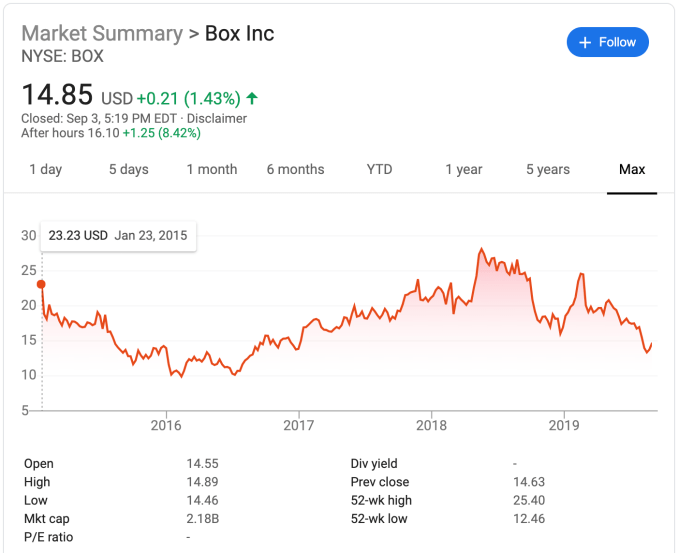
It is probably not a coincidence that Starboard Value looks for undervalued stocks. Box stock has been on a price roller coaster ride, since it went public in 2015 at a price of $14.00 per share before surging to $23.23 per share. It had high share price of $28.12 in May 2018, but the price dipped into the teens in March and was at $14.85 as we went to press. It has a 52-week low price of $12.46 per share.

Screenshot 2019 09 03 17.22.05


The company, which began life as a consumer storage company, made the transition to enterprise software several years after it launched in 2005. It raised more than $500 million along the way, and was a Silicon Valley SaaS darling until it filed its S-1 in 2014.

The S-1 revealed massive sales and marketing spending, and critics came down hard on the company. That led to one of the longest IPO delays in memory, taking 9 month from the time the company filed until it finally had its IPO in January 2015.

In its most recent earnings report last week, Box announced  $172.5M in revenue for for the quarter, putting it on a run rate close to $700M.

Levie will be appearing at TechCrunch Sessions: Enterprise on Thursday.

We emailed both Starboard Value and Box for comments on this article, but neither has responded as we went to publish. If this changes, we will update the article.

03 Sep 2019

Starboard Value takes 7.5% stake in Box

Starboard Value, LP revealed in an SEC Form 13D filing last week that it owns a 7.5% stake in Box, the cloud content management company.

It is probably not a coincidence that Starboard Value looks for undervalued stocks. Box stock has been on a price roller coaster ride, since it went public in 2015 at a price of $14.00 per share before surging to $23.23 per share. It had high share price of $28.12 in May 2018, but the price dipped into the teens in March and was at $14.85 as we went to press. It has a 52-week low price of $12.46 per share.

Screenshot 2019 09 03 17.22.05


The company, which began life as a consumer storage company, made the transition to enterprise software several years after it launched in 2005. It raised more than $500 million along the way, and was a Silicon Valley SaaS darling until it filed its S-1 in 2014.

The S-1 revealed massive sales and marketing spending, and critics came down hard on the company. That led to one of the longest IPO delays in memory, taking 9 month from the time the company filed until it finally had its IPO in January 2015.

In its most recent earnings report last week, Box announced  $172.5M in revenue for for the quarter, putting it on a run rate close to $700M.

Levie will be appearing at TechCrunch Sessions: Enterprise on Thursday.

We emailed both Starboard Value and Box for comments on this article, but neither has responded as we went to publish. If this changes, we will update the article.