Attentive’s first product allowed for what it calls “two-tap” sign-up, where users can tap on a link on their phone, creating a pre-populated text that signs them up for SMS messages from that retailer.
Since then, it’s built a broader suite of messaging tools, with support for cart abandonment reminders, A/B testing, subscriber segmentation and other features that allow retailers to get smarter and more targeted in their messaging strategy.
The startup says its platform can improve clickthrough rates by more than 30%, and that it now works with more than 400 customers including Sephora, Urban Outfitters, Coach, CB2 and Jack in the Box.
The Series B was led by Sequoia, with participation from new investors IVP and High Alpha, as well as previous backers Bain Capital Ventures, Eniac Ventures and NextView Ventures. The plan for the new funding is to grow the entire team, especially sales and engineering.
“CRM is changing,” Long said in a statement. “Businesses can’t build a relationship with the modern consumer through email alone. Email performance, as measured by how many subscribers click-through on a message, is down 45% over the last five years. Rather than continuing to shout one-way messages at consumers, smart brands will stay relevant by embracing personalized, real-time, two-way communication channels.”
A week after gaming platform Roblox announced its new milestone of 100 million monthly users — topping Minecraft — the company said at its fifth annual developer conference that its developer community is on track to earn $100 million in 2019. Roblox also introduced a new set of developer tools for building immersive, more realistic 3D experiences; detailed its plans to make its developer software fully cloud-based; unveiled a new Developer Marketplace where creators can set their development assets and tools to others; and more.
The company provides game creation tools via Roblox Studio, which developers use to build their own games for people to play. Roblox doesn’t pay the developers for their work — rather, the developers generate revenue through virtual purchases, which players buy using the in-game currency Robux.
At its invite-only event, the Roblox Developers Conference, which was held Friday, August 9 through Sunday, August 11, the company announced new tools aimed at enabling small developer teams to work together to build more massive games that can support hundreds of players.
The news follows the growing popularity of Roblox’s larger games, like Adopt Me (180.7K players), Royale High (68.7K players), Welcome to Bloxburg (66.7K players), MeepCity (52.4K players), Murder Mystery 2 (33.7K players), Work at a Pizza Place (32.7K players), and others.
The new toolset will offer developers access to an enhanced lighting system, updated terrain, and other visual upgrades, including support for building competitive matchmaking games which will match players of similar skill levels, the company said.
The company said at RDC it’s also on track to bring its creation tools, Roblox Studio, to the cloud by year-end, the company. This will allow developers to collaborate in real-time, access their development files online, and work across computing platforms to do things like manage permissions, versions, and rollbacks.
In addition to monetizing their games, developers will also be able to monetize their development assets and tools through a new Developer Marketplace where they can sell their plug-in, vehicles, 3D models, terrain enhancements, and other items.
“The Roblox creator community thinks of things we could never imagine, and their continued growth is our future,” said David Baszucki, founder and CEO, Roblox, in a statement about the new tools. “With top Roblox experiences achieving more than 100,000 concurrent users and 1 billion plays, there’s no denying the power of user-generated content. We are committed to supporting our creator community with the tools and resources they need to realize even greater success,” he added.
The company also made note of its improved localization support for Brazilian Portuguese, English, French, German, Japanese, Korean, Simplified and Traditional Chinese, and Spanish, and discussed its recent Microsoft partnership in more detail.
Roblox had previously announced a collaboration with Microsoft Azure PlayFab, which made PlayFab’s LiveOps analytics service free to Roblox’s top 10,000 developers. This allows the game creators to track trends in player behavior, purchase history, and game telemetry.
Alongside Roblox’s user growth, its creator community has been expanding, as well.
Today, there are over 2 million Roblox game creators worldwide, ranging from indie developers to studios with teams of 10 or 20 people. Over 500 developers attended the three-day event in San Francisco and the private RDC 2019 viewing party in London.
“We ultimately become more and more inspired and convinced that this not just the future of gaming, this is really the future of a whole new category,” said Baszucki, during the keynote. “I believe we’re sitting with not just the future of gaming,” he said, addressing the crowd of developers at RDC, “but the future of human co-experience.”
“We have this vision that there’s a new category emerging that’s bigger than gaming,” the CEO continued. “It’s the category that allows people around the world to connect, to not just play together, but to work together, to learn together, and to create together.”
TechCrunch’s Extra Crunch recently analyzed Roblox’s history and business in its EC-1, which you can read here.
Ro, a two-year-old startup known for its online pharmacy of men’s health products, has named BuzzFeed’s Todd Levy its chief technology officer.
Levy first joined BuzzFeed in 2014 as the digital media company’s vice president of engineering; he was named CTO in 2016. Prior to BuzzFeed, Levy co-founded and led link management tool bit.ly. Levy begins his new role Wednesday, August 14.
We’ve reached out to BuzzFeed for comment.
Ro, valued at $500 million earlier this year, has raised $176 million in venture capital funding from Canaan Partners, FirstMark Capital, BoxGroup, Initialized Capital, General Catalyst, SignalFire and others. The fast-growing startup poised to enter the unicorn club in the next year represents an opportunity for Levy to get back in the business of early-stage startups.
The news comes months after BuzzFeed announced its largest layoffs to date. Despite having raised $500 million over the last decade, the site has struggled to find a path to profitability. BuzzFeed chairman Ken Lerer, a prolific media investor, stepped down this June.
Former BuzzFeed CTO Todd Levy.
In an email announcement to staffers, Ro co-founder Saman Rahmanian said the new hire will help usher the business into a new phase of growth: “First and foremost, we needed a great team builder – someone who cares about team spirit not just the code,” Rahmanian wrote:
Given the high growth state of our business, we also needed a leader who has seen or led the scaling of an engineering team like ours into the next stage (from 30 engineers to 200). We also needed someone with a strong technology background who has gone through the ranks and is fluent in modern software architecture. And equally as important, we needed someone that was the right fit for Ro – someone who will provide strong mentorship, who is excited about a distributed team, and who will evangelize the engineering team inside the business as well as outside of Ro to attract top talent.
New York-based Ro was founded in 2017 and has quickly become a leader in the direct-to-consumer health and wellness movement. The company competes with Hims, another online service for health products, as well as Numan, Manual and Thirty Madison, which have raised capital recently.
Ro was started by a trio of entrepreneurs: Rob Schutz, the former vice president of growth at Bark&Co; Rahmanian, a co-founder of the WeWork-acquired business Managed by Q; and chief executive officer Zachariah Reitano, who previously co-founded a Y Combinator -backed startup called Shout.
The startup initially launched under the name Roman, which became its flagship brand when the business adopted the umbrella name Ro last year.
In a 2017 interview with TechCrunch’s Josh Constine, Reitano said he began experiencing ED at 17 years old: “I think in a good way I’ve become numb to the embarrassment,” he said. “I remember the embarrassment of having the condition with no solution, and that’s much worse than sharing the fact that I had it and was able to fix it myself.”
Roman offers men a $15 online doctor’s consultation and access to an instant prescription for Viagra, Cialis or generic drugs that can be filled at Roman’s in-house cloud pharmacy. The company also sells hair loss, cold sore medication and more under the Roman brand.
Ro also operates Zero and Rory, purveyors of a quit smoking kit and a line of women’s health products, respectively.
3D TVs may have grabbed all of the headlines a decade ago at CES, but the tech never found a useful inroad into consumers homes. Not everyone has given up on them, though they look a bit different now.
Light Field Lab, a Bay Area startup that emerged from stealth two years ago, wants to build holographic screens that enable viewers to see “volumetric” 3D without wearing special glasses. You won’t only see depth in the images, you’ll be able to physically move around the display and see new perspectives of the action, giving you the sensation that the digital content is floating mid-air.
“Light field” technology has had a rough go finding its way to market. Lytro, which was developing light field capture cameras, was bought by Google for a pittance and Magic Leap was unable to crack the technology for its first augmented reality product even after raising billions.
Light Field Lab hopes that the tech advances they’ve made for light field displays will be enough to get consumers onboard eventually, though the company certainly has plenty of residual problems from the 3D TV era left that need new solutions thought up.
For now, Light Field Lab isn’t focused on at-home light field experience, rather they want to build a modular platform that lets entertainment venues stack together tons of their devices to create huge 3D video walls that deliver a very unique 3D experience.
It’s a bold prospect but the company now has millions of VC dollars to carry it out.
Light Field Lab announced today that it has scored a $28 million Series A from Bosch Venture Capital and Taiwania Capital with further investment from Khosla Ventures, Samsung Ventures, Verizon Ventures, and Comcast also investing, among others. Last year, the company raised $7 million from Khosla Ventures and Sherpa Capital.
Although Light Field Lab will initially target large format location-based entertainment venues, a version of its holographic technologies will ultimately be developed for the consumer market. “Although Light Field Lab will initially target large format location-based entertainment venues, a version of its holographic technologies will ultimately be developed for the consumer market,” a press release from the company reads.
Just in time for back-to-school shopping, Nike today officially announced its entry into the subscription service market with the launch of a “sneaker club” for kids called Nike Adventure Club. The new program is specifically designed to make shopping easier for parents who struggle to keep up with their quickly growing children’s shoe needs. Instead of taking kids to the store and trying on pair after pair to try to find something the child likes, the new Nike Adventure Club will instead ship anywhere from four pairs to a dozen pairs of shoes per year, depending on which subscription tier parents choose.
The club serves kids from sizes 4C to 7Y — or roughly ages 2 to 10.
Club pricing begins at $20 per month which will ship out new shoes every 90 days. For $30 per month, kids get 6 pairs per year. And for $50 per month, kids will get new shoes every month — a choice that may be excessive except for the most active kids who were their sneakers every day, play sports, or have a tendency to wreck their shoes in short order.
However, even the minimum of four pairs per year may be too frequent for some parents of older kids.
According to the American Orthopaedic Foot & Ankle Society, toddlers under 16 months grow more than one-half a foot size every two months. From 16 to 24 months, they grow an average of one-half a foot size every three months. From 24 to 36 months, it’s one-half a foot size every four months. Then things slow down.
Children over three years old grow one-half a foot size every 4 to 6 months. That means some older kids only need to replace their shoes twice per year, outside of excessive wear and tear.
That said, Nike allows parents to upgrade or downgrade their subscription at any time, or even put it on pause.
Once signed up, parents will receive an email with a selection of over 100 styles of Nike and Converse shoes to choose from, which they can review with their kids. They then pick which shoes they want to receive, and these are shipped to the home in a box with the child’s name on it. This box also includes an “adventure kit” filled with activities and games for parents to do with their kids, stickers, plus a small gift. The kit is created in partnership with the nonprofit KaBoom, which is focused on encouraging kids to lead healthy lifestyles.
If the shoes are the wrong size, exchanges are free within a week of delivery.
Twice a year, Nike will ship out a prepaid bag where parents can send back their kids’ worn shoes, which will either be donated to families in need if in good condition or recycled through Nike Grind, a program that separates out the rubber, foam, leather, and textile blends, grinds them into granules, and incorporates those into new products including footwear, apparel, and play surfaces.
“We see Nike Adventure Club sits as having a unique place within Nike, and not just for it being the first sneaker club for kids,” says Dave Cobban, VP of Nike Adventure Club, in a statement about the launch. “It provides a wide range of options for kids, while at the same time, it removes a friction point for parents who are shopping on their behalf.”
Nike has been testing the program since 2017, when it was known as Easy Kicks. The test reached 10,000 members, the company said.
Stitch Fix also offers a kids’ styling service. And Amazon offers a try-before-you-buy shopping service without a subscription, Prime Wardrobe. Amazon’s variation offers both girls and boys options where parents can fill a box with apparel, shoes, and accessories for home try-on and easy returns.
Nike’s Adventure Club is launching today but is easing in new customers via a waitlist option.
If the sheer amount of information that we can tap into using the internet has made the world our oyster, then the huge success of Google is a testament to how lucrative search can be in helping to light the way through that data maze.
Now, in a sign of the times, a startup called Lucidworks, which has built an AI-based engine to help individual organizations provide personalised search services for their own users, has raised $100 million in funding. Lucidworks believes its approach can produce better and more relevant results than other search services in the market, and it plans to use the funding for its next stage of growth to become, in the words of CEO Will Hayes, “the world’s next important platform.”
The funding is coming from PE firm Francisco Partners and TPG Sixth Street Partners. Existing investors in the company include Top Tier Capital Partners, Shasta Ventures, Granite Ventures and Allegis Cyber.
Lucidworks has raised around $200 million in funding to date, and while it is not disclosing the valuation, the company says it been doubling revenues each year for the last three and counts companies like Reddit, Red Hat, REI, the US Census among some 400 others among its customers using its flagship product, Fusion. PitchBook notes that its last round in 2018 was at a modest $135 million, and my guess is that is up by quite some way.
The idea of building a business on search, of course, is not at all new, and Lucidworks works in a very crowded field. The likes of Amazon, Google and Microsoft have built entire empires on search — in Google’s and Microsoft’s case, by selling ads against those search results; in Amazon’s case, by generating sales of items in the search results — and they have subsequently productised that technology, selling it as a service to others.
Alongside that are companies that have been building search-as-a-service from the ground up — like Elastic, Sumo Logic and Splunk (whose founding team, coincidentally, went on to found Lucidworks…) — both for back-office processes as well as for services that are customer-facing.
In an interview, Hayes said that what sets Lucidworks apart is how it uses machine learning and other AI processes to personalise those results after “sorting through mountains of data”, to provide enterprise information to knowledge workers, shopping results on an e-commerce site to consumers, data to wealth managers, or whatever it is that is being sought.
Take the case of a shopping experience, he said by way of explanation. “If I’m on REI to buy hiking shoes, I don’t just want to see the highest-rated hiking shoes, or the most expensive,” he said.
The idea is that Lucidworks builds algorithms that bring in other data sources — your past shopping patterns, your location, what kind of walking you might be doing, what other people like you have purchased — to produce a more focused list of products that you are more likely to buy.
“Amazon has no taste,” he concluded, a little playfully.
Today, around half of Lucidworks’ business comes from digital commerce and digital content — searches of the kind described above for products, or monitoring customer search queries sites like RedHat or Reddit — and half comes from knowledge worker applications inside organizations.
The plan will be to continue that proportion, while also adding in other kinds of features — more natural language processing and more semantic search features — to expand the kinds of queries that can be made, and also cues that Fusion can use to produce results.
Interestingly, Hayes said that while it’s come up a number of times, Lucidworks doesn’t see itself ever going head-to-head with a company like Google or Amazon in providing a first-party search platform of its own. Indeed, that may be an area that has, for the time being at least, already been played out. Or it may be that we have turned to a time when walled gardens — or at least more targeted and curated experiences — are coming into their own.
“We still see a lot of runway in this market,” said Jonathan Murphy of Francisco Partners. “We were very attracted to the idea of next-generation search, on one hand serving internet users facing the pain of the broader internet, and on the other enterprises as an enterprise software product.”
Lucidworks, it seems, has also entertained acquisition approaches, although Hayes declined to get specific about that. The longer-term goal, he said, “is to build something special that will stay here for a long time. The likelihood of needing that to be a public company is very high, but we will do what we think is best for the company and investors in the long run. But our focus and intention is to continue growing.”
Even the most enterprising startup founders can suffer a bout of procrastination or last-minute decision making. We get it. That’s why we’re extending the early-bird deadline for TC Sessions: Enterprise 2019 in San Francisco on September 5.
You now have until August 16 at 11:59 p.m. (PT) to save $100 on this day-long conference focused on the richest, most competitive tech behemoth, enterprise software. Buy your early bird ticket now and save.
More than 1,000 attendees will join us, including some of the industry’s biggest names, best technologies, disruptive founders and intrepid VCs — the people making it happen in enterprise today. Not to drop names, but here are a few of the people who will be on stage with TechCrunch’s editors:
Andrew Ng, Landing AI founder
Jim Clarke, Intel director of Quantum Hardware
Susan Larson-Green, Qualtrics chief experience officer
Scott Farquhar, Atlassian co-founder and co-CEO
Shruti Tournatory, Sapphire Ventures partner
Jason Greene, Emergence Capital Partners founder and partner
Aaron Levie, Box co-founder and CEO
Aparna Sinha, Google director of product, Kubernetes and Anthos
Max Wessel, SAP Chief Innovation Officer
Bindu Reddy, RealityEngine’s co-founder and CEO
When you have a minute or two, peruse the conference agenda to see all the main-stage interviews and panel discussions, plus break-out sessions and speaker Q&As. In the meantime, here are two quick examples of the programming at this day-long conference.
While we’re still a few years away from having quantum computers that will fulfill the full promise of this technology, many companies are already starting to experiment with what’s available today. We’ll talk about what startups and enterprises should know about quantum computing today to prepare for tomorrow.
You can’t go to an enterprise conference and not talk about Kubernetes, the incredibly popular open-source container orchestration project that was incubated at Google. For this panel, we brought together three of the founding members of the Kubernetes team and the current director of product management for the project at Google to talk about the past, present and future of the project and how it has changed how enterprises think about moving to the cloud and developing software.
Pro Tip: Buy four or more tickets at once and save 20%. Plus, every ticket you buy to TC Sessions: Enterprise includes a free Expo Only pass to TechCrunch Disrupt SF on October 2-4.
Twitter in more recent months has been focused on making conversations on its platform easier to follow, participate in, and in some cases, block. The company’s latest test, announced via a tweet ahead of the weekend, will allow users to subscribe to replies to a particularly interesting tweet they want to follow, too, in order to see how the conversation progresses. The feature is designed to complement the existing notifications feature you may have turned on for your “must-follow” accounts.
Many people already have Twitter alert them via a push notification when an account they want to track sends out a new tweet. Now you’ll be able to visit that tweet directly and turn on the option to receive reply notifications, if you’re opted in to this new test.
If you have the new feature, you’ll see a notification bell icon in the top-right corner of the screen when you’re viewing the tweet in Twitter’s mobile app.
You probably have notifications on for your must-follows. Now you can get notifications when there’s a new reply to a Tweet you’re interested in! We’re testing this on iOS and Android now. pic.twitter.com/MabdFoItxc
When you click the bell icon, you’ll be presented with three options: one to subscribe to the “top” replies, another to subscribe to all replies, and a third to turn reply notifications off.
Twitter says top replies will include those from the author, anyone they mentioned, and people you follow.
This is the same set of “interesting” replies that Twitter has previously experimented with highlighting in other ways — including through the use of labels like “Original Tweeter” or “Author,” and as of last month, with icons instead of text-based labels. For example, one test displayed a microphone icon next to a tweet from the original poster in order to make their replies easier to spot.
The larger goal of those tests and this new one is to personalize the experience of participating in Twitter conversations by showcasing what the people you follow are saying, while also making a conversation easier to follow by seeing when the original poster and those they mentioned have chimed in.
This latest test takes things a step further by actually subscribing you to those sorts of replies — or even all the replies to a tweet, if you choose.
The new experiment comes at a time when Twitter is attempting to solve the overwhelming problem of conversation health in other ways, too. Beyond attempting to write and enforce tougher rules regarding online abuse and harassment, it also last month officially launched a “Hide Replies” feature in Canada that would allow the original poster to put replies they didn’t feel were valuable behind an icon so they weren’t prominently displayed within the conversation. It’s unclear how “Hide Replies” would work with this new reply notifications option, however — presumably, you’d still get alerts when someone you follow responded, even if the original poster hid their reply from view.
Twitter says the new test is available on iOS or Android.
German auto industry giant Bosch is developing new technology that will add glasses-free 3D imaging to future versions of its in-car digital display technology. These 3D displays use passive 3D tech, which mans you won’t need to wear glasses to see the effect, and it also skips eye tracking, which is a key ingredient for most high-quality glasses-free 3D displays today.
Going glasses-free, and not requiring that a viewer look from a very specific position are both key ingredients for successfully bring 3D display tech to cars – for obvious reasons. A driver needs to be focused on the road, and the fundamental guiding principle for all Curren in-car display tech is that they provide easy-to-grasp information at a glance, so that a driver’s focus stays exactly where it should.
But why would a driver even want 3D visual effects in their instrument panel or infotainment display? Well, Bosch says that there are multiple compelling reasons, including making sure that crucial alerts really pop-out when they need to in an attention-catching way. Plus, parking cameras can present even more accurate 3D views to the driver so they really get a sense of the space they’re working with. And during navigation, guidance can offer 3D representations of where and when to turn, which can eliminate questions around whether that next corner really is the right corner you’re looking for.
That’s all stuff that could be beneficial now, but it’s also a bet on a future where vehicles are autonomous at least part of the time, and in-car immersive displays could be even more of an opportunity to entertain and inform passengers while they’re ferried to their destinations.
Bosch says that part of the reason they can do this now, compared to in the past, is that more powerful mobile computing has changed the game for what they can build. Instead of having essentially a myriad of tiny, cheap underpowered controllers scattered throughout a car’s tech stack, automakers are generally moving towards having one centralized computer that’s plenty more powerful, and that can be updated easily and quickly over-the-air.
The company doesn’t say when we’ll see these systems actually in use through their automaker customers in shipping cars, but especially in the high end where premium distinguishing features can make all the difference, it shouldn’t be long before some carmaker takes the plunge.
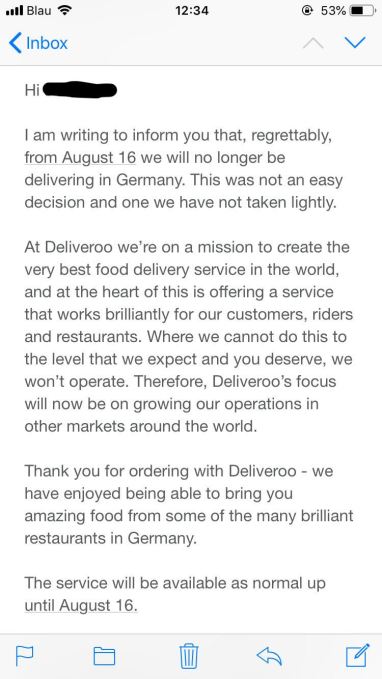
UK on-demand food delivery startup Deliveroo is pulling the plug on its service in Germany.
The startup expanded into the market more than four years ago. But in an email sent to users it writes that — “regrettably” — it will be exiting Germany on August 16.
“This was not an easy decision and one we have not taken lightly,” it adds, saying its focus will be on “growing our operations in other markets around the world”.
The company had already dialled back service in the market, shuttering services in a number of smaller German cities a year ago. At the time it said it would focus on Berlin, Munich, Cologne, Hamburg and Frankfurt.
A spokesperson for Deliveroo confirmed it’s complete exit from Germany, emailing TechCrunch the following statement:
We want to thank all of the riders and restaurants who worked with Deliveroo in Germany, as well our wonderful customers. It has been an honour to serve so many people amazing food from Germany’s many great restaurants and to work with so many brilliant, hard-working riders. We are grateful to our extremely talented employees for their commitment to bringing fantastic foods to people’s homes, and they will be supported in this period. Deliveroo will continue to grow and invest in markets across the world, seeking to become the world’s definitive food company.
The spokesperson added that Deliveroo intends to refocus resources and investment to accelerate growth and expansion in other markets across Europe and APAC — without specifying exactly where it plans to focus.
Support for riders and affected employees will include unknown levels of compensation and goodwill packages, according to information provided by Deliveroo.
It also said it does not ruling out returning to Germany in future, albeit it expressed a similar sentiment when it downsized its service footprint in the market last year.
At the time of its launch into Germany, back in April 2015, we wrote that Deliveroo would face “stiff competition”, noting for example that Berlin was already host to a range of local food delivery startups.
Competition in the on-demand food delivery space in Europe has raged fiercely for years — with very little to distinguish one delivery app from another, aside from price. Switching service is always just an app tap away. But with consolidation now starting to eat into the market the temperature is rising.
At the end of last year another Deliveroo rival, Delivery Hero, ceded its entire business in Germany to Netherlands-based Takeaway.com — selling the unit for €930M.
While, late last month, UK-based Just Eat and Takeaway.com announced they were in advanced talks to combine their businesses. Their boards reached agreement on terms last week — with the deal set to be put to their respective shareholders before the end of the year.
Most likely that mega-merger is concentrating minds at Deliveroo. Competing for customers with a platform giant valued at $10BN+ certainly does not sound like a cake walk.
TechCrunch’s Steve O’Hear contributed to this report