Year: 2019

24 Jul 2019

Tesla has begun preparations for Model Y production at its Fremont factory

Tesla has already started the preparations required to get production started on its forthcoming Model Y compact all-electric SUV, according to Tesla CEO Elon Musk . Musk noted that prep had started at its facility in Fremont during his introductory comments on the automaker’s Q2 2019 earnings call, confirming a report from CNBC from March.

In Tesla’s first earnings call for 2019, Musk said that it was in the process of deciding between Fremont and its Gigafactory in Nevada for production of the Model Y, which is going to be based on the Model 3 platform and will share some of its componentry, something that Musk noted will help reduce its cost of production.

The Model Y, revealed in March, looks quite similar at first glance to the Model 3. It has a slightly higher profile, however, putting it in this compact SUV range. It has similar interior features to the Model 3, including the horizontal 15-inch touchscreen, and also features a panoramic roof more like its larger Model X premium all-electric SUV sibling. Pricing for the Model Y will begin at $39,000, and that version will have a 230-mile range. It’s currently planned to ship sometime in the fall of 2020.

24 Jul 2019

Tesla ‘on track’ to begin Model 3 production at China factory by end of year

Tesla said Wednesday that Model 3 production is on track to begin at its Shanghai factory by the end of the year — a critical milestone for the automaker if it hopes to continue to increase sales and avoid the high cost of shipping and tariffs.

The Gigfactory Shanghai “continues to take shape, Tesla wrote in its quarterly earnings letter to shareholders. Machinery was moved into the factory during the second quarter in preparation for the first phase of production.

“Depending on the timing of the Gigafactory Shanghai ramp, we continue to target production of over 500,000 vehicles globally in the 12-month period ending June 30, 2020,” the company wrote.

That is a rosier outlook than the company provided just three months ago when it said that goal didn’t appear very likely. At the time, Tesla noted that it was “targeting” as many as 500,000 vehicles globally based on reaching volume production early in the fourth quarter. “However, based on what we know today, being able to produce over 500,000 vehicles globally in the 12-month period ending June 30, 2020 does appear very likely,” the company wrote in its first-quarter earnings letter posted April 24.

The production line at the factory in China will have a capacity of 150,000 units annually and will be a simplified, more cost-effective version of the Model 3 line at its Fremont, Calif. factory.  Tesla has previously said this second-generation Model 3 line will be at at least 50% cheaper per unit of capacity than its Model 3-related lines in Fremont and at its Gigafactory in Sparks, Nevada.

Tesla is counting on sales in China to continue its sales momentum.

“Given Chinese customers bought well over a half million mid-sized premium sedans last year, this market poses a strong long-term opportunity for Tesla,” the company said Wednesday.

Producing the Model 3 locally would reduce the costs of shipping and tariffs. However, that doesn’t remove every obstacle there.

Automotive sales in China have taken a hit over the past year. The first signs of a recovery were reported earlier this month when preliminary numbers from the China Passenger Car Association showed vehicles sales rose 4.9% to 1.8 million units in June from a year earlier. That’s the first increase since May 2018 for the world’s biggest market.

24 Jul 2019

Uber loses Arianna Huffington and Benchmark’s Matt Cohler as board members

Uber has lost two of its board members today. Arianna Huffington, CEO at Thrive Global, and Benchmark General Partner Matt Cohler‘s resignations from the board went into effect today, according to two Uber filings with the SEC.

“Given Thrive’s growth, it has become clear to me that I will no longer be able to give my Uber board duties the attention they deserve, so I will be stepping down,” Huffington said. “It has been an unforgettable three-year ride, and I’m grateful to have been able to work alongside my fellow board members and witness the incredible work of thousands of Uber employees around the world.”

Cohler, who notified Uber of his resignation yesterday, said he and his partners “have had the privilege of being part of the Uber journey since the Series A nearly a decade ago. I’m thrilled with the company’s position, excited for the road ahead, and extend my deepest thanks to all of Uber’s past and present employees, directors, drivers, and customers.”

Benchmark, one of the largest investors in Uber, now no longer has a seat on Uber’s board of directors. It’s also worth noting that Benchmark at one point filed a lawsuit against former Uber CEO Travis Kalanick, but later dropped it.

In the filings, Uber’s independent chairperson of the board, Ron Sugar, spoke highly of both Huffington and Cohler. Regarding Huffington, Sugar said she was a “dynamic and invaluable board member.” Regarding Cohler, Sugar said Cohler and Benchmark’s “immeasurable contributions have helped make Uber the company it is today.”

Both of the filings noted that neither of their resignations was the result of any disagreements with the company or board of directors. These departures come to a couple of months after Uber’s first employee, Ryan Graves, resigned from the board of directors.

Uber closed the day trading at $43.76 per share and is currently trading at $43.60 after hours. I’ve reached out to Uber and will update this story if I hear back.

24 Jul 2019

Microsoft in talks to invest in SoftBank’s second Vision Fund

SoftBank is said to be preparing the announcement of a $40 billion investment in its second Vision Fund, according to a new report from The Wall Street Journal. News of the mammoth investment comes after weeks of rumors the Japanese telecom giant was struggling to secure capital for its second fund, citing lukewarm reception from investors of the firm’s initial Vision Fund.

SoftBank declined to comment.

Goldman Sachs and Standard Chartered are amongst the first confirmed investors in the second Vision Fund. SoftBank is reportedly in talks with Microsoft to invest in the fund under the condition that SoftBank encourage its portfolio companies to transition away from Amazon Web Services to Microsoft’s Azure, the company’s cloud platform. Microsoft did not immediately respond to a request for comment.

The Department of Justice is set to announce its approval of T-Mobile’s merger with Sprint, majority-owned by SoftBank, as soon as this week. Once the merger is confirmed, SoftBank is expected to deploy additional capital to its sophomore Vision Fund.

The debut SoftBank Vision Fund, led by SoftBank CEO Masayoshi Son, has been making headlines since plans for the massive vehicle were announced in late 2016. In May 2017, the firm held a first close on $93 billion, later increasing the fund’s size to $98 billion. The fund has a general focus on global tech companies across industries including IoT, AI, robotics, mobile applications & computing, cloud technologies & software, consumer tech and fintech. To date, it’s invested large sums in Brandless, WeWork, Ola, Grab, Didi Chuxing, Uber, Lemonade and several others.

The debut fund’s largest investors are Saudi Arabia’s sovereign wealth fund and Abu Dhabi’s national wealth fund, a fact that’s ignited a debate across Silicon Valley on the ethics of accepting capital from Saudi Arabia, a country responsible for numerous human rights abuses. Apple, Qualcomm and Foxconn Technology are among its other LPs.

24 Jul 2019

Tesla reports larger-than-expected losses of $408 million in second quarter

Tesla reported Wednesday a loss of $408 million, or $2.31 a share per share, and generated $6.3 billion in revenue in the second quarter despite record deliveries.

Tesla shares fell 11% after the report was posted.

Earlier this month, Tesla reported it delivered 95,200 of its electric vehicles in the second quarter, a dramatic reversal from a disappointing first period. Those numbers have been since adjusted to 95,356 vehicles. The record-breaking figures stood in stark contrast to the company’s first quarter delivery numbers when it reported deliveries of 63,000 vehicles, nearly a one-third drop from the previous period.

Analysts surveyed by FactSet were expecting an adjusted loss of 35 cents a share on revenue of $6.47 billion. The net loss in the second quarter included a $117 million of restructuring and other charges, the company said in its earnings report.

While earnings missed Wall Street expectations, Tesla has recovered since the first quarter of the year when it posted a loss of $702 million, or $4.10 a share, after disappointing delivery numbers, costs and pricing adjustments to its vehicles cut into profits. When adjusted for one-time losses, Tesla lost $494 million, or $2.90 a share in the first quarter.

Revenue has also jumped 40% from $4.5 billion in the first quarter to $6.3 billion in the second period thanks again to the increase in sales, particularly for the Model 3.

Those losses were smaller than previous quarter,  were buffered by record-setting deliveries in the second quarter.

Tesla generated free cash flow (operating cash flow less capital expenditures) $614 million compared to a loss of $920 million in the first quarter.

Developing

24 Jul 2019

Facebook says it’s under antitrust investigation by the FTC

Facebook’s investors were not phased by the announcement of a $5 billion FTC fine after baking it into share price expectations, but Facebook’s admission that it was not under investigation by the FTC over antitrust issues was a surprise.

Facebook detailed in its Q2 earnings release that it has paid a the record fine and agreed to certain privacy stipulations, but a short sentence in the release also detailed that the company’s FTC troubles may continue.

“The online technology industry and our company have received increased regulatory scrutiny in the past quarter,” the release read. “In June 2019, we were informed by the FTC that it had opened an antitrust investigation of our company. In addition, in July 2019, the Department of Justice announced that it will begin an antitrust review of market-leading online platforms.”

We’ll have more details from the company’s earnings call starting shortly.

24 Jul 2019

Lyft poaches Bird’s head of vehicle product

Shared electric bike and scooter services are constantly at war with each other — whether it’s battling for an operating permit in a highly-coveted market, raising a massive round of funding or making a key hire. Today, the war continues with Lyft’s recent hiring of Eugene Kwak, Bird’s now-former head of vehicle product. Kwak’s first day as Lyft’s head of hardware product for bikes and scooters was this past Monday.

Bird has been on a tear as of late, between actively raising a massive D round at a $2.5 billion valuation and having been one of the first scooter startups to deploy its own custom-built scooter. The in-house scooters, previously overseen by Kwak, have proven to have a positive impact on Bird’s unit economics.

Lyft, on the other hand, is still relying on Segway for its scooters. This hire, however, signals Lyft’s shift to deploying scooters built in house.

In addition to Kwak’s hire, Lyft has spent the last couple of months beefing up its bikes and scooters hardware team in order to keep iterating on its products. Earlier this month, Lyft also brought on Marc Fenigstein, co-founder of the now-defunct electric motorcycle company Alta Motors. Fenigstein is Lyft’s product lead for new vehicles.

Last month, Lyft brought on Mark Holveck from Tesla, where he served as a senior manager for the technology research and development team. At Lyft, Holveck is the head of hardware technology.

“We couldn’t be more excited to add these three leaders to take our hardware team to the next level,” Lyft Head of Bikes and Scooters Dor Levi said in a statement to TechCrunch. “They bring experience from some of the top hardware technology companies in the industry, and we look forward to continue offering best-in-class mobility solutions to our riders to help them easily get around their cities.”

Lyft is undoubtedly hitting its stride as a multi-modal transportation provider. To date, Lyft operates its bikes and scooters in 20 markets. Just last week, Lyft had a major legal win when a judge granted the company a preliminary injunction to prevent San Francisco from offering permits to other bike-share services.

Although Lyft is newer to the micromobility space than Bird, it’s noteworthy that the company poached a key member of one of its major competitor’s teams. Given the relative newness of this space, any little bit of a leg up on the competition will surely help.

I’ve reached out to Bird and will update this story if I hear back.

24 Jul 2019

Following record FTC fine, Facebook stock pops on Q2 earnings beat

Hours after receiving a record $5 billion FTC fine on privacy violations, Facebook delivered a Q2 earnings beat with revenue of $16.9 billion with $1.99 adjusted EPS compared to the Zacks Consensus Estimate of $1.90 EPS on revenue of $16.45 billion.

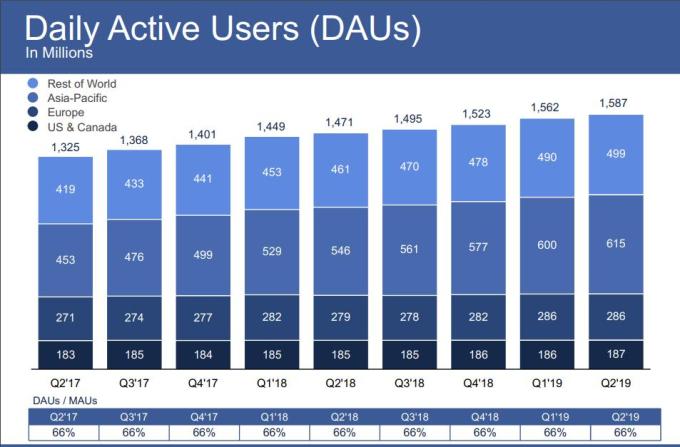
Facebook reported it has 1.59 billion DAUs and 2.1 billion daily active users of its family of apps. The US & Canada and Asia-Pacific contingents continued to see nearly flat growth while the company saw quicker growth in its European and “Rest of World” sectors.

EARTU4AAffxT

The company’s stock was up 3% in after-hours trading.

Facebook detailed that it will be paying a $5 billion FTC fine as was confirmed this morning, but for those hoping this agreement signaled the end of Facebook’s FTC troubles, the earnings report detailed that may not be the case. The release disclosed that last month theFTC opened an antitrust investigation of Facebook, this news follows reports of a DOJ investigation into the company — among others — as well.

The online technology industry and our company have received increased regulatory scrutiny in the past quarter. In June 2019, we were informed by the FTC that it had opened an antitrust investigation of our company. In addition, in July 2019, the Department of Justice announced that it will begin an antitrust review of market-leading online platforms.

Updating

24 Jul 2019

Postmates’ self-driving delivery rover will see with Ouster’s lidar

Postmates’ cooler-inspired autonomous delivery robot, which will roll out commercially in Los Angeles later this year, will rely on lidar sensors from Ouster, a burgeoning two-year-old startup that recently raised $60 million in equity and debt funding.

Postmates unveiled the first generation of its self-described “autonomous rover” — known as Serve — late last year. The vehicle uses cameras and light detection and radar sensors called lidar to navigate sidewalks as well as a backup human who remotely monitors the rover and can take control if needed.

A new second-generation version made its debut on stage earlier this month at Fortune’s Brainstorm Tech event. This newer version looks identical to the original version except a few minor details, including a change in lidar sensors. The previous version was outfitted with sensors from Velodyne, a company that has long dominated the lidar industry.

The supplier contract is notable for Ouster, a startup trying to carve out market share from the giant Velodyne and stand out from a global pack lidar companies that now numbers close to 70. And it could prove substantial for the company if Postmates takes Serve to other cities as planned.

Lidar measures distance using laser light to generate highly accurate 3D maps of the world around the car. It’s considered by most in the self-driving car industry a key piece of technology required to safely deploy robotaxis and other autonomous vehicles.

Ouster’s strategy has been cast wider net for customers by selling its lidar sensors to other industries, including robotics, drones, mapping, defense, building security, mining and agriculture companies. It’s an approach that Waymo is also pursuing for its custom lidar sensors, which will be sold to companies outside of self-driving cars. Waymo will initially target robotics, security and agricultural technology.

Ouster’s business model, along with its tech, has helped it land 437 customers to date and raise a total of $90 million.

The contract with Postmates is its first major customer announcement. COAST Autonomous announced earlier this week that it was using Ouster sensors for its a low-speed autonomous shuttles. Self-driving truck companies Kodiak and Ike Robotics have also been using the sensors this year.

Ouster, which has 125 employees, uses complementary metal-oxide-semiconductor (CMOS) technology in its OS1 sensors, the same tech found in consumer digital cameras and smartphones. The company has announced four lidar sensors to date, with resolutions from 16 to 128 channels, and two product lines, the OS-1 and OS-2.


24 Jul 2019

Snap overtakes its IPO debut price

Snap may no longer be the laughing stock of the New York Stock Exchange.

On the heels of renewed user growth and an earnings beat, Snap closed Wednesday with a share price at $17.60, up 18.68% for the day, giving the company its first close above its $17 IPO debut price since March of last year.

After a highly anticipated debut sent Snap’s share price climbing 44% on its first day of trading in March of 2017, the company’s stock soon plummeted as its first earnings report detailed slowed user growth that would continue for the next several periods. It was only a few months later that the company’s stock dipped below its $17 debut share price, a number it briefly rose above in early 2018 before sinking to an all-time low of $4.82 in late December.

The company’s earnings report yesterday may signify a turning point for the social media company which has reportedly struggled to retain executive and engineering talent in recent months in the face of a rapidly declining investor enthusiasm. In the company’s Q2 earnings report, Snap executives highlighted their strengths as they highlighted a 13 million quarter-over-quarter increase in daily active users and a command over the 18-24 age bracket.

The key to maintaining that growth will be whether Snap can continue to deliver viral hits that bring users to the platform like its augmented reality lenses that the company said contributed 7-9 million of the new users that came aboard last quarter.

Wednesday’s rally will give Snap more breathing room to pursue its original content strategy and its more ambitious efforts like its game development and augmented reality platforms.